

The rear-engine Volkswagen Transporter T2 was discontinued in Germany back in 1979. However, in Brazil, production continued until December of last year! I had the opportunity to drive both a German-built classic and a fresh Brazilian version—guess which one was better?
A Sketch by a Dutch Dealer
According to legend, the Transporter was invented by Ben Pon. This Dutch car dealer arrived in Wolfsburg in 1946 to negotiate the supply of Beetles and noticed an interesting works vehicle: small carts with a cabin on a Beetle chassis, used to move things around the Volkswagen factory. Pon sketched the first design for a van on a Volkswagen chassis — cabin at the front, engine at the rear, cargo compartment in between.
The factory’s leadership liked the idea; post-war Germany badly needed affordable delivery vehicles. But the priority was increasing Beetle production, so work on the van did not begin until October 1948 — and prototypes were ready a year later. The powertrain and the independent torsion suspension came from the Beetle, but the floor was reinforced and the track widened, and to increase torque, since the base 1.1-liter engine produced only 25 hp, they added wheel reduction gears from the military Kübelwagen. The rear of the cargo compartment carried a large hump hiding the engine, so wide swing-out doors were added to make loading easier. Early models had a solid rear wall; a hatch arrived in 1955.
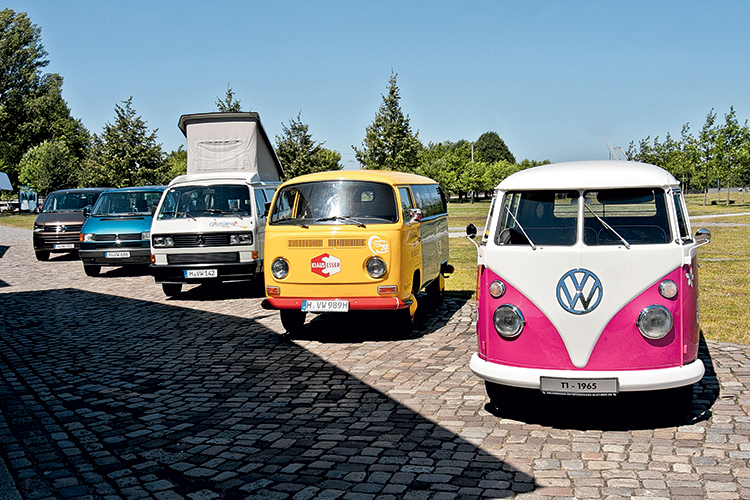
More than 11.5 million Transporters of five generations have already been produced, and the long-lived T2 was expectedly the most widespread. At first, the vehicles were assembled in Wolfsburg, at the same plant as the Beetles, but in 1956 a separate plant was launched in Hanover, which remains the home of the Transporters to this day
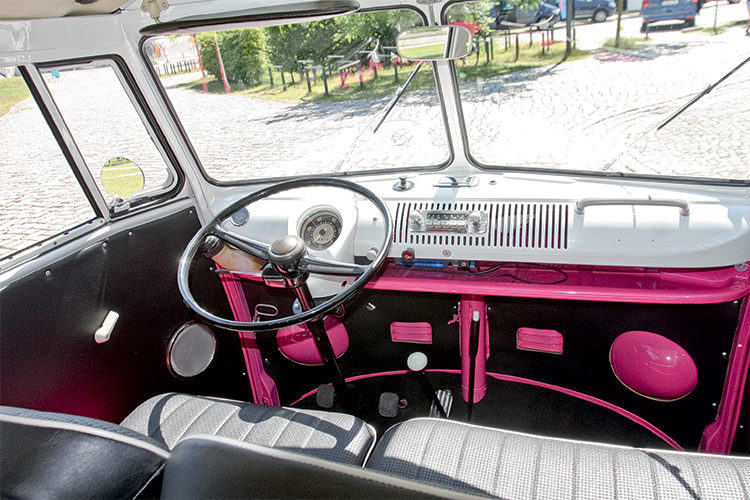
The interior of the first generation Transporter is holy simplicity: bare metal dashboard, minimum instruments, V-shaped windshield, narrowed front, no heater… But — a radio!
From 0.74 to 0.44
The production model, Transporter Typ 2 — the second after the Beetle Typ 1 — entered production in the autumn of 1949 and was notable for its carefully worked aerodynamics: after wind tunnel tests at Braunschweig Technical University the drag coefficient came down from an initial 0.74 to 0.44. The van was followed by other variants: the microbus, the flatbed truck, the double-cab pickup and even a camper. With a 930 kg payload these vehicles went to delivery services, the police and ambulance fleets — and earned real affection among hippies in the U.S. In 1956 production moved from Wolfsburg to a newly built factory in Hanover, where every subsequent model has been made.
1967: The T2
In 1967 the second-generation Volkswagen T2 arrived. The dimensions barely changed, but the vehicle grew heavier and more comfortable, with a roomier cabin thanks to a redesigned front body and a safer interior using plastic parts. Payload rose to 980 kg, the base 1.6-liter engine now produced 47 hp — which did away with the need for wheel reduction gears — and, finally, the side doors slid.
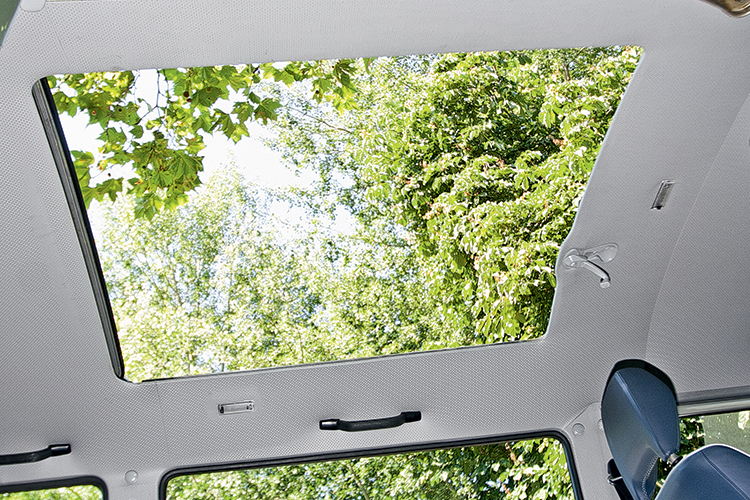
The first generation minibus had a soft roof that folded like an accordion, while the second generation cars could be ordered with a metal hatch that slid back by turning the handle
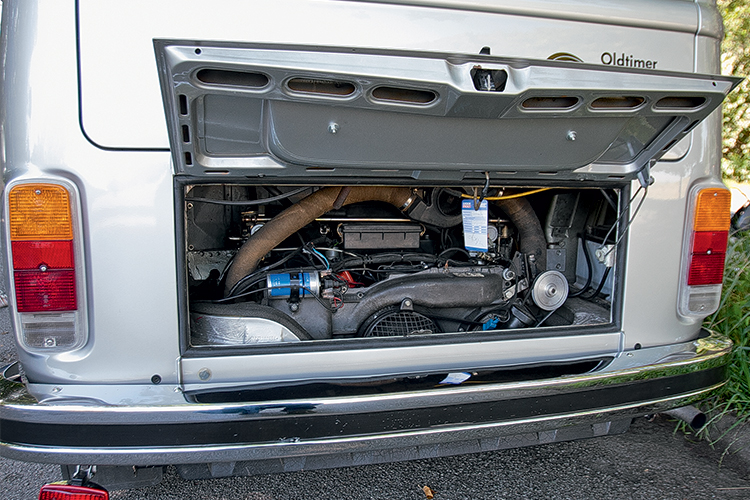
The “flat” boxer engine is installed in the rear overhang
What the Flower Children Were After
I began with the sliding door. It opened with almost no effort, and behind that wide opening — what a platform. There is no second-row seating in this vehicle; it could be left out at purchase. Now I understand the appeal to the hippies: a large, flat platform with no transmission tunnel and a neat carpet over it is exactly what the flower children needed. Those children, as we remember, urged everyone to make love, not war.
The rear bench offers limousine-like space, but only for two: the vehicle is narrow, so three is a squeeze, and there are just two simple lap belts. The front seats, though, have inertial three-point belts.
Silberfisch, 1979
This silver bus comes from the German farewell series Silberfisch — Silver Fish — of 1979. Its equipment would have made some cars of the period envious: side mouldings, a large roof hatch, front disc brakes, fog lights, headlight washers and a cassette radio. And how thoughtfully the German engineers worked some of it out. The front doors, for instance, have ventilation channels that carry air to the back of the cabin.
The driving position is unmistakably that of a bus: a huge, almost horizontal steering wheel and stiff floor-hinged pedals, with the accelerator shifted to the right, which tires the ankle quickly in that twisted position.
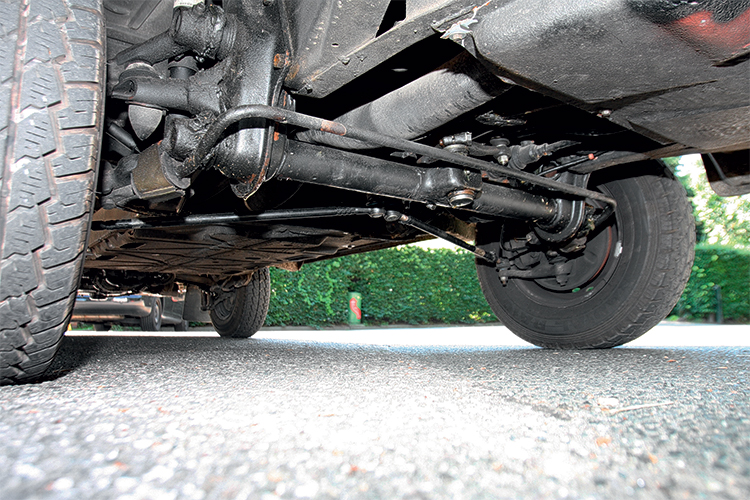
Front suspension of the Transporter: longitudinal arms are connected in pairs to the ends of the torsion bars, placed in two large transverse tubes
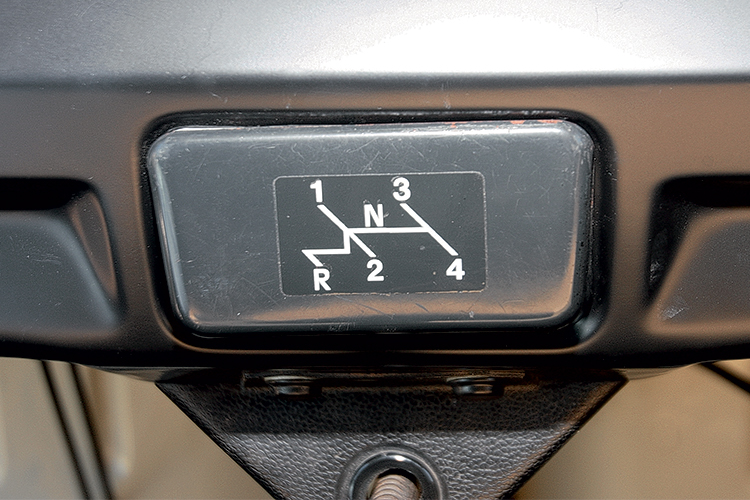
The gear shift pattern is indeed slanted, and coupled with the long lever strokes…
Where Is the Choke Lever?
The key is in place — but where is the choke lever? There isn’t one: this 1970s workhorse has an automatic choke, and not on one carburettor but on two Solex carburettors. My car has the largest engine in the family, a 2.0-liter air-cooled flat-four producing 70 hp, though even the more modest versions came with two carburettors.
The Sound, and the Gear Lever
How smooth and sweet an air-cooled engine sounds. The tone is like a Zaporozhets, but with less iron rawness in the voice. Nobody makes engines that sound like this any more. It does not struggle from very low revs either — peak torque arrives at 2800 rpm. The trick is shifting on time, and that can be a problem: the lever of the four-speed manual is imprecise, because it connects to the gearbox through long linkages that run under the vehicle for almost its entire length. The distance between first and second is nearly half a metre, and to engage third you have to push it towards the glovebox.
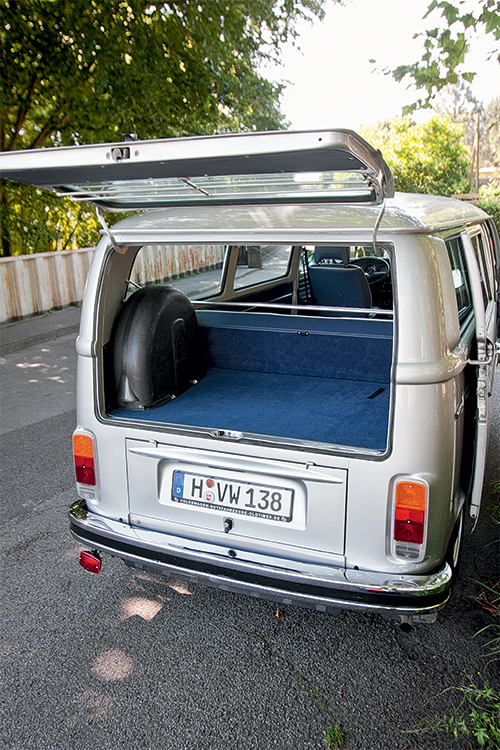
There is a full-fledged trunk above the engine compartment. And if you remove the spare tire and remove the floor panel secured with four wing nuts, the power unit will be in full view
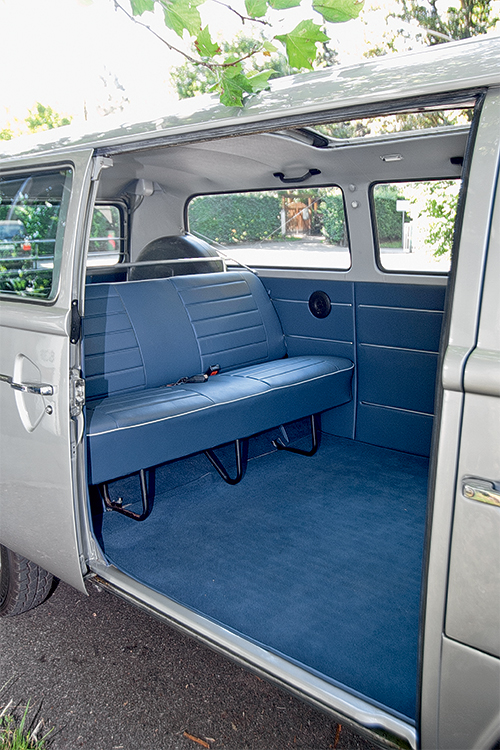
Perfectly flat floor, no step, a soft bench seat — isn’t it a limousine? You could have refused the middle row of seats when buying
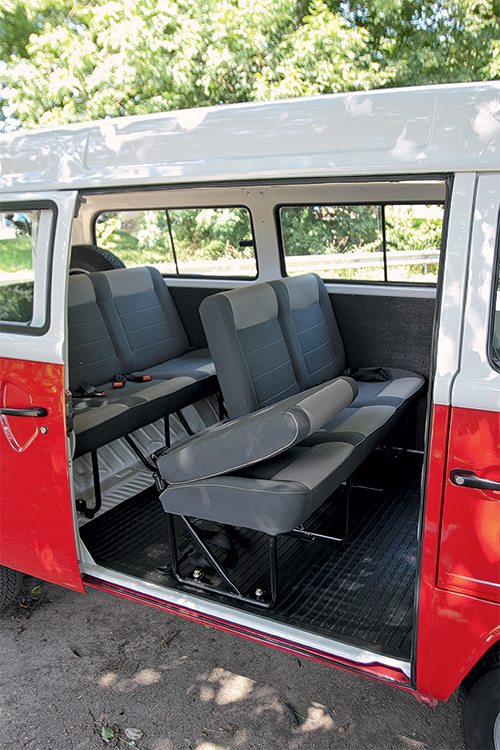
Minibus in Brazilian style. The seats are hard and uncomfortable, the chairs themselves are screwed tightly – to get to the back row, only one section of the middle row back folds down. At least all the windows are sliding
Steering You Turn More Than You Expect
I try not to dwell on the fact that in an accident only a thin body panel stands between me and the outside world. But the visibility is like sitting in an aquarium, and the steering — a worm gear, with no assistance — is informative. You turn it more than you are used to, because the steered wheels are not ahead of you but directly underneath you.
The Suspension Is the Point
But the main feature of the Volkswagen T2 is its suspension: independent, with transverse torsion bars in place of conventional springs. The ride quality is magical and the energy absorption phenomenal. Even over cobbles the little bus seems to float, barely noticing seams and cracks in the asphalt. As speed rises, though, it begins to wander, and the body roll becomes alarming enough to make anything above 80-90 km/h unpleasant.
So how does the Brazilian version compare?
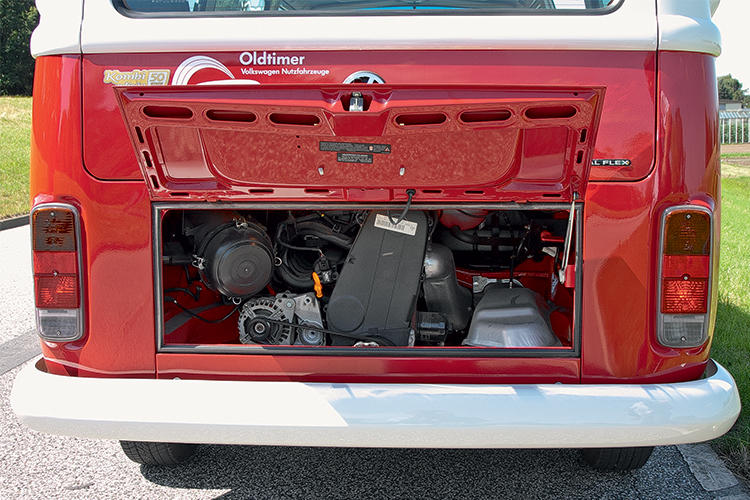
The inline “four” fit into the standard engine compartment at the limit – there is no headroom

The red Brazilian minibus is from the anniversary series dedicated to the 50th anniversary of the T2 model. In 2007, only 50 of these cars were made, this example is number 33
Fifty Years in Latin America
At the factory in São Bernardo do Campo, production of Transporters began almost simultaneously with Germany — back in 1950. The second-generation vehicles reached Mexico in 1971 and Brazil five years later, where the Latin Americans modernised them independently. In 1981, for instance, Brazilians were the first to fit the Transporter with a liquid-cooled engine, a 50-hp 1.6-liter diesel — though that version sold poorly and disappeared quickly.
Ten years later Mexico began producing vans with a liquid-cooled 1.8-liter gasoline engine of 71 hp, but that model ended in 1996. The Brazilians held out longest. Only new environmental regulations forced them to give up air cooling: since December 2005, Brazilian Transporters have carried the inline EA111 engine of 1.4 liters with liquid cooling, taken from the Volkswagen Fox compact hatchback.
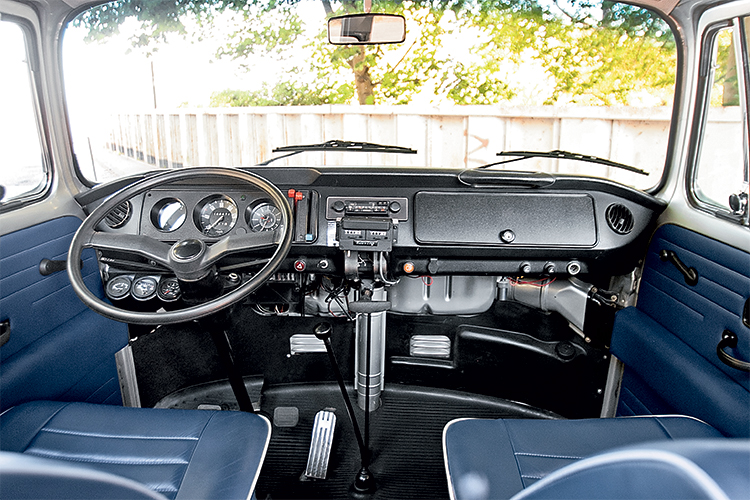
The second-generation Volkswagen Transporter has already acquired a plastic front panel, a collapsible steering column and a heater. In the center under the radio is the parking brake handle. Additional instruments to the left of the steering wheel and a trip master are installed today: this bus often participates in retro rallies
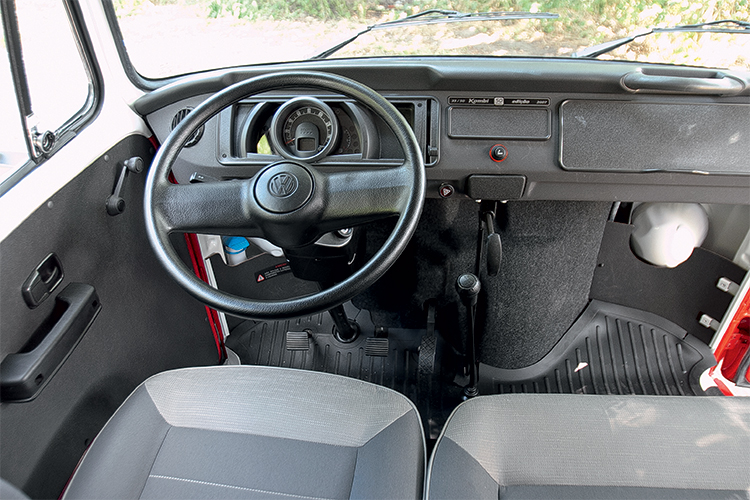
The “Brazilian” interior can hardly be called improved. The number of buttons and switches has been radically sequestered, and a radiator casing for the engine cooling system has grown in front of the feet
A Bus That Lost Its Ventilation
This version of the Transporter is easy to recognise: a large plastic grille at the front, with the radiator behind it. The roof is also raised by 85 mm. But why such a bare interior? Poor rubber mats on the floor, the sliding door lock left visible. The new instrument cluster has an electronic odometer, and the only gauges are the speedometer and the fuel level. As for climate control, there is one lonely slider, and at first glance nothing changes when you move it. It turns out that in hot, sunny Brazil the Transporter lost not only the heater but the entire forced ventilation system. Only the incoming airflow remains, and that single slider works the vent flap. Drive, and there is ventilation; stop, and you are in a sauna, relying on draughts from the windows. An irony of fate: overheating in traffic is now a problem for the passengers rather than the engine.
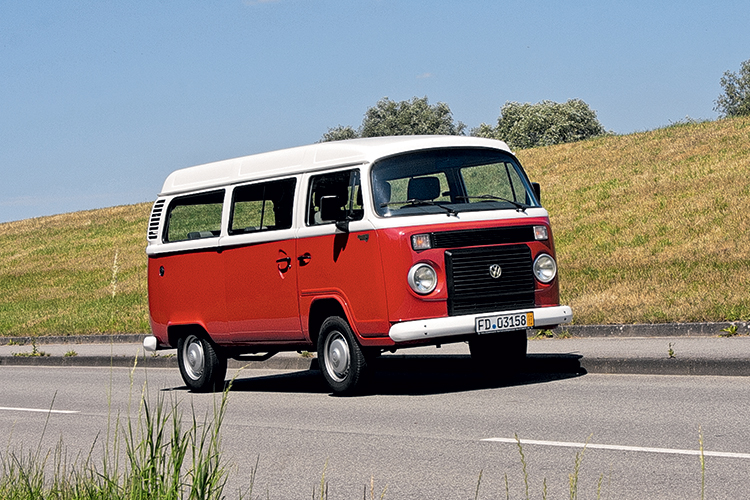
A plastic radiator grille, a raised roof and colourless turn signal lenses are all the external differences between the late Brazilian T2 and the original German cars.
More Power, Less Torque
The 1.4-liter fuel-injected engine is nominally more powerful than the two-liter carburetted flat-four, 78 hp against 70, but peak torque is much lower — 123 Nm against 143 — and it sits higher in the rev range. So the Brazilian microbus will not move at low speeds. The engine has to be revved, the sound is a long way from pleasant, and poor insulation makes it intrusive. The gearbox is unchanged and even vaguer than before: was that first, or third?
The steering still has no assistance and has grown looser still. The suspension design has not changed, but on the same cobbles the Brazilian bus rattles and sways from side to side. The body roll, at least, is slightly reduced.
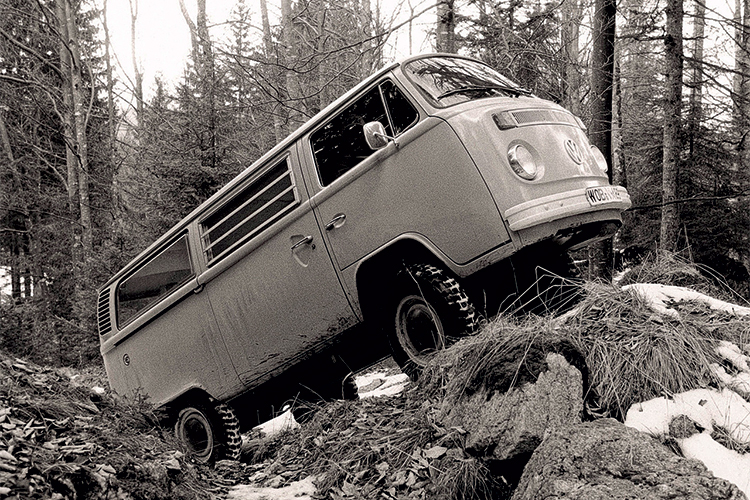
The Volkswagen T2 also managed to “try on” all-wheel drive: in 1975, a group of Volkswagen engineers led by Gustav Maier built five prototypes with an engine from the Volkswagen Iltis SUV, increased ground clearance, a rigidly connected front axle drive and interwheel limited-slip differentials. During testing, the cars demonstrated enviable cross-country ability, but the company’s management “killed” the project, fearing low sales. The production Transporter Syncro appeared only in 1985 — already in the T3 family and with a viscous coupling in the front axle drive. However, there was also a version with a manually engaged front axle — for the army.
Cheaper Than a Bukhanka
On the whole I do not regret that this mutated Volkswagen T2 was finally discontinued last December — and it was not discontinued voluntarily: the ancient design no longer met new safety standards. Without that, the T2 would have carried on. At around $14,000, cheaper than a UAZ “Bukhanka”, it was selling 25,000-30,000 units a year and sat inside the top 40 best-selling models in the Brazilian market. But it was no longer the charming German bus. It was a workhorse without a soul, now with liquid cooling.
The original German Volkswagen T2, though, I will remember fondly. They really did know how to make them.
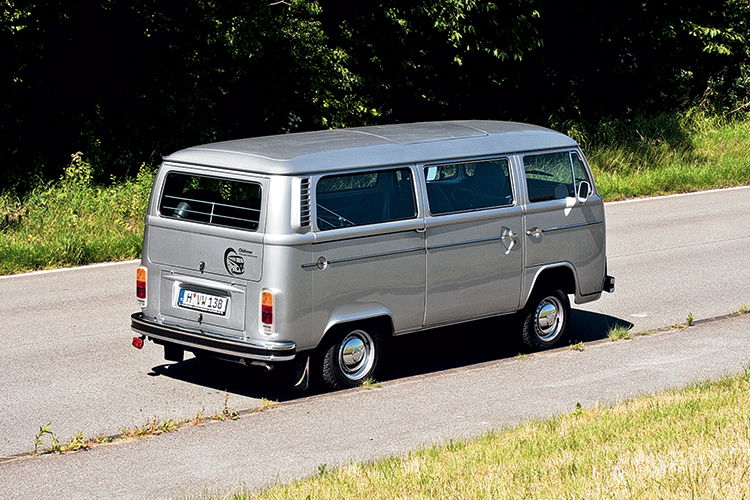
Isn’t it a cutie? Even when the car is stationary, the trim towards the stern is noticeable, and when accelerating, the front wheels are unloaded even more
Full Specifications
| Parameter | Volkswagen T2 Kombi (Germany, 1979) | Volkswagen T2 Kombi (Brazil, 2007) |
|---|---|---|
| Body type | Four-door minibus | Four-door minibus |
| Seating capacity | 5 | 9 |
| Dimensions, mm Length Width Height Wheelbase Track (front/rear) | 4505 1720 1955 2400 1385/1426 | 4505 1720 1955 2400 1385/1426 |
| Curb weight, kg | 1180 | 1259 |
| Gross weight, kg | 2250 | 2259 |
| Engine | Gasoline, with dual carburetors | Gasoline, with multi-point injection |
| Engine location | Rear overhang, longitudinal | Rear overhang, longitudinal |
| Cooling system | Air-cooled | Liquid-cooled |
| Number and arrangement of cylinders | 4, flat (opposed) | 4, inline |
| Displacement, cm³ | 1971 | 1390 |
| Cylinder bore/stroke, mm | 94.0/71.0 | 76.5/75.6 |
| Compression ratio | 8.0:1 | 10.5:1 |
| Number of valves | 8 | 8 |
| Max. power, hp/kW/rpm | 70/51.5/4200 | 78/57/4800 (80/59/4800)* |
| Max. torque, Nm/rpm | 143/2800 | 123/3500 (125/3500)* |
| Transmission | Manual, 4-speed | Manual, 4-speed |
| Gear ratios I II III IV Reverse Final drive | 3.80 2.06 1.26 0.82 3.61 5.38 | 3.77 2.06 1.22 0.81 3.28 5.50 |
| Drive type | Rear | Rear |
| Front suspension | Independent, torsion, longitudinal arms | Independent, torsion, longitudinal arms |
| Rear suspension | Independent, torsion, diagonal arms | Independent, torsion, diagonal arms |
| Front brakes | Disc | Disc |
| Rear brakes | Drum | Drum |
| Tires | 185 R14C | 185/80 R14 |
| Max. speed, km/h | 127 | 130 |
| Acceleration 0-100 km/h, s | 17.0 | 16.6 (16.1)* |
| Fuel consumption, L/100 km (combined cycle) | 12.9 | 9.1 (12.8)* |
| Fuel tank capacity, L | 51 | 45 |
| Fuel type | AI-92 gasoline | AI-92 gasoline (ethanol)* |
*Values in parentheses are for ethanol
Photo: Igor Vladimirsky
This is a translation. You can read the original article here: Volkswagen T2 по-немецки и по-бразильски: наш ретротест

Published April 17, 2025 • 11m to read