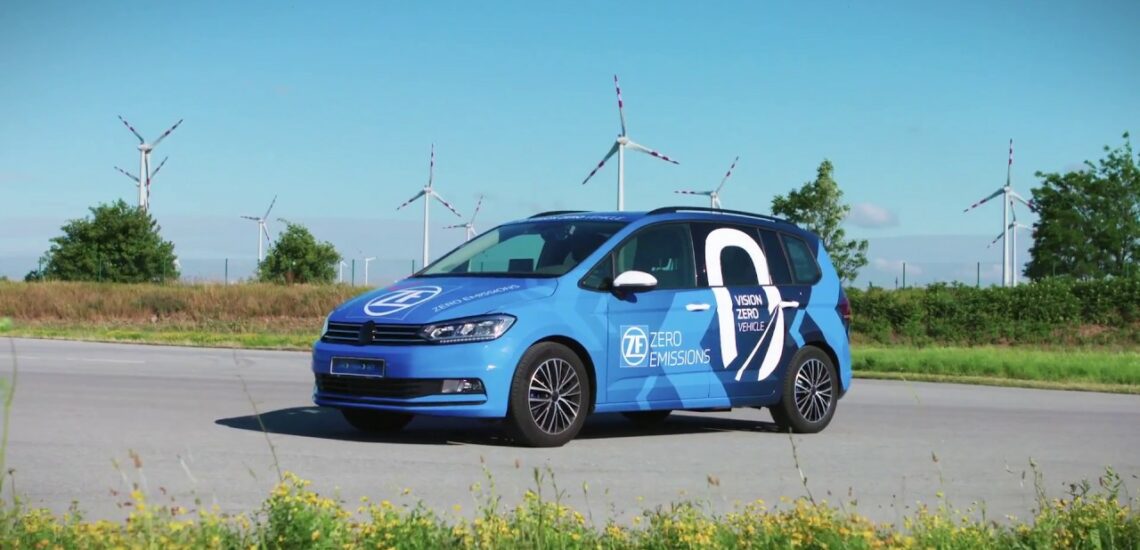

ZF Friedrichshafen AG, one of the world’s leading automotive suppliers, has developed the Vision Zero prototype — a radical reimagining of what a safe, sustainable, and intelligent vehicle can look like. Built on a heavily modified Volkswagen Touran, this concept car brings together cutting-edge safety systems, electric drive technology, and autonomous driving capabilities under one roof. The name says it all: Zero Emissions and Zero Accidents — inscribed right on the sides of the prototype.
Electric Drivetrain and Redesigned Chassis
ZF engineers replaced the Touran’s conventional internal combustion engine with a large lithium battery pack at the front of the vehicle. But the transformation didn’t stop there — the entire rear suspension was redesigned from scratch to accommodate the ZF mSTARS unit (Modular Semi-Trailing Arm Rear Suspension).
The mSTARS system integrates several advanced features in a single compact module:
- Integrated electric drive for improved efficiency and packaging
- Active rear-axle steering (AKC — Active Kinematics Control) to enhance both low-speed maneuverability and high-speed stability
- sMOTION active damping system, which uses a pump built into each suspension unit to apply additional force on the shock absorber rod in either direction
Unlike conventional passive shock absorbers that simply dampen vibrations, the sMOTION system actively responds to road surface changes in real time, significantly reducing body roll and improving ride comfort. According to ZF’s engineers, these active chassis components become especially valuable in vehicles equipped with full or partial self-driving capabilities and emergency control systems.
Autonomous Driving and Sensor Integration
ZF developed the Vision Zero prototype in collaboration with several technology partners specialising in autonomous driving hardware and software. The sensor suite fitted to the prototype includes:
- Radar sensors for long-range object detection
- LiDAR units for precise 3D environmental mapping
- Stereo cameras for lane and object recognition
- AI processing blocks to interpret sensor data and make real-time driving decisions
ZF’s own in-house developments complement this sensor array, forming a fully integrated system where active chassis components, safety assistants, and autonomous driving functions work in sync.
Driver Distraction Assist: Keeping Eyes on the Road
One of the most impressive systems developed by ZF is the Driver Distraction Assist. Using an infrared camera with laser illumination — capable of working in complete darkness — the system monitors not just the driver’s eyes, but the position of the entire head. The moment it detects inattention, it triggers a staged response:
- An audible alert sounds and a warning appears on the dashboard
- The seat belt automatically tightens and the lane-keeping system activates
- If the driver still doesn’t respond, the vehicle gradually decelerates
- The car then steers itself to the right side of the road and comes to a safe stop
Wrong-Way Inhibit: Preventing Dangerous Driving Errors
Fatigue and disorientation are leading causes of wrong-way driving incidents. ZF’s Wrong-Way Inhibit system addresses this directly by combining high-precision digital maps with real-time recognition of road signs and lane markings. As soon as the system detects that the driver is beginning to turn onto an oncoming lane or a closed exit, it responds in escalating stages:
- Visual and audible warnings activate, accompanied by seat belt vibration
- Steering wheel resistance increases to discourage the wrong turn
- If the driver continues, the electronics take full control — steering the car to the road’s outer edge, reducing speed, and bringing it to a complete stop with hazard lights and low-beam headlights on
- Once stopped, the system evaluates the surrounding situation and permits the driver to exit the danger zone — either forwards or in reverse — only when it determines it is safe to do so
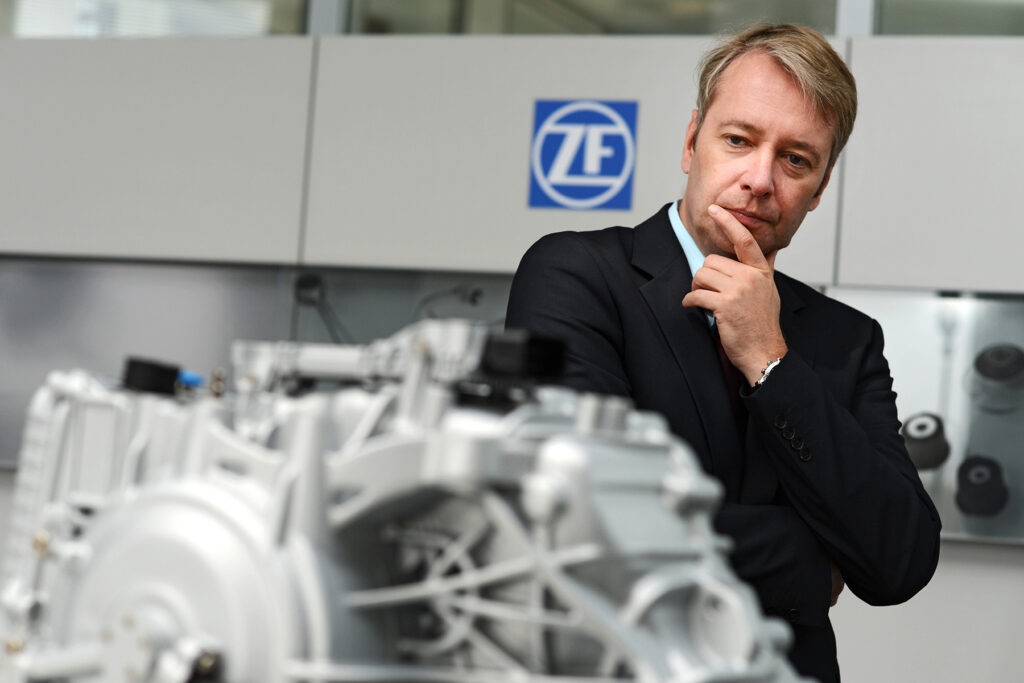
“We can achieve zero accidents and zero emissions only if all cars become electric, autonomous and integrated into one network. We are working hard to make this possible,” said Dr. Stefan Sommer, CEO of ZF Friedrichshafen AG, commenting on the range of technologies showcased in Austria.
Integrated Safety: A Holistic Approach
ZF’s engineers stress that truly effective vehicle safety cannot rely on isolated systems. Instead, all active and passive safety devices must work together — responding collectively to road conditions, the behavior of surrounding vehicles, and the actions of road services. This integrated philosophy is at the core of the Vision Zero concept, and it’s what sets the prototype apart from vehicles that simply stack individual driver-assistance features on top of one another.
Openmatics Telematics: Smart Fleet Management for Zero-Emission Fleets
Rounding out the Vision Zero showcase, ZF also presented the Openmatics on-board telematics platform and its accompanying Dashboard web application — a fleet management tool designed with electric vehicles in mind. The platform gives fleet operators real-time visibility into:
- Vehicle location across the entire fleet
- Workload and utilisation data for each vehicle
- Battery charge levels for electric vehicles
With this data, operators can plan routes based on actual drive range, dispatch the most suitable vehicle for each job, and continuously optimise the fleet’s overall energy consumption — making the transition to electric fleets both practical and efficient.
This is a translation. You can read the original here: https://www.drive.ru/technic/595f2239ec05c4fd19000010.html

Published September 23, 2021 • 5m to read