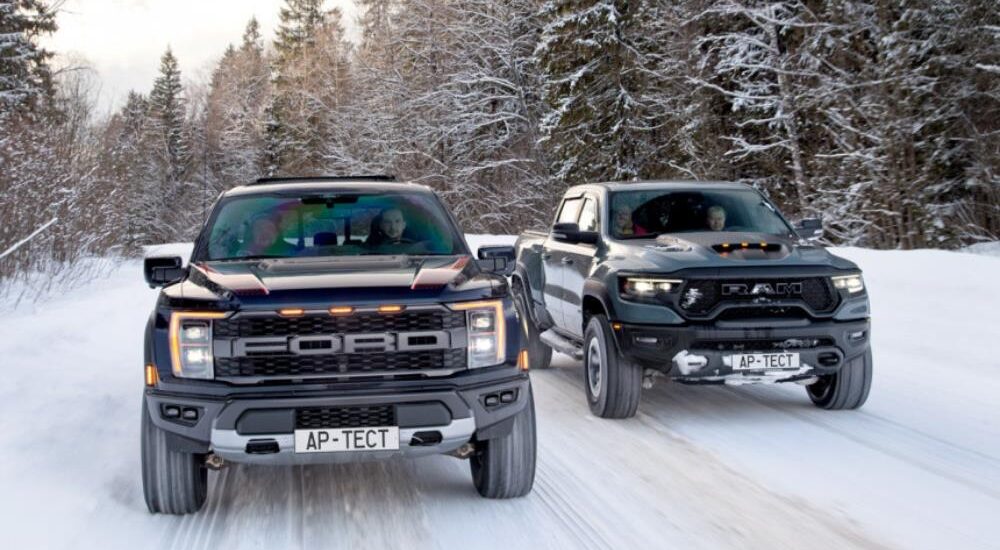

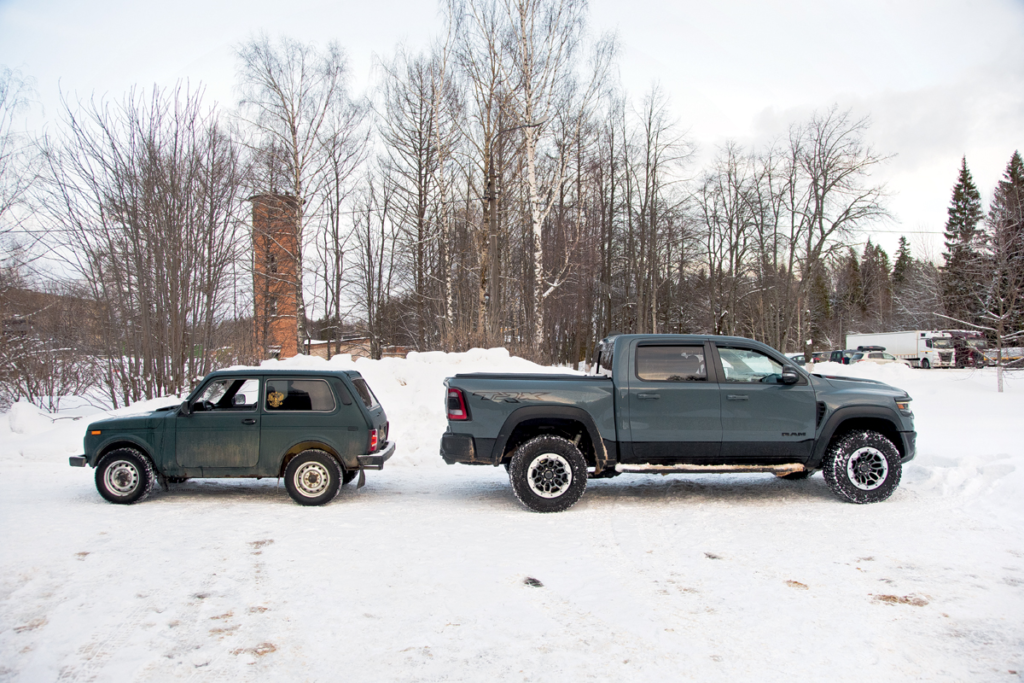
Raw power, intense thrill, and an unrelenting surge – these are the vehicles that make the terrain wince. The Ford F-150 Raptor and Ram 1500 TRX are the modern dinosaurs of the truck world, and they never really left. At first glance, they stand as direct rivals: imposing appearances, similar dimensions, and colossal wheels.
Why Buy a Raptor or TRX? It’s Not About the Baja 1000
Are there any actual owners of these trucks reading this? Let’s be honest – you didn’t buy one to leap across sand dunes the way the promotional videos suggest. You didn’t buy it to race the Baja 1000, the very event that inspired these off-road performance pickups in the first place. Stripped from their historical habitat, the real superpower of these giants is bragging rights. Nobody blinks at a Mercedes-AMG G 63 anymore, but the Ram TRX is a different story entirely. Everyone looks at it, everyone hears it, and it intimidates everyone on the road. Right now, Ram is the undisputed star of this segment.
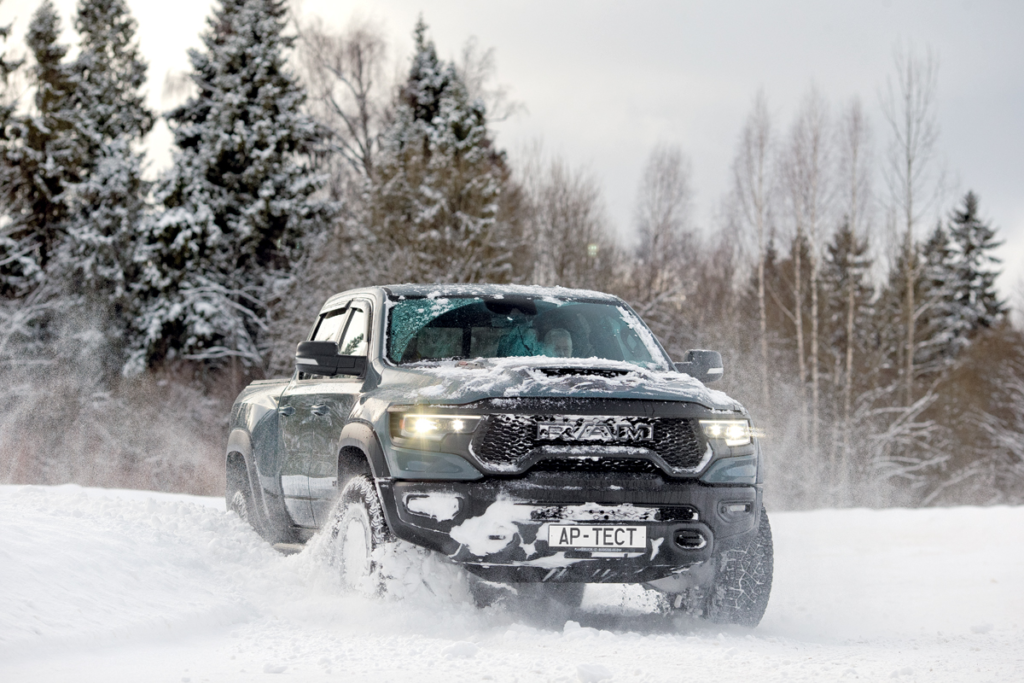
A true stunner, no doubt. One look and you’re soaked in its spirit. Who mentioned “unrestrained freedom”? Freedom to choose your own roads and directions. Freedom while composing your packing list. If the 1.7-meter cargo bed falls short, you can hitch a four-ton house on wheels to the back. And then there’s the freedom of self-expression, with over a hundred branded accessories available. Even the test truck in Launch Edition trim is already seriously impressive.
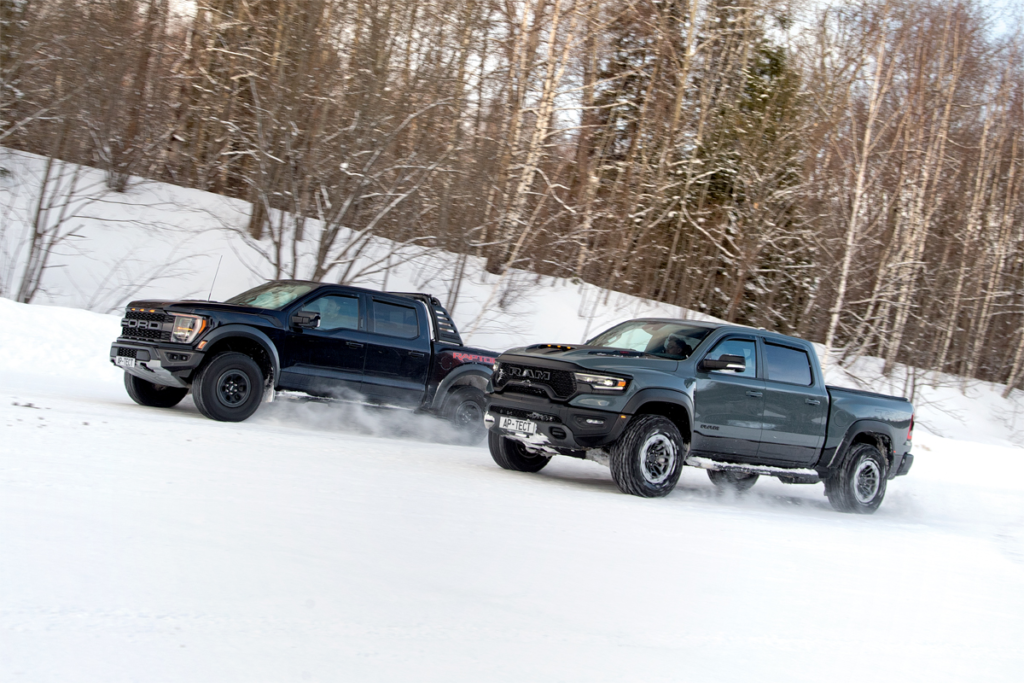
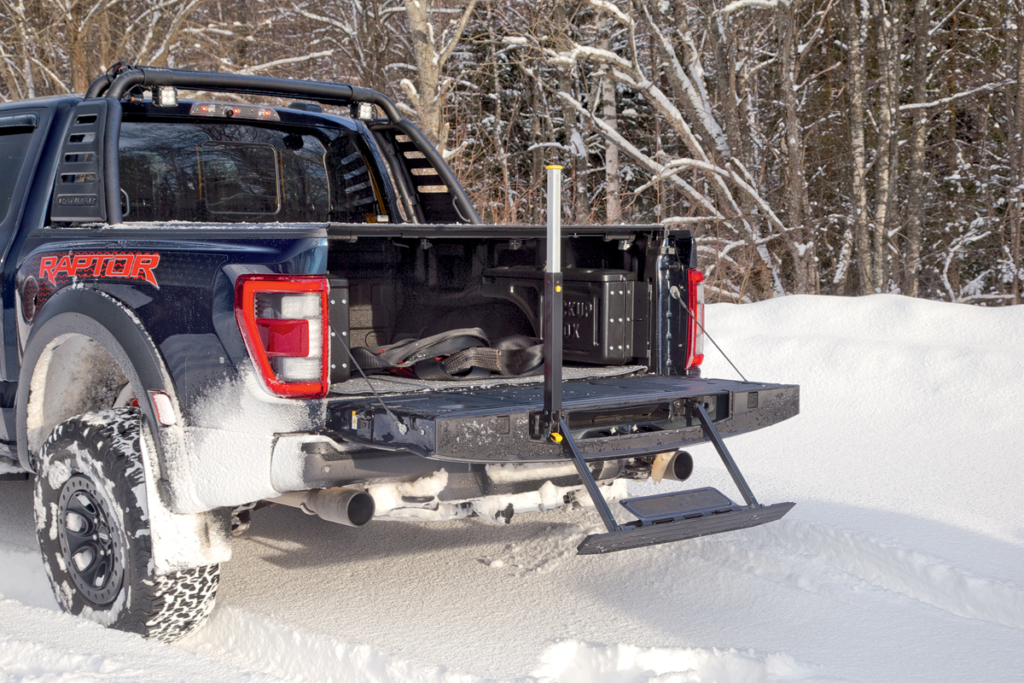
But is the Ford any less impressive? Its vertical front end stands tall like the gates of a lavish mansion (the surround-view cameras are practically part of the family too). Massive 35-inch wheels match the Ram’s, and the equally capacious cargo bed leaves a lasting impression. The Raptor’s bed even raises and lowers via an electric drive, complete with a built-in step and handle. On top of that, Ford’s truck can play the role of the world’s least efficient power generator, producing up to 2 kW of electricity on the side – though given its engine, it might be cheaper to burn family portraits for heat.
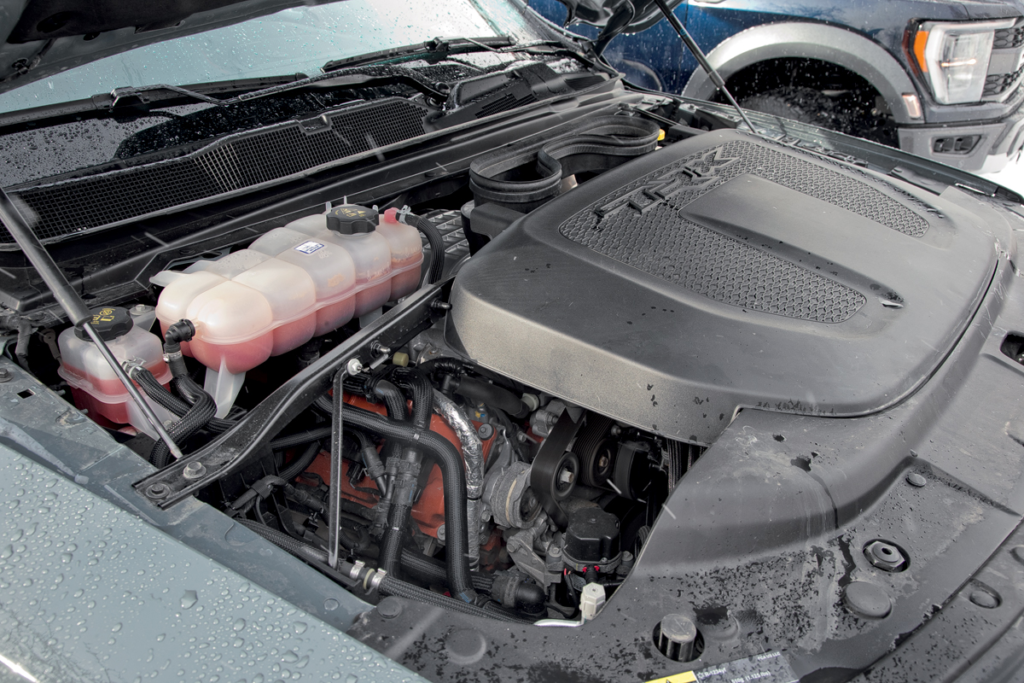
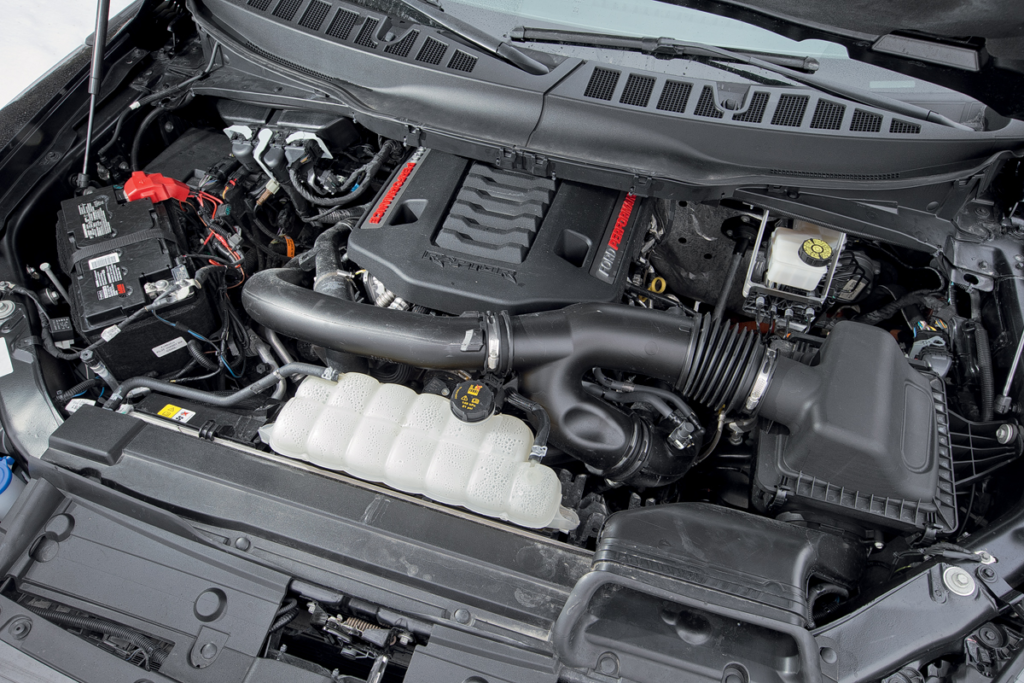
Engines and Horsepower: V8 Hemi vs. Twin-Turbo EcoBoost V6
Or maybe the Raptor isn’t quite so impressive after all. There’s no V8 here – it was replaced by a downsized V6 3.5 EcoBoost. Eco-friendly and fuel-efficient, sure, but that doesn’t quite match the spirit of this truck. This is exactly why the Raptor now boasts a V8 again in its top trim. Ford grew tired of third-party tuners cashing in by dropping Mustang engines under that colossal hood, so now the factory does it themselves – using the supercharged unit from the GT500 coupe. That version delivers a staggering 710 hp. Our test truck, despite carrying the “R” badge, doesn’t roar quite that loud – it delivers a “mere” 456 hp. Still nothing to scoff at, especially given its 2,779 kg loaded weight and six-meter length.
Especially when compared to the Ram and its astonishing 711 hp.
Let’s break it down. Seven hundred and eleven horsepower – after this, it’s no surprise that “dyno” and “dinosaur” practically rhyme. That number brings a bigger road tax, a 4.5-second sprint to 100 km/h, and the unmistakable growl of a supercharged V8 Hemi. The rhythm of the flashes from the 6.2-liter engine mirrors the sound of a tyrannosaurus after a hearty feast – bur-bur-bur, one tasty meal. Even at idle, it’s clear this engine could handle any load, theoretically infinite, much like the Ram itself. In all my years testing vehicles, this is the first time I’ve seen a truck registered as a “passenger pickup” that still manages to overwhelm our scales.
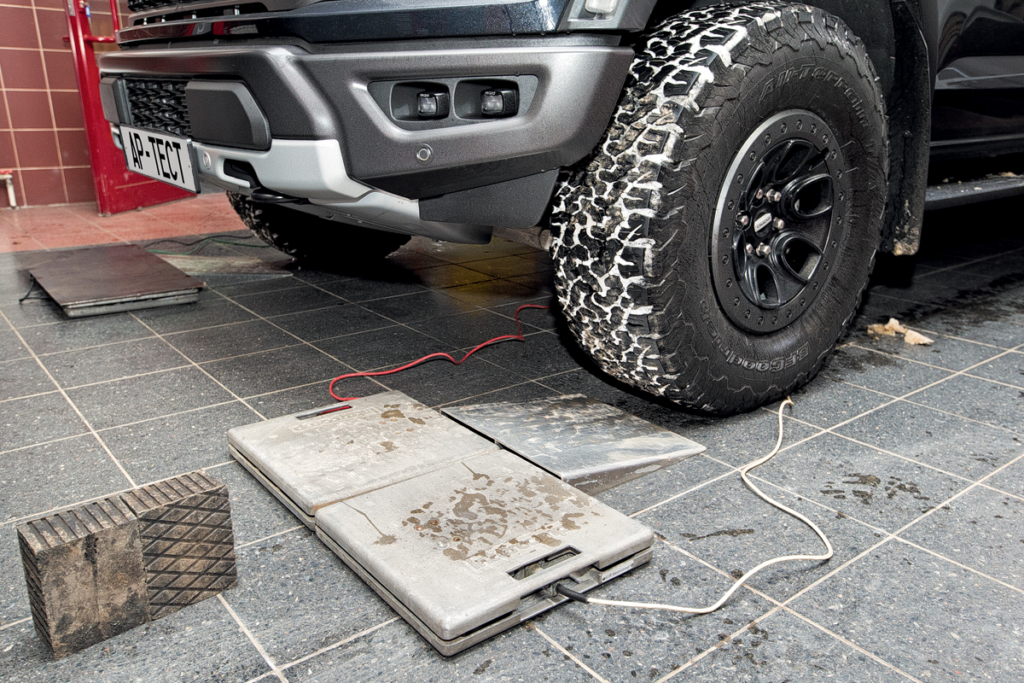
Here’s what happened when we tried to weigh it:
- Each of our four weighing platforms is rated for 750 kg, but the Ram’s front axle overloaded them.
- We had to weigh the TRX in two steps: first the rear axle, then two platforms stacked under each front wheel.
- Final total: 3,043 kg – genuinely a three-ton truck.
- Three yellow lights on the hood vent, normally reserved for semi-trucks, hint at exactly this kind of heft.
- The hood-mounted air intake feeds half of the engine’s total air volume into a massive 29-liter air filter box – the largest replaceable filter element in the passenger vehicle industry.
Behind the Wheel: The Cab Experience
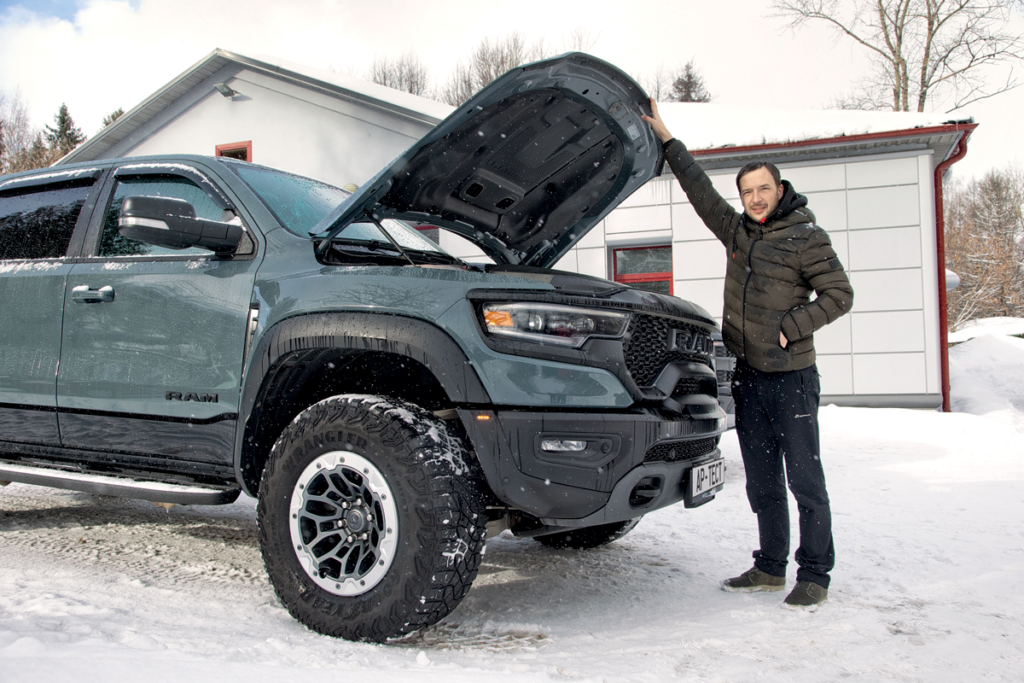
But come on, how is this really a “passenger vehicle”? At 188 cm tall, I can barely reach the open hood, and our photographer walked what felt like seventeen kilometers just circling the truck during the interior shoot. You grab the door handle bar, step onto the convenient foothold, and climb up to the second floor to get behind the wheel. From up there, you’re looking down on drivers of light commercial vans. And the sensation of piloting a truck never leaves you, even once you’re rolling.
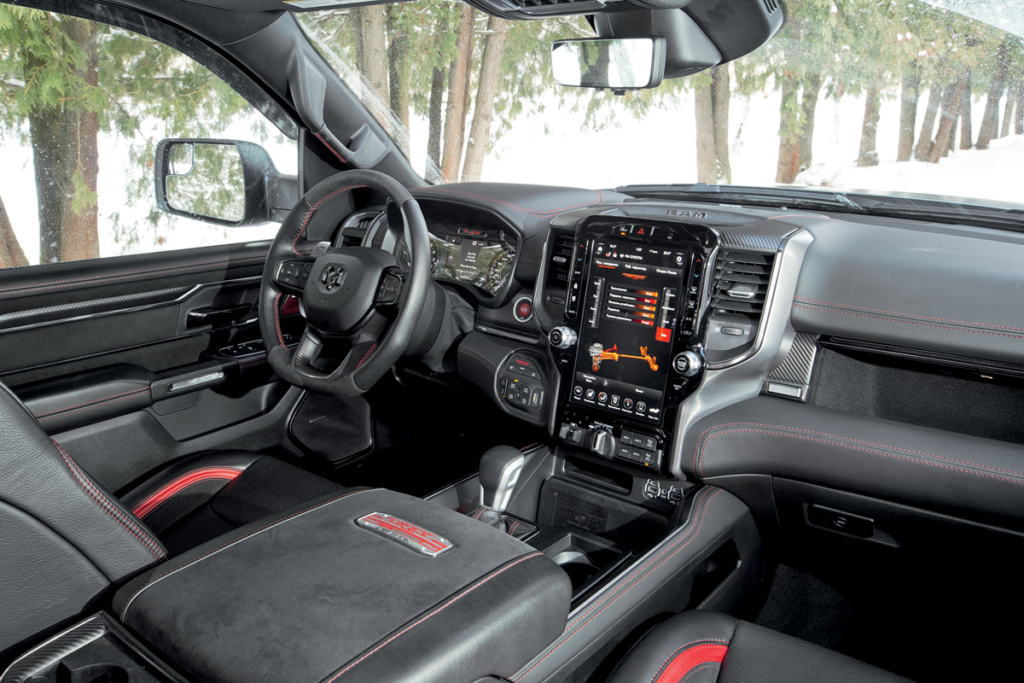
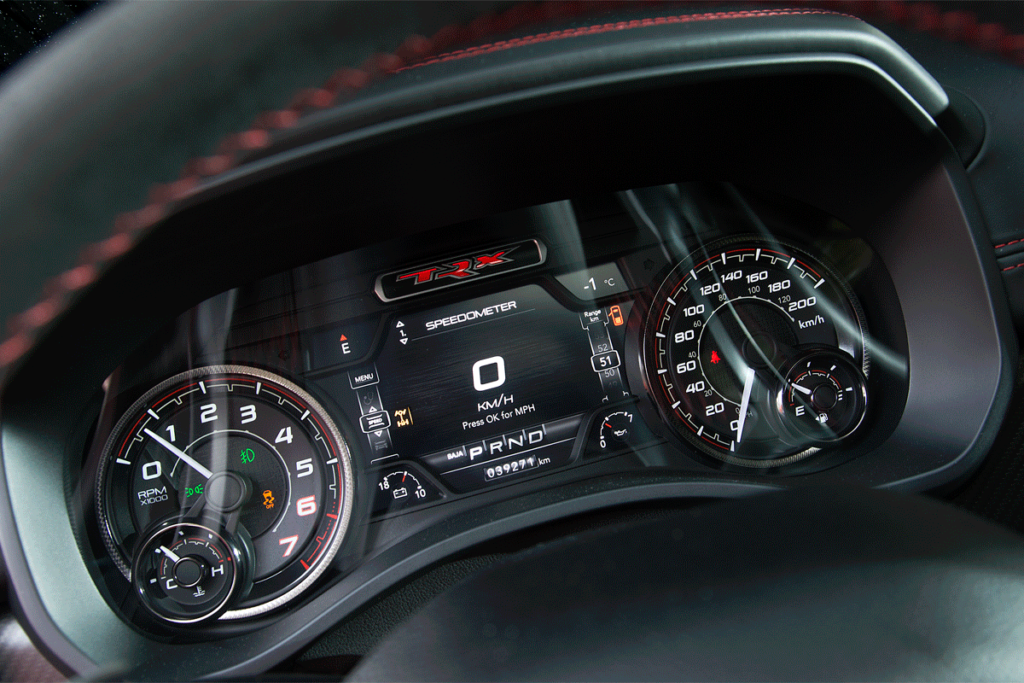
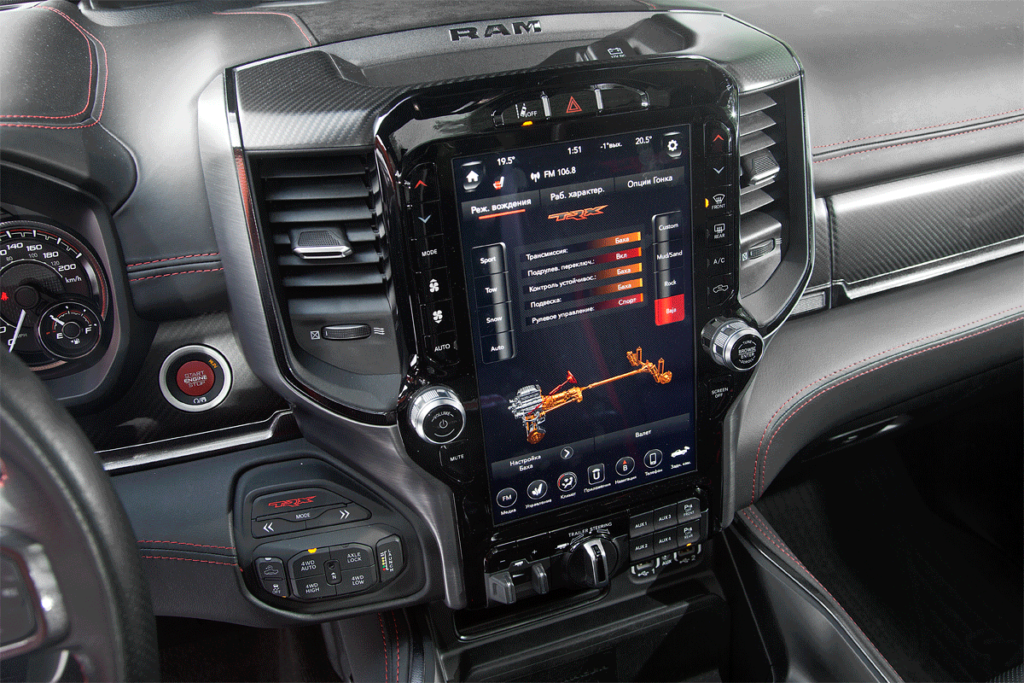
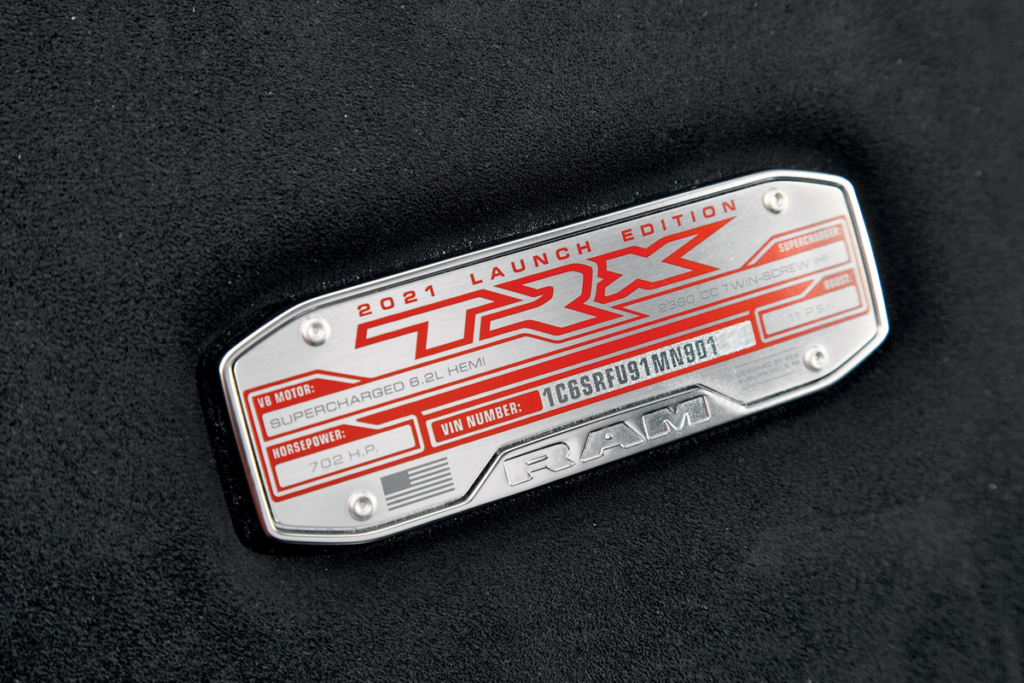
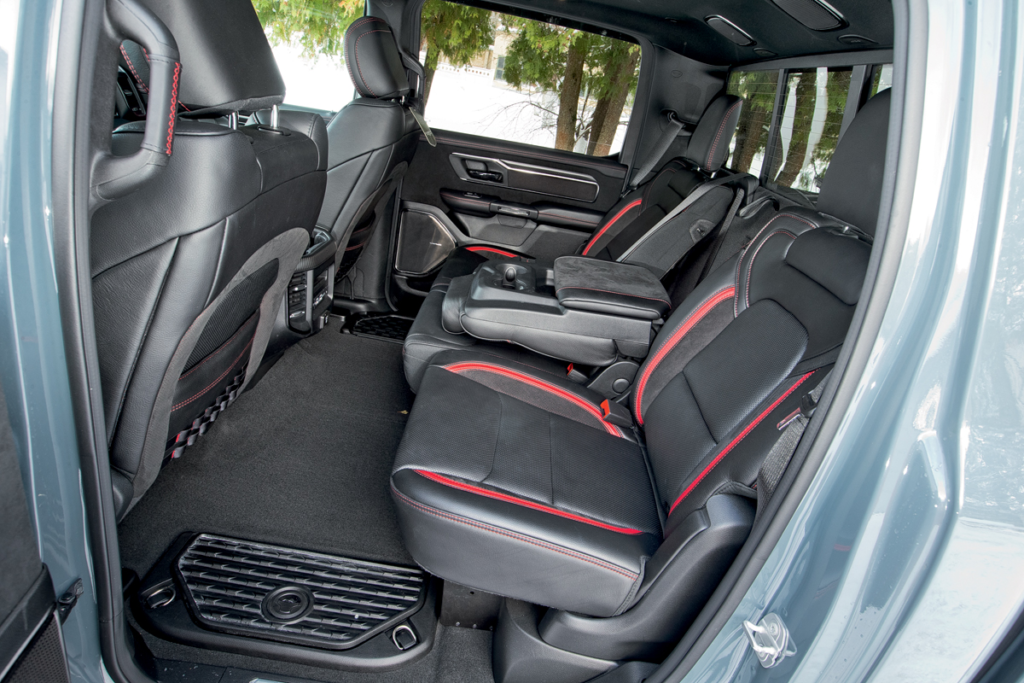
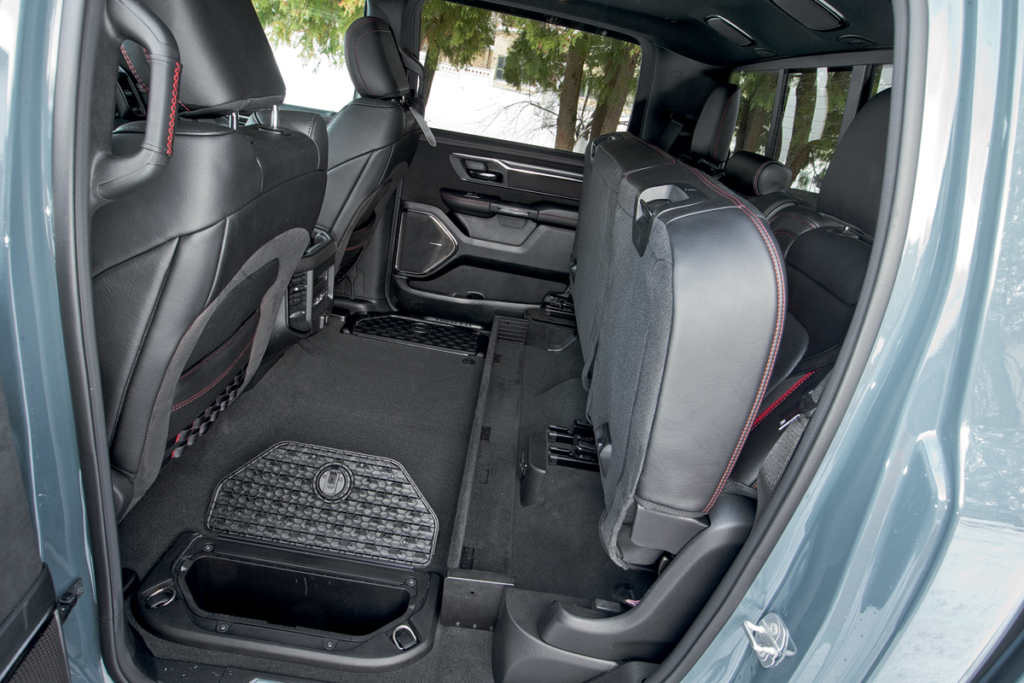
The Ram’s interior pleasantly surprised me with its “lightness.” Abundant leather and Alcantara, premium plastics, precise detailing on every button. Even the Tesla-esque center screen doesn’t evoke any negative feelings – the menu is visually pleasing, and inside this cavernous cabin (with an armrest 1.65 meters wide) it doesn’t strive to dominate, blending in as just another interior element. The textured instrument cluster, with its broad color information display, actually manages to capture more attention.
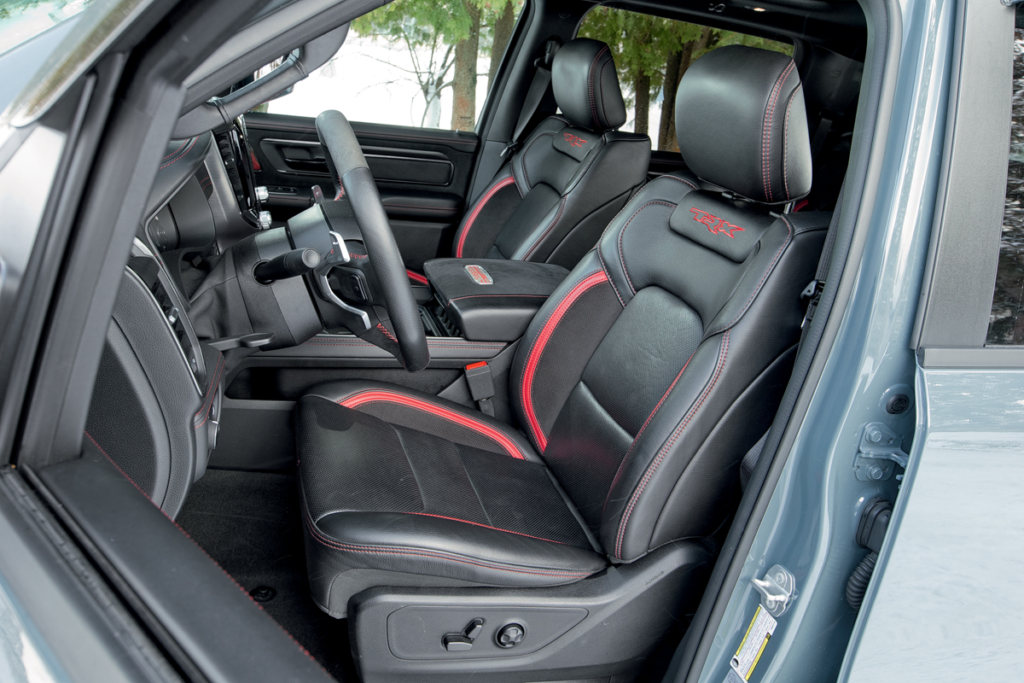
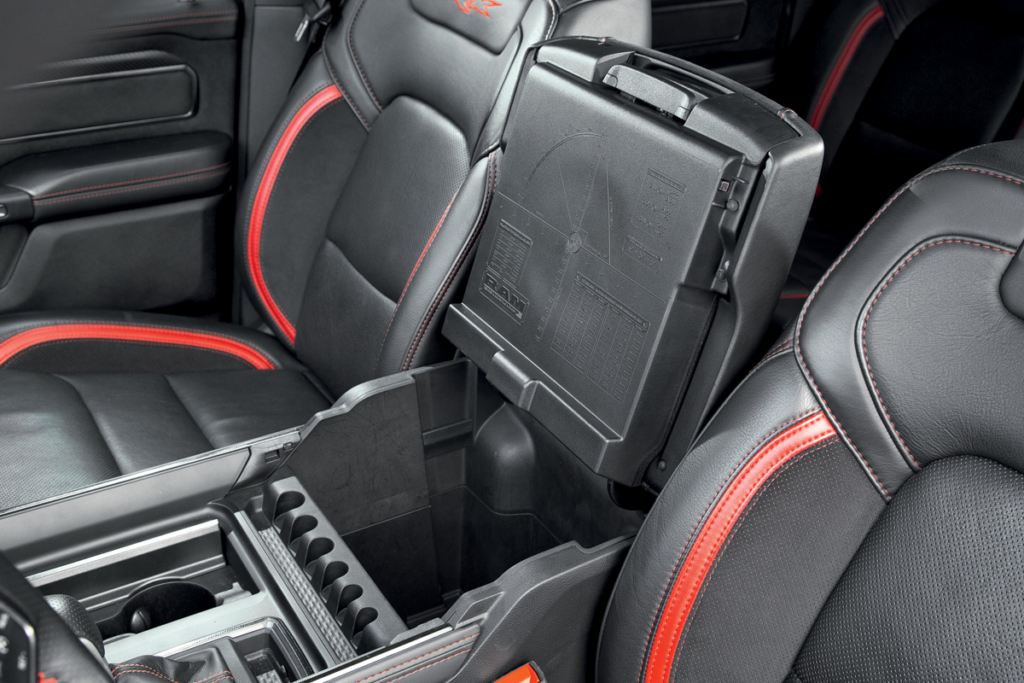
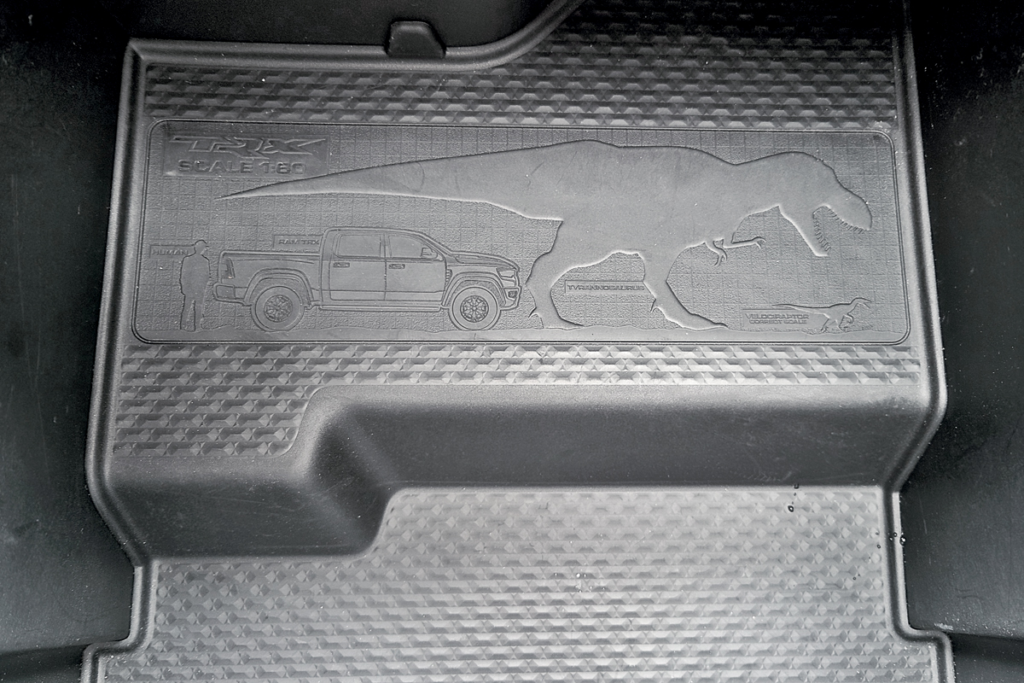
The seats are excellent, the steering wheel adjusts across a wide range, and if that’s not enough, you can adjust the pedals too. The designers turned the massive lid of the center console into an aesthetic statement, decorating it with mathematical formulas and compass markings. Inside lies a rubber mat bearing equal-scale images of the Ram TRX, a tyrannosaurus, and a velociraptor – and the comparison clearly isn’t in the velociraptor’s favor. Lucky for it, the velociraptor and the tyrannosaurus missed each other by at least a million years.
Transmission and Drivetrain: How These Trucks Deliver Power
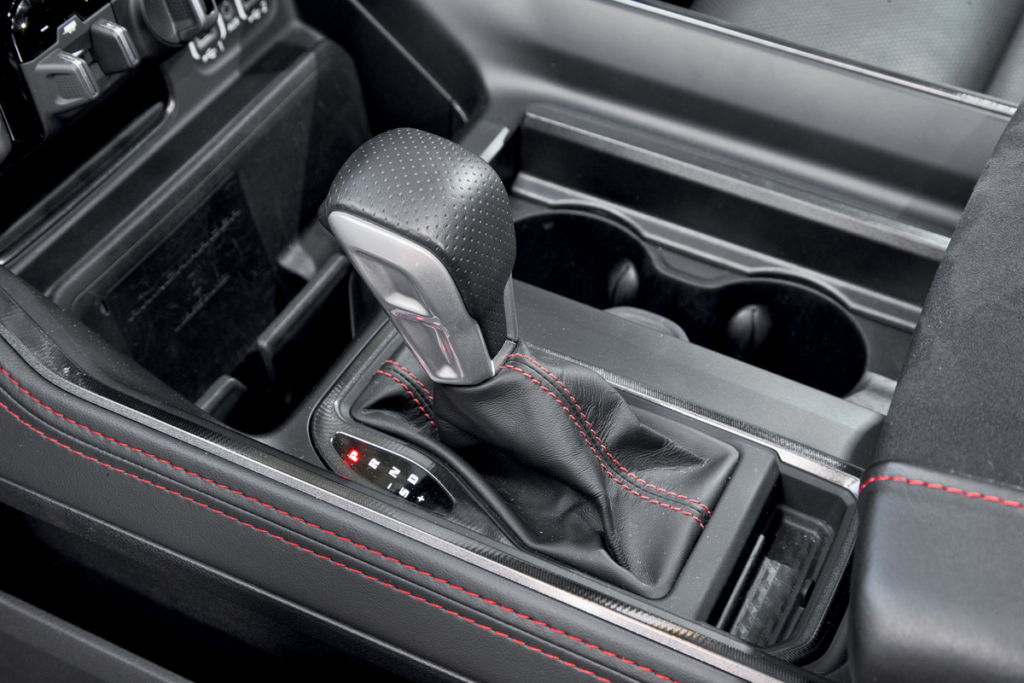
The Ram’s engine and its accompanying eight-speed TorqueFlite 8HP95 transmission deserve a spot in the Rock and Roll Hall of Fame. It’s the Fender Stratocaster of the automotive world, letting you play any melody you want. Sing a mellow ballad at near-idle RPMs, or push down a couple of “frets” – the automatic transmission’s friction packs – and unleash the roar of a dinosaur from under the hood. Floor the throttle in the “ty-rex” and all the exhaust burbles fall away, replaced by a unique compressor whine. At first it might sound like a cat tangled in a drive belt as the howl transitions into a screech at certain RPMs. But in the automotive world, we call that a song.
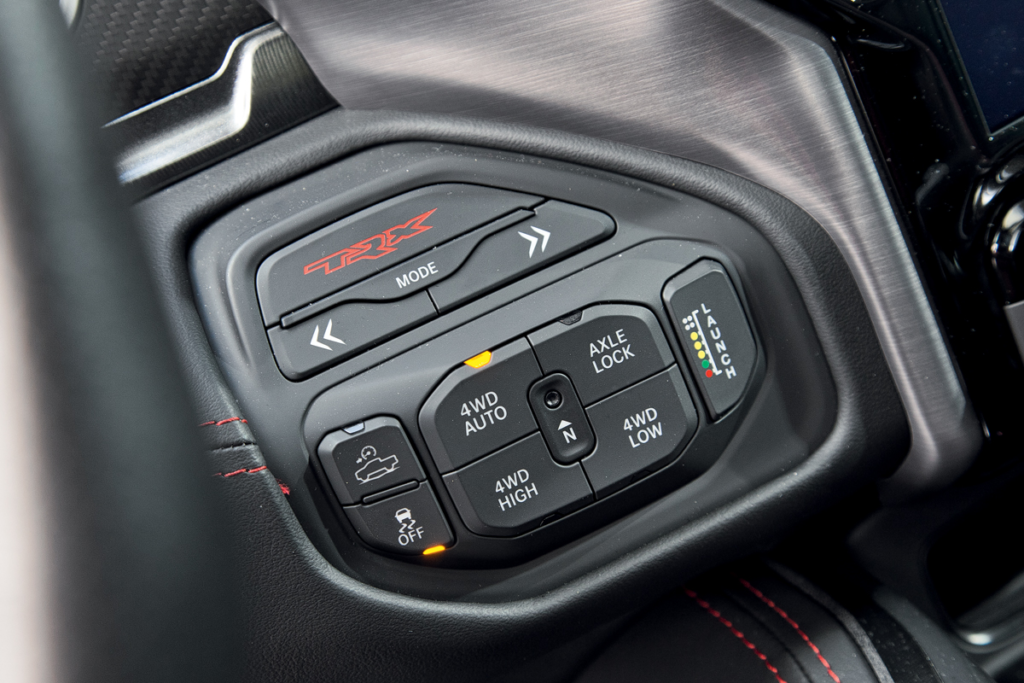
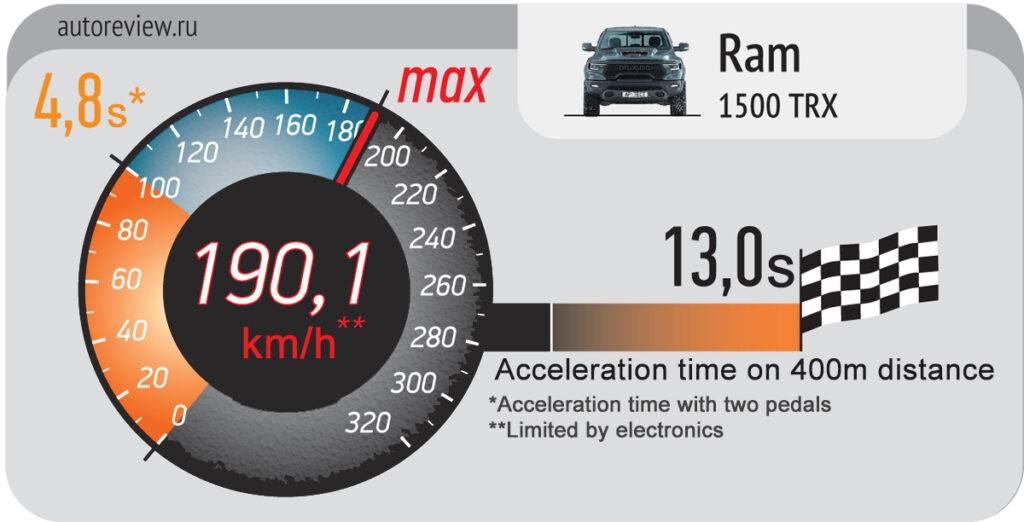
And it’s not just for show: 4.8 seconds for a 0-100 km/h sprint on wet asphalt, despite not being able to use the launch control system. It activated fine, but the moment I floored the gas, the brakes couldn’t stop the rear wheels from spinning. No traction means no inter-axle differential – both of these trucks send power to the front wheels through a clutch-based all-wheel-drive system rather than a traditional differential.
Even so, the Ram TRX only slightly deviated from its factory-claimed numbers, and the 402-meter distance results confirmed them. Strangely, though, the electronic limiter cuts acceleration at 190 km/h – by that point, the “ty-rex” can’t even cover a full kilometer from a standstill. Impressively, even at that speed, the three-ton behemoth stays stable and obedient enough to change lanes confidently. The steering doesn’t offer abundant feedback, but it’s enough to tell you, in the first tense corner, that the Ram isn’t exactly built for tight asphalt twists. You simply can’t hide three tons.
Suspension and Off-Road Hardware Compared
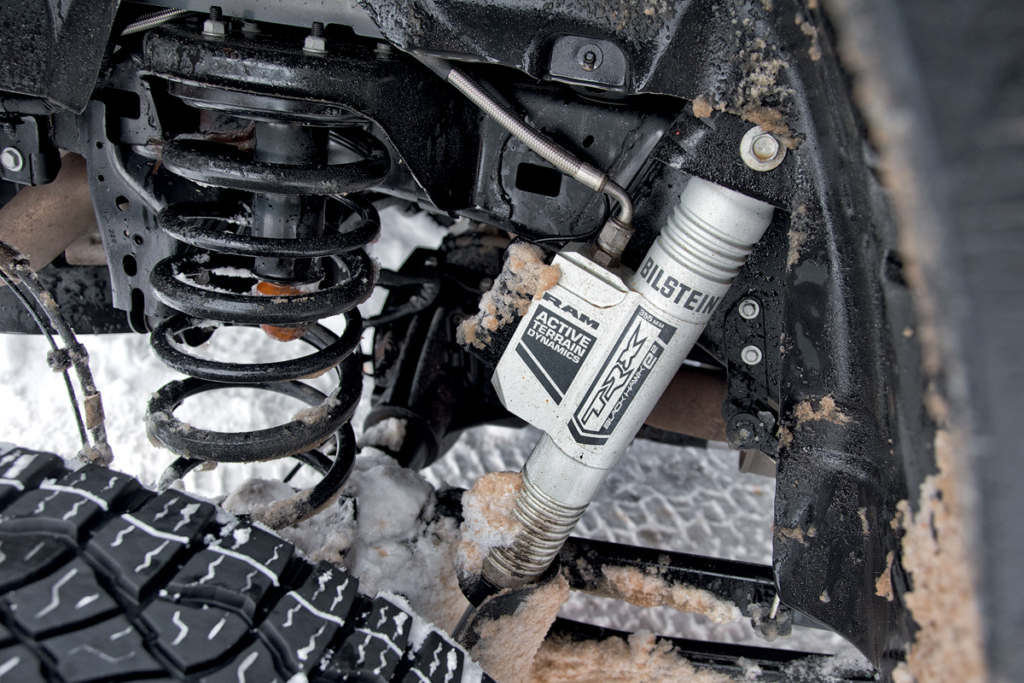
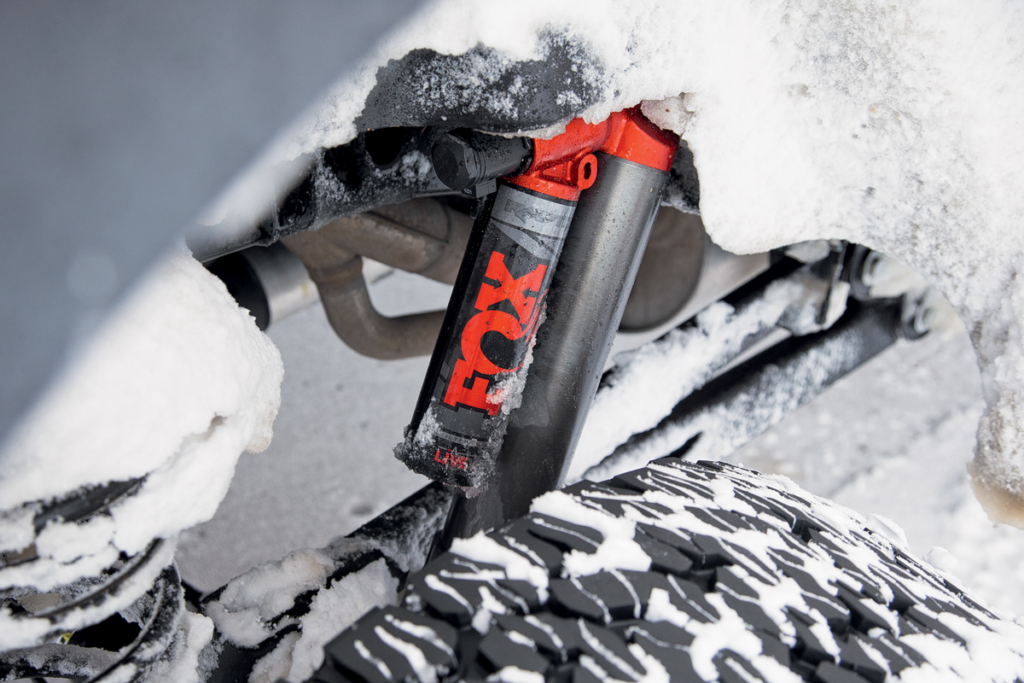
Suspension? Just look at these shock absorbers – diameters as large as sewage pipes, with additional hydraulic lines running to auxiliary reservoirs. Alongside the rugged bodywork and extra lighting, these anodized aluminum shock bodies are the main exterior highlight on both trucks: Bilstein Black Hawk e2 units in the Ram’s wheel arches, Fox Racing Shox in the Ford’s. Both exceed 60 mm in body diameter, and rebound travel seems nearly infinite.
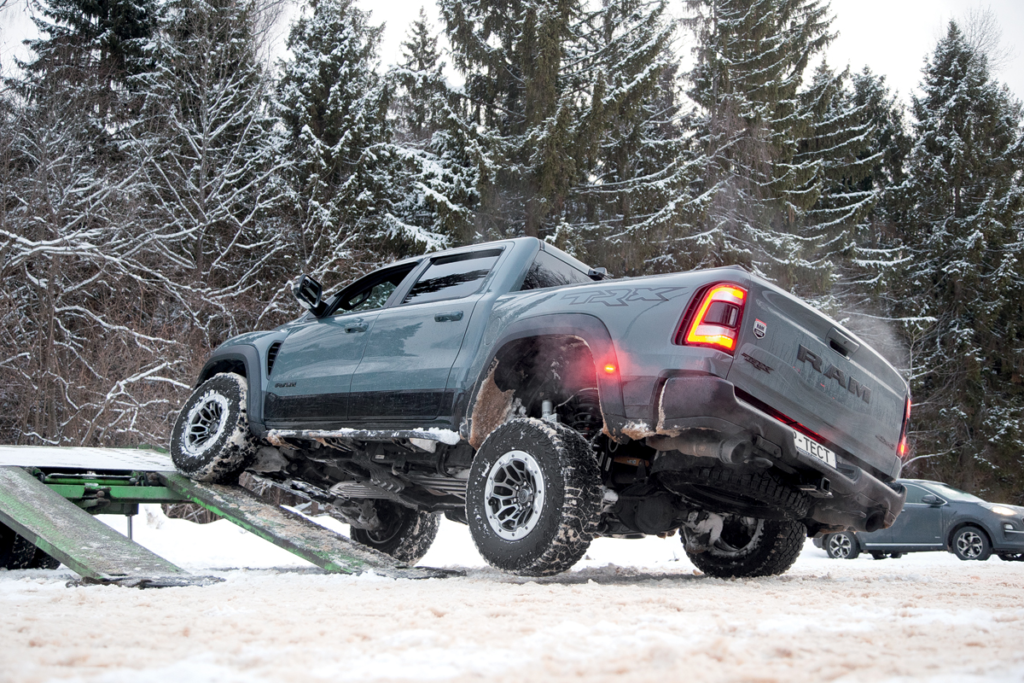
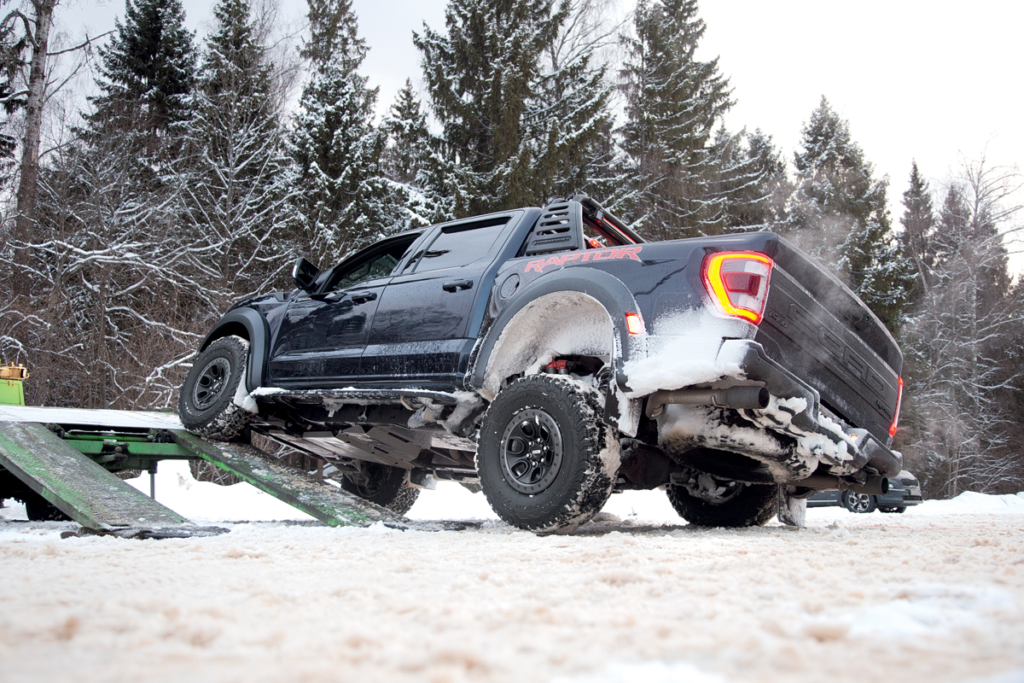
To test real-world wheel travel, we had to bring in a tow truck. Loading each pickup onto the platform from one side revealed some striking numbers:
- Ford F-150 Raptor: lowers the wheel by 342 mm before lift-off.
- Ram 1500 TRX: lowers the wheel by 293 mm before lift-off.
- Toyota Land Cruiser 300 (for comparison, and widely considered nearly unrivaled off-road among conventional SUVs): just 231 mm of rebound travel.
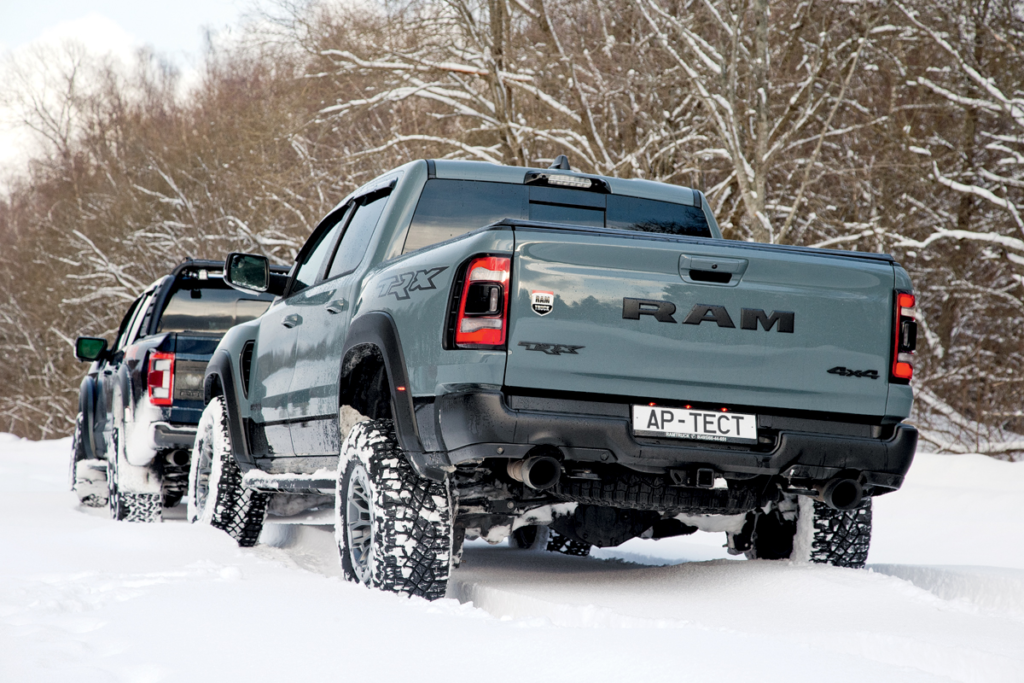
Both trucks also impress from an engineering standpoint underneath. Their frames are unique to these performance versions, built with extensive high-strength steel, extra reinforcements, and special mounting brackets for auxiliary components. Up front sit mighty double wishbones with aluminum parts, while one-and-a-half-meter longitudinal arms hold the rear axle – riding on coil springs rather than leaf springs. On the Ram, there’s an additional shock absorber mounted at the upper differential housing point specifically to dampen torsional vibrations. The Dana 60 TRX axle is borrowed from the heavy-duty Ram 2500, with further internal upgrades. The driveshafts and propeller shaft are massively thick – the aluminum tube resembles a storm drain more than a car part. Curiously, there’s an empty space where an inter-axle differential would normally sit, leaving the clutch packs to handle 700-900 Nm of torque entirely on their own.
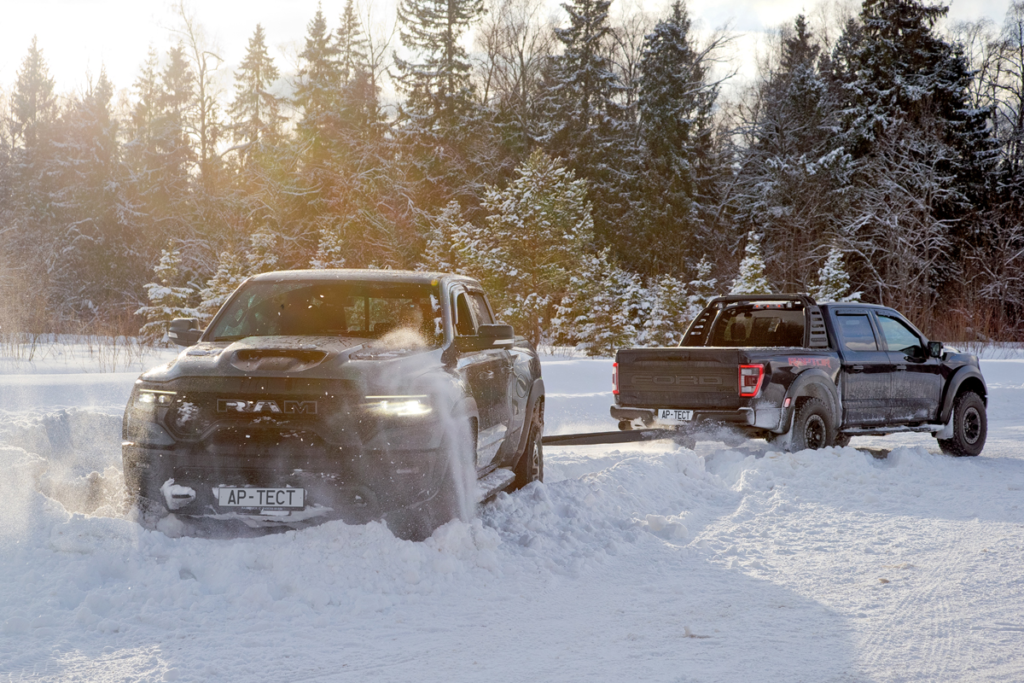
Both assembly lines are located in Michigan, yet somehow the roads there don’t seem to have a single smooth joint – or at least that’s how it feels through the constant internal tremor on sharp bumps, the relentless shaking, and powerful jolts, especially in the rear seat.
How They Drive: Dirt, Snow, and Drifting
Maybe more suspension travel is the answer? To a point, yes – many issues fade, but the Ram TRX swallows unevenness along with everything else. You might want to fasten five-point seatbelts, eat a light breakfast, and speed across tricky terrain the way I once did behind the wheel of a Mitsubishi Triton rally raid prototype. Enduring shake in a Spartan sports-car interior is one thing I’m ready for – this is a different kind of ride entirely.
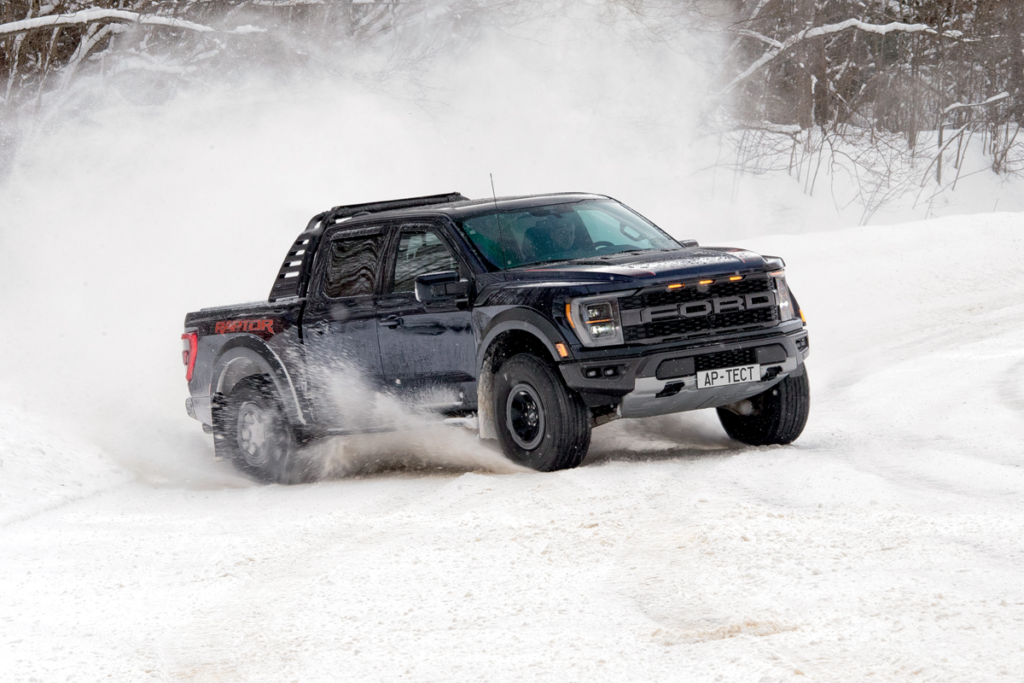
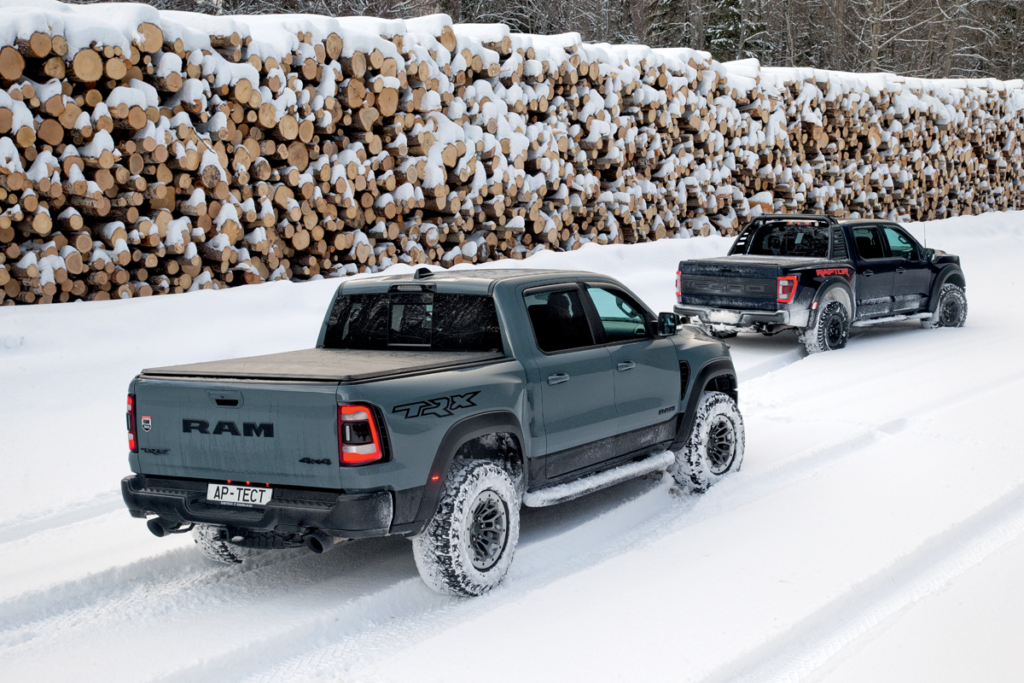
Rally raid prototypes are considerably lighter, and steering them across winding snowy roads is pure delight. Here, though, inertia rules with a capital “I,” and the stability control logic feels mysterious at times. Switch it off by holding the button, kick the TRX into a slide, ease off the throttle to tame the impulse – and right at that moment, the electronics intervene anyway and hit the brakes. Even in the most exhilarating chassis mode, Baja, the Ram doesn’t turn into a drift king. And in its most off-road-focused mode, Mud, it doesn’t quite become a true “mudder” on loose ground either. Slow down even slightly in deep snow and a strong tug takes over.
The noticeably lighter Ford, by contrast, feels more lively in these conditions and drifts masterfully. Turn the wheel in, hit the gas, and off you go – with impressive angles on tap during sequential gear shifts along a straight road. This is honestly the only moment when the Raptor genuinely lifted my spirits.
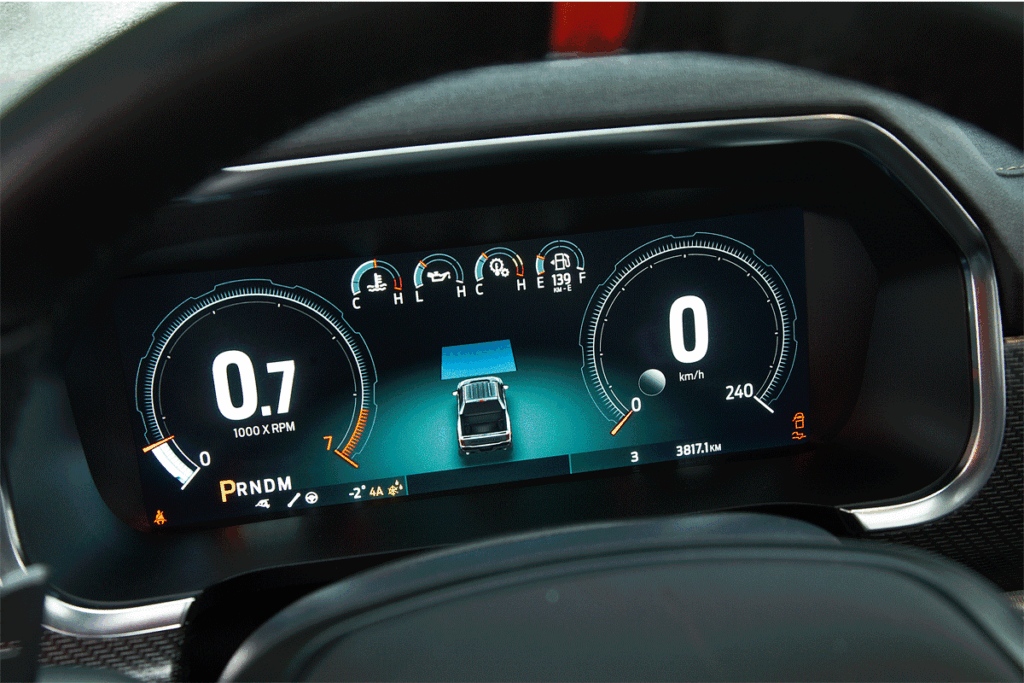
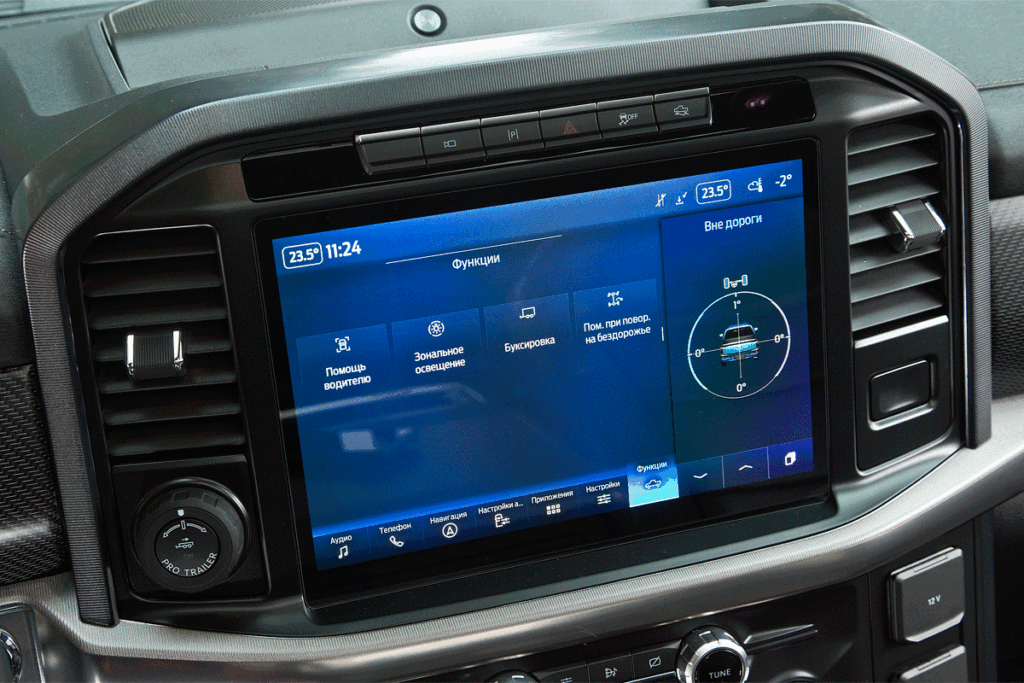
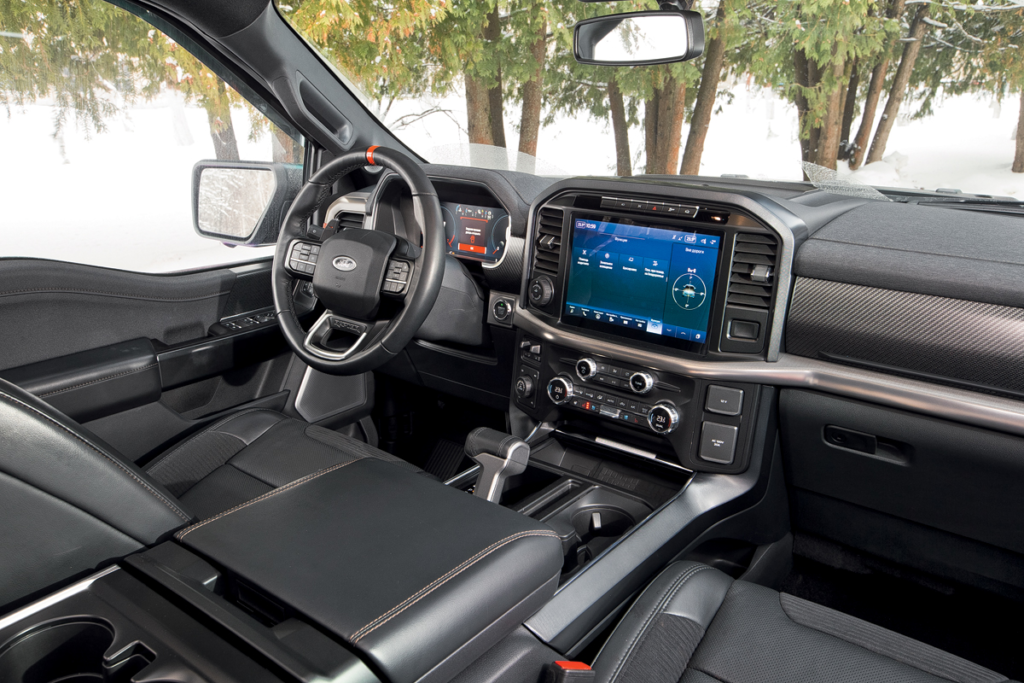
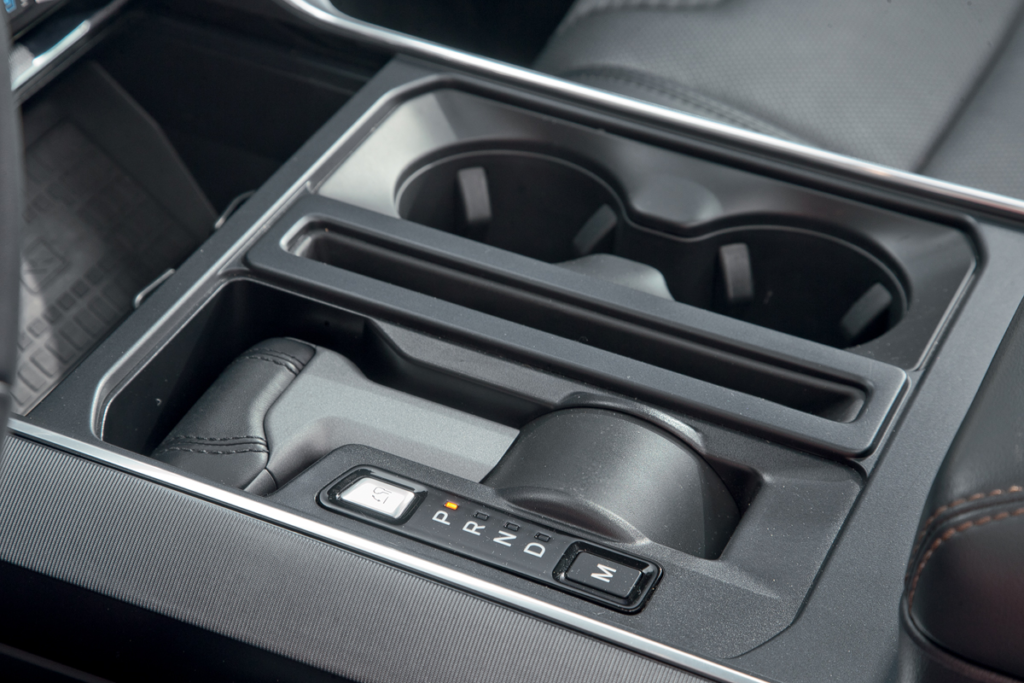
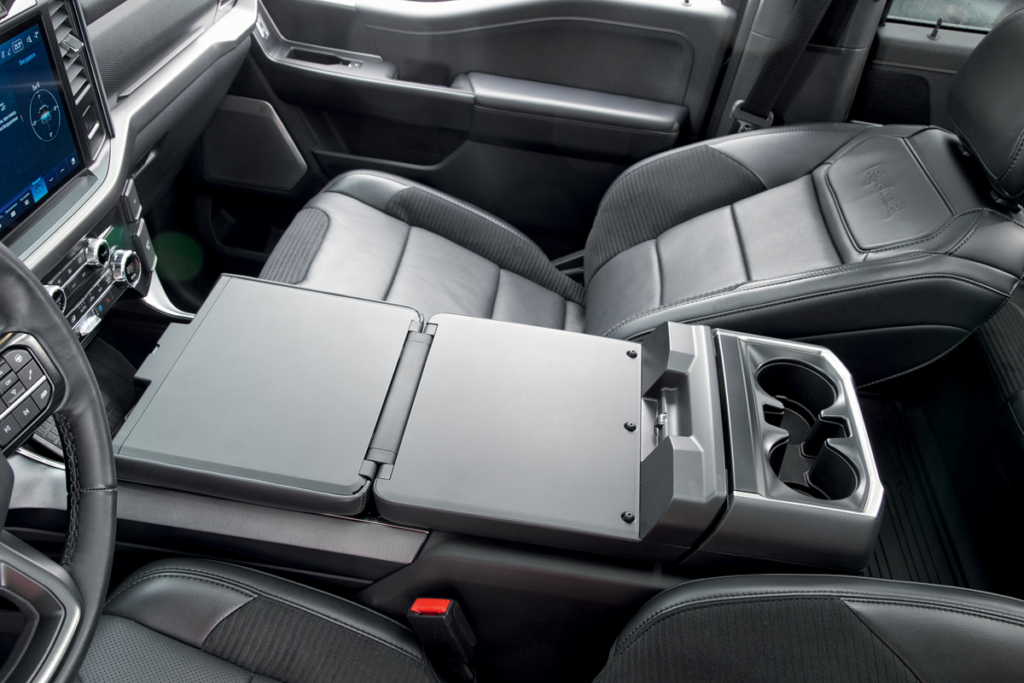
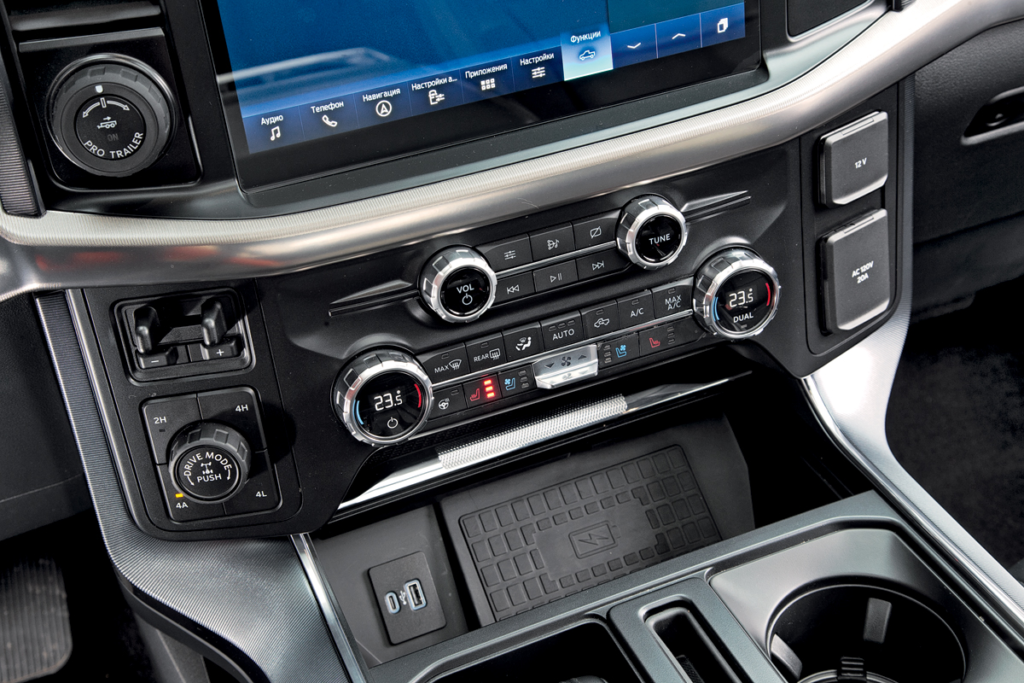
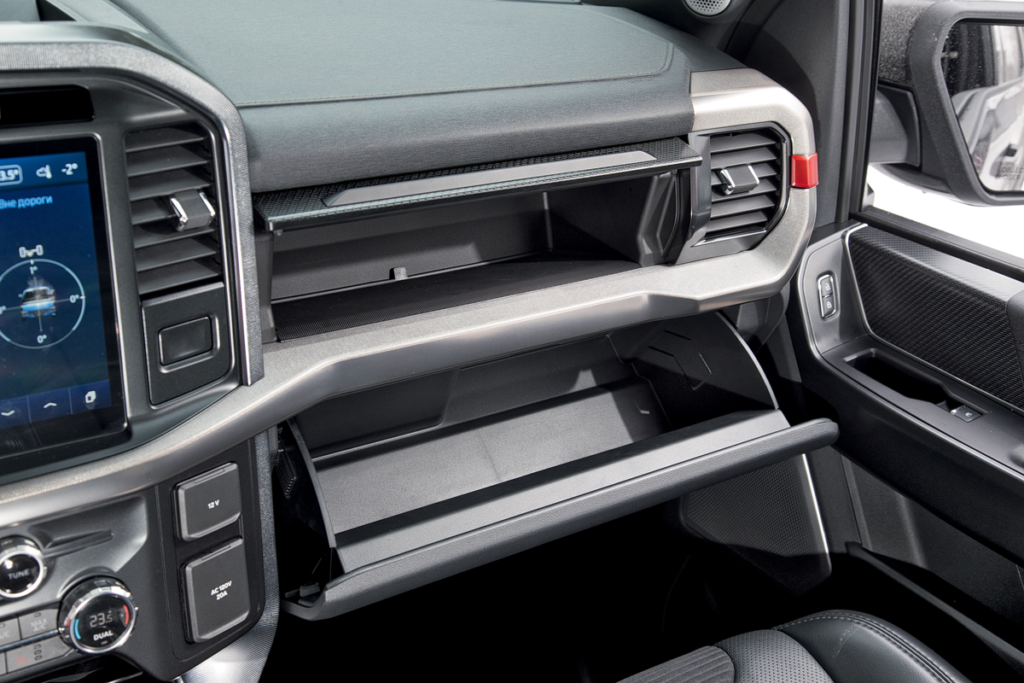
That’s largely because its interior is much simpler. The plastic handles have play, and the electric drive that stows the automatic shift lever flush with the tunnel tends to jam. The seats are more basic, the gauges duller, and the Sync infotainment interface genuinely puzzling.
0-100 km/h Acceleration: Raptor vs. TRX on the Road
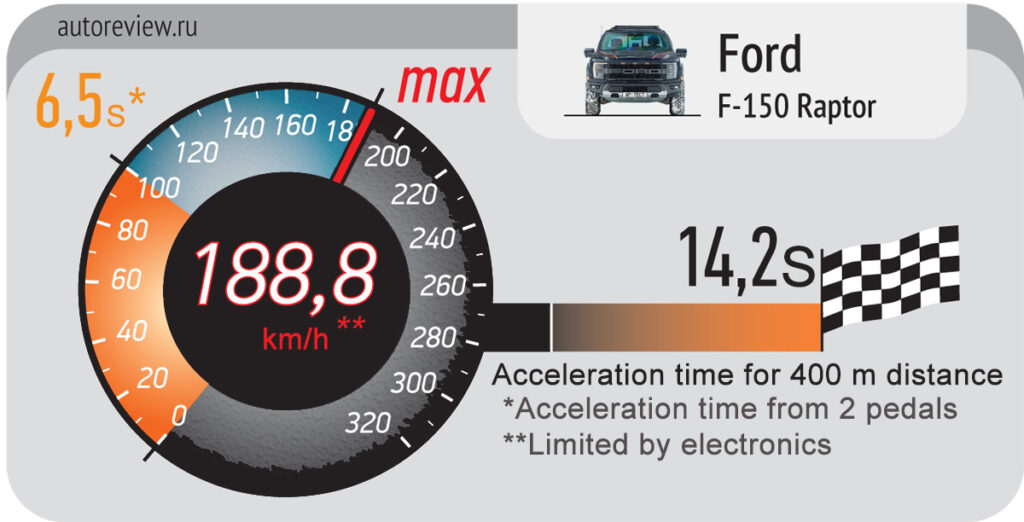
What starts as a “parallel” comparison with the Ram quickly turns “sequential” with the Ford. In the Ram, you need to tame excessive wheel spin off the line; in the Ford, you just keep the right pedal floored, and 100 km/h arrives in 6.5 seconds. After half a minute, the Ford reaches its top speed, limited to the same 190 km/h as the “ty-rex.” But where you might regret pushing the Ram that hard, you’ll actively enjoy it in the Ford – because from roughly 110 km/h onward, things get uncomfortable and frankly a little scary in the Raptor at triple-digit speeds. The steering goes heavy through a fairly wide zone around center, then suddenly lightens up, all with sluggish responses. The Predator chassis was clearly tuned for rough terrain, but even rally buggies with soft, long-travel suspensions behave more predictably on pavement.
Ford F-150 Raptor: Key Performance Numbers
- Top speed: 188.8 km/h (electronically limited)
- 0-60 km/h: 2.8 seconds
- 0-100 km/h: 6.5 seconds
- 0-150 km/h: 15 seconds
- 400-meter distance: 14.2 seconds
- 1,000-meter distance: 27 seconds
Ram 1500 TRX: Key Performance Numbers
- Top speed: 190.1 km/h (electronically limited)
- 0-60 km/h: 2.4 seconds
- 0-100 km/h: 4.8 seconds
- 0-150 km/h: 11.1 seconds
- 400-meter distance: 13 seconds
- 1,000-meter distance: 24.5 seconds (at the top speed limiter)
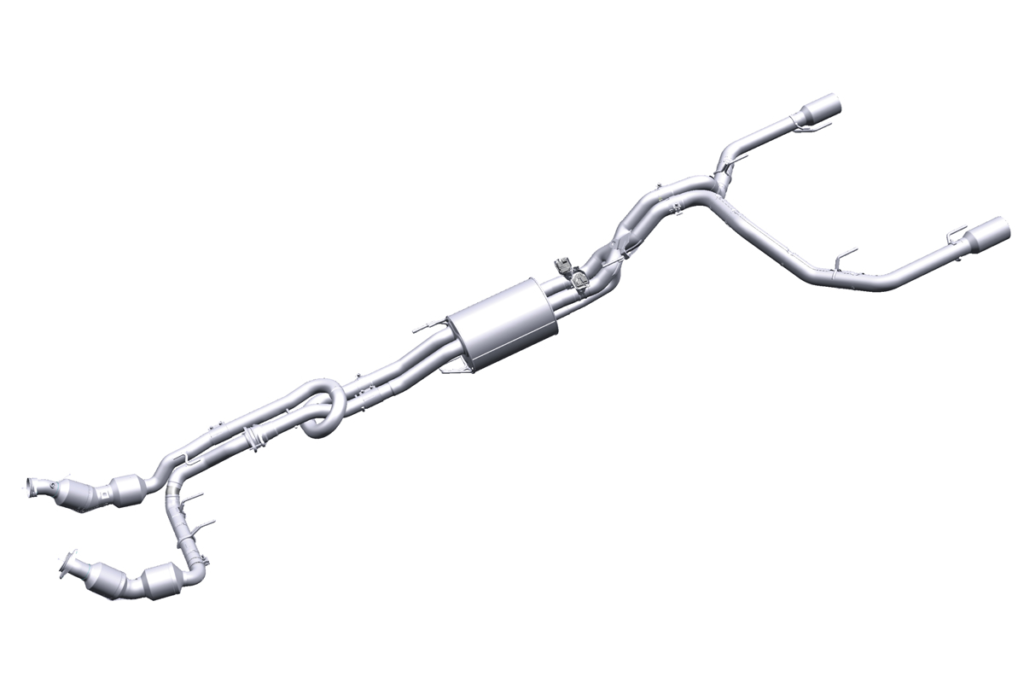
To be fair, you can soften the Raptor’s ride somewhat, letting it absorb minor bumps without trying to rearrange your internal organs. Its sound insulation is also noticeably better – the engine is barely audible in the cabin, thanks to a four-mode exhaust system that includes a so-called “trombone loop.” It’s worth a look; engineers pull out all the stops when they lose a V8. And on a cold morning, you can start the Raptor without waking the neighbors, while the Ram will wake the entire block.
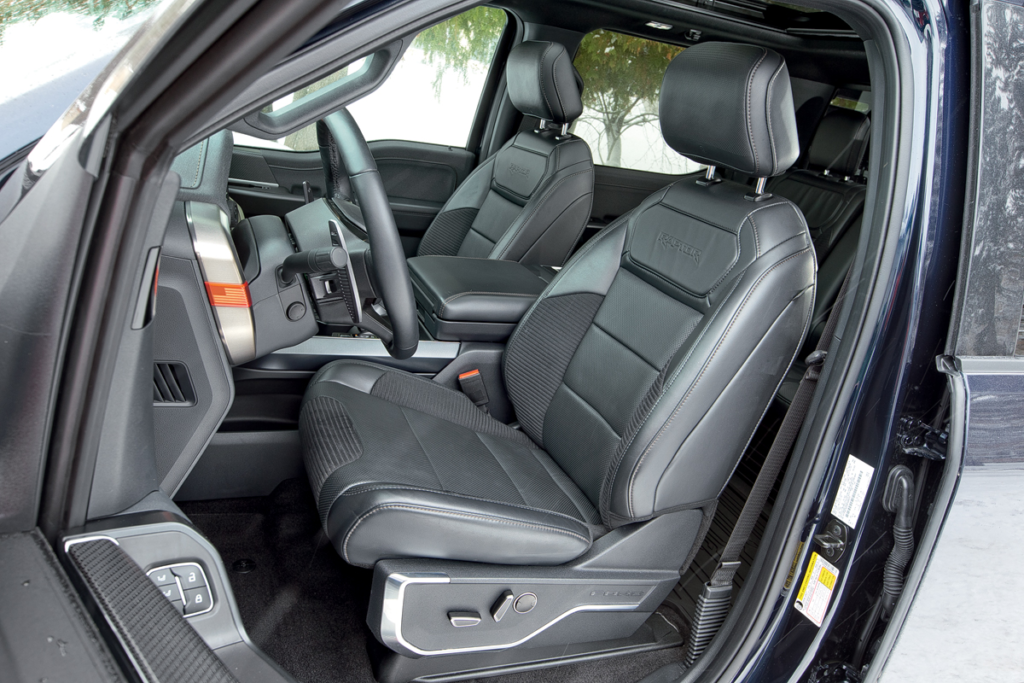
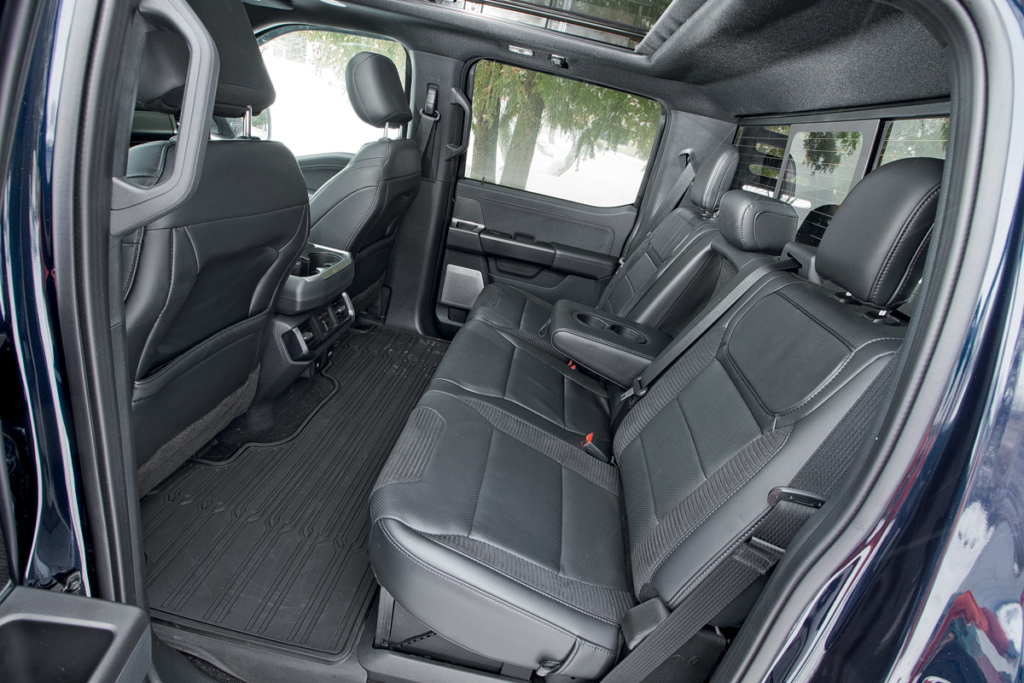
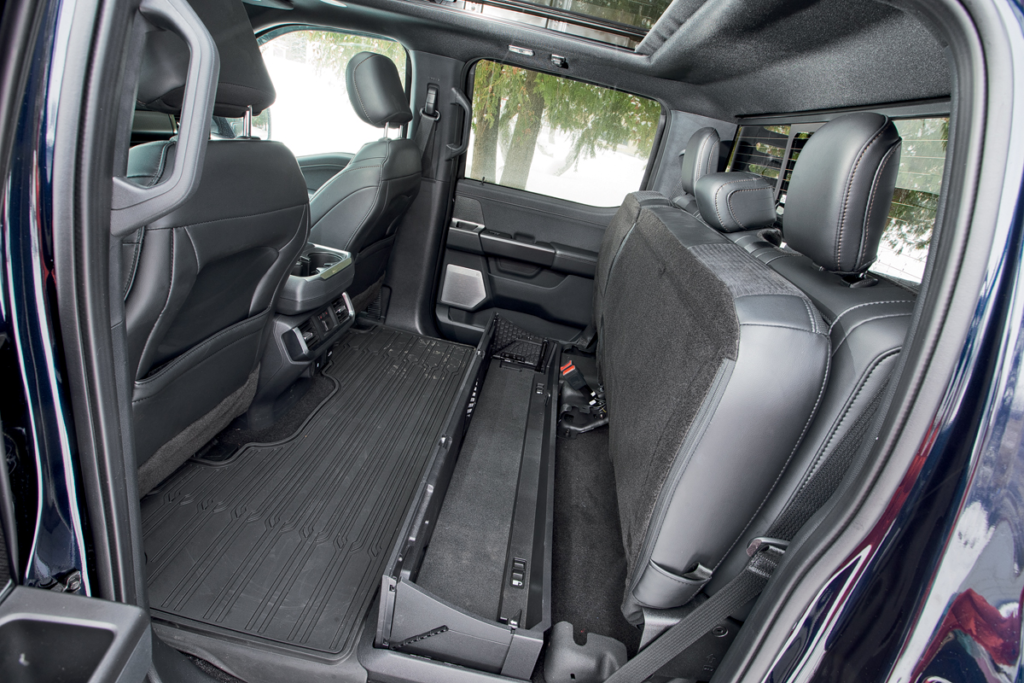
Before signing on the dotted line, it’s worth asking: “Why start it at all?” Yes, the Ford drifts beautifully, but almost any all-wheel-drive passenger car can do that at least as well. Enjoying the unyielding, energy-sapping suspension? It’s already knocking with less than 30,000 kilometers on the odometer. Savoring a 6.5-second run to 100 km/h from a temperamental EcoBoost engine?
Verdict: Which Truck Should You Actually Buy?
Honestly, the Ford F-150 Raptor struck me as one of the strangest and least reasonable ways to spend money on a good-mood vehicle. If you truly need an American SUV with real charisma, the Jeep Wrangler 392 looks far more appealing – it has a V8, thrilling dynamics, genuine off-road capability, and reasonable dimensions to match.
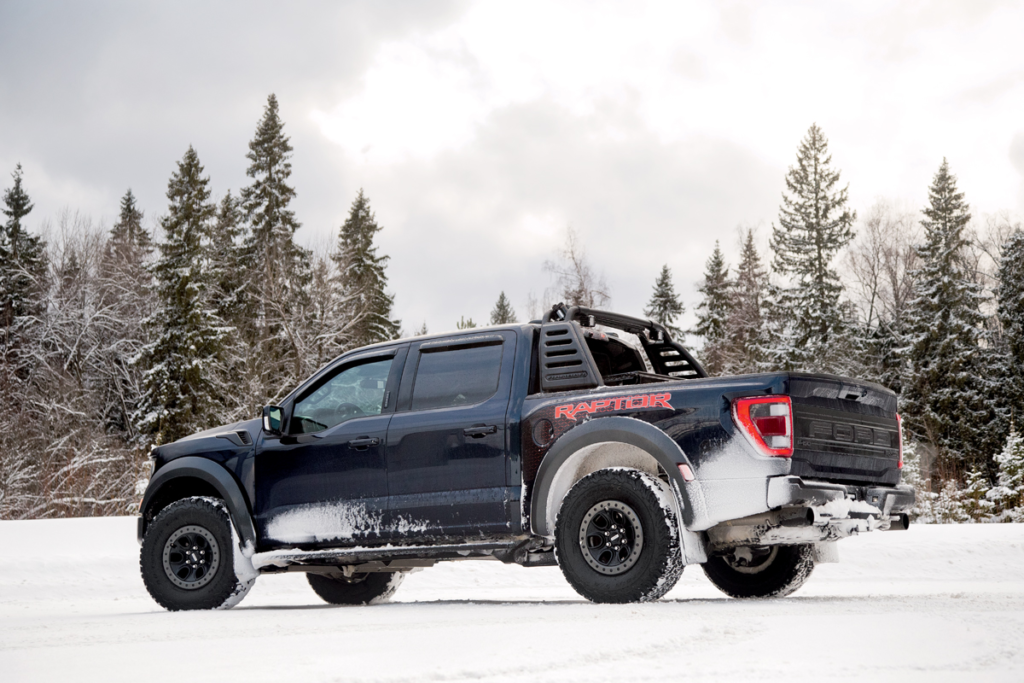
That said, taken outside their intended natural habitat, both trucks offer a different kind of value: pure show-off appeal, and a genuinely impressive engine. Those emotions are priceless. Well – except when I remember that shaking after lunch. Did I say all these emotions were positive?
Expert Scorecard: Ram 1500 TRX vs. Ford F-150 Raptor
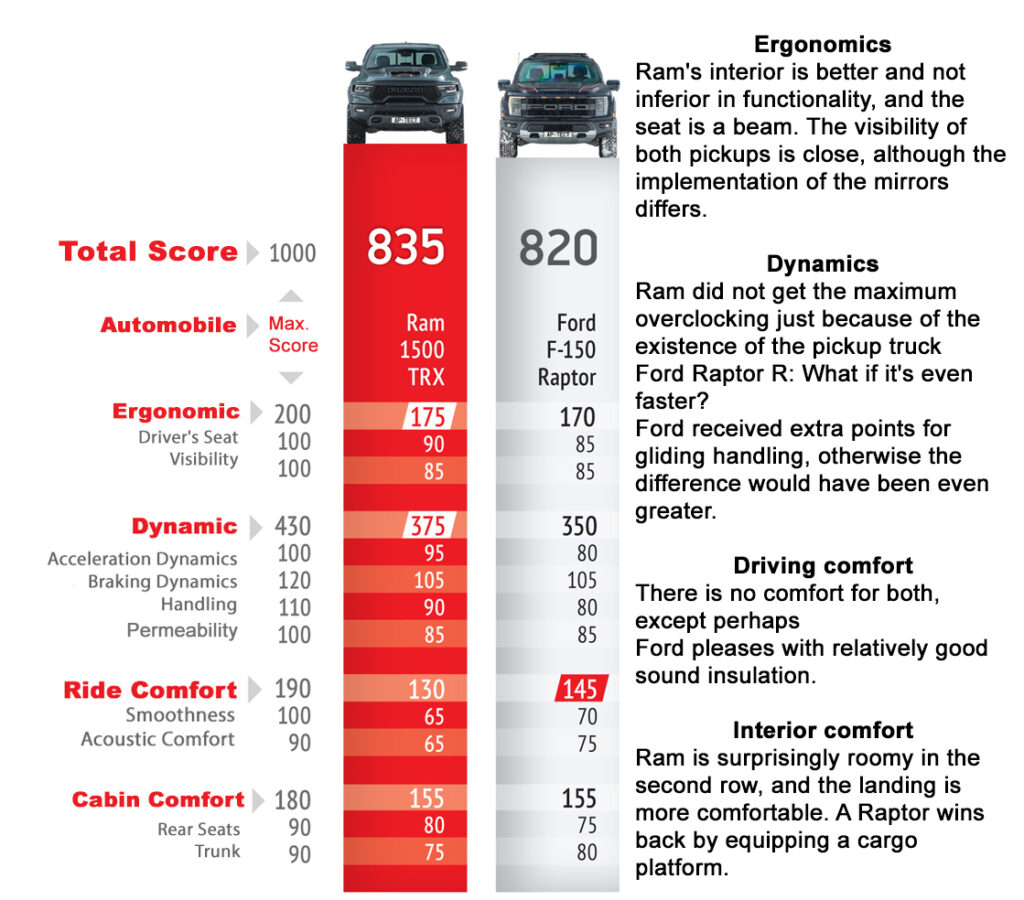
Overall score (out of 1,000):
- Ram 1500 TRX: 835 / 1,000
- Ford F-150 Raptor: 820 / 1,000
Ergonomics (out of 200): The Ram’s interior is better and no less functional, with a stand-out driver’s seat. Visibility is close between the two, though the mirror designs differ.
- Ram 1500 TRX: 175 / 200 (Driver’s Seat: 90/100, Visibility: 85/100)
- Ford F-150 Raptor: 170 / 200 (Driver’s Seat: 85/100, Visibility: 85/100)
Dynamics (out of 430): The Ram didn’t earn a perfect score only because the Ford Raptor R exists – what if it’s even faster? The Ford picked up extra points for its confident drifting, otherwise the gap would have been even larger.
- Ram 1500 TRX: 375 / 430 (Acceleration: 95/100, Braking: 105/120, Handling: 90/110, Off-Road Ability: 85/100)
- Ford F-150 Raptor: 350 / 430 (Acceleration: 80/100, Braking: 105/120, Handling: 80/110, Off-Road Ability: 85/100)
Driving comfort (out of 190): Neither truck offers much comfort, though the Ford does benefit from noticeably better sound insulation.
- Ram 1500 TRX: 130 / 190 (Ride Smoothness: 65/100, Acoustic Comfort: 65/90)
- Ford F-150 Raptor: 145 / 190 (Ride Smoothness: 70/100, Acoustic Comfort: 75/90)
Interior comfort (out of 180): The Ram is surprisingly roomy in the second row, with a more comfortable seating position. The Raptor claws back points thanks to its cargo bed.
- Ram 1500 TRX: 155 / 180 (Rear Seats: 80/90, Trunk: 75/90)
- Ford F-150 Raptor: 155 / 180 (Rear Seats: 75/90, Trunk: 80/90)
Cargo Bed and Towing Capacity
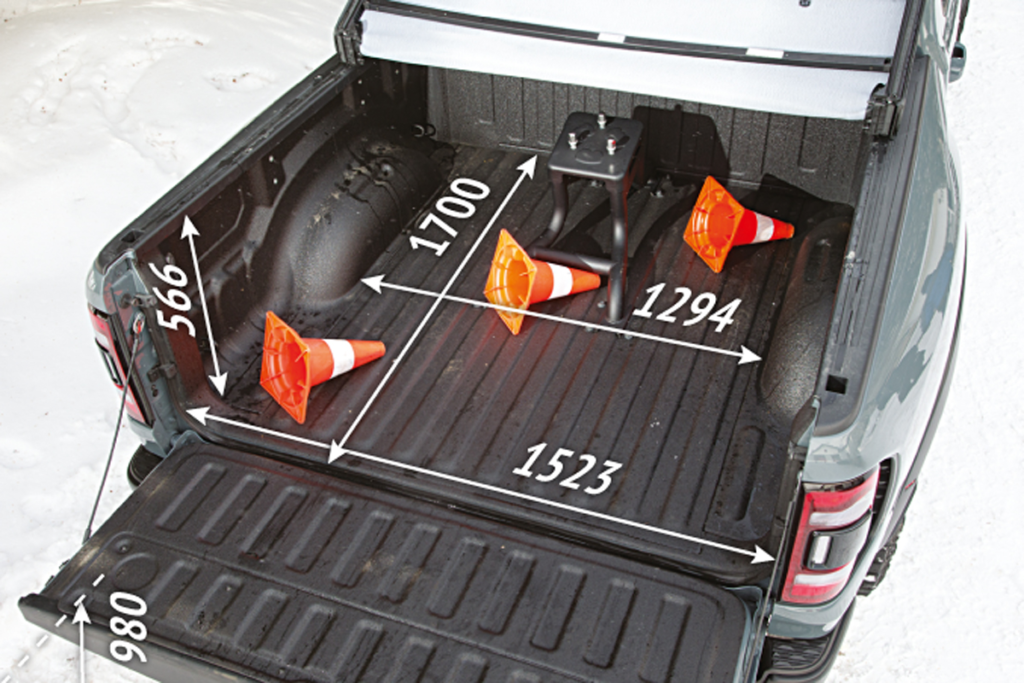
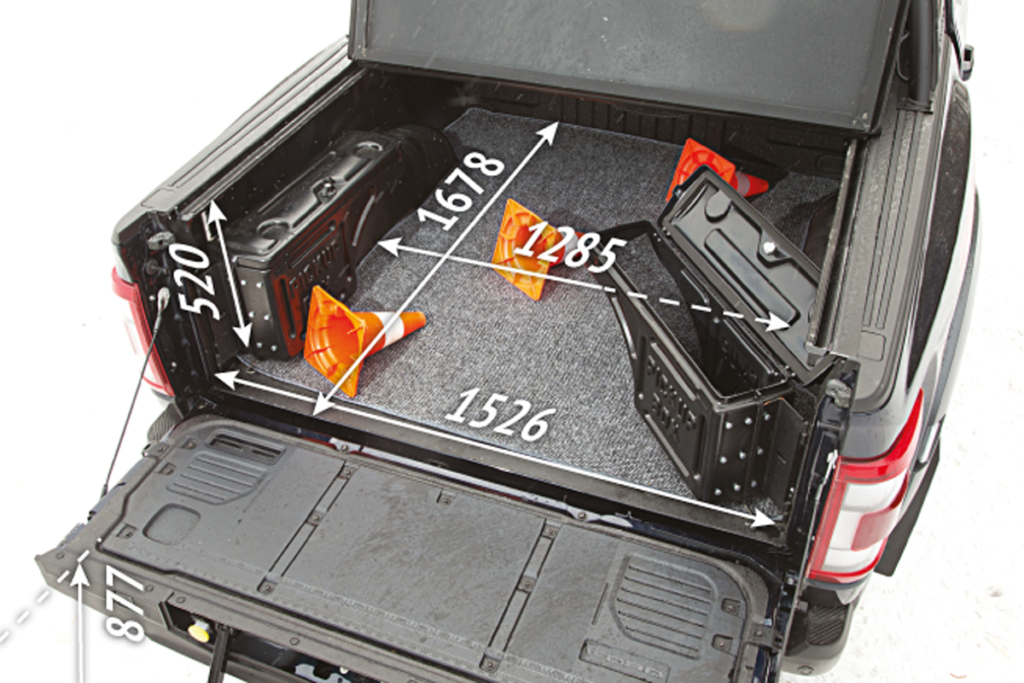
The sizes of the cargo beds are quite close between the two trucks. Take note of the hitch platform in the Ram’s bed. Both pickups can tow trailers weighing up to 3,700 kg.
Full Specs: Ford F-150 Raptor vs. Ram 1500 TRX
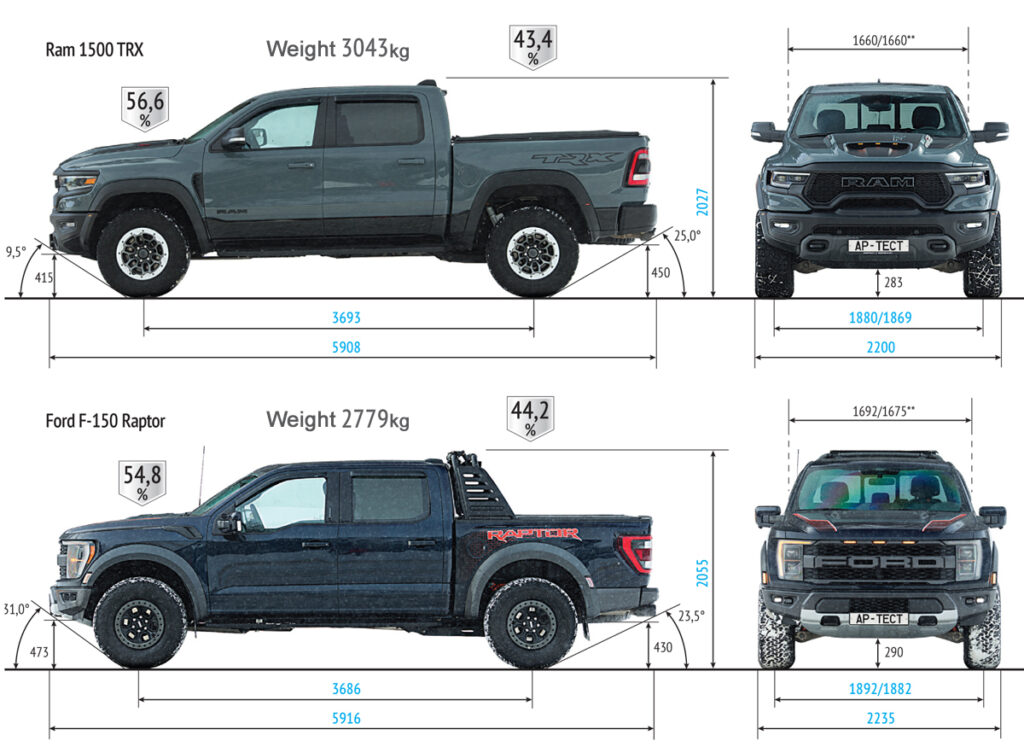
*Actual vehicle weight without driver, with full fuel tank and full process fluids
**For right rear seat
**Interior width at shoulder level in the first/second row of seats.
Ford F-150 Raptor Specifications
- Body type: Four-door pickup, 5 seats
- Ground clearance: 305 mm
- Departure/approach angle: 31.0° / 23.9°
- Ramp angle: 22.7°
- Curb weight: 2,604 kg
- Gross vehicle weight: 3,243 kg
- Trailer weight capacity: 3,720 kg
- Engine: Gasoline, combined injection, biturbocharged, 6-cylinder V-shaped
- Displacement: 3,496 cc
- Bore/stroke: 92.5 / 86.6 mm
- Compression ratio: 10.5:1
- Valves: 24
- Max power: 456 hp / 336 kW at 5,850 rpm
- Max torque: 691 Nm at 3,000 rpm
- Transmission: 10-speed automatic
- Drive type: Full-time AWD with multi-disc clutch front-wheel drive
- Rear differential: Forced lock
- Low range ratio: 2.64:1
- Front suspension: Independent, spring, double transverse arms
- Rear suspension: Dependent, spring
- Front brakes: Ventilated discs, 350 mm, 2-piston floating caliper
- Rear brakes: Ventilated discs, 336 mm, 1-piston floating caliper
- Tires: 315/70 R17
- 0-97 km/h: Not disclosed
- Fuel consumption: 16.8 l/100 km (urban), 13.1 l/100 km (extra-urban), 15.7 l/100 km (combined)
- Fuel tank capacity: 136 l
Ram 1500 TRX Specifications
- Body type: Four-door pickup, 5 seats
- Ground clearance: 300 mm
- Departure/approach angle: 30.2° / 23.5°
- Ramp angle: 21.9°
- Curb weight: 2,880 kg
- Gross vehicle weight: 3,538 kg
- Trailer weight capacity: 3,674 kg
- Engine: Gasoline, distributed injection, supercharged, 8-cylinder V-shaped
- Displacement: 6,166 cc
- Bore/stroke: 103.9 / 90.9 mm
- Compression ratio: 9.5:1
- Valves: 16
- Max power: 711 hp / 523 kW at 6,100 rpm
- Max torque: 882 Nm at 4,800 rpm
- Transmission: 8-speed automatic
- Drive type: Full-time AWD with multi-disc clutch front-wheel drive
- Rear differential: Forced lock
- Low range ratio: 2.64:1
- Front suspension: Independent, spring, double transverse arms
- Rear suspension: Dependent, spring
- Front brakes: Ventilated discs, 378 mm, 2-piston floating caliper
- Rear brakes: Ventilated discs, 375 mm, 1-piston floating caliper
- Tires: 325/65 R18
- 0-97 km/h: 4.5 seconds
- Fuel consumption: 23.5 l/100 km (urban), 16.8 l/100 km (extra-urban), 21.4 l/100 km (combined)
- Fuel tank capacity: 125 l
The History Behind the Rivalry: How Ford and Ram Built the Ultimate Super-Trucks
Raptors and tyrannosaurs never actually crossed paths in nature: the former roamed the Earth around 71 million years ago, while the latter emerged roughly a million years later. Against the backdrop of today’s hybrids and electric vehicles, the Ford Raptor and Ram TRX are very much modern-day dinosaurs. But unlike their prehistoric namesakes, they’re not facing extinction any time soon – and the story of how their rivalry developed deserves its own telling.
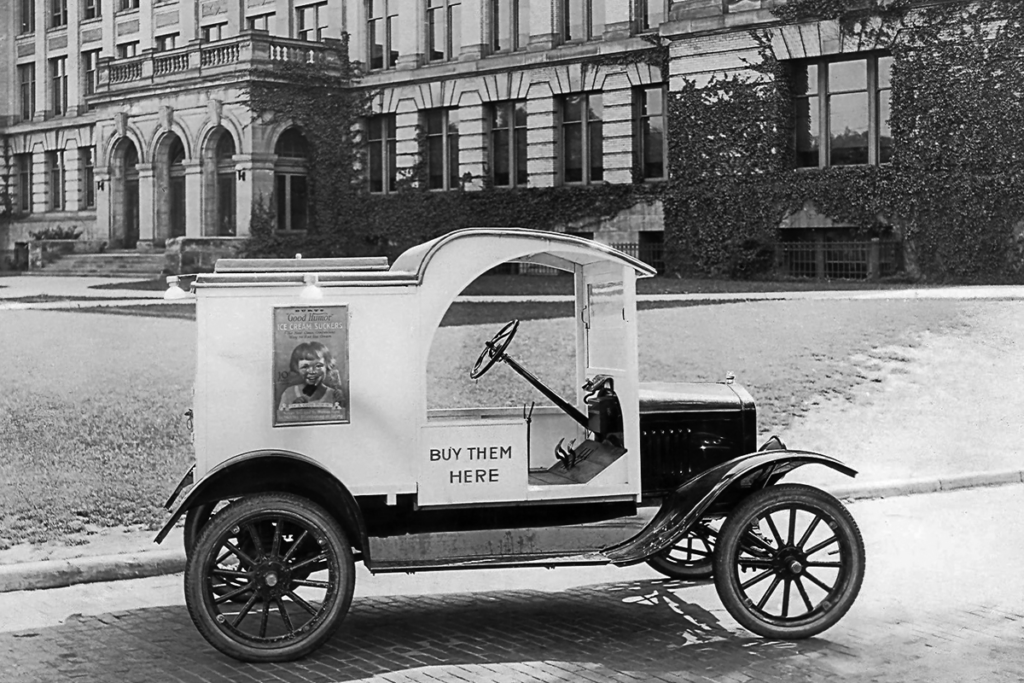
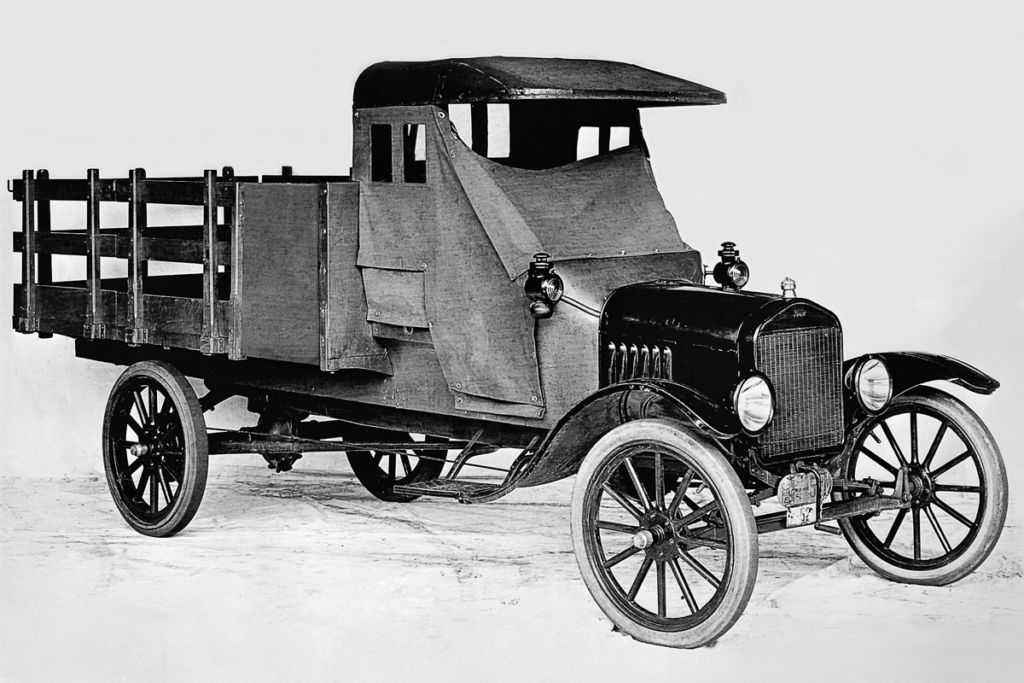
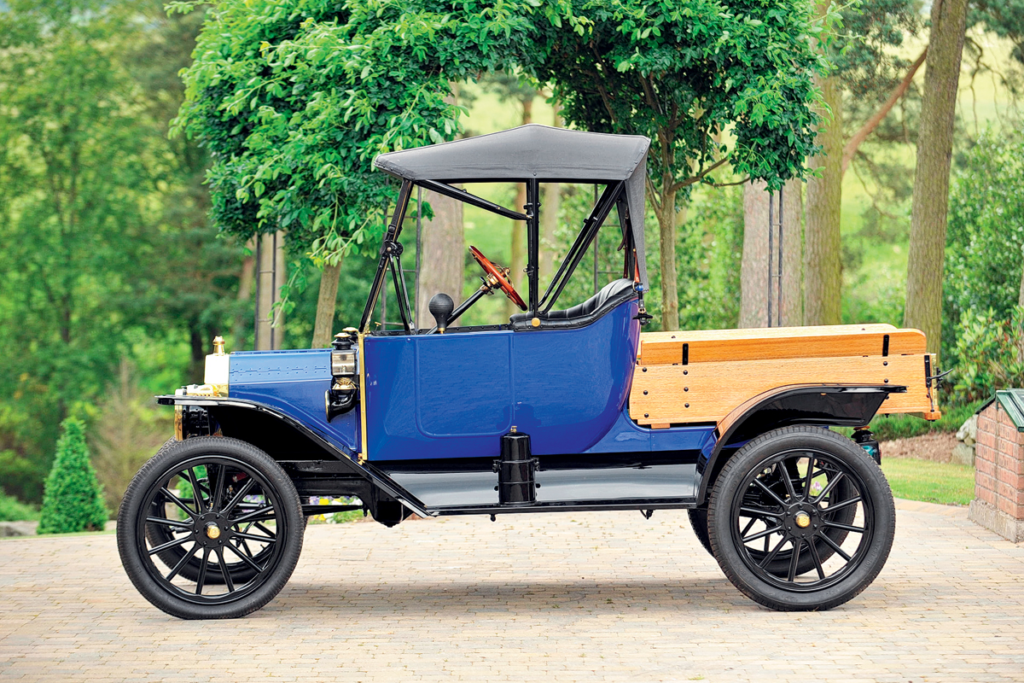
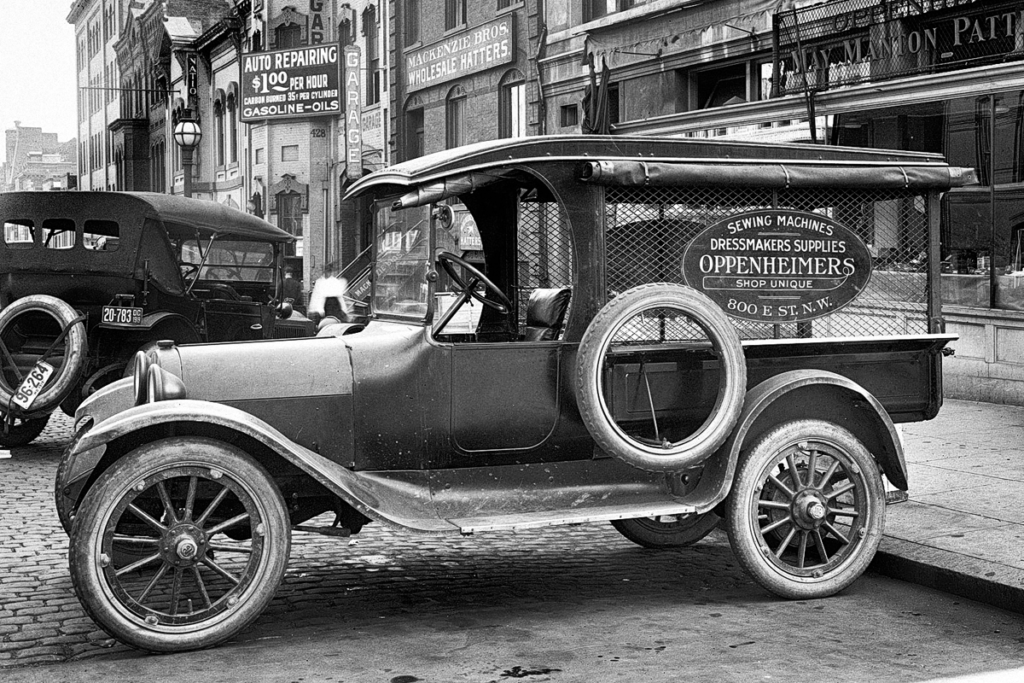
Private individuals and small companies began building utility vehicles with cargo platforms based on the iconic Ford Model T almost immediately after its 1908 debut. The first mass-produced Ford TT truck, derived from the Model T, appeared in 1917 and was only offered as a bare chassis. Dodge, a year later, built a full-fledged truck with a 35-horsepower engine and a body capable of carrying half a ton of cargo. It wasn’t until 1925 – just a couple of years before the Model T’s production run ended – that Ford finally offered a factory version with its own cargo bed, known as the “T Pickup.”
The Birth of the F-Series and the Dodge Power Wagon
After this, neither Ford nor Dodge stopped making pickups – reinforced, cargo-hauling versions of their current car models. In 1948, Ford introduced the F-1 pickup, with its distinctive wavy design and a 100-horsepower V8. From then on, Ford’s pickups underwent generational updates roughly every ten years, adding new features along the way – the third generation, for instance, introduced all-wheel drive. With the F-1 came Ford’s naming convention: the letter “F” for Ford, followed by a number indicating load capacity (1 for 500 kg, 2 and 3 for 750 kg, 4 and 5 for a ton, 6 for two tons, 7 and 8 for three tons). By the end of the 1950s, the growing lineup forced a change to this system, and the lightest pickup became the F-100 (later F-150 starting with the sixth generation), with heavier models labeled F-250, F-350, and so on.
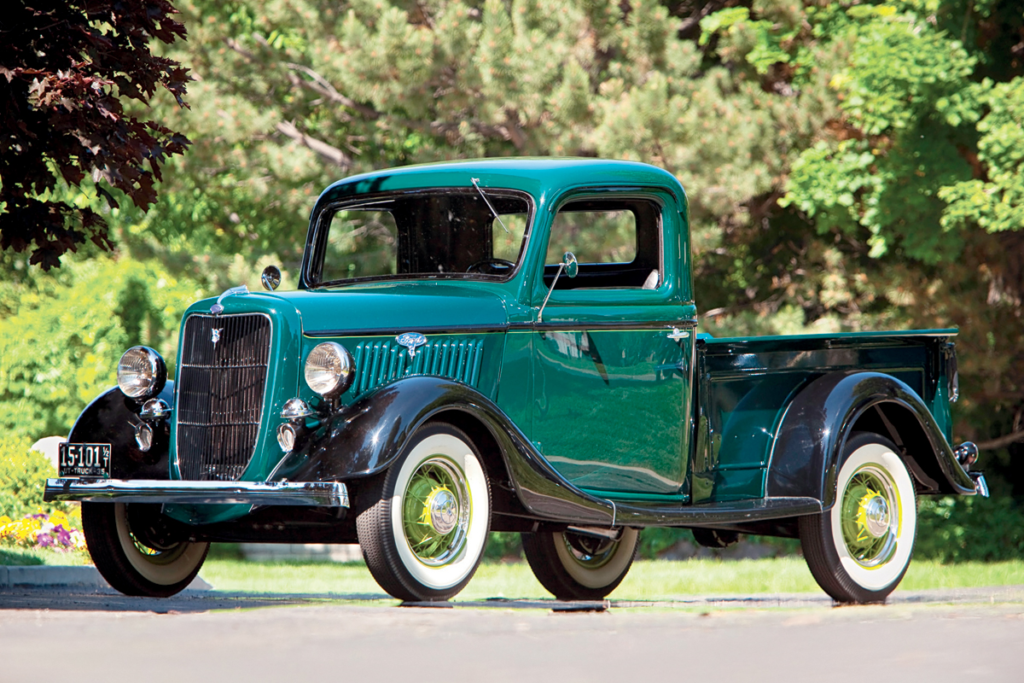
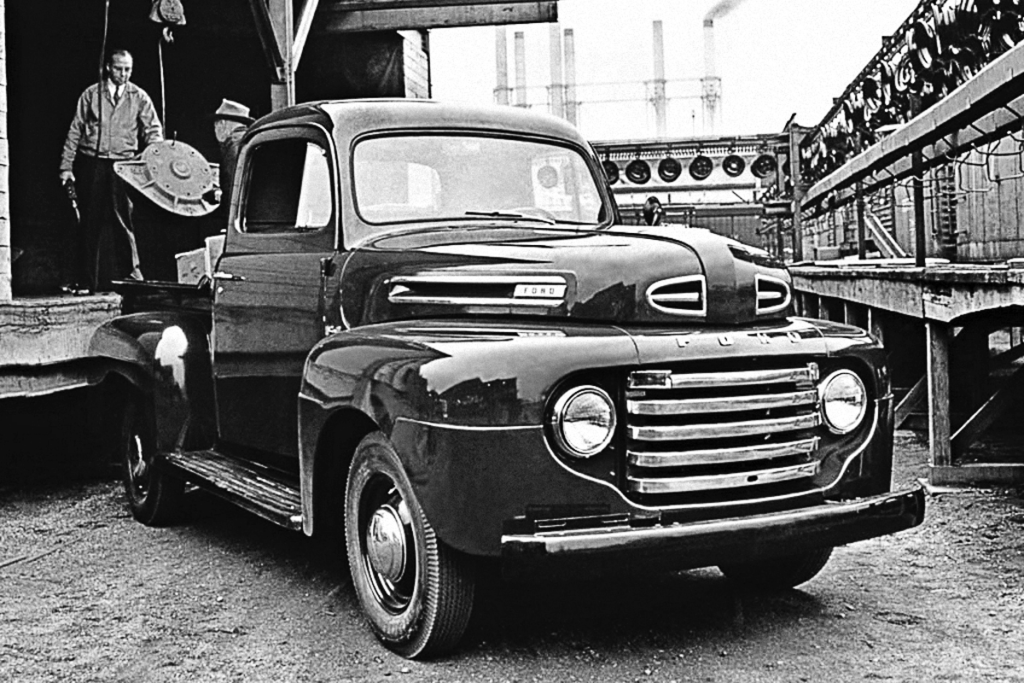
Dodge took a different path. During World War II, the company produced vehicles for the Lend-Lease program, including all-wheel-drive Weapons Carriers (WC) supplied to Allied nations, including the USSR. But once the war ended, the US Army’s demand for these trucks dropped sharply, and deliveries elsewhere nearly stopped, leaving Dodge with a surplus of unclaimed parts. So Dodge decided to enter – or really, to create – the civilian utility vehicle market.
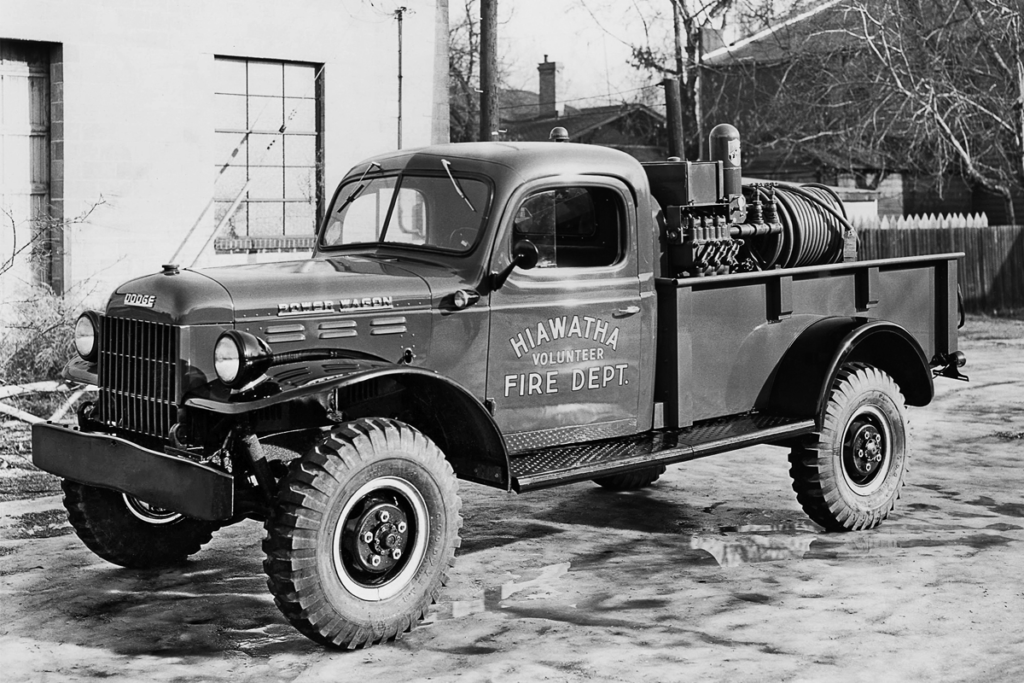
This led to the creation of the monstrous Power Wagon – named after a driver’s magazine. It reused WC mechanical components, but the chassis was stretched to 3.4 meters and fitted with a steel body borrowed from a 1942 pickup. The cab stayed the same, apart from swapping the angular front grille for a rounded one taken from the Dodge T234, a truck built for the Chinese market. The engine remained standard (3.77 liters, 94 hp), but a new two-speed transfer case was added to the gearbox.
The result was a massive, all-wheel-drive pickup with an unusual look – something like an American Unimog. It appealed strongly to farmers, and period advertisements even suggested buying one instead of a tractor, backed by a long list of add-on equipment like plows and seeders.
With only minor updates, the classic Power Wagon stayed in production until the end of the 1970s, and its name went on to anchor Dodge’s later all-wheel-drive pickup lineup.
Early Performance Pickups: Dodge’s First Sport Trucks
In fact, it was in the 1960s that Dodge began experimenting with sport versions of its full-size pickups. In 1964, the brand dropped a massive 7-liter V8 with 364 hp under the hood of the standard D100. Named the Custom Sport Special, it could hit 60 mph in just 7.6 seconds.
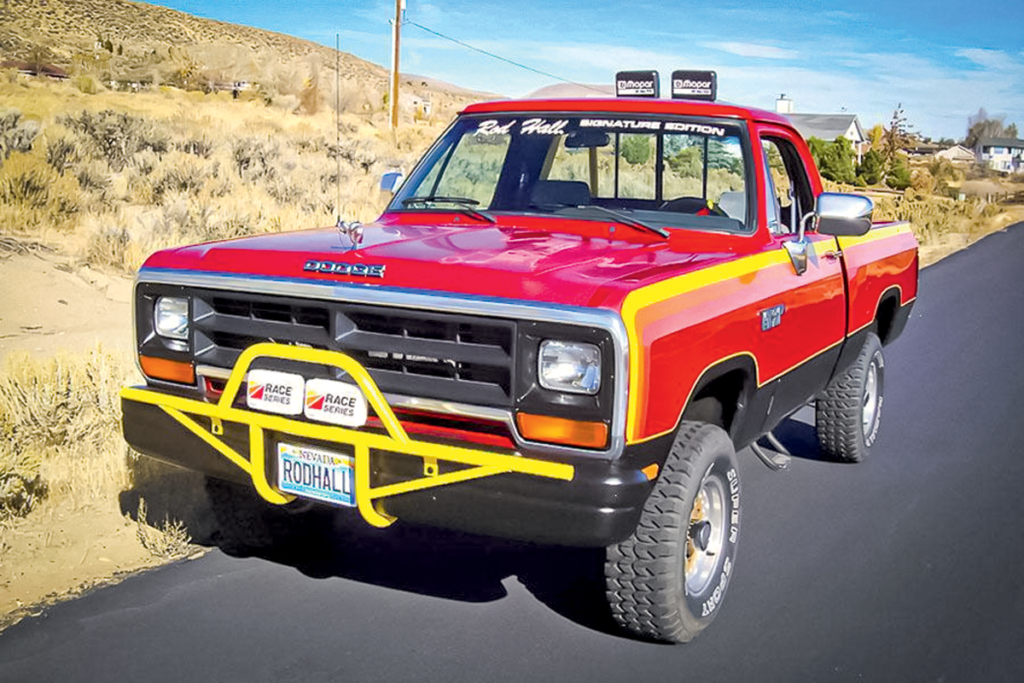
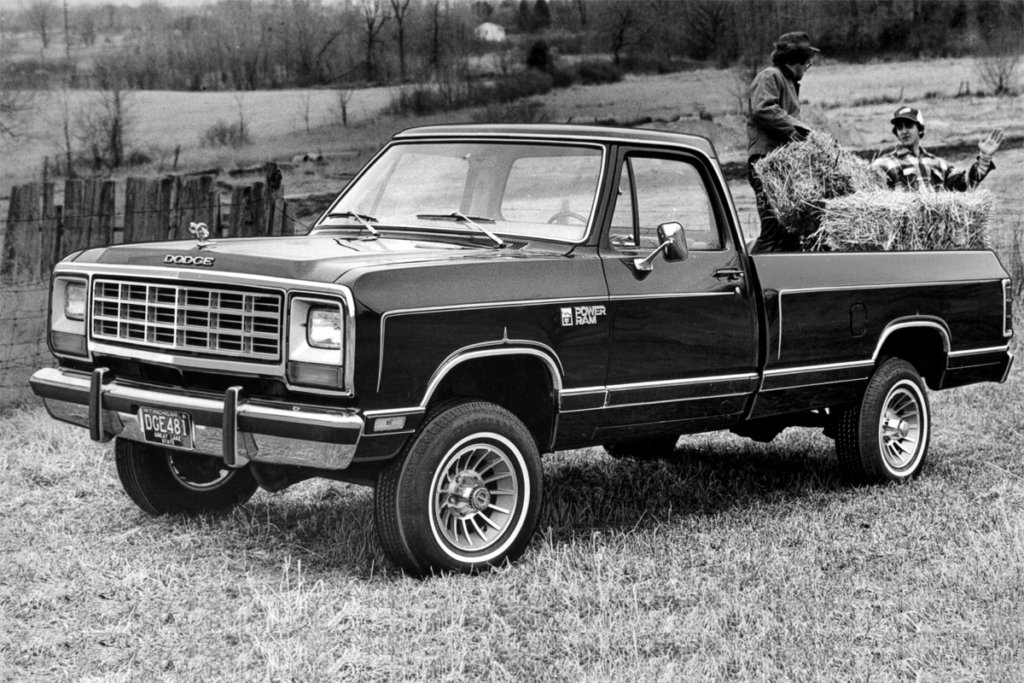
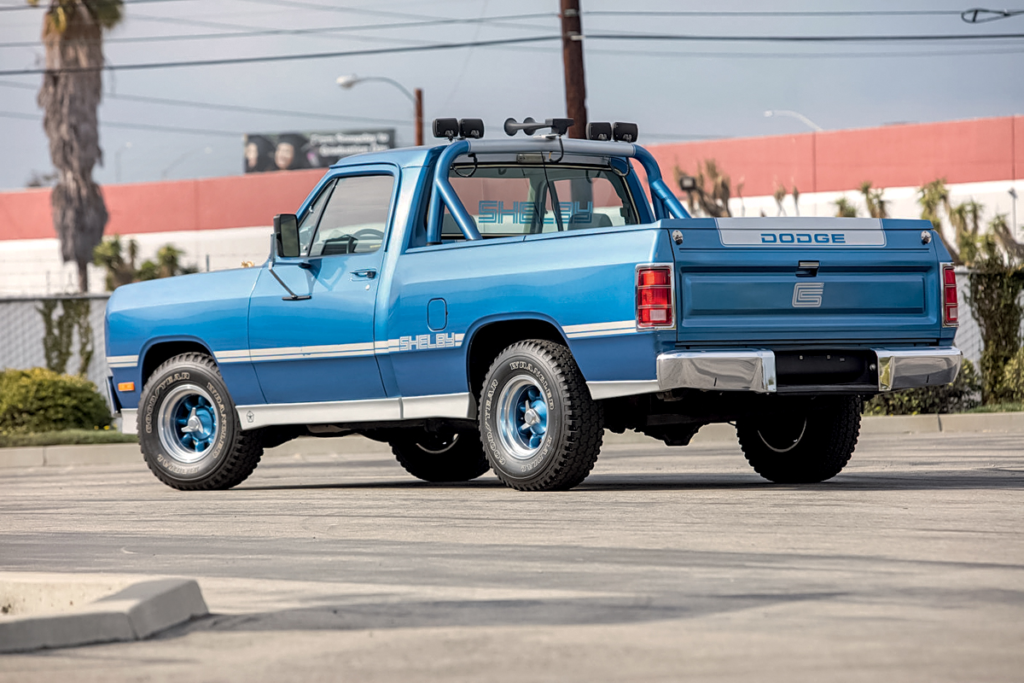
While Ford largely stayed quiet on this front after the fuel crisis, Dodge kept experimenting. All of the brand’s full-size pickups took on the Ram name, and special-edition development continued – though the 300 hp Shelby Ram V8 concept from 1983 never reached production, and the off-road Ram Rod Hall, a tribute to multi-time Baja 1000 winner Rod Hall, was limited to just 14 units.
The real technical battle for the title of ultimate pickup manufacturer between Ford and Dodge, however, didn’t kick off until the 1990s.
The 1990s and 2000s: Lightning, SS/T, and the SRT-10
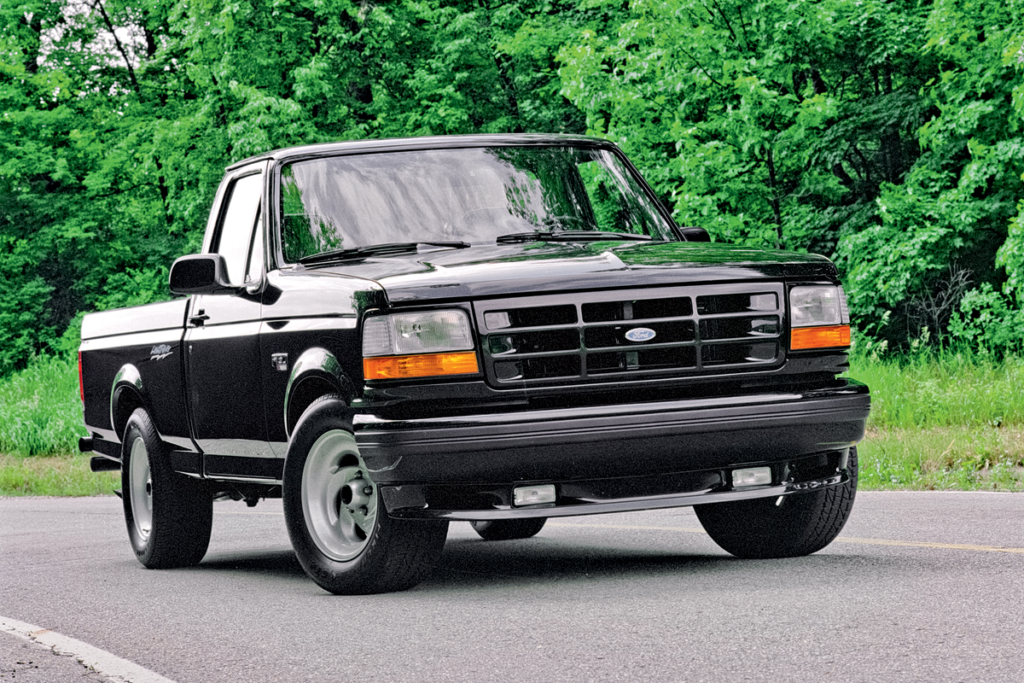
Ford drew first blood. By 1992, the ninth generation of F-series pickups had launched, and a year later the F-150 got its first true sport variant: the F-150 SVT Lightning. Its Windsor V8 gained aluminum cylinder heads, an intake manifold, and camshafts borrowed from the contemporary Mustang Cobra, producing 240 hp and 460 Nm of torque. A reinforced driveshaft and high-traction differential let this rear-wheel-drive truck hit 60 mph in a claimed 7.2 seconds, with a top speed of 190 km/h.
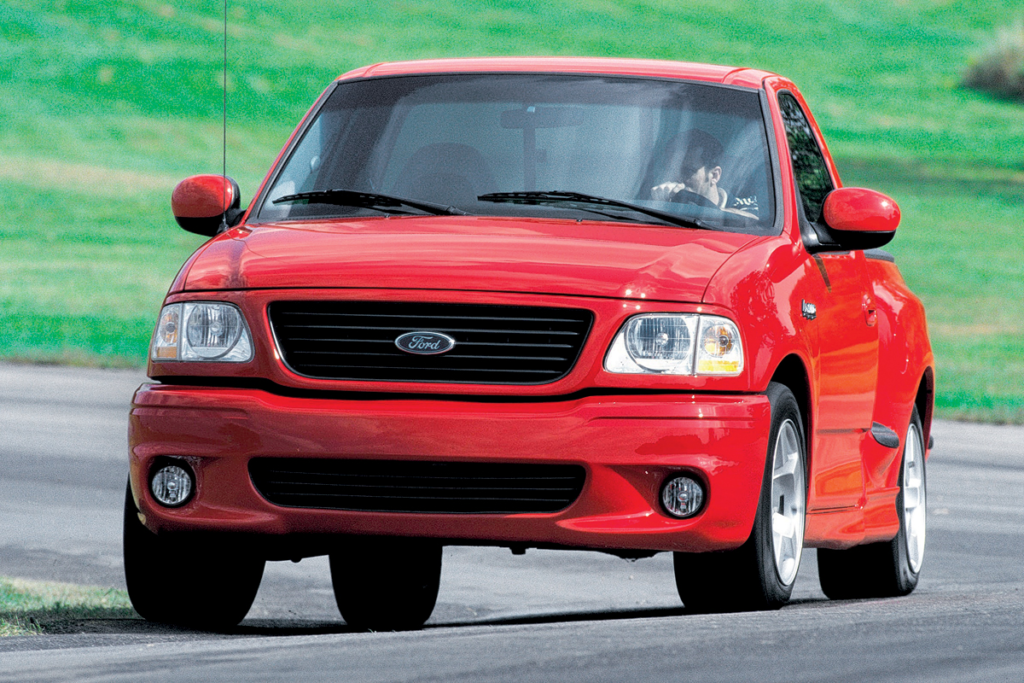
Five years later, in 1997, Dodge answered with the Ram 1500 SS/T, a road-going version of the Indy 500 pace car. Its 5.9-liter V8 produced 245 hp, and short gear ratios promised a 6.9-second 0-60 mph time. Ford’s next-generation Lightning arrived in 1999, running a Triton 5.4 with an aluminum block and a supercharger. Power jumped to 360 hp, though reliability issues soon followed. By 2003, SVT had reworked the design around a cast-iron block while boosting output further – the revised Lightning ran 0-60 mph in 5.2 seconds and topped out at 235 km/h.
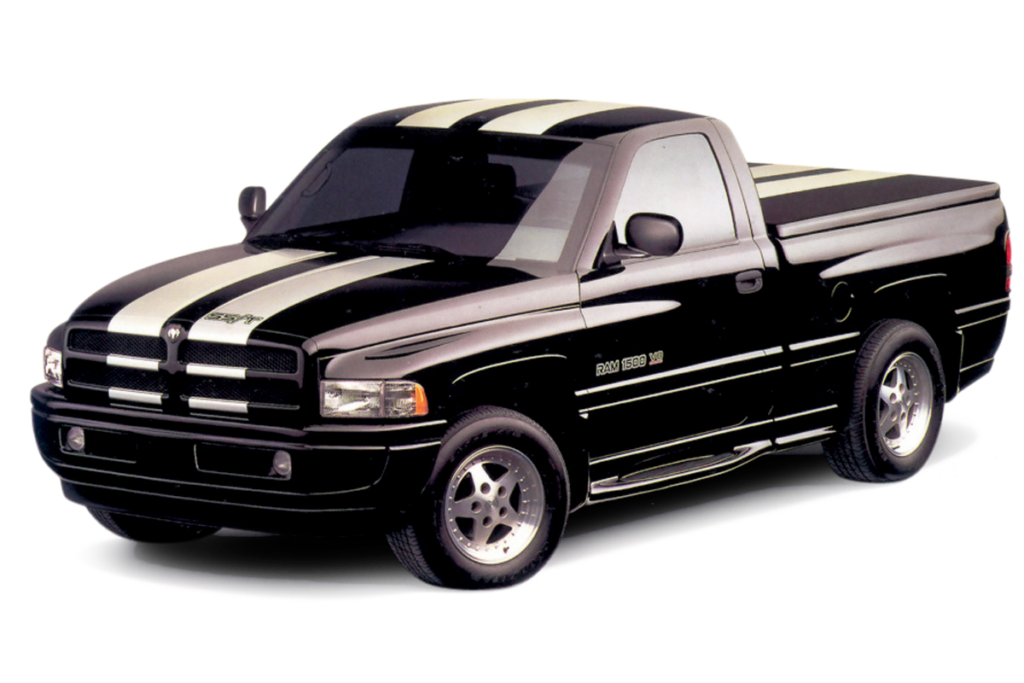
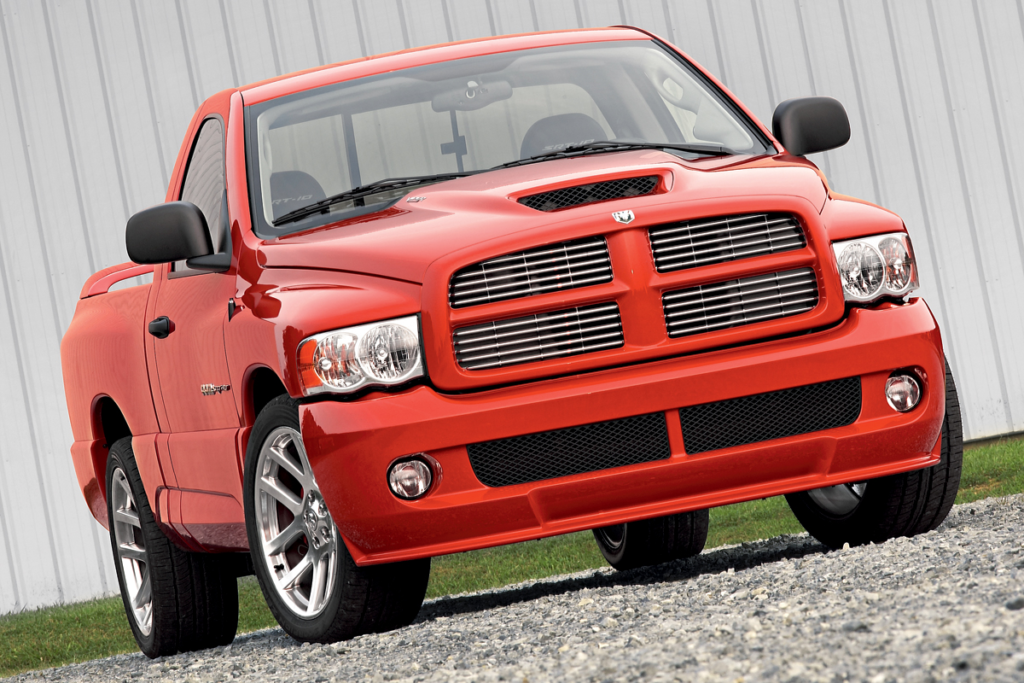
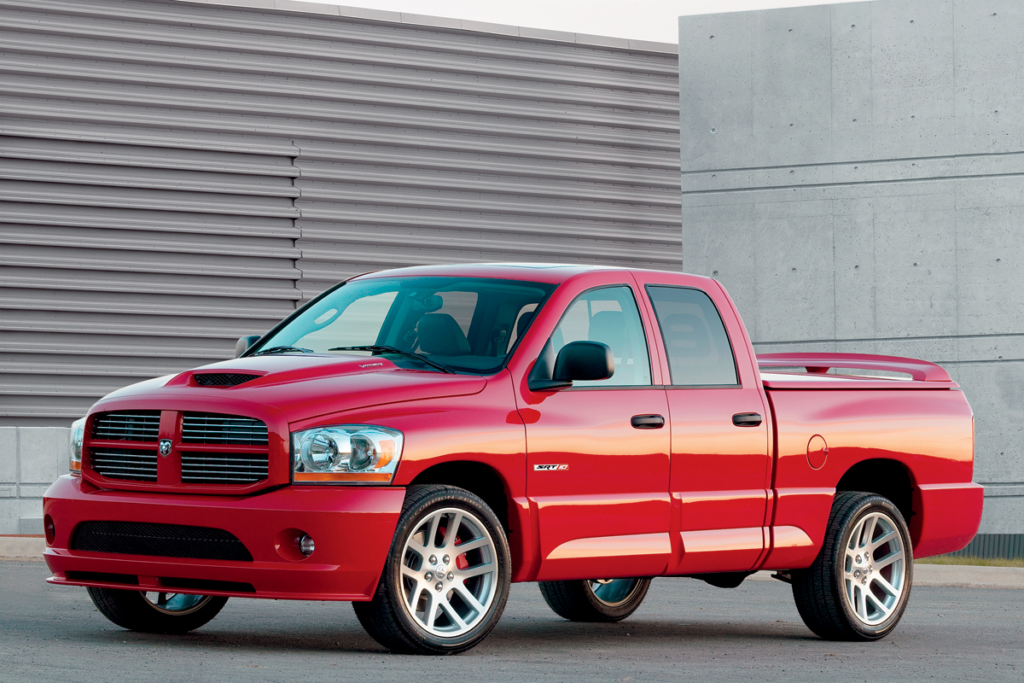
These achievements clearly struck a nerve at Dodge, because there’s no other way to explain the wild Ram 1500 SRT-10 that arrived in 2004. Ingeniously, engineers fit a 8.3-liter V10 borrowed from the Viper supercar, with an aluminum block and cast-iron sleeves, producing 500 hp and 712 Nm of torque – tamed only by the Viper’s Tremec T-56 manual gearbox, paired with a reinforced Dana 60 rear axle. The sprint to 60 mph took just 5.6 seconds, and top speed hit 249 km/h, an official world record for production pickups at the time. Checkmate?
From the First Raptor to the Modern TRX
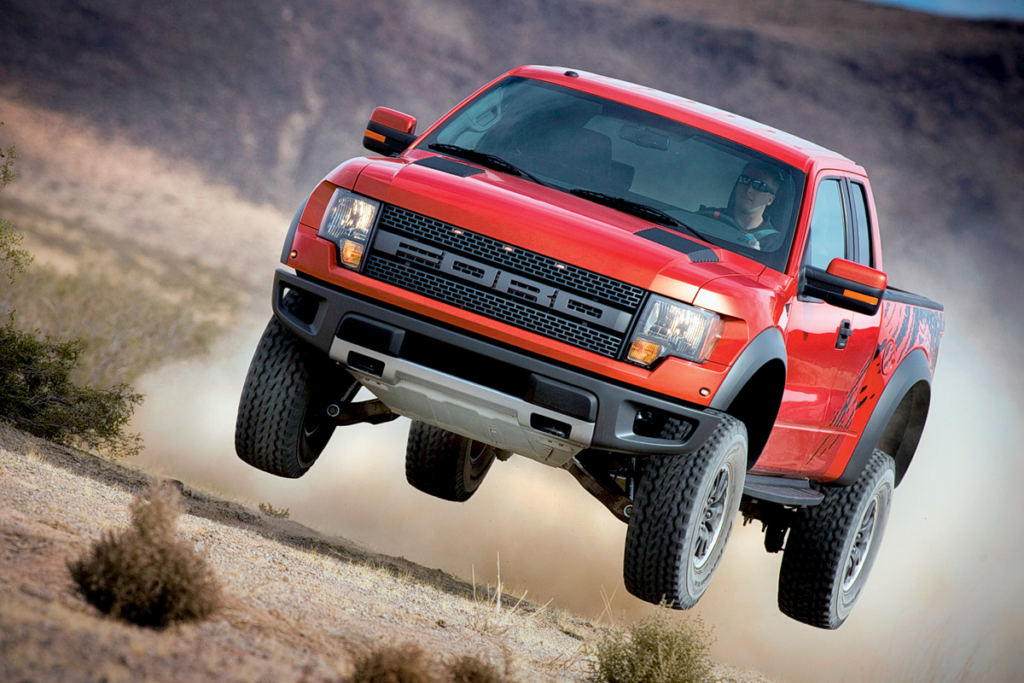
Whatever the case, Ford didn’t build another high-speed road pickup after that. The Lightning name would only return decades later, attached to the electric version of the F-150. Instead, in 2010, Ford introduced the first F-150 SVT Raptor, shifting the focus squarely to off-road capability. It launched with a 340 hp 5.4-liter V8, later upgraded to a 6.2-liter V8 producing 411 hp, riding on a widened track and adjustable Fox Racing shocks with three stiffness settings.
The next-generation Raptor, in 2017, dropped the V8 in favor of a 510 hp twin-turbo V6, an even wider track, and a full-size double-row cab. Around the same time, the Fiat Chrysler group spun Ram off as an independent brand under the new Stellantis alliance, and unveiled the Ram Rebel TRX concept – a 575 hp Hemi V8 monster on aggressive 37-inch tires. That concept eventually led to the production Ram 1500 TRX, launched in 2020 with 711 hp.
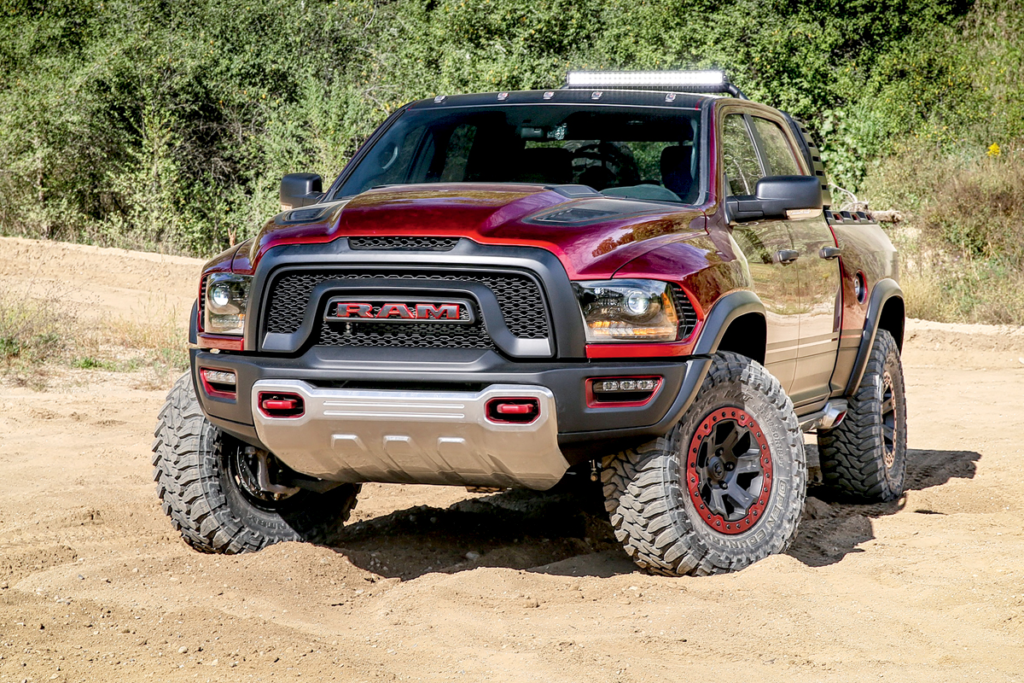
You might wonder why this arms race continues to escalate in an increasingly eco-conscious era. But Ford took up the challenge once more: the latest Raptor generation now includes an R version packing a V8 that delivers an impressive 710 hp. The only question left is how Ram plans to respond next.
Photo: Dmitry Pitersky
This is a translation. You can read an origianl article here: Пикапы Юрского периода. Ford F-150 Raptor или Ram 1500 TRX? Тест на полигоне

Published August 23, 2023 • 27m to read