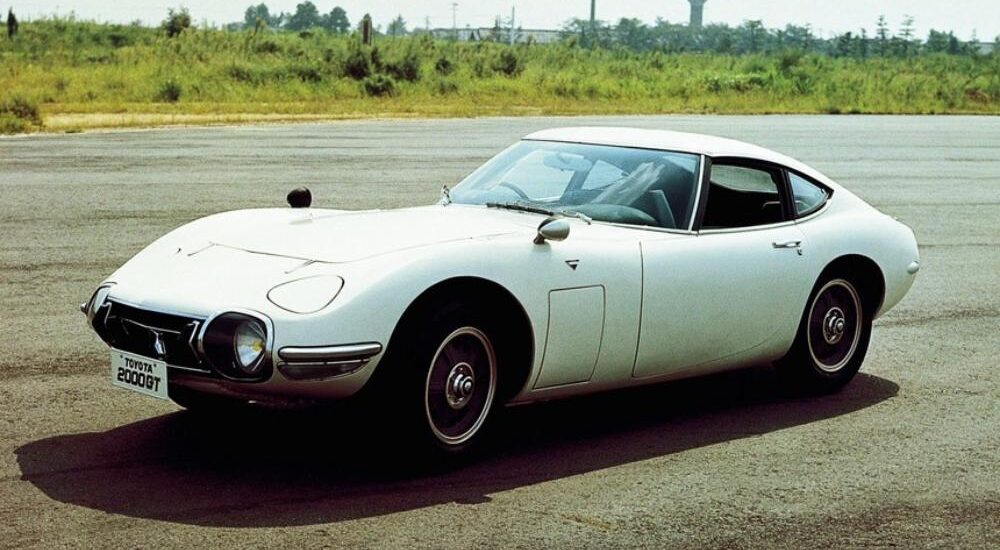


The new Toyota Supra is about to be unveiled: we’ve already seen the pre-production models and delved into their details. To create this model, Toyota sought support from BMW, which provided the chassis, engine, and transmission. In fact, the new Supra shares only its design and tuning with Toyota. However, this approach to creating a sports car is not new for Toyota. This isn’t just about the modern GT86 coupe, developed together with Subaru. If we dig a little deeper, we find that this experience dates back more than half a century — because the beautiful Toyota 2000GT coupe of the 1960s is also the result of a joint effort.
It Started as a Nissan Project
Toyota launched its 280A project in May 1964. But the story of the resulting car began a little earlier, in October 1962, when Nissan and Yamaha started a joint development for a lightweight sports coupe. The 1960 Datsun Fairlady roadster served as the initial base, and its design was quickly transformed beyond recognition: a closed body with two subframes instead of a separate frame, disc brakes on all four wheels instead of drums, and the weak 1.2-liter overhead-valve engine replaced by a more robust two-liter with dual overhead camshafts.
Nissan’s involvement was limited to the designers who oversaw the appearance and the interior; all the engineering was handled by Yamaha’s specialists. Construction of prototypes began in the spring of 1964 — by which time Nissan had already lost interest in the joint project and was concentrating on its own Silvia coupe, technically similar to the old Fairlady.

The second prototype of the Yamaha A550X in the company’s factory yard.

Yamaha Carried On Alone
But Yamaha did not abandon the project. Its engineers perfected the two-liter XY80 engine, which had two Solex carburettors and produced around 120 hp. In August-September 1964 two Yamaha A550X prototypes with steel bodies were completed, differing in detail and in colour — one white, one black.
The Goertz Legend
There is a legend that the German designer Albrecht Goertz — creator of the BMW 507 roadster and one of the stylists on the Porsche 911 — took part in the design work. Nissan did indeed involve him in the Fairlady and the Silvia, but there is no concrete evidence of his involvement in the A550X. Even Goertz’s autobiography refers only vaguely to a “two-liter sports car for the American market”, so attributing the design of the Yamaha to him is not accurate.

Third prototype of Yamaha A550X
Both completed cars went to Nissan under the contract. But a third prototype had been planned too, and Yamaha handed the job of building it to an outside company, GK Design. It differed from the first two in having a fiberglass body, finished in red — and Yamaha had quite different plans for this one.
Meanwhile, Toyota Wanted a Halo Car
Now back to Toyota’s ambitions. The company needed a prestigious car to show what it could do on the world stage. After winning the 1963 Japanese Grand Prix, Toyota’s leadership had no doubts: it had to be a sports car the size of a Porsche 911, with the standing of the Jaguars of the era.

Early sketches of the 280A project
To develop it, in the spring of 1964 Toyota created a special division under racing director Jiro Kawano. He assembled a team of five engineers and was given what amounted to carte blanche, working apart from the mass-model developers with minimal oversight. The deadlines were tight, though: the project had to exist on paper by November, with a 1:5 scale model presented in December.
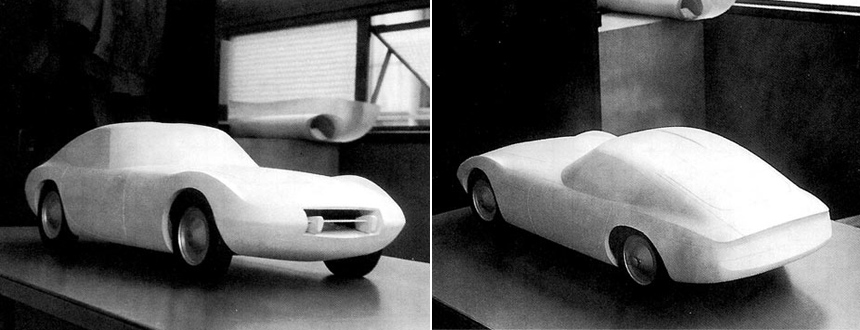
First mock-up of Project 280A (late 1964)
Learning by Buying the Competition
Since Toyota had no experience of developing sports cars, Kawano’s team bought several to study. The Porsche 911 and the Jaguar E-Type, naturally, but also the Lotus Elan, the MGB, the Triumph TR2 and the Honda S600. Examining them, the engineers learned as much from the good solutions as from what not to do: they discarded the Porsche’s rear-engine layout immediately, while the Lotus backbone X-frame became an inspiration.
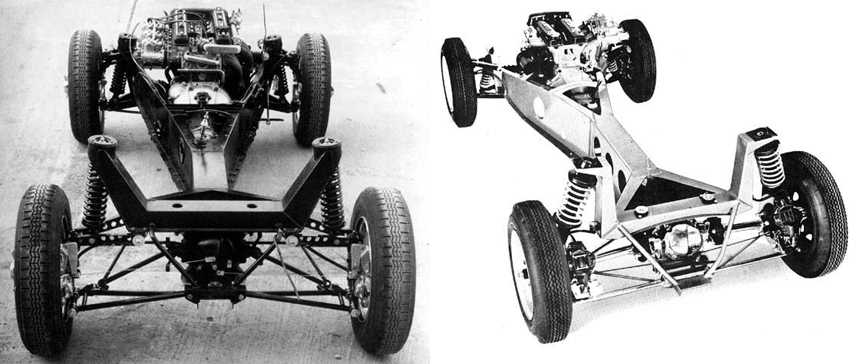
Left – Toyota 2000GT coupe chassis, right – Lotus Elan roadster
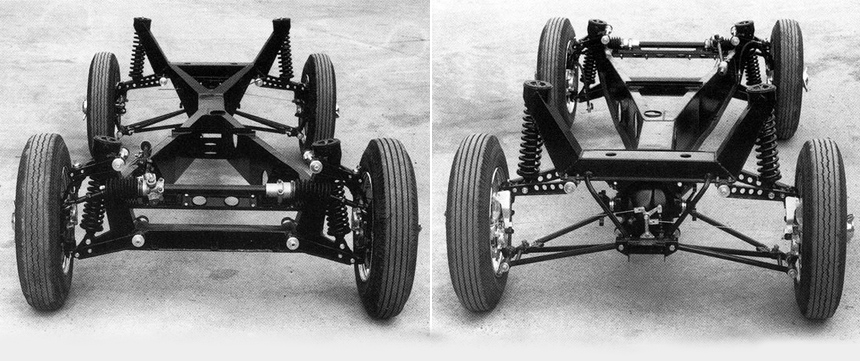
Toyota 2000GT coupe chassis
Yamaha Heard About It
As so often happens, the project could not be kept secret. Yamaha quickly caught wind of it, and by September 1964 Yamaha’s president Genichi Kawakami was hurrying to meet Toyota’s management to present his finished design. Soon Toyota’s development team was visiting Yamaha to inspect the red A550X coupe that Nissan had not claimed.
As Toyota’s engineers later recalled, the situation initially disappointed them: the engine was separate from the car and they could not drive it straight away. But Yamaha had full documentation, and — more importantly — was eager to finish the project and outdo Nissan. Toyota, it seems, had already grasped the size of the task it had taken on, and a contract with Yamaha for joint development of the sports car was signed on December 28, 1964.
Not Simply a Rebadged A550X
None of which meant that Toyota and Yamaha simply turned the A550X prototype into the future Toyota 2000GT. What began was the process of adapting the existing design to Toyota’s requirements and wishes. The car’s appearance, for one thing, was finalised by the end of 1964, and differs significantly from the Yamaha. Incidentally, although Japanese companies tend to avoid personalising the design of their cars, enthusiasts later established that the designer of the 2000GT was Satoru Nozaki, a Japanese who had studied in California and joined the project team at the outset.
The partners also rejected Yamaha’s four-cylinder engine in favour of Toyota’s M-series inline six of 2.0 liters, the same unit used in Toyota Crown sedans — though Yamaha’s engineers were given the job of developing it further. The chassis from the A550X, with double wishbones all round, and the overall body construction were retained.
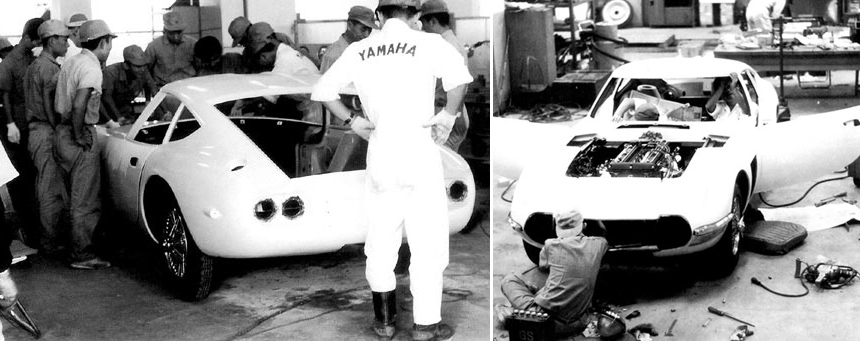
Assembly of the first prototype within the walls of Yamaha
Out of the Gates in Midsummer 1965
The engineers worked at full speed, and by April 1965 Yamaha’s shop had begun building the first running prototype under the code 280A/I. The car rolled out of the factory gates in the middle of summer and went straight into testing — successfully. Even Toyota’s own drivers had no major complaints about the coupe’s setup after track work, though development head Kawano noted some instability at high speed. For a first prototype, it was a success.
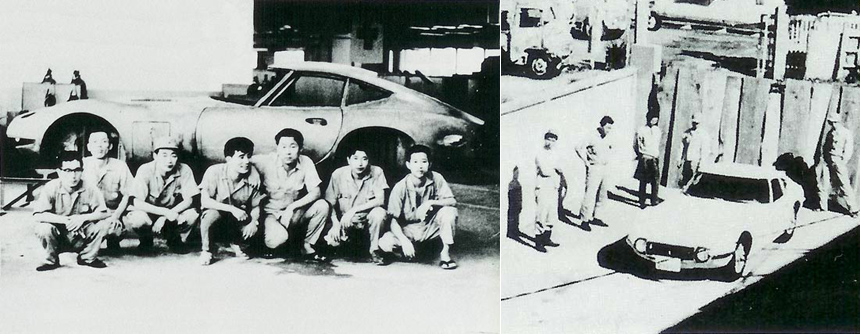
On the left is the first finished body, on the right the completed prototype driving out of the workshop for the first time
A Drag Coefficient of 0.28, by Intuition
The aerodynamics deserve a mention. Toyota ran no wind tunnel tests, and the engineers shaped the body as best they could by intuition. Many years later, testing revealed that the Toyota 2000GT had a drag coefficient of just 0.28 — impressive even by today’s standards, and startling next to the Lamborghini Miura of the same period at 0.37. And yet, for all the beauty and the futurism, some exterior elements had unexpected origins: those stylish round rear lights were identical to the ones on Toyota’s production buses.
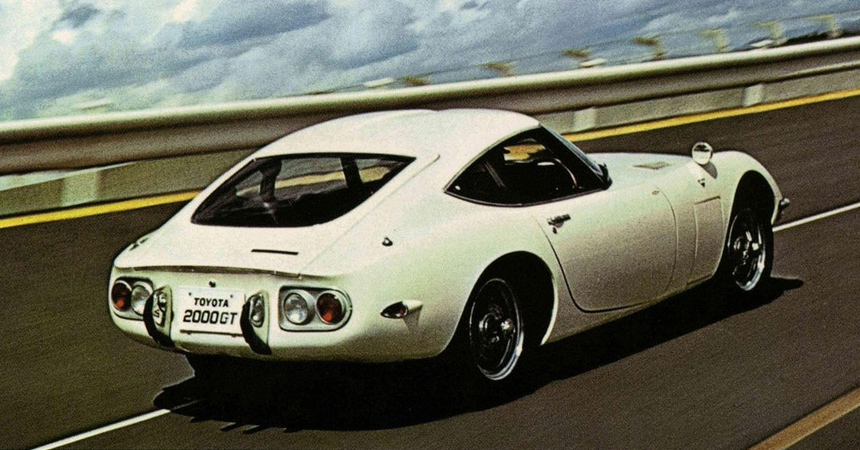
Premiere at the 1965 Tokyo Motor Show
Meanwhile the second prototype went straight to Toyota’s stand at the Tokyo Motor Show, where the coupe had its world premiere in October 1965. The early prototypes differed from the production car in a few ways: three windshield wipers, different retractable headlight housings, and windscreen pillar bases shifted 40 mm further into the door opening — later moved back to make getting in and out easier.
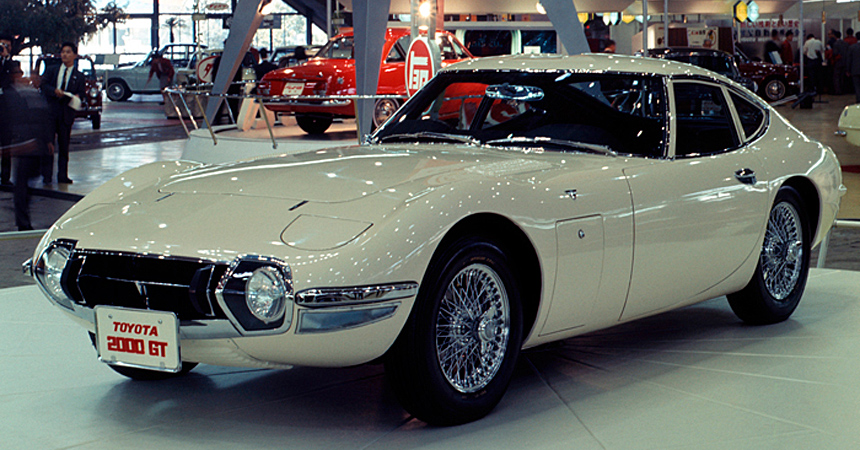
Toyota 2000GT at the 1965 Tokyo Motor Show

Built by Hand, Checked by Toyota
Final adjustments and preparation for production took another year and a half, and the first production cars were ready by March 1967. Yamaha was given the job of building them, setting up three new workshops for body parts, engines and final assembly. Many components came from Toyota’s factories and the transmission was supplied by Aisin, but the cars were largely assembled by hand — and since this was Yamaha’s first experience of car production, Toyota took responsibility for quality control.

Assembly of production cars…
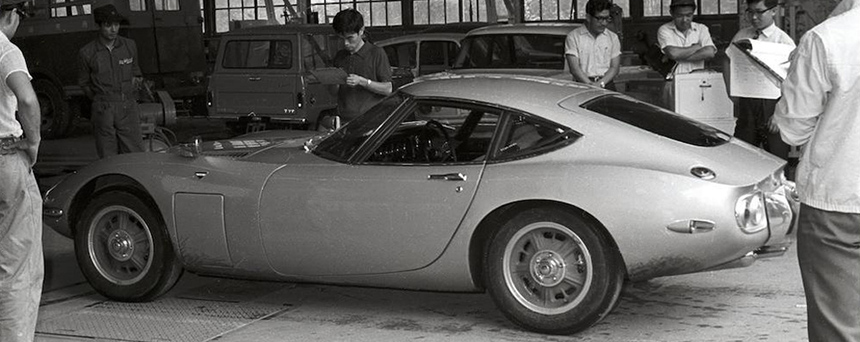
…and acceptance of the vehicle after a test drive
150 hp, and a Gearbox From a Truck
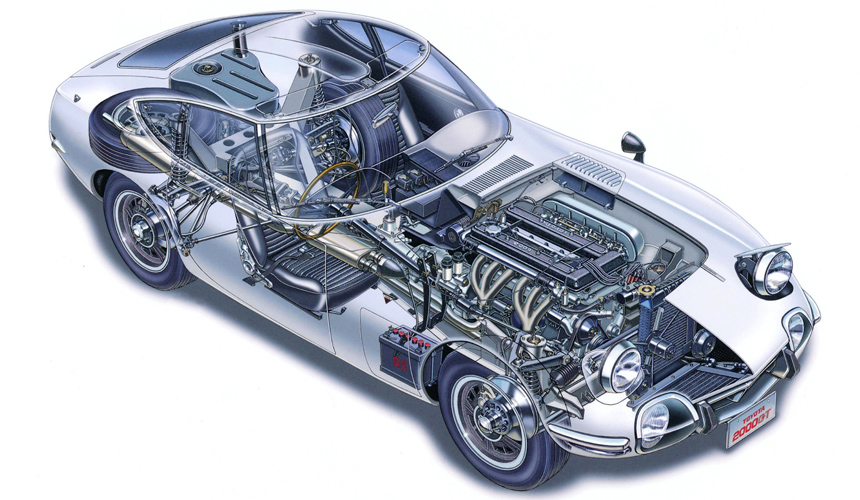
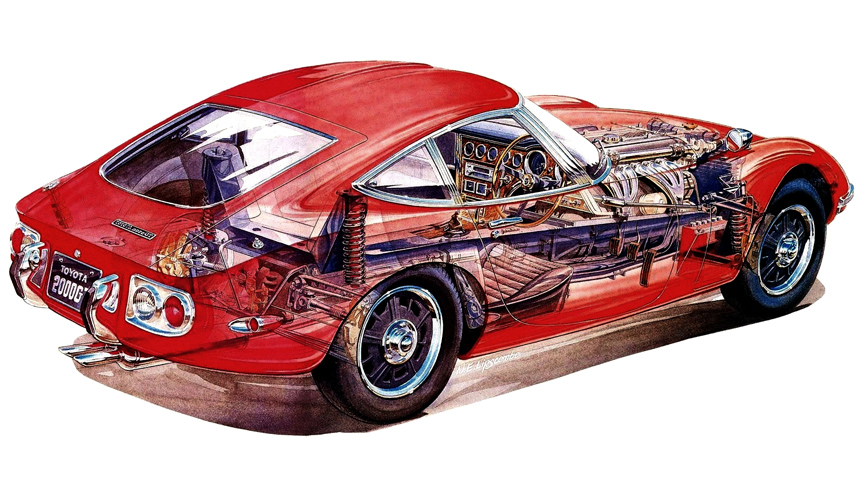
The Toyota 2000GT was a cutting-edge car for its time. The two-liter six, after further refinement by Yamaha’s engineers, received a twin-cam cylinder head and three twin-chamber Mikuni-Solex carburettors. Where the original engine produced 105-125 hp depending on version, the sports coupe reached 150 hp and 177 Nm — and it revved beautifully.

The length of the coupe is 4175 mm, the height is 1160 mm
The team also struggled to find a suitable transmission in Toyota’s passenger car range, because of the width of the frame, so they used one from a truck: narrow, and with a generous margin of strength. A fifth gear had to be added. The Toyota 2000GT had a limited-slip differential and, for the first time in Japanese automotive history, disc brakes on all four wheels. It weighed 1,120 kg, had a top speed of 220 km/h, and reached 60 mph (97 km/h) in 10.1 seconds.
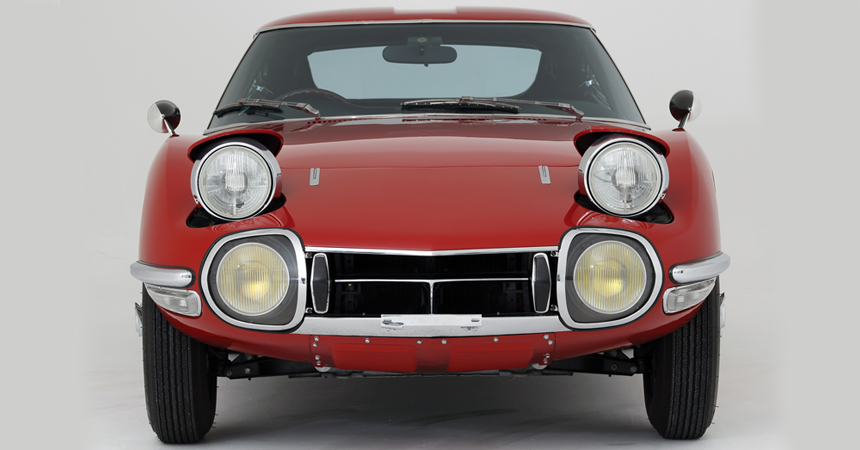
The main headlights are retractable, and fog lights are installed under transparent fairings.
An Interior Built by Instrument Makers
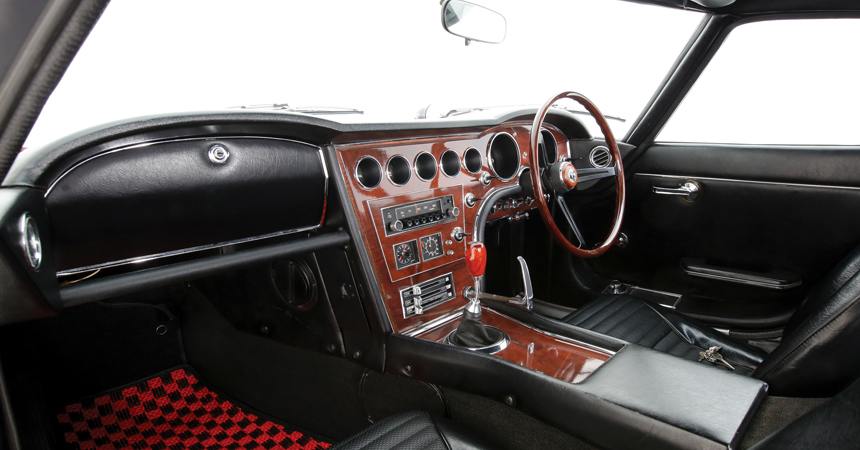
Another source of pride was the interior, produced with the involvement of Yamaha’s musical instrument division. The result was high-quality wood trim with excellent fitting — and the wooden steering wheel rim was made by Yamaha’s musicians too.
More Expensive Than a Porsche 911
It is no surprise that the car was very expensive. The price in Japan was ¥2.38 million — enough for two Toyota Crown sedans, or six Toyota Corolla sedans, which were not exactly cheap themselves. In the U.S. it was priced at $6,800, where the Porsche 911 coupe started at $6,490 — and Porsche already had a name, while Toyota was still firmly associated with affordable small cars.
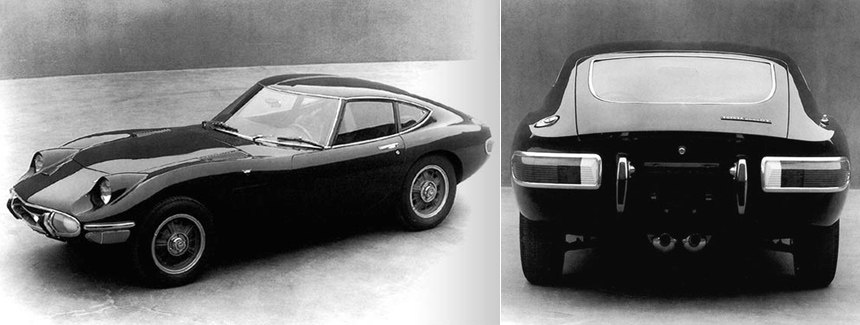
In the fall of 1967, with the help of Kanto Auto, an experimental, cheaper version of the coupe was built. It had different lighting and a radiator grille, and instead of wood trim, plastic was used in the interior. The experiment was considered unsuccessful.
351 Cars in Three Years
Given the labour-intensive hand assembly, it is clear why only 351 Toyota 2000GTs were built by the autumn of 1970, prototypes included. Of those, just 58 were sold in the U.S., nearly all in 1967, and 115 in total were exported.
Production divides roughly into two series. The first ran for just a year, 233 cars, and in April 1968 came an updated version with a slightly altered front — the fog lights smaller, visually merged into the air intake. A further 109 were produced by October 1970, including a few with a three-speed automatic introduced in the summer of 1969. The remaining nine were a simplified version with a 2.3-liter single-camshaft engine producing 140 hp and 201 Nm, and were never sold.
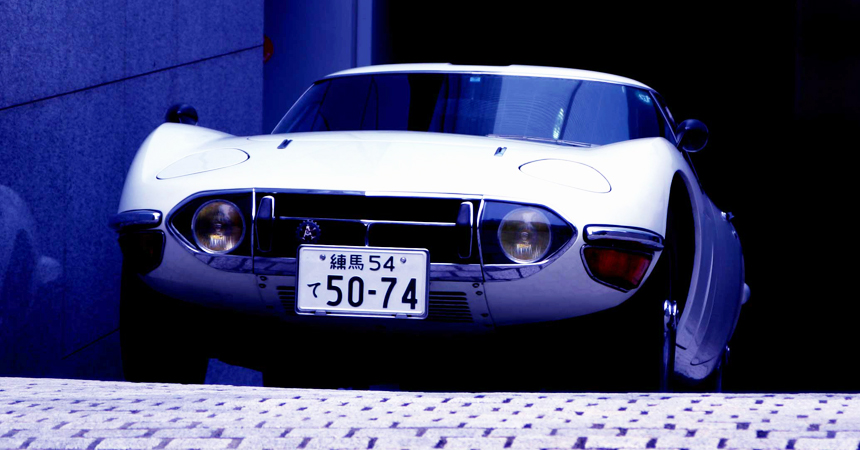
Toyota 2000GT second series
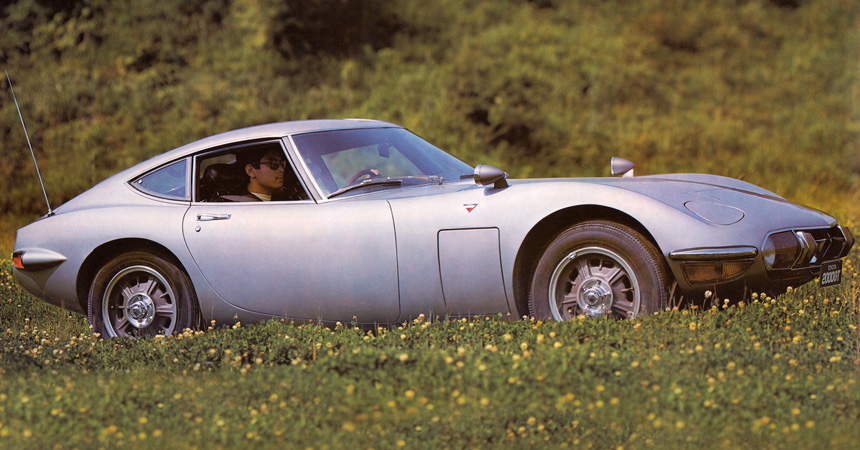
The Car That Was Too Small for James Bond
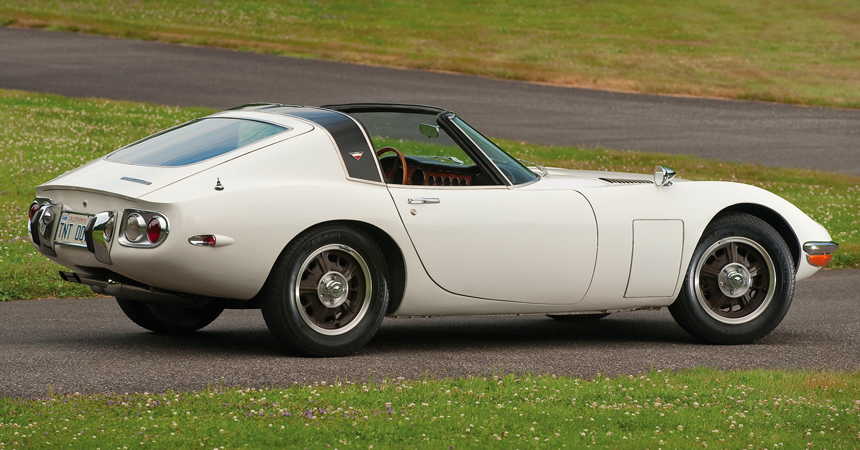
There were also versions without a roof, created specifically for the world’s most famous fictional spy. The 1967 film “You Only Live Twice” was shot in Japan with Toyota as one of the main sponsors, and having the newest sports car on screen would be superb advertising. There was an unexpected problem, though: Sean Connery, who played Agent 007, was 1.88 metres tall and simply did not fit inside the cramped Japanese coupe.
The first solution was a Targa version with a removable roof panel above the occupants’ heads. In that car, though, the tall Connery looked comical, his head towering over the windshield and the rear fairing. So within two weeks Toyota’s craftsmen turned the Targa into a full roadster for filming. The schedule was too tight for a soft top, but they did fit a mock-up luggage compartment behind the seats, and the car had a removable windshield to make camera placement easier.
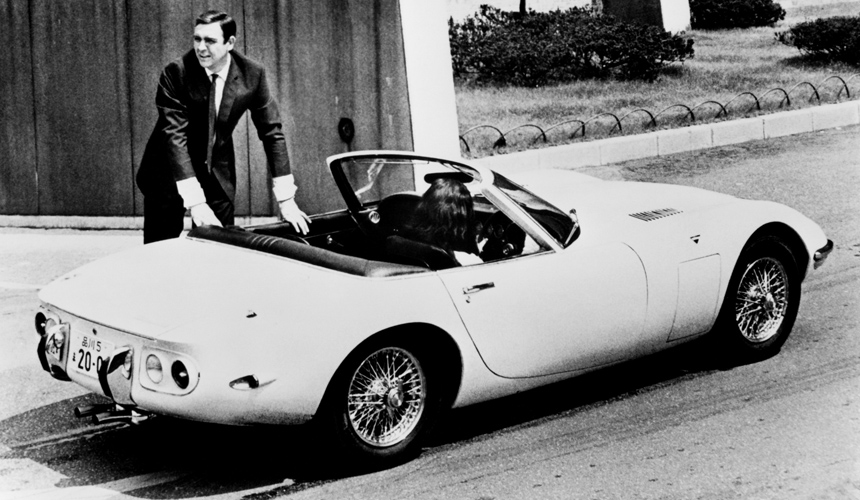
The first manufactured roadster and Sean Connery on the set of the film
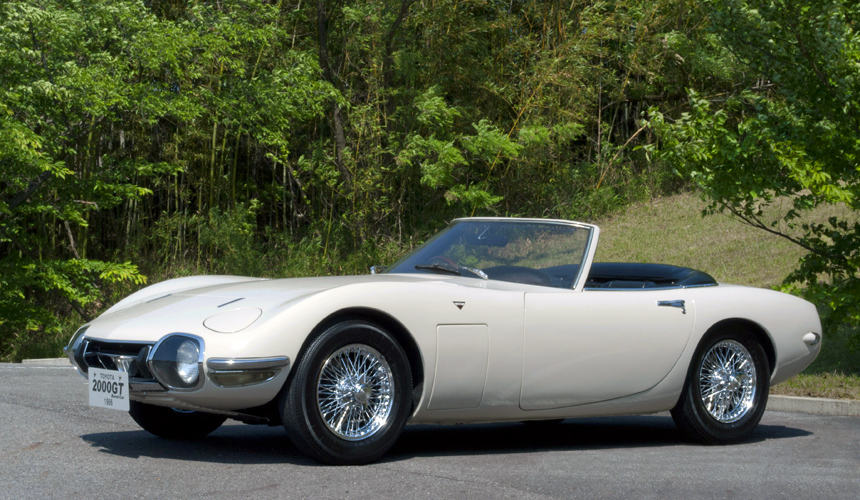
The second manufactured roadster, this car remained in the collection of the Toyota company museum
A second roadster was made later for promotional purposes, but the version never went into mass production. Some coupe owners later converted their cars into open versions “like Bond’s”, and in the 1980s the Targa was recreated from the original blueprints.
A Million Dollars, and a Long Silence Afterwards
Today the Toyota 2000GT is the most expensive Japanese classic there is: at auction these cars sell for more than a million dollars. And yet Toyota’s experience with it severely dampened the company’s appetite for serious sports cars for a long time. The next six-cylinder coupe did not appear until 1978 — the relatively mass-produced Toyota Celica Supra, series A40. As for genuine supercars, Toyota returned to that market only in the 21st century, and through its luxury division, Lexus.
Photo: 2000gt.net | autowp.ru | csp311.net | Toyota
This is a translation. You can read the original article here: Совместная работа: спорткар Toyota 2000GT как прародитель Супры

Published May 15, 2025 • 10m to read