
Dieppe, 1950. Post-war Normandy is slowly recovering—beautiful, yet devastated. Not long ago, Jean Rédélé inherited his father’s car dealership, selling Renault cars. Still under thirty, Rédélé was the youngest Renault dealer in France, but his soul craved adventure—preferably automotive adventures. But what could he do when Renault didn’t have a single exciting car in its lineup?
From the 4CV to a Company of His Own
The nationalised post-war company was busy building inexpensive rear-engined “French Beetles” — the 4CV. And it was in that car that Jean Rédélé began his rally career.
Success came almost immediately. In the mid-1950s Rédélé twice won his class, up to 750 cc, at the legendary Mille Miglia, and in the same four-cylinder 4CV he also took the French rally Coupe des Alpes. Tall and stately, he always raced in a tie and a three-piece suit — the true gentleman driver. Can you picture him behind the wheel of the tiny 4CV?
Youthful energy and good taste came together, and soon the first car built on Rédélé’s own initiative appeared: the Rédélé Special coupe with a 550 kg aluminium body, which he took rallying straight away. In 1955 Rédélé founded Alpine, and shortly afterwards began small-scale production of the A106 coupe, followed in 1960 by the A108 with a Renault Dauphine engine of 40 hp. This was only the beginning.
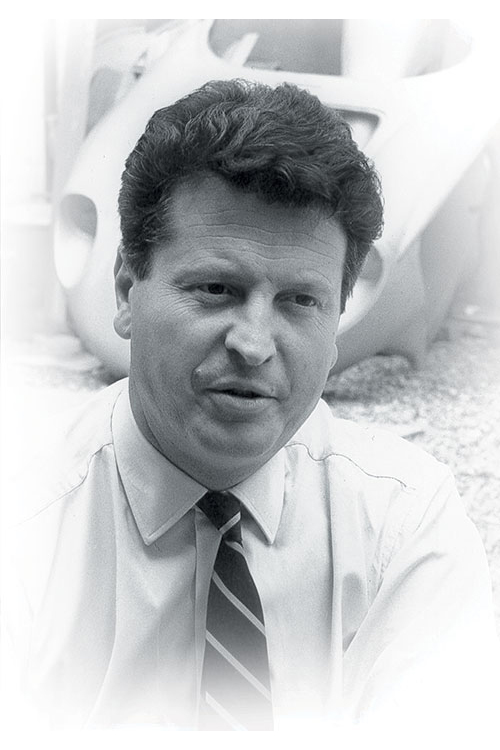
Jean Rédélé was born in Dieppe in 1922 and lived to be 85. But he left his main brainchild, the Alpine company, back in 1978, shortly after its takeover by the Renault concern.
A Masterpiece Built on a Shoestring
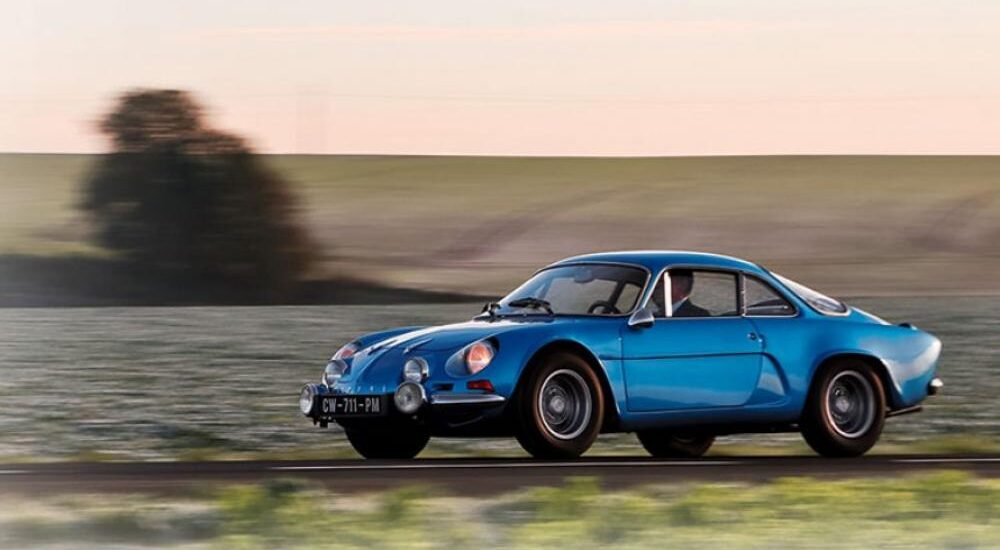
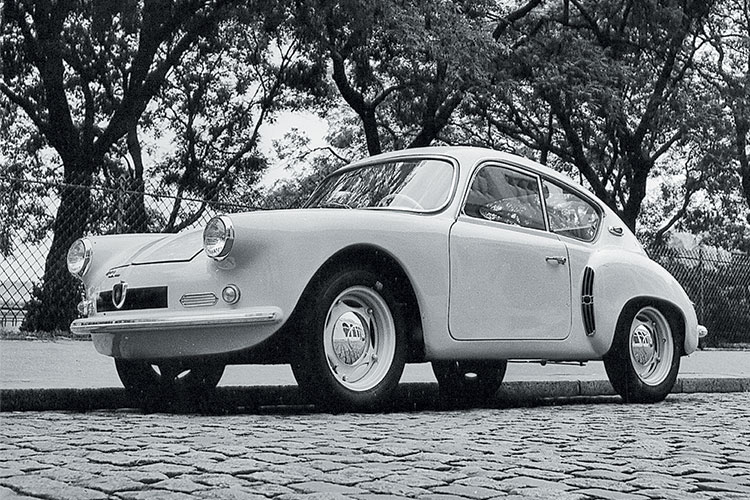
However long I look at the Alpine A110 from the Renault Classic collection, it stays a masterpiece. How did Rédélé’s company manage to create a car in 1963 that still looks stylish and modern today?
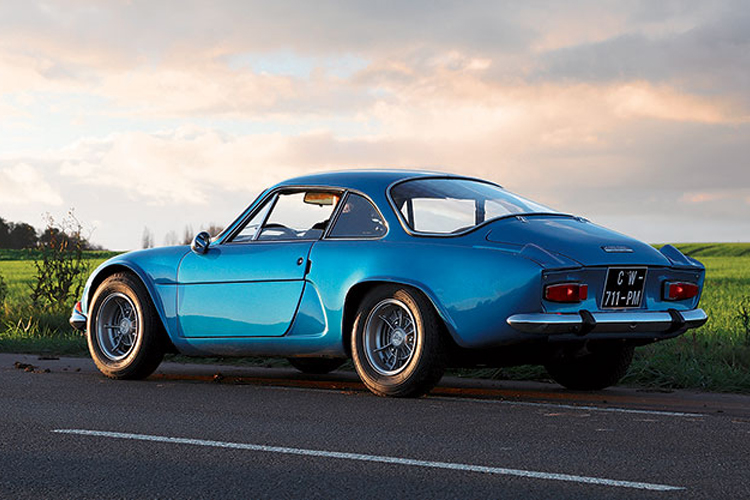
By skimping on everything, is the answer. The body was as simple as it could be — a space frame of steel tubes with plastic panels attached to it. Suspension and powertrain were borrowed from the most modern Renault of the day, the rear-engined Renault 8. And yet the A110’s low, sleek silhouette, which is why it was so often called a berlinetta rather than a coupe, and its light weight took it past 170 km/h on only 55 hp.
Alpine at the time was essentially a large garage assembling two cars a week. It was a fight for survival, because the A110 cost one and a half times what a Renault 8 sedan did. The obvious idea followed: build a coupe for foreign markets, manufactured abroad. Over ten years more than 4,000 cars were produced in Brazil, Mexico, Spain and even Bulgaria. And Rédélé knew the universal method of boosting sales — rally victories.
The first big success was first, second and third place at the 1971 Monte Carlo Rally. In the marathon circuit races, the related Alpine A210 and A220 prototypes kept a low profile
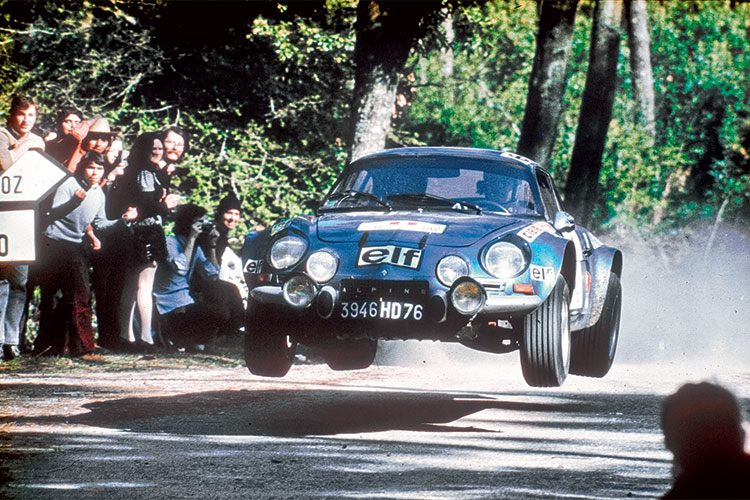
The first big success was first, second and third place at the 1971 Monte Carlo Rally. In the marathon circuit races, the related Alpine A210 and A220 prototypes kept a low profile
Getting In Is the First Test
How on earth did anyone race in these conditions? Getting into the driver’s seat is a challenge in itself: you squeeze in, tucking your legs into the narrow gap between the giant wheel arch and the central tunnel. At 187 cm tall I do not simply have the roof pressing on my head — it would have to be raised by at least 10 cm for me to sit upright. The pedals are shifted to the right and there is nowhere to put your left foot. Only the soft, amorphous seat makes sitting behind the wheel bearable, and even then awkwardly. Rally drivers complained about visibility: the seating position is so low that on British and Finnish stages nothing could be seen over the crests of the road. In the rain it was worse still, because the wiper mechanism from the Renault sedans could not bring the left blade to the pillar, missing it by nearly 25 cm.
Light and Reliable Beat Powerful
In racing, though, the A110’s advantages showed up quickly: handling and reliability. Light weight played an enormous part — the lightest version, with thin body panels, weighed just 685 kg, while the heaviest, the “Morocco”, came in at around 900 kg with all its reinforcements. The reliability came from the simplicity of the design.
The Long Search for Power
But the four-cylinder Renault engines, taken from mass-production models, were too weak for racing even after the customary rework by the Mignotet workshop. Attempts to boost the Alpine A110 began in 1966 with the 1300 version. Various Gordini engines went under the rear hood: by 1969 there was a 1300S with 120 hp, and two years later the 1600S with 138 hp. There were even experiments with 16-valve cylinder heads and turbocharging. Nothing quite worked.
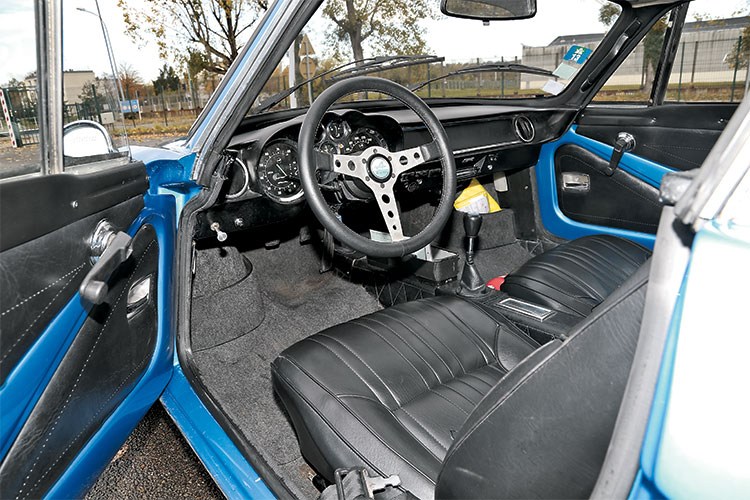
Behind the wheel you sit folded like a croissant: your legs prop up the steering wheel, your head props up the roof, and your elbow jams into the door. The trim is small-series work.
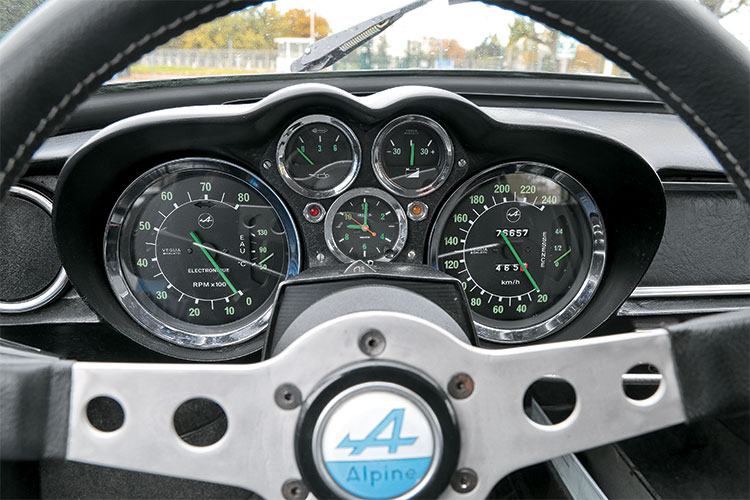
Electronique, Eau, Essence… This is France! And the clock in the very center of the dashboard hints at rally roots
Behind the Wheel of a 1975 1300S
“My” car is a 1975 Alpine A110 1300S, a road version from the final production batches. It has a more modern engine of nearly 80 hp from the Renault 16, and yet the acceleration is underwhelming. The magnificent big speedometer, marked to 240 km/h, looks almost like a joke, and the tachometer redline at 8,000 rpm is clearly too optimistic. The engine barely pulls low down; after 4,000 rpm it wakes up a little, then fades again by 5,500 rpm. The noise inside is so loud it feels as though you have climbed into a combustion chamber.
Is this really a rally legend?
Consistency Instead of Horsepower
The competition — Porsche 911, Lancia Stratos, Ford Escort, Fiat Abarth 124 Spyder — was always more powerful, and the Alpine drivers made up for it with consistency. In 1971 they took the first three places at the Monte Carlo Rally, and the recognition came in the form of permission to call the racing team Alpine-Renault.
In 1972 the rally drivers finally got a more powerful engine: a 1.8-liter unit with more than 180 hp. By then the powerful brakes from the Renault 16 were available too, though the car had used disc brakes all round from the start. Bodies began to be built with wider wheel arches for larger tires, and the second pair of headlights had appeared earlier.
Then, in 1973, came the real success: in the debut World Rally Championship (WRC) season the Alpine team won gold. There was no individual classification, only a team one — Björn Waldegard would probably have won it in a BMW — but the Alpine crews triumphed through stability and reliability, taking seven of the ten races.
Why Collectors Prefer the 1971 Cars
From 1972 the rear suspension was upgraded to a more modern double wishbone layout in place of the outdated rear axle with trailing arms, which improved the handling. In rally conditions, however, that setup combined with a higher centre of gravity to produce constant oversteer. Which is why drivers then, and collectors now, consider the 1300 versions of 1971 the best balanced of all.
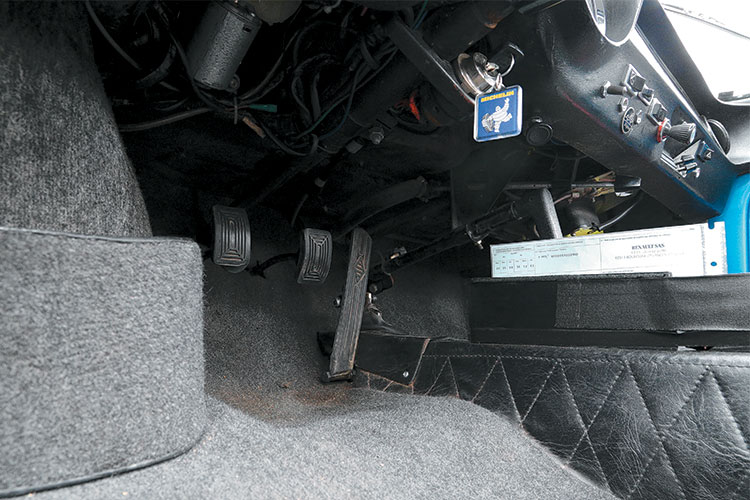
The pedal assembly is shifted to the right, and there is nowhere to put the left foot
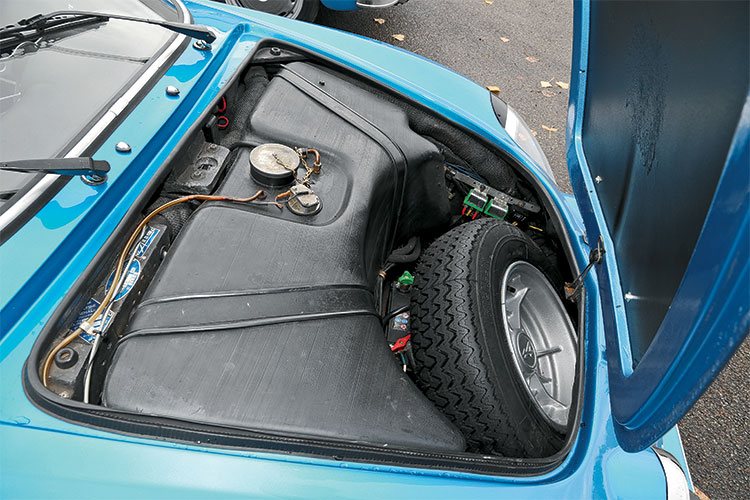
In recent years, the fuel tank has been located at the front, although on rally versions it was sometimes placed in the base, in front of the engine shield
Like a Kart — Until the Road Gets Bumpy
The belief was that in rallying the A110 should always be driven with a degree of slide, the trick being to keep it small. I cannot test that 70s postulate in a museum car, but even driving gently there is a real joy to the Alpine. The ultra-light car answers the steering so directly and so quickly that it seems to have no mass at all, despite its 700 kg. Most of that mass sits at the rear, which leaves the steering feeling almost weightless even without assistance. This precision was routinely compared to karting — it follows the wheel so closely and takes corners so flat that the association is unavoidable.
The condition is a smooth road. Over bumps the A110, with its short-travel, stiff suspension, jumps off its line — the steering column shakes as though trembling with fear — and even straight-line stability is in short supply. But the ancient rear suspension causes no trouble in corners: the A110 does not suffer the excessive oversteer of the taller Renault 8 sedan.
You Need to Be Under 170 cm
There is one condition for enjoying the nimbleness and the featherweight sharpness of the Alpine: you need to be under 170 cm tall. I have to press the pedals from the side, and God forbid my foot slips off the stiff brake. My left elbow is jammed against the door, which makes proper steering impossible, and the lower part of the wheel is blocked by my legs. The hardest manoeuvre of all is a sharp right turn. Selecting second while tucking the short gear lever under my right knee, turning the wheel and working the indicator stalk at the same time is simply impossible — there is no room.
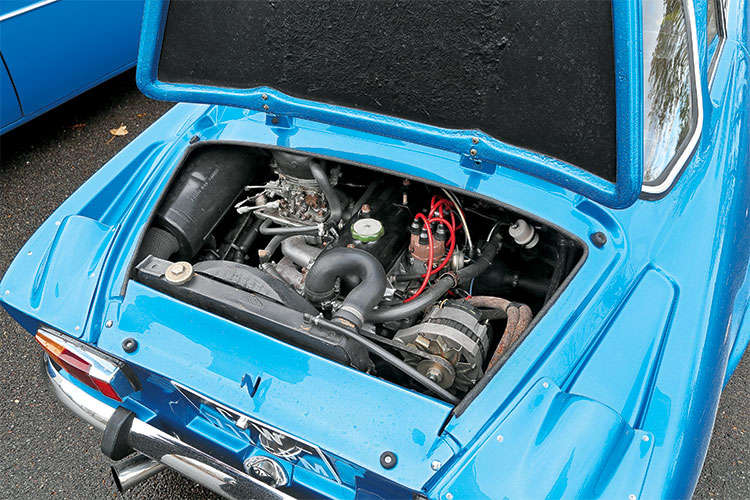
Air for the engine intake came through the “ears” on the rear fenders and on dirt tracks turned out to be excessively dusty. In such conditions, the air intake was often moved into the cabin
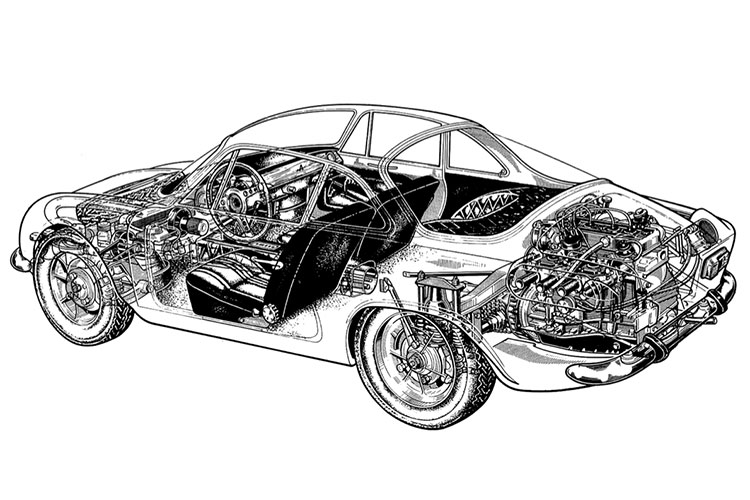
For the rally, the frame of each body was made individually: if for asphalt races they took tubes with a cross-section of 25×25 mm, then for heavy African soils – up to 30×50 mm. The curb weight of the cars differed by almost one and a half times. And taking into account at least a dozen different engines that they tried to install on the A110, exact technical characteristics can only be given for each specific example. Alpine was one of the first in the world to use external panels made of fiberglass
1968: Into Renault’s Dealer Network
The story of the A110 ended at almost the same moment as Alpine’s independence. In 1968 Jean Rédélé achieved the unimaginable: he secured the right to sell his berlinettas through Renault’s vast dealer network. In effect Rédélé was building cars for Renault, which then found the buyers. Money poured in, a new Alpine factory opened, and production rose to six to eight cars a day. But the “fatherly” corporation influenced company policy more and more. In that same 1968 Rédélé secretly built the advanced Alpine A350 racing car for Formula 1, with a three-liter Renault-Gordini engine and an original suspension — double wishbones whose upper arms were connected by a Watt’s linkage to keep the wheels perpendicular to the road. At Renault’s insistence the project was closed: the corporation was interested only in Le Mans and rallying.
1973: An Audit, and a Sale
The integration grew tighter, and by 1971 every A110 carried the twin Alpine-Renault badges. By 1973 a Renault audit had found the Alpine factory disorganised and its accounting neglected, and Rédélé was persuaded to sell the majority of his shares to Renault. Perhaps it was for the best. This was the era of the oil crisis, interest in sports cars was fading, and speed limits were starting to appear in traffic law — something that had never existed before.
The French Porsche That Wasn’t
Renault’s managers pictured Alpine as “the French Porsche”. The A110’s handling could still be measured against a Porsche 911, but in comfort and everyday practicality it was no match. It is enough to say that the A110 had no luggage space at all: the front compartment was entirely taken up by the fuel tank, the spare wheel and the battery.
The next model, the A310, was supposedly the better car on the road, and yet something was missing. Sales were respectable — about 8,000 A110s were sold and more than 11,000 A310s — but who remembers it now? Renault’s priorities had shifted, and the A310, with its finally powerful V6, was never homologated for international rallies. Everything went into Le Mans and Formula 1, where Alpine engineers played a significant part in developing a 1.5-liter turbo engine. Those races were a long way from road cars.
And the Alpine A110 berlinetta stays with us on posters, T-shirts and racing emblems. French charisma is concentrated in this car the way the essence of Normandy apples is concentrated in thirty-year-old Calvados. In its silhouette you see Jean Rédélé in a tie at the start of a race; in its handling you feel the twist and drive of the French Alpine roads. It is a car created in the name of rallying that somehow stayed democratic.
The Bronze Alpine of Orense
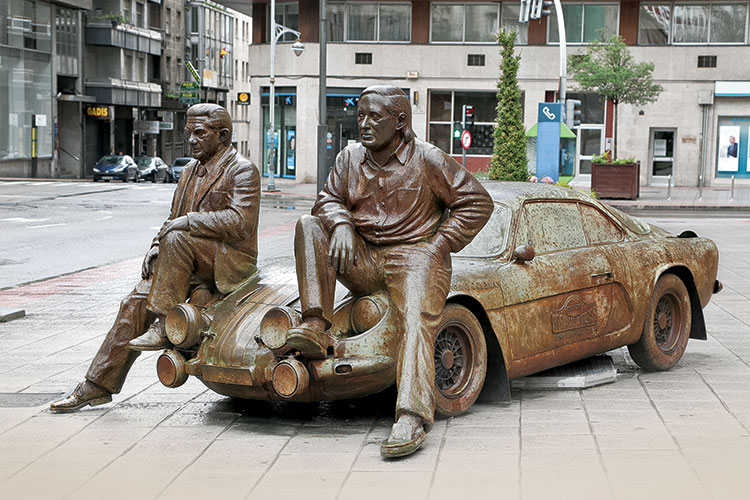
Few cars have been honoured with life-size monuments, but in the Spanish city of Orense I happened to stumble on a bronze Alpine A110. The monument is doubly unique, because it is not quite an Alpine A110. The berlinetta’s central problem — the lack of power — was one the factory and its enthusiasts fought throughout the car’s life, and the Spanish rally driver Estanislao Reverter solved it radically, by installing an engine from a wrecked Porsche 911R under the rear hood. The one-off was named Realpor, from Reverter, Alpine and Porsche, but everyone came to know it as the Alpinche.
At first the car ran a 220-hp 2.2-liter flat-six, and with that engine the coupe lightened its front wheels noticeably under acceleration, which made it hard to control. Later came a 2.4, then a 2.7 with 280 hp. With power like that the Alpinche won several rallies before being wrecked in 1975.
The monument was raised not only to the car but to its drivers. Estanislao Reverter and Antonio Coleman spent their lives rallying, organising races and teams in Orense, and earned the lasting gratitude of the locals. Reverter’s descendants are now preparing to open the Estanislao museum, and eventually to recreate the Alpinche.
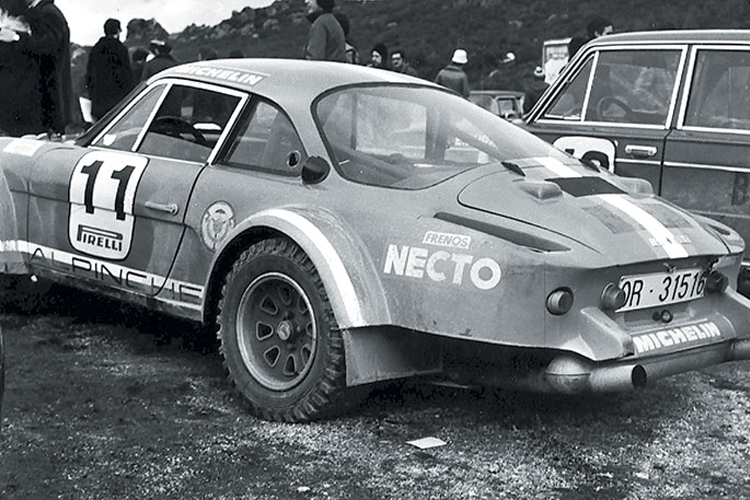
To accommodate the Porsche’s six-cylinder engine, the Alpine’s rear end had to be lengthened (Estanislao Reverter Foundation)
Gordini: The Other Answer to a Weak Engine
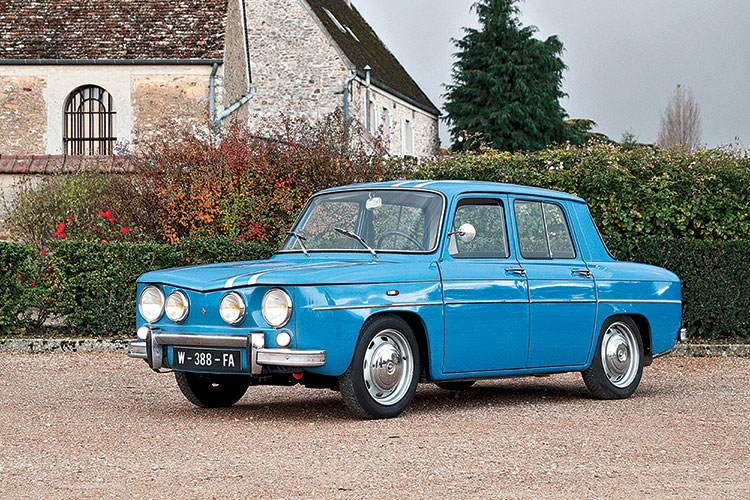
One way of fighting the engine weakness was to fit Gordini units to the Alpine A110 — the same Renault engines, but deeply reworked by the engineer Amédée Gordini. I drove the Renault 8 Gordini sedan with its 110-hp four-cylinder. What a difference.
Gordini’s main innovation was a cylinder head with the spark plugs set at the centre of hemispherical combustion chambers, marked by the famous G logo on the cam cover. Together with horizontal Weber carburettors it gives the engine a magnificent growl and a high-revving character. You can feel the racing heritage in it.
A rear-engined car is interesting in its own right, and this was a genuinely democratic sports car for its time. The Renault 8 Gordini went on sale in 1964 in a single colour, blue with white stripes. In 1966 displacement grew from 1108 to 1224 cc and two extra headlights were added, and that same year a racing monocup was introduced which gave many aspiring drivers their way into professional motorsport.
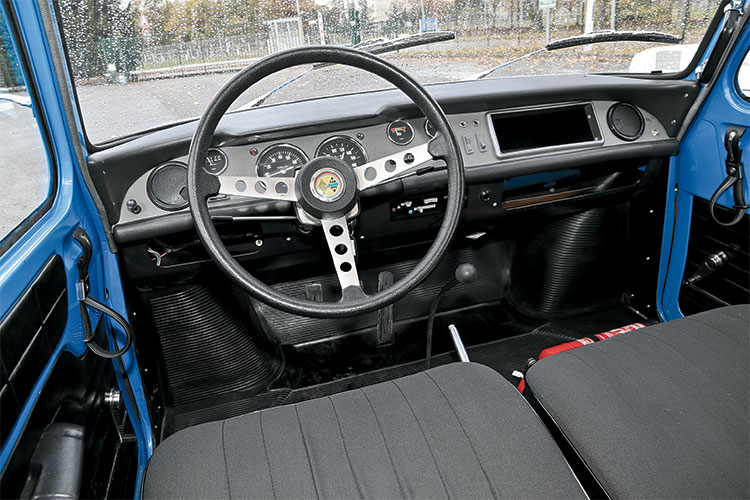
The pedals are as uncomfortable as those on the Alpine A110, and the steering wheel is noticeably offset to the right.
A Democratic Sports Car to Sit In
Wealthy people would never have sat in a car like this. The driving position in the Renault 8 is only marginally better than in the Alpine A110 — at least the roof does not press on your head. But the gear lever, or rather the thin rod with a rubber ball on the end, hides even further under your right foot, and its travel is enormous and imprecise. You sink into the soft seats as if into straw, and it is precisely that which holds you in place. I would not want to do a multi-day rally in this position, and yet the Renault 8 Gordini won both the Monte Carlo Rally and the Tour de Corse.
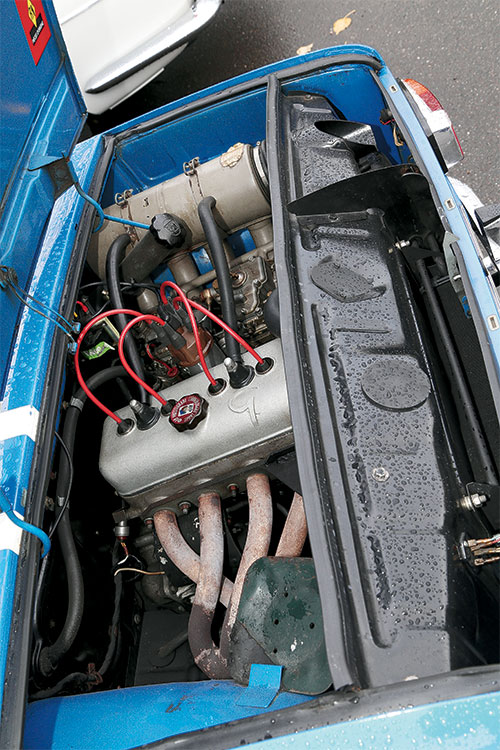
Renault 8 Gordini: a lively engine and a five-speed gearbox! The gears are close together like in a racing car, but the shifting is unclear
How? I do not understand, because keeping a Renault 8 Gordini on the road with that soft suspension is no simple task. The rear tends to overtake the front even on a straight, and take a corner slightly too fast and the rear wheel collapses on its trailing arm and sends the car into an early skid. You are forever winding the wheel back and forth, even when driving calmly. The brakes, though, are fantastic: the Renault 8 was the first car in history with Bendix disc brakes all round.
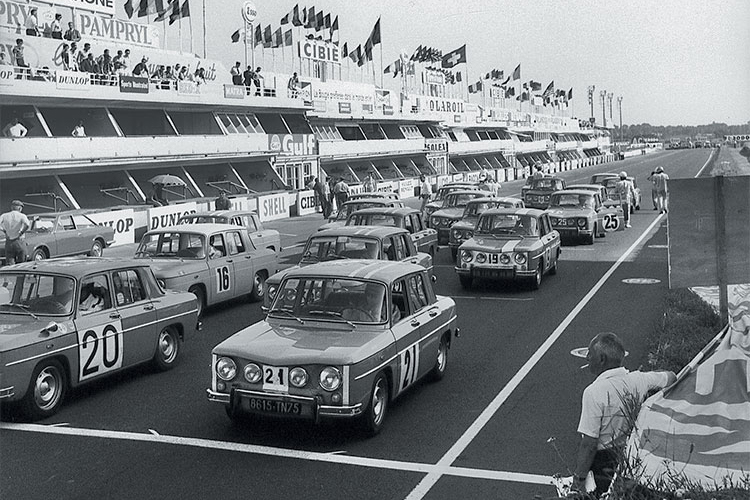
The Coupe Gordini (Gordini Cup) series has produced many stars of French motorsport, such as Jean-Pierre Jabouille
The Last Alpine: GTA, A610 and a Le Mans That Never Was
The first car Alpine created after being absorbed completely by Renault was the GTA coupe, which had become the A610 by 1991. The ambition was high — the A610 was meant to take on coupes from Porsche, Lotus and Ferrari — but the model was a failure, and by 1995 it was out of production and Alpine’s last road car.
In 1993 the hope was to reawaken public interest with a “charged” Le Mans version whose turbocharged engine was boosted from 250 to 285 hp. It never reached production — and it was exactly this version, from the Renault Classic collection, that I got to drive.
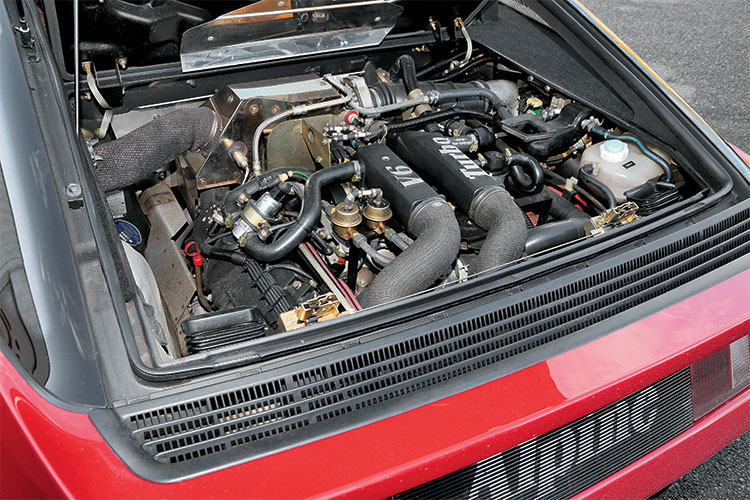
In the rear overhang is a supercharged version of the PRV V-6, created by Renault in the mid-70s in collaboration with Volvo and PSA
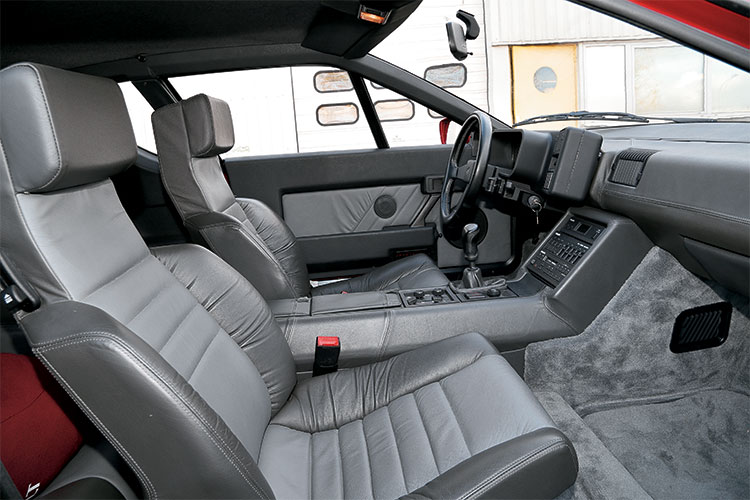
The seat holds the sides very well, but the stylish headrest rests against the lower part of the neck. Note the left wiper – the right one, accordingly, looks to the right
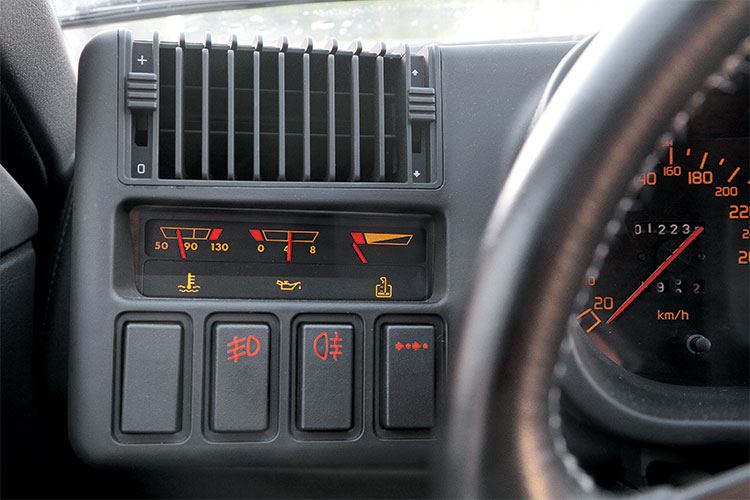
The equipment for the early 90s is luxurious: an oil level indicator, a trip computer, a washer fluid level indicator lamp…
A Cabin Like a Spaceship From the ’70s
The strongest impression the A610 leaves is its interior design. It is a spaceship from the ’70s, or perhaps something by Le Corbusier: an elegant mixture of rectangles and arcs. To the left of the steering wheel sits a block of extra instruments including an oil level gauge, and to the right the washer fluid level indicator. There is air conditioning, ABS and a digital radio. The wipers rise from the lower corners towards the centre of the screen, slightly out of step, the right one setting off first and the left following.
The ergonomics are another matter. The steering column does not adjust, and pressing the floor-hinged clutch pedal puts your foot into the wheel arch. By modern standards the A610 drives poorly. The steering has no assistance and the wheel stays heavy even at speed, and the slightest bump or change in camber tugs it to one side. The suspension is bone-jarringly stiff and there is next to no sound insulation. You cannot stay in this car for long, so it is hardly surprising that it fell out of favour against the GT coupes of the touring class.
But That Turbo
The 2.8 turbo engine, though, is superb. It pulls from 1,000 rpm, and by 2,500 rpm the big turbo is spinning, driving the boost gauge into the red and refusing to give up until 5,000 rpm. The acceleration is powerful and forceful, with that classic turbo surge. There is also a deep turbo lag: at any engine speed you press the throttle and only a second later does the car hiss, breathe, spit out air and fire the Alpine forward. Straight into history.
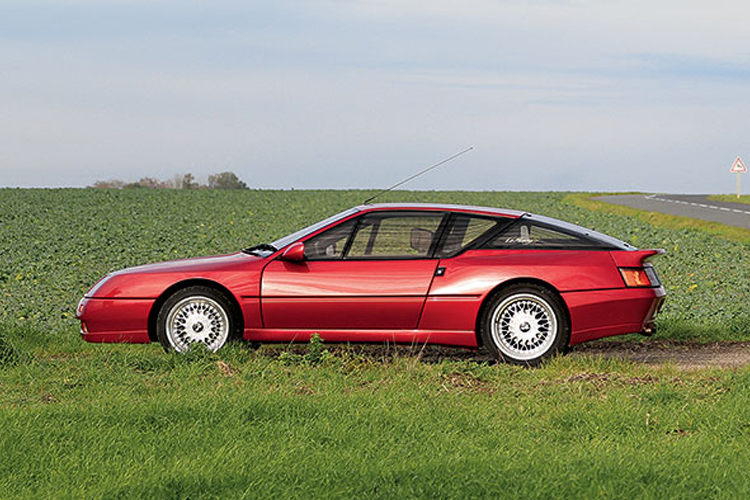
Photo: Renault | Nikita Gudkov
This is a translation. You can read the original article here: Никита Гудков рассказывает, как компания Renault начинала делать зажигательные машины

Published May 01, 2025 • 14m to read