
History often unfolds in surprising ways, and the American automotive landscape is no exception. While the Chevrolet Corvette reigns supreme as an American icon today, it’s worth noting that the Kaiser Darrin could have easily stolen the spotlight. In a parallel universe where the GM conglomerate faced a bit less fortune and entrepreneur Henry Kaiser exhibited more visionary thinking, the Kaiser Darrin might have been the name on every car enthusiast’s lips. Let’s delve into the captivating tale of how this unique automobile came into being and why it deserves its place in automotive history.
From Shipyards to Showrooms
Henry Kaiser was no failure in business. He began with cement and road construction, and by 1939 had moved into shipbuilding; within four years his shipyards employed 300,000 people. Even during World War II his instinct for what came next held good, and he anticipated a post-war shortage of cars. To prepare, he joined forces with Joseph Frazer, former president of Graham-Paige, and in the summer of 1945 they created the Kaiser-Frazer automobile company. Within a year they had unveiled the Kaiser Special and Frazer Standard sedans.
Boom, Then Bust
At first business boomed, at 170,000 cars a year. Kaiser’s cars were genuinely innovative next to those of the Big Three, who were still selling warmed-over pre-war models. But once GM, Ford and Chrysler launched new designs, demand for Kaiser’s fell away. By the early 1950s Frazer had left the business, and the company — now Kaiser Motors — had shifted its attention to a compact, affordable model called the Henry J, named after Kaiser himself.
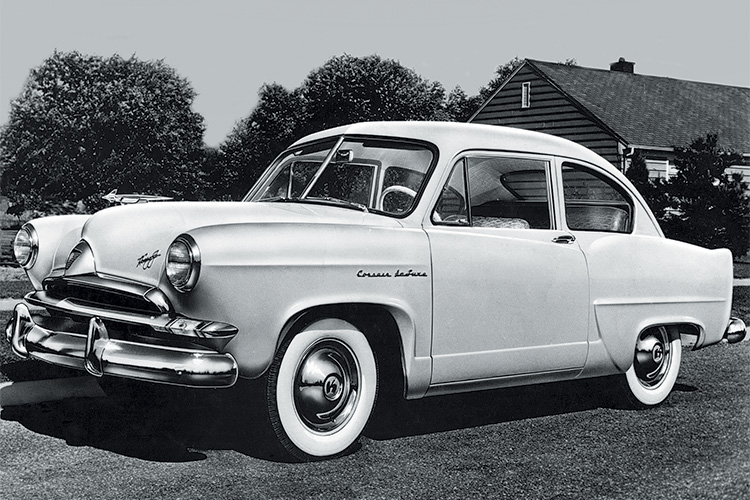
The donor for the chassis and power unit of the roadster was the compact two-door Henry J: from 1950 to 1954, 124 thousand cars were produced.
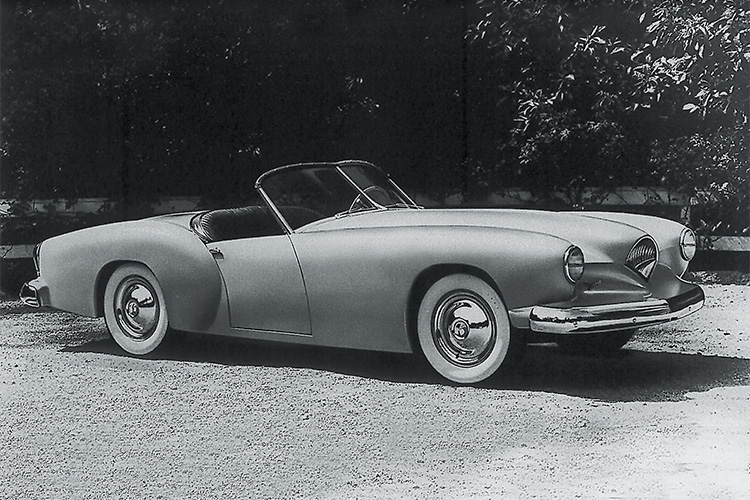
The prototype built by Howard Darrin in 1952 looks more harmonious than the production cars due to the headlights being positioned lower – later, they had to be raised to comply with federal laws. Among other differences are the V-shaped windshield, instruments scattered across the entire width of the front panel, a single-piece trunk lid, and a triple-carburetor engine instead of one.
The People’s Car Nobody Wanted
The Henry J was a sensible choice: a sturdy frame, a compact two-door body of just 4.4 metres, economical engines bought in from Willys-Overland, and a price of $1,363 — nearly a thousand dollars below Kaiser’s full-size Special sedan. On paper it was the people’s car America needed. But the American economy was booming and living standards were rising, which made a basic car from a little-known brand a hard sell. It managed 82,000 units in its first year and only 24,000 in its second.
And yet the Henry J was not a bad car. American journalists of the day grumbled about the build quality but praised the robust powertrain and the lively chassis. It was ahead of its time, and in the wrong place at the wrong moment.
Enter Howard Darrin
Darrin had begun in automotive design in the United States in the 1920s, then moved to Paris, where he built custom bodies for prestigious European models. Having weathered the Great Depression he returned to the States and worked with Packard, and after the war he became a design consultant to Kaiser-Frazer. His relationship with the leadership there was turbulent: his avant-garde proposals were repeatedly set aside in favour of more practical ones, and the flamboyant Darrin twice stormed out, only to return.
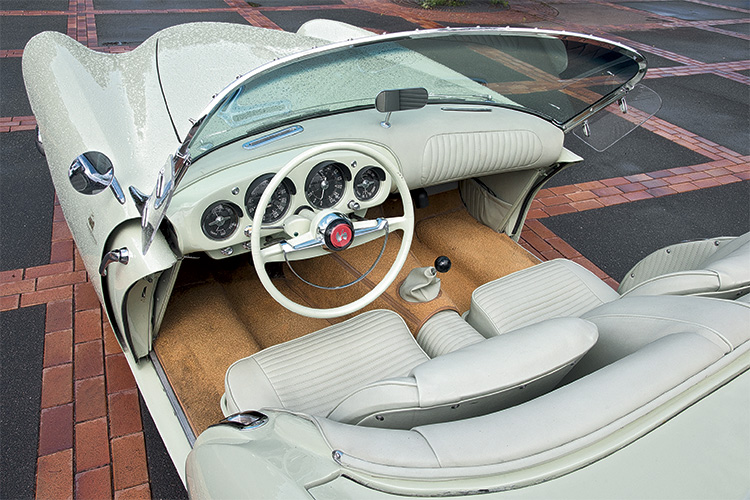
Getting into the cabin is not easy, but once inside, there are no problems, despite the developed sills that conceal the frame. The front panel is trimmed with the same leather as the seats, and protection from the side wind is provided only by small wind deflectors on the windshield frame. The tinted strip at the top of the glass is a factory option for $16.
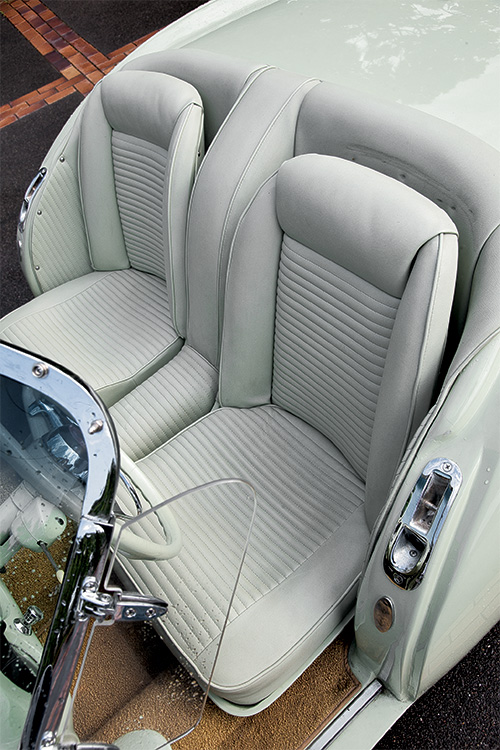
The seats are moderately soft and quite comfortable, with even longitudinal adjustment available.
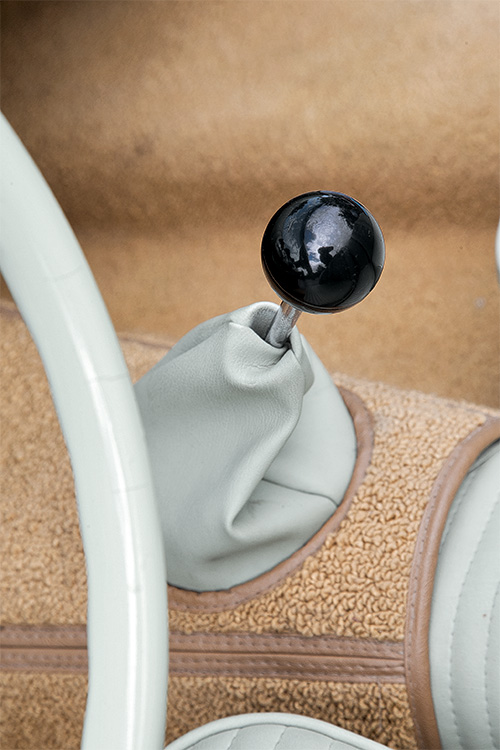
Working with the short lever of the three-speed manual transmission is a pleasure.
A Sports Car Built Without Permission
By the early 1950s Darrin could see the automotive business struggling and the Henry J floundering, and he decided to take matters into his own hands. He would build a striking sports car on the Henry J — in his own time, with his own money, and without the blessing of the company’s management.
His inspiration was Bill Tritt, founder of Glasspar, a company specialising in fiberglass components. Tritt had set Glasspar up in 1950 and introduced the fiberglass-bodied Glasspar G2 sports roadster in 1951; those two-seaters, built on their own chassis with Ford engines, were produced in small numbers until 1953. In 1952 Howard Darrin ordered a two-seater fiberglass body from him.
A Reprimand, Then a Green Light
By the autumn of that year the car was finished and shown to Henry Kaiser himself. The initial response was criticism and a reprimand — but Kaiser soon recognised it as a publicity magnet for a car business in decline. Given how popular small British roadsters had become, the project got its green light.
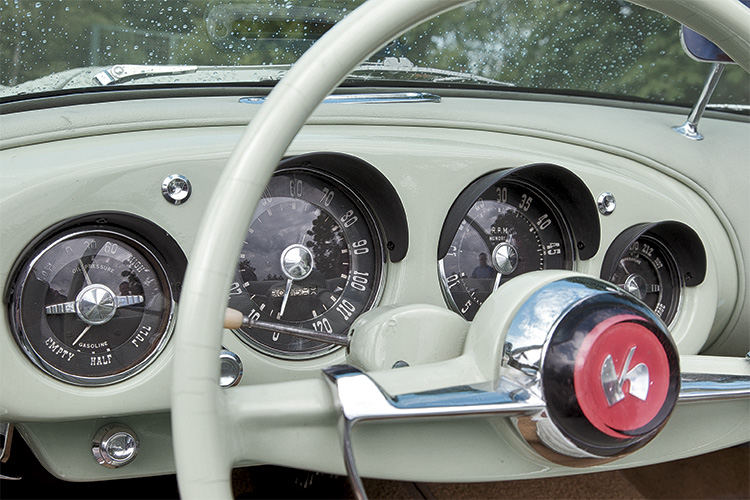
A rich set of instruments! However, there is only one indicator light, which is for the “turn signals.”
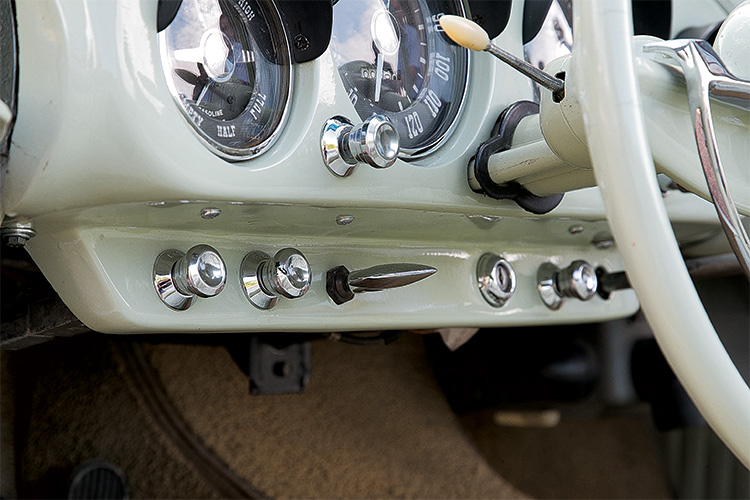
On the left, below the steering column, there is an extending lever for engaging the overdrive.
Beaten to Market by the Corvette
In November 1952 the two-seat Kaiser Darrin made its debut at the Petersen Motorama in Los Angeles, stealing the limelight from its main rival, the Chevrolet Corvette roadster. But while GM began Corvette production in the summer of 1953, Kaiser could not start building the roadster until the winter.
Was the wait worth it for buyers? We found a Kaiser Darrin in Moscow, in the collection of a restoration workshop in Kamyshmas — a car that had been extensively restored before it ever reached Russia.
Grace, and a Fan-Shaped Grille
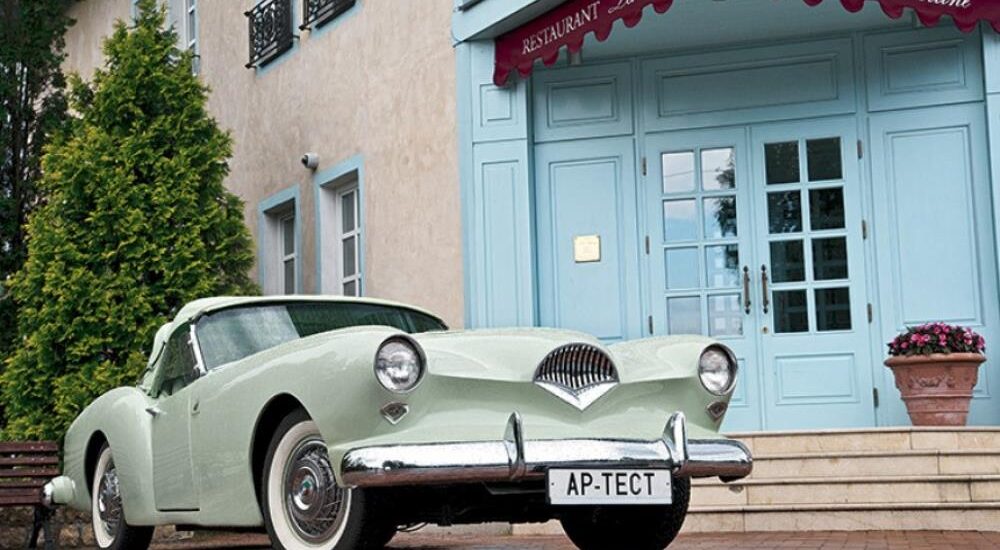
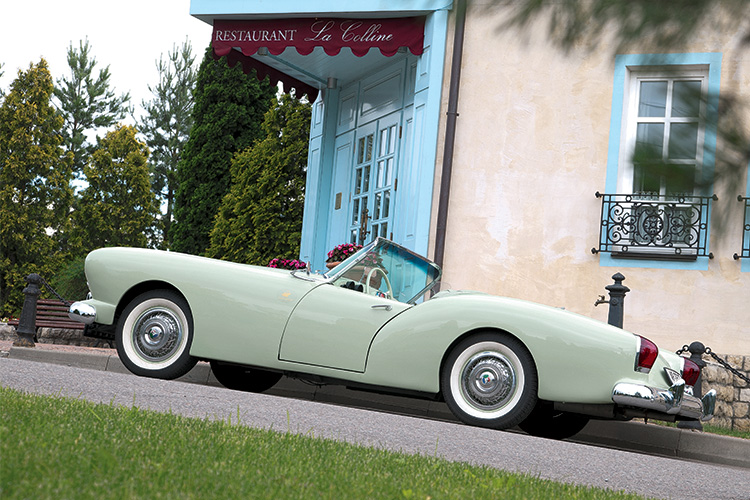
The design is graceful and sophisticated. Darrin’s signature shows in the way the front fenders flow into the rear arches. The fan-shaped radiator grille, with its under-grille pods, adds elegance, and there is nothing superfluous anywhere on the body.
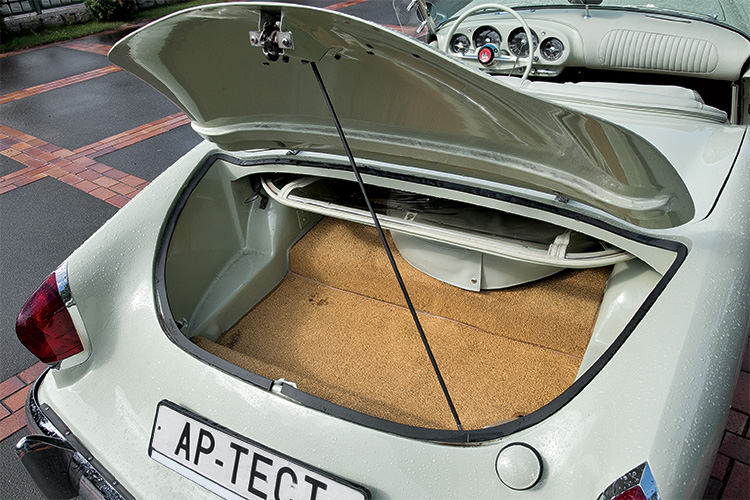
The trunk compartment has two covers: the rear one opens with a key and is intended for loading luggage…
At the rear there are two lids. The rear one opens with a key and is for luggage; the front one hides the folded roof, and unlocking it is a sequential business.
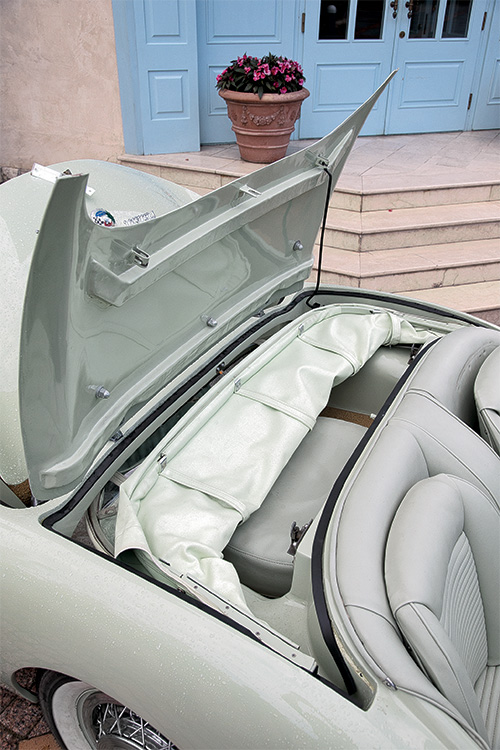
…while the front one covers the folded roof, and the handle for unlocking its lock is located in the trunk itself – the covers have to be opened sequentially.
A Roof With Two Settings
The soft top, with a polythene rear window, folds neatly into the trunk. Raised, it offers two configurations: fully closed, or targa-style, with the roof’s visor folded inside and securely fastened with buttons. The Darrin had no side windows, though aftermarket companies later offered attachable soft ones.
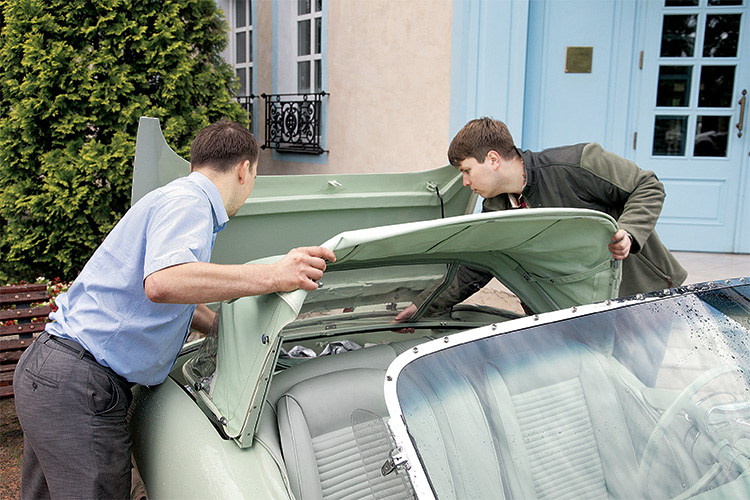
Installing the roof on the Kaiser Darrin is a breeze when you have a helping hand; it takes just about three minutes. The rear part securely attaches to the trunk lid with three latches, while the visor fastens to the windshield frame using buttons.
Ninety Horsepower, and a Ton to Move
Under the hood the Kaiser Darrin carries the same Willys-Overland inline six as the Henry J: 2.6 liters, or 161 cubic inches, which is where the internal factory index comes from. The rise from 80 to 90 horsepower may not sound like much, but the Darrin, with its fiberglass body, weighs only a little over a ton.
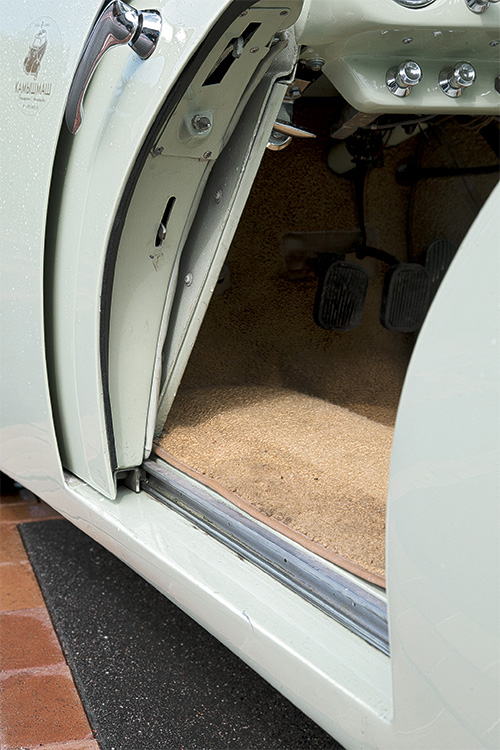
To ensure the doors slide smoothly within their openings, regular maintenance of the sill guides, including cleaning and lubrication, is necessary. The door lock mechanism is straightforward, consisting of a latch that engages with the rear end of the opening.
A Gear Pattern From Another Era
Start the engine, and the thing to treat carefully is the three-speed manual — no automatic was even offered. The synchronisers are delicate, and the shift pattern follows the conventions of its day. First sits where most modern cars put second; second occupies the place of third; third is where fourth usually lives; and reverse is where we now expect first. It is a layout reminiscent of the Volga or the GAZ-69 “Goat” from the same era.
What stands out is the precision. Despite the linkage between the lever and the gearbox, missing a gear is very nearly impossible. Downshifts are smooth and effortless, and the engine answers the throttle promptly with a warm growl that could be a Volga’s.
The Overdrive, at $107
The roadster also has an overdrive — an additional two-speed gearbox from Borg Warner, set between the main transmission and the driveshaft. Engage it while cruising in a high gear and a simple automatic system shifts to a 0.7:1 ratio, dropping the engine RPM and improving economy. It can also be engaged by hand, with a lever under the front panel. Offered as a $107 option on the Darrin and on other American cars of the period, it became popular enough that by the 1970s manufacturers were building it into the main gearbox housing.
How It Actually Drives
On the road the Darrin handles corners well, with minimal roll and a confident line. The steering is precise but unexpectedly heavy, and short of feedback. Braking demands a genuinely strong foot: the system is hydraulic, but there is no assistance at all.
It accelerates briskly and reaches 80 km/h without effort, which fits it neatly into modern city traffic. Pushing beyond that is less comfortable. Wind buffeting arrives from every direction, and the stiff rear suspension — five-leaf springs, designed for heavier loads — starts passing vibration and impacts into the body, which sways from side to side. Holding it steady through an unassisted steering wheel gets tiring quickly.
435 Cars, and the End of Kaiser
In sum, Kaiser and Darrin did not produce a full-blooded sports car. Then again, the first Corvette had much the same problem, even at “only” $3,523 — $132 less than the Darrin. And buyers hesitated to put money into a car from a manufacturer on the brink of bankruptcy. During the brief 1954 production run only 435 roadsters were built, and demand was lower still. Production stopped, and by the spring of 1955 Kaiser had left car manufacturing altogether.
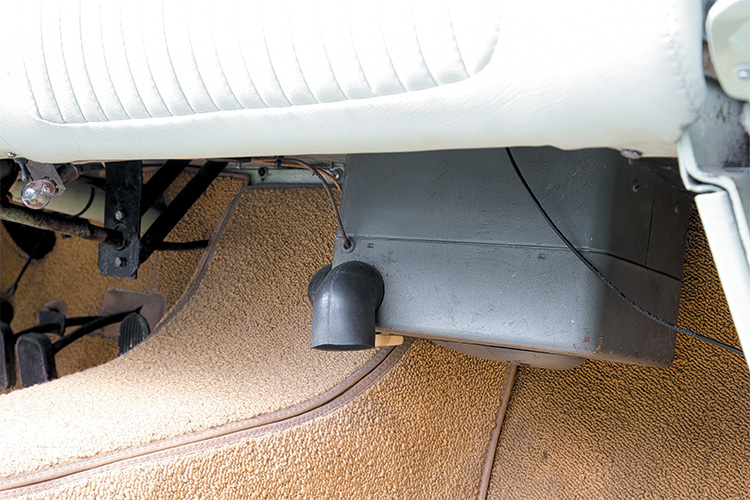
The heater was offered as an option for $68. It only has one mode of operation – warm air is directed towards the windshield and the passengers’ feet.
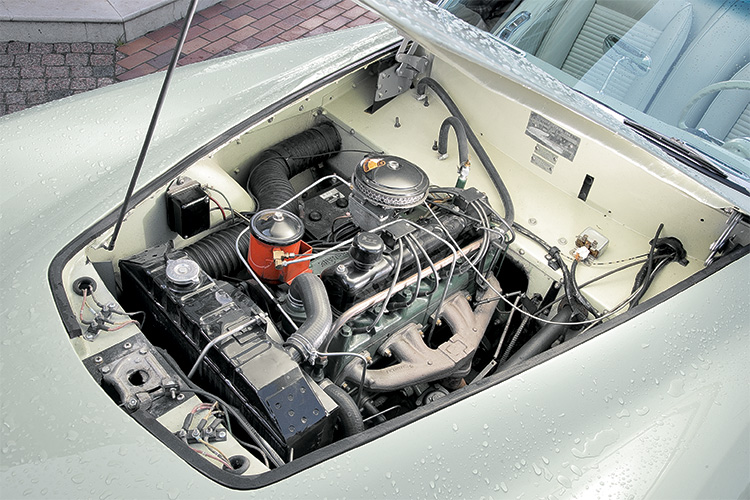
The inline-six carbureted engine was placed in the engine compartment with ample space – later, Howard Darrin installed V8 Cadillac engines here.
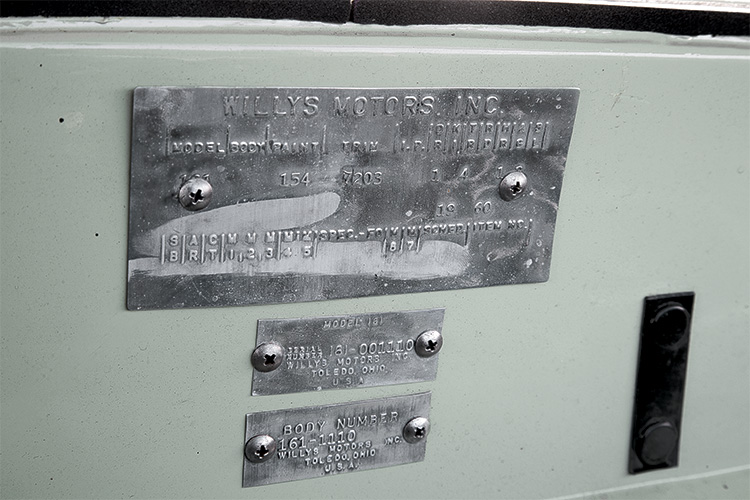
As early as 1953, Kaiser sold the Michigan plant to the General Motors conglomerate and relocated production to the Willys factory in Toledo. As a result, the roadster is attributed to Willys Motors Inc. as the manufacturer.
Henry Kaiser did not leave the industry, though. In 1953 he acquired Willys-Overland and found success building the increasingly popular Jeep.
Fifty Cars, a Hollywood Showroom, and a Cadillac V8
Nor did the Darrin’s story end there. By early 1955 the manufacturer still held nearly a hundred unsold cars. Howard Darrin bought fifty of them himself and sold them through his Hollywood showroom until 1958. He offered a hardtop as an option, and on selected cars he replaced the base engine with a Cadillac V8 and added a McCulloch supercharger. Those cars were dramatically livelier — and by then it was far too late.
Today around three hundred Darrins survive worldwide, priced between $100,000 and $140,000 depending on condition.
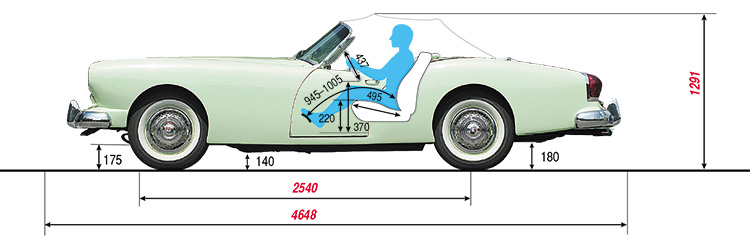
Manufacturer data is highlighted in red text, while black text represents measurements by Autoreview.
Full Specifications
| Car | Kaiser Darrin 161 |
| Body Type | Two-door Roadster |
| Number of Seats | 2 |
| Dimensions (mm) Length Width Height Wheelbase | 4648 1716 1291 2540 |
| Front/Rear Track (mm) | 1372/1372 |
| Curb Weight (kg) | 1070 |
| Engine | Gasoline, Carbureted |
| Engine Placement | Front, Longitudinal |
| Number and Arrangement | 6, Inline |
| Displacement (cc) | 2638 |
| Bore/Stroke (mm) | 79.4/88.9 |
| Compression Ratio | 7.6:1 |
| Number of Valves | 12 |
| Max Power (hp/kW/rpm) | 90/66/4200 |
| Max Torque (Nm/rpm) | 183/1600 |
| Transmission | Manual, 3-speed, with Overdrive |
| Gear Ratios I II III Overdrive Reverse Final Drive | 2.61 1.63 1.00 0.70 3.54 4.10 |
| Drive | Rear |
| Front Suspension | Independent, Spring, Double Wishbone |
| Rear Suspension | Dependent, Leaf Spring |
| Brakes | Drum |
| Tires | 5.90-15 |
| Max Speed (km/h) | 158 |
| 0-96 km/h Acceleration (s) | 13.8* |
| Fuel | Gasoline (AI-92) |
Measurements from Motorsport magazine, December 1954
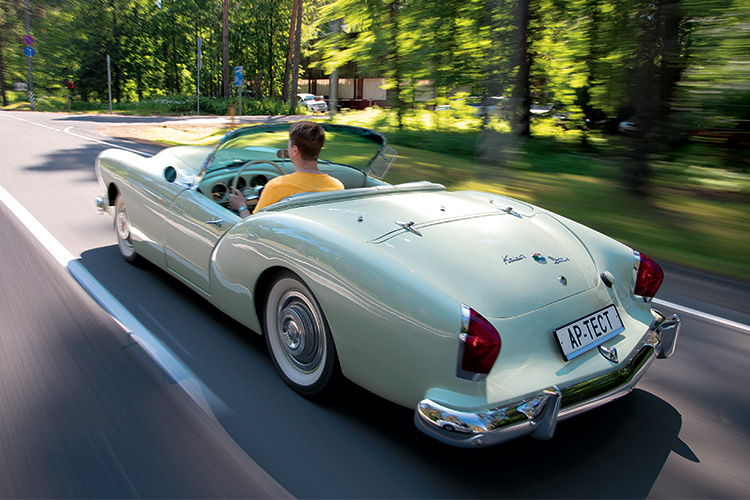
Photo: Stepan Schumacher
This is a translation. You can read the original article here: Kaiser Darrin — в руках Игоря Владимирского на ретротесте Авторевю

Published November 22, 2023 • 10m to read