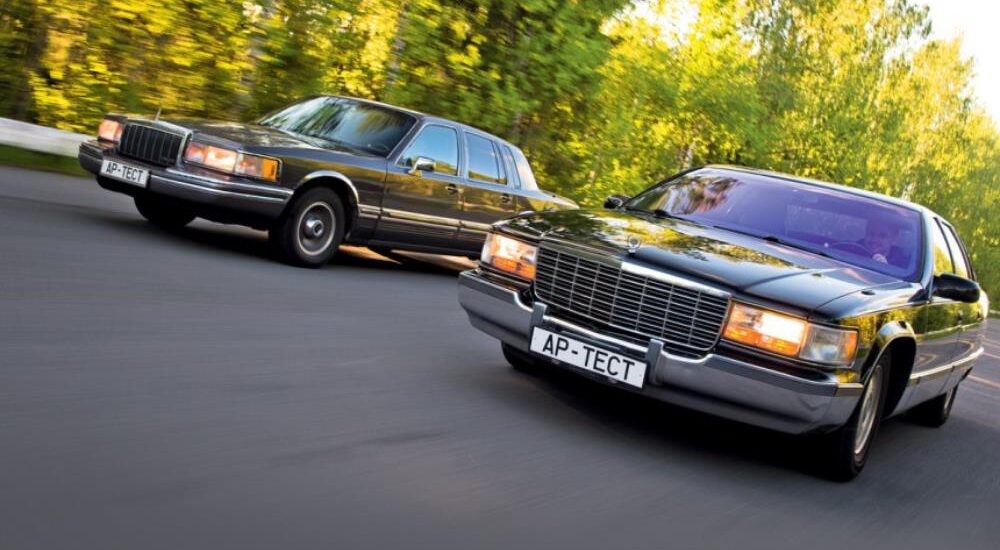

Close the heavy door, sink into a seat the size of a small sofa, pull the gear selector down and turn the steering wheel almost four times from lock to lock before easing out onto the Dmitrovskoye Highway. This is not really a car. It is a way of travelling that the 1990s took with them when they left. Two cars, in fact: the Lincoln Town Car and the Cadillac Fleetwood Brougham, two titans of American luxury, driven back to back.
Both were sold as the last word in American luxury; both are now old enough to be somebody’s hobby. What follows is what they are actually like to live with and to drive, thirty years on.
The Fleetwood Brougham: Cadillac’s Last Rear-Drive Giant
The Fleetwood’s debut in 1993 was nothing short of dazzling. Chrome accents and emblematic medallions covered the exterior; gleaming polished-metal trim ran along the sills and the fenders, and even across the bumpers. For an extra $1,600 you could have chrome wheels, and another $925 added a vinyl roof covering.
The Fleetwood Brougham was Cadillac distilled. Introduced to mark the brand’s 90th anniversary, it was 10 cm longer than its predecessor and kept the classic separate frame. This was also the model chosen as the basis for President Bill Clinton’s official limousine. For all its grandeur it could not compete with Mercedes or Lexus, and by the end of 1996 General Motors had stopped building it — the end of an era for the body-on-frame, rear-wheel-drive sedan.
Much like the Titanic, the Fleetwood went down before it could truly shine. The new 5.7-litre engine delivering 264 horsepower and an upgraded transmission arrived in 1994. Our test car, a final 1996 model, is that car at the peak of its evolution.
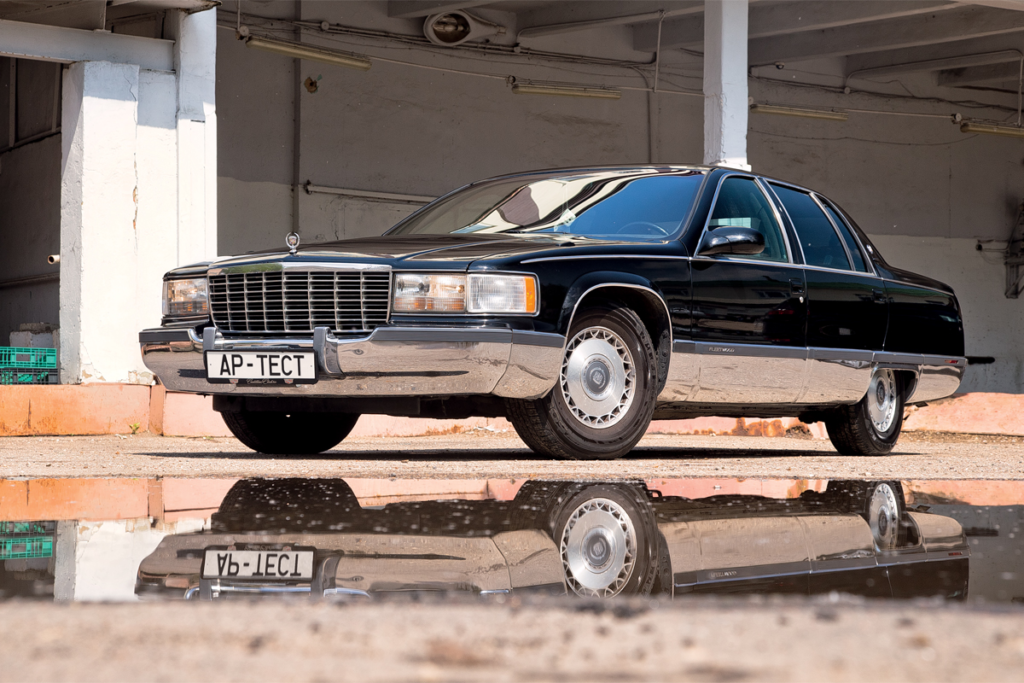
Chrome details are a heavy burden for any retro car owner. On the Cadillac, they are in the most “sandblasted places.” Either you need to order replacement panels from the USA, or re-chrome the old ones at astronomical prices.
A Car the Length of a City Block
Walking the length of the Fleetwood feels like traversing a city block. It is a behemoth, and it demands attention wherever it goes. From the long, sloping hood to the abruptly retro tail, it looks as though two distinct vehicles were melded into one. This is no ordinary sedan — it is a statement, and a testament to American automotive ingenuity.
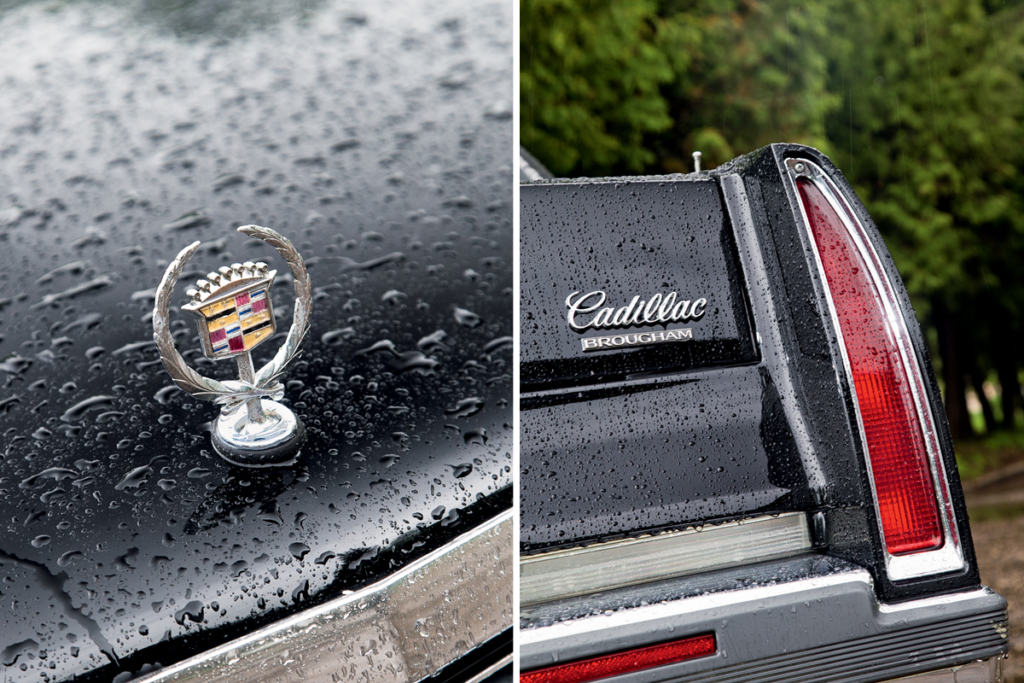
The emblem with the “ducks” also became history. In 2000, the birds disappeared from the emblem (six swans on yellow panels), and in 2014, so did the wreath.
The shining calligraphy on the body is just the “starter kit” of a Cadillac, for an extra fee you could get emblems and inscriptions covered in 24-carat gold, and even a gold-plated ignition key.
Underneath is GM’s venerable D-body platform: the traditional frame and a rigid rear axle, with pneumatic elements added for comfort and stability.
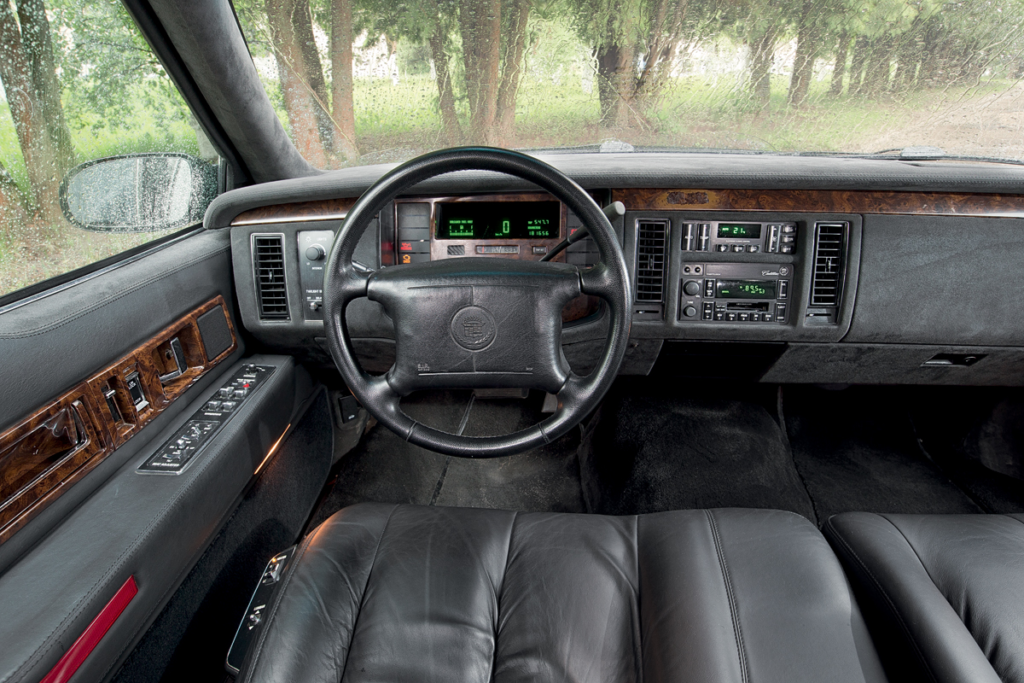
The dimensions of a Cadillac are not only in the length of the hood, the width of the couch, and the height of the front panel. The driving experience is not far behind the visual – the steering wheel makes 3.5 turns from lock to lock. But why in such a large car was there not enough space for a footrest for the left foot?
While every other manufacturer chased aerodynamic gains, Cadillac kept its own iconic shape — visible in the distinctive curve of an open door, and in a drag coefficient of 0.36.
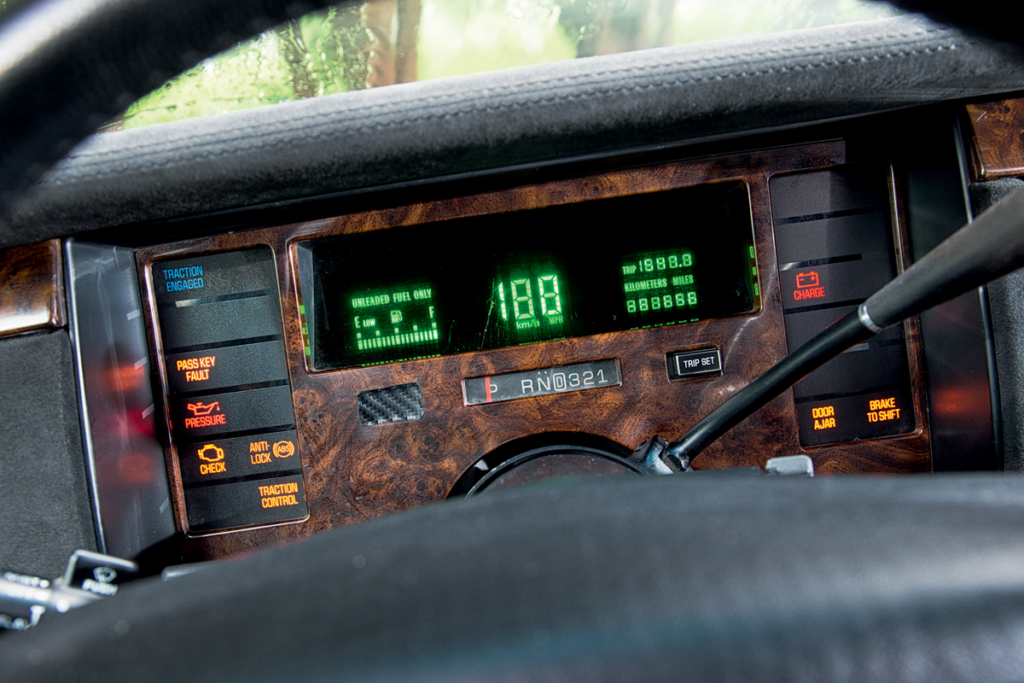
Brevity is the sister of informativeness? Speed, mileage, and fuel reserve – everything a driver needs to know. Plus a few signal lamps.
Inside the Fleetwood: A Texan Living Room on Wheels
Everything you touch inside the Fleetwood is opulent. The door handle has the heft of a diplomat’s briefcase, and the sumptuous sofa-like seats evoke the living room of a Texan villa. Despite the car’s commanding presence on the road, the seating position is surprisingly low — an invitation to settle in and savour the journey rather than hurry through it.
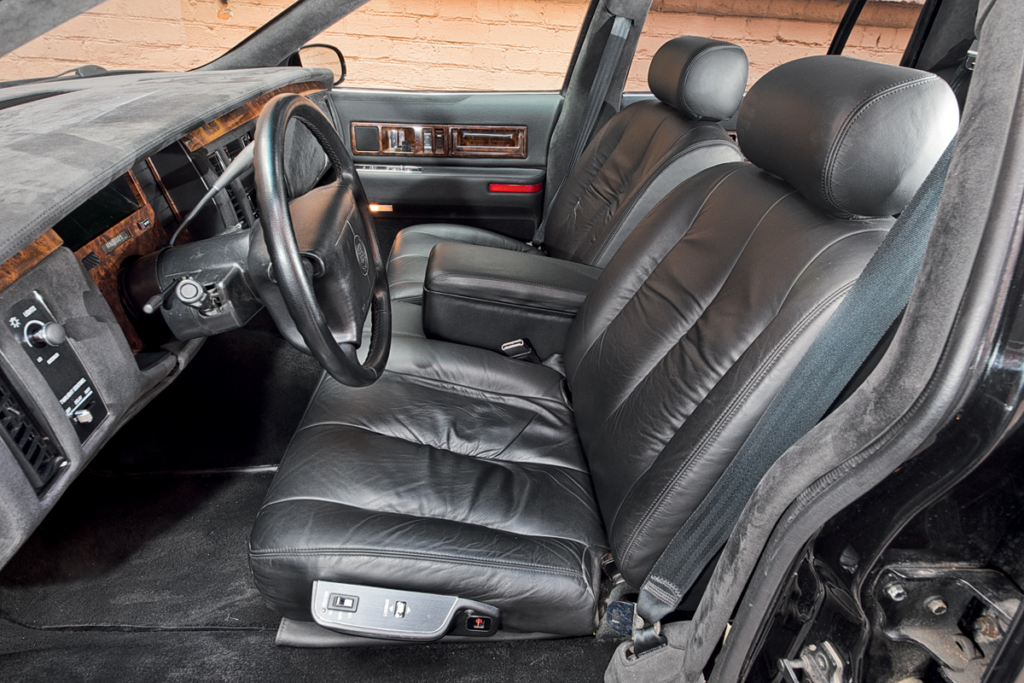
The leather interior required an additional payment of $570, but the split half-couch with a full set of power adjustments is standard equipment. With the armrest raised, it can accommodate three people (the passenger airbag covers both right seats). The history of six-seat GM sedans ended only in 2011 on the Chevrolet Impala model.
The interior has been meticulously restored rather than merely preserved: black leather, quilted sofas, chrome accents and wood inserts, and a sense of timeless elegance. The expansive dashboard, once leather-clad with embossed “Cadillac” lettering, now wears Alcantara. It is worth noting that the “furniture” architecture of Tesla’s Model 3 harks back to exactly this traditional American cabin layout, where the driver occupies a position akin to a desk.
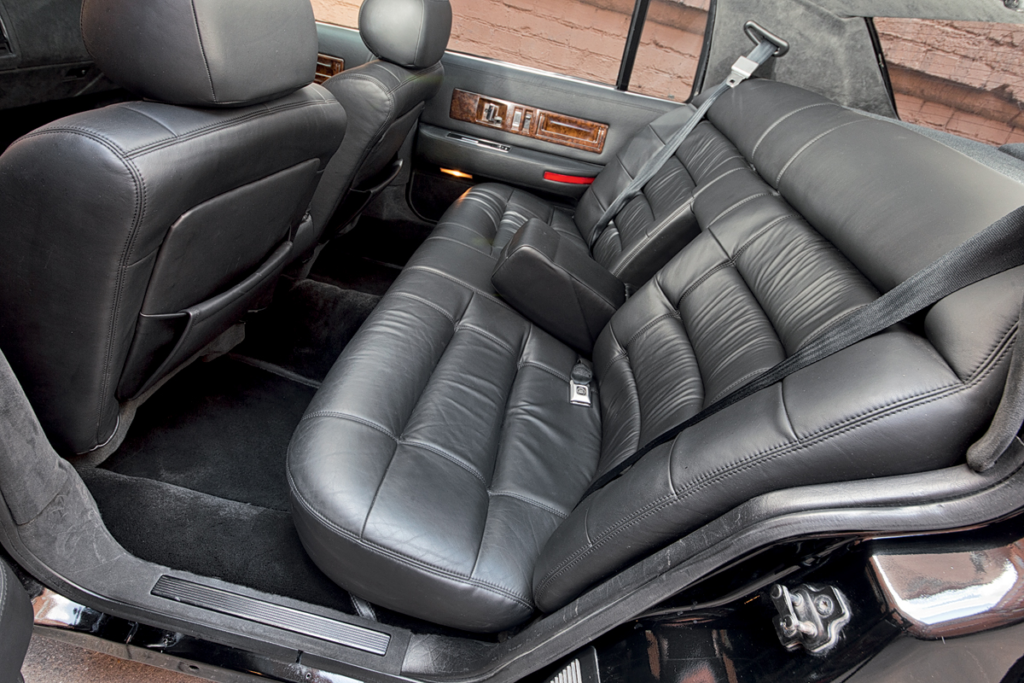
This sofa is so tempting just by its appearance alone. But the most comfortable thing to do here is just to sit back and enjoy the atmosphere and the outstanding smoothness of the Cadillac’s ride.
The Back Seat Is Not the Point
Measuring five metres and seventy centimetres, the Fleetwood is longer even than a long-wheelbase S-Class. Yet for all those dimensions, rear passengers get nothing like the comfort a European or Japanese executive sedan of the era offered. There are minimal seat adjustments and no entertainment options at all; you simply luxuriate in the plush sofa, in the semi-darkness behind wide roof pillars. Cadillac’s brochures said as much — Mercedes, BMW and Lexus were not in the same league, and the Lincoln Town Car stood as the sole external rival.
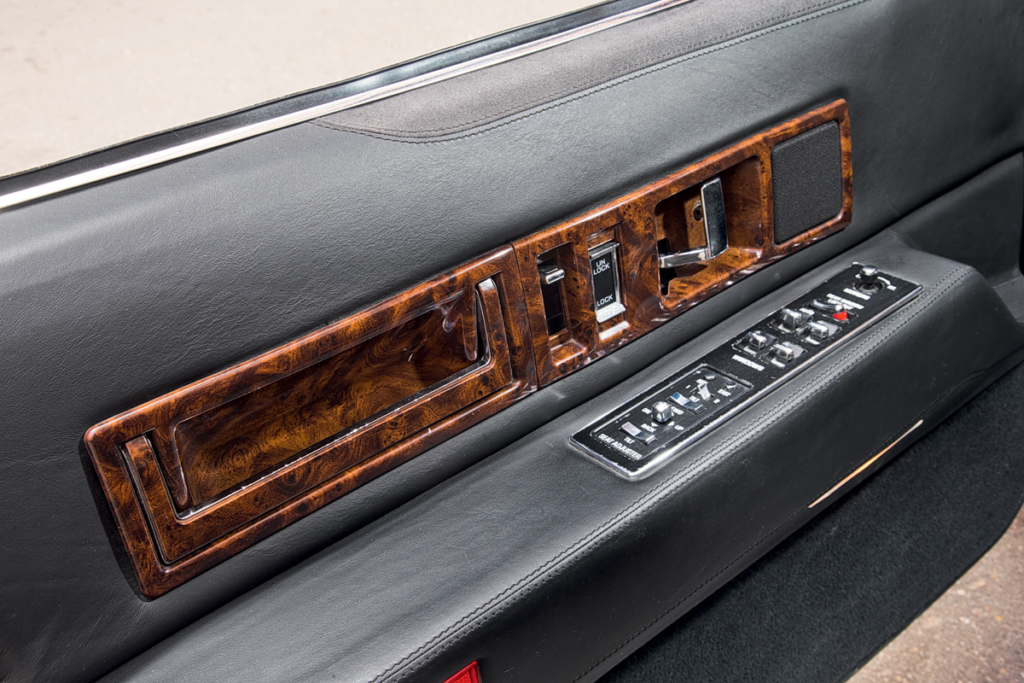
Most of the seat adjustment buttons and joysticks are located on the door. And of course, they are all covered in chrome imitation.
Lincoln Town Car: Thirty Years Without Changing Its Mind
Time has a way of revealing irony. The Town Car’s design had remained virtually unchanged since 1980: the same characteristic hood and trunk slabs, the high cabin profile, the turbine wheels, the imposing radiator grille and the narrow rear window pillar. Lincoln simply kept them while automotive design evolved around it. Three decades later, set against Cadillac’s more contemporary aesthetic, the Town Car exudes a timeless allure — an ancient temple that has outlived the fashion around it.
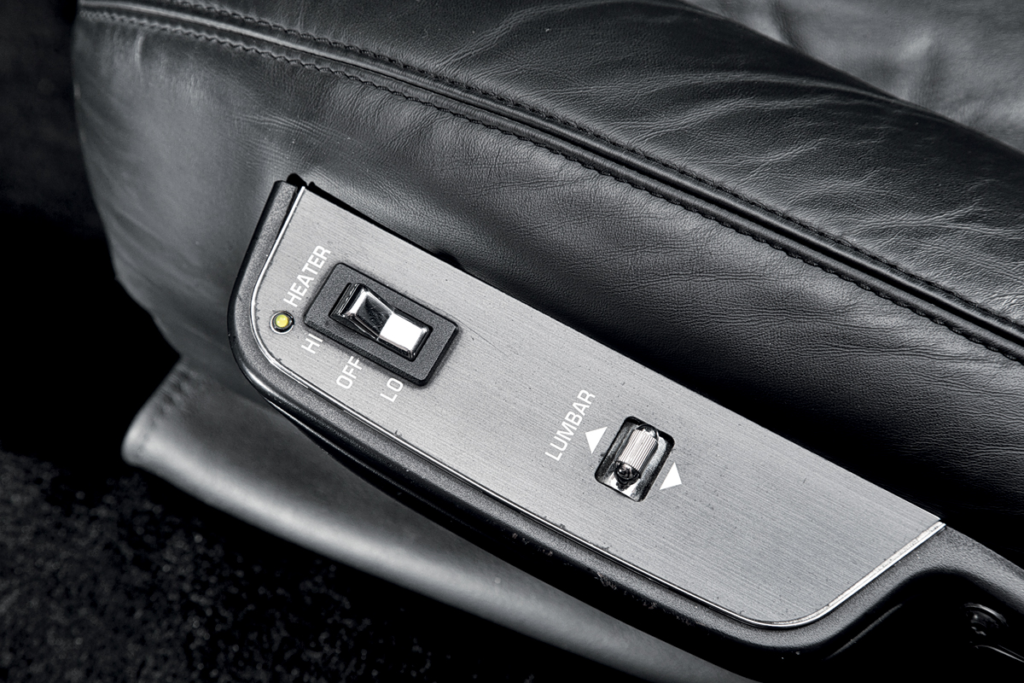
Heated front seats and lumbar support adjustment are part of the standard equipment in the Brougham version.
Inside the Town Car: A Theatre Box in Currant Red
Perceptions shift quickly once you step inside. If the Cadillac’s interior evokes an old villa, then the Town Car… could it be likened to a district illuminated by red lights?
In truth, the burgundy interior pays homage to theatrical tradition. Ever wonder why seats in auditoriums are so often upholstered in red? Because red is the last colour we lose sight of in the dark. Lincoln saloons dating back to the 1960s aimed to capture the ambiance of a grand opera hall, and their optional velvet upholstery in a rich Currant Red was cherished nearly as much as leather.
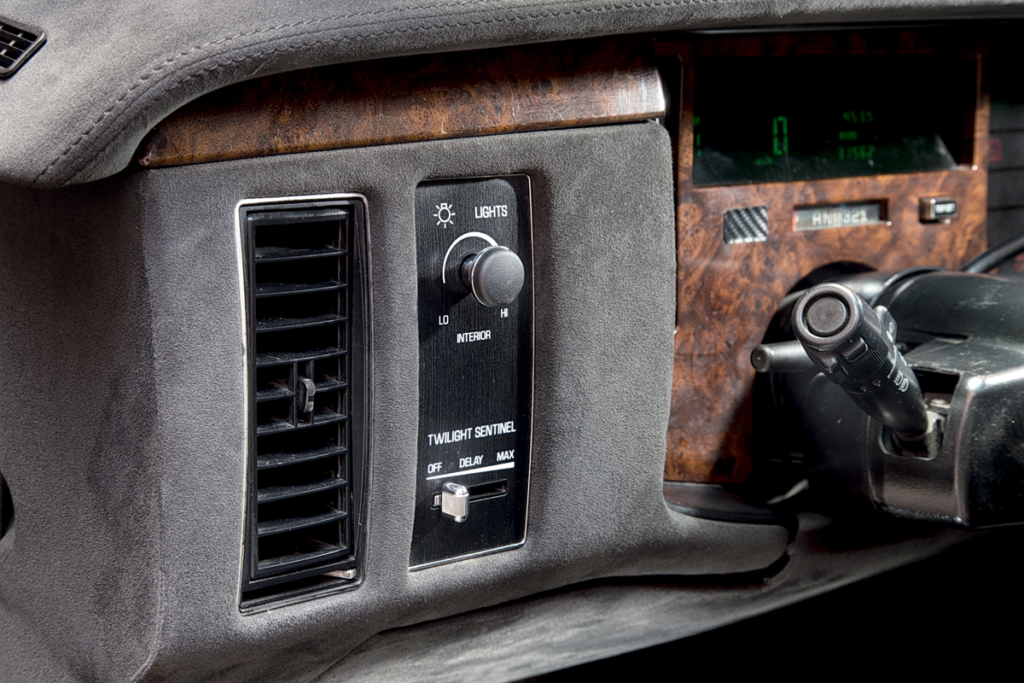
The only steering wheel lever is overloaded like on Mercedes. The lights are turned on by pulling the stalk towards oneself, and the Twilight Sentinel is Cadillac’s “auto” mode tied to the light sensor.
Step inside and you are not entering a car interior so much as a theatre box. The drama does not translate into comfort or practicality, though. The space around the rear sofa is both lower and narrower than the Fleetwood’s, and there is nothing back there beyond embroidered emblems. Legroom is fractionally more generous than in the Cadillac despite a wheelbase nearly 11 cm shorter — and only because the front seats barely move. Their range of adjustment is so restricted that tall drivers end up uncomfortably close to the pedals, while shorter ones have to stretch to reach them.
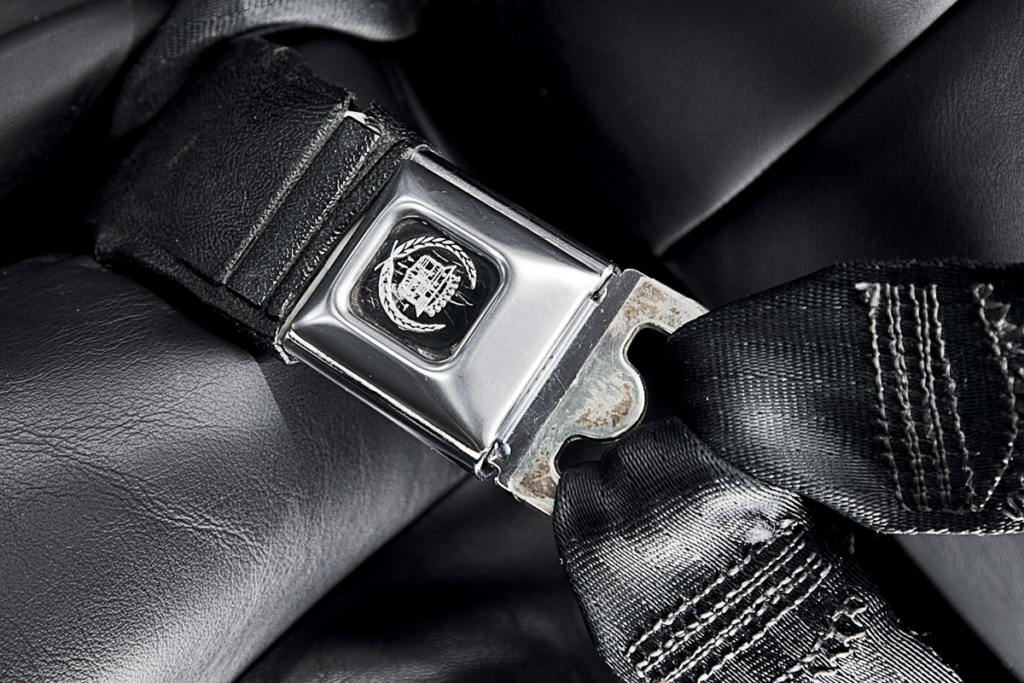
The seatbelt locks are a work of art. The Cadillac has two inertia reels, and the belt tongue is fixed in place.
The thin steering wheel and antiquated instruments, meanwhile, harken back to the 19th century. The 1989 Town Car had introduced a fluorescent digital panel, but basic models kept vintage analogue speedometers. Stepping into this car straight out of the Cadillac thrusts you back at least a decade. Onlookers may see a timeless classic; the driver cannot shake the feeling of being transported to the era of antique carriages.
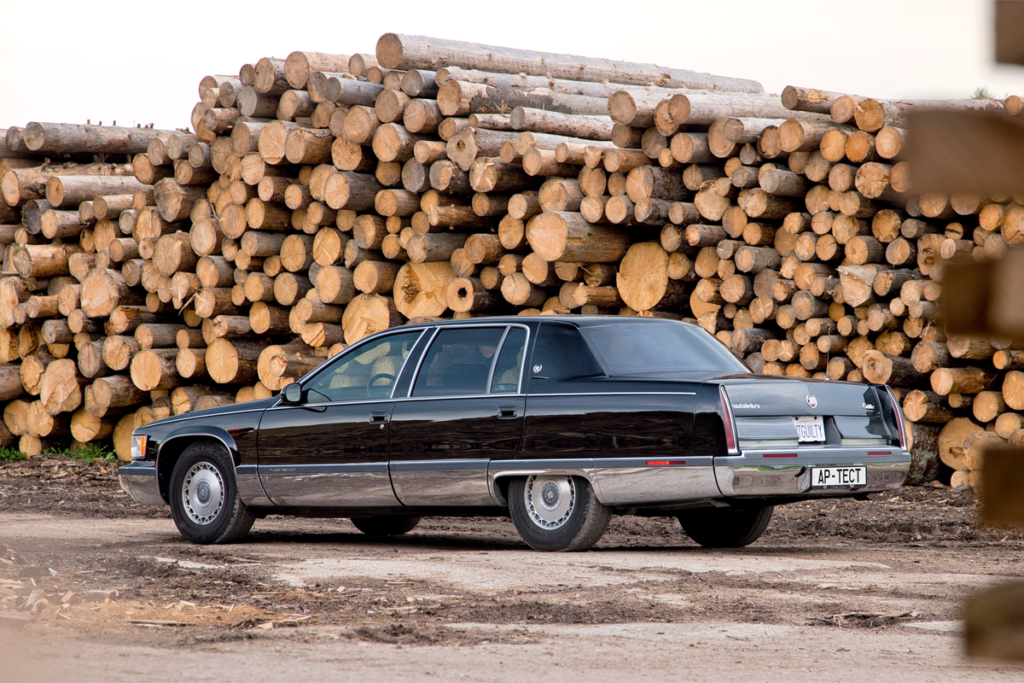
The 235/70 R15 tires make a defining contribution to the smoothness of the ride. But also to the handling. Part of the chrome trim around the rear fender is removed to facilitate tire replacement.
On the Road: Two Owner-Driven Cars
Whatever they look like from outside, both the Town Car and the Fleetwood were designed with the driver in mind. They belong to the owner-driven category — cars for owners who do not mind getting behind the wheel themselves. With that in mind, Yaroslav Tsyplenkov and I put them through a comprehensive driving test, offering little leeway for their age. Neither disappointed.
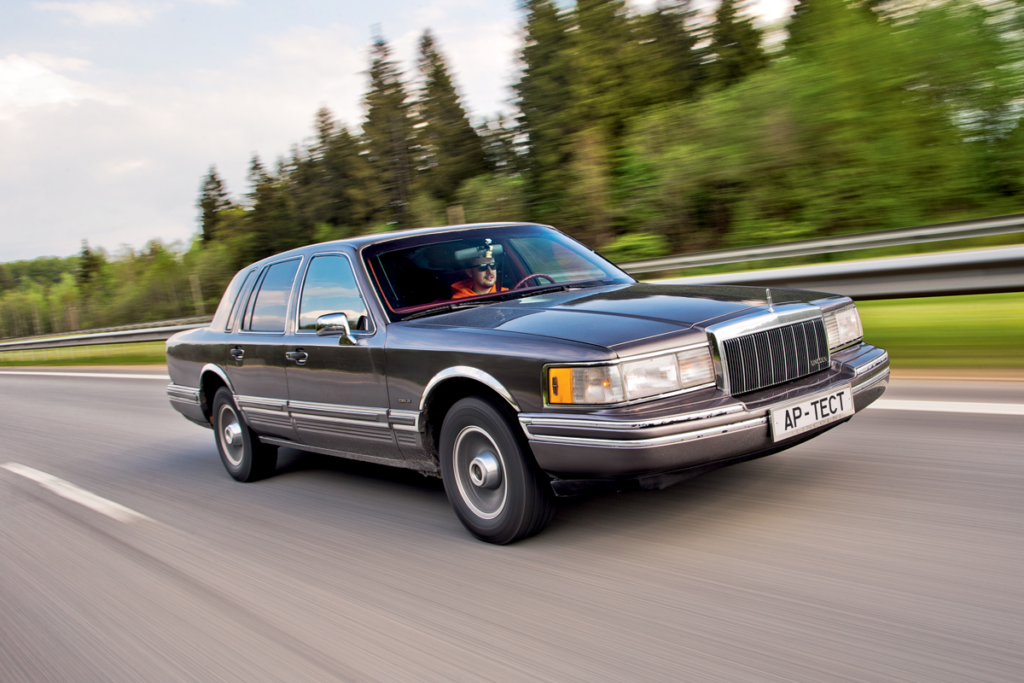
The proportions of the headlights and grille are timeless classics. Thanks to its appearance and frame construction, the Town Car was widely imported to Russia and other post-Soviet countries for use as limousine rentals, so, unlike the Cadillac, it’s much easier to find donor parts for the Lincoln.
Because of how they are built and what condition they are in, both offer a fascinating but eclectic mix of disparate and sometimes conflicting driving characteristics. In a modern vehicle those traits would be seamlessly integrated into one cohesive experience; the Cadillac and the Lincoln present them to the driver separately, as if laid out on a chopping board.
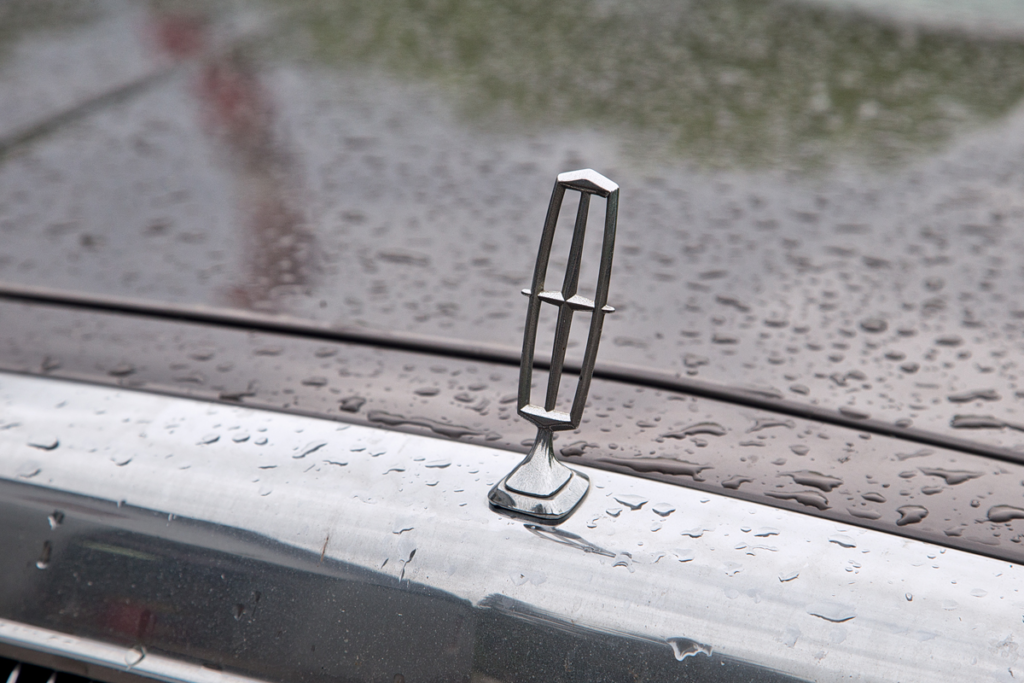
The Lincoln emblem is more modest, as is the entire body decor.
Acceleration Without Feedback
Consider acceleration without feedback — this is precisely how the Fleetwood behaves. The heavy gas pedal takes a significant amount of pressure. In response the Cadillac moves off smoothly, and with more pressure it lunges forward. What you do not get is any control over the process as it unfolds. With no tachometer and no gear indicator, even gauging the shifts by feel proves challenging, because the four-speed automatic operates exceptionally smoothly. The design is tailored to relieve the driver of such minutiae: depress the pedal, and await the seamless execution of actions.
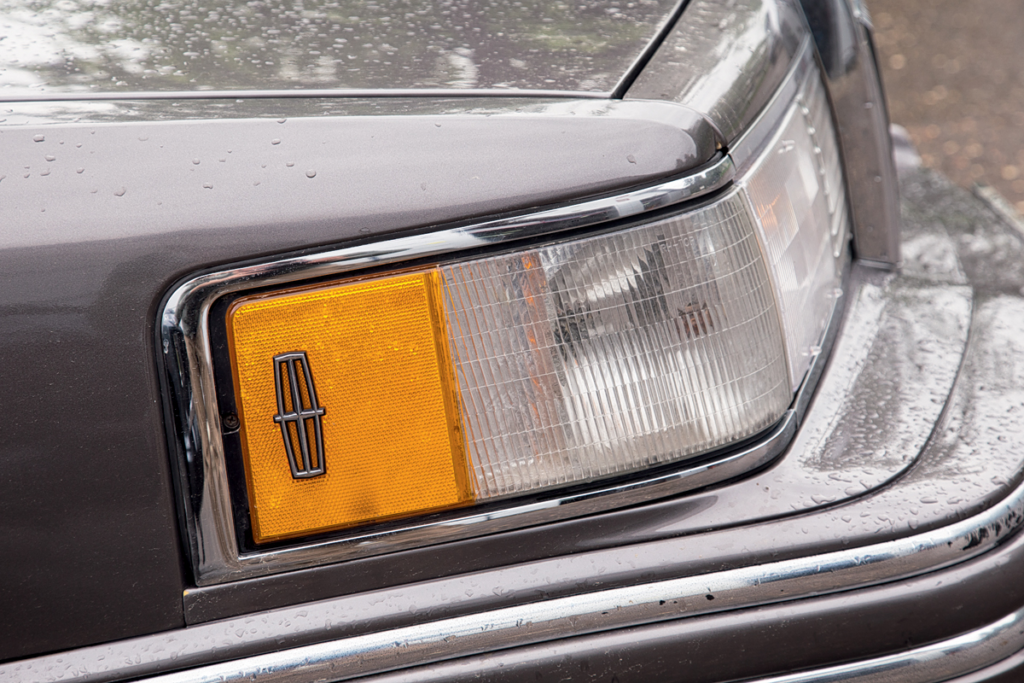
Corrosion-free fenders, chrome, and functional electronics — a rare set for a healthy Lincoln.
And the Fleetwood’s maximum acceleration is nothing short of remarkable. The LT1 5.7-litre V8 purrs with richness and never lacks power: 264 horsepower and an impressive 447 newton-metres of torque. For the Brougham version, Cadillac fitted a “shortened” main gear ratio of 2.93 in place of the standard 2.56.
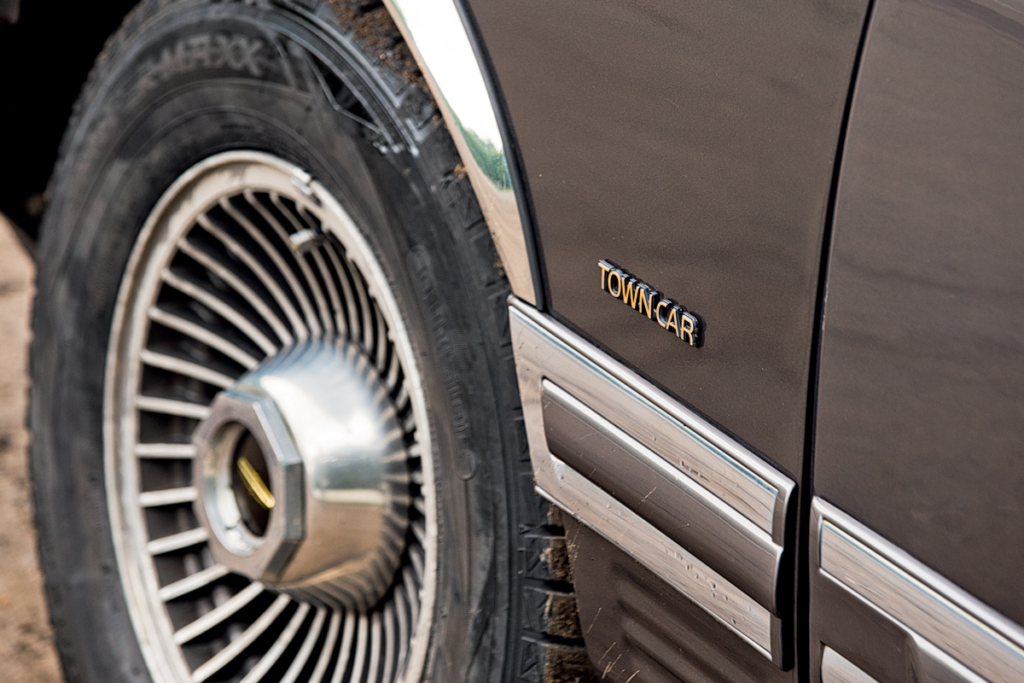
The wheels with a “turbine” pattern are Lincoln’s signature style since the 70s. The hubs are covered with decorative imitation center caps.
Acceleration to the first hundred takes 10.9 seconds, because the engine seems to hesitate at the start. Once it kicks in, the pull is so strong it borders on intimidating. The electronic speedometer ticks upward through a hundred and seventy, a hundred and eighty and beyond, the Cadillac holding its course with some noticeable shuddering at full throttle.
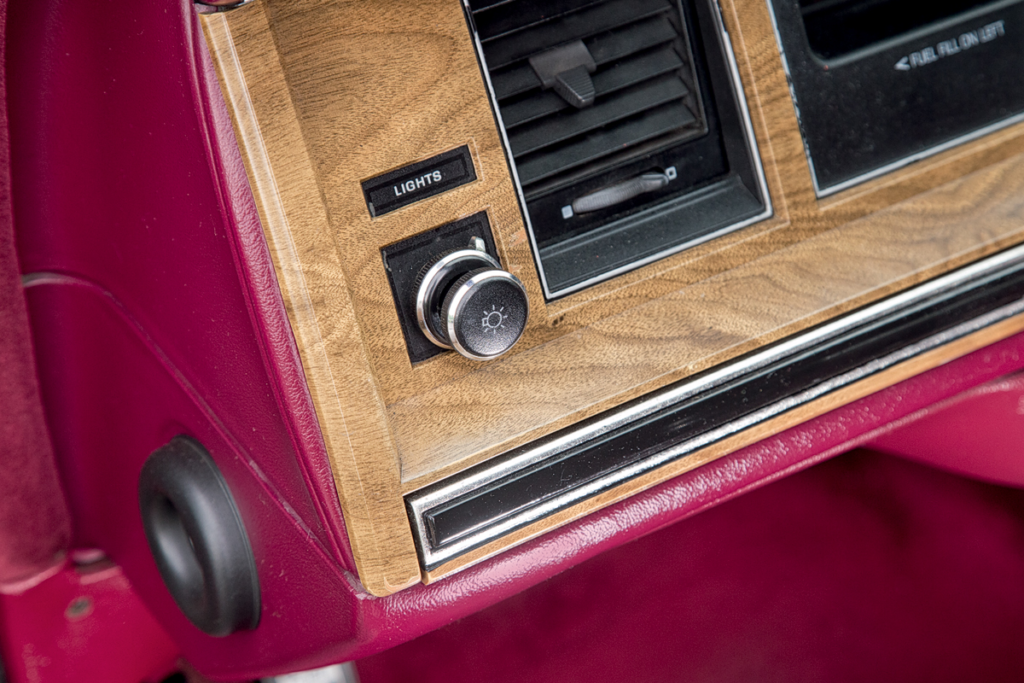
A modest pull-out handle turns on the marker and low beams.
209.5 km/h on Rear Drum Brakes
The values keep climbing until they reach a point where the figure simply is not encoded on the Fleetwood’s digital display, and the readings “reset” after 200 km/h. The acceleration does not cease. Andrey Mokhov recorded a top speed of 209.5 km/h before I eased off the accelerator, mindful of a curb weight of two tons and rear drum brakes that had almost certainly not experienced such speeds in quite some time.
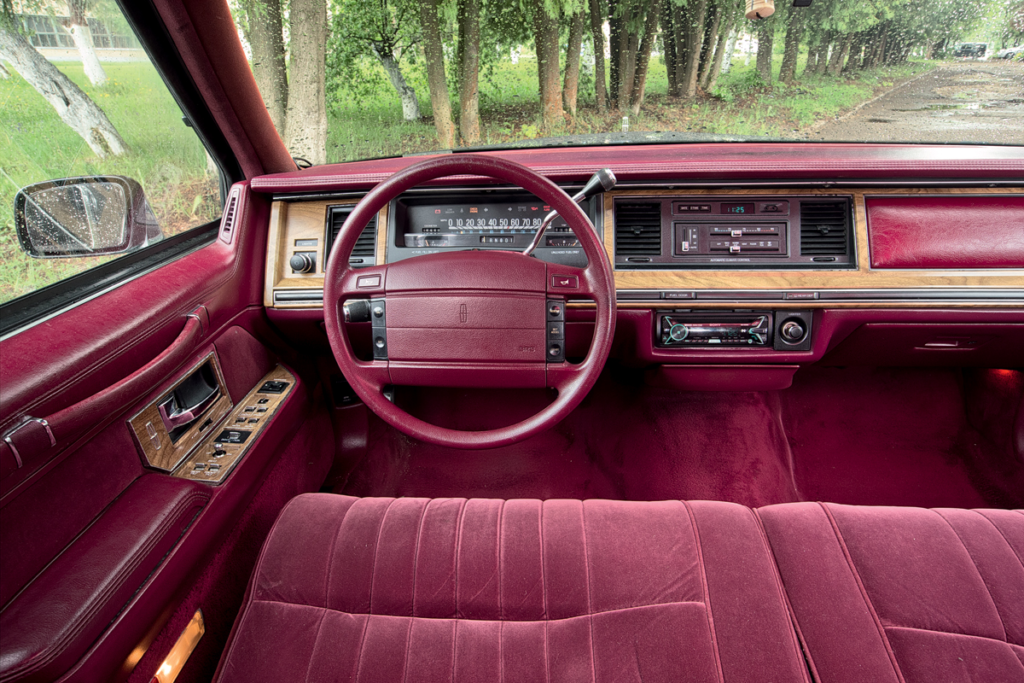
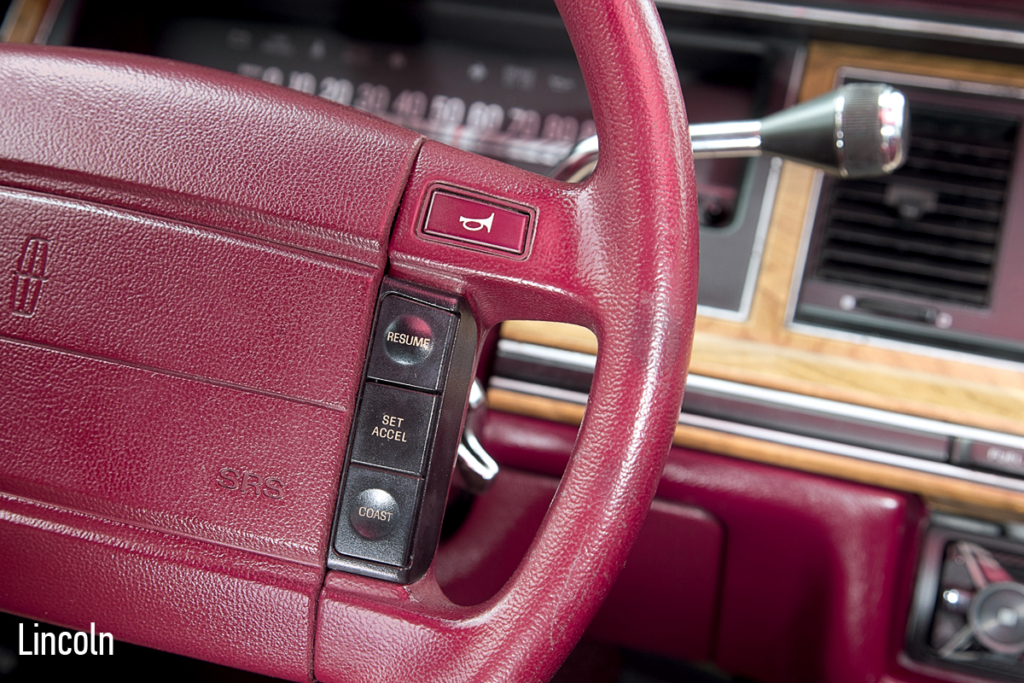
The 90s on the outside, the 80s on the inside. The thin steering wheel and old instruments add age to the Lincoln. But with burgundy velour, you can forgive a lot. Moreover, the Town Car offers a steering wheel with cruise control buttons, which the Cadillac was fundamentally deprived of.
Brakes, and the Electronics That Took the Day Off
Surprisingly, the Fleetwood’s brakes perform admirably. There is reassuring feedback from the pedal, which offers resistance after a slight free play and allows precise control over deceleration. We did not measure the braking distance, however: the ABS seemed to have taken a day off along with all the other electronics in the car, traction control included — and that was standard equipment.
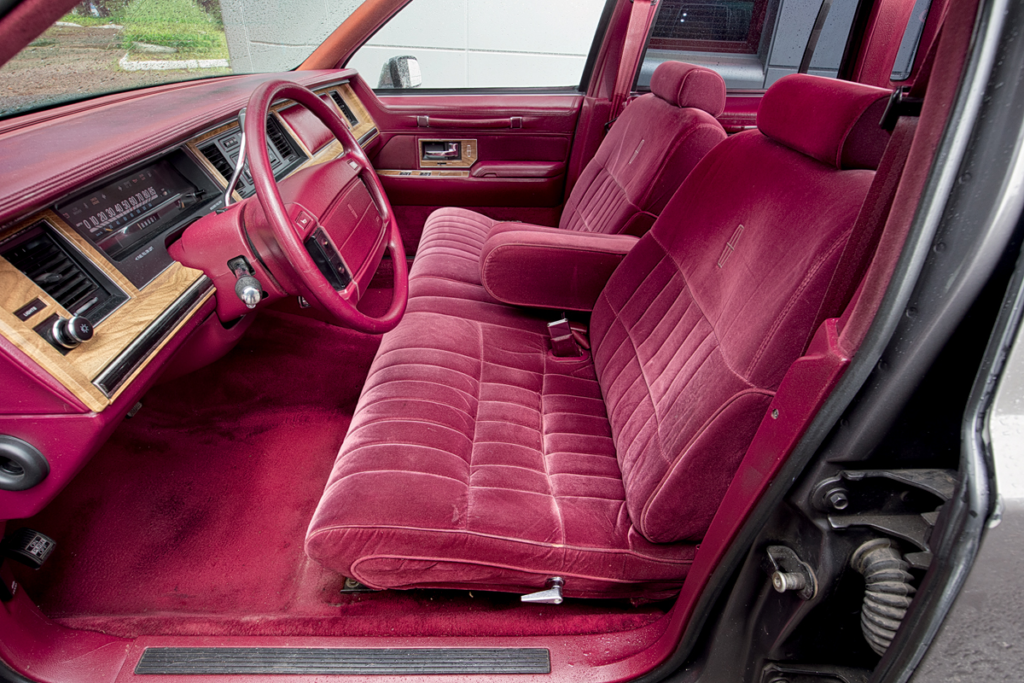
The front bench in the Lincoln is also designed for three, and the profile here is better suited for such seating. But the passenger airbag in the 1991 model year was optional.
The Town Car Feels Quicker Than It Is
The Lincoln Town Car is the opposite case: responsive, but short of acceleration. In 1990 it received a new “modular” overhead V8 4.6 engine producing 193 horsepower, an improvement on its predecessor. As in the Fleetwood there is no tachometer and no gear indicator, and the automatic operates smoothly. Compared with the Cadillac, the Town Car feels almost like a “hot” hatchback, reacting promptly to every touch of the accelerator. Its actual performance falls short: 11.3 seconds to a hundred, and beyond that the acceleration feels strained, reaching a maximum of 85 mph (136 km/h), where the speedometer scale simply ends. Mokhov noted a top speed of 168 km/h.
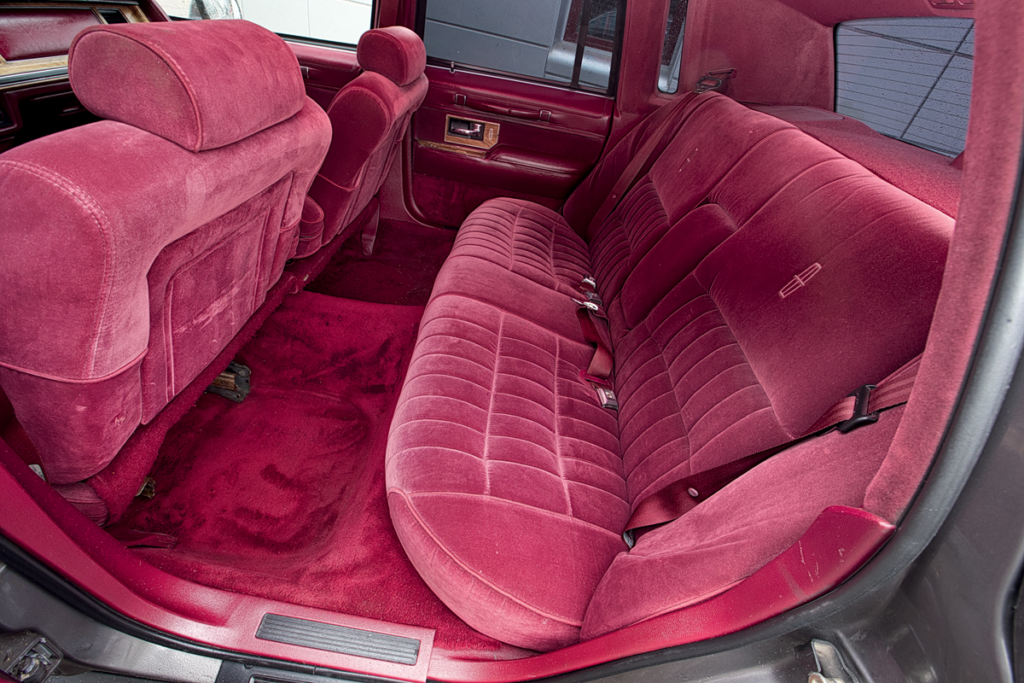
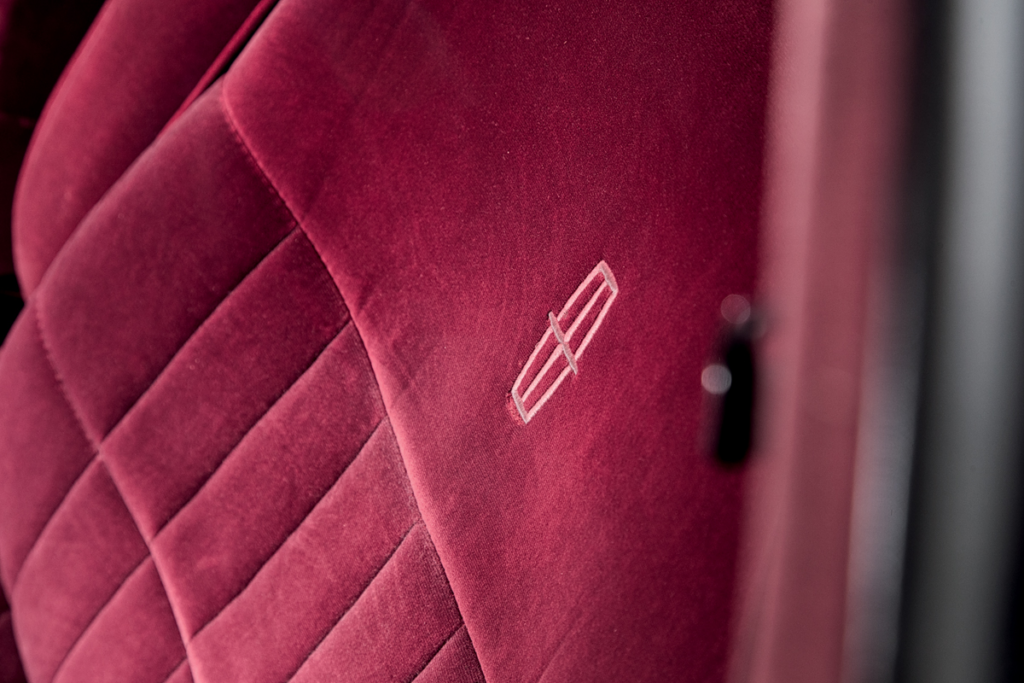
You don’t go to the theater every day, and the red interior of the Lincoln is not the best fit for everyday routine either. But at least once in your life, you need to sit here and ride as if you’re going to the premiere of your own musical.
The Steering Wheel With No Middle
Both cars can feel much alike from the driver’s seat, but the Town Car presents a challenge in driving straight. Constant corrections are necessary, exacerbated by the play in the steering wheel. There is no clear zero position — the wheel oscillates between two “working” positions, neither of which aligns with straight-line motion. Corrections are needed at any speed, complicated by the Lincoln’s tendency to steer smoothly to the right but sharply to the left, with the steering wheel failing to return to centre on its own. It is a true test of bravery, and unlikely to have been intentional on Ford’s part.
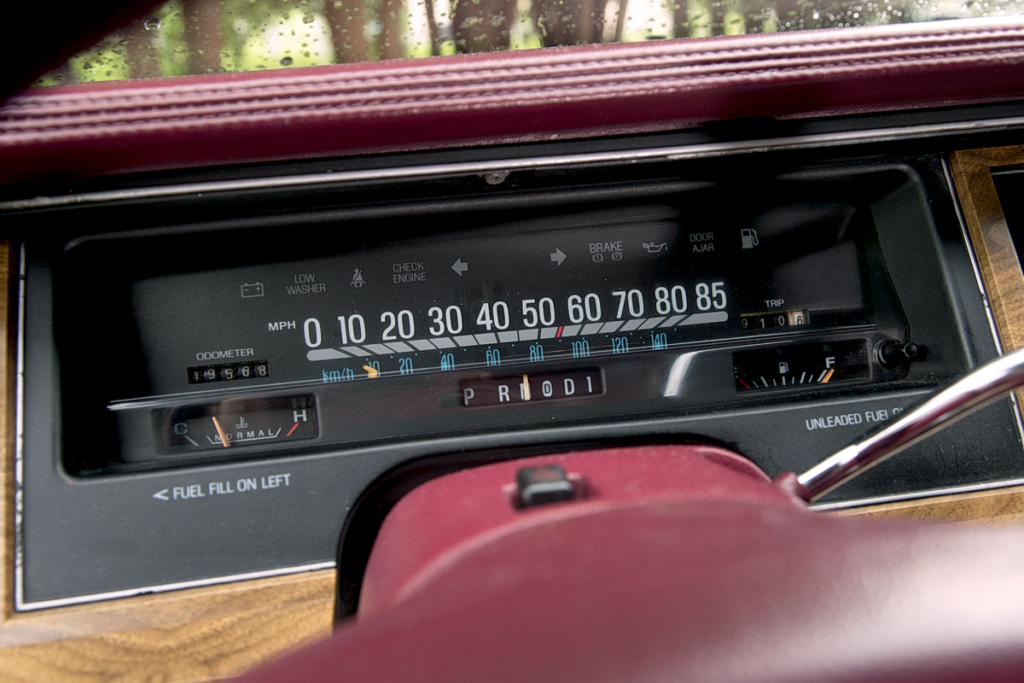
Lincoln supplements the minimal information set with a coolant temperature gauge. But the old-style speedometer doesn’t match the capabilities of the “new” 4.6 engine.
Only at speeds up to 100 km/h can one relax slightly, and even then corrections continue, just less urgently. This is the Town Car’s leisurely register: a gentle pace, a subtle engine hum, seamless shifts, one hand on the wheel and the other draped over the front bench backrest. It embodies the essence of a “city car”, not one built for racing.
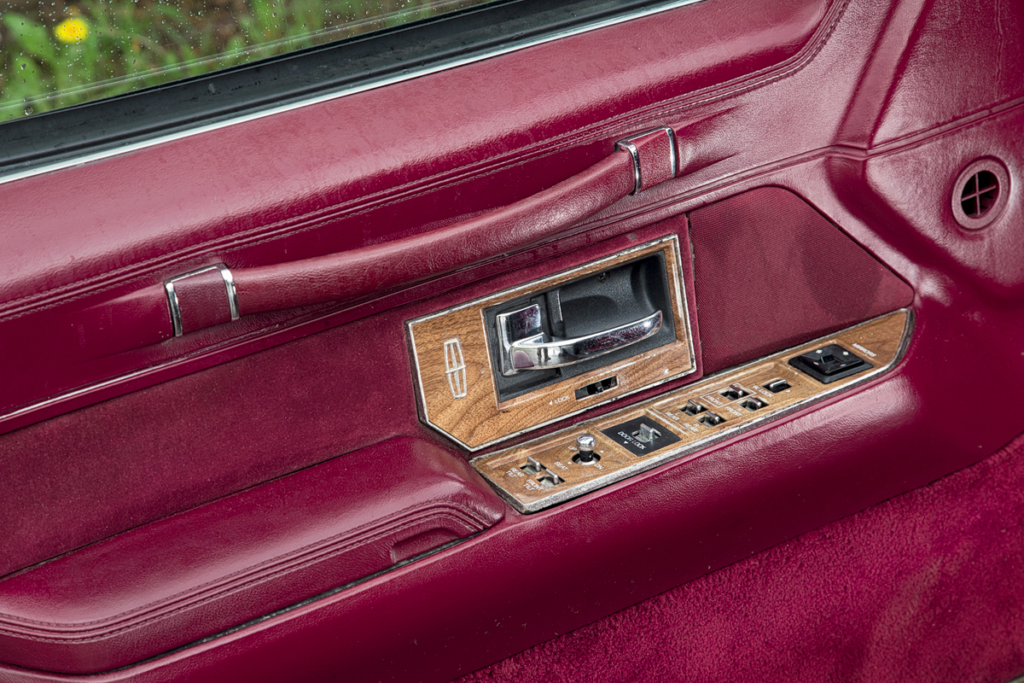
The power seat control panel of the driver’s half of the bench is next to the power window switches, but the backrest of the Lincoln is manually adjustable.
Where the Lincoln Wins
The Lincoln excels in braking, with a pedal setup that feels modern and is even superior to the Fleetwood’s. It also handles turns better than the Cadillac. The Fleetwood, in contrast, tends to wander. Its steering wheel exhibits no play, but it feels somewhat empty at zero, which prompts subconscious swaying. Force yourself to keep it still and it turns out the car merely wiggles slightly off course — it never actually alters direction.
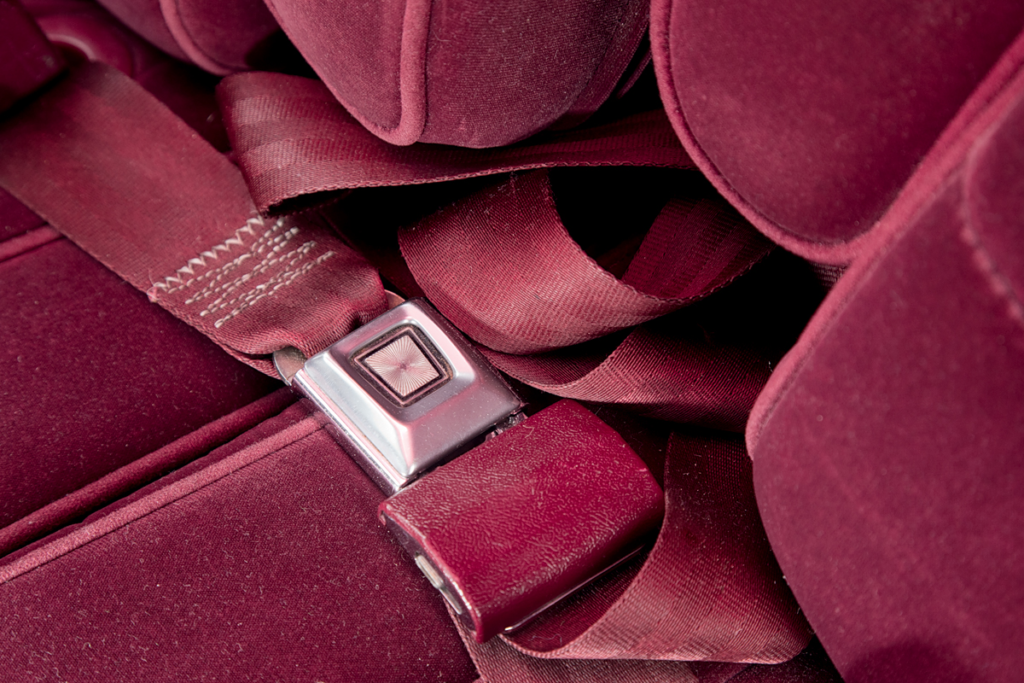
Inertial seat belts, like in the Cadillac, are provided only for four passengers.
Cornering: Wait Until the Cadillac Agrees
In turns the Fleetwood’s delayed steering response is pronounced. You turn the wheel, you encounter resistance, and the car persists in its forward trajectory. When it eventually responds it leans first, and from there manoeuvrability depends largely on speed. At low speeds it turns calmly; carry too much speed and steering effort results only in squealing tyres, with continuous wheel-turning achieving little beyond drifting. Redirecting the car inward means releasing the throttle and awaiting the Fleetwood’s readiness to turn.
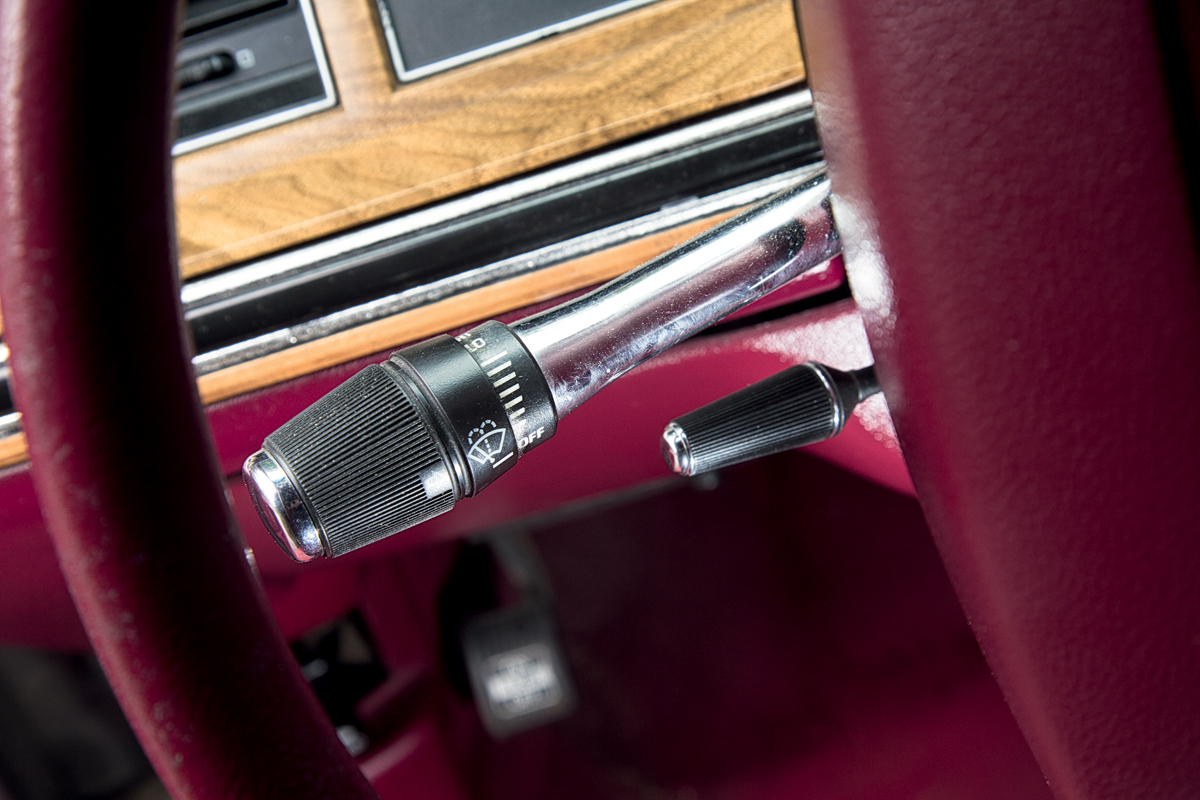
A large lever controls the turn signals, wipers, and high beams. The small one is for adjusting the tilt of the steering wheel.
The Lincoln, on the other hand, demonstrates agility within a turning radius as wide as the Cadillac’s. Despite similar large rolls and an equally uninformative steering wheel, the Town Car exhibits minimal understeer as the lock goes on, transitioning smoothly to a steeper trajectory. Lifting off the gas prompts a noticeable dive and slide — a glimpse of a more dynamic driving experience, if it were not for the soft ride.
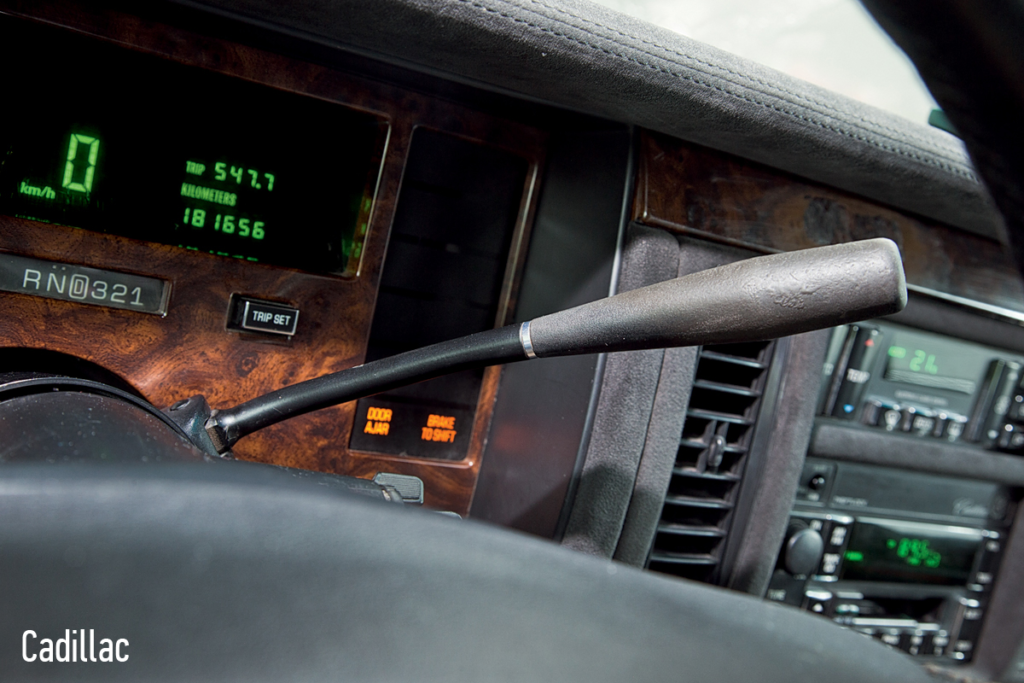
Both “fire irons” move tightly and with approximate accuracy; even mechanical indicators of the selected position do not always help determine where the lever landed.
Ride Comfort: The Cadillac Wins Outright
Equipped with front springs and rear pneumatic balloons, the Town Car’s suspension struggles with anything beyond micro-profile roads. Medium and large irregularities produce jolts and rattles, while speed bumps expose the stiffness of that “air suspension” next to steel springs. Long waves provoke rocking, compounded by yawing in turns, and ultimately undo whatever handling allure the car had.
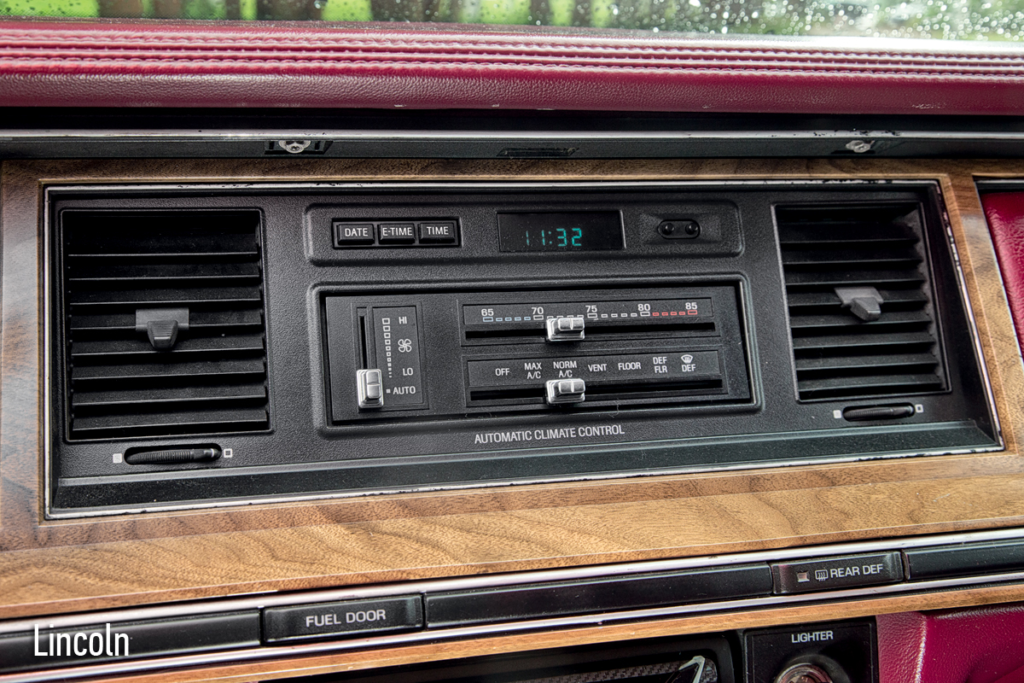
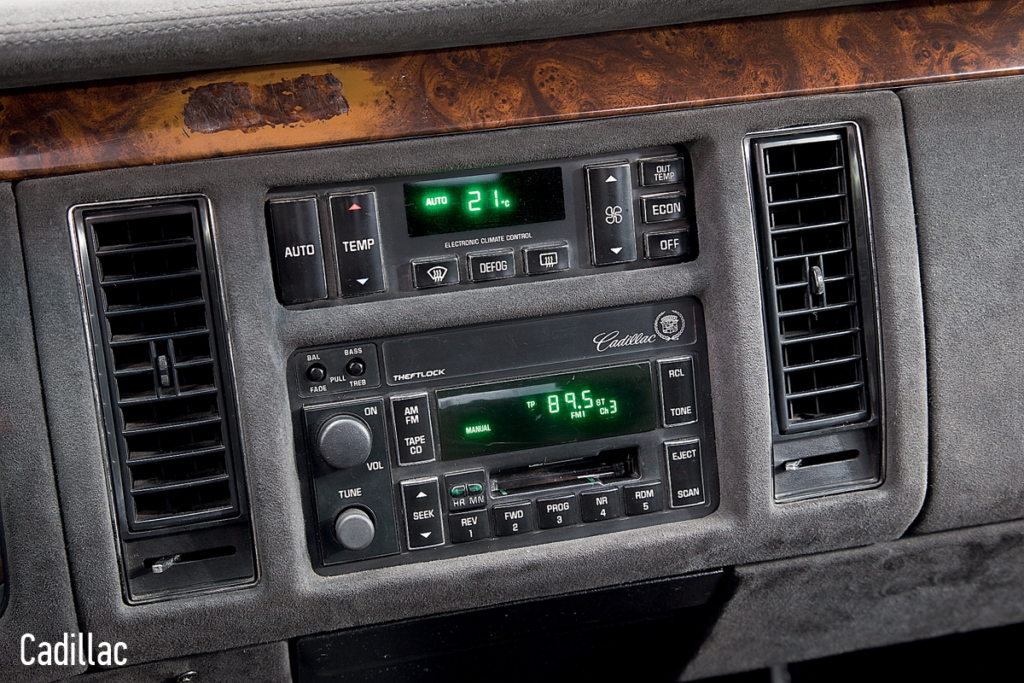
Climate control panels in both cars have automatic modes but do not allow manual adjustment of airflow distribution.
In contrast, the Cadillac sets a standard for ride smoothness that few modern cars reach. Micro-profile and short waves hardly register, cushioned by a gentle push and a modest vibration from the unsprung masses. It navigates speed bumps with ease, swaying lightly, and body waves barely unsettle it. Even on dirt roads it remains remarkably composed. It is one of the most comfortable cars we have tested in years.
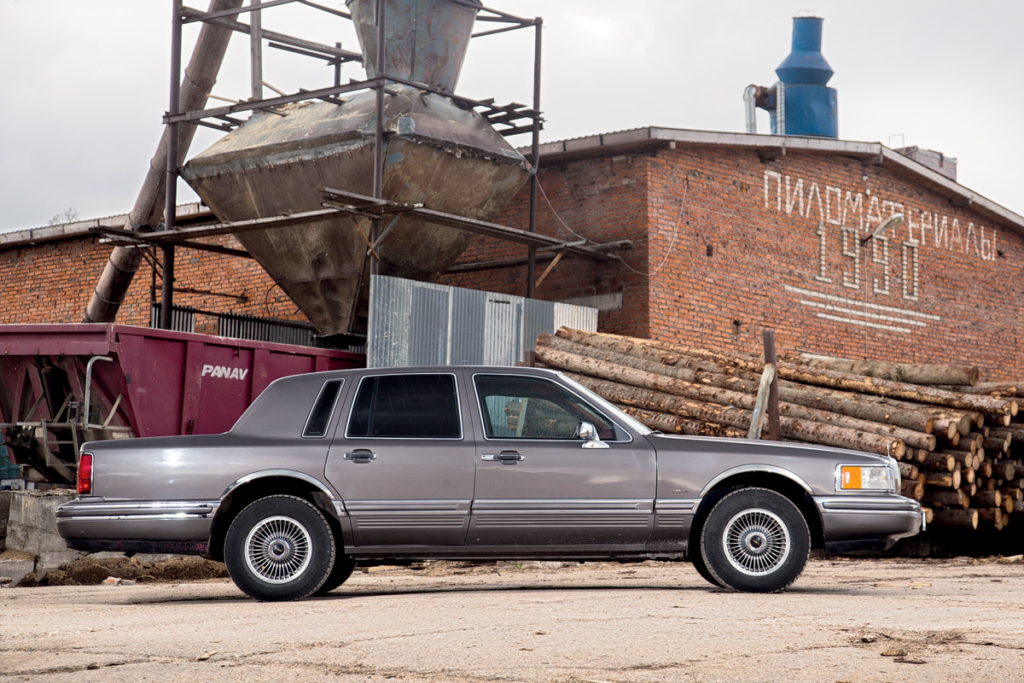
Traditional for Lincolns, the window in the rear pillar of the body is called an “opera window,” inherited from limousines with folding “opera” seats for additional passengers. But the Town Car lost this window already in 1997.
What These Two Cars Turned Into
Charisma, tradition and contradiction: between them, the Cadillac and the Lincoln offer insights into how cars evolved from the 1990s to the 2020s. Modern cars have gained handling and structural integrity. What they sacrificed was this design spirit, and this class of ride smoothness.
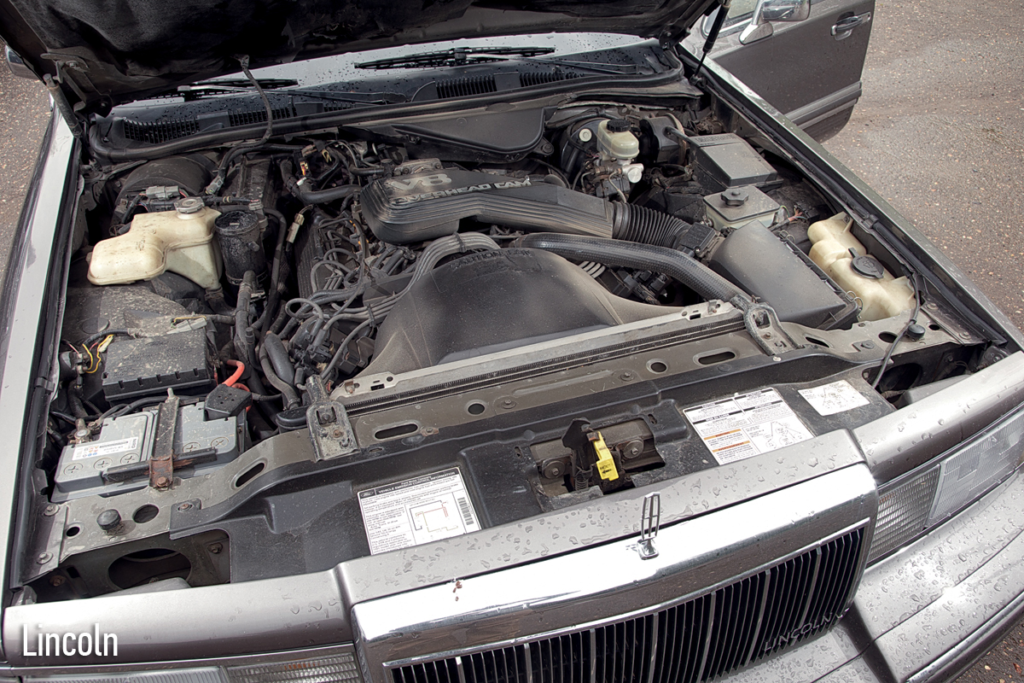
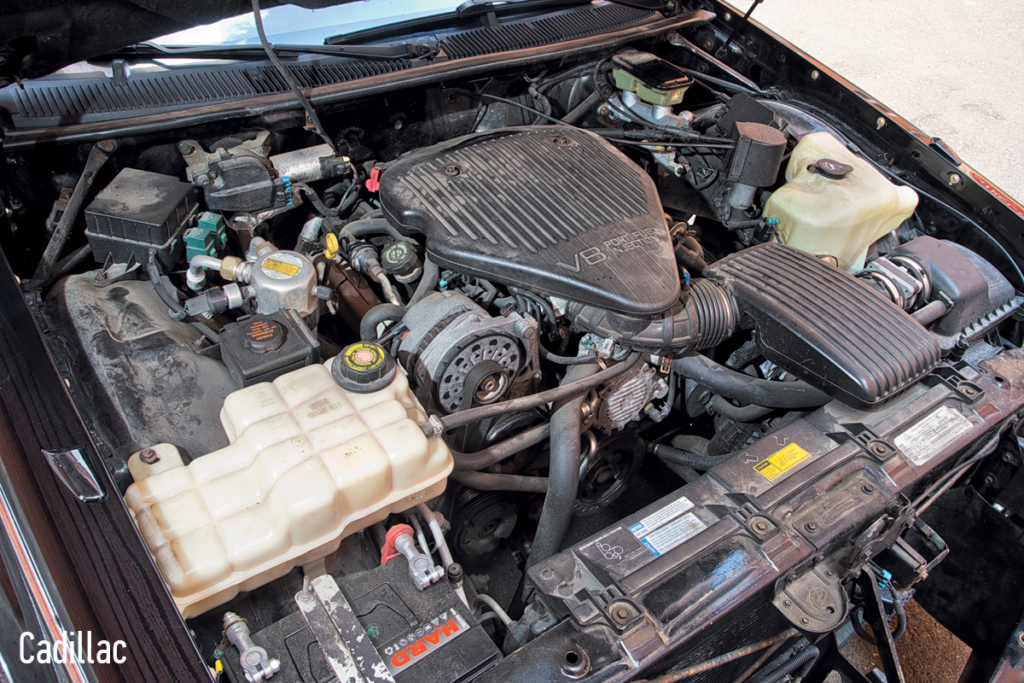
In November 1990, Lincoln received the overhead Modular 4.6 engine with distributed injection. Ford invested $750 million in this architecture and still uses “modular” engines in Mustangs. These engines were also used in Rover, Panoz, and even Koenigsegg. Cadillac used the bottom-mounted LT1 “eight” based on the Corvette engine — the last generation of the legendary small-block family.
It is true that large American frame sedans have formally vanished, but their legacy lives on. Behind the wheel of the Cadillac you cannot shake the feeling of piloting a large SUV masquerading as a sedan — and modern frame SUVs can fairly be considered the spiritual successors of the Fleetwood and the Town Car. It is no coincidence that once Cadillac production ceased, the Texas plant in Arlington shifted focus to the Escalade and the Suburban.
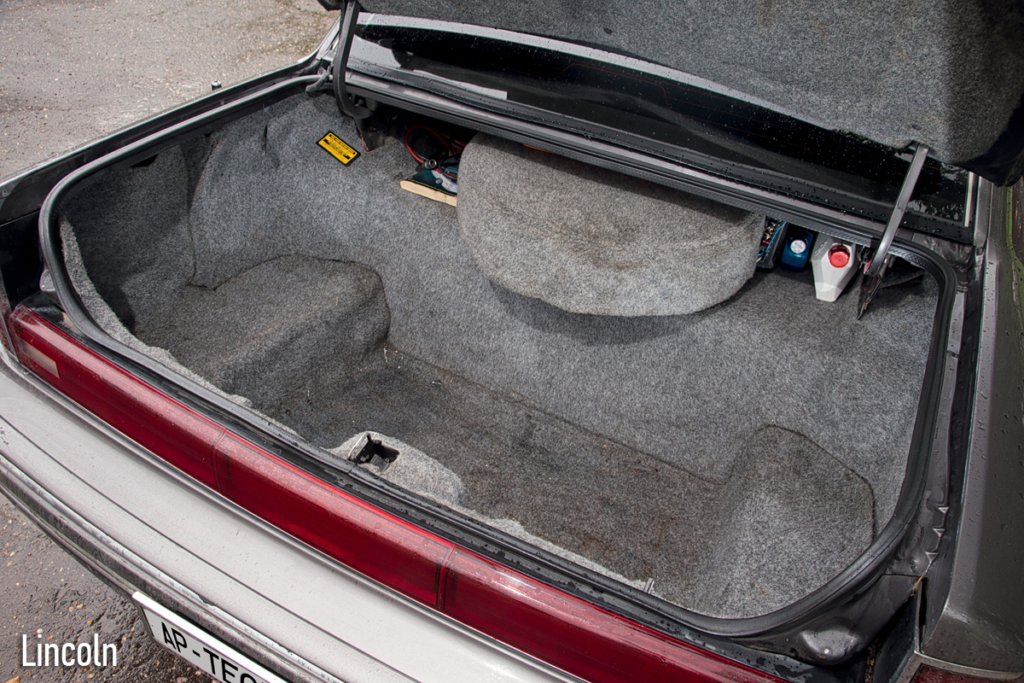
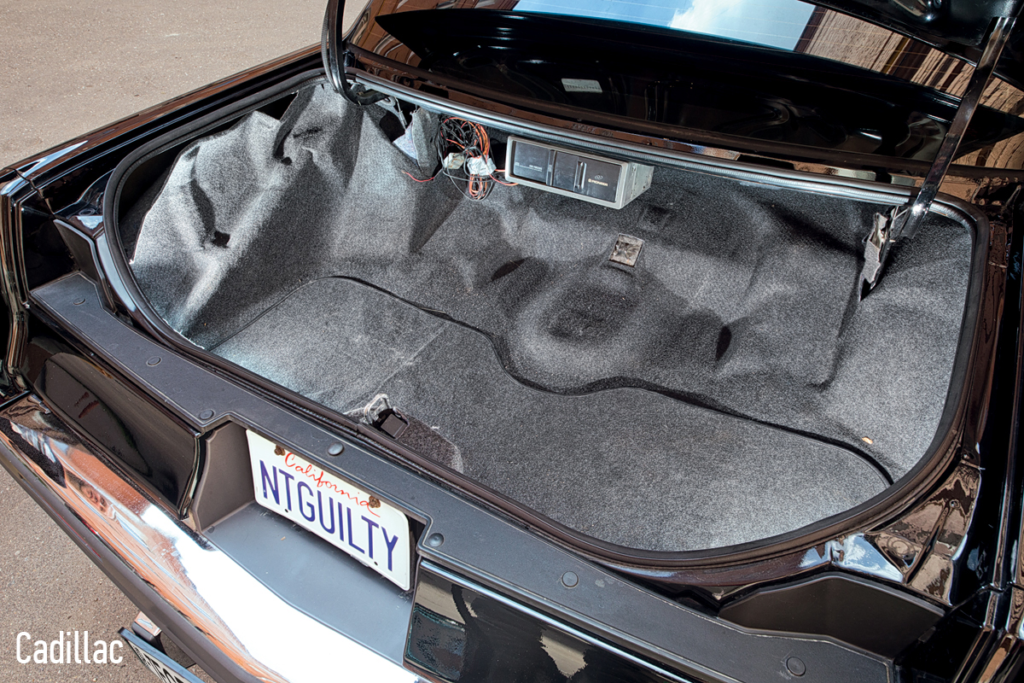
Infinite trunks compete in the inconvenience of loading and unevenness of the floor; Lincoln promises 631 liters of usable space, Cadillac — 588 liters. In both cases, the lid is equipped with a closing assist. The Fleetwood’s fuel filler neck is located under the rear license plate.
Approach the Fleetwood today as you would a large SUV and you may find that in many ways it remains relevant. That is a concept beyond Lincoln’s capabilities; for the Town Car it is nothing more than a relic reserved for weekend outings.
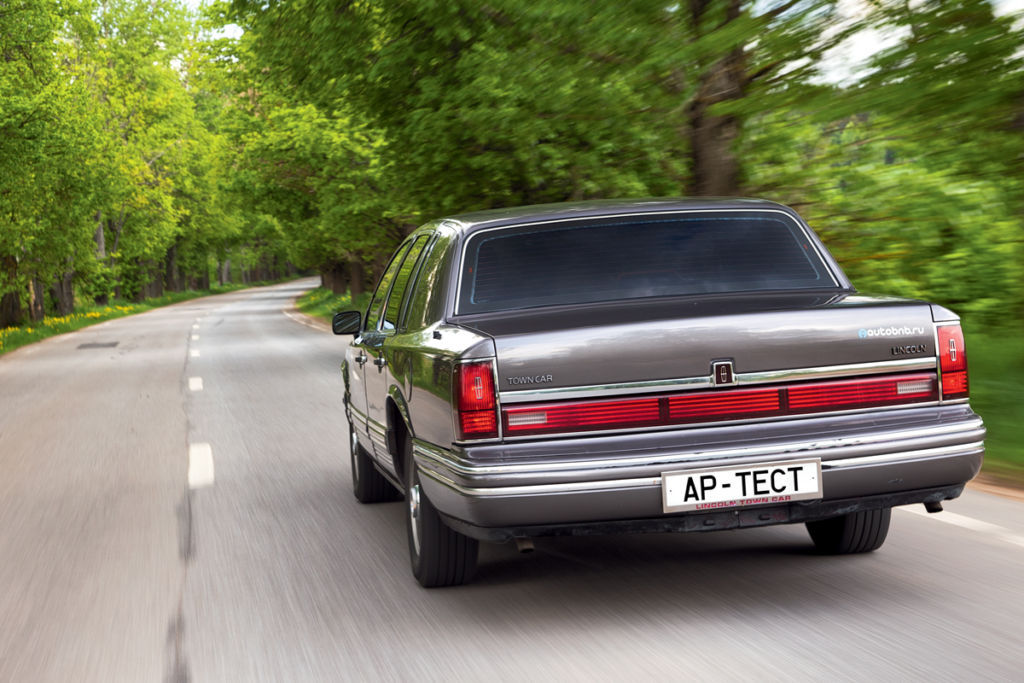
In the base 193-horsepower version of the Town Car 4.6, it had one exhaust pipe, and with the optional split exhaust, the engine developed 213 hp. But the two pipes were installed on this Lincoln already after the sale. But under the hood, there’s already a modernized “modular” overhead engine, which began to be installed on the Town Car in November 1990.
Which is precisely what it excels at. Both the Town Car and the Fleetwood now live with their owners as vehicles of nostalgia, serving as “Titanic joyrides” on the autobnb.ru platform — the automotive counterpart to the popular housing rental aggregators.
Sports and performance cars may dominate the rental market, but I would argue that beginning with a Cadillac and a Lincoln offers something better: a unique opportunity to delve into automotive history and trace the trajectory of automotive progress across the past five decades.
Measured Results
Dimensions, weight* and weight distribution along axes
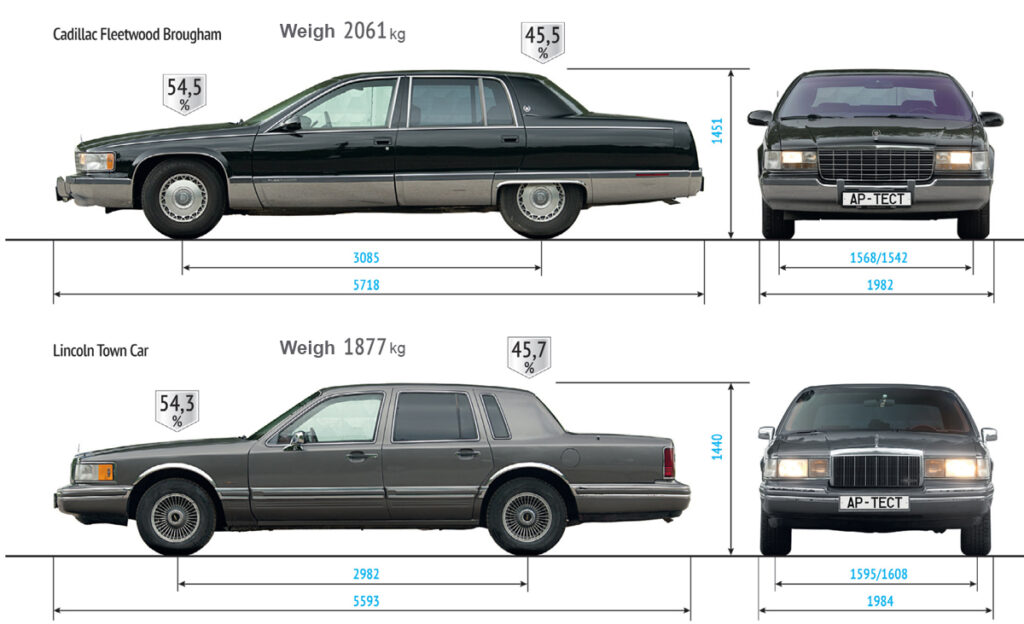
Manufacturers’ data are highlighted in blue/Autoreview measurements are highlighted in black. Dimensions are in millimeters.
*Actual vehicle weight without driver, with full fuel tank and full process fluids
**For right rear seat
**Interior width at shoulder level in the first/second row of seats.
| Parameter | Cadillac Fleetwood Brougham | Lincoln Town Car |
|---|---|---|
| Maximum Speed (km/h) | 209.5 | 168 |
| Acceleration Time (s) 0-50 km/h 0-100 km/h 400 m Path 60-100 km/h (D) 80-120 km/h (D) | 4.5 10.9 17.9 5.6 7 | 4.5 11.3 18.2 6 7.9 |
Some measurement results Autoreview
Cadillac Fleetwood Brougham vs Lincoln Town Car: Full Specifications
| Parameter | Cadillac Fleetwood Brougham | Lincoln Town Car |
|---|---|---|
| Seating Capacity | 6 | 6 |
| Trunk Volume (liters) | 588 | 631 |
| Curb Weight (kg) | 2034 | 1827 |
| Gross Weight (kg) | 2250 | 2180 |
| Engine | Gasoline, with central injection | Gasoline, with distributed injection |
| Number and Arrangement of Cylinders | 8, V-shaped | 8, V-shaped |
| Displacement, cc | 5733 | 4601 |
| Cylinder Diameter / Piston Stroke, mm | 101.6/88.4 | 90.2/90.0 |
| Compression Ratio | 10.0:1 | 9.0:1 |
| Number of Valves | 16 | 16 |
| Max. Power, hp/kW/rpm | 264/194/5000 | 193/142/4200 |
| Max. Torque, Nm/rpm | 447/3200 | 353/3200 |
| Drive | Rear | Rear |
| Transmission | Automatic, four-speed | Automatic, four-speed |
| Front Suspension | Independent, spring, on double wishbones | Independent, spring, on double wishbones |
| Rear Suspension | Dependent, spring, four-link | Dependent, pneumatic, four-link |
| Steering Mechanism | Rack and pinion | Rack and pinion |
| Turning Diameter, m | 13.6 | 12.4 |
| Front Brakes | Disc | Disc |
| Rear Brakes | Drum | Disc |
| Base Tire Size | 235/70 R15 | 215/70 R15 |
| Maximum Speed (km/h) | 173 | n/d* |
| Acceleration 0-100 km/h (s) | 9 | n/d |
| Average Fuel Consumption, l/100 km | 13.1 | 13.1 |
| Fuel Tank Capacity, l | 87 | 76 |
| Fuel | Gasoline AI-92 | Gasoline AI-92 |
n/d* – no data
Lord and Panther
This historical context would have been narrated most eloquently by Andrey Vasilyevich Khrisanfov, but he passed away just a few days before the test. He had already penned the background meticulously, at something close to encyclopedia length. Through his extensive narratives on the history of American manufacturers we learn, for instance, that a town car is not simply a “city car” but a type of horse-drawn carriage in which the coachman sits under the open sky while the passengers occupy a separate enclosed cabin.
Where “Brougham” and “Fleetwood” Come From
Andrey Vasilyevich also delved into the origin of the term “Brougham”, which stems from the surname of the English lord Henry Brougham. In the late 1830s Brougham conceptualised a new carriage body — a two-seater featuring windows in the doors but solid panels on the sides of the sofa, so that passengers were shielded from prying eyes. It was essentially a town car without windows on the sides. By the early 20th century General Motors had adopted the term to denote a luxurious trim level for cars with conventional closed bodies, and broughams from other manufacturers followed.
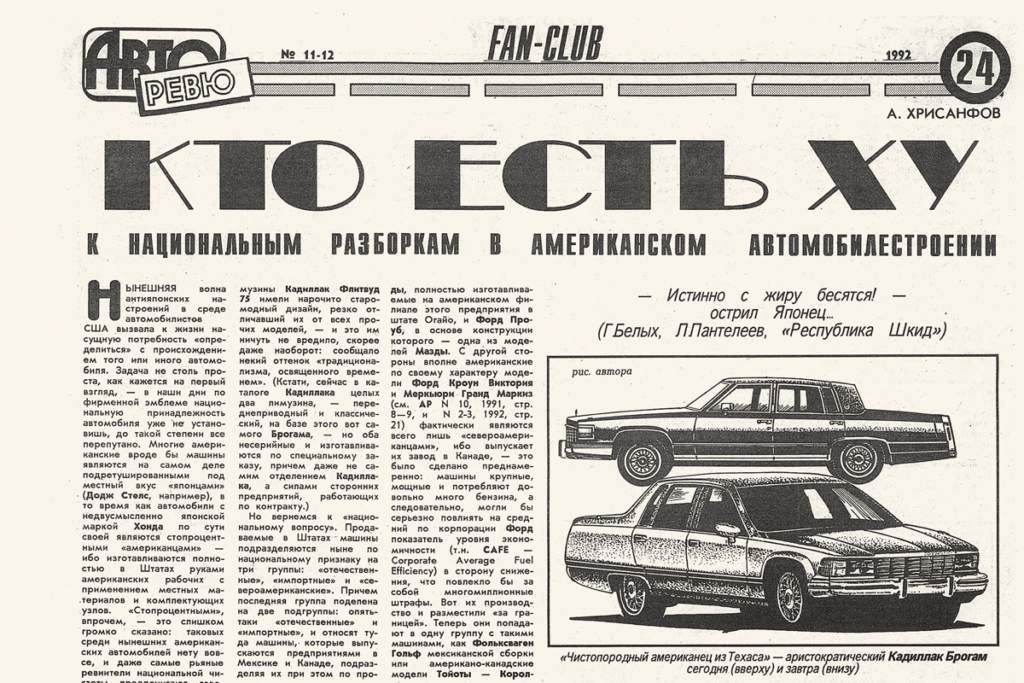
In the mid-1992, the appearance of the Fleetwood was no longer a secret: Andrey Vasilyevich Khrisanfov explained who was who among the passenger cars on the US market. The purest “American” car at that time was the predecessor of the Fleetwood — the Cadillac Brougham (pictured above). Its share of local components was 99.7%.
The name “Fleetwood” likewise has direct ties to horses: it belonged to the company founded by Henry Fleetwood in Pennsylvania, which through the 19th century produced carriages and carts. By the 1920s it had become an exclusive coachbuilder for Cadillac, before being absorbed by the GM corporation.
The designations “Fleetwood” and “Brougham” first surfaced together in 1977, on a large rear-wheel-drive sedan that remained in production until 1986. It was succeeded by the Cadillac Brougham, with the Fleetwood name moving to a front-wheel-drive sedan, and finally, in 1993, our protagonist emerged: the last rear-wheel-drive Fleetwood Brougham, touted as the largest passenger car in the USA at the time.
Its exterior drew inspiration from the Voyage and Solitaire concept cars, through which Cadillac had been seeking a refreshed modern image in the late 1980s. In 1992, however, the same concepts also produced the Seville STS sedan, which used a more progressive front-wheel-drive platform and carried a similar price tag of around 37-39 thousand dollars.
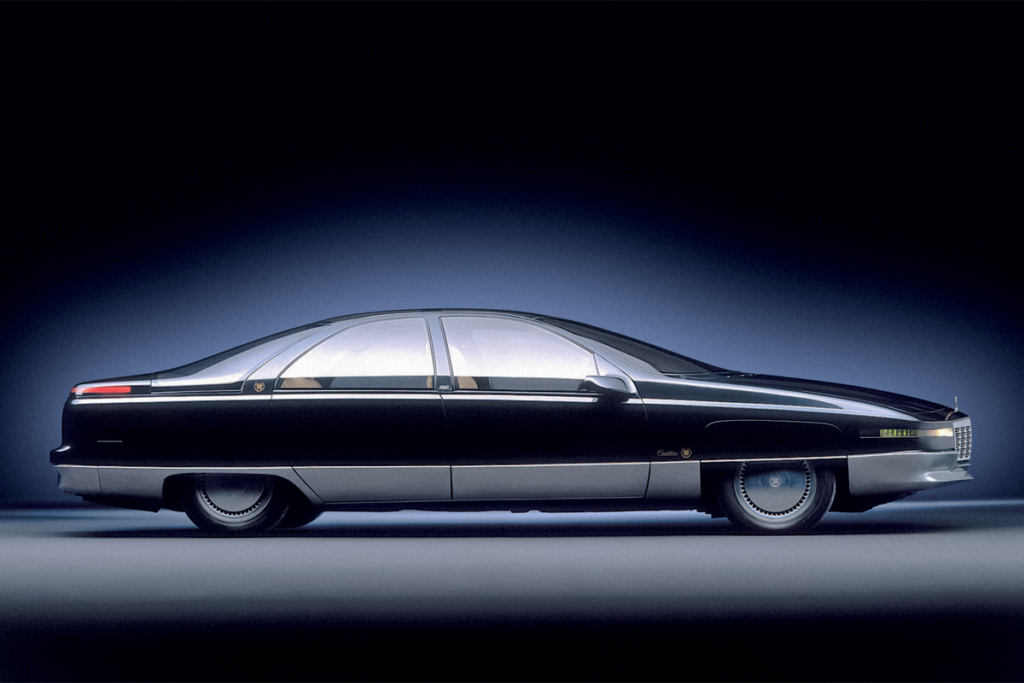
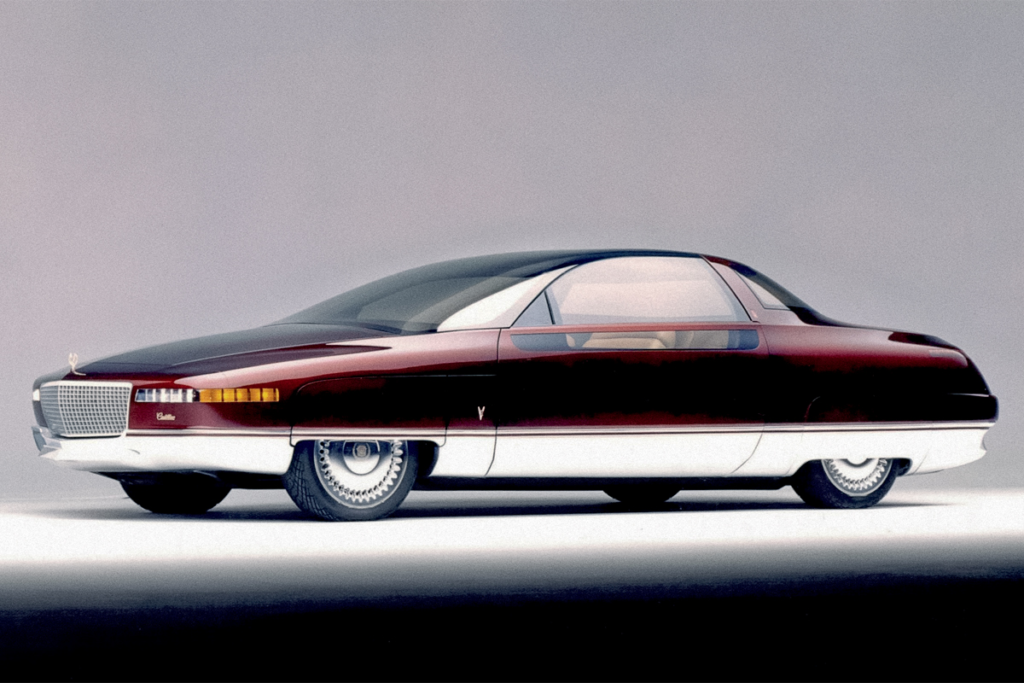
The Voyage concept cars (1988) and the Solitaire coupe (1989) promised Cadillac a renaissance of “heavy classics” with a modern face. The streamlined body had a coefficient of drag of 0.28 — for this, the front wheels were covered with active shields that extended outward in turns. The front suspension used McPherson struts, while the rear had a transverse spring. The layout was traditional, but the sedan had a V8 4.5 engine (275 hp) and an all-wheel-drive transmission, while the rear-wheel-drive coupe had a V12 6.6 engine (430 hp) developed in collaboration with Lotus. The estimated top speed was up to 320 km/h. This engine did not go into production, but GM’s collaboration with the British brought the LT5 “eight” for the Corvette.
The Seville was the model Cadillac’s marketers envisioned as a competitor to the flagship sedans of Europe and Japan. It was equipped with all the latest technology, including the 32-valve Northstar 4.6 engine (223-305 hp) and adaptive suspension.
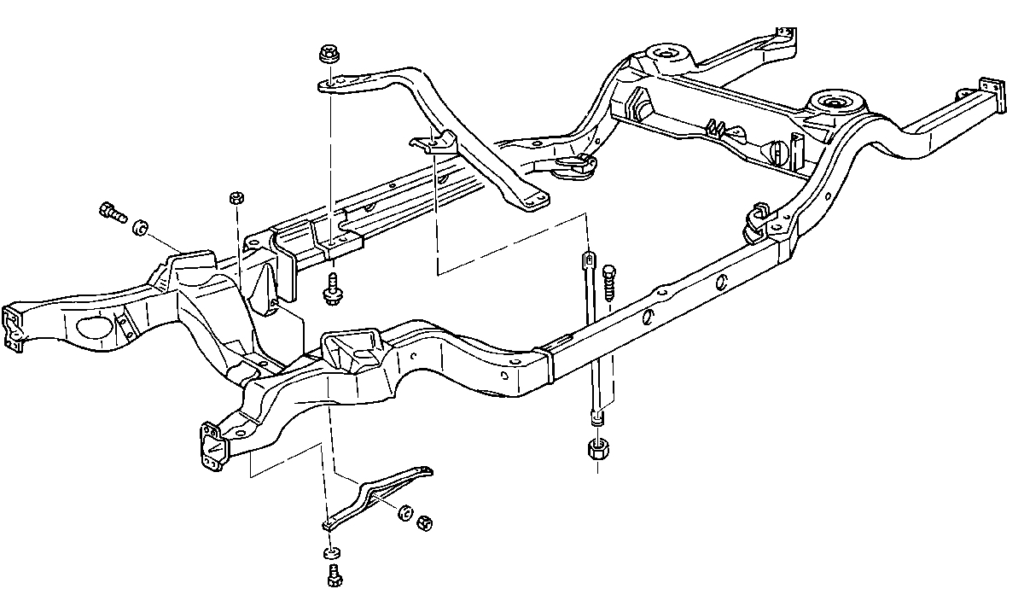
In the 1990s, the frame on sedans was already a relic of the past, but it still retained its practical value: before the crossover boom, large sedans often served as tow vehicles for trailers. For example, the Fleetwood with the optional main pair of 3.42 instead of 2.56 could tow more than three tons. And the frame also facilitated the production of commercial versions, on the basis of which limousines and hearses were built.
Then, in 1994, Cadillac introduced the front-wheel-drive DeVille, aimed precisely at enthusiasts of the American full-size sedan. Despite a striking resemblance to the Fleetwood, the DeVille boasted separate climate control, steering wheel-mounted buttons, adaptive shocks and an equally spacious cabin. These Cadillacs sold at a rate of 100-120 thousand units per year, whereas total production of the Fleetwood barely surpassed 90 thousand cars in less than four years.
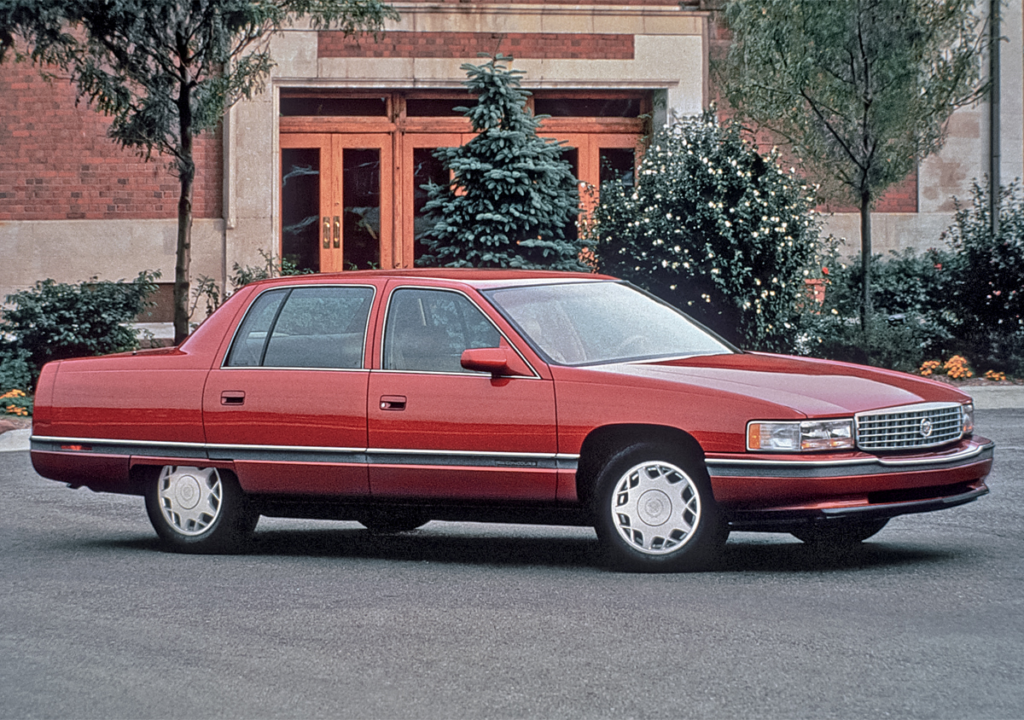
The Cadillac DeVille also evolved from the Voyage concept, but did not receive a V12 or all-wheel drive, instead getting a front-wheel-drive K-body platform that GM had been using since the early 1980s.
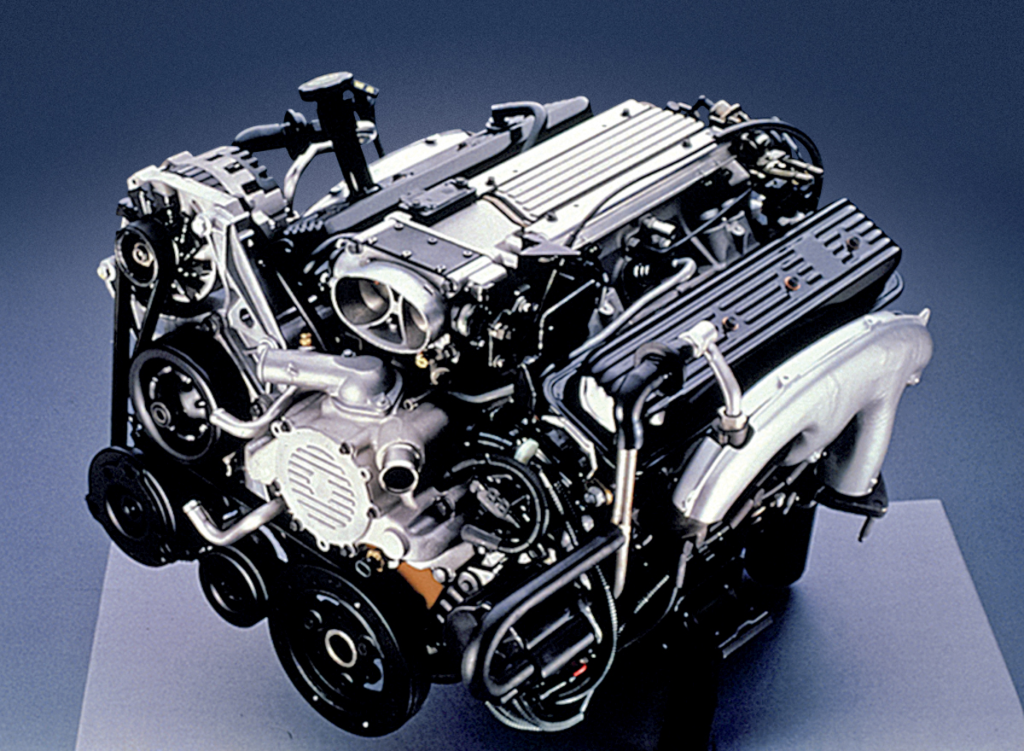
The LT1 5.7 engine featured a “reverse” cooling system (head first, then block) and an “optical” OptiSpark ignition distributor, which was regularly flooded with coolant from the cooling system pump.
Why the Older Town Car Outsold It
Even more surprising was the enduring popularity of the more conservative and older Town Car over the same period. Throughout the 1990s it consistently achieved sales of around 100 thousand cars per year. Ford had cut costs on the development of the new Lincoln by reusing the old Panther platform from the 1980 model, and the car thrived anyway. Rough engineering came from the British company IAD (later absorbed by Daewoo), and body panel production from the Japanese company Ogihara Iron Works.
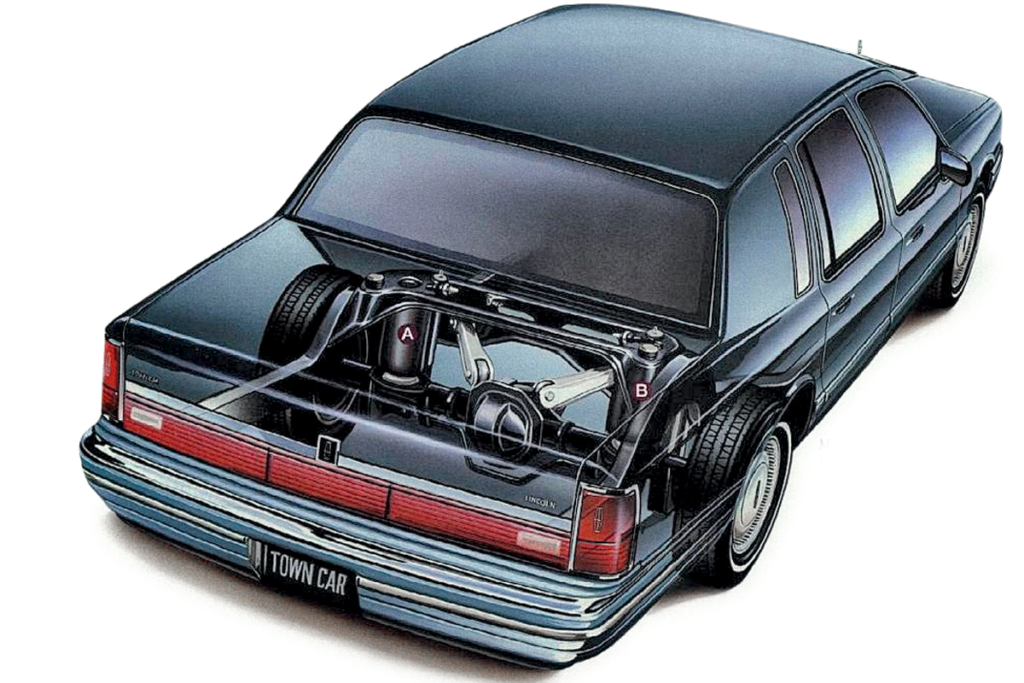
The Lincoln’s rear suspension has two pneumatic balloons powered by an electronically controlled compressor. The rear axle attachment to the body is through two longitudinal and two diagonal arms. The Cadillac’s spring suspension is similarly arranged, where the pneumatic balloons serve only to maintain clearance.
Ford’s designers knew what they were doing — Jack Telnack, known for the Taurus sedan, and Gale Halderman, creator of the original Mustang — and the marketing decisions were equally shrewd. The Town Car boasted a slightly lower price point, disc brakes on all wheels, cruise control, adaptive suspension and the largest trunk of any passenger car on the American market.
GM’s decision to discontinue the Fleetwood alongside its platform-sharing sedans, the Buick Roadmaster and the Chevrolet Caprice Classic, further cemented the Town Car’s dominance. With those models gone, the Town Car reclaimed its status as the largest car in the USA and experienced a resurgence in sales.
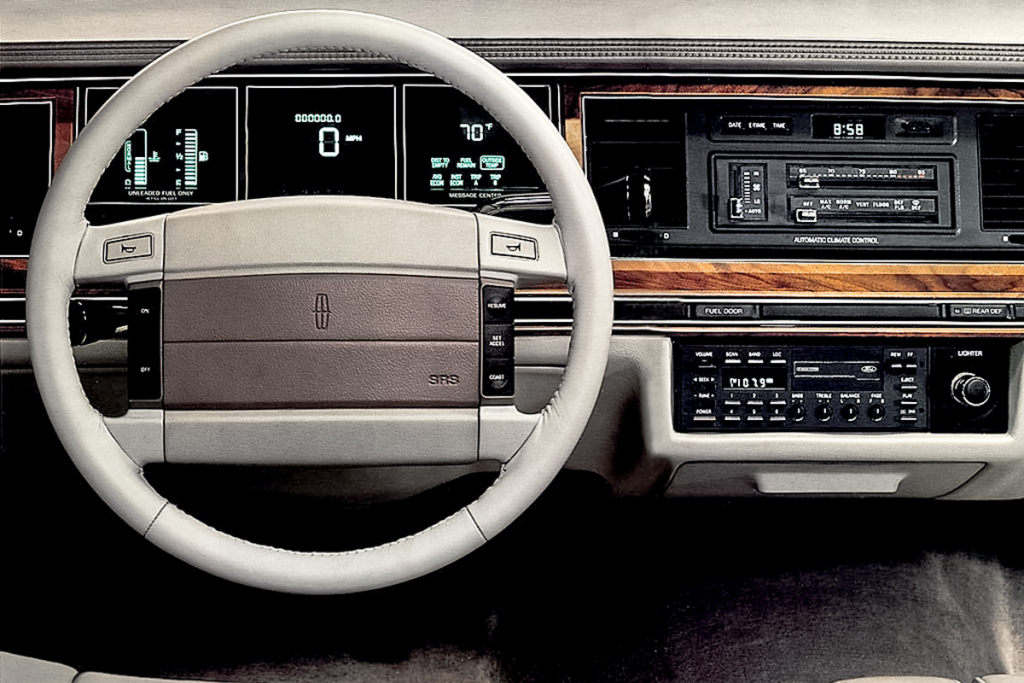
This is how the interior of the 1990 model looked, with an electronic instrument panel and a JBL stereo system.
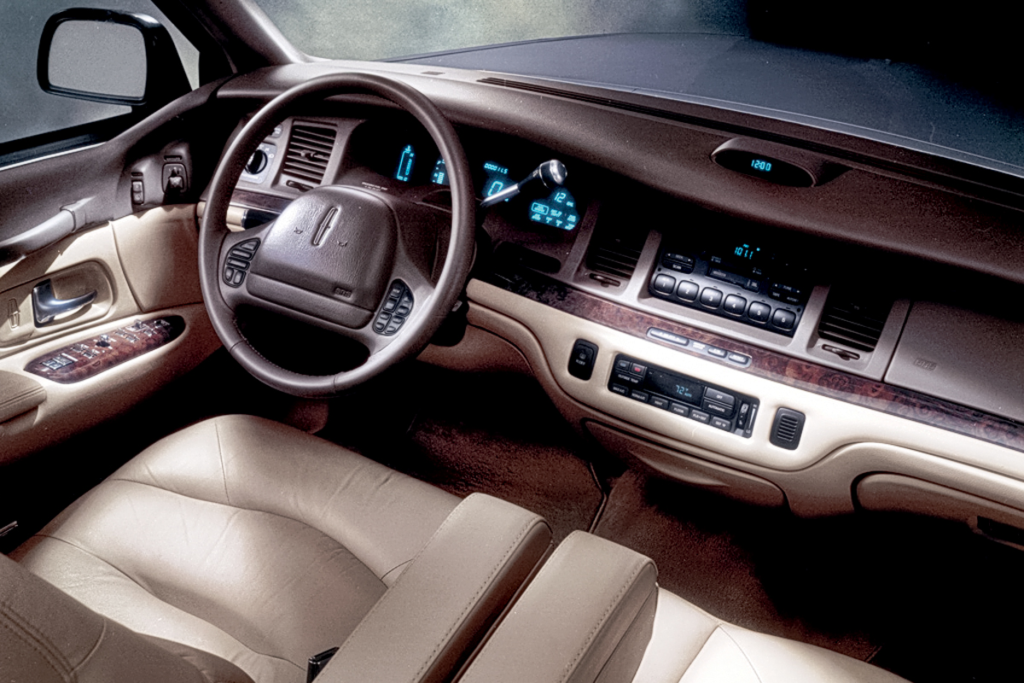
Only in 1994 did the Town Car receive a cabin that matched the spirit of the times — with smooth contours of the front panel and a two-spoke steering wheel.
In late 1994 Lincoln underwent a facelift that included new headlights and a new interior. By the end of 1997 the next generation appeared on the same platform, more rounded and without the opera windows, but equipped with a Watts mechanism in the rear suspension. In 2003 the Panther platform received rack-and-pinion steering. At the end of 2007 Ford closed the Wixom plant in Michigan and relocated Lincoln production to Canada, alongside the Ford Crown Victoria and Mercury Grand Marquis, and it was there that the last Town Car was assembled in 2011.
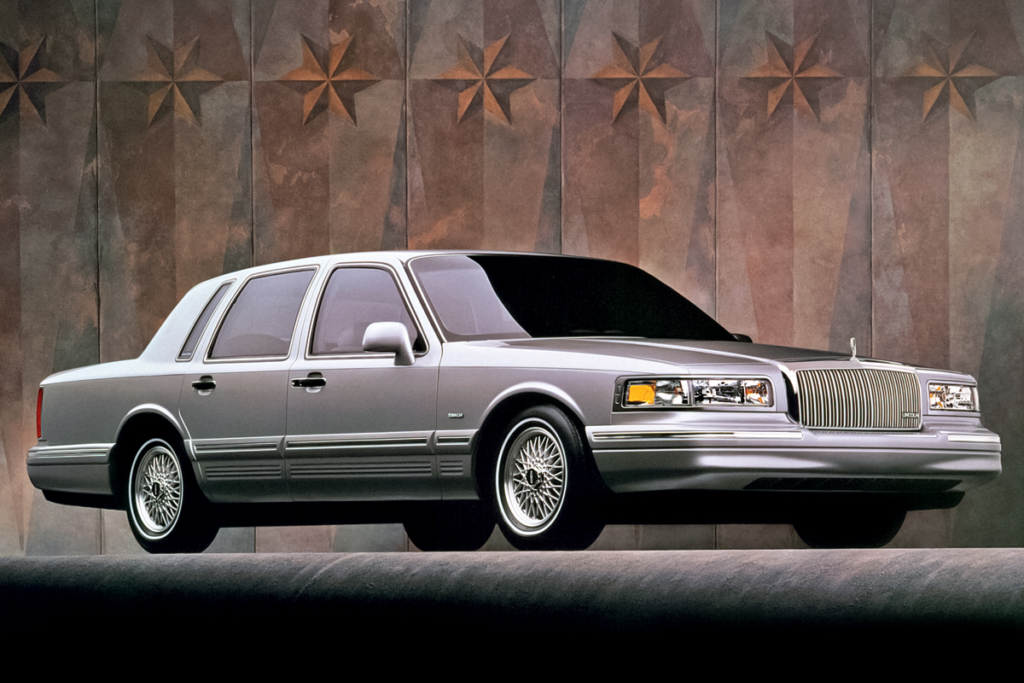
The result of the 1994 facelift was the Town Car with narrow headlights, forward-shifted mirrors, and a new “automatic.” But a plastic intake manifold was installed on the engine, which brought many problems to the owners of elderly Lincolns.
Remarkably, demand for this sedan did not dip below 50 thousand units per year until the mid-2000s. By comparison, in 2021 Lincoln managed to sell a maximum of only 87 thousand cars in the USA.
Should You Buy One Today?
The rarer Cadillac Fleetwood is the more intriguing proposition, as an investment in genuine American youngtimer culture. In the US, these sedans with mileage up to 100 thousand kilometres typically cost around ten thousand dollars, while those up to 150 thousand kilometres can be found for five to seven thousand. There are cheaper offers, but restoring such a car and battling corrosion in our conditions can prove an arduous mission, as many parts are no longer in production.
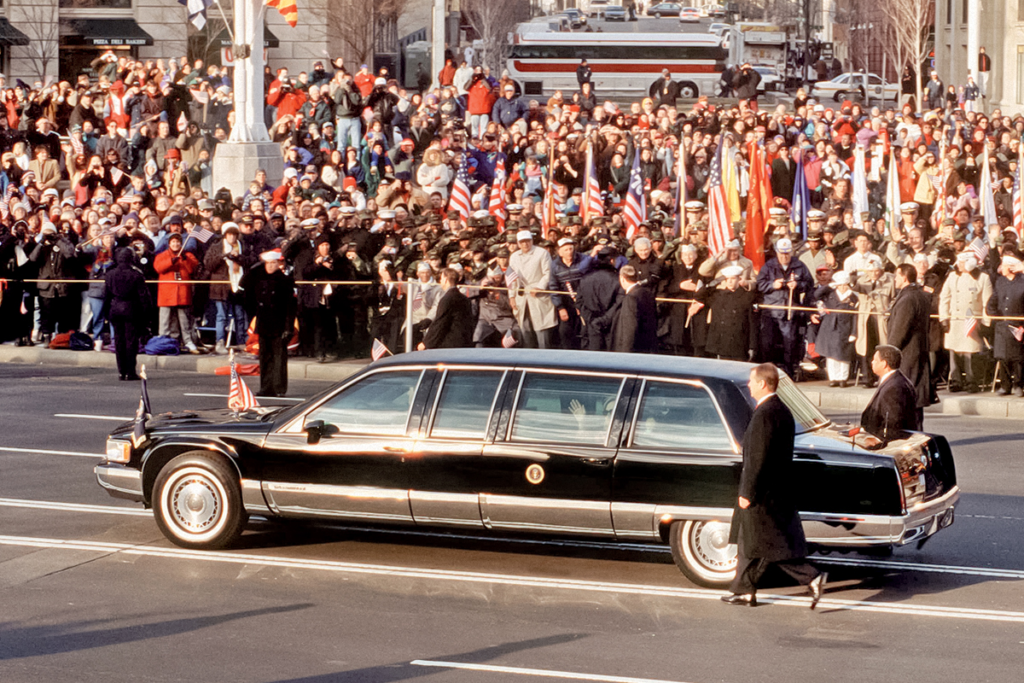
The armored vehicle based on the Fleetwood carried Bill Clinton from 1993 to 2001 (his predecessor George Bush preferred the Lincoln Town Car), and in the 21st century, presidential Cadillacs were transferred to a special chassis from pickups and trucks.
The early-90s Lincoln Town Car is considerably less expensive — priced at up to 3000 dollars in the US. But while the engine is the most problematic component on the Cadillac, the Lincoln demands attention to the cooling system, the pneumatic suspension, the electrical wiring and numerous body elements prone to corrosion.
Key Facts at a Glance
- Cadillac Fleetwood Brougham (1993-1996): LT1 5.7 V8, 264 hp, 447 Nm, four-speed automatic, rear-wheel drive, D-body frame platform
- Lincoln Town Car (Panther platform, from 1980): “modular” 4.6 V8 from 1990, 193 hp, four-speed automatic, rear-wheel drive
- Measured by Autoreview: Cadillac 10.9 s to 100 km/h and 209.5 km/h flat out; Lincoln 11.3 s and 168 km/h
- Size: the Fleetwood is five metres and seventy centimetres long — longer than a long-wheelbase S-Class — with a drag coefficient of 0.36
- Six seats each, thanks to front and rear benches; the last six-seat GM sedan was the Chevrolet Impala, in 2011
- Trunk: Lincoln 631 litres, Cadillac 588 litres
- US prices today: Fleetwood around ten thousand dollars; Town Car up to 3000
Frequently Asked Questions
Which is faster, the Cadillac Fleetwood Brougham or the Lincoln Town Car? The Cadillac, comfortably. It reaches 100 km/h in 10.9 seconds and was measured at 209.5 km/h; the Lincoln needs 11.3 seconds and managed 168 km/h.
Why did Cadillac stop building the Fleetwood? It could not compete with Mercedes and Lexus, and it sold barely 90 thousand cars in under four years while the front-wheel-drive DeVille was selling 100-120 thousand a year. GM ended production at the end of 1996, along with the platform-sharing Buick Roadmaster and Chevrolet Caprice Classic.
What does “Brougham” actually mean? It comes from the English lord Henry Brougham, who in the late 1830s designed a closed two-seat carriage with windows only in the doors. General Motors borrowed the word in the early 20th century as a luxury trim designation.
And why is it called a Town Car? A town car is a type of horse-drawn carriage in which the coachman sits out in the open while the passengers ride in a separate enclosed cabin.
Which of the two is more comfortable? The Cadillac, without argument. Its ride smoothness is a standard few modern cars reach, while the Lincoln’s air-sprung rear end jolts and rattles over anything larger than micro-profile roads.
Which one is worth buying today? The Fleetwood is the better car and the better investment, at around ten thousand dollars in the US for a well-kept example. The Town Car is the cheaper way in at up to 3000 dollars, but budget for the cooling system, the pneumatic suspension, the wiring and the rust.
Photo: Dmitry Pitersky | Ford Company | GM company
Expert group: Andrey Mokhov | Yaroslav Tsyplenkov
This is a translation. You can read the original article here: Городские Титаники: ретротест рамных седанов Cadillac Fleetwood Brougham и Lincoln Town Car

Published March 21, 2024 • 25m to read