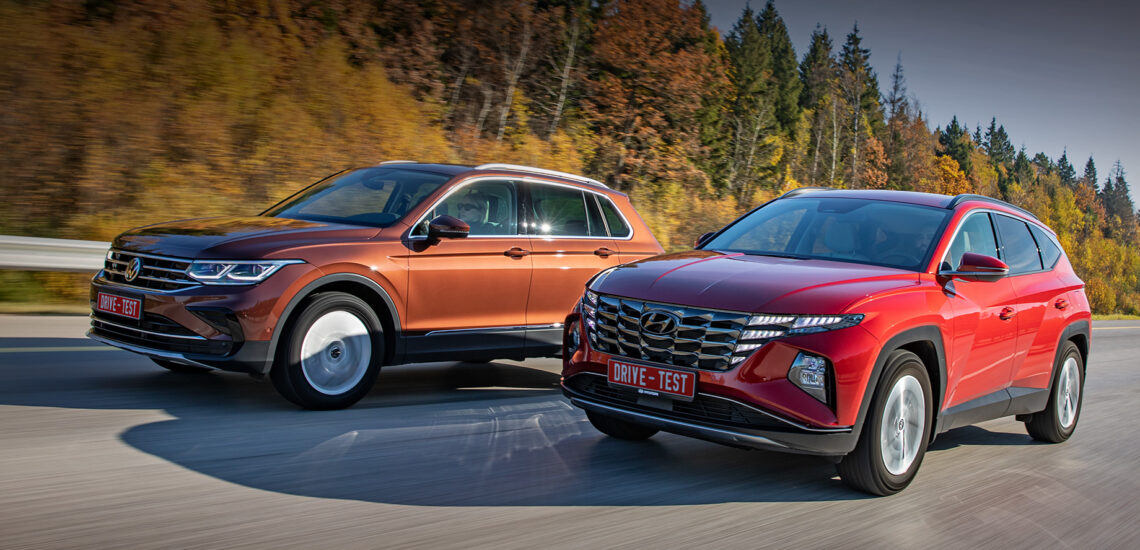

South Korea vs Germany, Hyundai vs Volkswagen — two of the world’s most popular compact crossovers go head to head. The new Tucson turns heads with its bold styling, competitive equipment, and a noticeably improved chassis. The refreshed Tiguan, meanwhile, raises the bar with German precision and driving dynamics. But which one actually wins? The answer might surprise you.
Exterior Design: Bold Korean Style vs Understated German Elegance
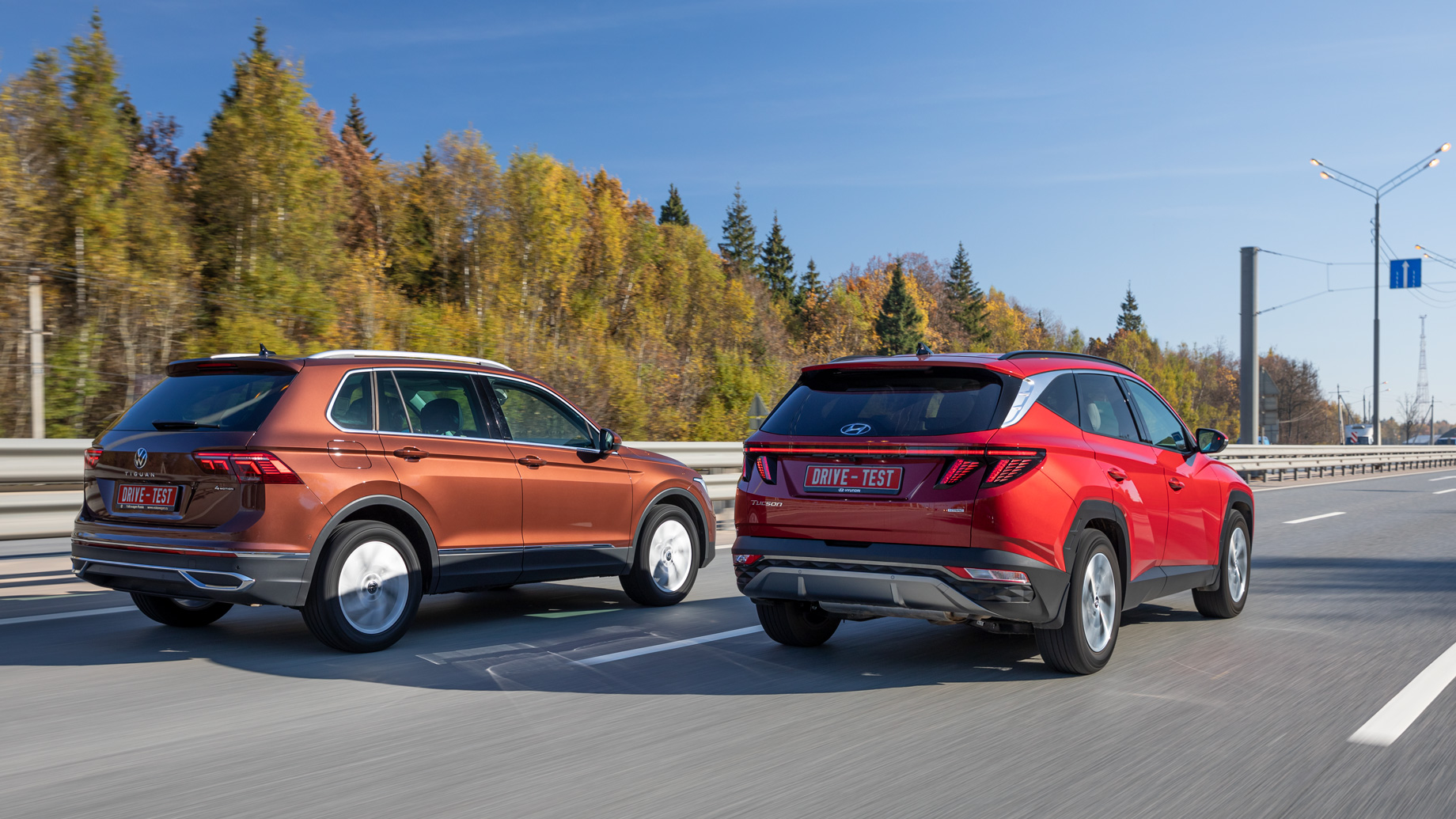
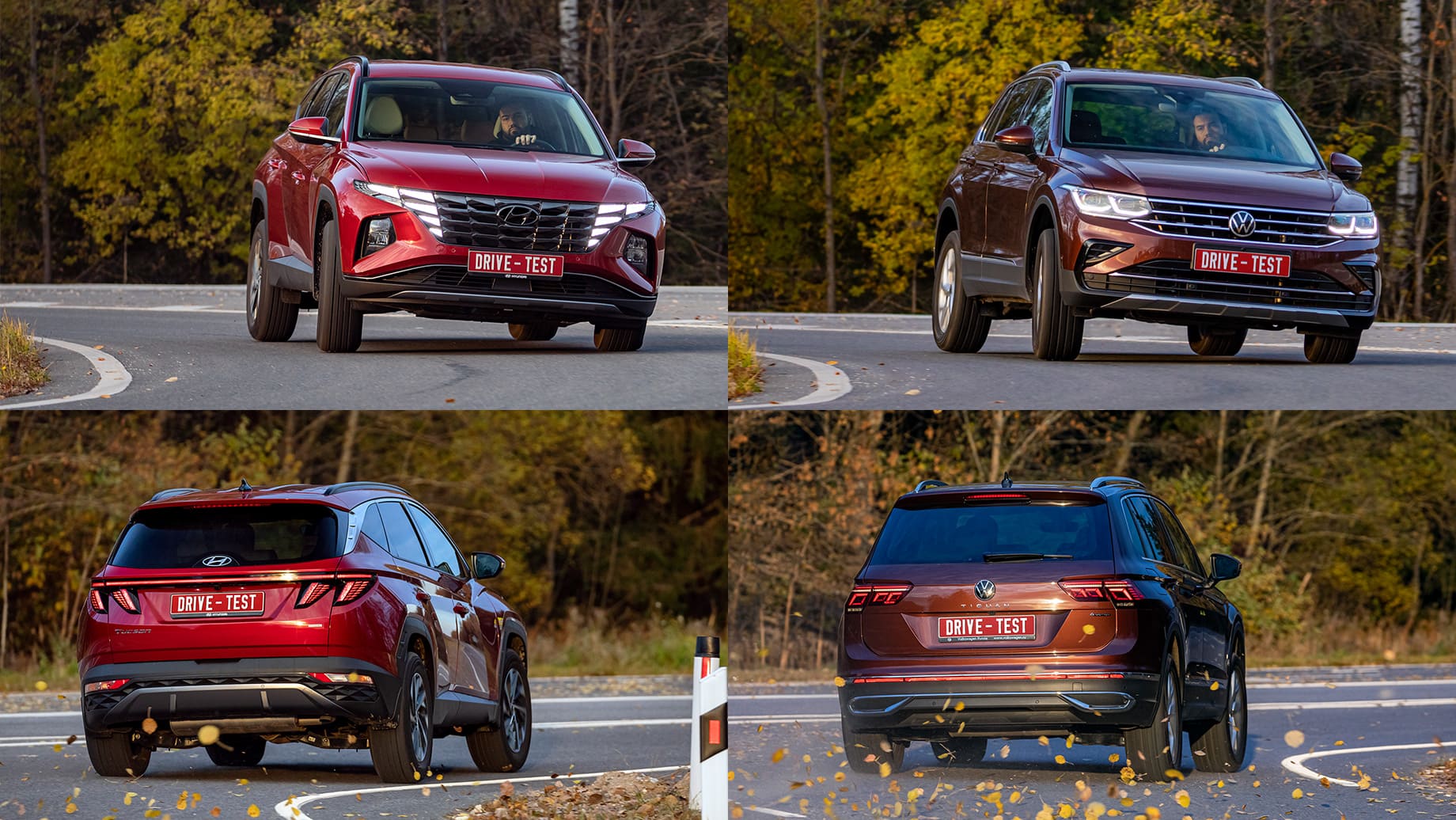
The Tucson makes a strong first impression in photos, but in person, some of its design elements don’t land as well. The front radiator grille garland and running lights tend to get lost, while the rear LED light blade and waffle-patterned bumper insert feel slightly overdone. Individually, each detail is interesting — together, they come across as a bit garish. The Tiguan avoids this problem entirely with a cleaner, more cohesive look.
Size is another key difference between the two. The Tucson is noticeably larger:
- 4.6 inches longer overall
- 1.02 inches wider
- 2.99 inches longer wheelbase
Next to the Tucson, the Tiguan looks like a raised hatchback beside a full-size crossover. Despite the Hyundai’s larger footprint, however, the extra dimensions don’t always translate into practical entry and exit advantages — the Tucson’s front doorways are actually narrower than the Volkswagen’s. One area where the Tucson does win: its doors fully cover the lower body panels, meaning no dirt strip along the sills — something Tiguan owners will notice after every muddy drive.
Interior Quality and Ergonomics: Which Cabin Is Better?
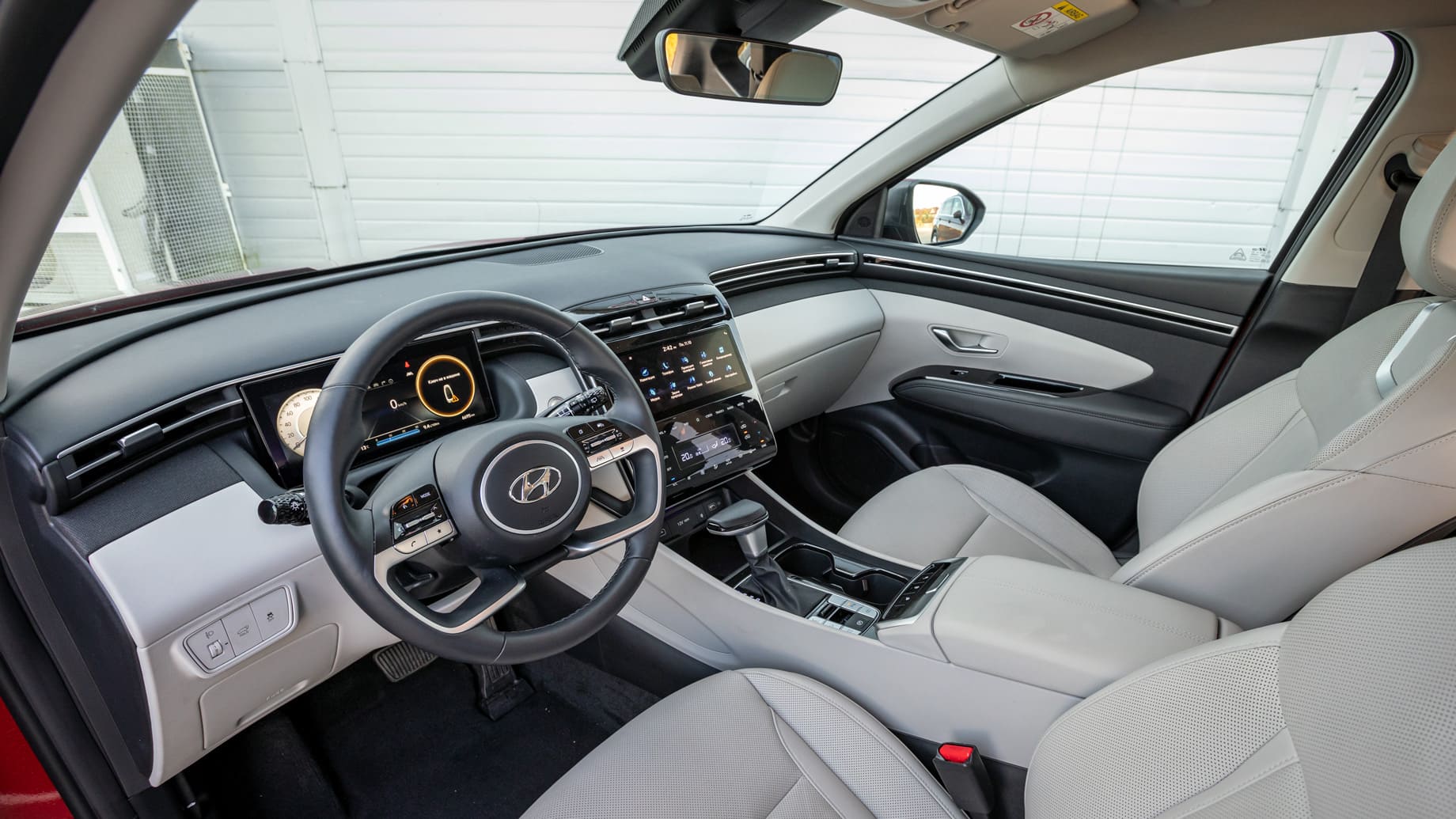
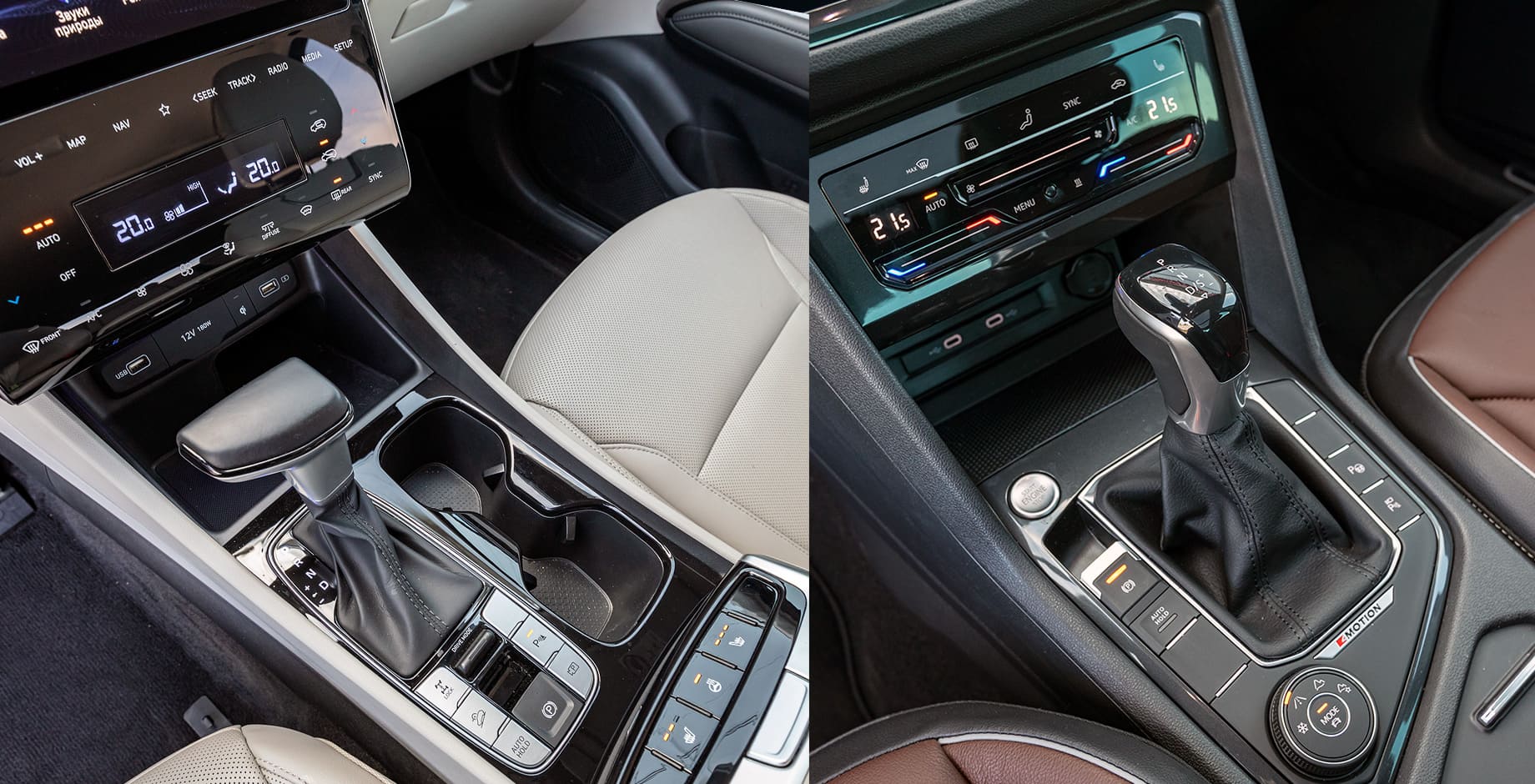
The Tucson’s interior shines brightest at night. The frameless digital instrument panel with swappable themes and a wide infotainment display embedded in the center console create a genuinely premium atmosphere after dark. During the day, the mix of plastic textures, fabric dust-collecting inserts, and glossy black trim with metal-like edging is less convincing — it doesn’t feel as upmarket as it looks in photos.
That said, the Tucson’s ergonomics are largely excellent:
- Plenty of physical, easy-to-use buttons throughout the cabin
- Well-positioned heating controls for front seats and steering wheel
- High-quality infotainment display with sharp icons and smooth scrolling
- Fast and reliable Android Auto and Apple CarPlay integration
- Responsive navigation system
The touch panels for climate control and multimedia can occasionally be unresponsive — a frustration in daily use.
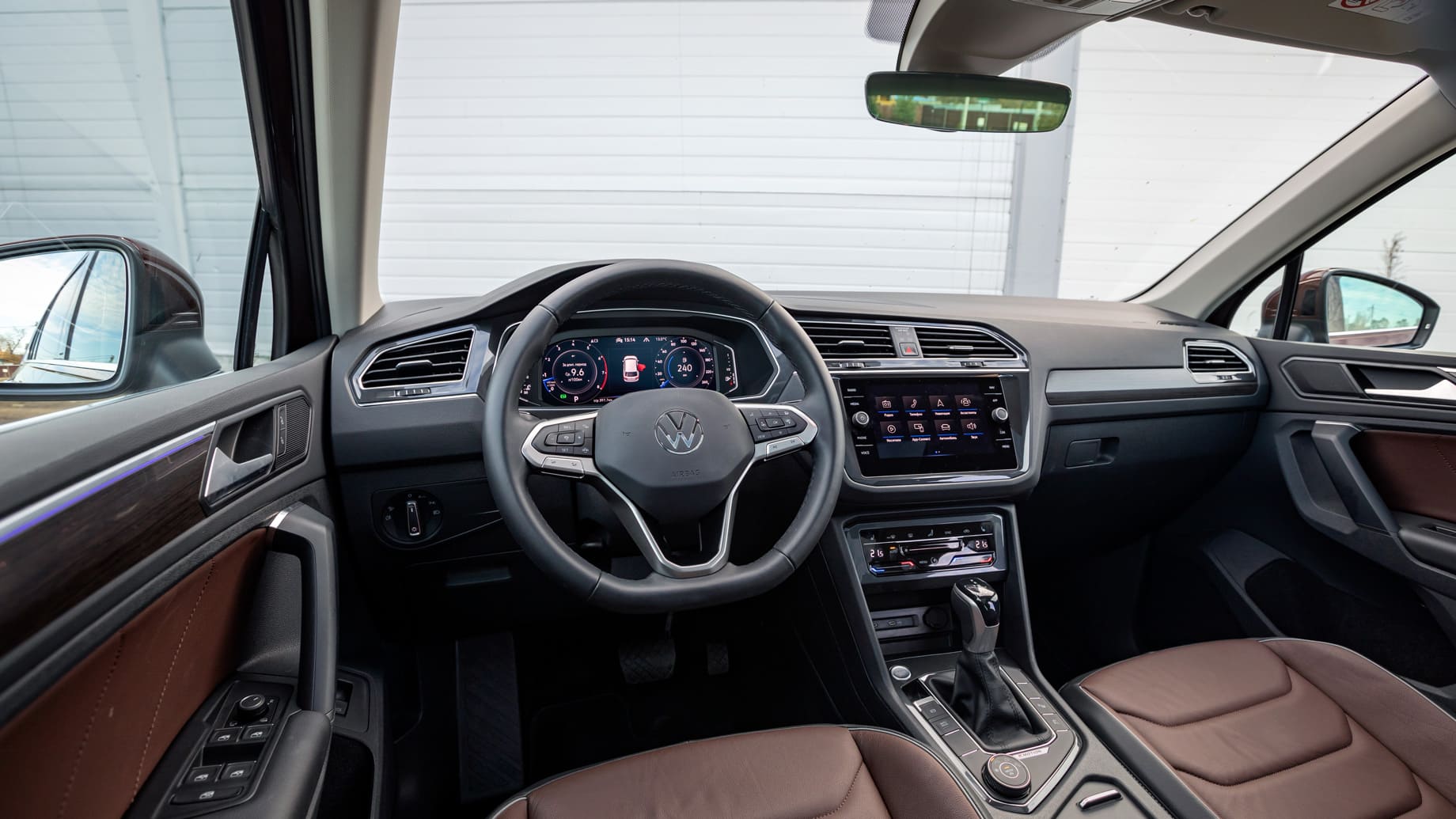
The Tiguan’s interior is more restrained — even a bit plain. The instrument display feels awkwardly integrated into the shroud above the steering wheel, and the faux wood trim isn’t convincing. But the overall execution is tighter. Build quality is clearly higher, and the attention to detail in everyday touches is noticeable. Highlights include:
- Three-stage heated steering wheel (compared to Tucson’s single, often scalding, mode)
- Electrically adjustable front seats with memory function for both driver and passenger
- Centrally positioned touchscreen with fast touch response
- Larger, more colorful infotainment icons and faster Android Auto / Apple CarPlay pairing
The Tiguan’s screen resolution does fall short — grain is clearly visible on the glossy panel. The digital dashboard makes up for it with a generous array of display options, including a full-screen navigation map. Ergonomic downsides include touch-based climate controls and an adjustable armrest that conflicts with the gear lever and the drive mode selector.
Seating Comfort and Visibility
The two crossovers offer very different seating positions and front seat experiences.
Volkswagen Tiguan front seats:
- Lower seating position with a sportier feel
- Excellent padding with soft central sections and firm bolsters — a great combination
- Adjustable headrests and lumbar support in multiple directions
- Slightly smaller side mirrors, but the best rear glass visibility of the two
Hyundai Tucson front seats:
- Higher, more traditional crossover seating position — great for road awareness
- Comfortable cushion with generous padding, though lateral support is lacking
- Good all-round visibility, though the left wiper doesn’t quite reach the A-pillar
- A significant drawback: the headrests are uncomfortably hard
Rear Seat Space: Tucson Takes a Clear Win
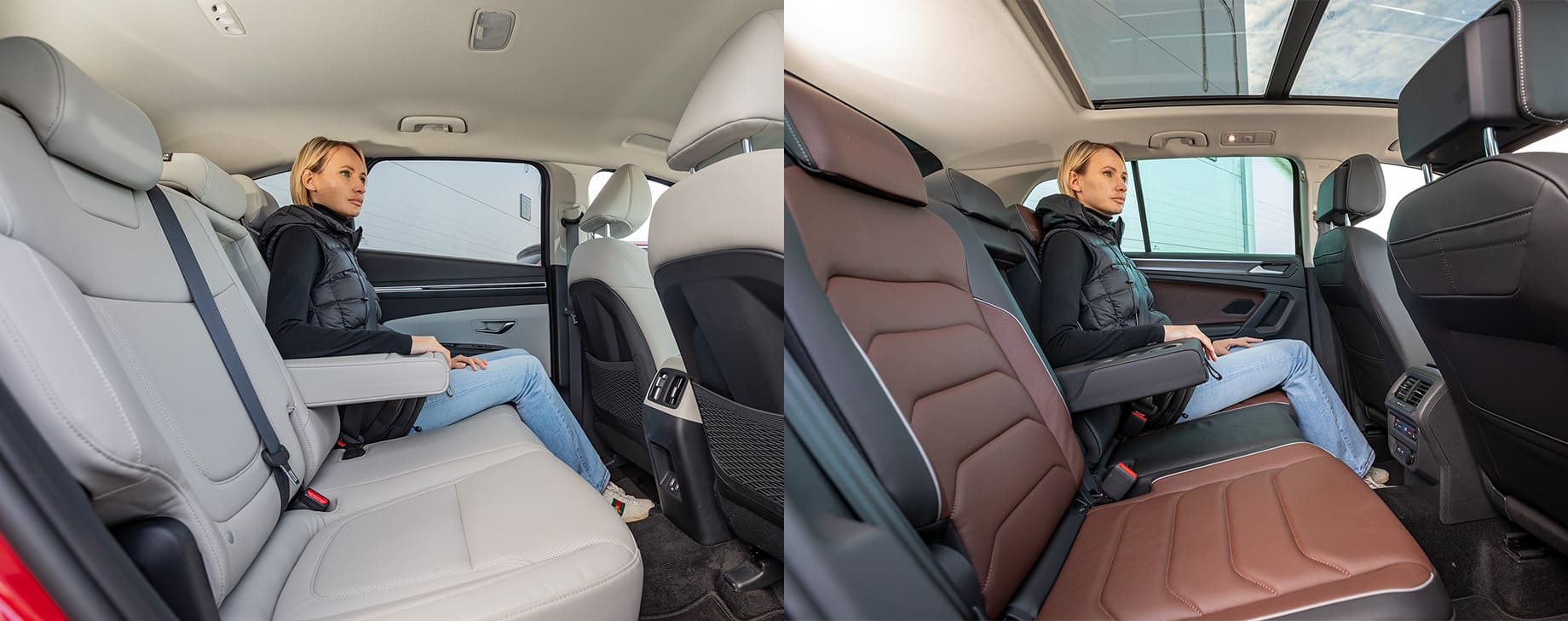
This is where Tucson’s larger dimensions pay off most. Rear passengers get:
- Wide rear door openings with no interference from the roof edge or wheel arch
- 4.33 inches of knee room behind a 5’9″ driver’s seat
- 4.72 inches of headroom
- A deeply reclining backrest — almost flat in its extreme position
- A wide, flat floor tunnel suitable for a center passenger
The Tiguan’s rear isn’t cramped by any means, and the higher door opening means less ducking to get in. The seat itself is softer and wider at elbow level. But the numbers are noticeably smaller: 3.15 inches of legroom and 3.54 inches of headroom. The backrest reclines only slightly, the central tunnel is high and narrow, and the flat seat back lacks contouring. One advantage: the rear seat slides forward to expand boot space.
Engine Performance: Both Make 150 HP, But Feel Very Different
Despite sharing the same headline power figure, these two engines drive nothing alike.
The Tucson runs a 2.0-liter naturally aspirated four-cylinder from Hyundai’s Smartstream family, paired with a six-speed automatic. It produces 150 hp, but torque peaks at just 192 Nm — and only at 4,500 rpm. The result is an engine that feels lethargic at low and mid-range revs, where most everyday driving happens.
- 0–62 mph: 12.1 seconds (official: 11.6 seconds)
- Throttle response is initially sharp, then becomes unpredictable
- The automatic transmission is slow to downshift, undermining overtaking attempts
- No sport mode available
The Tiguan’s 1.4-liter turbocharged engine is a completely different story. With 250 Nm available from just 1,500 rpm, it feels alive from the moment you pull away. Paired with a DSG dual-clutch gearbox with full launch control, this setup transforms the driving experience.
- 0–62 mph: 9.9 seconds (official: 9.8 seconds) — nearly 2 seconds quicker than Tucson
- Without launch control: 10.7 seconds — still 1.5 seconds faster than the Hyundai
- Excellent throttle response and gearbox communication
- Pulls strongly on the highway up to 93 mph
- Feels like a warm hatchback in urban conditions
The trade-off: gear changes under hard acceleration can feel abrupt, and the engine note under full throttle is reminiscent of a vacuum cleaner at full blast.
Handling and Driving Dynamics
The Tiguan is clearly the more driver-focused crossover. Its steering is precise and well-weighted, communicating road feel without becoming tiring. It corners confidently, resists mid-corner bumps, and trails naturally to the outside radius under braking. In ESC Sport mode, it can even be coaxed sideways in a controlled slide. In standard mode, the electronics manage both understeer and oversteer efficiently.
The Tucson rolls more noticeably and responds to steering inputs more slowly. At the limit, it will push the nose wide progressively enough to read what’s happening — but without the stabilization system engaged, it understeers weakly and ignores both steering and throttle corrections. The electronics are not optional here; they’re essential to keeping the car on course.
Ride Comfort and Road Noise
Here’s where the Tucson genuinely surprises. Its ride quality is arguably its strongest attribute — a massive improvement over previous Hyundai crossovers. It handles surfaces with impressive composure:
- Absorbs small and medium bumps almost silently
- Handles road joints smoothly without crashing through
- Notably less body float over undulating roads compared to older Hyundais
- Can maintain speed on rough surfaces where other crossovers would slow down
- Only protests on speed bumps taken too fast or sharp-edged potholes at speed
The Tiguan is similarly composed over gentle surface imperfections, but harder-edged on typical city roads. More critically, the suspension is acoustically loud — it rumbles over almost every bump, and road noise at concrete slab joints can be genuinely unpleasant. This is an unusual failing for an MQB-platform Volkswagen.
Off-Road Capability
The Tiguan has a technical advantage off-road: more ground clearance and better approach and departure angles. It’s less likely to ground out and more predictable in mud — at least while traction control is active. With the off-road traction program engaged, it drives through cross-axle situations immediately. Turn it off, and it spins helplessly. The DSG gearbox is the weak point here — under sustained wheel spin, it eventually cuts power rather than risk damage.
The Tucson is slower through mud and loses traction more easily, but it has a key advantage: a manually lockable multi-disc rear clutch. When wheels are hanging in the air, the Hyundai can force its way out of situations the Tiguan would give up on. And after prolonged slip, the Korean clutch stays healthy — holding up better under sustained off-road stress.

Hyundai Tucson vs Volkswagen Tiguan: Final Verdict
The new Tucson has made a genuine generational leap. It’s no longer the underdog in this comparison — it matches or beats the Tiguan in several meaningful areas:
- More striking exterior and interior design
- Superior ride comfort on everyday roads
- More rear passenger space
- Better-tuned driver assistance systems, including an adaptive cruise control and lane assist that could teach a thing or two to far more expensive cars
- Stronger real-world off-road capability thanks to the lockable rear clutch
But the Tiguan still holds important advantages that matter to driving enthusiasts:
- A significantly more responsive and faster turbocharged engine
- A sharper, better-balanced chassis
- Higher interior build quality with more thoughtful detail
- A more engaging driving experience overall
If you prioritize comfort, space, and value, the Tucson is now a genuinely compelling choice that holds its own against European rivals. If you care more about driving dynamics and powertrain refinement, the Tiguan remains the benchmark in this class — noise issues notwithstanding.
This is a translation. You can read the original here: https://www.drive.ru/test-drive/hyundai/volkswagen/618d333830bd69250e250fc8.html

Published April 21, 2022 • 8m to read