
The first patent for a tire was filed back in 1846, and ever since, drivers have been dealing with flat tires. A loss of tire pressure isn’t just an inconvenience — it’s a genuine safety hazard. That’s precisely why “tire pressure check” appears as one of the very first items in the daily maintenance section of virtually every car owner’s manual.
Why Low Tire Pressure Is Dangerous
When a tire starts losing pressure, rolling resistance increases significantly. The consequences can be serious:
- Higher fuel consumption
- Accelerated tire wear
- Unpredictable side slip and reduced vehicle control
- Risk of the tire detaching from the rim during emergency braking or sharp maneuvers
What makes this especially dangerous is that a slow pressure leak is easy to miss. A slight drift can be mistaken for road camber or wheel tracks, meaning a driver may continue for miles unaware that a tire is critically underinflated. In an emergency situation, that delayed awareness can lead to a serious accident.
The Traditional Approach: Manual Pressure Checks
The most straightforward solution is to check tire pressure manually before every trip — attaching a pump or pressure gauge to each wheel in turn. However, this requires discipline, the right tools, and frankly, the willingness to crouch by your wheels in cold or rainy weather. Most drivers don’t keep up with it consistently. Fortunately, there are now several systems that can do this job automatically.
Pressure Indicator Caps: Simple but Limited
The simplest electronic-free solution is a set of special valve caps with built-in color indicators. These replace your standard valve caps and give you a quick visual read on tire pressure:
- Green — pressure is within the safe range (typically 2.2–2.4 bar)
- Yellow/Orange — pressure has dropped below the warning threshold (around 10% below normal, ~1.9–2.1 bar)
- Red — pressure is critically low (25% or more below normal, below ~1.8 bar)
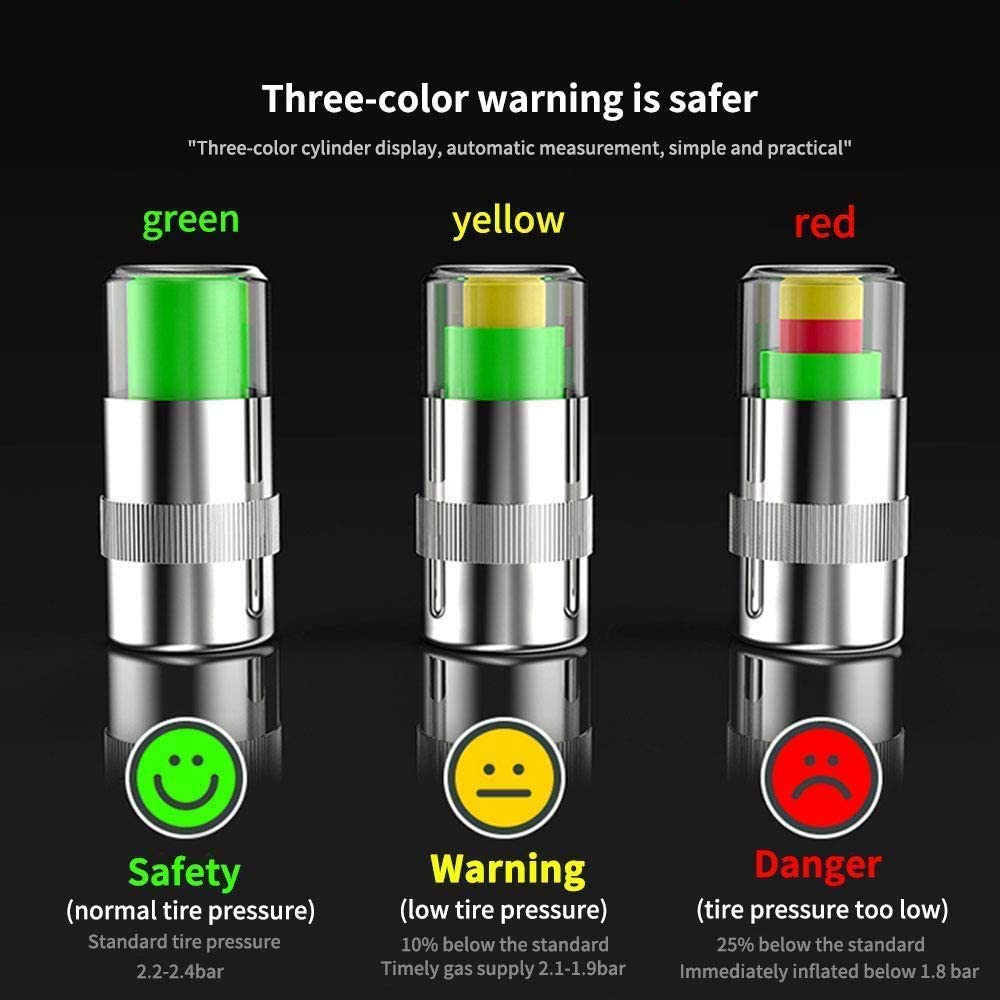
“Three-color cylinder display, automatic measurement, simple and practical”
GREEN
Safety
(normal tire pressure)
Standard tire pressure 2.2-2.4bar
YELLOW
Warning
(low tire pressure)
10% below the standard Timely gas supply 2.1-1.9bar
RED
Danger
(tire pressure too low)
25% below the standard Immediately inflated below 1.8 bar
The main advantage of indicator caps is their simplicity — no electronics, no installation complexity. The downsides, however, are worth noting:
- They can only be checked when the car is stationary
- They alert only when pressure drops below preset thresholds, which may not match your specific vehicle’s requirements
- They must be selected for your car’s specific recommended tire pressure
That said, a quick visual check of the caps as you walk around the car before a trip is still far more practical than pulling out a gauge every time.
Electronic TPMS: Real-Time Pressure Monitoring While Driving
For real-time monitoring while on the road, an electronic Tire Pressure Monitoring System (TPMS) is the gold standard. These systems alert the driver the moment pressure drops to a dangerous level — giving enough time to safely pull over, especially during a slow puncture where there’s no obvious handling change.
Modern TPMS solutions vary in how they communicate data:
- Radio-frequency sensors — transmit tire pressure and temperature data directly to a central display unit in the vehicle
- Bluetooth-enabled sensors — pair with your smartphone or tablet, showing live pressure readings in a dedicated app
It’s worth noting that TPMS is standard equipment in new vehicles across many markets and is required by law in countries such as the United States and across the EU.
ABS-Based Indirect TPMS: Clever but Not Foolproof
Many factory-fitted systems take a different, more indirect approach: instead of using dedicated pressure sensors, they work through the car’s existing ABS wheel speed sensors. Here’s how the logic works:
- When a tire loses pressure, its section height decreases slightly
- A smaller diameter means that wheel rotates faster to cover the same distance
- The ABS sensors detect an unusual difference in rotational speed between wheels on the same axle
- When this discrepancy exceeds a calibrated threshold, the system triggers a warning
This approach is cost-effective since it uses hardware already present in the vehicle. However, it has some notable limitations:
- False alarms on long corners — in extended turns, outer wheels naturally spin faster than inner wheels, which can trigger the system incorrectly
- Ineffective with Run-Flat tires — tires with Run-Flat technology use reinforced sidewalls that maintain the tire’s shape even with zero pressure. The section height barely drops (only 30–40%), so the speed differential is too small to register as a warning
- No temperature data — unlike direct sensor systems, indirect TPMS can’t flag issues related to heat buildup
Run-Flat Tires and TPMS: An Important Combination
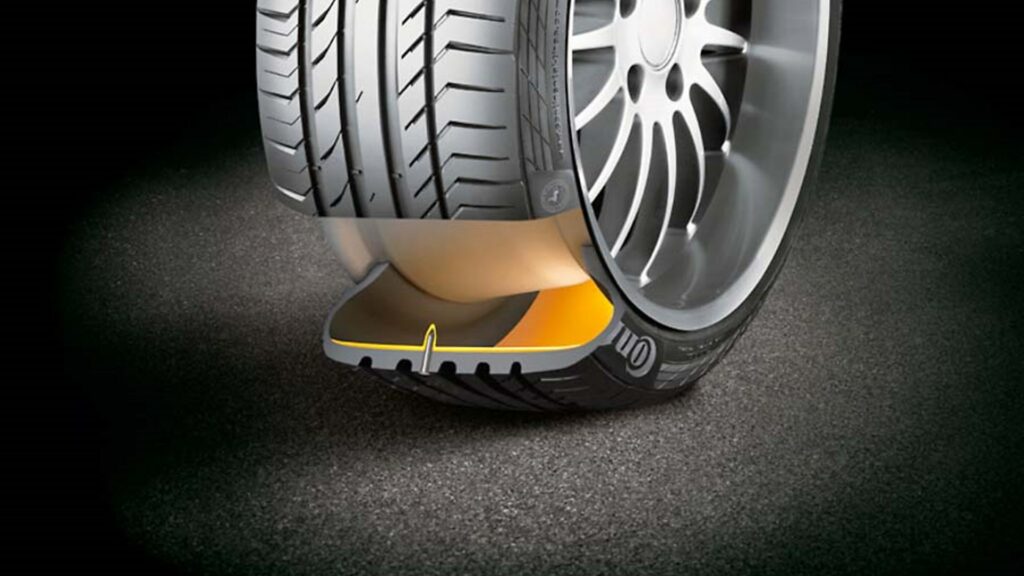
Run-Flat tires are a great safety innovation — they allow you to continue driving for a limited distance even after a complete loss of pressure, thanks to their reinforced sidewalls. But because they don’t visibly deflate, drivers may have no idea there’s a pressure problem at all. This makes a direct-reading TPMS not just useful, but essentially mandatory when running this type of tire.
TPMS Pros and Cons: Quick Summary
Direct TPMS (dedicated pressure sensors):
- ✅ Accurate real-time pressure and temperature readings
- ✅ Works with all tire types including Run-Flat
- ✅ Alerts while driving, not just at a standstill
- ❌ Sensors require battery replacement over time
- ❌ Higher cost than indirect systems
Indirect TPMS (ABS-based):
- ✅ No additional hardware required
- ✅ Factory-fitted in many vehicles
- ❌ Can produce false alarms on long corners
- ❌ Unreliable or ineffective with Run-Flat tires
- ❌ No temperature monitoring
The Bottom Line: Monitor Your Tire Pressure
Electronic monitoring systems — whether direct sensors, ABS-based, or even basic indicator caps — are genuinely useful safety tools, especially for catching slow leaks before they become emergencies. But no system replaces good habits. Check your tire pressure at least once a week, and if a tire looks even slightly flat, don’t put it off — inflate it before your next trip.
This is a translation. You can read the original here: https://www.drive.ru/technic/4efb330d00f11713001e35c3.html

Published January 06, 2022 • 5m to read