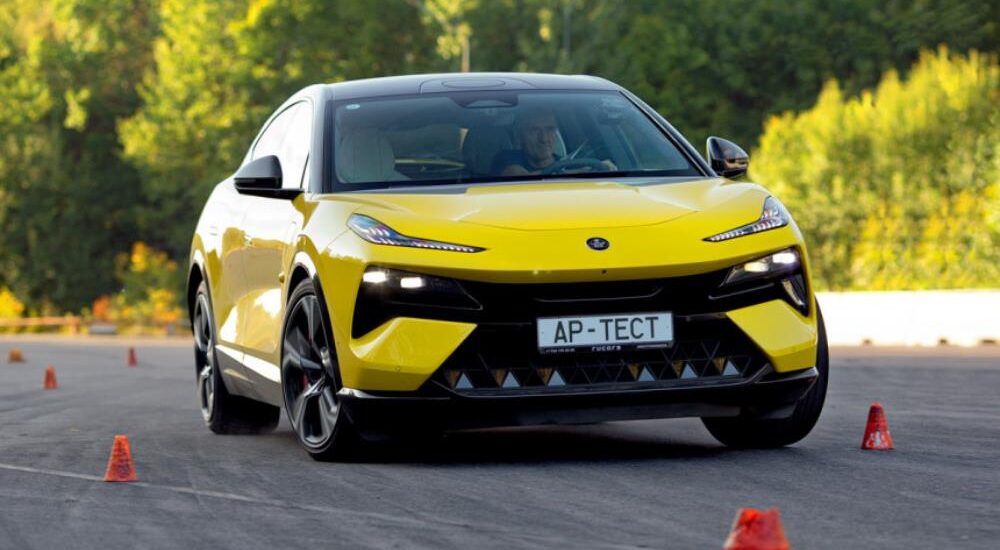

The Lotus Eletre is a landmark for the British marque twice over: it is the company’s first electric crossover, and the first Lotus built in China. We took one round a high-speed test track — an exercise that was not without its complications, particularly when the time came to put the charge back into the battery.
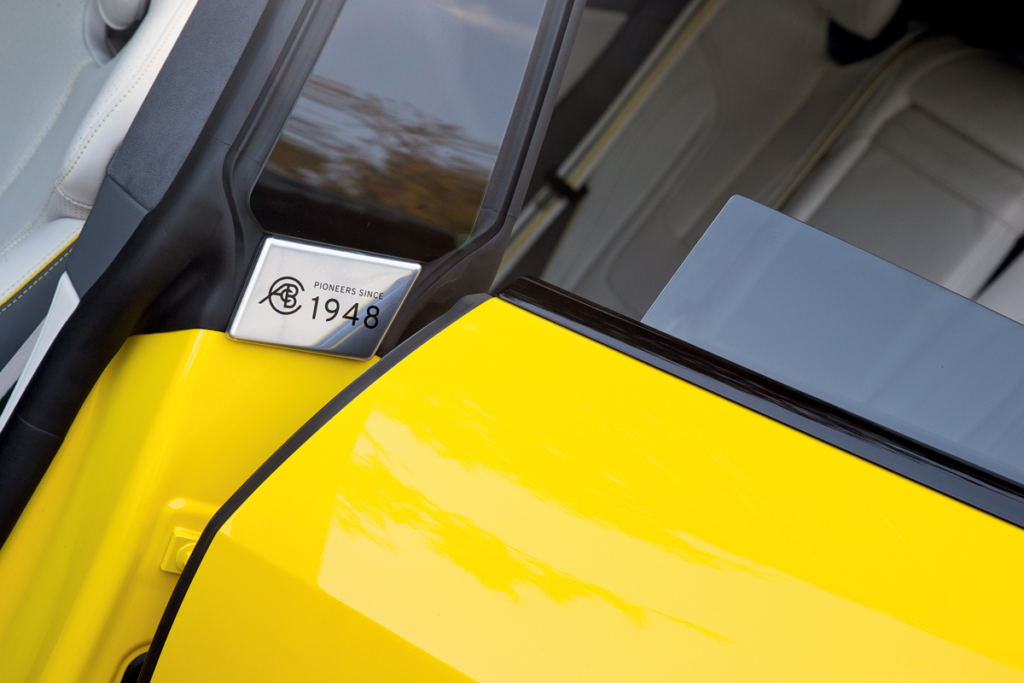
Lotus Engineering was founded in 1952, but as early as 1948, Colin Chapman built his first racing car in a garage, as reminded by this plaque on the central pillar of the Eletre.
From Colin Chapman’s Garage to Geely
Lotus Engineering was founded in 1952 by the engineers Colin Chapman and Colin Deyre, and spent its early years building racing cars while dabbling in road cars on the side. Its Formula 1 dominance between 1963 and 1978 — seven Constructors’ Championships and six drivers’ titles — settled its place in motorsport history for good. Then the money ran out. Financial trouble in the early 1980s forced the company into other people’s hands.
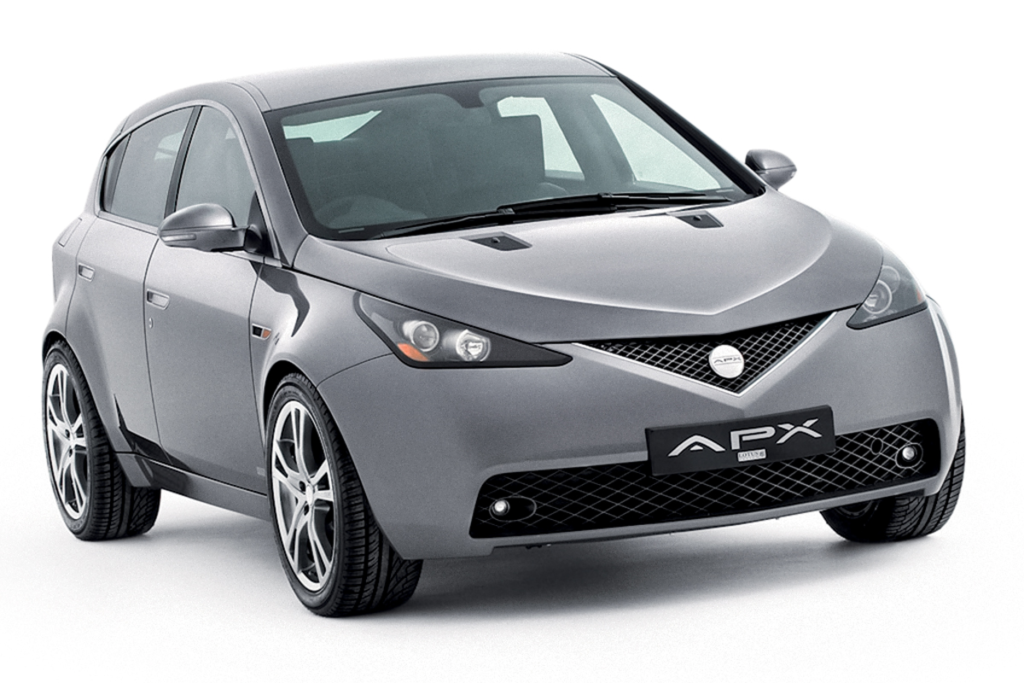
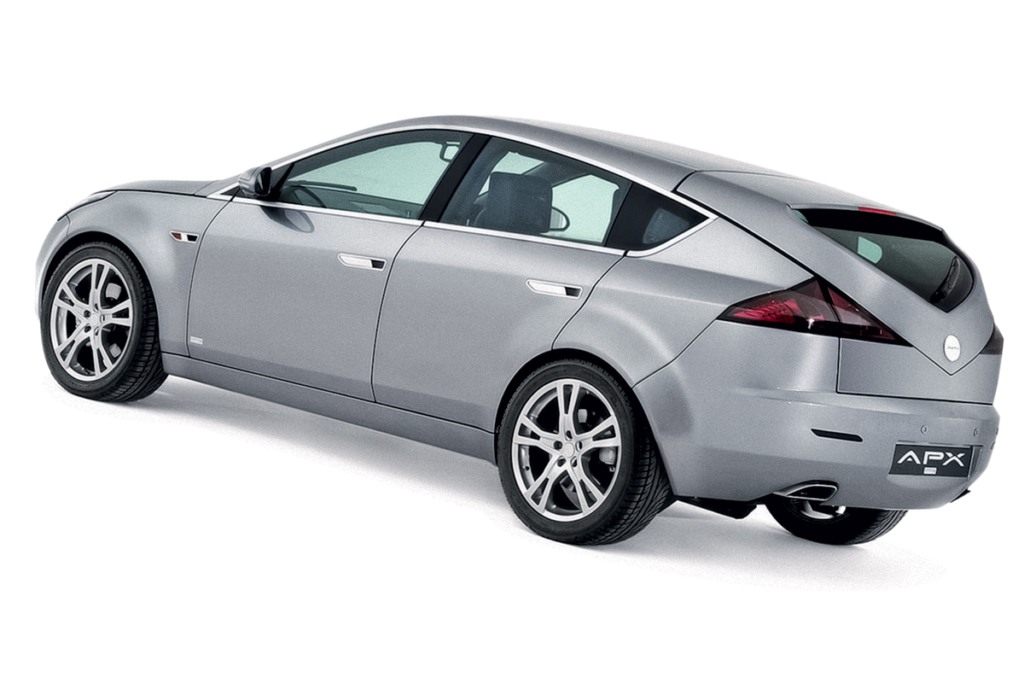
The 2006 Lotus APX (Aluminium Performance Crossover) concept featured an aluminum body, a supercharged 3.0 V6 engine (300 hp), and permanent all-wheel drive. Looking at the design of the car, one wouldn’t regret that the project was canceled.
The American conglomerate General Motors took ownership in 1986, the Malaysian firm Proton bought the company in 1996, and through both Lotus struggled to find its feet again. The turning point came in 2017, when the Chinese group Geely took a controlling stake — bringing the capital the company needed and setting its electric future in motion.

The six hexagons at the bottom of the bumper feature active flaps that open to allow air to the cooling system’s radiators for the electric motors and battery.
The Crossover Lotus Wanted for Twenty Years
The idea of a powerful, high-performance crossover had been simmering at Lotus for a long time, with the Porsche Cayenne as the obvious model. The aluminium-bodied, supercharged V6-powered Lotus APX concept appeared as early as 2006, but there were never the resources to take it further. What finally realised the idea was the Eletre, developed with input from Volvo and Polestar — fellow Geely subsidiaries.
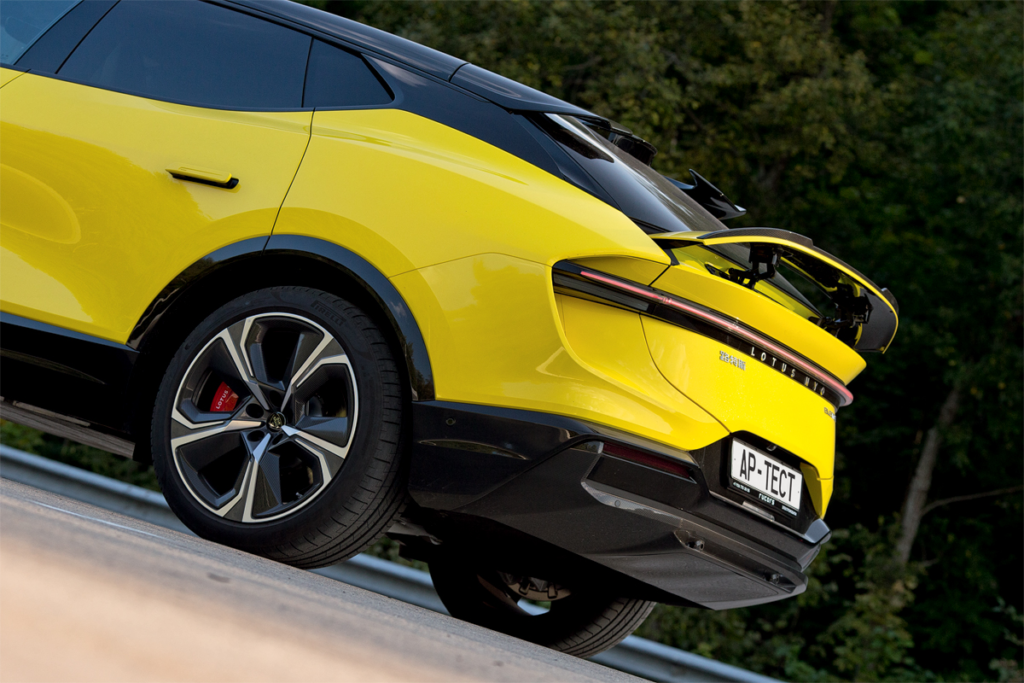
The spoiler extends depending on the driving mode. At high-speed braking, the angle of ascent reaches 34 degrees.
The Lotus Emira, the marque’s last petrol model, still caters to petrolheads, but the future is plainly electric. The limited-run Lotus Evija hypercar, with more than 2000 hp, was originally to have been the brand’s first electric car; delays have held it up, and the more accessible Eletre has gone ahead of it into production and into showrooms worldwide.
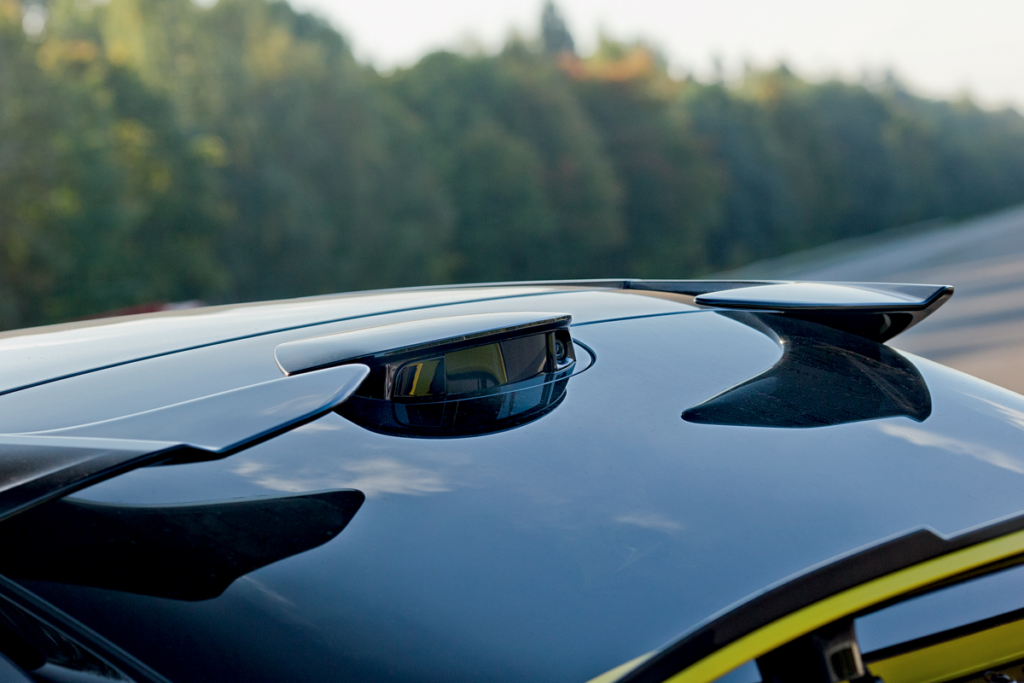
The rear window does not have a wiper; the air flow, shaped by the side flaps, is supposed to blow the water off.
In the first half of 2023 the Eletre outsold the petrol Emira by a wide margin, which tells its own story about where the demand is. It has since arrived in Europe with the United States to come, and the sales projections are rising accordingly. A new plant in Wuhan, with capacity for 150,000 vehicles a year, shows how serious Geely is — a scale Lotus has never worked at before.

As Big as an Urus, and Slipperier
For anyone contemplating the move from a bellowing Lamborghini Urus to a silent Eletre, the dimensions make the case. The two are almost identical in size, and both are striking, with the aerodynamics worked into every surface rather than bolted on. The Eletre’s drag coefficient is 0.26.

The interior, finished in Nappa leather and Alcantara, looks luxurious. The doors have soft-close mechanisms and frameless double glazing.
The EPA Platform, Tuned by Lotus
We took the Eletre to the Dmitrovsky test track, and it did not disappoint. Before the fast laps, though, it is worth saying what actually sets this car apart.

It’s challenging to see anything other than speed on the narrow strip of the display. Though in Off-Road mode, it even squeezes in data on the angles of longitudinal and lateral tilts.
It is built on the EPA platform — Electric Premium Architecture, the sporting version of Geely’s SEA (Sustainable Experience Architecture) — so its technical DNA is shared with Zeekr and Polestar. What separates it is the chassis work Lotus did on top: over a million miles of testing across several continents, and a great many laps of the Nürburgring. The Eletre is not merely a crossover. It is an electric racing car that expects to be driven hard.

At the base of the console is an induction charging pad and a minimalistic climate control unit, which includes a touch-sensitive button to open the glove compartment.
Lotus cars have traditionally been light — that was Colin Chapman’s founding principle. Electric power has put an end to it: the S+ weighs 2624 kg. What the Eletre does have, despite the mass, is a near-perfect front-to-rear weight split, and its handling is the better for it.
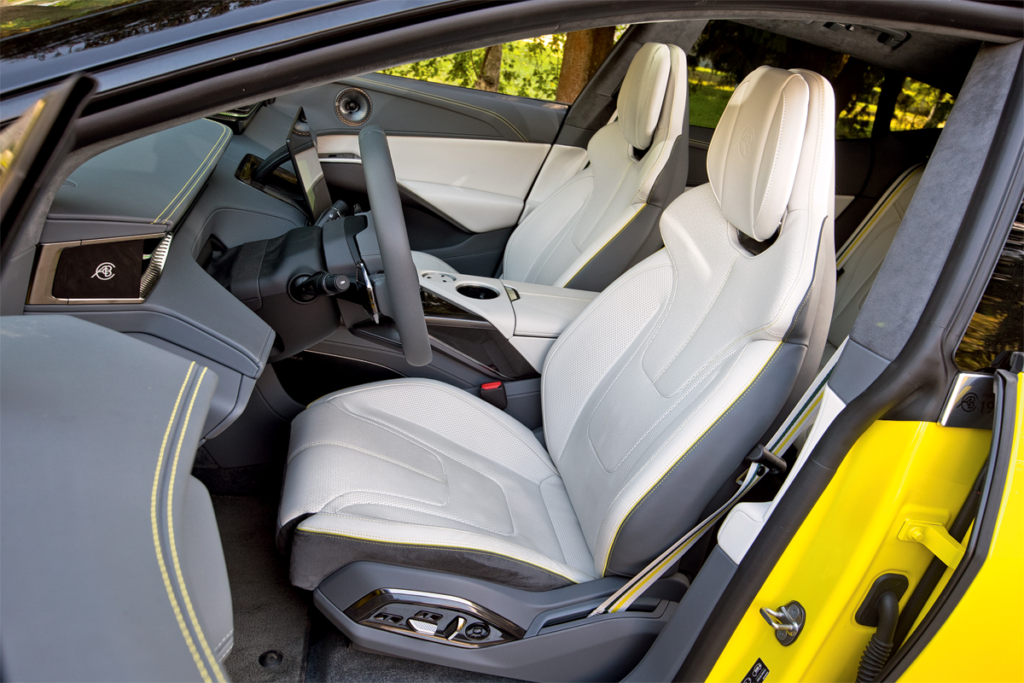
From Lotus seats, one would expect better lateral support. However, they do have ventilation and massage functions.
Sport Mode on the Track
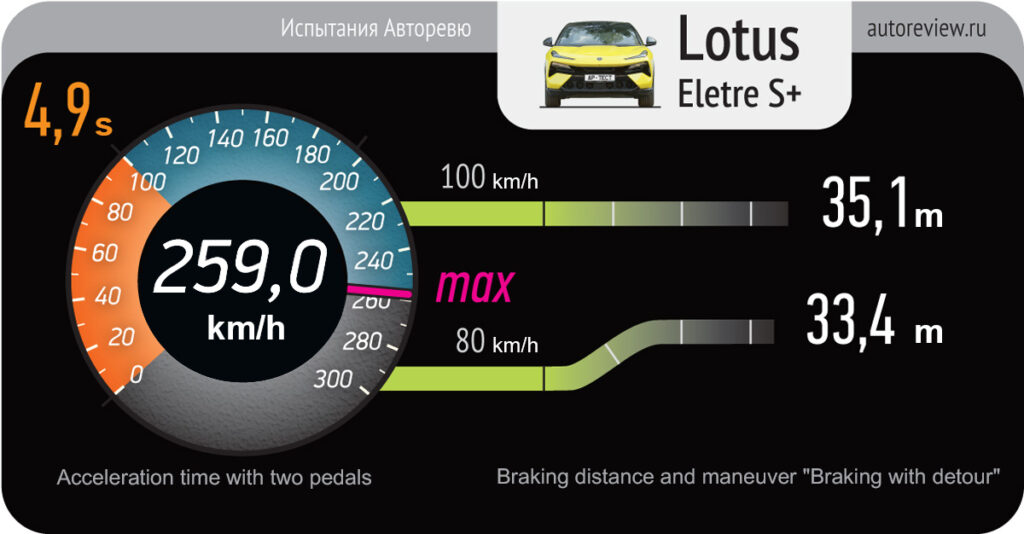
Select Sport and the Eletre comes alive. Two electric motors produce a combined 612 hp, and the car reaches 100 km/h in 4.9 seconds — brisk by any measure. The suspension firms up to match, at some cost to ride comfort over broken surfaces.
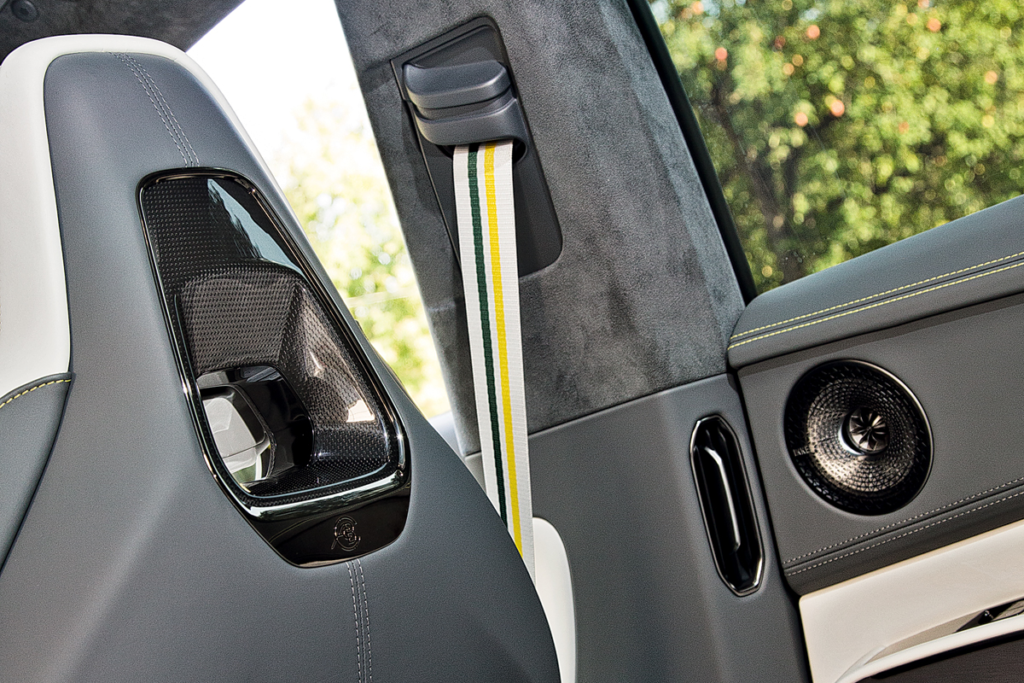
The seats are adorned with carbon fiber inserts, and the safety belts can be ordered in one of six colors.
Brakes and Cornering
The braking is every bit as convincing: barely any nose dive, and no sign of overheating even after repeated hard stops. The standard brakes have all the stopping power you need, though carbon-ceramic discs are available for anyone planning serious track work.
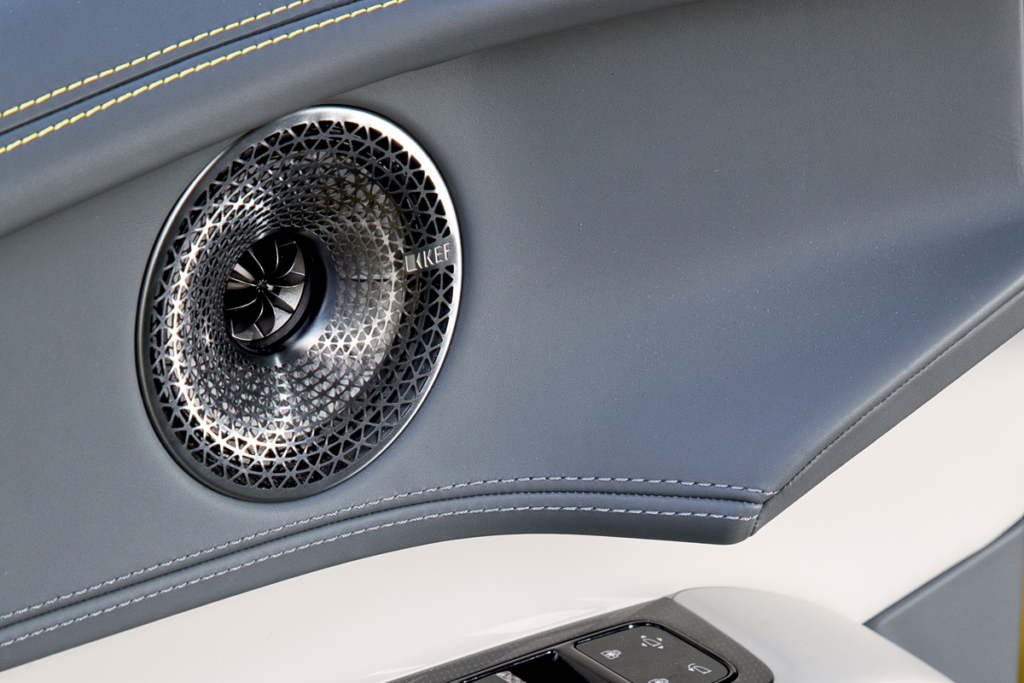
The metallic tweeter of the high-frequency speaker, combined with a mid-range speaker, is a hallmark of the English company KEF. The base model includes 15 speakers (1380 Watts), but for an additional fee of 562,500 rubles, a more powerful sound system with 23 speakers (2160 Watts) is available.
On the twisting mountain section of the test track the Eletre is in its element, turning in eagerly with very little roll. The optional active anti-roll bars and rear-wheel steering sharpen it further, to a degree that recalls the German premium crossovers.
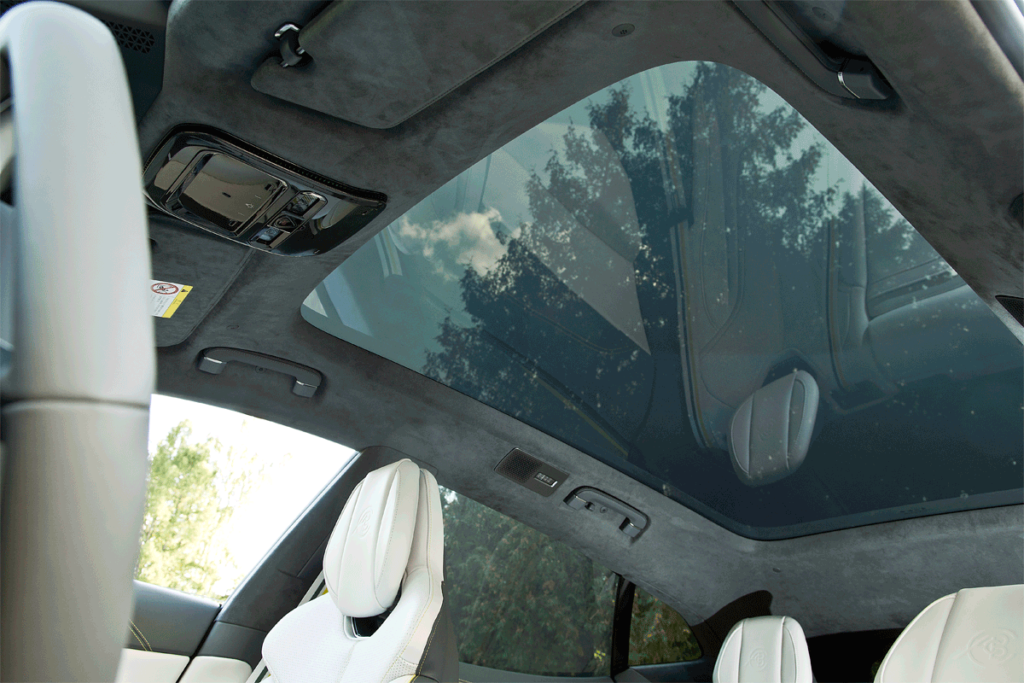
The transparency of the electrochromic roof gradually changes via the menu, without a traditional curtain.
For all its sporting intent the car stays composed on dry asphalt and does not slide easily. It does let go eventually, and then it needs an active correction at the wheel. How it behaves on snow remains to be seen; what its wide 22-inch Pirelli P Zero tyres do offer is Seal Inside technology, which makes a small puncture a non-event.
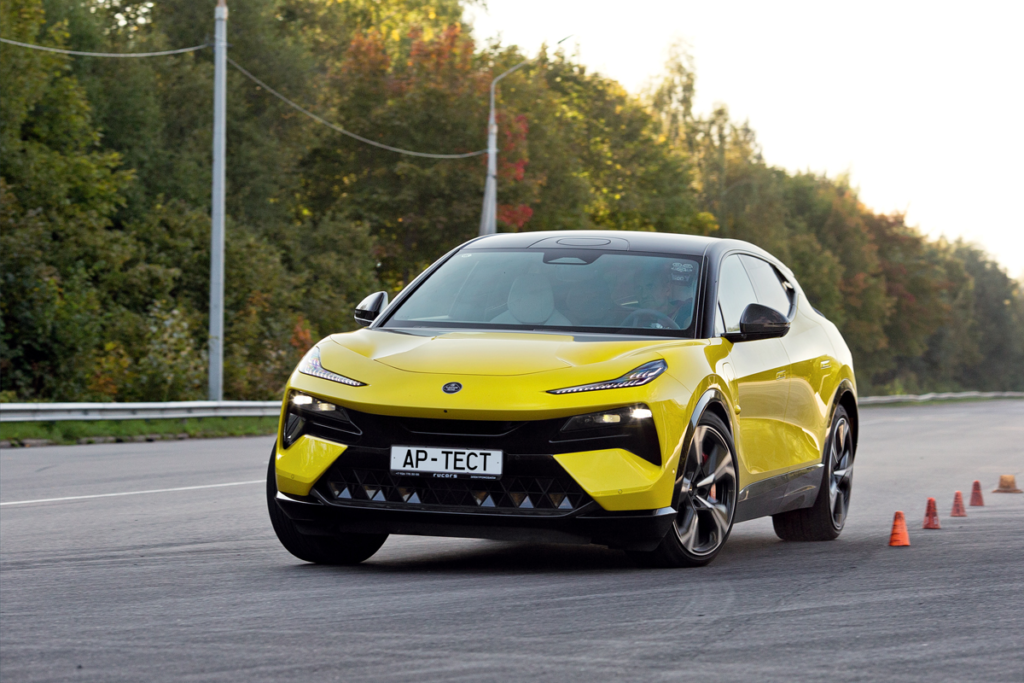
Thanks to active stabilizers, the Eletre almost rolls without tilting during maneuvers. However, by the third lap, some artificial, “parasitic” efforts appeared on the steering wheel. To avoid breaking the power steering, we stopped the measurements. We did manage to record the braking distance from 80 km/h when swerving around an obstacle: an average of 33.4 meters.
Our time with the Eletre was not trouble-free, but it taught us a great deal about what this crossover can and cannot do.
Measured on a Puncture and 30% Charge
We ran the dynamic measurements with a punctured tyre and only 30% in the battery, and the Eletre still performed. Even at that state of charge it reached its claimed maximum speed without difficulty, and got to 100 km/h just 0.4 seconds off the quoted 4.5.
Charging: 100 kW From a Rosseti Terminal
With the battery down to 9% we had a problem. The first station would not charge the car at all, and we fell back on a Lukoil filling station fitted with a Rosseti terminal. That one started without fuss and delivered nearly 100 kW. In 56 minutes the Eletre took on 75 kWh, which showed as 358 km of range at 71% charge.
| Parameters | Electric Vehicle Lotus Eletre S+ |
|---|---|
| Maximum Speed, km/h | 259 |
| Acceleration Time, s 0—50 km/h 0—100 km/h 0—150 km/h 0—200 km/h 0—250 km/h 400 m Sprint Time 1000 m Sprint Time 60—100 km/h (D) 80—120 km/h (D) | 2.4 4.9/5.0* 8.5 15.7 35.2 12.9 23.2 2 2.2 |
| Braking Distance | |
| from 100 km/h Distance, m Deceleration, m/s² | 35.1 11 |
| from 150 km/h Distance, m Deceleration, m/s² | 82.8 10.5 |
| from 200 km/h Distance, m Deceleration, m/s² | 146.9 10.5 |
* Acceleration with two pedals / foot transfer
Tour Mode, and the Cabin
Switch to Tour and the car relaxes: softer throttle response, more compliant suspension. The heavy 22-inch wheels still send jolts through on a bad surface, but the cabin stays quiet, helped by active noise cancellation and the KEF audio system.
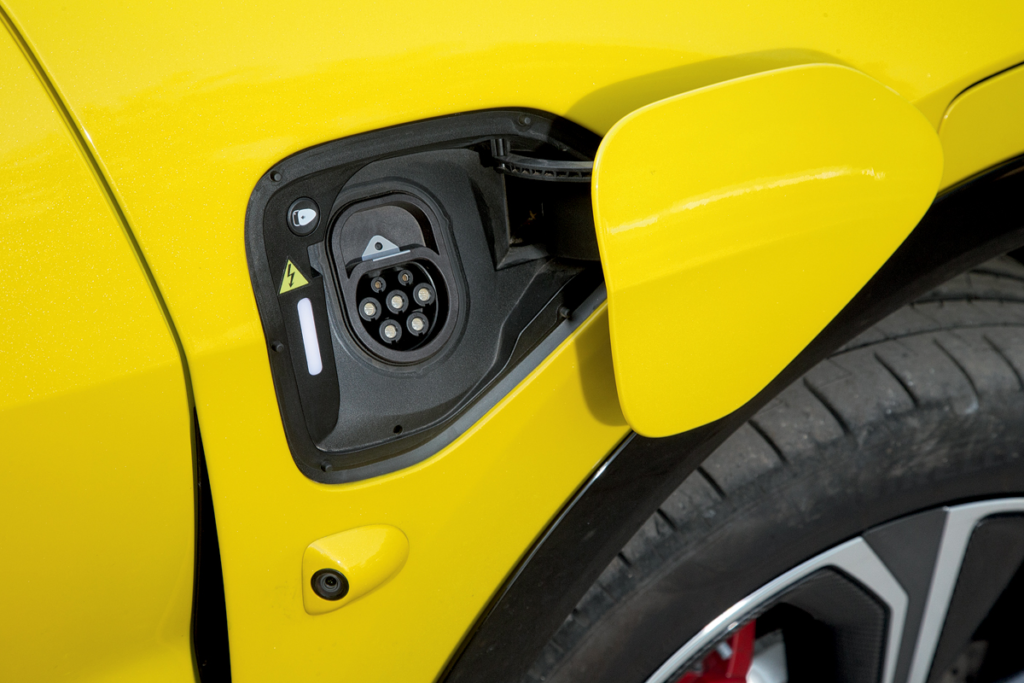
Under the right flap is a socket for alternating current charging. When connected to the public three-phase charging system “Energia Moskvy,” the actual power reached 12 kW.
Inside, the Eletre is genuinely luxurious, and the detail work is careful: metal paddle shifters, seats that adjust every way and offer heating, ventilation and massage, an electrochromic panoramic roof. The absence of conventional instruments takes some getting used to, but the 29-inch projection screen carries everything you need, autopilot functions included.

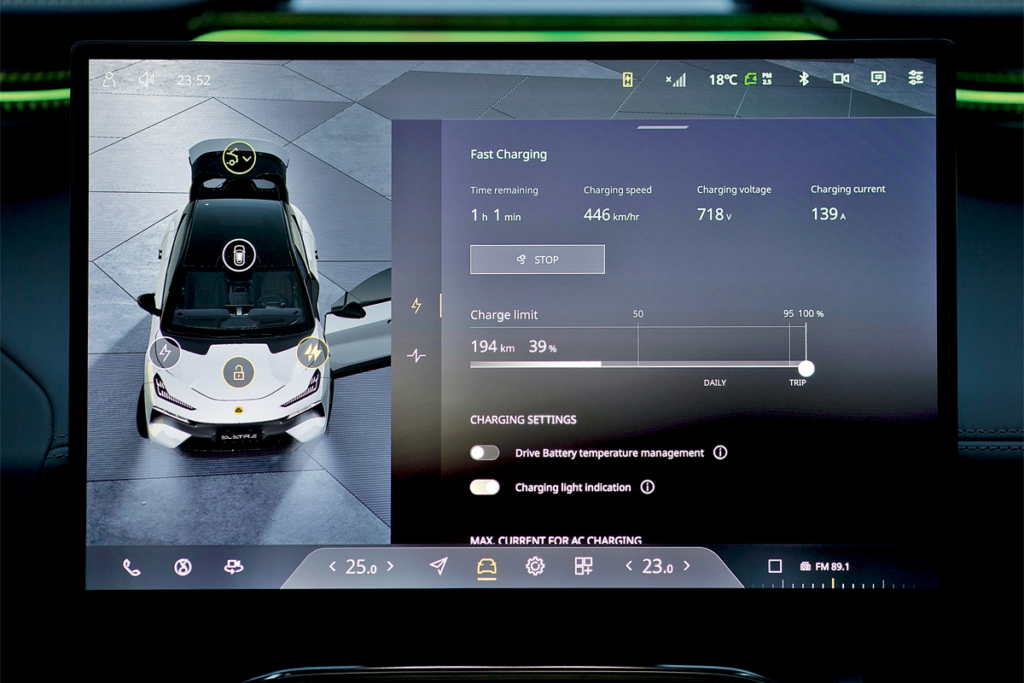
Lotus’s 800-volt electrical system allows charging at terminals with up to 350 kW power. In Russia, such terminals are simply non-existent; the maximum delivered by Rosseti charging stations was 100 kW, which is also quite good.
Lidar, Spoiler, Screens
On the subject of autonomy, the Eletre hides lidar sensors in its bodywork, giving it a picture of its surroundings up to 200 metres out. The rear spoiler adjusts its angle continuously for aerodynamics and stability, and there are metal buttons on the steering wheel and optional camera mirrors to go with them.
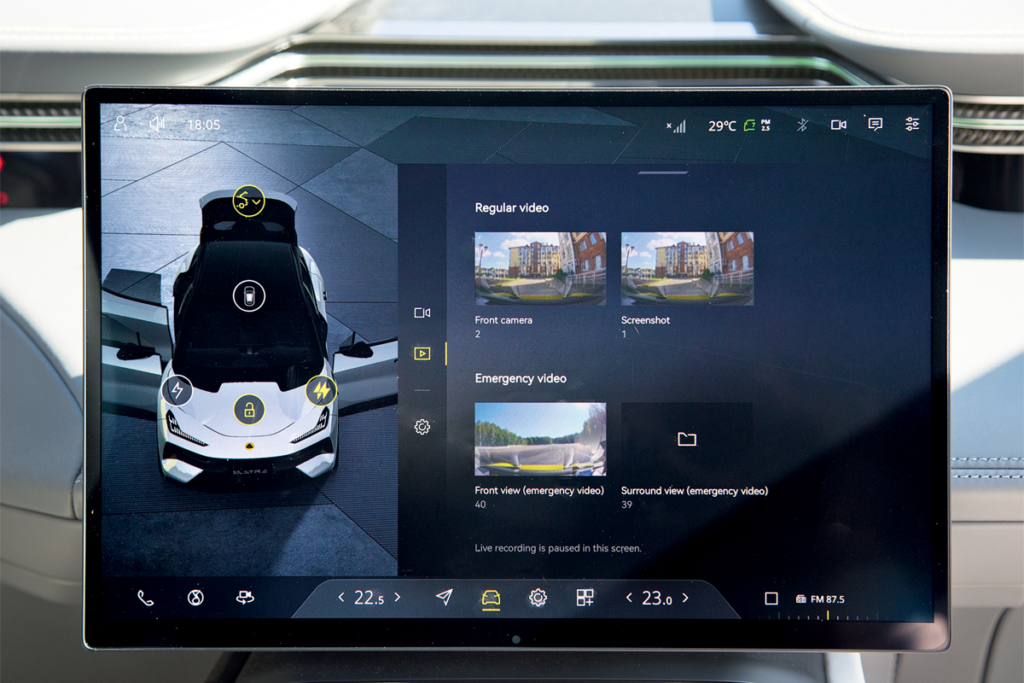
The built-in dashcam automatically records clips in an emergency. All our braking and maneuvering at the test site ended up in the onboard video library.
There are quirks — the horizontal display position, the stiff buttons — but the Eletre impresses all the same, with a combination of pace, comfort and technology that does the Lotus name no harm at all. Track day or weekend away, it electrifies either one.
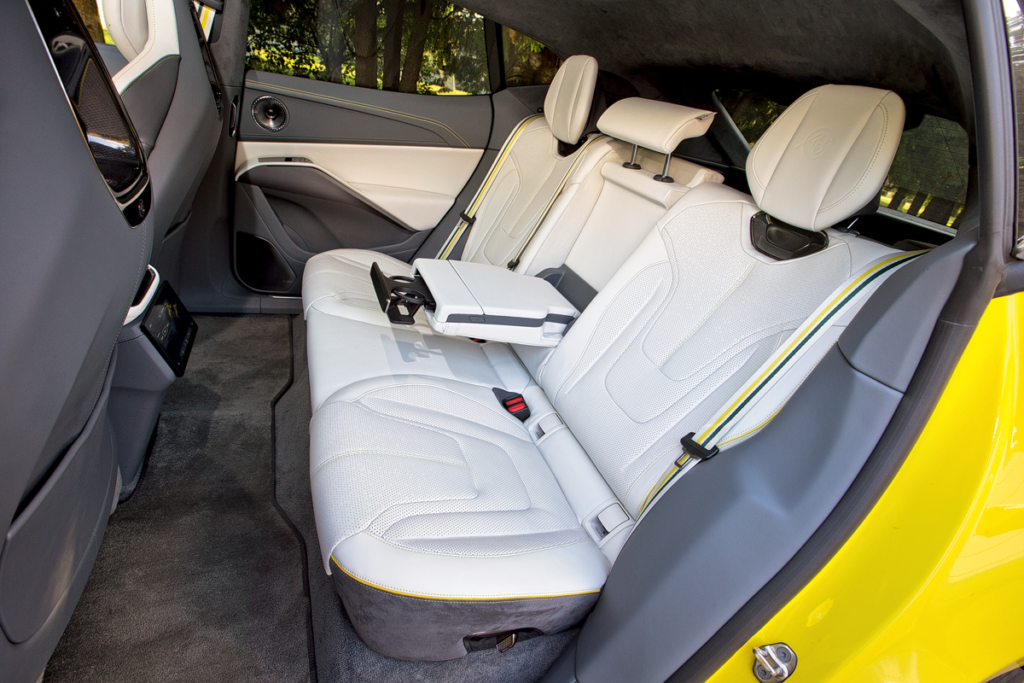
The second row is spacious, with electrically adjustable seat backs.
Configurator, Prices and Warranty
And do not overlook the pleasure of building your own car in the configurator. Rucars, who supplied our test Eletre, has it on their website: interior colours, carbon fibre trim, the lot — much as one used to spend an evening specifying a Porsche or a BMW. Patience is required, mind. A car built to your order takes five to six months to arrive.
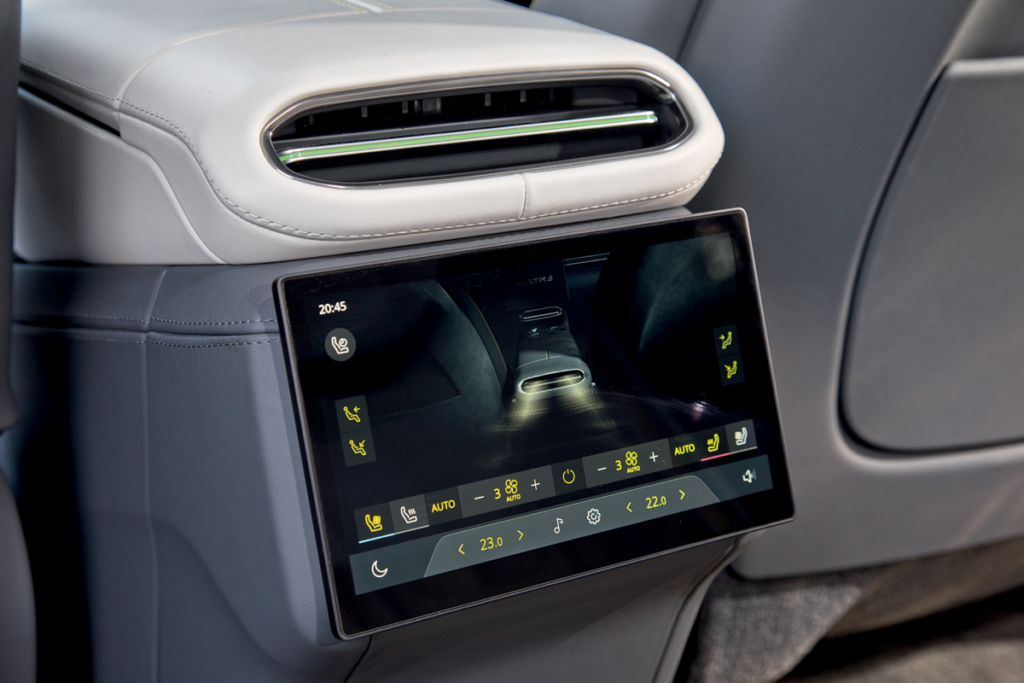
Rear passengers have their own tablet for controlling climate, seat heaters, and music.
The choice does not end with the colours, either. The base Eletre S+ starts at 15.4 million rubles; the range-topping Eletre R+, with 918 horsepower, starts at 18.9 million. The gap between the two will not frighten a Tesla, but the Eletre’s Off-Road mode lifts the ground clearance to 255 mm and takes it places where a conventional SUV would give up.
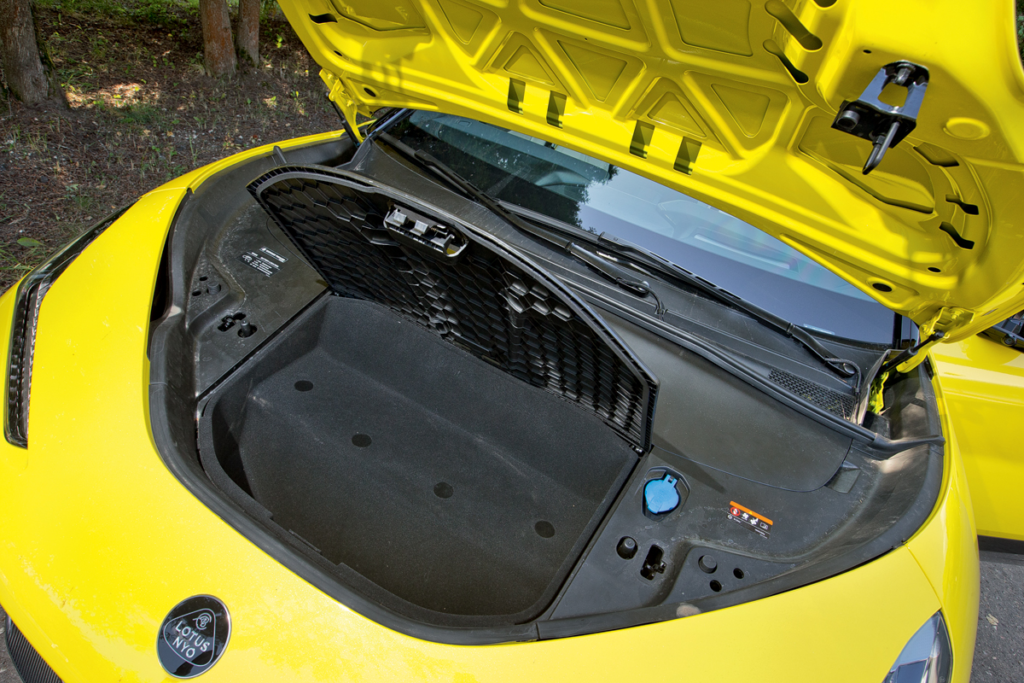
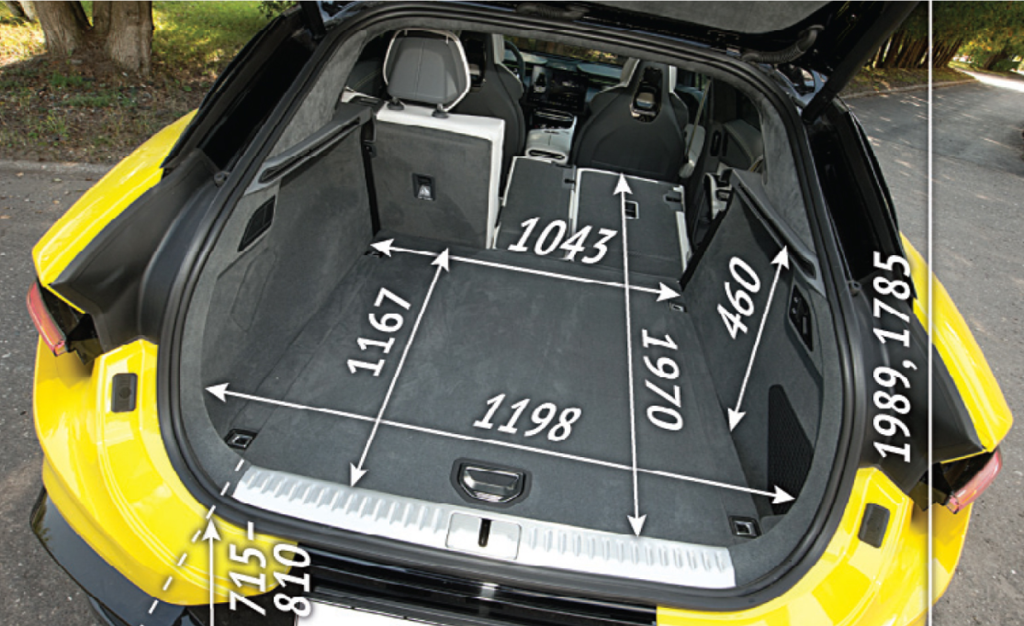
The rear bench seat backs fold in a 40:20:40 ratio, with buttons for controlling the air suspension located on the right—loading height can be reduced from the standard 810 mm to 715 mm.
Dimensions, Weight and Axle Distribution

Manufacturers’ data are highlighted in blue/Autoreview measurements are highlighted in black. Dimensions are in millimeters.
*Actual vehicle weight without driver, with full fuel tank and full process fluids
**For right rear seat
**Interior width at shoulder level in the first/second row of seats.
Lotus has no plans for an official Russian market release, and the appeal persists regardless. The warranty is the sticking point: European buyers get up to five years or 150,000 kilometres, while here the most on offer is a dealer’s one-year cover, and that costs extra. For anyone who wants a powerful Chinese electric car with European engineering and British heritage inside it, the Eletre is still a tempting thing.

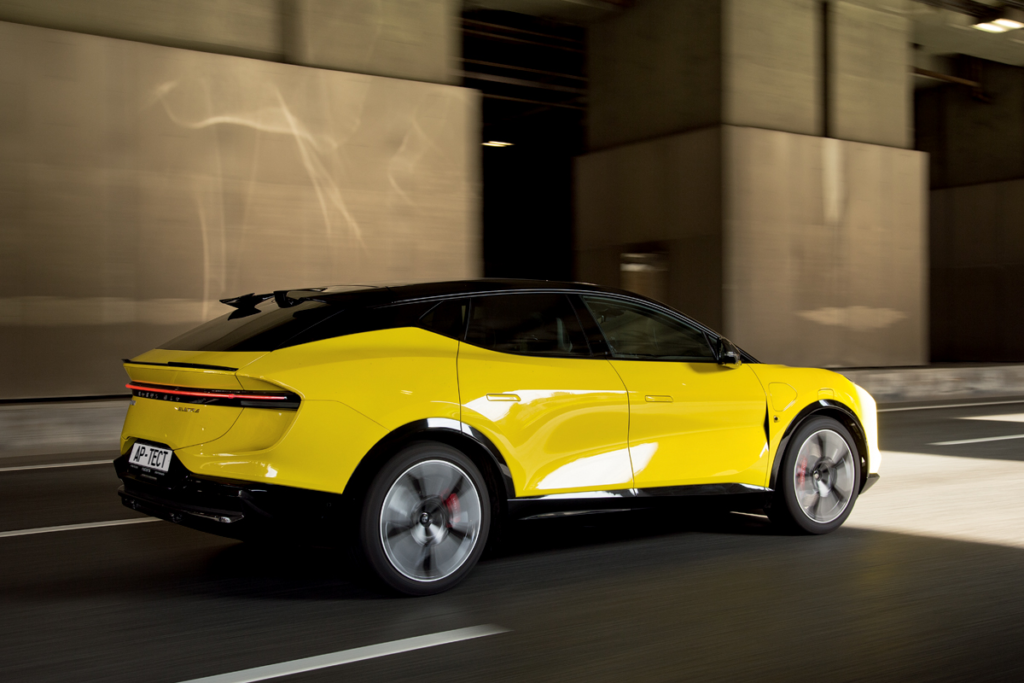
Photo: Dmitry Pitersky
Expert group: Andrey Mokhov
This is a translation. You can read the original article here: Кроссовер Lotus Eletre на полигоне: мчит даже на последних киловаттах!

Published May 09, 2024 • 9m to read