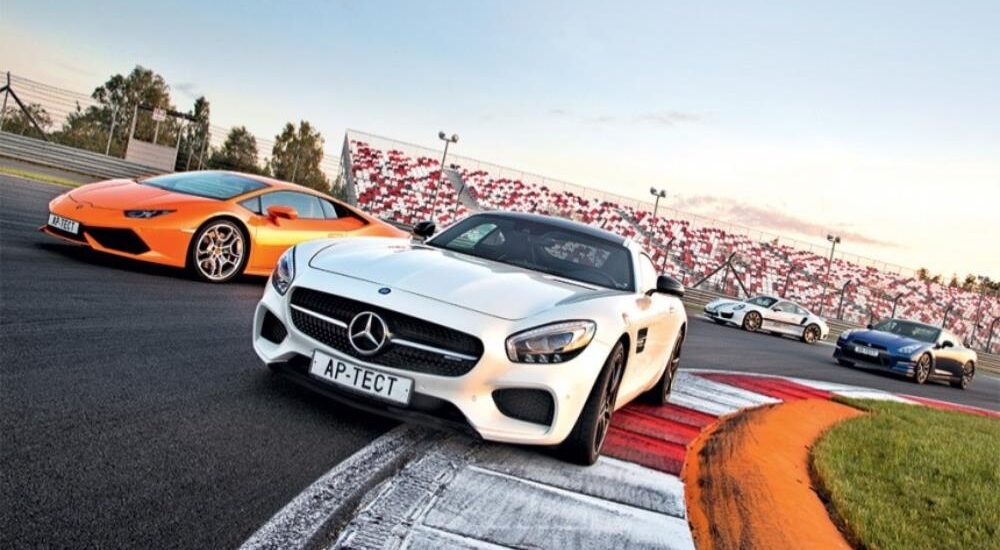

Gathering these four together is like assembling a cast of stars — every one of them a legend. The Lamborghini Huracan, dazzling to look at; the luxurious Mercedes-AMG GT S; the classic Porsche 911 Turbo S; and the mighty Nissan GT-R. All of them are here to be measured against each other.
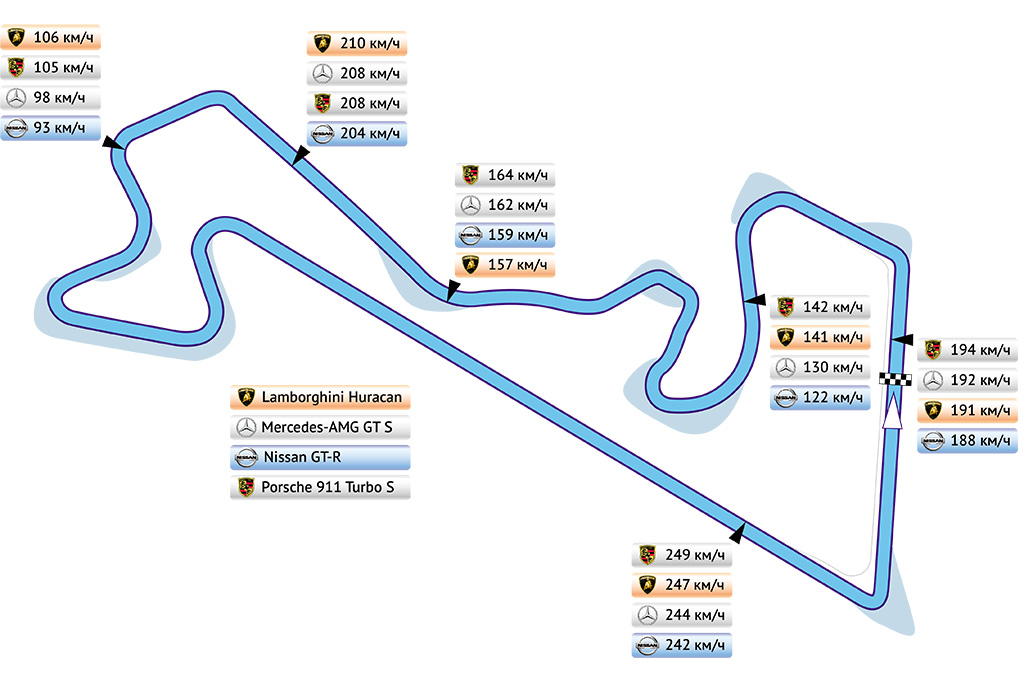
Speed of Cars on the Moscow Raceway Track (FIM Configuration) According to VBox Sport GPS Receiver
Nissan GT-R
- 0—250 km/h: 20.8 s
- Leap Time: 1 min 52.624 s
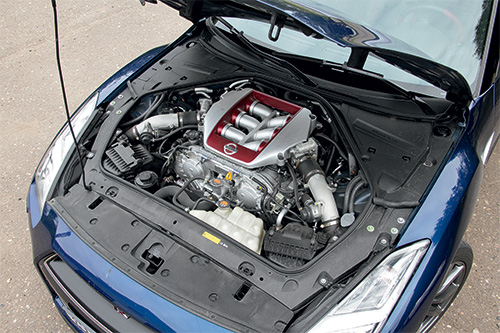
The Nissan GT-R opens the account with an impressive ratio of price to performance. Its 3.8-litre biturbo V6 makes 540 horsepower and takes the car to 100 km/h in 2.8 seconds. For all its shortcomings — the noise insulation among them — the GT-R delivers an exhilarating experience for the money.
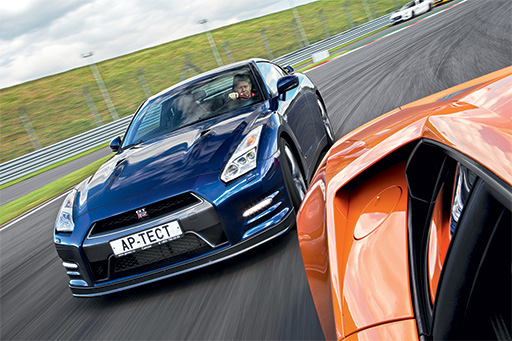
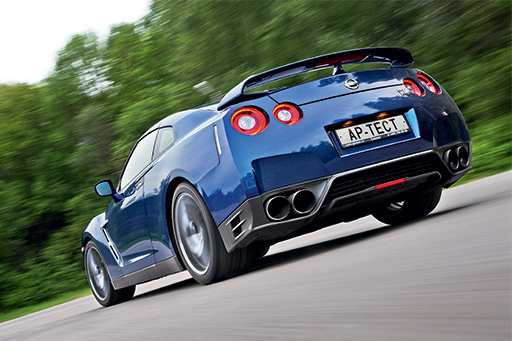
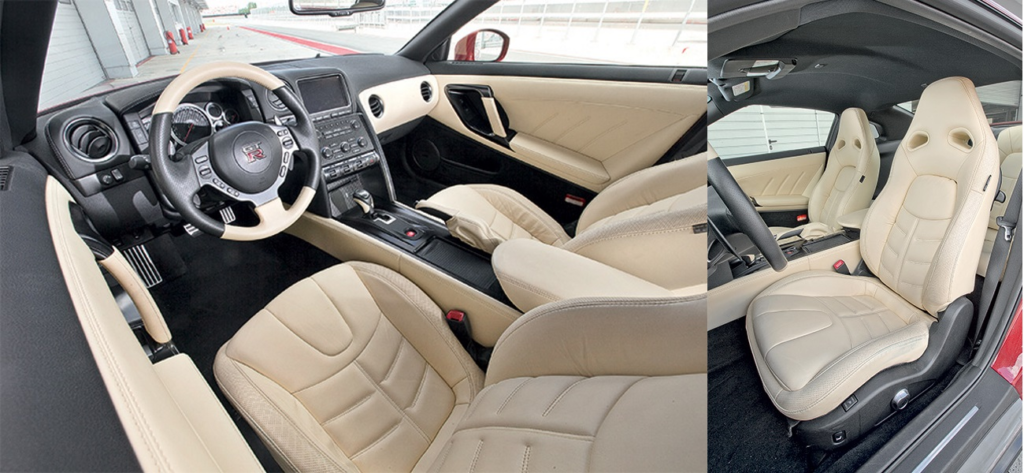
The festive shade of a wedding dress suits the Nissan’s brutal cabin surprisingly well, and the pale leather is pleasanter to the touch than black would be. The seat is softer than the others and has the fewest adjustments, yet it is comfortable enough to sit in.
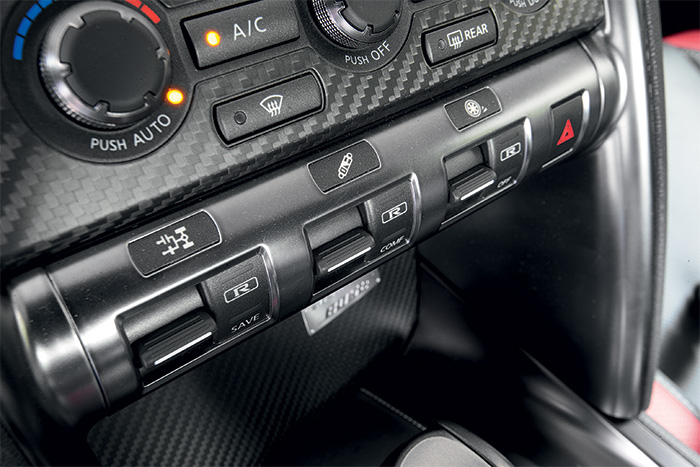
De jure the GT-R offers nine combinations of chassis settings; de facto there are seven. Of the powertrain settings you use two: the restrained Save position is only good for the return lap to the pits, and switching the stability system off altogether is prohibited by the terms of the warranty.
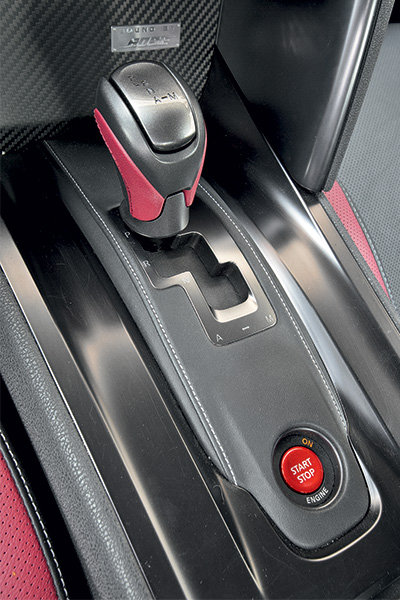
The six-speed BorgWarner automated gearbox is the weak point of the GT-R even in good order. The shifts are long, and in race mode they sometimes arrive with an unpleasant jolt. There is no honest manual mode either: the robot still upshifts for itself at maximum revs.
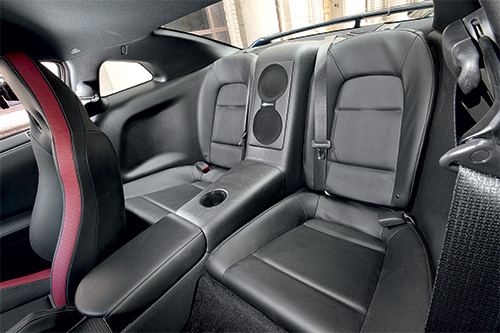
There is more headroom in the back of the Nissan than in the Porsche, but sitting there with your legs anywhere useful means cramping the front passenger further.
The Nissan is not only the heaviest car in the group but also the most nose-heavy: almost 55% of its weight sits on the front wheels, against the Mercedes’s 47.6%.
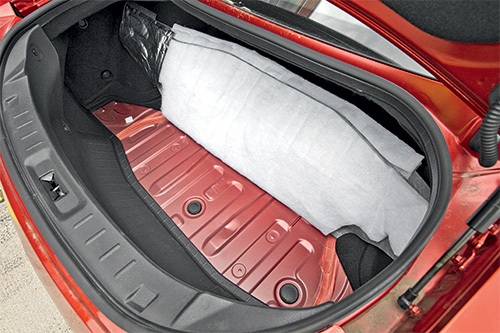
A boot finished like this, in a car costing five million rubles, is not a pleasing sight. On the other hand, it is a war on excess weight.
Porsche 911 Turbo S
- 0—250 km/h: 18.3 s
- Leap time: 1 min 48.081 s
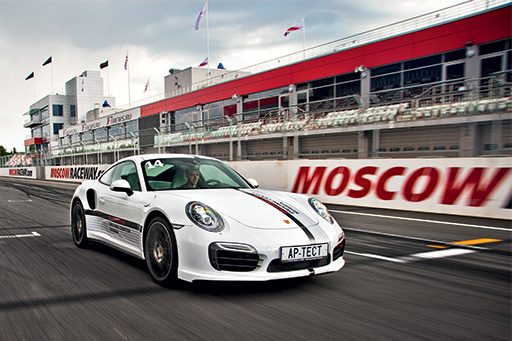
Next, the standard-bearer of the supercar world. The Porsche 911 Turbo S impresses with 560 horsepower, 100 km/h in 3.5 seconds and a top speed of nearly 316 km/h. The stiff suspension and the noise may put some people off.
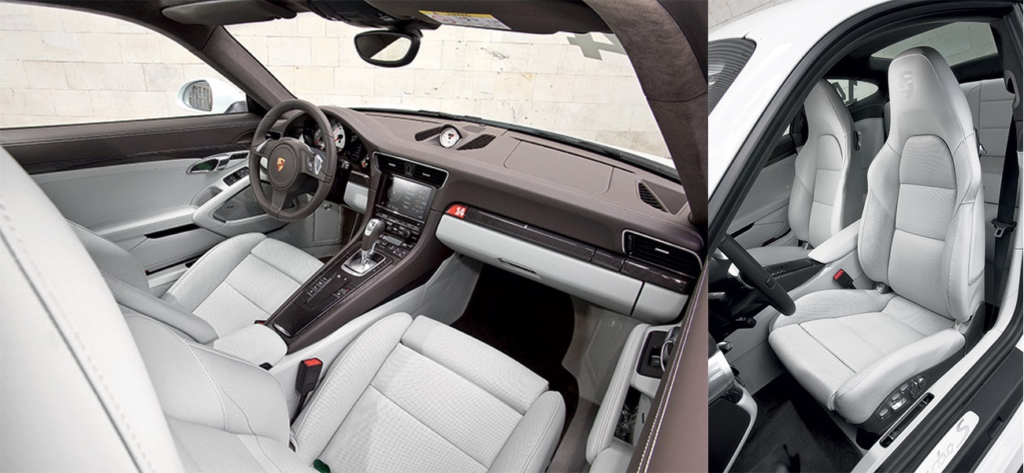
The interiors of the base Carrera and the twice-as-expensive 911 Turbo S are almost indistinguishable. The multi-adjustable seats can be swapped for lightweight buckets at no extra charge.
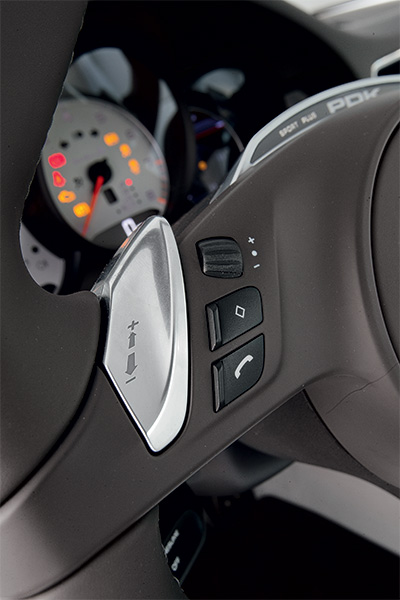
The PDK gearbox needs no lessons in shifting, though it would be pleasant to change up by pulling the paddle towards you rather than the other way round.
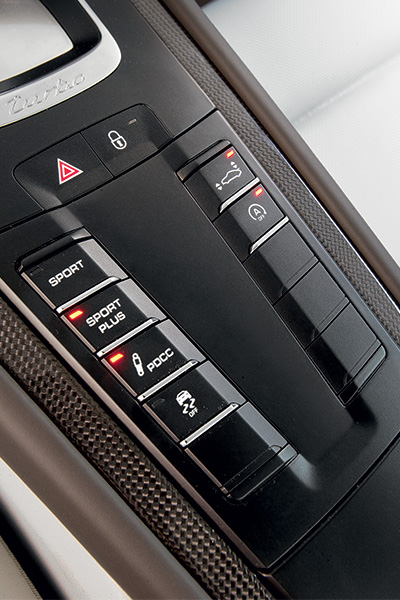
The Sport and Sport Plus buttons call up their settings for the powertrain and the suspension. PDCC — Porsche Dynamic Chassis Control — brings in the active anti-roll bars, thanks to which the Turbo S seems neither to roll nor to squat under braking. Top right is the button for PAA, Porsche Active Aerodynamics, which extends the rear wing and inflates the spoiler under the bumper.
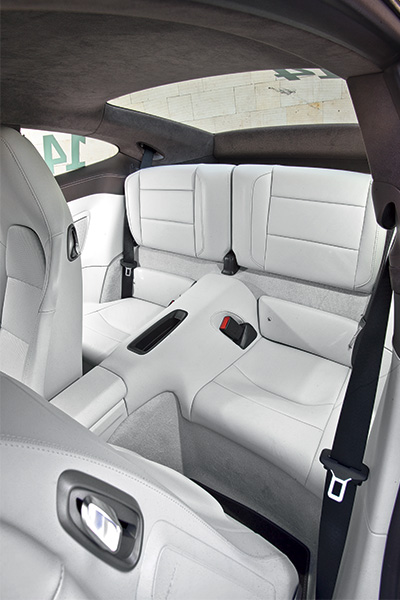
You can make jokes about the usefulness of the Porsche’s rear seats, but there is more room back there than it looks.
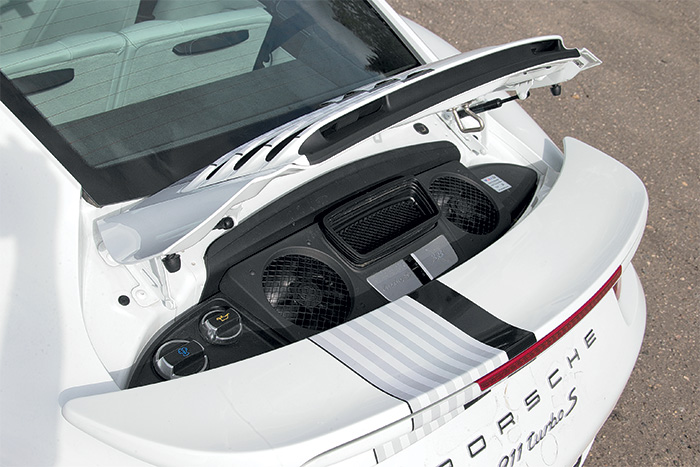
The 911 Turbo’s engine pleases neither the eye — every 991-series coupe shows you nothing but a pair of fans under the lid — nor the ear: the turbocharged flat-six is unmusical.
Lamborghini Huracan
- 0—250 km/h: 17.3 s
- Leap Time: 1 min 50.380 s
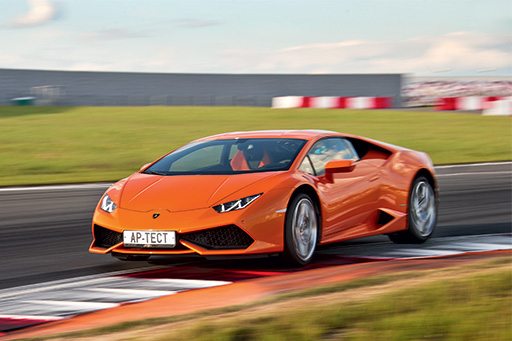
You do not need a racetrack to be happy behind the wheel of a Lamborghini: the Huracan is magnificent on ordinary roads.
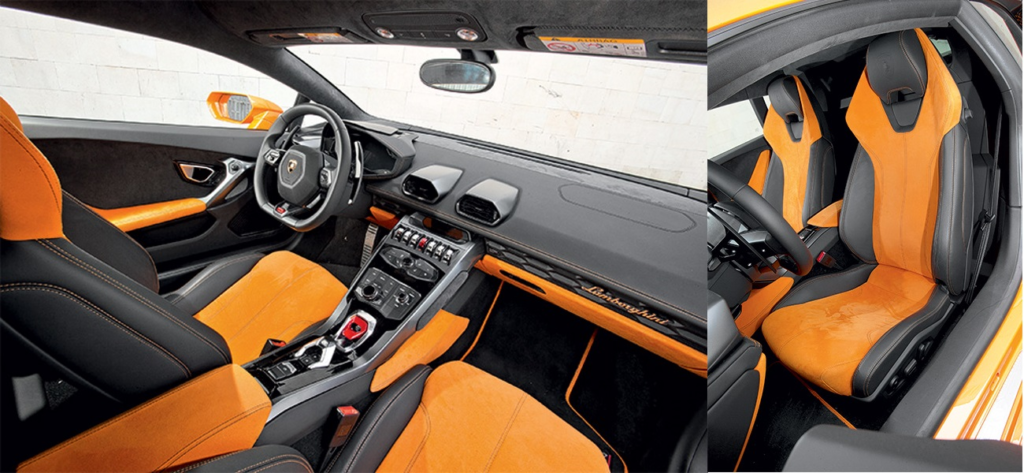
Inside the Lamborghini everything is still unusual, and nothing falls off any more: the quality has finally arrived. The seat is very stiff and short of lateral support — only the grippy suede lining saves you in a corner.
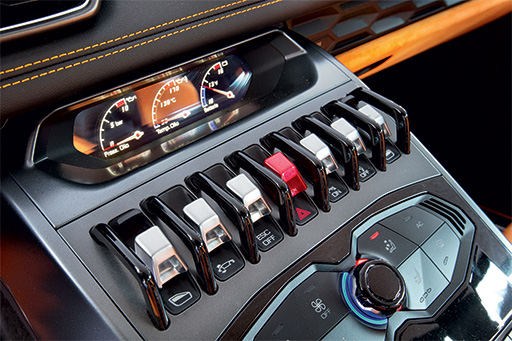
Press. Olio, Temp. Olio, Batteria, a row of switches. The Huracan may repeat the Audi R8 underneath, but the mood behind its wheel is 100% Italian.
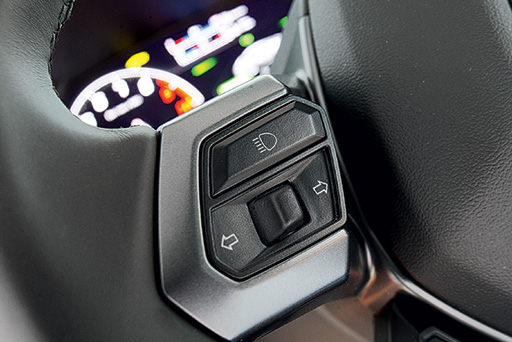
This car is like a motorcycle, and not only in its insane acceleration — even the indicators are worked the way a bike’s are.
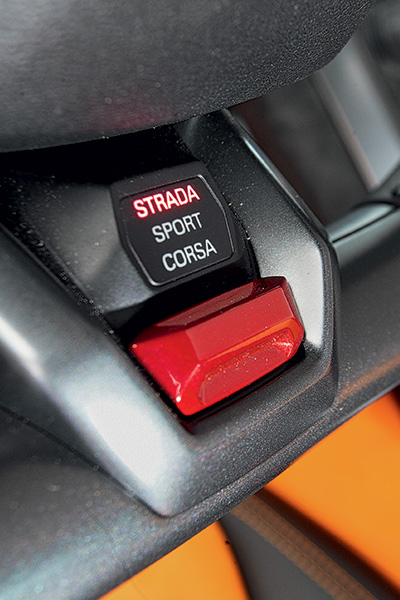
The slider on the vertical spoke of the steering wheel moves the mood from the road setting, Strada, to the racing one, Corsa, in two clicks, adjusting the powertrain, the suspension and the weight of the steering as it goes.
On the ramp of the centre console, a mixture of bespoke elements and switches from various Audis.
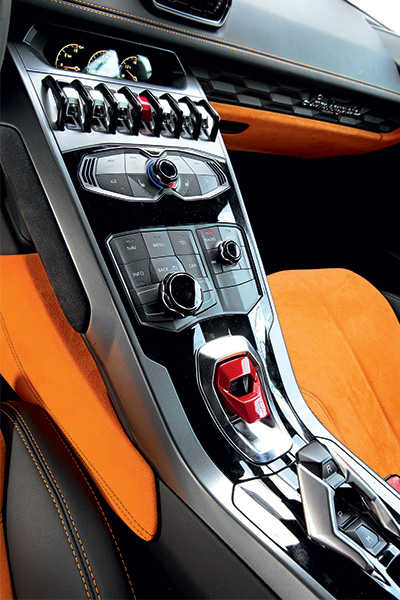
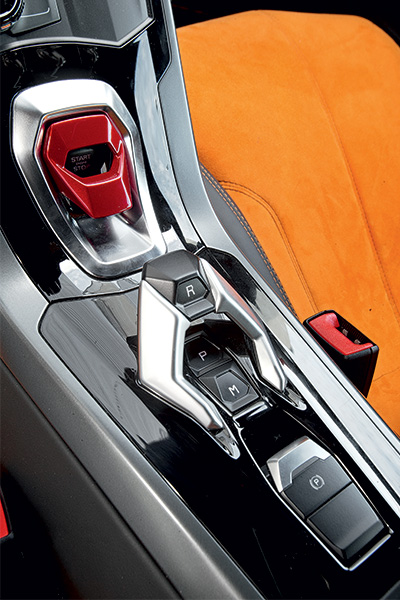
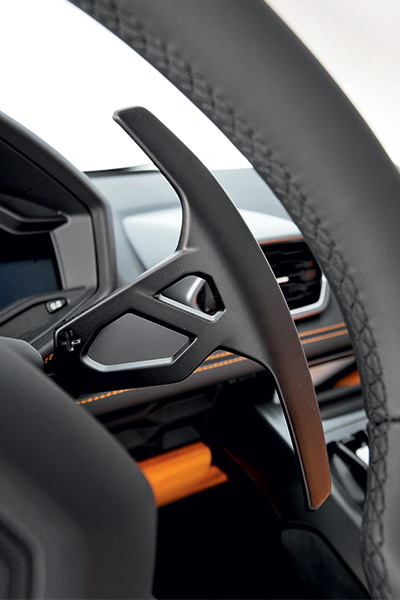
Starting the engine means lifting the red cap over the button. Below it is the claw that engages reverse in the robotised LDF (Lamborghini Doppia Frizione) gearbox. There is no Drive button: to select first, you pull the right-hand paddle.
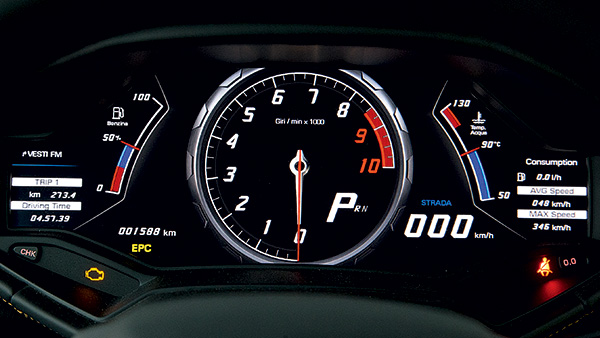
The Lamborghini’s information screen is not the highest-resolution here, but the graphics are impressive. It will swap the speedometer and tachometer round, or give over space to secondary menus, the navigation map included.
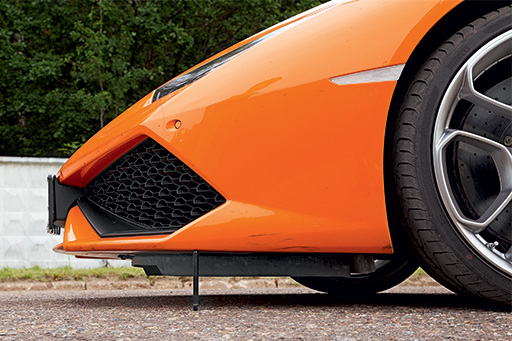
Up to 70 km/h the Huracan can tiptoe: the nose lifts by four centimetres, which is what you want when crossing an artificial hump.
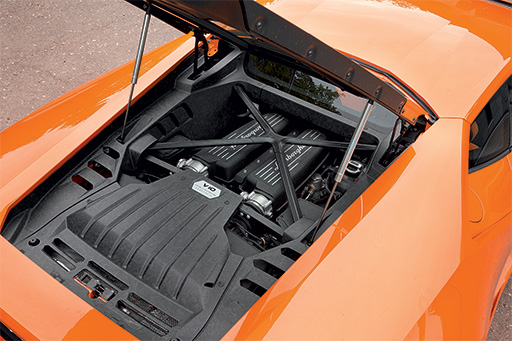
And who else but Lamborghini would put the cylinder firing order on display?
Mercedes-AMG GT S
- 0—250 km/h: 20.5 s
- Leap time: 1 min 52.090 s
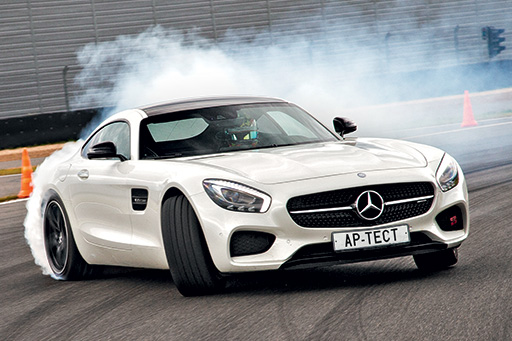
Instead of the high-revving roar of a sports bike’s V10, as in the Lamborghini, the Mercedes gives you the rumble and bubbling of a V8 with a pair of turbochargers. At idle it emits sound in pulses, reminiscent of a classic Harley-Davidson. The rear-wheel drive and powerful electronically controlled limited-slip differential, coupled with a fully disableable stabilization system, easily turn the rear tires into smoke. And yet, the AMG GT S is not the king of drifting: the AMG C 63 sedan does it with more ease.
The robust sound of the Mercedes engine turns it into a drum machine, and with the stability system off it becomes a smoke machine.
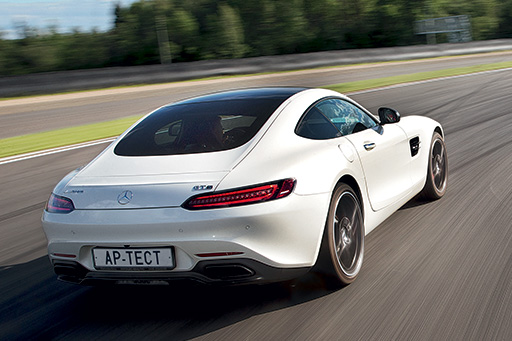
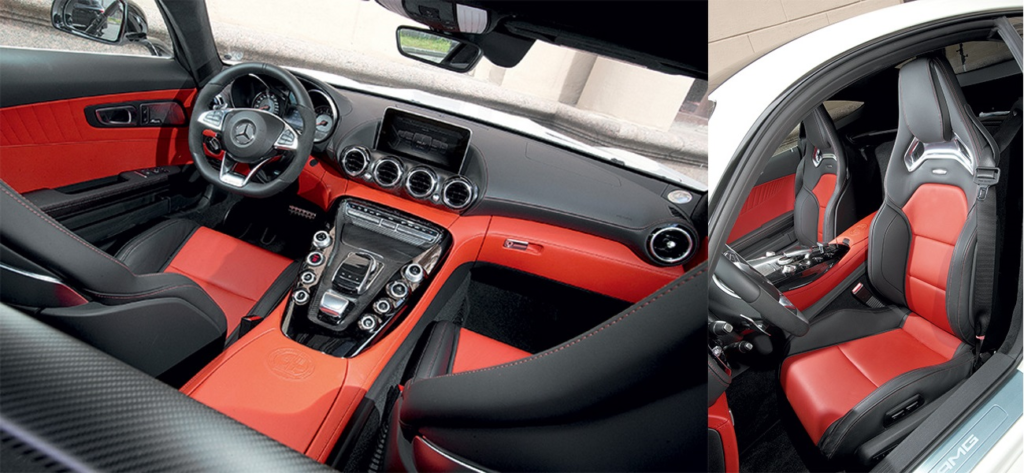
The Mercedes has nozzles. The cabin is studded with round vents and switches, and the colour scheme is a matter of taste, but the sense of sitting in a cockpit is total — largely because of the ultra-low seating position in excellent seats that adjust for backrest width and cushion.
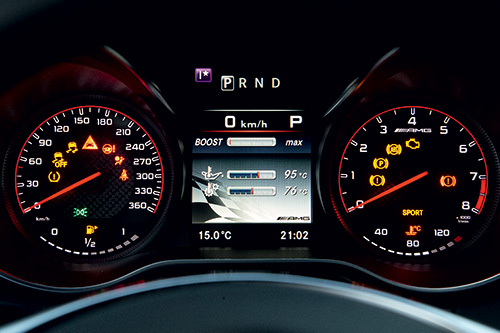
The instruments are overly colourful. In practice you use the central display most: oil temperature to start with, then the digital speedometer once everything is warm.
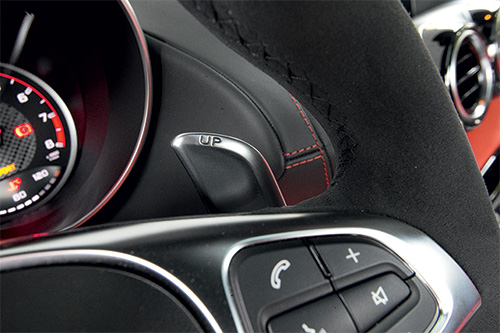
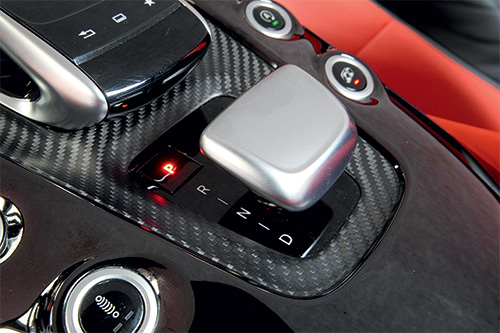
The paddles in the AMG GT S are fixed to the steering wheel and more convenient than the stationary ones in the Lamborghini and the Nissan. The joystick for the Getrag automated gearbox sits too far back.
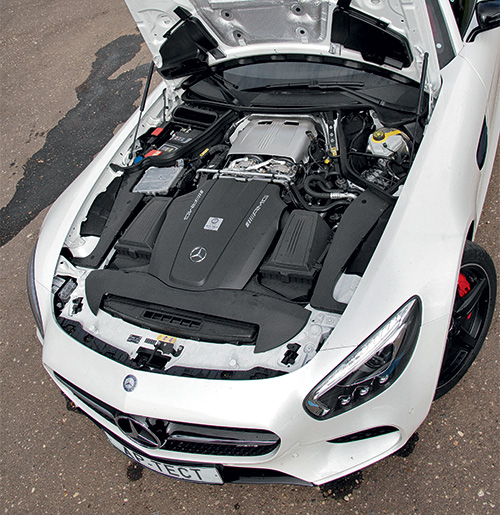
Under the enormous bonnet lies a 4.0-litre V8, pushed back within the wheelbase. The two turbochargers nestled in the vee of the block create a heavily loaded thermal regime, which is why the AMG GT S’s cooling fans run louder and longer than anyone else’s after you switch off.
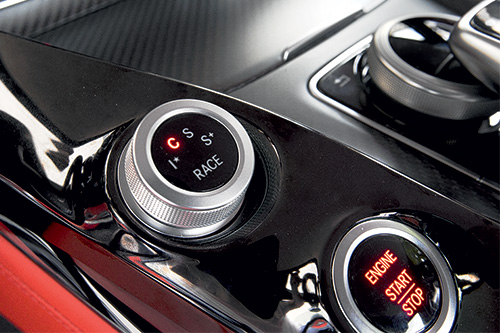
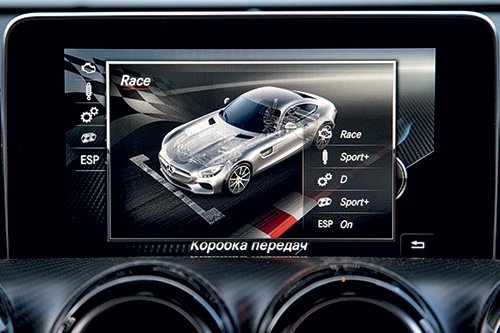
The main switch on the massive centre tunnel governs the car’s settings. All three supercars offer combinations of modes for the gearbox, the suspension, the stability system and the exhaust note, and here every position is displayed beautifully and legibly on the screen. Note that there is no separate tab for steering weight: as in the Porsche and the Nissan, it stays the same in every mode.
Comparative Analysis
Porsche: Precision, at a Price in Tyres
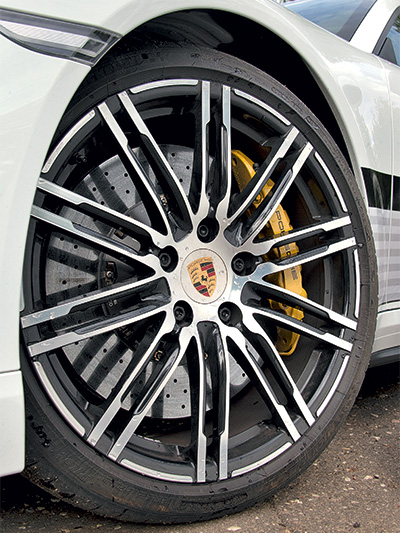
The Porsche 911 Turbo S sets itself apart on dynamics and on feel, running as if on rails and accelerating hard enough to be genuinely exciting. It is sensitive to tyre choice, and that shows on different surfaces. Its low-end punch is formidable, the grip on original tyres exceptional, and the brakes allow it to be braked later than the others — which is where a good deal of its advantage comes from. It is unsettled above 280 km/h, but the braking stays dependable.
Porsche 911 Turbo S
Lamborghini: Fierce, and Friendlier Than Expected
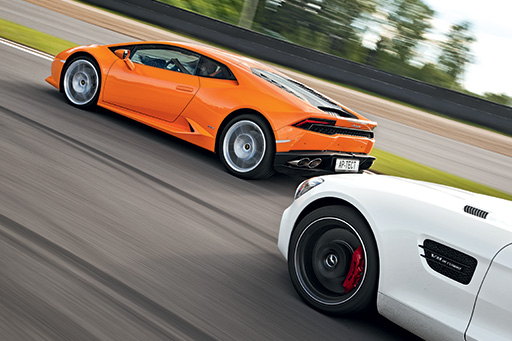
The Lamborghini Huracan is a marked step up from the Gallardo, in engine and in transmission alike. The Formula 1 soundtrack and the track-ready behaviour sit oddly against brakes that lack initial bite. Quite what the all-wheel drive contributes is arguable, but the Huracan is a fierce car that stays friendly, its powerful engine and stiff suspension giving it dynamics all of its own. The harsh engagement of its ABS complicates planning a line, though once you have acclimatised its performance — stability at up to 325 km/h included — is remarkable.
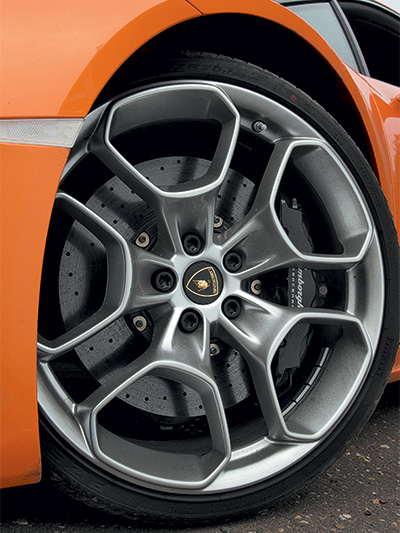
Lamborghini Huracan
Mercedes: Simpler Than the SLS
The Mercedes-AMG GT S is a simpler, more approachable car than the SLS was, with a well-balanced chassis and a mild tendency to oversteer. The stability system and the brakes both need fine-tuning for consistency. Emotionally it stands out, on the strength of that sound and that interior. It is ready for a racetrack, and it keeps its balance and its temperature even when the conditions are against it.
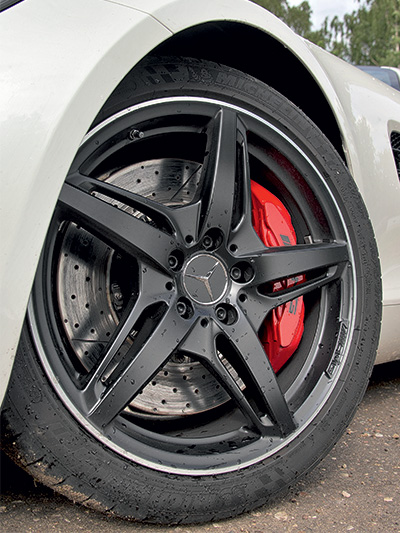
Mercedes-AMG GT S
Nissan: Fast, but No Longer That Nissan
The Nissan GT-R, with its powerful engine and comfortable suspension, handles confidently but has drifted away from its old image as the super-stable, super-quick one. The driving experience is peculiar, not least because the stability system cannot be switched off. Stable as it is at high speed, the GT-R struggles with brake overheating and slow gearchanges, and both blunt its sporting character. It shines in a drag race; in standard form the acceleration is less convincing.
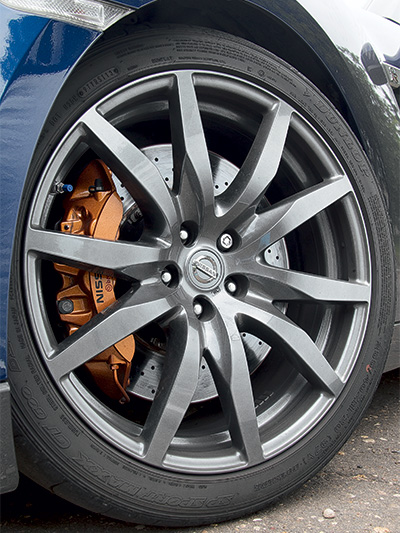
Nissan GT-R
Stability and Handling in Emergency Situations
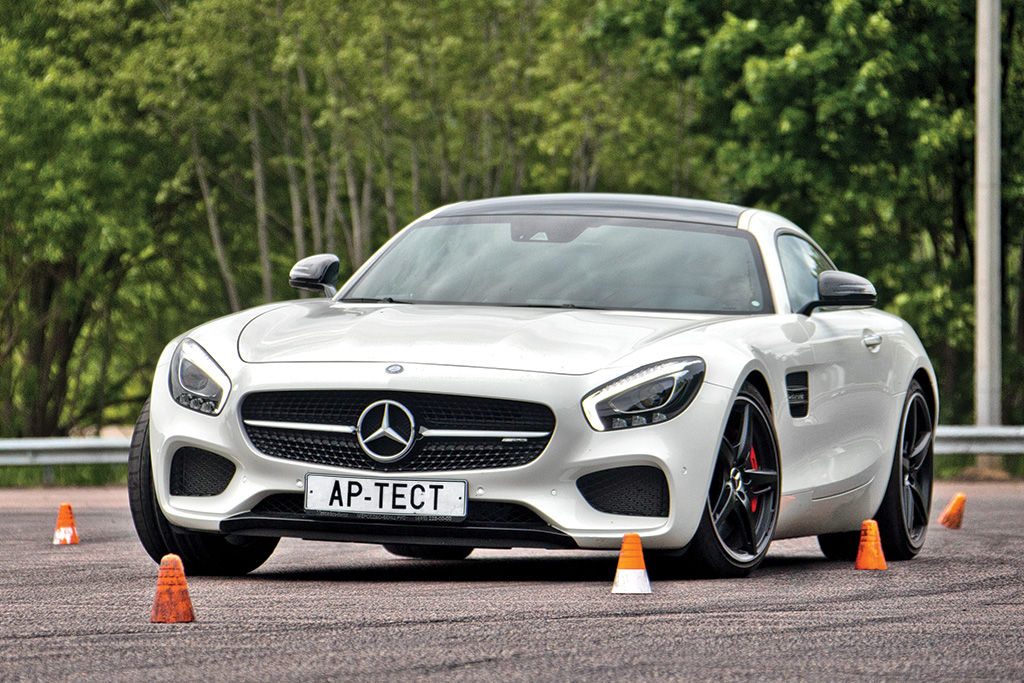
The special-roads complex at the proving ground is not a racing surface: on old, dusty asphalt the advantage of grippy supercar tyres is neutralised. In the tight corridors of the “Turn” and “Rearrangement with braking” manoeuvres, what decides the outcome is the calibration of the ABS and the stability system.
Lamborghini Huracan showed excellent stability at 75 km/h with no slip at all, and a minimal four-wheel slide at 77.5 km/h. Its braking manoeuvre came to 29.8 metres, though the ABS was rough enough to shave a little deceleration off the lane change.
Porsche 911 Turbo S steered neutrally at manageable speeds up to 75 km/h and drifted slightly at 77.5 km/h. It excelled under braking, stopping consistently within 30.5 metres.
Mercedes-AMG GT S let its ESP allow a minor deviation into understeer at 72.5 km/h, and its rear-axle seating position demanded early steering inputs through the tight cone corridors. Its braking distance was slightly inferior at 32.4 metres, with a tendency to slip at the rear axle producing 1.7 metres of scatter.
Nissan GT-R, heavier and with stricter electronics, coped well at lower speeds but began to drift and clip cones at 75 km/h. Its braking matched the Mercedes, with a slightly wider scatter of two metres.
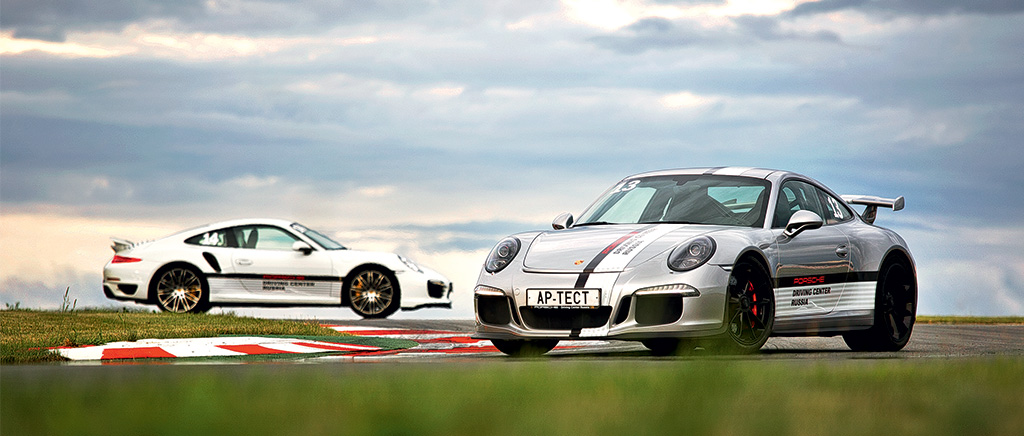
Each of these cars brings its own strengths and its own difficulties, and between them they cover a genuinely wide range of high-performance experience.
Photo: Stepan Schumacher
Expert group: Andrey Mokhov | Ivan Shadrichev | Roman Cherny | Yaroslav Tsyplenkov
This is a translation. You can read the original article here: Lamborghini Huracan, Mercedes-AMG GT S, Porsche 911 Turbo S или Nissan GT-R?

Published January 25, 2024 • 10m to read