
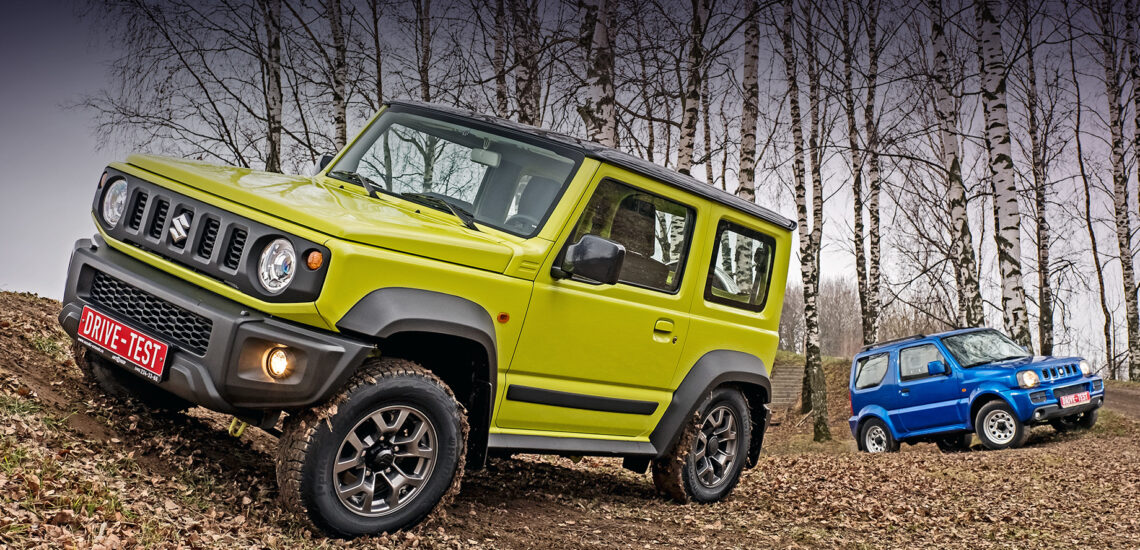


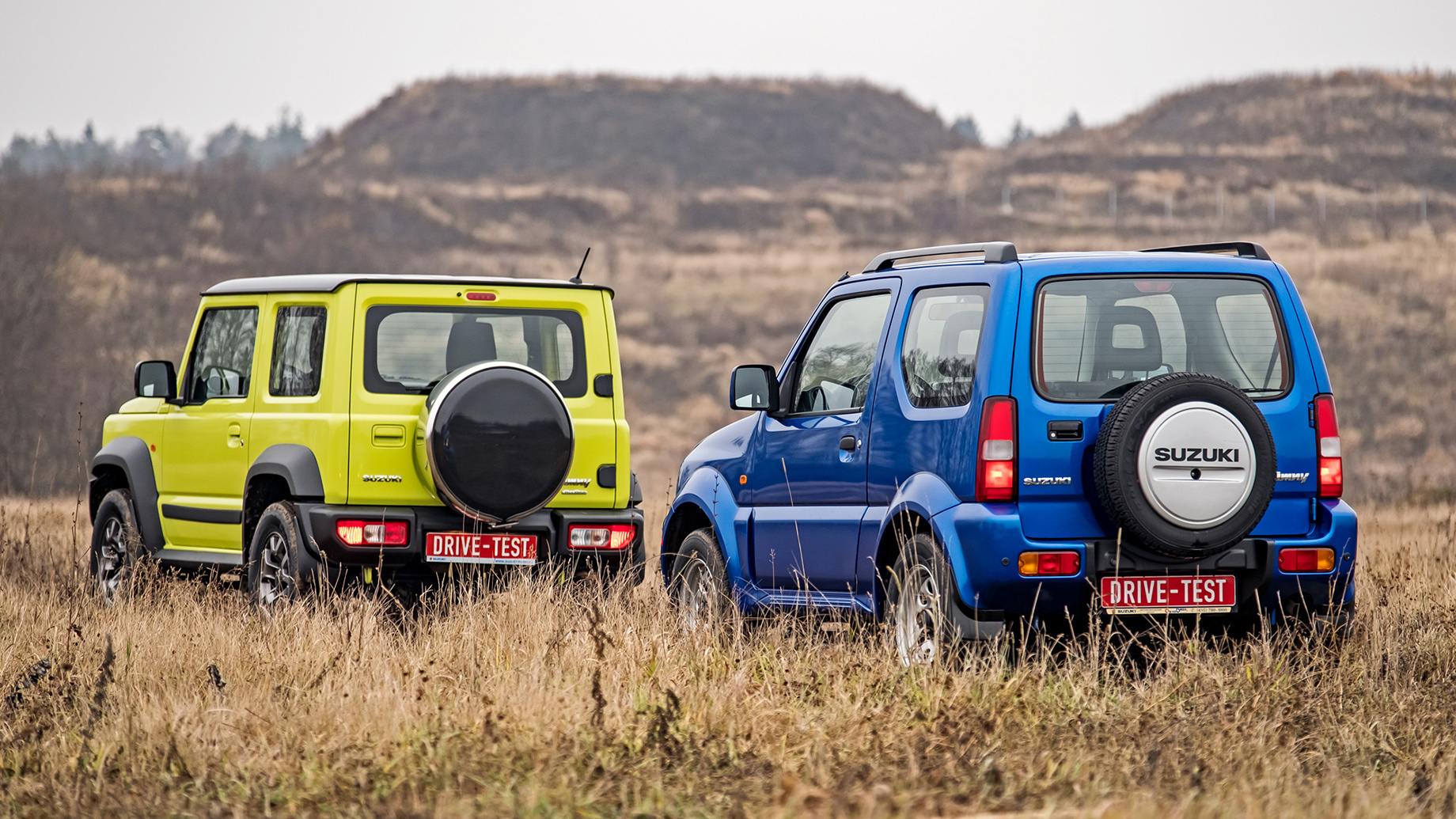
At first glance, the new Suzuki Jimny looks suspiciously familiar. The conservative body-on-frame chassis with rigid axles carries over largely unchanged, apart from a new rear anti-roll bar. The wheelbase is identical to the previous generation, the brakes still use non-ventilated front discs and rear drums, and the automatic gearbox remains a four-speed unit. So is this really a new generation, or just a deep restyling? We put the old and new Jimny side by side to find out.
Meet the Test Cars: Old vs. New Jimny
For this comparison, we found a completely original last-generation Jimny from 2007 with 49,709 miles on the clock. Bought new for $20,000, it has never changed hands — even the tires are still factory original. This gives us a rare, honest baseline to measure the new Jimny against.
Exterior Design: A More Mature, More Muscular Jimny
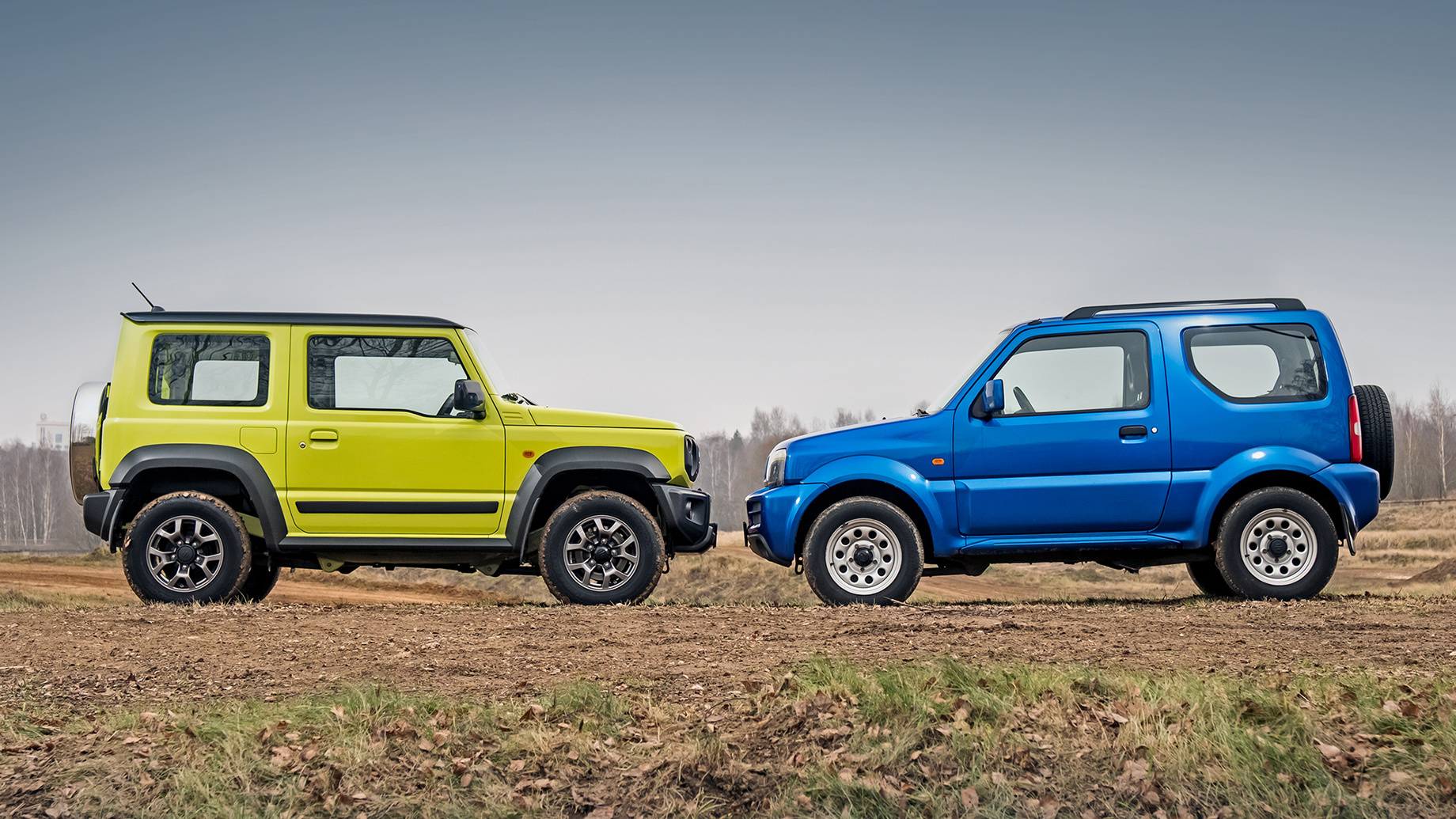
Round one — design — goes to the new Jimny. Despite keeping nearly identical dimensions, the new model looks noticeably more mature and eye-catching; passers-by genuinely turn their heads. Key styling elements include:
- Massive unpainted wheel arches for a rugged, off-road look
- Vertical windows that echo classic 4×4 design
- Faux gaps between the bumpers and body (in reality, everything fits tightly)
Together, these details give the new Jimny a much more brutal, purposeful off-road presence than its predecessor.
Interior Quality and Cabin Layout
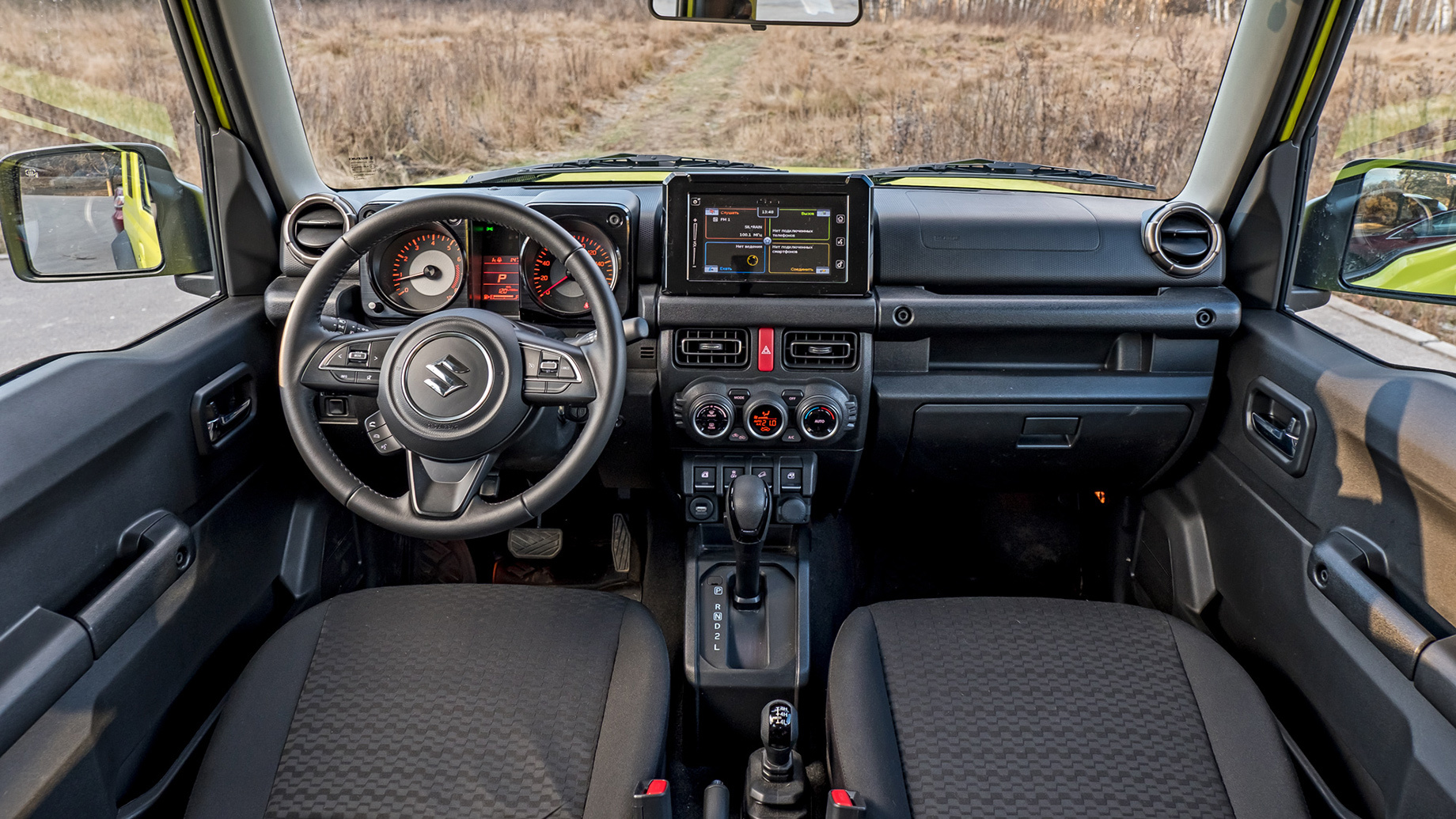
The cabin is where the new Jimny really shines. The front panel, with its massive handrail and dashboard dials “bolted” on top, reliably draws an admiring “wow” from passengers. The design leans into function over form — big, chunky buttons being a good example. It’s not immediately obvious that there isn’t a single soft-touch panel in the cabin, and fit-and-finish isn’t perfect everywhere. Where the old car wrapped all its metal in plastic, the new Jimny leaves the rear window frames bare, and the door panels don’t extend all the way to the floor — which raises a fair question about winter comfort.
Practicality takes a small step back in a few areas:
- Transfer case control returns to a mechanical lever, which owners of the old model will welcome — the old push-button electric drive was prone to wiring failures
- The new lever, combined with a mechanical handbrake, eats up cabin space — there are now only two cup holders, both pushed toward the rear
- The glove compartment and door pockets remain modest in size
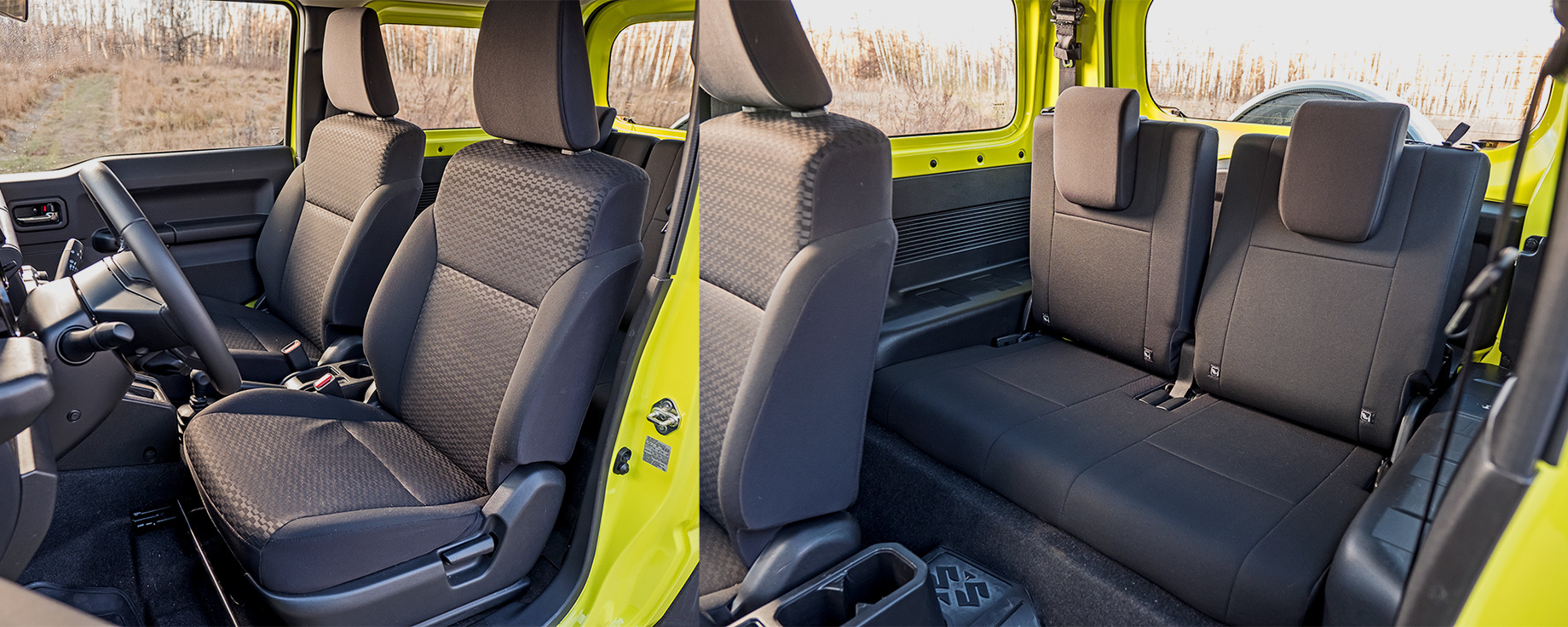
- There’s effectively no boot space — the rear seat was shifted 1.5 inches back, so not every backpack fits behind the seatbacks
- Jimny remains, in practice, a car for two — its overall length without a spare tire is still only about 11.4 feet
Driving Position and Comfort
The driving position makes it clear the interior has been thoughtfully reworked. The old Jimny is genuinely cramped for the driver — the seat sits too high, there’s no way to move it back, and your left hand has nowhere to rest but the cold window glass. The new Jimny still offers only two seat adjustments, and the backrest moves in steps rather than smoothly, but sitting on a seat cushion lowered by 1.18 inches makes a huge difference. Suzuki also added height adjustment for the steering wheel, and — most importantly — your left leg and arm are no longer pinned against the door. In fact, the old Jimny’s driving position is arguably more comfortable than a Dacia Duster’s. The only sore point in the new car is the right leg, which can contact the edge of the platform housing the automatic gearbox selector.
Visibility on the Road
Visibility from the driver’s seat is distinctive — the narrow windshield flanked by vertical pillars feels more like a Jeep Wrangler or Mercedes G-Class than a nod to Jimny’s own heritage. As long as the glass is clean, all-around visibility is excellent. You can practically reach out and touch the corners of the body, and you barely notice the absence of parking sensors or a rearview camera thanks to the strong sense of the car’s dimensions. The downside shows up in bad weather: the windshield wiper coverage is narrow, and road grime collects heavily on the flat rear window.
Engine and Transmission: A Completely New Powertrain
Pop the hood and the old and new Jimny have almost nothing in common — the engine shield and the layout of components and assemblies have all been redesigned. Turning the key confirms it: this is a genuinely different engine. The new naturally aspirated 1.5-liter unit starts smoothly, with none of the old car’s vibration, and idles quietly. The automatic gearbox’s shift gate is straight, so it’s easy to slip past “D” into “2” or “L” by mistake. The Overdrive-off button remains on the shifter, and you can still manually select gears under braking.
Real-World Performance: City vs. Highway
That manual gear control comes in handier off-road than on it, because in the city the new Jimny feels surprisingly lively without much effort. The transmission shifts quickly and at the right moments, and there’s no shortage of dynamics up to about 55–60 mph — with only 100 hp, it still feels responsive around town.
On the highway, the story changes. The Jimny can hold 60–70 mph without much trouble, but there’s little reserve left for overtaking, and acceleration up to a 90 mph top speed is slow — not much improved over the old generation. The brakes also feel underwhelming: light pressure feels fine, but push harder and the pedal sinks noticeably, with the Jimny just nodding forward as it reluctantly slows.
Ride Quality and Handling on Pavement
Where the old Jimny jolted over every bump and transmitted the shocks straight to the steering wheel, the new one rides noticeably better. Higher-profile tires (a relatively rare 195/80 R15 size) soak up small bumps, softer springs and dampers smooth out medium-sized hits, and a steering damper paired with electric (rather than hydraulic) power assistance keeps the wheel calm. Straight-line stability, however, hasn’t really improved — the new Jimny still gets knocked around by expansion joints and crosswinds just like before.
The short-wheelbase chassis, running on live axles with Panhard rods, behaves much like before in corners too — early body lean, roll, and delayed, vague steering responses are all still present. Even the steering itself needs the same 4.2 turns lock-to-lock, though it now takes noticeably more effort to turn quickly at low parking-lot speeds, likely due to the added steering damper. Add in the fact that the Jimny spends most of its time in rear-wheel drive — all-wheel drive still only engages on hard-packed surfaces — and it’s arguably fortunate that this test took place during a mild, low-snow winter.
Off-Road Capability: More Clearance, More Electronics
Off-road, there are two major upgrades: increased clearance under the axle housings (up 0.5–0.7 inches, thanks to larger wheels) and new electronic driving aids. With the old Jimny, the driver had to rely entirely on their own skill — though it’s a remarkably easy car to read. It moves through mud predictably and precisely, and even the four-speed automatic doesn’t get in the way of finely metering out traction. The near-total absence of front and rear overhangs feels almost intoxicating — it seems like you could climb a vertical wall or cross any ditch, as long as you avoid tipping sideways on the narrow track.
The new Jimny tackles rough terrain in a more composed, deliberate way, with a supple suspension tuned for a measured driving style, and no loss of off-road capability overall. The one downside: directional stability on loose surfaces isn’t as strong — on more aggressive winter tires, the new Jimny slides sideways in mud more often than the old one did on worn all-season rubber. That said, the extra clearance is noticeable in deep ruts, and the new electronics change the entire off-road strategy:
- As long as low-range isn’t engaged, you can floor the throttle in almost any condition — well-tuned brake-based wheel-lock simulation and traction control take care of the rest
- Traction control can be switched off, but automatically re-engages at just 18 mph — essentially at the first sign of wheel slip
- There’s no traditional “locking” feel in low range anymore, but the electronic cross-axle “locks” work effectively
The Jimny remains a genuine source of off-road fun — and thanks to the new electronic aids, that fun is now accessible to more casual drivers, not just experienced off-roaders.
Noise, Comfort, and Everyday Livability
Heading back to paved roads means accepting a few familiar Jimny traits: axles that oscillate on soft dampers, jarring over expansion joints, and a transfer case that hums constantly at city speeds. The new Jimny is quieter overall, especially its engine, but by the time you’re doing 60 mph the engine is already spinning around 3,000 rpm, so true silence was never really on the table. Road noise and the sound of grit hitting the wheel arches are both noticeably more present than in the average crossover.
Verdict: Is the New Suzuki Jimny Worth It?
The Jimny’s real appeal is that it refuses to be ordinary. About the only thing Suzuki borrowed from the crossover world is an all-wheel-drive system that works reasonably well in daily driving — though spending all winter guessing whether conditions are slippery enough to justify locking in the front axle (or whether you should spare the transmission instead) is a mixed blessing at best. In spirit, the Jimny’s real rivals are frame-based off-roaders like the Jeep Wrangler or UAZ Patriot, with a similar part-time 4WD system — not the Mercedes G-Class, which despite its retro looks drives almost like a passenger car.
What Suzuki managed to extract from a decades-old body-on-frame concept deserves real respect. The new Jimny won’t leave existing owners unimpressed — everything that needed improving has been improved — and it’s bound to win over plenty of new fans, too; it’s hard not to glance back at it one more time in a parking lot. The one thing to avoid dwelling on is the price: any crossover at the same price point will be roomier, faster, and better equipped. But then, not every vehicle is destined for a place in automotive history. The Jimny is one of the few that is.
This is a translation. You can read the original here: https://www.drive.ru/test-drive/suzuki/5e172accec05c4f26a000129.html

Published March 23, 2023 • 9m to read