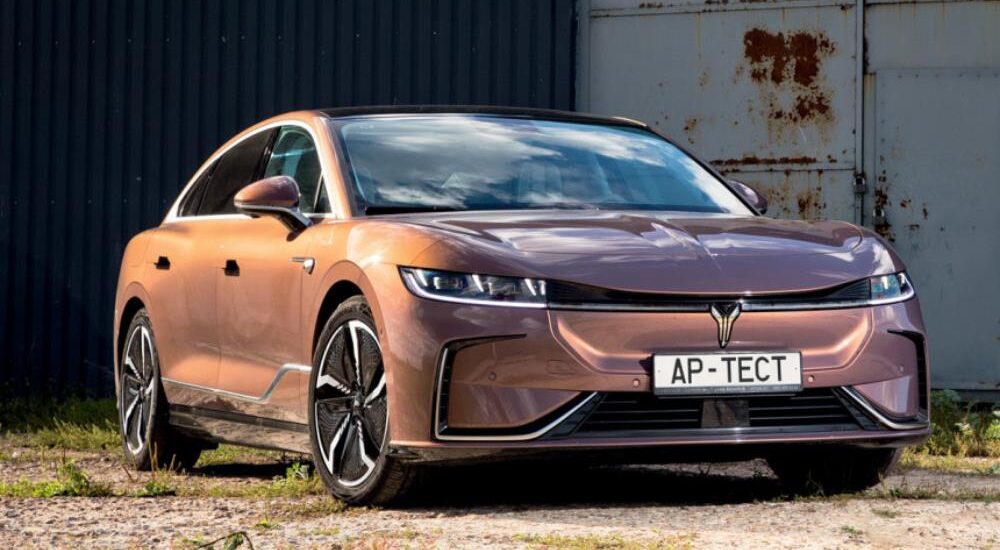

I twirl the oval transponder key in my hand, wondering if it’s the second key, possibly the service key? It’s lightweight, plastic, with inconvenient buttons on the edges that can be tricky to press. However, as I find myself inside the cabin, my initial annoyance turns into sheer delight. Ahead of me lies the dynamometer track at the proving ground, where the Voyah Passion is set to truly reveal its passion!
Voyah in Russia, in Numbers
Voyah, the Chinese brand created three years ago by the Dongfeng conglomerate, is steadily making its mark on the Russian market with a new line of electrified vehicles. By the end of summer 2023 the Voyah Free crossover and the Voyah Dreamer minivan had become the most popular electric vehicles in Russia, with 1989 units sold in just eight months. Demand is far higher at home in China, at 20 thousand units, but Russia is one of the top export markets: only 118 Voyah cars have been sold in Israel and roughly the same number in Norway. Sales have only just begun in Turkey. The Russian market is clearly a priority for the brand, right down to adaptation and Russification.
追光, or Chasing the Light
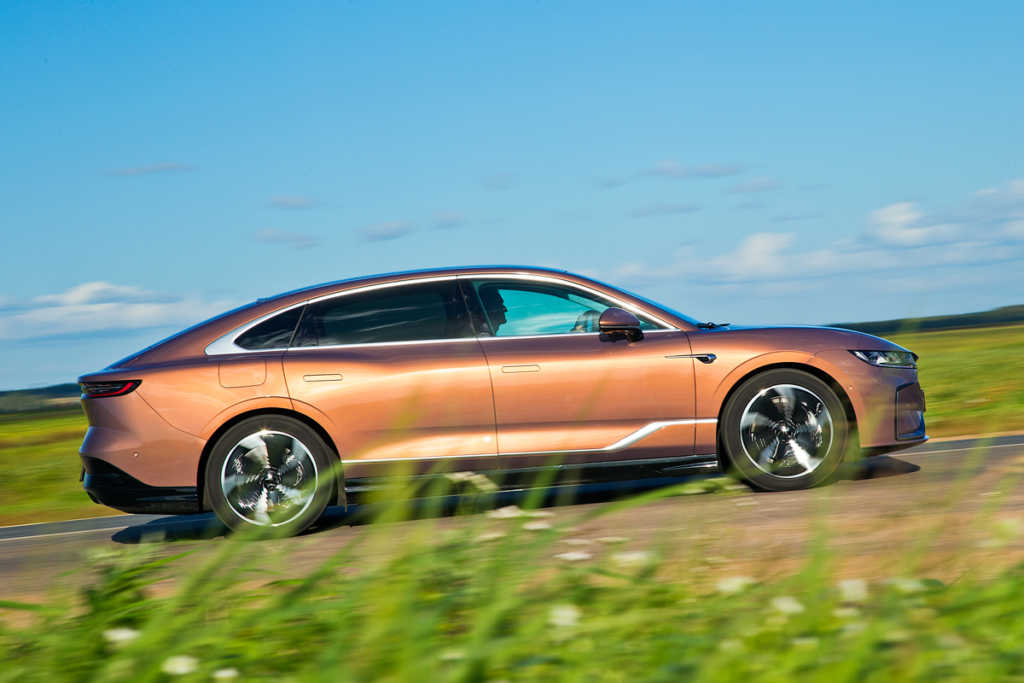
The sedan is Voyah’s third model. At home it goes by the name 追光, which translates from Chinese as “chasing the light”. It sounds romantic, though the pronunciation — “zhui guang” — may not be much of a customer magnet. For international deliveries the car has been named Voyah Passion instead, and the design lives up to the English name: this really is a passion project. Artists from the Italdesign studio contributed to the shape. Smooth lines define a body whose proportions suggest a liftback, even though it is technically a sedan.
Bronze That Changes Colour in the Sun
The detailing is precise, and you can see it in the panel gaps. The stunning bronze paintwork produces a chameleon effect in sunlight. There is no need to dwell on the lighting technology — even budget Chinese cars have advanced optics these days — but the Passion still has illuminated logos, LED strips running from ear to ear and dynamic turn signals, and the menu lets you choose one of three LED greeting scenarios when you unlock the car. Curiously, though, there are no keyless entry sensors on the retractable door handles. That is an odd omission on a car with an 8.5 million ruble price tag.
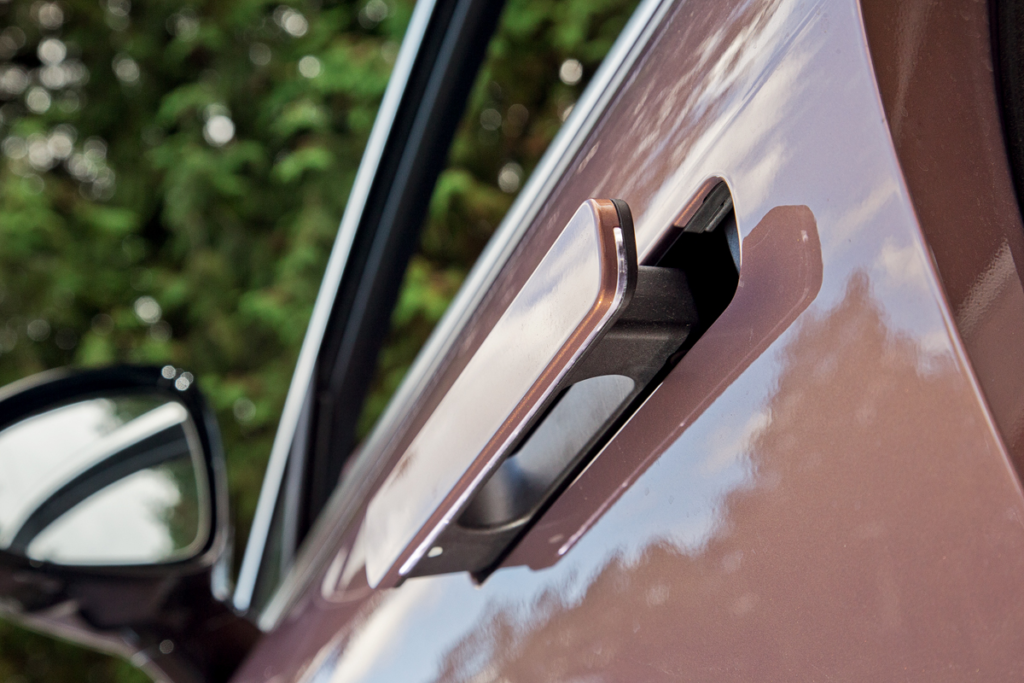
Retractable door handles – with built-in lighting
Inside: Glass, Alcantara and Four Screens
Inside, aesthetics take centre stage. Along with plastic, the cabin uses eco-leather, alcantara and aluminium trim. Two sunshades overhead slide back to reveal the huge panoramic roof, whose glass reaches all the way to the rear headrests. Between the materials and the generous glass area, the cabin feels bright even on an overcast day.

On the front panel, there are four screens at once. The right elbow often accidentally presses the ‘crystal’ button to open the central box.
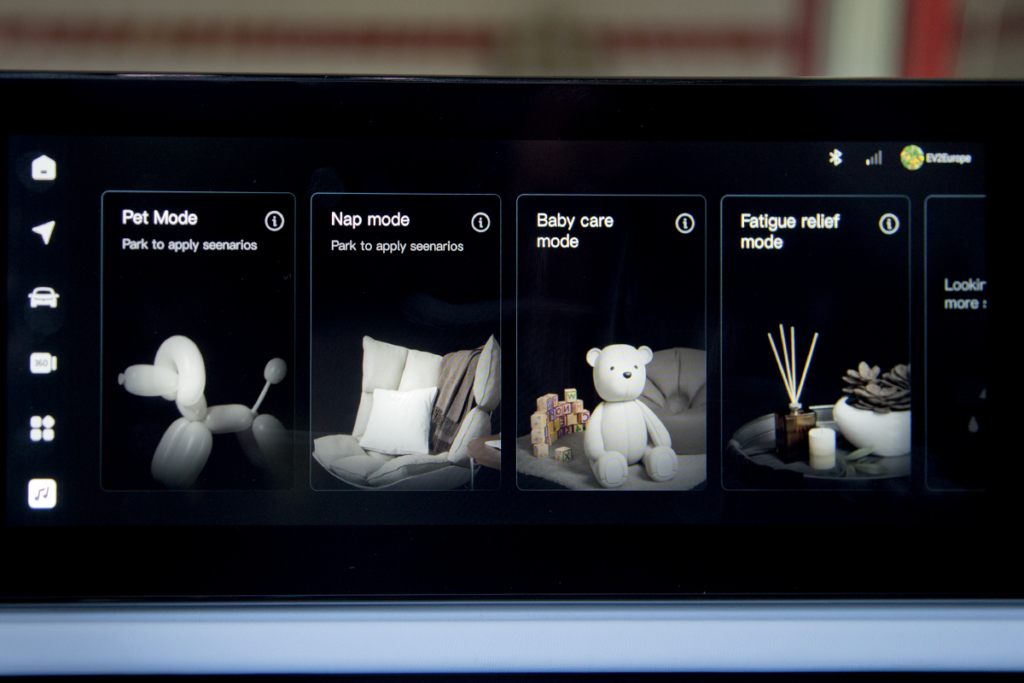
The menu includes comprehensive cabin settings. For example, the Baby Care mode involves closing the windows and the ceiling curtain, reducing the audio system volume, and displaying a view of the rear seats on the central screen.

The cabin camera allows you to observe children on the rear seats – and even record videos of their ‘performances.’

You can display images from different cameras on the central screen or activate the ‘transparent chassis’ mode.
That Faceted Steering Wheel
Your attention, though, is bound to be drawn to the multifaceted steering wheel. It is not flattened at the bottom or squeezed from both sides but genuinely faceted, built from a series of slightly curved chords. It is a long way from the fast steering the unforgettable Ernest Sergeyevich Tsygankov taught: here the wheel literally dances in your hands as you turn it from lock to lock, which takes the standard 2.7 turns. At least the classic quarter to three grip is comfortable on the rim.

Faceted steering wheel – not for fast rotation with interceptions
Touch-Sensitive to Its Core
As for touch controls for everything, even students of Tsygankov’s teachings would be puzzled. Climate control is managed from a tablet, the ceiling sunshades are opened by sensors, and even the window switches are touch controls that need a confident press — a gentle touch gets no response. You do adapt over time, of course, but traditional physical buttons are often simply more convenient. In Europe Volkswagen, having experimented with sensors on the steering wheel, is going back to physical buttons. The Voyah Passion goes the other way, touch-sensitive to its core, right down to the Qualcomm Snapdragon 8155 chip its operating system is built on.
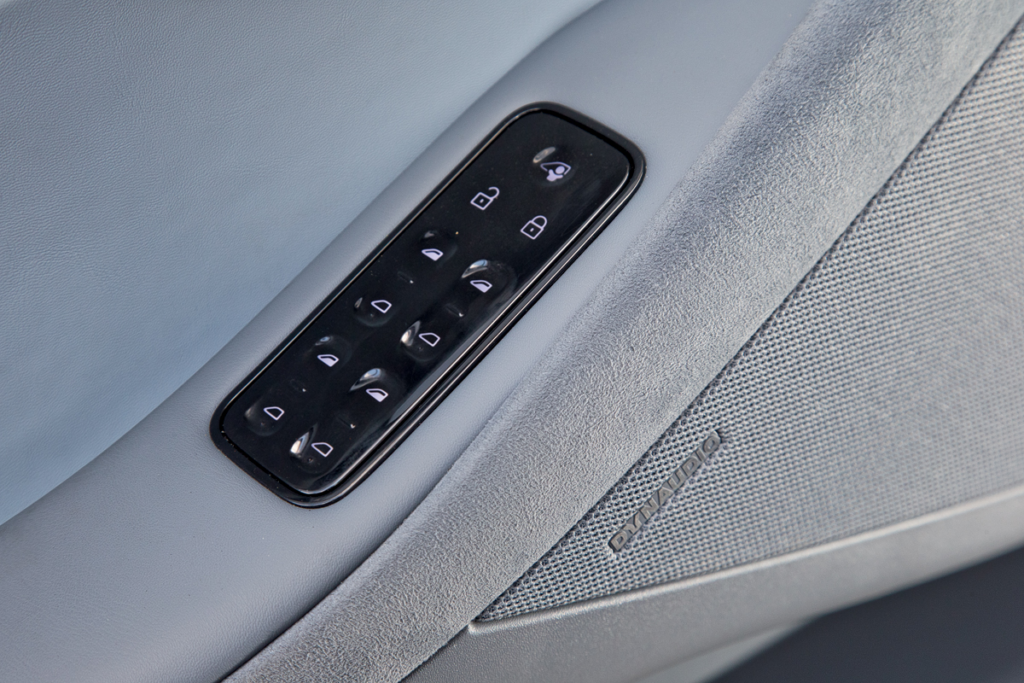
To partially open or close any of the four windows, you need to hold your finger on the touch button, while a short touch is sufficient for full opening or closing.
Too Many Settings, at First
The sheer number of settings can feel overwhelming at the start. Some live on the central display, others on the lower tablet, which also runs the four-zone climate system. You have to go hunting for the seat heating and ventilation, and for the massage programmes, which the rear passengers get as well. By the end of the third day I knew my way around the menu; the real difficulty is direct sunlight on the screen, which makes labels and symbols hard to read. All the menus are currently in English, with a Russian firmware update expected in November, like the one already available for the Dreamer minivans and Free crossovers on sale today.
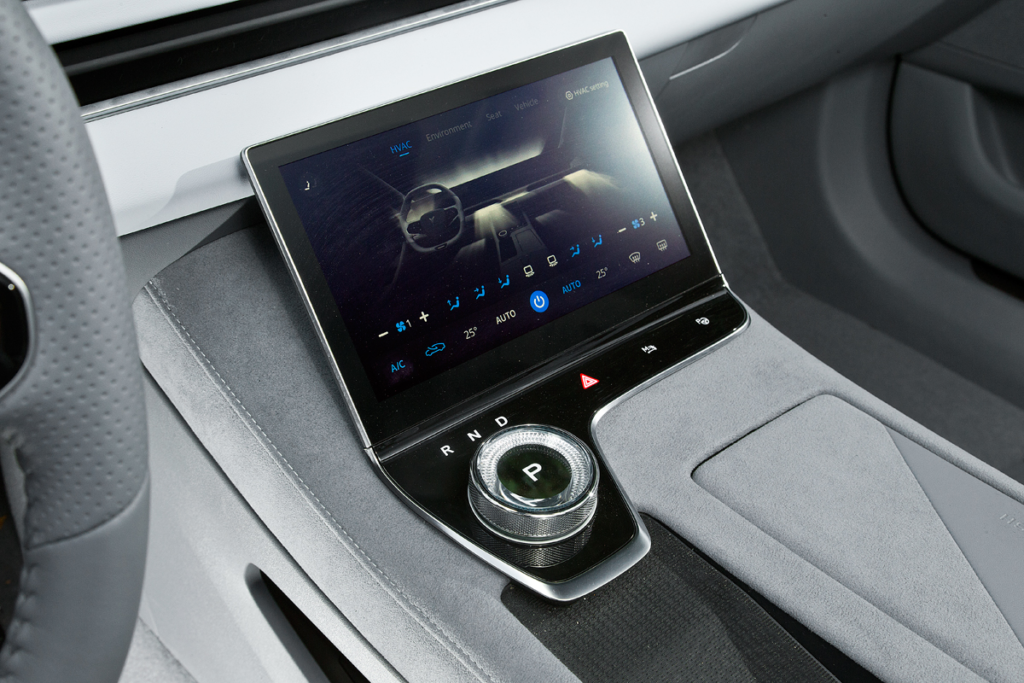
The transmission mode selection dial does not bother you with delays
What the Russification Will Not Fix
The transmission mode selector knob causes no delays, but even after Russification the Passion will not open up fully. Most of its services are built for a 5G network and require a mandatory link to an internal Chinese account. For passengers that mostly leaves admiring colourful widgets from Chinese websites and exploring the settings menu, which can be swiped across with three fingers from the central screen to the passenger’s.

The passenger entertainment center has limited functionality.
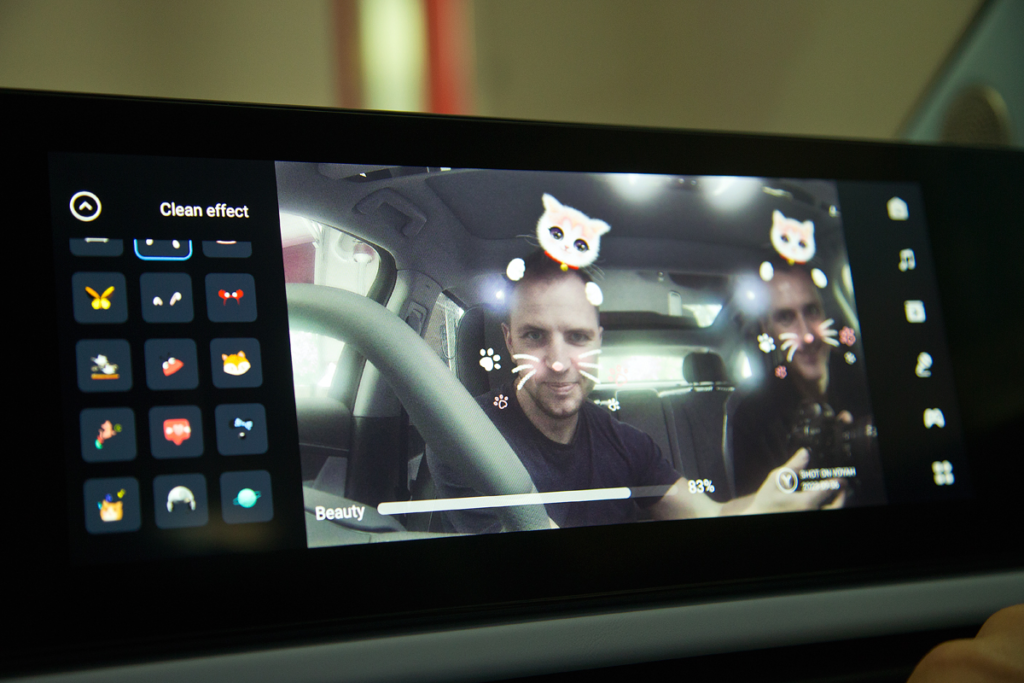
The interior cameras allow you to record videos with overlaid animations.
Kindergarten for Grown-Ups
Children get the most out of the interactive camera mode, which records video with funny animations laid over your face — soap bubbles on your head, ears, comical cat faces. It may feel like kindergarten, but it lifts the spirits even past 40.
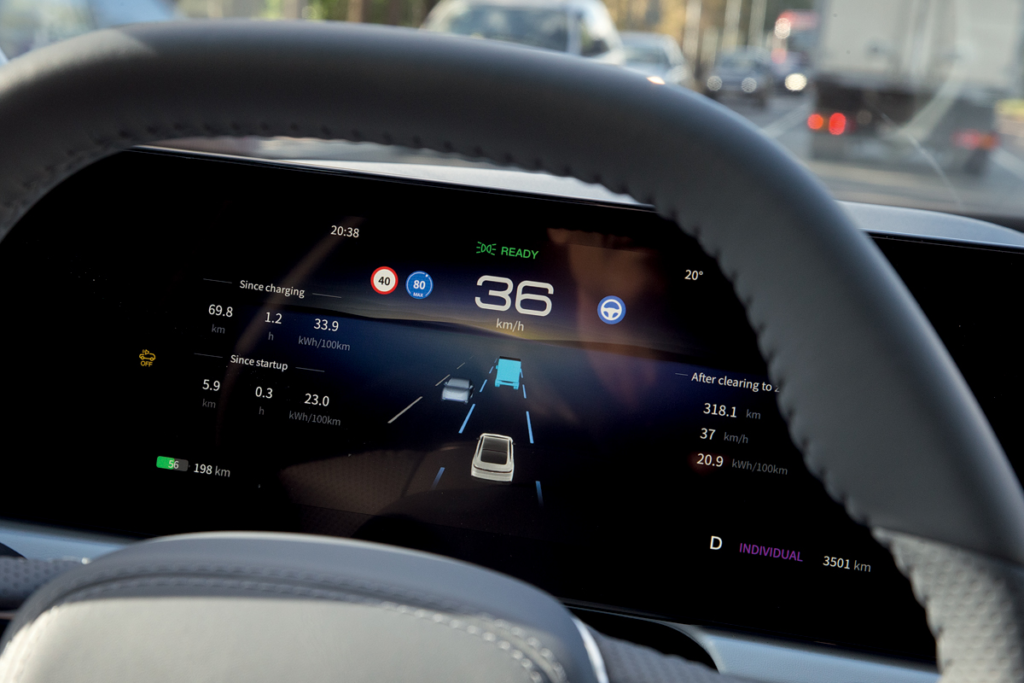
Strangely, Passion offers only one dashboard design.

On the projection display, there are large symbols. Unfortunately, the augmented reality navigation mode doesn’t work in Russia.
Distraction, and the Assistance That Offsets It
All of this is worth a word of caution, because entertainment that amuses passengers can just as easily pull the driver’s attention off the road. Happily, the Voyah Passion carries a full set of electronic driver aids, including lane keeping, automatic braking and active cruise control. The cruise control in particular works well. What it does not have is a speed limiter mode.
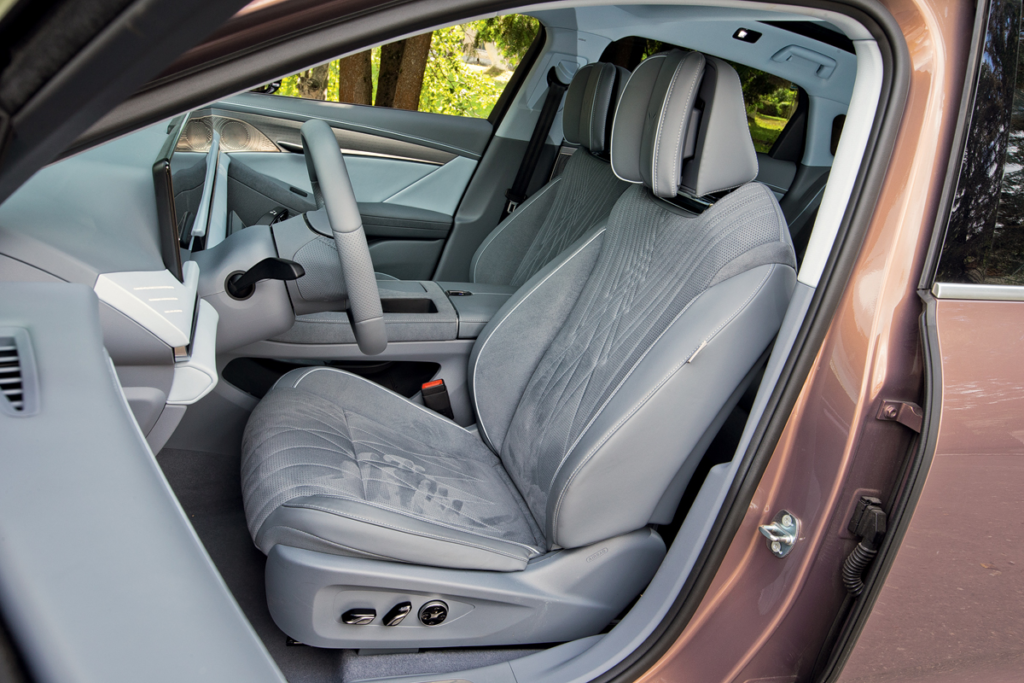
The cushion is a bit short, but the seat is equipped with not only heating and ventilation but also a power massager.

You can save settings for driving, relaxation, and something else on the driver’s seat.
Sign Recognition, and What You Can Switch Off
What it does have is a road sign scanner that displays speed limits, no parking and no stopping signs, and even roadblock warnings. If the notifications get to be too much, the function is easy to disable from the menu. Voyah is flexible that way: the slightly intrusive pedestrian warning synthesiser at low speed can be turned off too, as can the automatic switch to the side-view camera when turning. You are free to set the car up as you like — though it is worth thinking about the package as a whole before you buy.

The second row is spacious; the seatbacks can be adjusted in angle with electric drives. There’s also a footrest on the right, but it can only be fully utilized by passengers of average height.
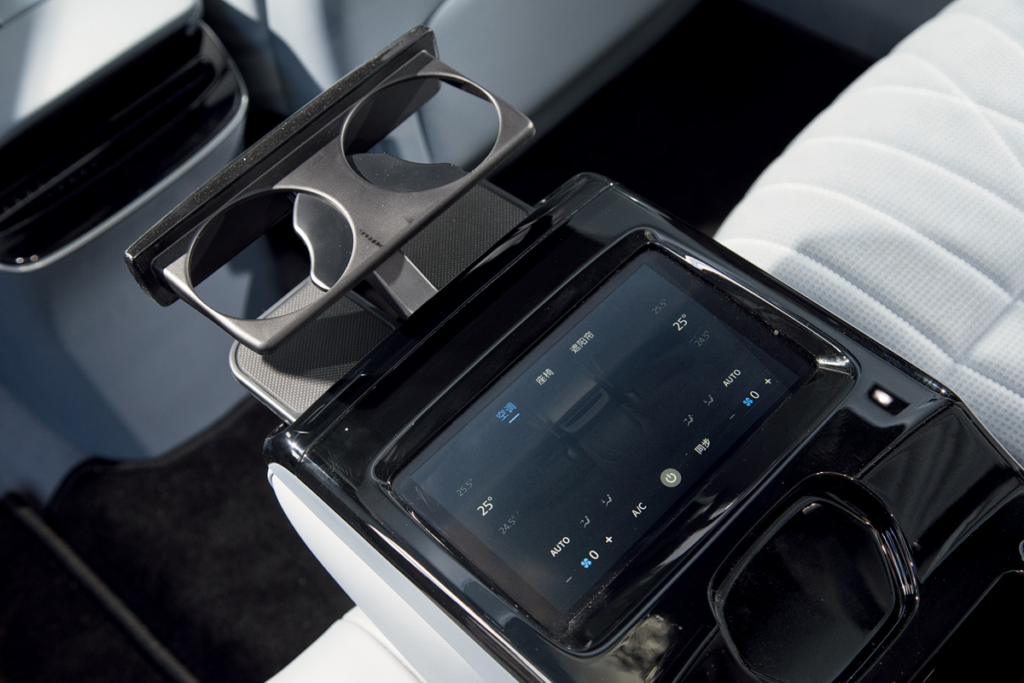
In the fold-down armrest on the rear sofa, there’s another tablet with climate control settings – including heating, ventilation, and massage! And don’t be put off by the hieroglyphs – everything is already in English on commercial vehicles.
510 hp, 730 Nm and Air Suspension
What you are paying for in a Voyah Passion is, above all, the striking design and the electric technology. There are two synchronous permanent-magnet motors with a combined output of 510 hp and a solid 730 Nm of torque — more torque, to put that in perspective, than the gasoline V12 in a Ferrari 812, which manages “only” 718 Nm. The Passion has all-wheel drive, near-perfect weight distribution and adaptive air suspension. Our test sedan carries the 82.1 kWh base battery, with an official range of 483 km on the European WLTP cycle.
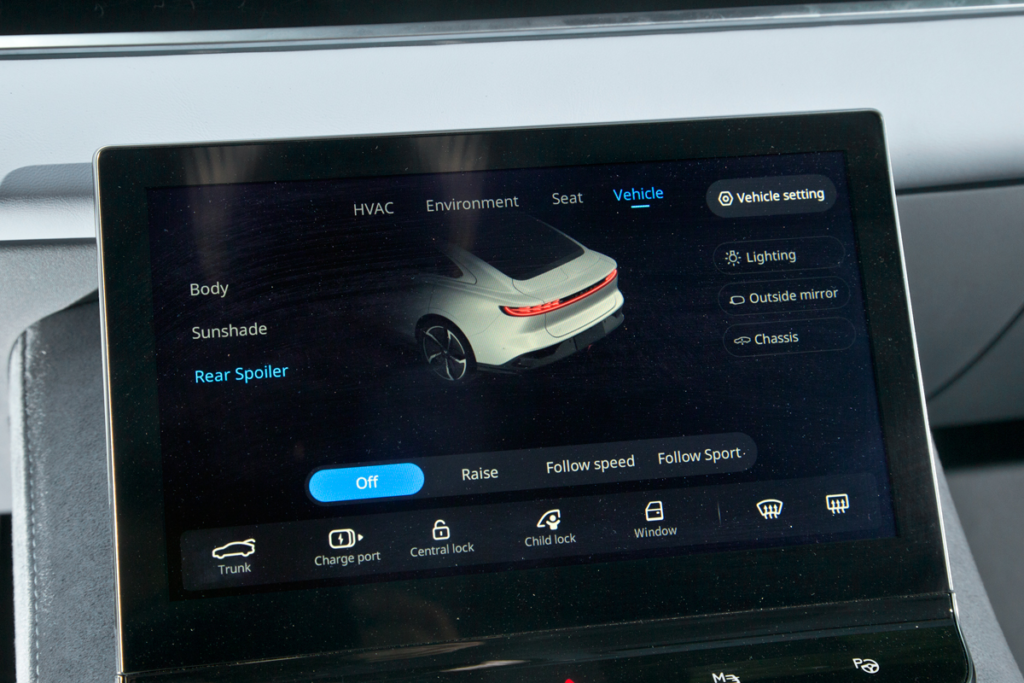
Through the menu you can set different scenarios for the operation of the rear spoiler. For example, it can rise in welcome mode when the car is unlocked
On the Dynamometer Track
While my colleague Andrey Mokhov sets up the measuring equipment, I dig through the settings menu, where it turns out you can configure the speed at which the rear spoiler raises and lowers. The manufacturer says the spoiler generates an additional 40 kg of downforce on the rear wheels — but for a clean acceleration run some drivers would rather leave it down. I set it to “Off” and roll onto the dynamometer track at the proving ground. Run after run, the Voyah Passion reaches 100 km/h in 4.2 to 4.3 seconds without launch control or a two-pedal start, and just 14 seconds from rest the speedometer shows 200 km/h. The acceleration is genuinely impressive. It does not last long, though: the electronic limiter steps in at 208 km/h on the speedometer. That is a serious figure, but not a match for the Tesla Model 3 Performance and its 260 km/h (AR #15-16, 2022).

*Acceleration in sport mode
| Parameters | Electric Car Voyah Passion |
|---|---|
| Maximum Speed, km/h | 207.5 |
| Acceleration Time, s 0—50 km/h 0—100 km/h 0—150 km/h 0—200 km/h 400 m Sprint (s) 1000 m Sprint (s) 60—100 km/h 80—120 km/h | 2 4,2/5,7* 8,1 14,2 12,4 23 2,0* 2,5* |
| Run Down 50 km/h 130—80 km/h 160—80 km/h | 856 1583 2415 |
| Braking Distance From 100 km/h Path, m Deceleration, m/s² From 150 km/h Path, m Deceleration, m/s² | 37,1 10,4 84,9 10,2 |
*Acceleration in Sport/Comfort mode
390 kW, Says the Wattmeter
The instantaneous readings on the electronic wattmeter during acceleration are worth a look: they reach 390 kW, which is a potent 530 horsepower, and exceeds the rated power by 15 kW. Move the driving electronics from Sport to Comfort, however — by touching one of the sensors next to the selector knob — and the car is noticeably subdued. In Comfort the Voyah Passion needs at least 5.7 seconds to 100 km/h, and the wattmeter shows the electronics holding power to 310 kW, or 422 hp.
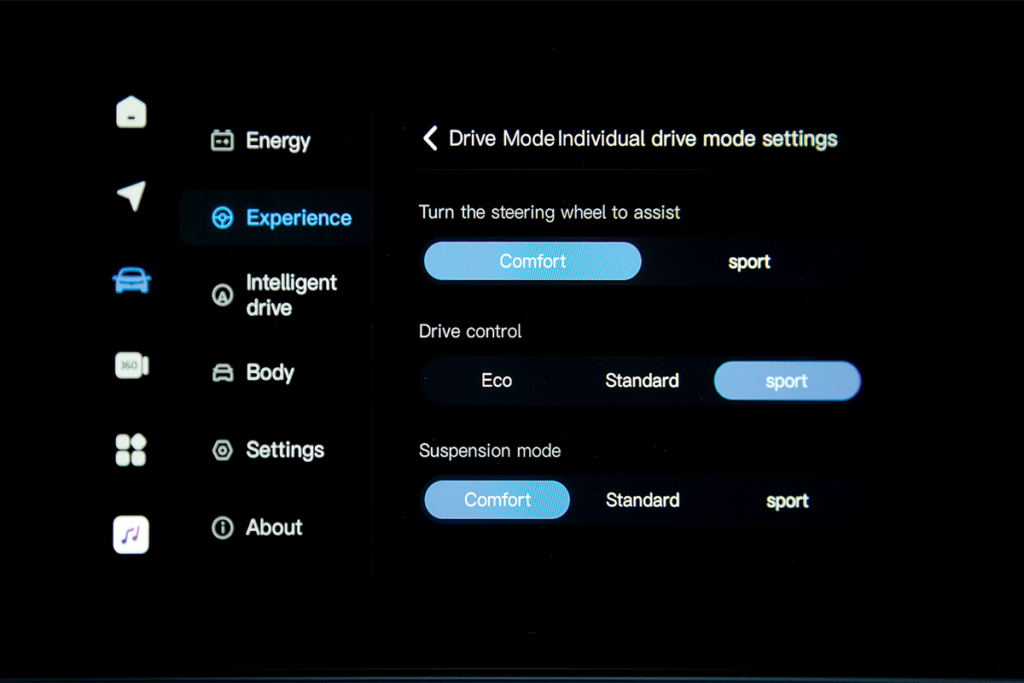
The Individual mode presents a valuable feature, allowing you to select maximum power delivery from the powertrain while retaining comfortable suspension settings.
Eco, Sport, and the Individual Compromise
In Eco a modest 210 kW, or 286 hp, is all you get, however hard you press the accelerator. That is a peculiar limitation: conventional cars give you the full engine on kick-down whatever mode is selected, and even electric cars normally restrict power only when the battery is critically low. Ours still had 80% charge. So dazzling passengers or other drivers with rocket acceleration means switching to Sport, where the suspension and steering firm up as well, which is less comfortable. The Individual mode is the answer: set the powertrain to Sport and leave the suspension and steering in Comfort, and the balance is perfect.

The sedan boasts an array of 12 cameras, with 10 positioned on the exterior. The company promises customers an online update for the autopilot, which currently operates solely as adaptive cruise control.
Brakes and Recuperation
Whatever state it is in, the Voyah Passion follows the accelerator pedal precisely and without delay. Managing speed in traffic is a pleasure, and so is slowing down. I tried all three recuperation modes and found no roughness in any of them. Braking efficiency and thermal stability were no trouble either: after the test there was only a faint smell of brake pads, and none of the smoke that is a routine event when testing Korean or Japanese cars. Ventilated discs are clearly fitted at the rear as well as the front, with two-piston calipers up front.
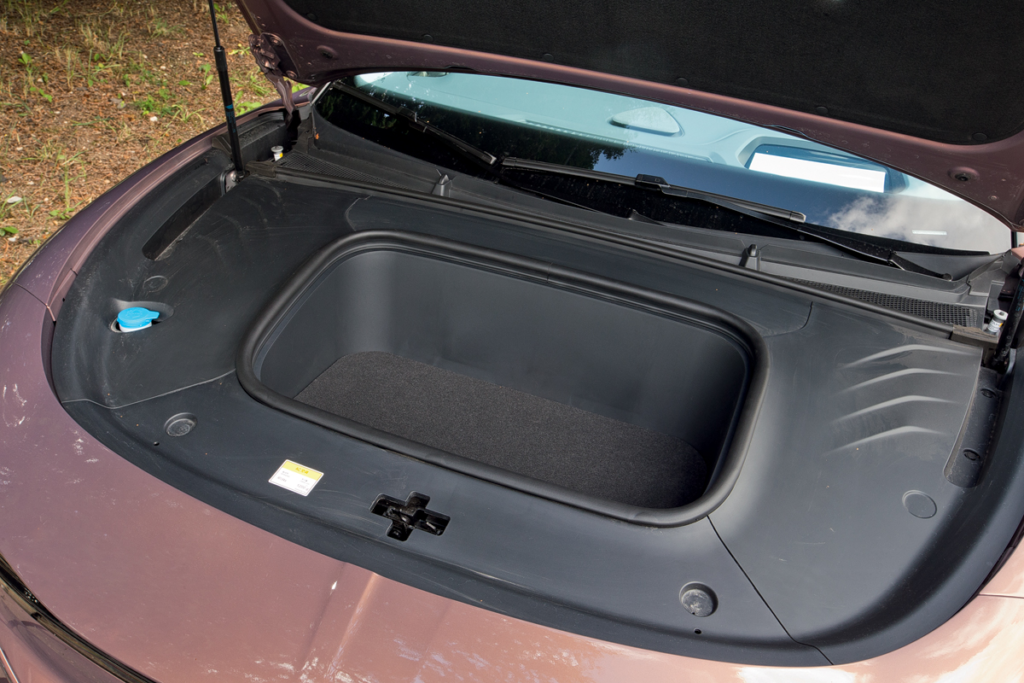
A handy additional storage compartment up front allows for convenient storage of charging cables. The lid is equipped with gas struts for ease of use.
The ESSA Platform and Its Camera-Fed Suspension
The Passion sedan is built on the same modular ESSA (Electric Smart Secure Architecture) platform as the Free and the Dreamer, with pneumatic suspension and adaptive dampers that vary their stiffness in real time from the road image captured by a camera under the windshield. The system works impressively, smoothing rough asphalt and speed bumps away. On bigger bumps it shows its limits and the dampers work close to their capacity — which is no surprise, since no pneumatic system can fully compensate for low-profile tires. The Passion runs 245/45 R20 rubber, European Continental EcoContact 6, albeit made in China.

The rear trunk lid has electric drive, but it can only be activated from the key or the display on the front panel; there’s no external button.
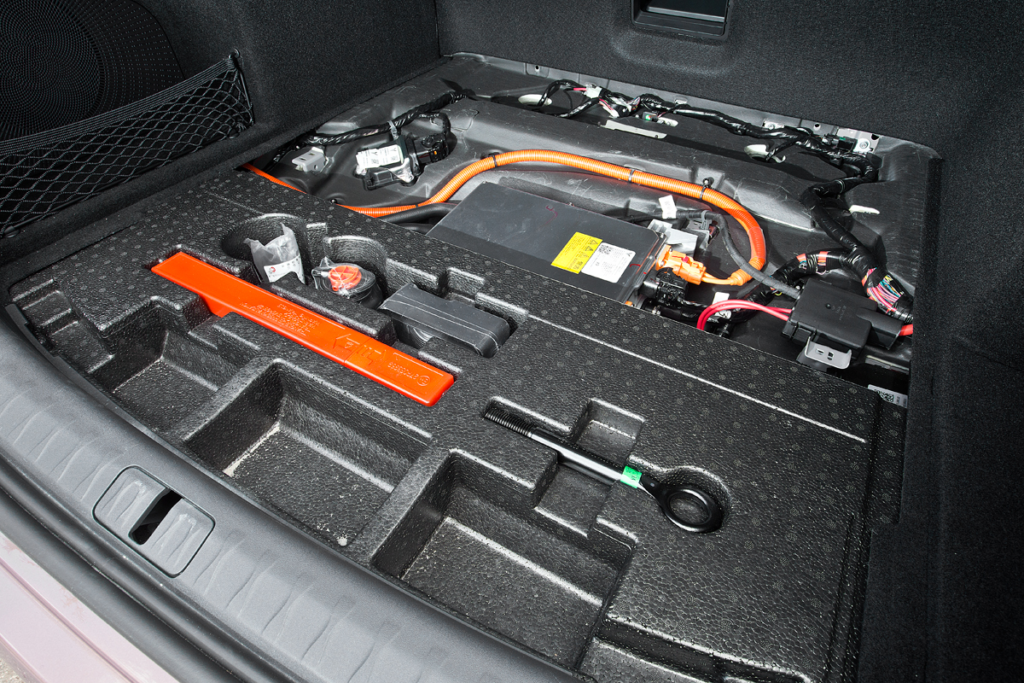
In the underfloor area, there’s a repair kit with sealant instead of a spare tire.
In the Corners
The adjustable suspension remains a genuinely valuable feature. If body roll in Comfort at speed is not to your taste, there are Standard and Sport presets waiting. In Sport the Voyah Passion goes through corners confidently, holding the road firmly and answering the steering accurately without being needlessly sharp. The rear axle helps maintain traction as conditions change, and lifting off gives that pleasant sense of being screwed into the corner. Under power the tires manage a slight squeal just before the stability control intervenes; the system can be switched off, but only up to 80 km/h. More natural steering weight would be a fine addition for track use. Even so, this remains a heavyweight, tipping the scales at almost 2.3 tons fully equipped.
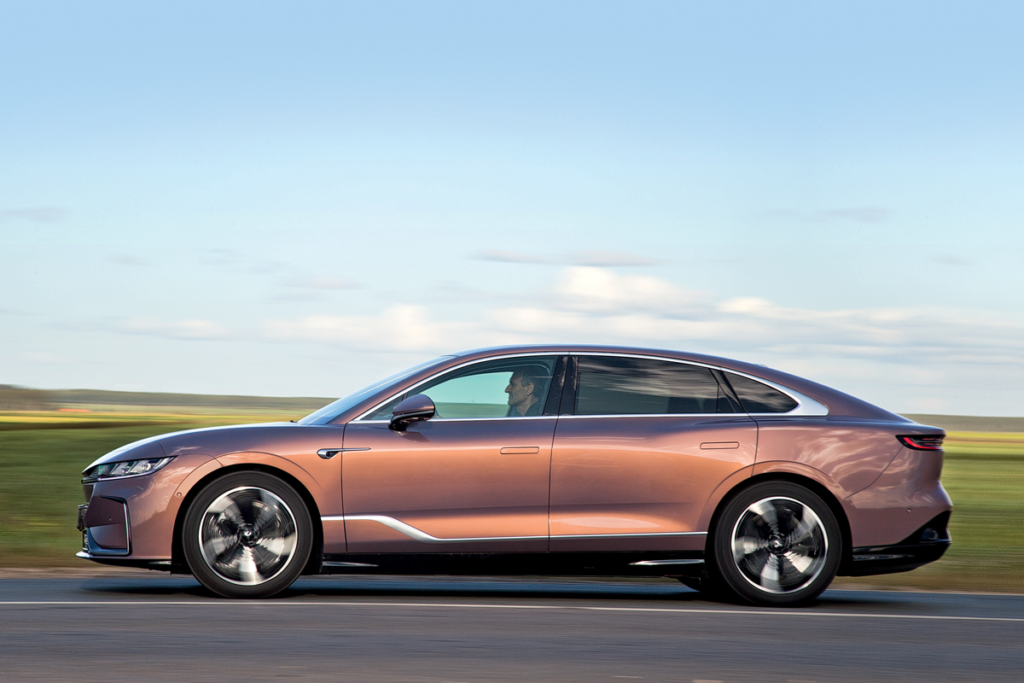
In Sport mode, the body is lowered by 16 mm; when driving on a bad road, it can be raised by 56 mm, but only at speeds up to 40 km/h
Real-World Range
For everyday brisk driving the car is very well suited, partly thanks to efficient energy recovery under braking, and the range figures show it. In town, 350-380 km is comfortably achievable with average consumption of about 21 kWh/100 km. The important thing is to switch the remaining-range counter from theoretical mode, based on the Chinese CLTC cycle, to the practical one. In the theoretical mode the Voyah Passion claims an astounding 580 km on a full battery.
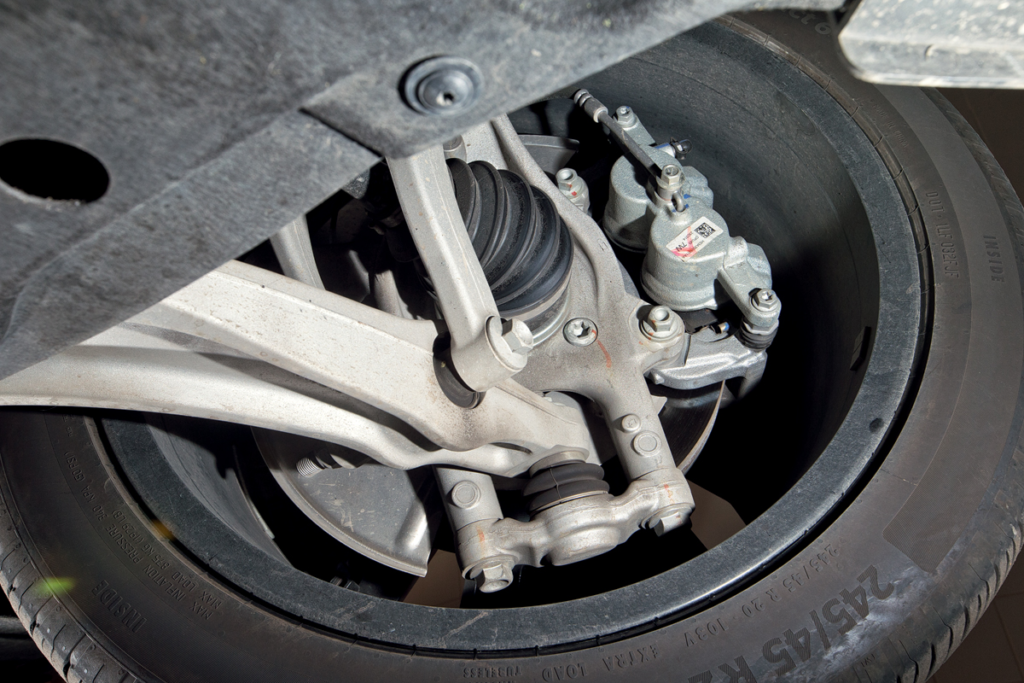
The front double wishbone suspension is entirely aluminum, with a two-point ball joint mount.
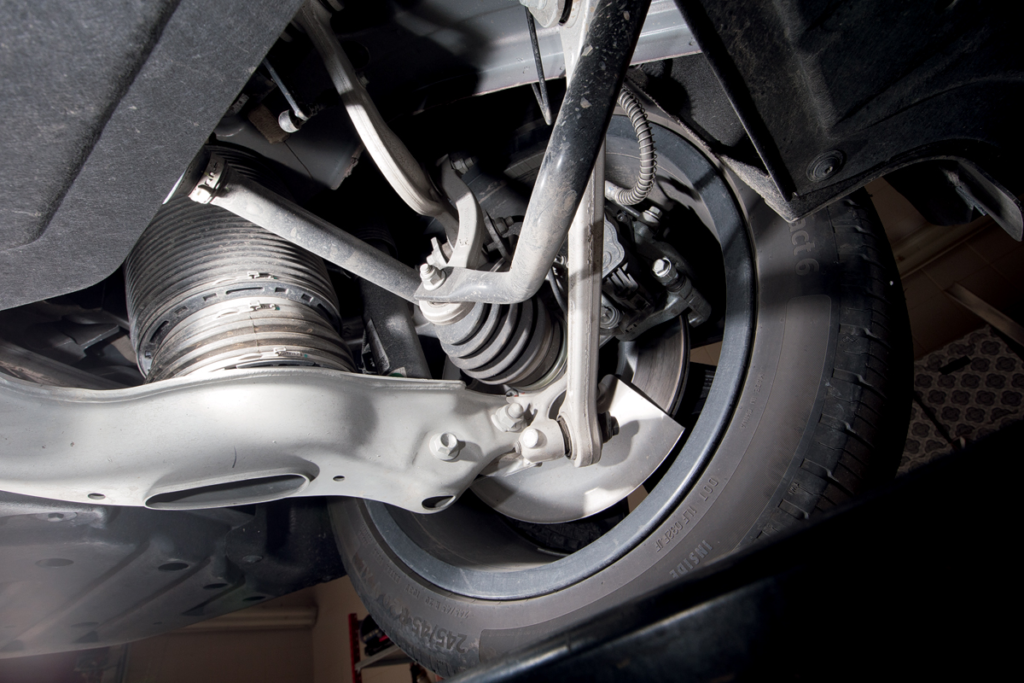
In the rear, there’s a multi-link suspension with intricate stabilizer bar mounts.
Charging
Charging is fairly standard. For rapid charging you need a terminal with the Chinese “GB/T pistol”; the Dmitrovsky test track had one, and the Passion went from 20% to 100% in about an hour and a half, with charging power peaking at 60 kW. We also tried alternating current at the free “Energiya Moskvy” terminals, which worked without a hitch, using all three phases through an onboard converter rated at 11 kW.

Passion Fruit, Seeds Included
So charge it up and enjoy the ride. The Voyah Passion has a flavour of its own, rather like passion fruit — a fruit whose name, as it happens, also comes from the word “passion”, and whose delightful pulp comes with the occasional inconvenient seed. Here the seeds are the angular steering wheel and the sheer quantity of sensors. The main consideration, though, is the price. The test car, at eight and a half million rubles, is not even the top of the range: Russia also gets the Voyah Passion Long Range with a larger 108.7 kWh battery and an advertised 608 km on the WLTP cycle, which in practice means 450-500 km on a charge — for 9.8 million rubles. Pricing for the hybrid Voyah Passion has not been set even in China, where sales have yet to start. We are waiting for it with interest, because three quarters of the Voyah cars sold here are hybrids.
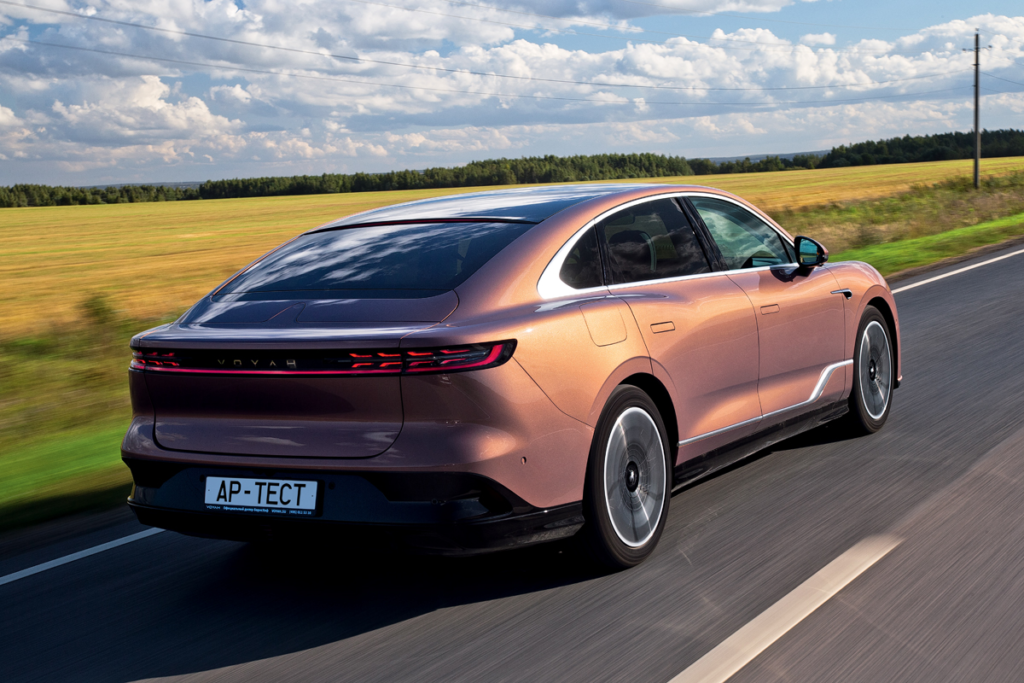
The protrusion above the rear window is the full-width strip of the third brake light
Dimensions and Weight

Manufacturers’ data are highlighted in blue/Autoreview measurements are highlighted in black. Dimensions are in millimeters.
*Actual vehicle weight without driver, with full fuel tank and full process fluids
**For right rear seat
**Interior width at shoulder level in the first/second row of seats.
Full Specifications
| Electric Car Information | Voyah Passion |
|---|---|
| Body Type | Four-door Sedan |
| Seating Capacity | 5 |
| Curb Weight, kg | 2266 |
| Gross Weight, kg | 2641 |
| Front Trunk/ Rear Trunk Volume, liters | 53/410 |
| Coefficient of Aerodynamic Resistance (Cx)⠀ | 0.225 |
| Front Traction Electric Motor Type Location Max Power, hp/kW Max Torque, Nm | Synchronous, Permanent Magnets Transverse, Above the Front Axle 217.5/160 310 |
| Rear Traction Electric Motor Type Location Max Power, hp/kW Max Torque, Nm | Synchronous, Permanent Magnets Transverse, Above the Rear Axle 292.5/215 420 |
| Combined Electric Motors Power, hp/kW | 510/375 |
| Combined Torque, Nm | 730 |
| Traction Battery Type Location Battery Capacity, kWh Operating Voltage, V | Semi-Solid, Lithium-Ion Under the Cabin Floor 82.1 400 |
| Drivetrain | All-Wheel Drive |
| Front Suspension | Independent, Pneumatic, Double Wishbone |
| Rear Suspension | Independent, Pneumatic, Multi-Link |
| Front Brakes | Ventilated Discs |
| Rear Brakes | Ventilated Discs |
| Tire Size | 245/45 R20 |
| Max Speed, km/h* | 210* |
| 0-100 km/h Acceleration Time, s | 3.8 |
| WLTP Cycle Range, km | 483 |
| Time for Slow AC Charging 20-80%, hours | 5.2 |
| Time for Fast DC Charging 30-80%, minutes⠀ | 27 |
*Electronic Limited Speed
Photo: Dmitry Pitersky
This is a translation. You can read an original article here: Страсть и маракуйя: смакуем Voyah Passion на полигоне

Published December 13, 2023 • 14m to read