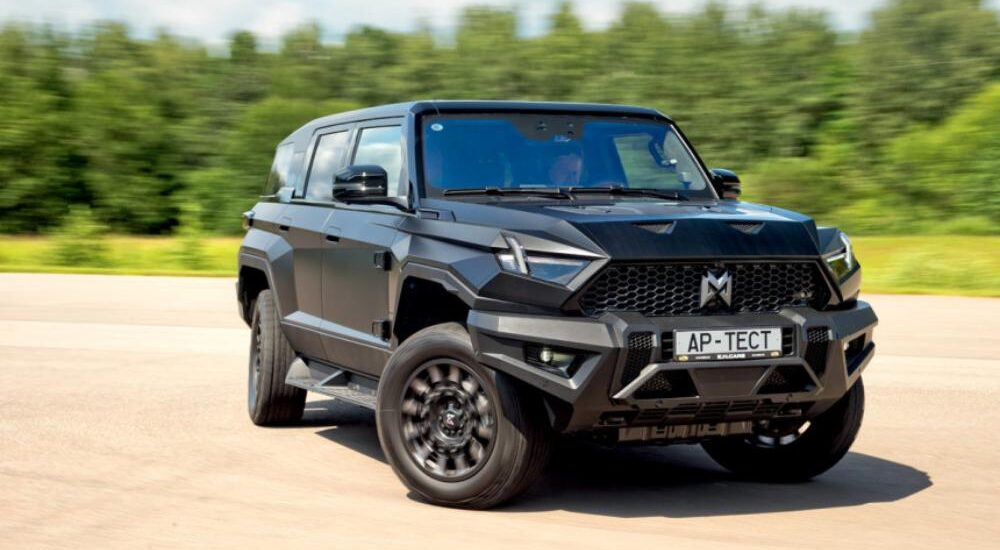

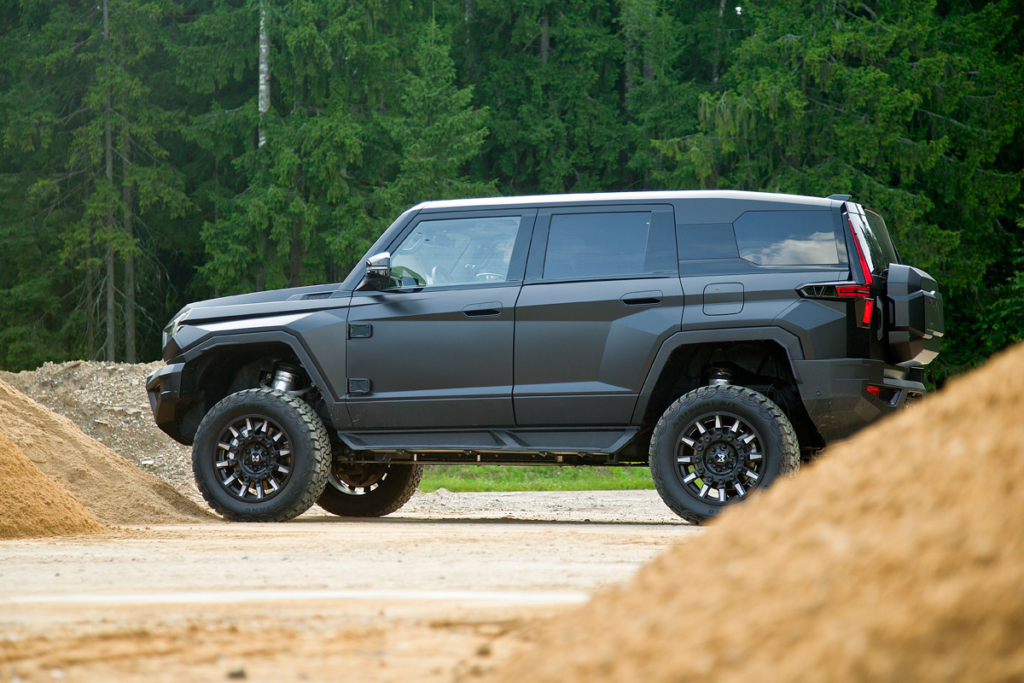
Crrr—the scales at the Autoreview Tech Center at the Dmitrov testing ground groaned under the weight of the brutal Chinese hybrid M-Hero 917. Curb weight: over 3.2 tons! The hit of the season, the dream of every real man? But where are these monsters on the roads? I think I know why.
A Short Lesson in Chinese
So: Dongfeng Mengshi.
Let’s learn some Chinese. The name of the automotive giant Dongfeng translates as “east wind” — the very dongfeng that, according to the great Mao’s doctrine, will defeat the West. If FAW is the First Automobile Works, founded by the Chinese Communist Party in 1953 on the model of Moscow’s ZIS factory, then Dongfeng could be abbreviated SAW: it is the Second. With a complicated history — the decision was taken back in 1957, but then came the search for a strategically safe location in accordance with Mao’s “Third Front” concept, and construction beginning only in 1969. In short, Dongfeng started mass production of its “East Wind” trucks only in the mid-70s.
The Warrior, With a Capital W
Dongfeng now includes the Voyah brand as well, but the company’s primary business is still heavy equipment, and primarily military equipment: the EQ2050 all-terrain vehicles modelled on the American HMMWV, for instance. It is these, not original Hummers, that carry brave special forces in Chinese action films like Operation Red Sea. Have you seen Operation Red Sea? Highly recommended, wonderful cinematography. And it explains why the Second Automobile Works created a separate brand, Mengshi — “Warrior” — for its military and civilian off-roaders. Specifically with a capital W. Because “warrior” in Chinese is “jiangshi”, whereas “Mengshi” means “Warrior”. Specific, if you will. The Warrior.
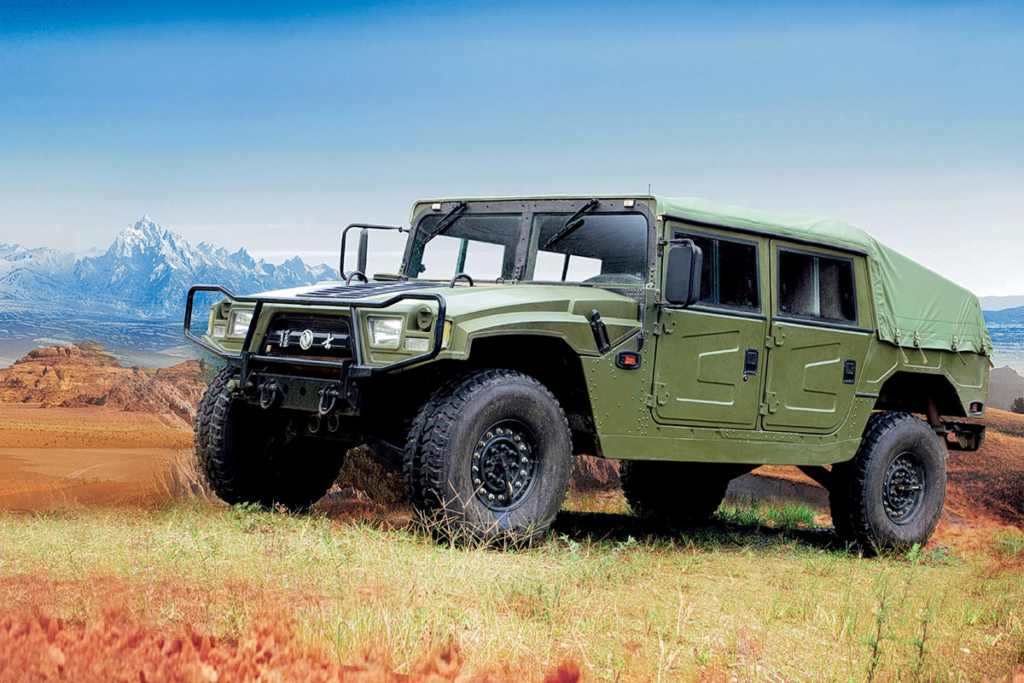
The Dongfeng EQ2050/2058 is what is called a “one-piece pull”: after the US Gulf War, the Chinese bought a Humvee, disassembled it and copied it. The vehicle kits were initially bought in the States, but gradually everything was localized except for the GM V8 turbodiesel (the Cummins “four” is produced in China under license). The all-terrain vehicles weigh at least 3.2 tons, reach speeds of up to 130 km/h, are equipped with a central tire inflation system and are available in a variety of versions (the first slide is the basic military version, the second slide is the civilian Mengshi M50)
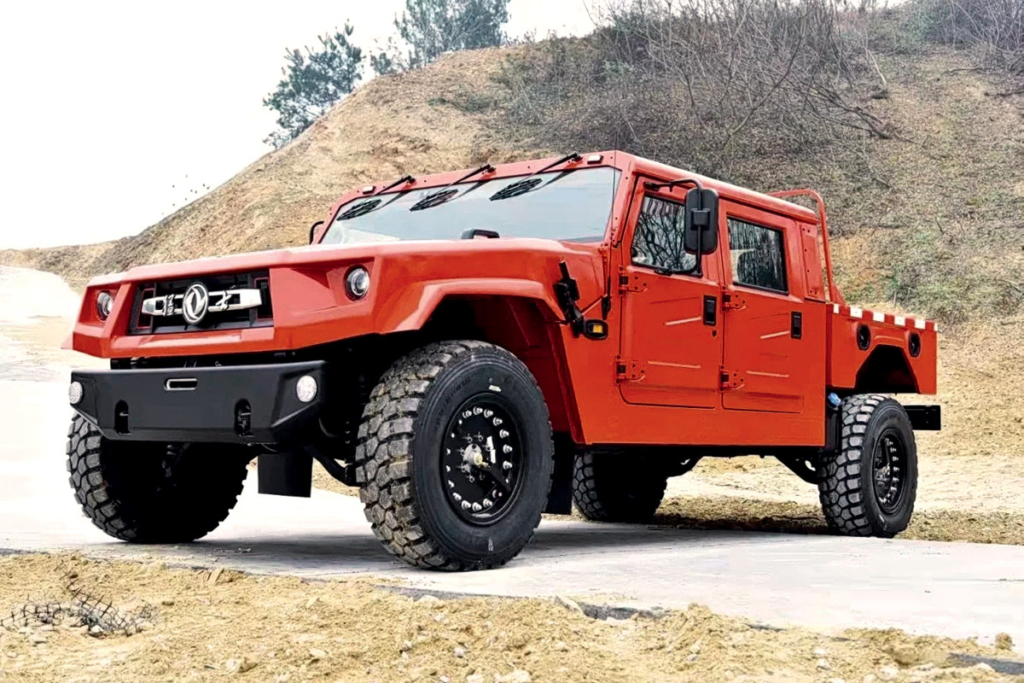
Mengshi at Home, M-Hero for Export
So in China it is the Mengshi 917, and M-Hero is the export name: Dongfeng is aiming at the Middle East and even Europe. In Russia the cars from “East Wind” are officially imported by Motorinvest, and I had hoped not only to test the Warrior but to clear up a few points. Why 917, for example — is it a nod to the Porsche racing cars? But since my article on the Evolute i-Jet, the Motorinvest press office is closed to Autoreview. Oops. What did I say that was so terrible?
Luckily the M-Hero 917 was available through our friendly company E.N.Cars. Unofficial and without plates — but here it is, on the testing ground scales. And on the dynamometer straight.
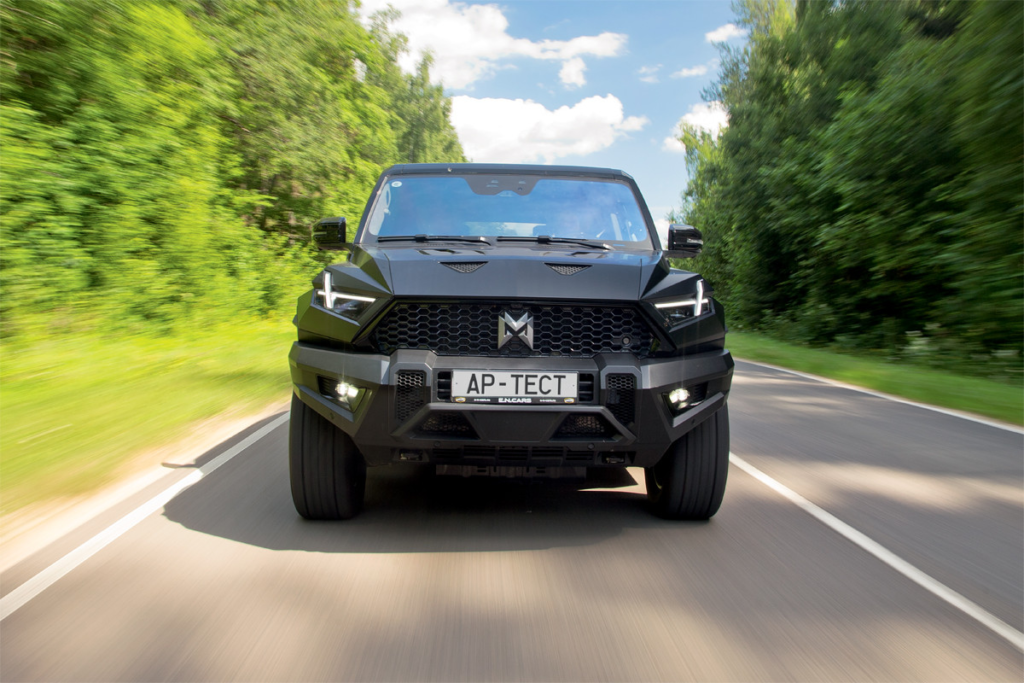
816 Horsepower, Three Motors and a Range Extender
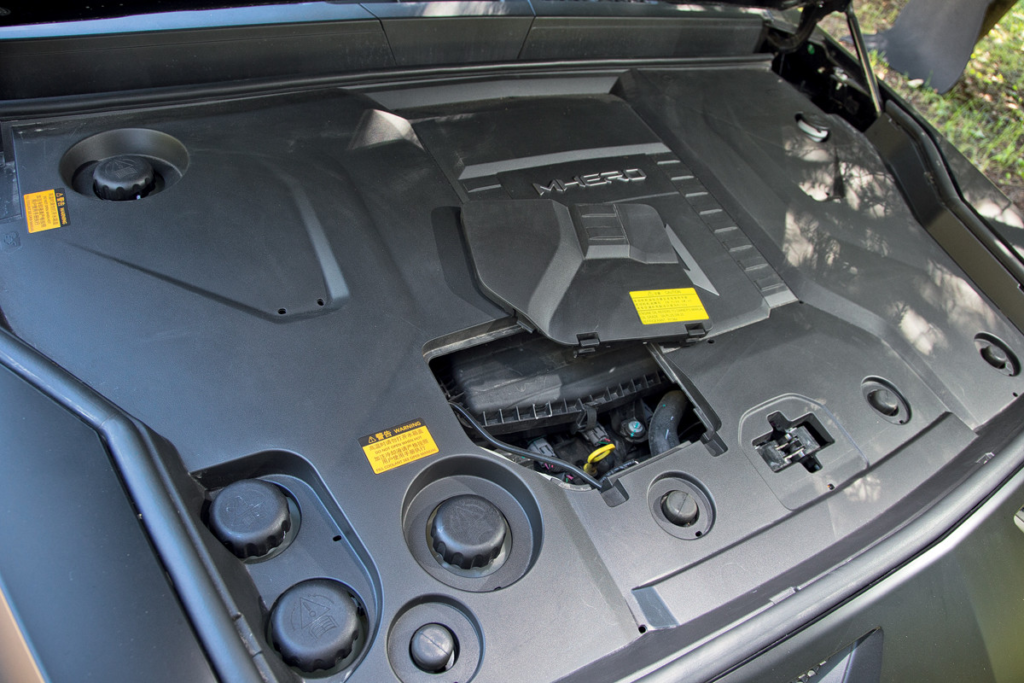
In China the M-Hero also comes as a pure electric car with four motors totalling 800 kW (1,088 hp) and a 143 kWh battery, but only the hybrids are imported into Russia. These have a single electric motor on the front axle, and under the hood a range extender in the form of a 145 kW (197 hp) turbocharged four driving a 100 kW generator. Three 200 kW electric motors — two of them at the rear — give a total of 600 kW, or 816 horsepower. It sounds like a lot, and divided by the measured 3,263 kg it works out at 250 hp per tonne. On power-to-weight, that is the same league as fast cars like the Porsche 718 Cayman GTS. So we are about to see four seconds to 100 km/h.
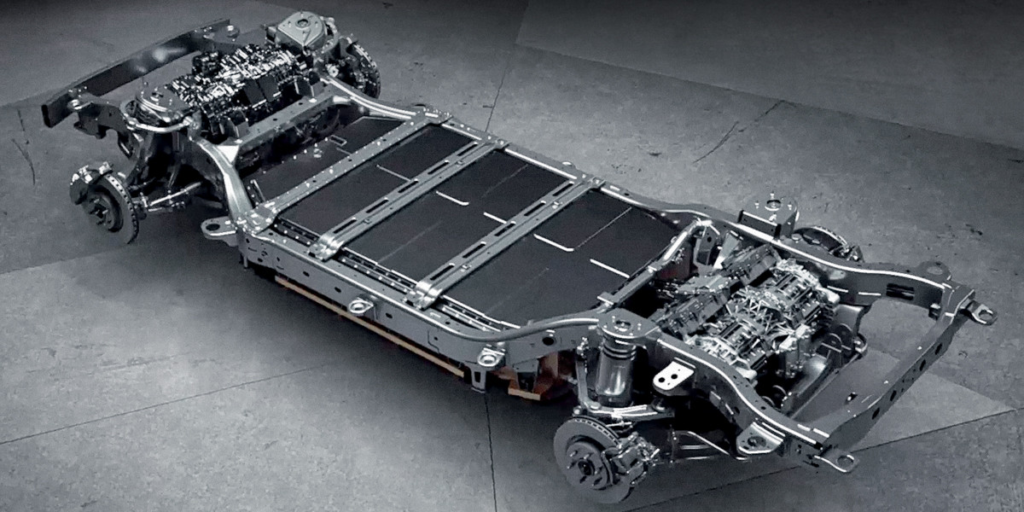
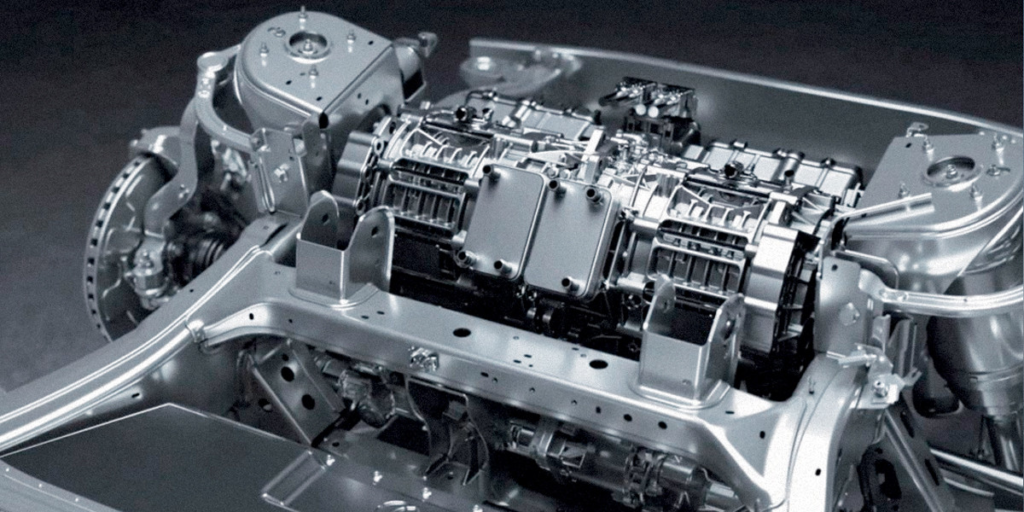
The Mengshi 917 is based on a powerful spar frame with a traction battery built into it. The electrical technology is far from advanced: the synchronous electric motors are low-speed (up to 13,000 rpm) and 380-volt, while the hybrid battery only produces up to 350 V. The front traction gearbox is single-stage, and the rear one has a two-stage transmission built into it.
Pedal to the Metal, and…
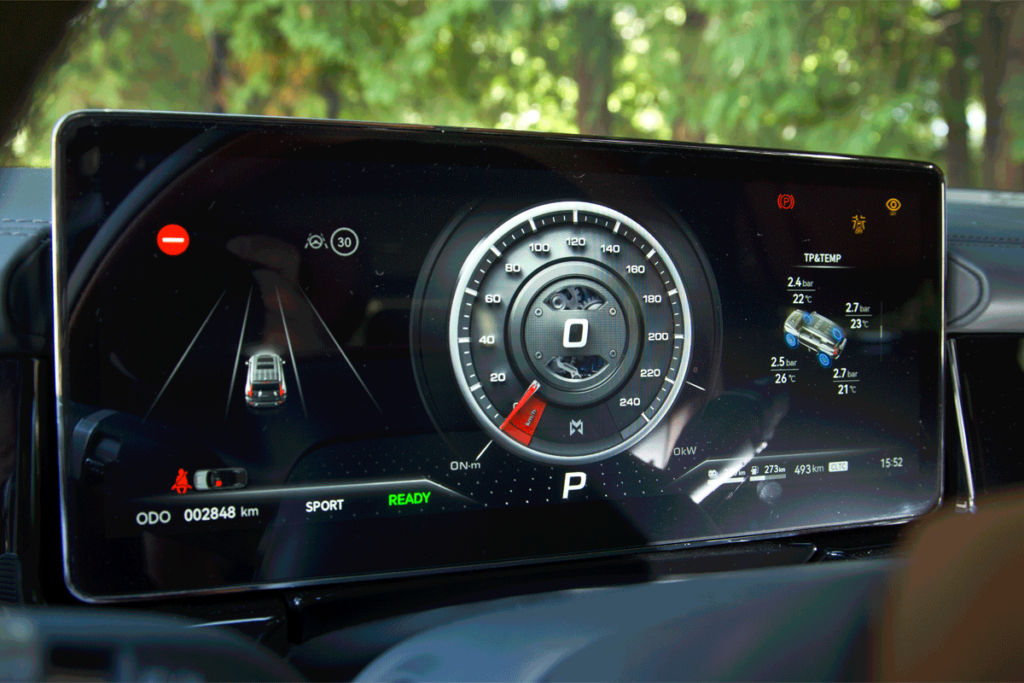
No, not silence — under the hood the gasoline engine sputters monotonously. I had pre-selected Sport mode, which turns the display a crimson hue, and put the hybrid system into its most aggressive charging mode, so that the traction battery, nearly full as it was, would not run down.
So where is the attack?
The hybrid has no launch control — only a pure electric car can set off using both pedals. So the M-Hero reaches 100 km/h in 6.3 seconds. What is more, past 120 km/h the rate of acceleration falls off, and only picks up again at 150 km/h. The thrill is not merely absent but very nearly lost. After that the three-tonne giant takes an unhurried 48 seconds to reach its top speed of 201 km/h.
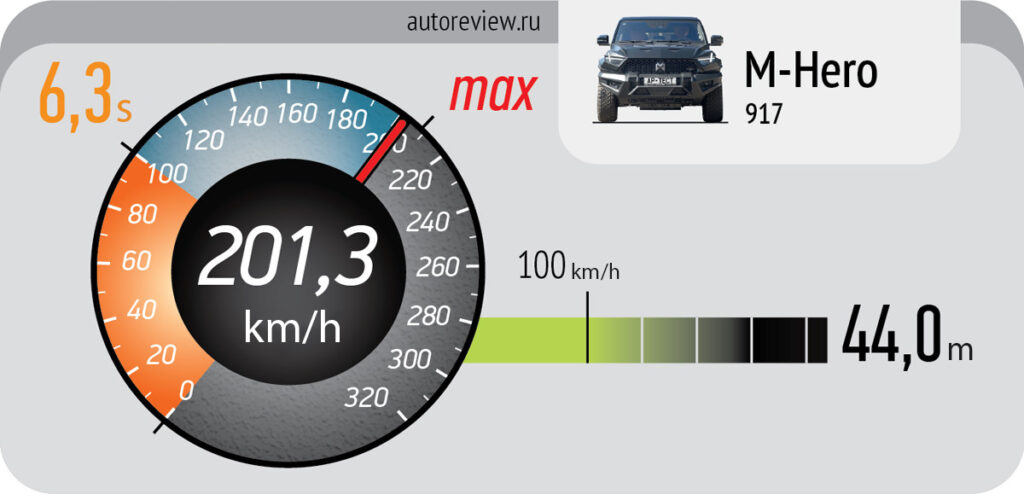
| Parameter | M-Hero 917 |
|---|---|
| Maximum speed, km/h | 201.3 |
| Acceleration time, s | |
| 0–50 km/h | 2.5 |
| 0–100 km/h | 6.3 / 6.3* |
| 0–150 km/h | 15.4 |
| 0–200 km/h | 48.9 |
| Over 400 m | 15.0 |
| Over 1000 m | 27.5 |
| 60–100 km/h (D) | 3.5 |
| 80–120 km/h (D) | 4.5 |
| Braking from 100 km/h | |
| Distance, m | 44.0 |
| Deceleration, m/s² | 8.8 |
| Braking from 150 km/h | |
| Distance, m | 99.2 |
| Deceleration, m/s² | 8.7 |
Acceleration with two pedals / using foot transfer
Where Did the Performance Go?
On one hand the passport promises six seconds. On the other — what happens when the battery is half empty? Or when it is drained and this giant is being hauled along by a 100 kW generator that is charging the batteries at the same time?
And what about that strange dip? My only guess is that at 150 km/h the two-speed rear power module changes gear. A manager at the official Motorinvest showroom took a time-out when I asked about the two-speed system, then called back to explain that the shift happens at… 40 km/h. So it is a reduction gear, then? A pity the experts at E.N.Cars have not yet dug into the M-Hero.
How It Compares
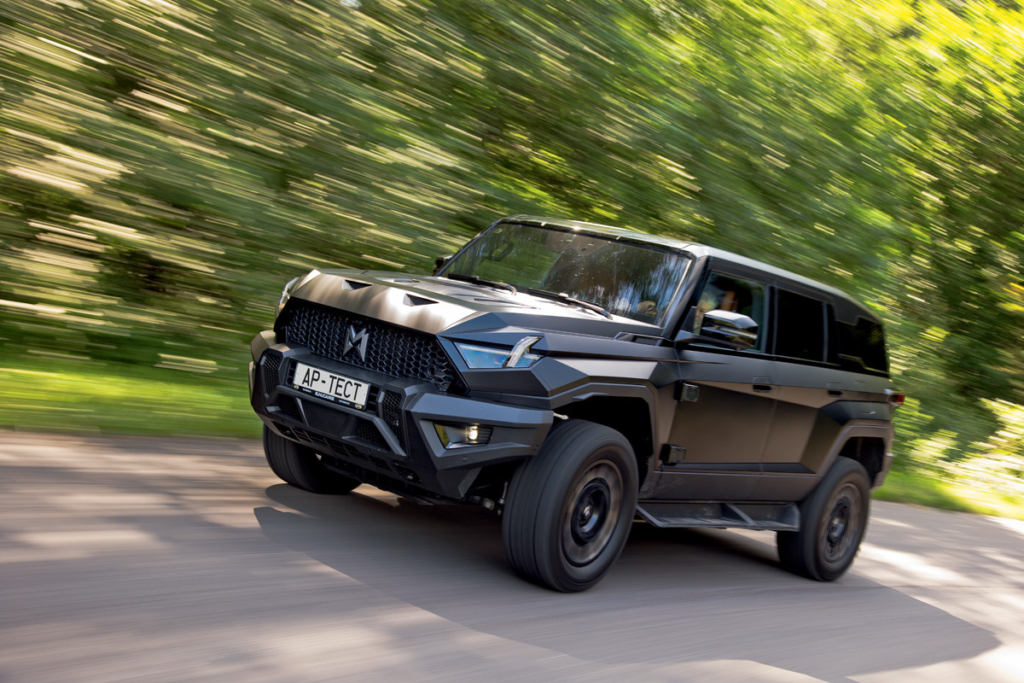
Either way, I would have liked more. The monstrous GMC Hummer EV pickup accelerates to 100 km/h in 3.7 seconds and, a year ago, tipped our scales at 4,147 kg.
It took an eternity to stop from that hundred, though — 48 metres from the start of braking. The M-Hero is a little safer at 44 metres: Brembo does not make half-baked products, and built powerful fixed calipers for it. But the electric Rivian R1S off-roader, which Vladimir Melnikov tested in tandem with the Hummer, beats it comfortably in both acceleration, at 3.8 s, and braking, at 39.5 m, on a similar weight of 3,124 kg.
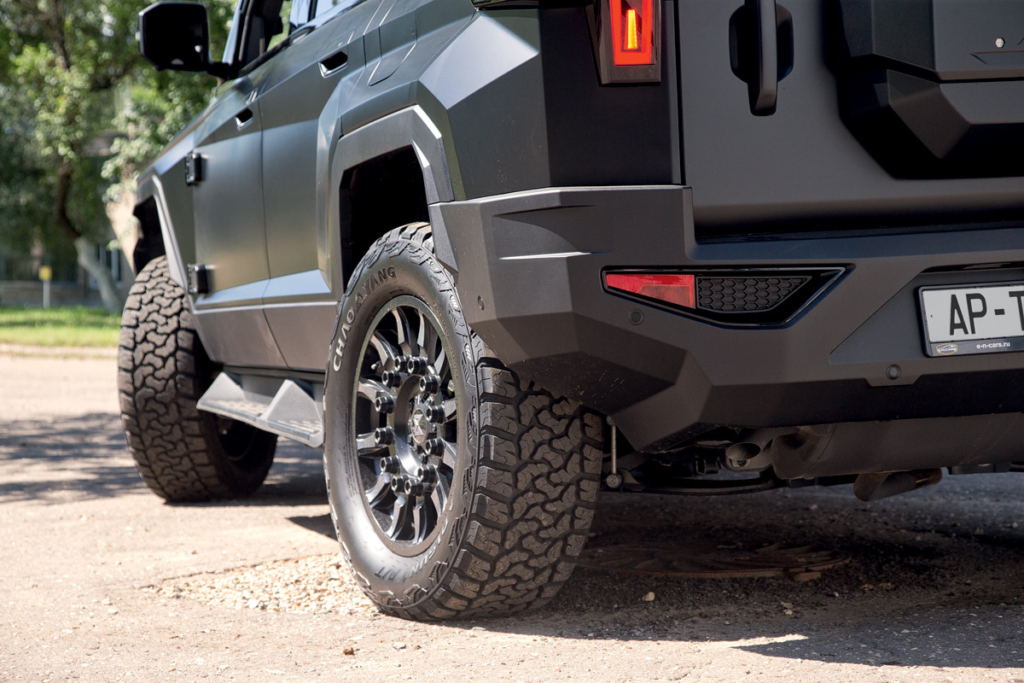
The distance could be shortened by road tires — Pirelli Scorpion, which are also fitted to the M-Hero. Honestly, they would suit its driving character better than these aggressive Chaoyang Arisun A/T tires.
Precise, Straight, and Surprisingly Manoeuvrable
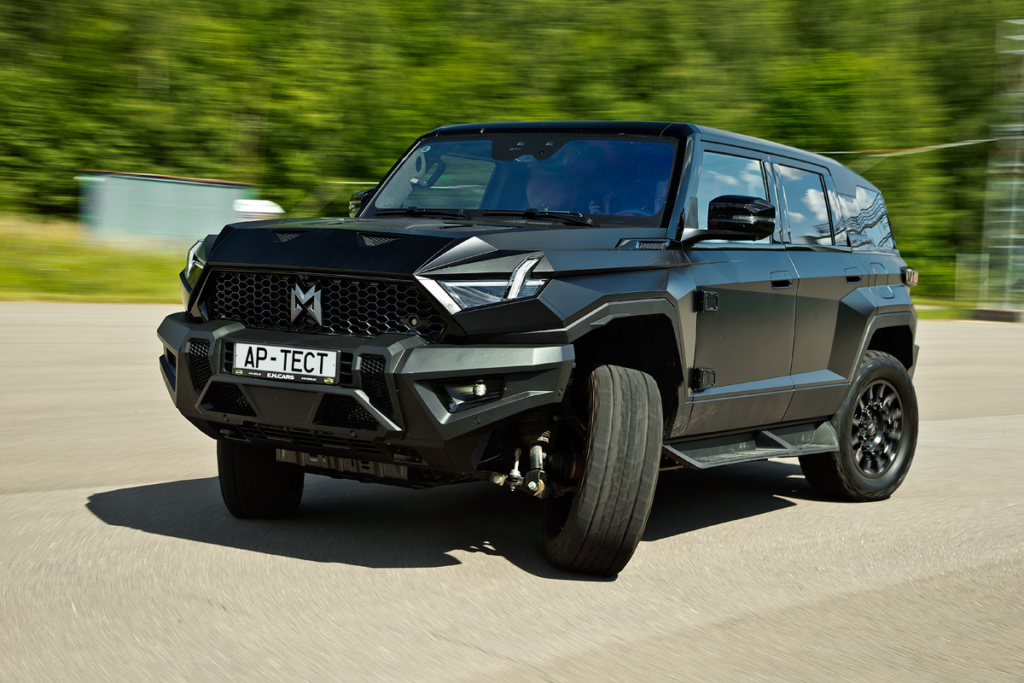
If you are not expecting a wow moment, the acceleration is not bad at all: the Mengshi 917 answers the pedal easily and precisely. It holds a straight line well, and in corners the steering responds with some lean but smoothly and predictably. An unexpected bonus is clear reactive feedback from the electric power steering. And the turning circle measured by Mokhov is just 10.7 metres, thanks to full four-wheel steering with impressive rear angles — a claimed 10.6 degrees.
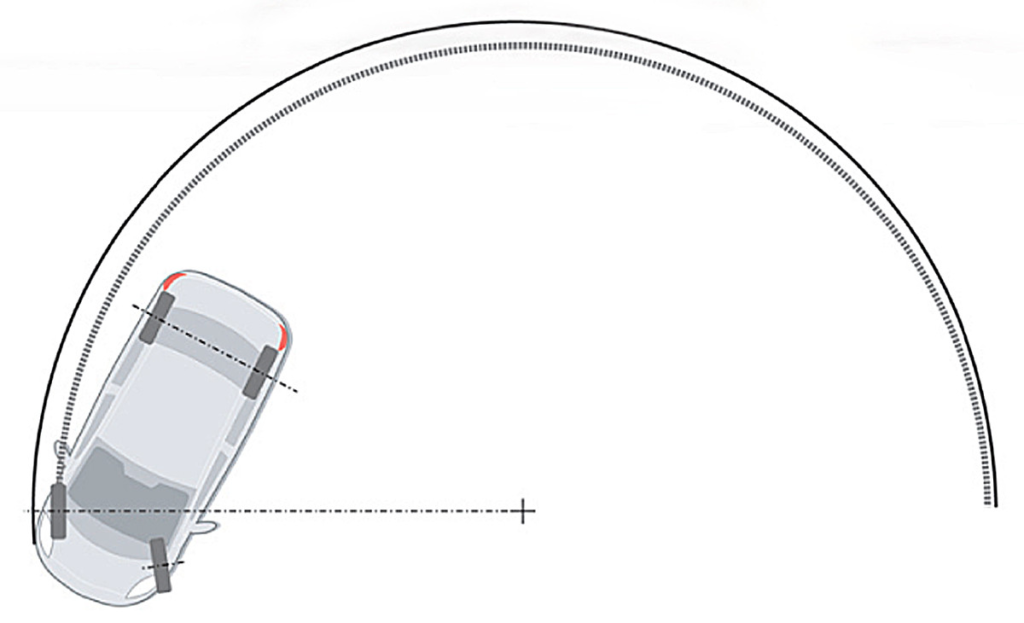
| Parameter | M-Hero 917 |
|---|---|
| Diameter along the track of the front outer wheel, m | 9.9 |
| Diameter along the front outer dimension, m | 10.7 |
But Not in a Fast Corner
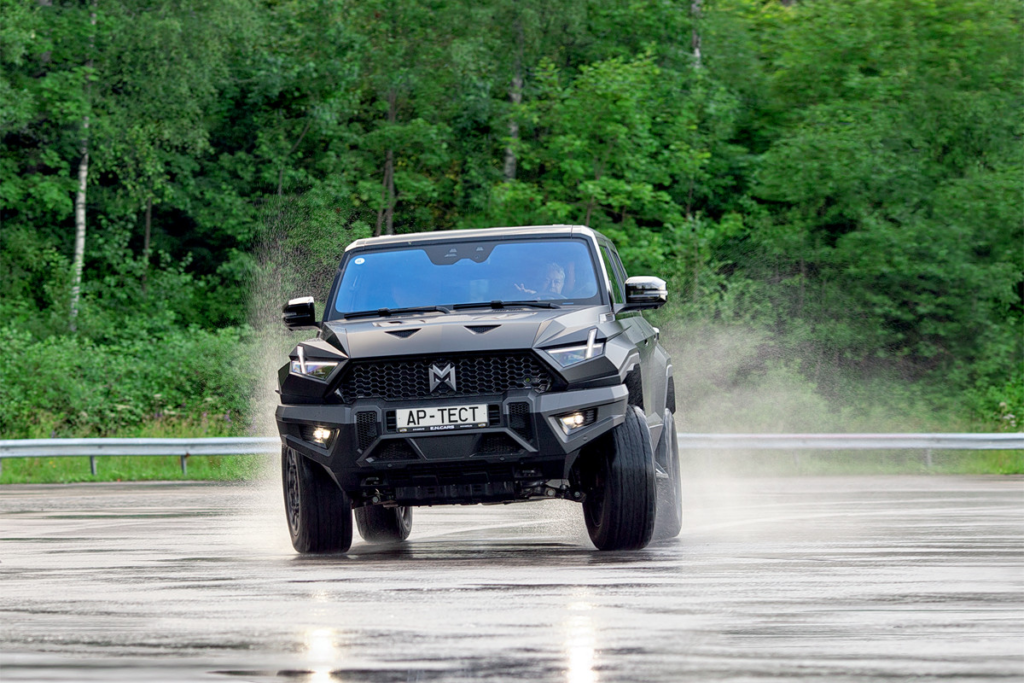
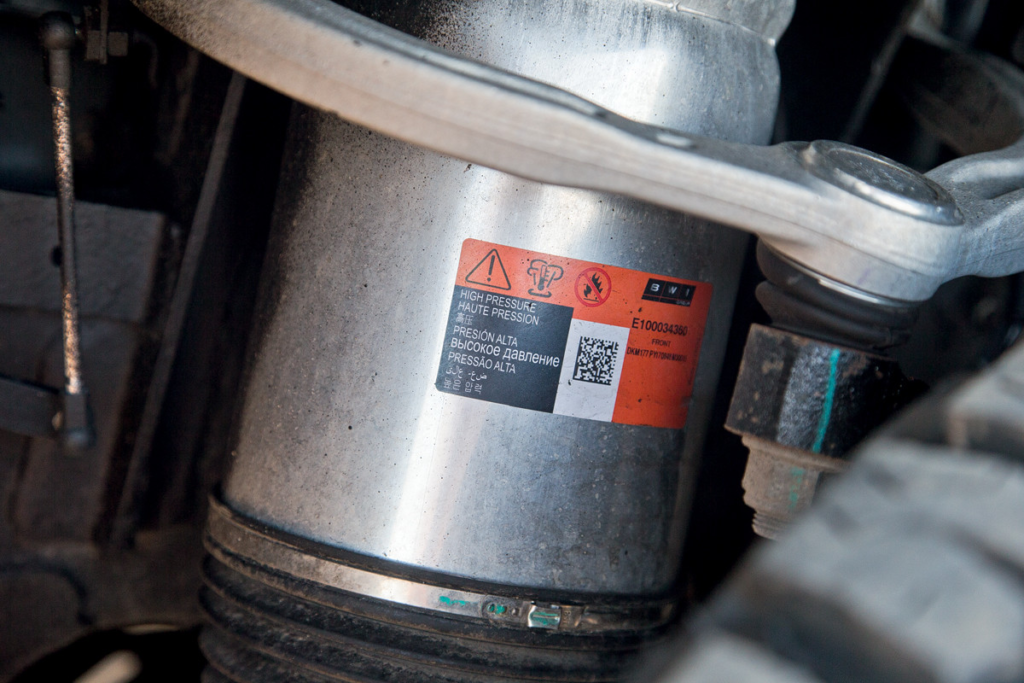
In a fast corner, though — forget it. On wet asphalt the M-Hero pushes wide on its brutish nose, the 20-inch Chaoyang Arisuns churning desperately, and the dampers simply cannot cope. Ride quality does not impress either: vibration from the unsprung masses shakes the body everywhere, as though there were rigid axles underneath. And the active Magic Carpet system, which reads bumps from the forward-facing cameras and prepares the electronically controlled dampers for them, does not seem to help much.
But the Ground Clearance
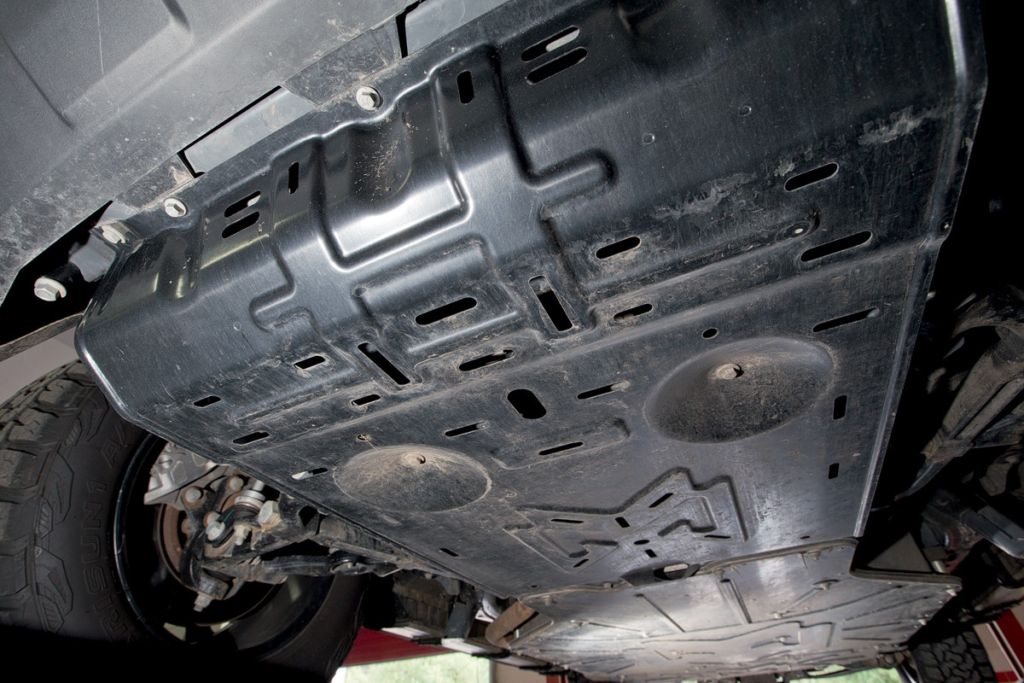
The ground clearance, on the other hand — wow. The air suspension can drop the M-Hero’s body to a crossover-like 208 mm, and in its highest position the underbody sits 353 mm off the ground. Add commendably generous approach and departure angles, 36.2 and 37.2 degrees.
Dimensions, weight and weight distribution along the axes
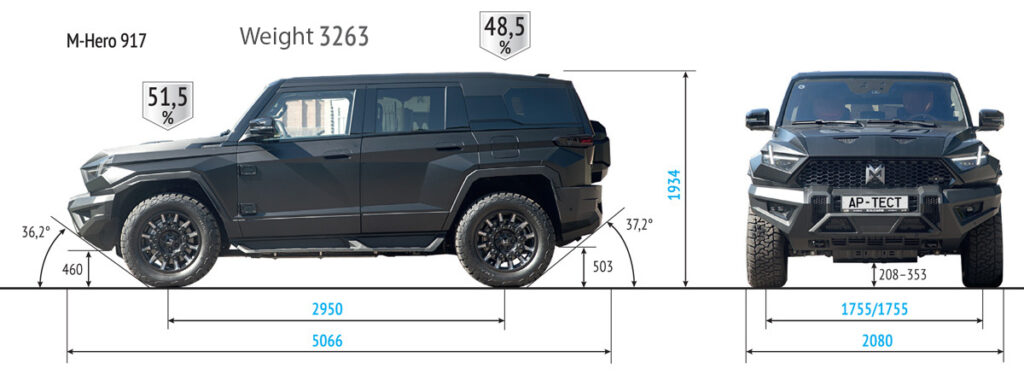
Manufacturers’ data are highlighted in blue, Autoreview measurements are highlighted in black.
Dimensions are in millimeters.
Actual vehicle weight without driver, with full fuel tank and full process fluids
Off-Road: Potential, and Three Problems
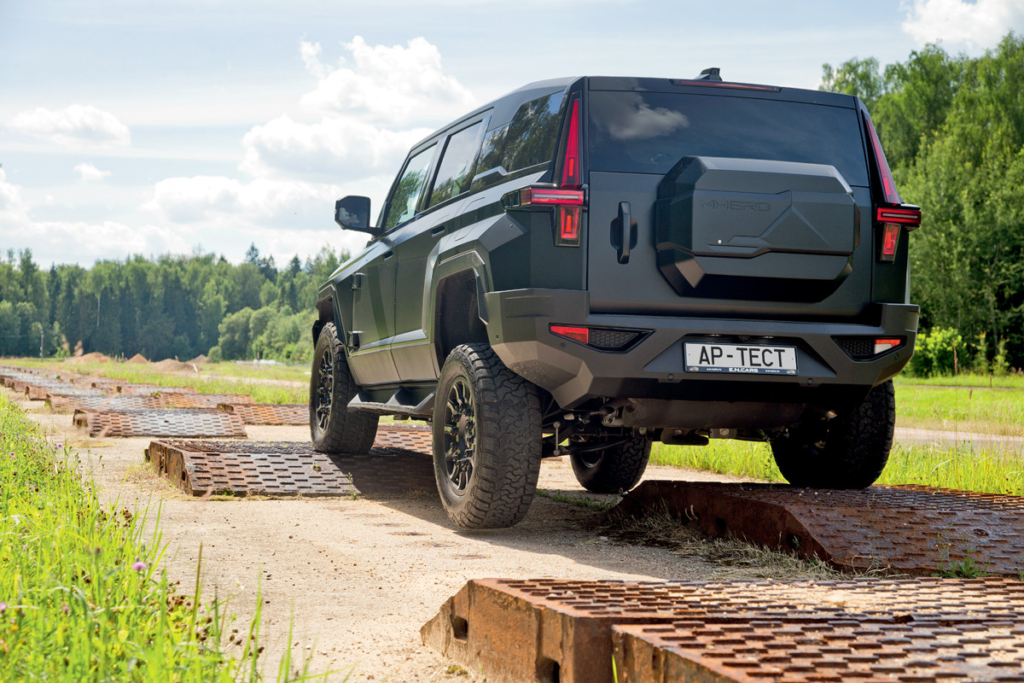
The M-Hero does have off-road potential. But off the asphalt there are three main problems: the weight, the absence of a rigid kinematic link between the axles, and somewhat weak electronics calibration. Cross-axled early, thanks to unimpressive wheel travel, the Mengshi 917 got out only after the cross-axle locks were forced into action. It set off confidently up a grassy incline and then quickly began digging holes with its toothy tires. Managing traction off-road is not easy either: there are plenty of modes, but the controls are opaque, purely electronic.
Crab Mode
But there is crab mode.
I have never driven the Hummer EV, so this was my first time. The sensation, I can tell you, is not for the faint-hearted. The steering angle available in crab mode is limited, though, and the actuators on the rear wheels are not omnipotent.
And why does the Warrior need this? I have a guess. It is like kung fu. You know it: the tiger style, the monkey style, the drunken master… and this one is the crab. Ordinary M-Heroes always go around. Enough talking — forward and sideways, and then, well, these are our crabs, they will help us. And the enemy, who certainly did not expect such a move, gets confused, is demoralised, disarmed, and surrenders to the mercy of the victor. Or rather, The Victor.
What the Press Releases Will Not Tell You
But why 917? Like in that joke. “Petka, instruments? – Seventeen! – What seventeen? – And what about the instruments?”
I tried searching for the characters through Google Translate — no luck, every Chinese site just carried the same press release summaries. The intellectual off-road architecture of Mengshi M-Tech, the MORA platform (Mengshi Off-Road Architecture), and so on. The turbocharged Dongfeng C15TP1 engine, familiar from Aeolus cars, was developed with Honda’s help. The traction battery is a CATL with a ternary NMC cathode — nickel, manganese, cobalt. On the motors, the generator and the controlling electronics there is nothing at all. How I would like to know how the traction modules are built: how the two motors are connected, how the differentials lock, how the axles are synchronised. Inspection on a lift did not clarify much, unfortunately, except that the rear-wheel actuator carried a sticker with the ZF logo.
And the People Behind It
Searching for people did not reveal much either. It is known that in 2021 Dongfeng hired a little-known designer, Henning Nopfle, whose pre-China resume consists only of Volvo Trucks. But the interview with Car Design News about the styling of the M-Hero 917 was given not by Nopfle but by a young Chinese designer, Yulian Zhang.
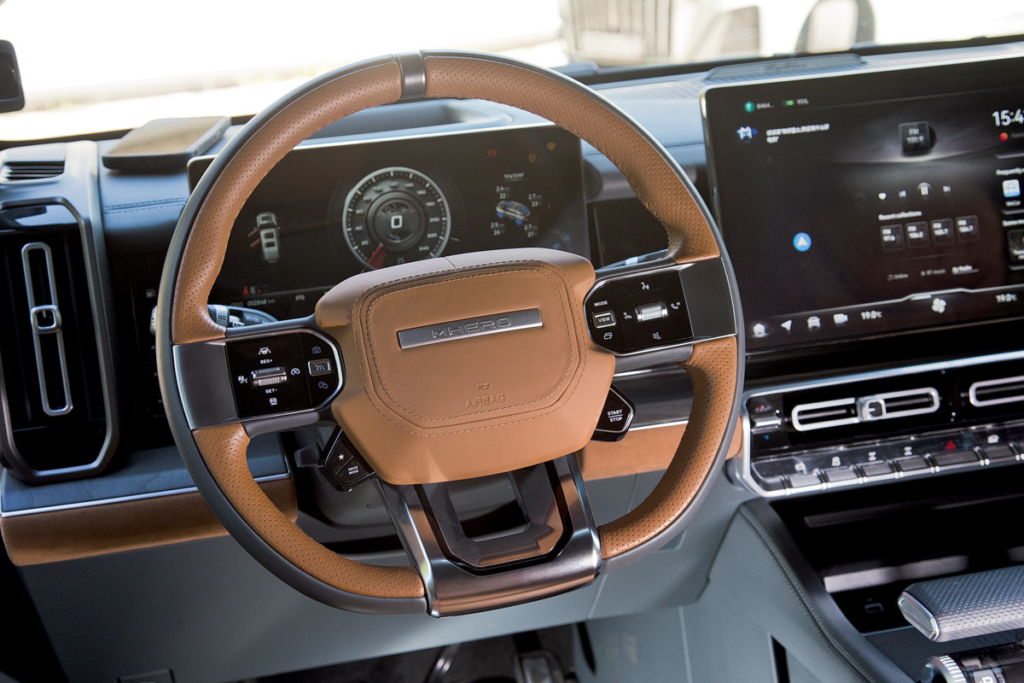
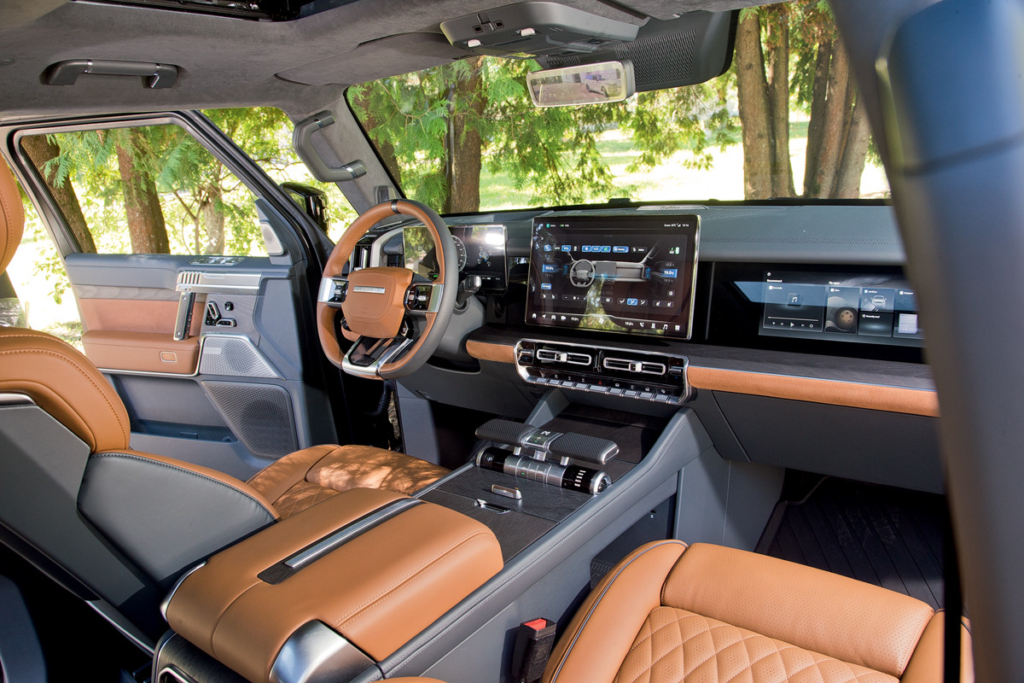
A steering wheel sawn off from below with a rally zero mark – how do you like that in a three-ton all-terrain vehicle?
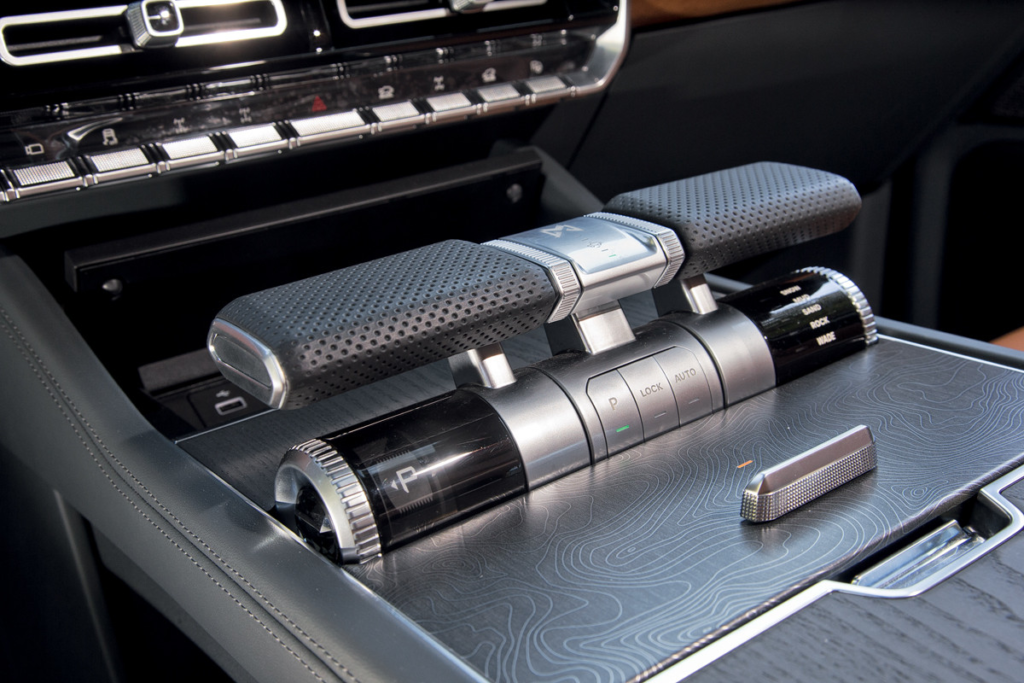
The highlight of the interior is the selector indicators in the form of flip calendars. You push the left lever towards you – and again it’s September 3rd, that is, D
Most likely the M-Hero really has nothing in common with the military “Hummers” Dongfeng EQ2050, their civilian M50 version, or the new CSK-131/141/181 transports. It is a separate project. Was it a successful one?
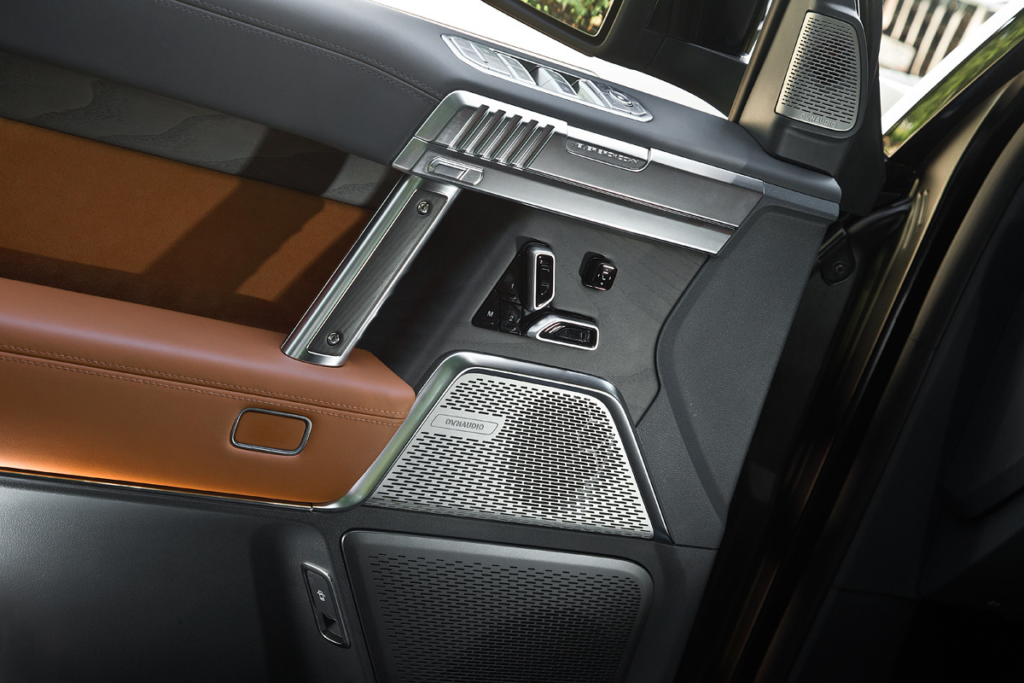
There are no closers, you have to slam the doors with all your might, and the speakers play the sound of a bolt being pulled. And pistols on the door cards. Kindergarten with a drum, by God
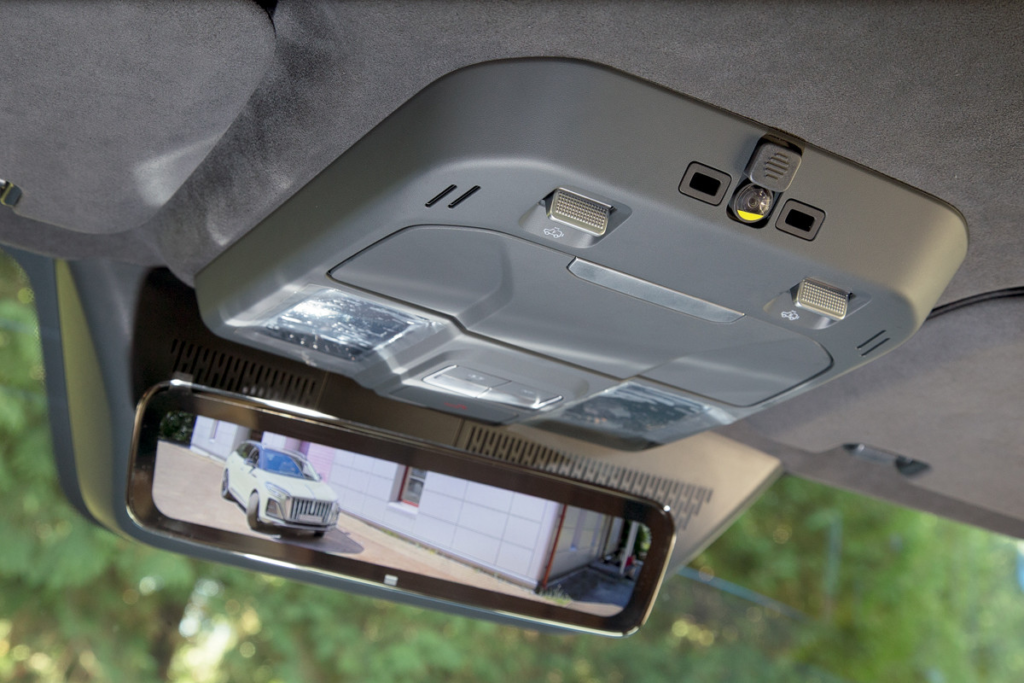
The video mirror has five viewing modes, both hatches can be opened with keys on the ceiling
What It Is Like to Live With
On one hand, the 917 is a sufficiently fast and brutish hybrid that even a slight woman could drive. Yes, you have to climb up into it and the visibility is somewhat tank-like, but the driver’s seat is comfortable, the finish is decent, and there is a mass of service electronics including exotica such as night vision and echo-locators for measuring the depth of a ford. On the Chinese CLTC cycle the 65.8 kWh battery is good for 200 km, though in reality the electric range will be at least half that. Fill the 84-liter tank with AI-92 and drive as long as you like, though — the gasoline engine has no unpleasant vibrations, and the M-Hero is commendably quiet even on off-road tires.
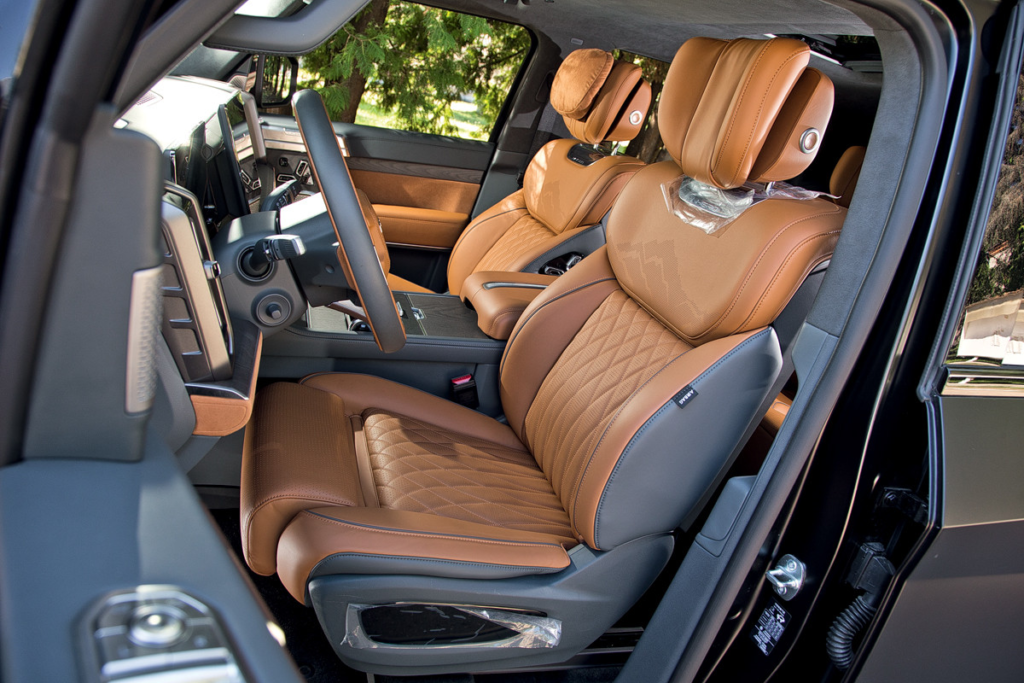
The seats are wide and comfortable (note the “ears” of the headrests)
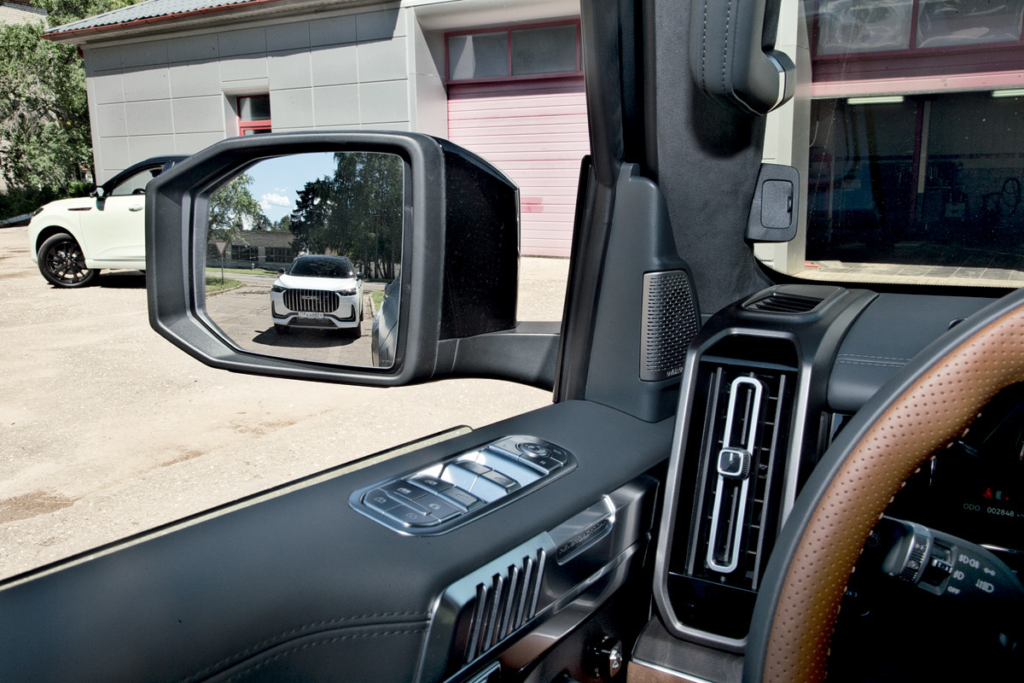
The exterior mirrors are large, and the capabilities of the cameras and generated “pictures from the outside” are more than sufficient
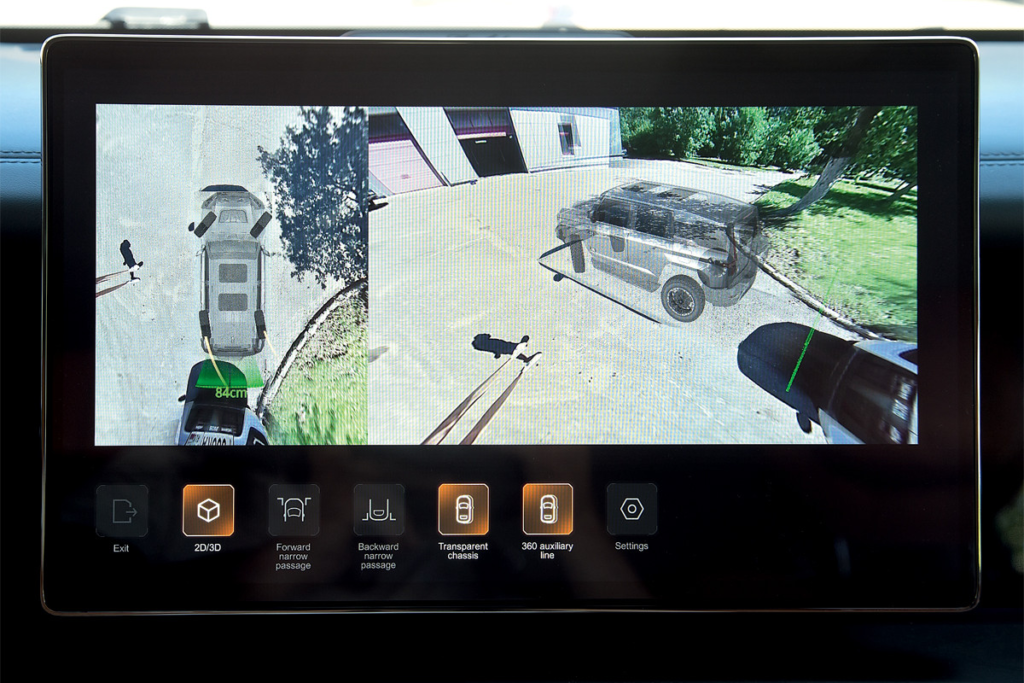
I was not able to test the adaptive cruise control in action, nor to try the night vision or the echo-locators. The massage is unremarkable and the Dynaudio-branded audio system is average. Claims to premium status? Valid, but not fully supported.
Ten Million Rubles, and a Truck Licence
Which raises the question: why would anyone buy the expensive M-Hero 917? E.N.Cars are ready to sell one for 10 million rubles, but with no warranty and with the requirement to hold a category C truck licence. Official dealers raise the price by 4 to 6 million rubles — unless you take a loan, or trade in your loathed G-Wagen for an M-Hero. In return you get a five-year warranty and a category B licence.
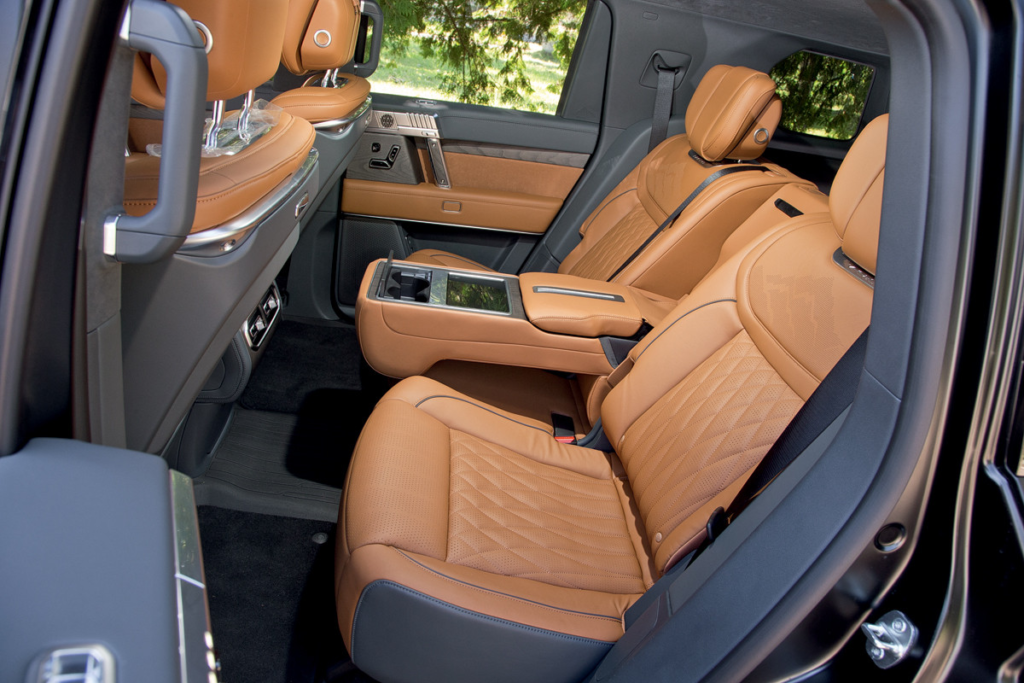
It is spacious in the back, except that the ceiling is a bit low, as is often the case in frame cars.
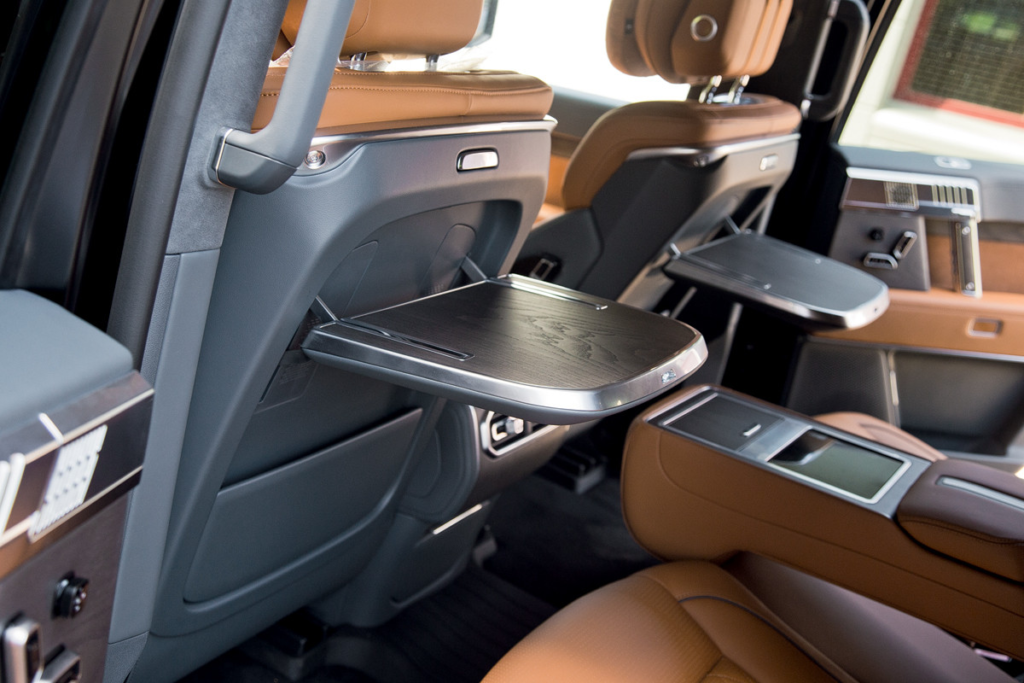
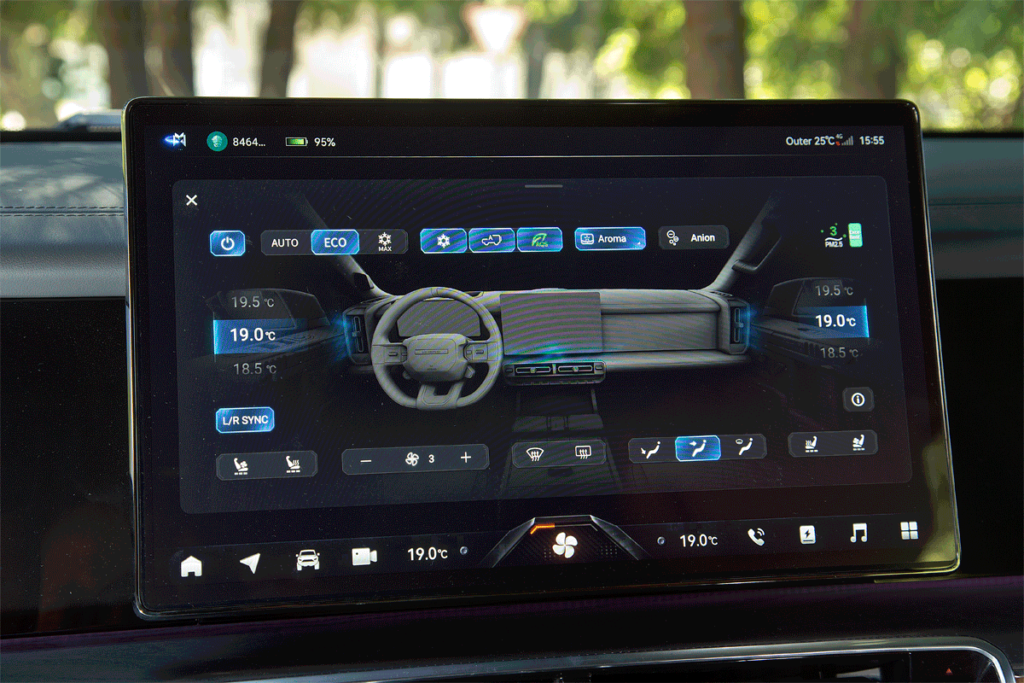
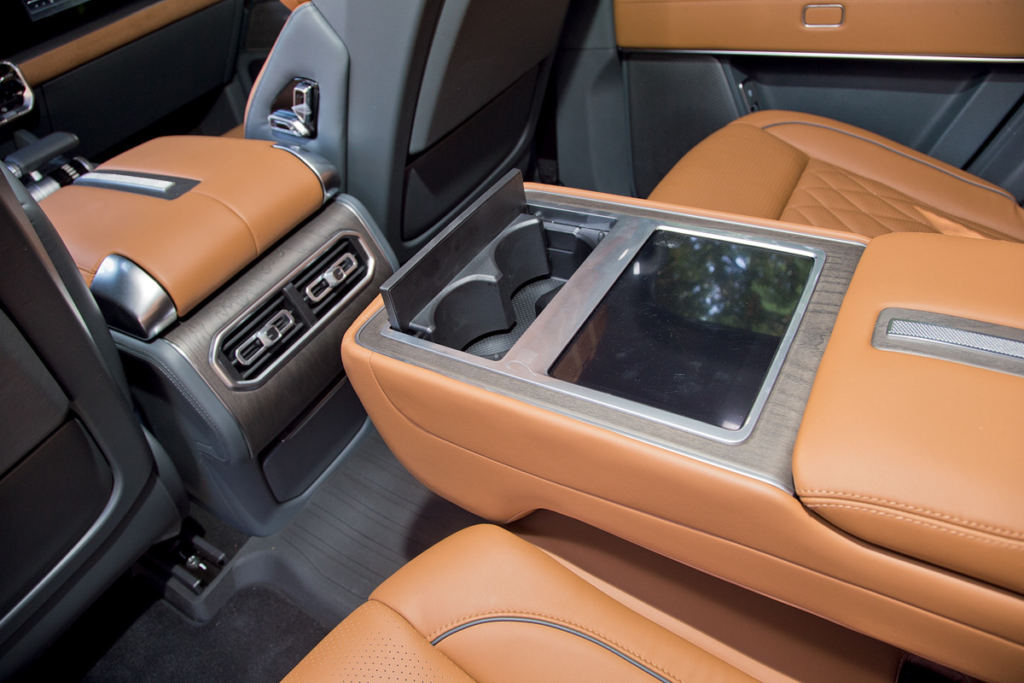
There are folding tables and a tablet in the armrest – it contains full control of heating-massage-ventilation
It is interesting how Motorinvest managed to classify the M-Hero, with its 240 kg of excess weight, in the passenger category with its 3.5-tonne limit. I remember that twenty years ago Avtotor solved the same problem on the official Hummer H2 by removing the third row of seats, the tubular side-step protection, a tire compressor, a second battery and other non-essential equipment.
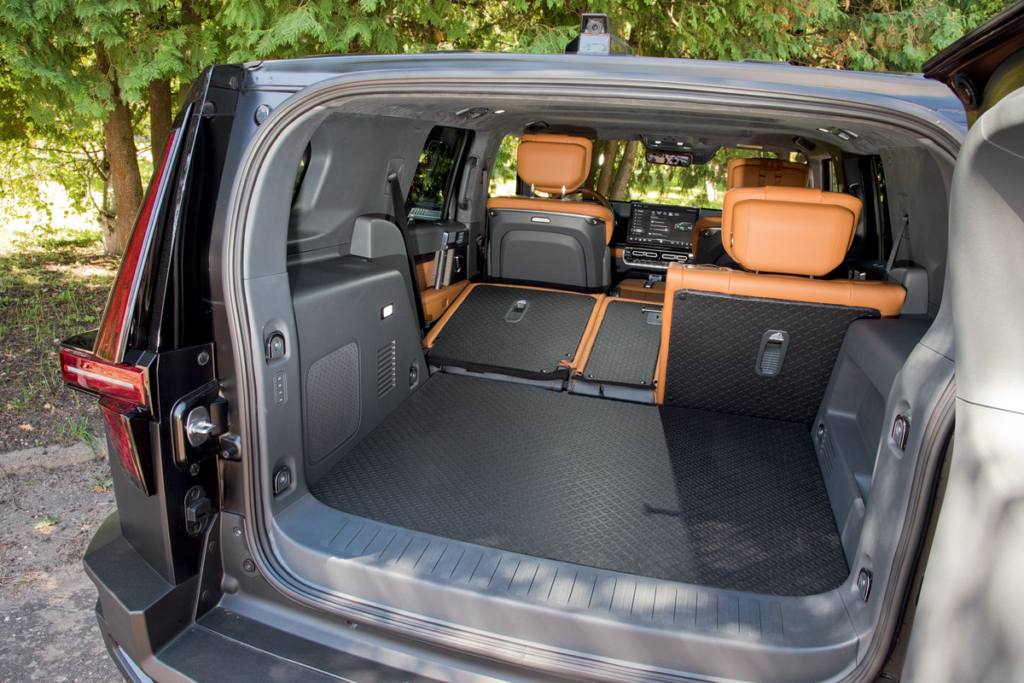
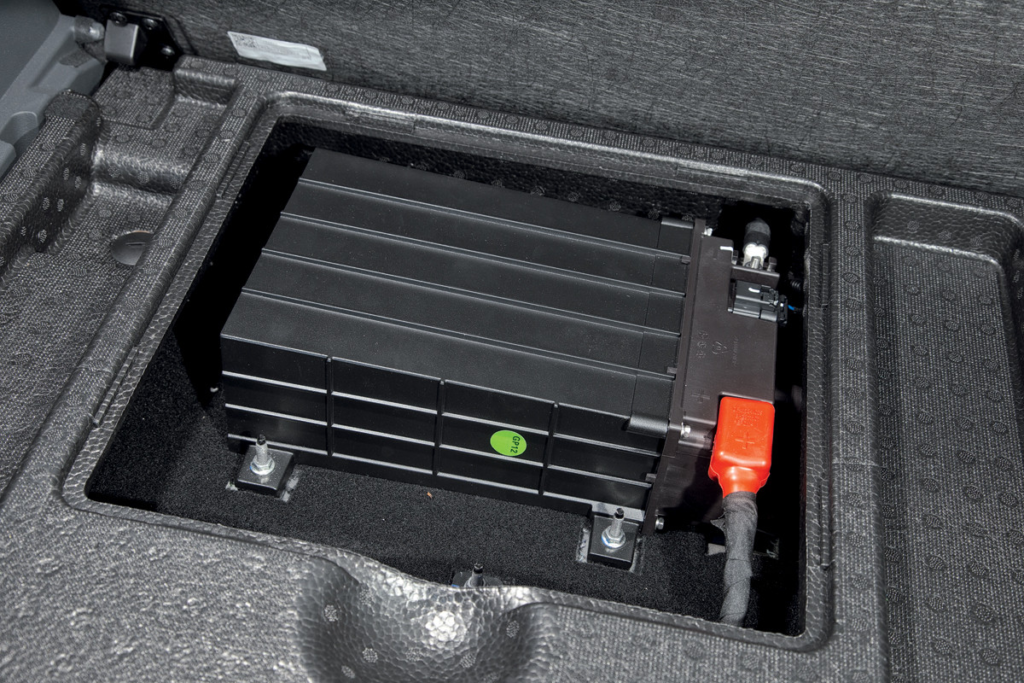
The fifth door is equipped with a closer, the compartment is large and easily transformable (alas, the backrests do not fall horizontally), under the floor there is a 12-volt lithium-ion battery with a capacity of 40 Ah
So Why Does the M-Hero Exist?
So why does the M-Hero exist? An expensive attention-grabbing toy? But the Dongfeng Mengshi does not really trade in emotion — it is fairly ordinary to drive. Nor would you especially want to take it into the mud. And the brand has no equity at all for now: only the Chinese can connect Mengshi with the military vehicles from the action films, thanks to the stylised M on the badge.
Does this not smell like another false start for a sub-brand, in the style of “produce ten thousand cars at a loss and then shut down the operation”?
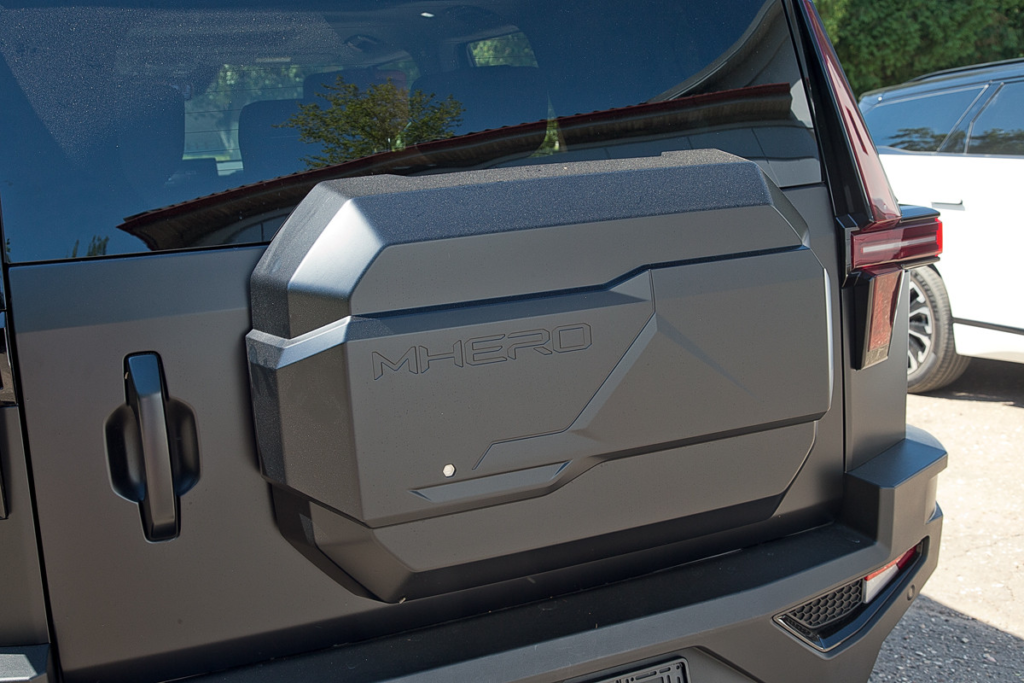
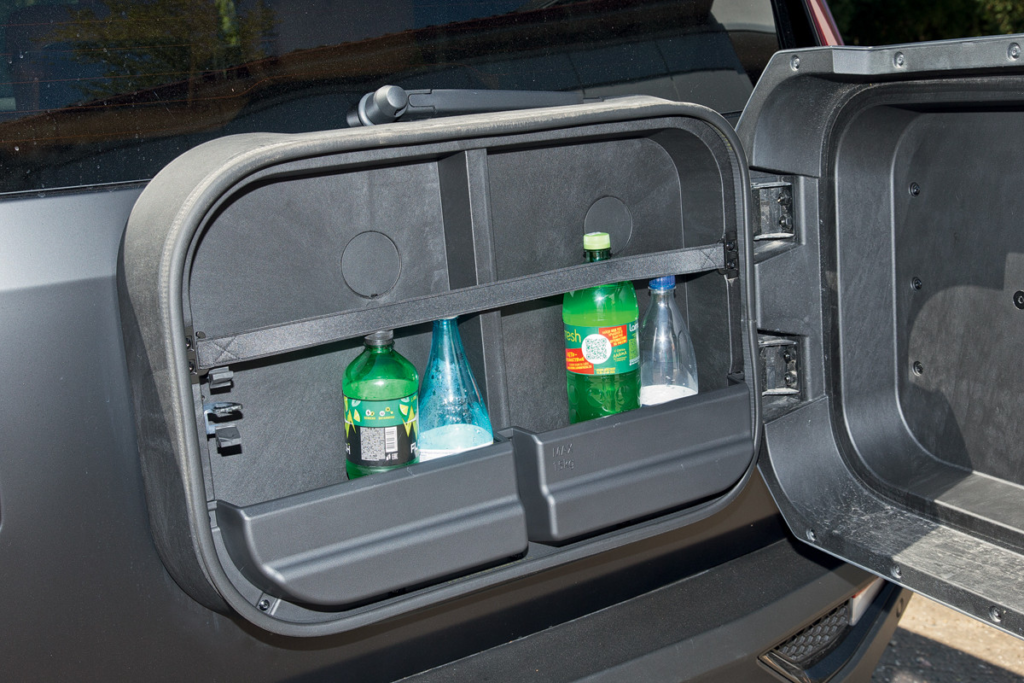
The outer plastic case serves a decorative function, but can hold six bottles. But there is no spare tire.
The East Wind Is Blowing
Look at the M-Hero as an indicator of progress in Chinese car manufacturing, though, and it is clear that the latest battle for respect has been won. Creating a high-tech off-roader from scratch, with a mass of luxury options — done. Especially when you remember where the Second Automobile Works started, and when. You can definitely feel the Eastern wind blowing.
But still — why 917? If anyone knows, please tell me.
Full Specifications
| Parameter | M-Hero 917 (Mengshi 917) |
|---|---|
| Body type | Five-door station wagon |
| Seating capacity | 5 |
| Luggage capacity, L | 452–1137* |
| Curb weight, kg | 3130 |
| Gross weight, kg | 3740 |
| Internal combustion engine | Gasoline, direct injection, turbocharged |
| Engine location | Front, transverse |
| Number and arrangement of cylinders | 4, inline |
| Displacement, cm³ | 1476 |
| Number of valves | 16 |
| Max. power, hp/kW | 197/145 |
| Max. torque, Nm | 300 |
| Max. generator power, hp/kW | 136/100 |
| Traction electric motors | Synchronous, permanent magnets |
| Number and location of motors | 3, one transverse at front axle, two transverse at rear axle |
| Max. power (electric motor), hp/kW | 272/200 |
| Max. torque (electric motor), Nm | 300 |
| Max. rotational speed, rpm | 13,000 |
| Transmission | Two-speed reducer at rear axle |
| Total power of electric motors, hp/kW | 816/600 |
| Total torque, Nm | 1050 |
| Drive type | All-wheel drive |
| Traction battery | Lithium-ion (NMC) |
| Battery capacity, kWh | 65.8 |
| Front suspension | Independent, pneumatic, double wishbones |
| Rear suspension | Independent, pneumatic, double wishbones |
| Tire size | 295/60 R20 |
| Maximum speed, km/h | 191 |
| Acceleration 0–100 km/h, s | 6.0 |
| Max. wading depth, mm | 900 |
| Range on battery charge (CLTC cycle), km | 200 |
| Max. total range (CLTC/WLTP cycle), km | 1026/750 |
| Fuel tank capacity, L | 84 |
| Fuel type | AI-92 gasoline |
*With rear seats folded
Photo: Dmitry Piterskiy | Dongfeng company
Expert group: Andrey Mokhov | Yaroslav Tsyplenkov
This is a translation. You can read the original article here: Тяжелый металл: внедорожник M-Hero 917 на полигоне

Published April 03, 2025 • 13m to read