
The Ford Fairlane 500 Skyliner holds a unique place in automotive history as the world’s first mass-produced coupe-convertible with a retractable hardtop. Built between 1957 and 1959, this ambitious Ford model combined the comfort of a hardtop with the open-air freedom of a convertible, decades before rivals like the Mercedes SLK popularized the concept. Here’s the story behind its invention, engineering, and eventual decline.
The Origins of the Retractable Hardtop Concept
The idea of a car with a retractable hardtop belongs to American inventor Ben Ellerbeck from Salt Lake City. Back in 1922, he built the world’s first “transformer” car with a removable hardtop, based on a two-door Hudson Super Six. The roof was a single unit with the rear window and moved backward through a lever mechanism, activated by a rotating handle on the right side of the car, “covering” the rear part of the body. Ellerbeck offered his invention to Ford and Packard, but neither company showed interest at the time.
Georges Paulin and the European Coupe-Convertible
The concept resurfaced almost a decade later, in 1931, thanks to Frenchman Georges Paulin – a dentist by profession, but a designer and engineer by vocation. His construction, named Eclipse, used a bulky electric drive, with the roof folding into the trunk. Paulin initially tried, unsuccessfully, to interest André Citroën in his invention. He later partnered with the Pourtout body shop, and in 1933 the first car built with Paulin’s folding roof design was the four-door Hotchkiss.
The design was later used on the Lancia Belna, produced in France, and by 1934 it had reached Peugeot. Early coupe-convertibles were built to individual order, but the first relatively mass-produced “transformer” was the Peugeot 402 Eclipse, with 580 units produced between 1935 and 1939. Buyers could choose an expensive electric roof drive as an option, while the base model used a hand crank similar to Ellerbeck’s original design.
In 1940, the retractable hardtop idea returned to America with one of the world’s first concept cars, the Chrysler Thunderbolt. It featured an aluminum body whose roof “flipped” into a separate compartment, rotating around an axis behind the seats.
How Ford Brought the Retractable Hardtop to the Masses
After World War II, Americans were the first to revisit the coupe-convertible concept – fittingly, through the Ford Motor Company, whose managers had turned down Ellerbeck’s original idea thirty years earlier. The retracting hardtop mechanism was initially designed by engineer Gil Spear’s team for the 1955 Continental Mark II, the most expensive model in Ford’s lineup, marketed separately from the Lincoln brand.
However, demand for the base coupe was so low that Ford lost a thousand dollars on every unit sold, despite its $10,000 price tag. The model was discontinued in 1957. By then, Ford had already spent more than two million dollars developing the retractable hardtop and needed to recoup that investment by fitting the mechanism to another model. Unfortunately:
- The early-1950s Lincoln body didn’t have enough trunk space for the mechanism, and the redesigned model wasn’t ready until 1958.
- The new Mercury lineup was also delayed.
- The Ford passenger cars were the closest to production readiness.
As a result, this premium-segment technology – in today’s marketing terms – landed on a “people’s car”: the 1957 Ford Fairlane 500.
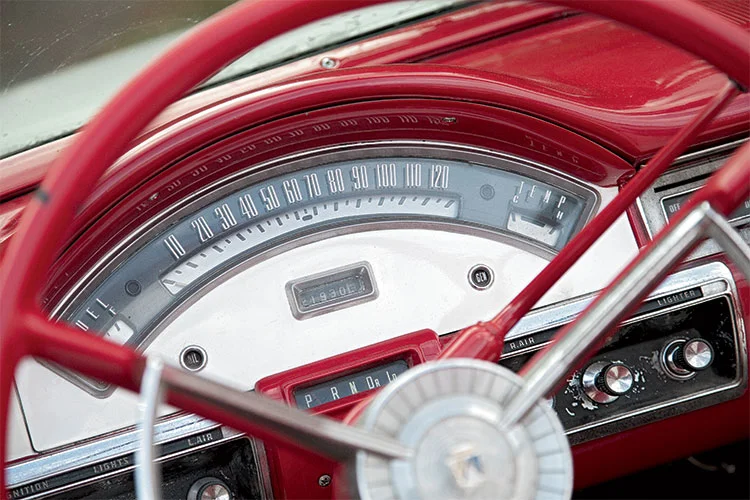
Meet the Skyliner: Size and Design
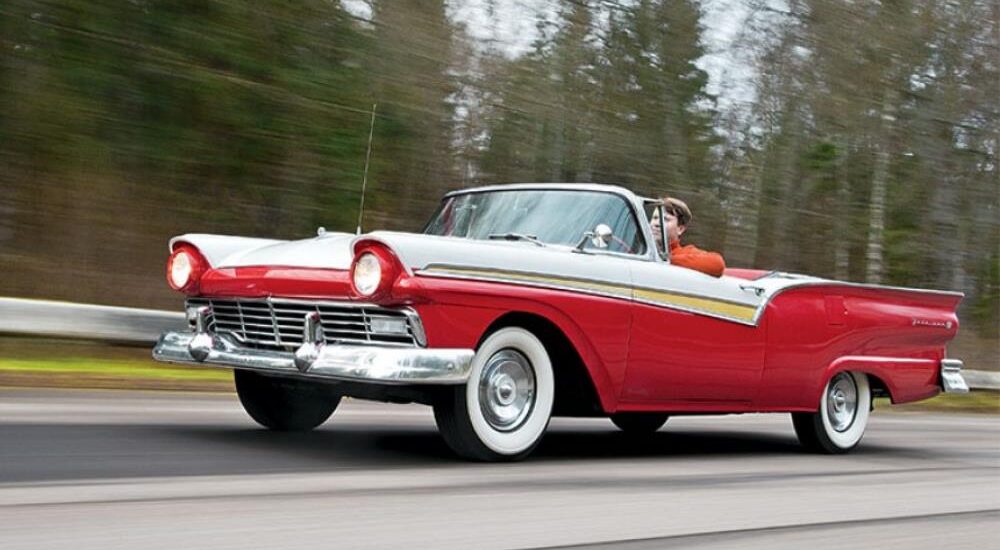
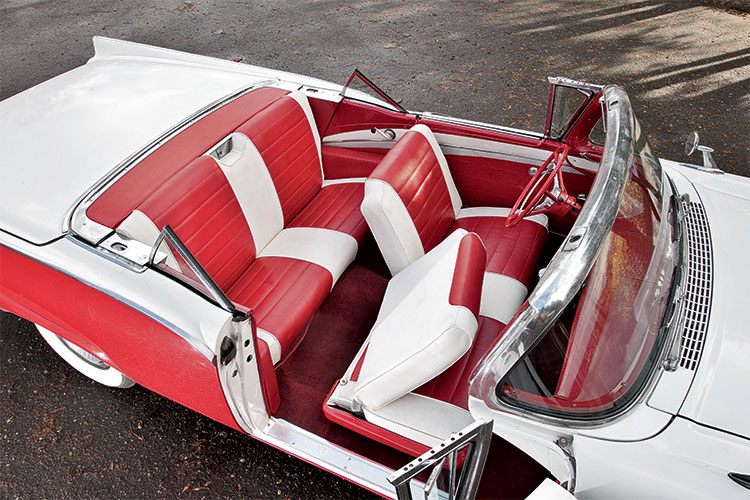
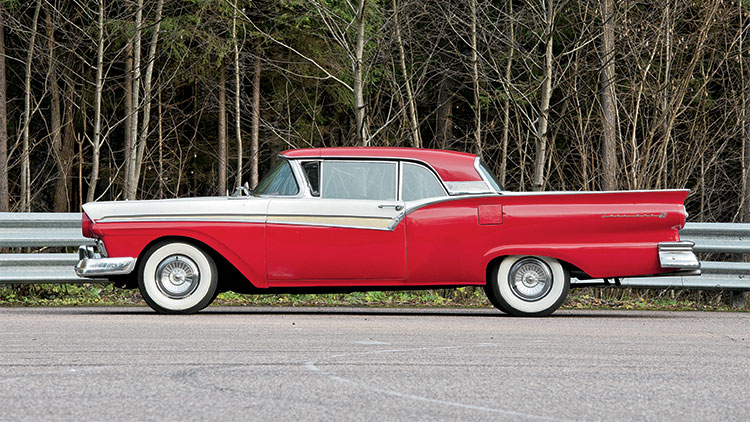
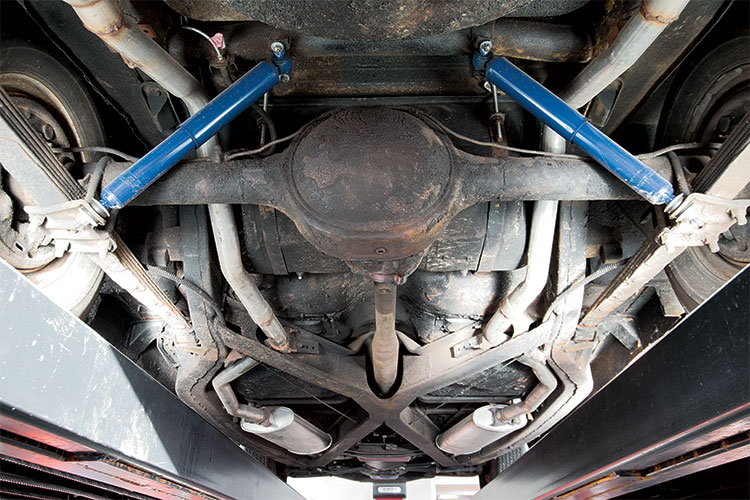
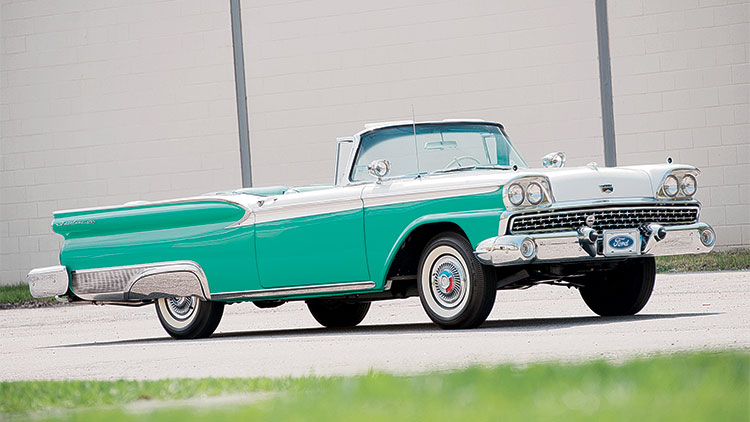
Named Skyliner, this coupe-convertible was the longest model in Ford’s lineup – nearly 5.4 meters from bumper to bumper and almost two meters wide. Everything about it feels oversized: the differential housing resembles a truck’s, and the rear suspension uses six-leaf springs.
How the Retractable Hardtop Mechanism Worked
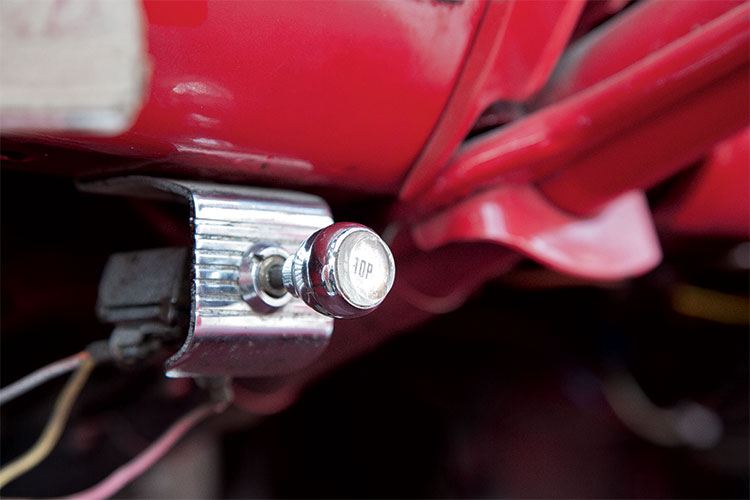
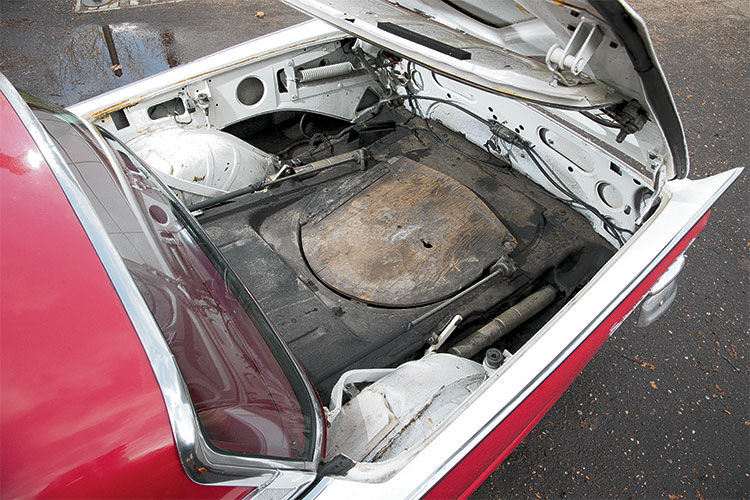
The folding roof is operated by a lever mounted to the left of the steering column. A relay unit in the trunk controls the process, connected to electric motors and limit switches placed along the roof’s path and its supporting mechanisms. There’s a noticeable two- to three-second pause between phases. Without any electronics involved, this mechanical sequencing prevents conflicts between different parts of the system – for example, the roof cannot begin folding while the trunk lid is closed. The full transformation takes almost a minute.
Seven electric motors are involved in the transformation process:
- Unlocks the two screw locks of the trunk lid
- Lifts the trunk lid itself
- Folds the lid’s front section (which turns into a shelf behind the rear seats)
- Unlocks the roof latches at the windshield frame
- Unlocks the roof latches at the rear of the body
- Retracts the roof into the trunk (the most powerful motor)
- Rotates the roof’s “visor” section simultaneously with retraction
After that, the trunk lid returns to its original position. The entire process lasts 58 seconds.
One quirk worth noting: it’s impossible to open the trunk manually. To load a bag, you have to use the same lever to start the transformation process and interrupt it after the trunk lid lifts – provided the roof is already raised – then lower it back the same way.
Engine and Performance Specs
The 1957 Skyliner was offered with a choice of four V8 engines ranging from 4.5 to 5.1 liters:
- Base version: 190 hp
- Most powerful supercharged version: 300 hp
- Our test car: naturally aspirated 5.1-liter engine, 245 hp, paired with a three-speed Ford-O-Matic automatic transmission built by Borg Warner
Let’s go!
What It’s Like to Drive the Skyliner
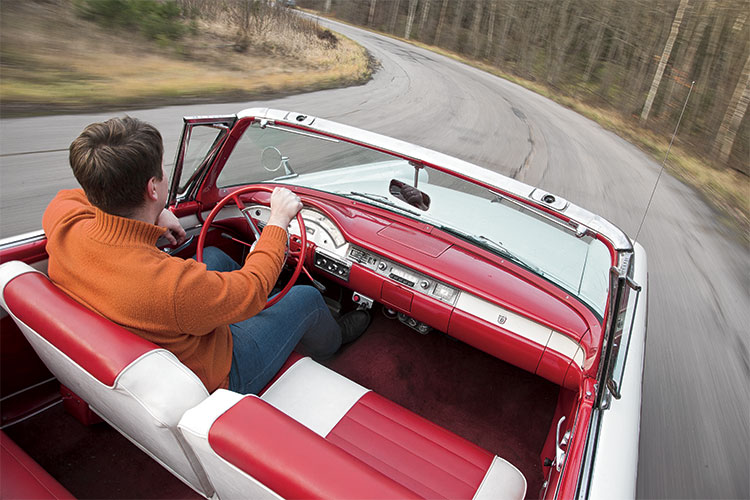
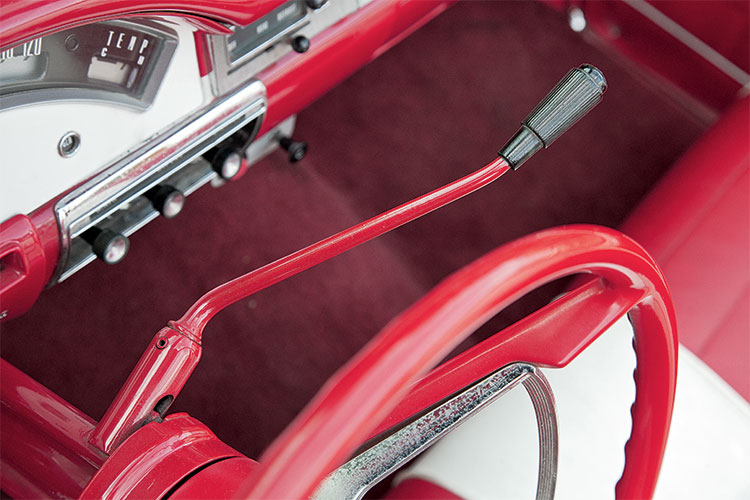
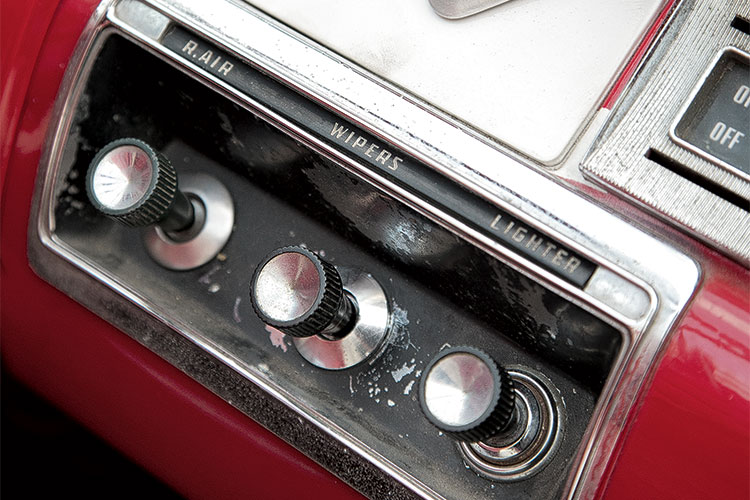
Using a small key, similar to a mailbox key, I start the engine, pull the steering column lever toward me and down, and with a noticeable jerk it engages – not first, but second gear. In Drive mode, the transmission only uses second and third gears, which is why Ford’s automatic is often mistakenly considered a two-speed unit.
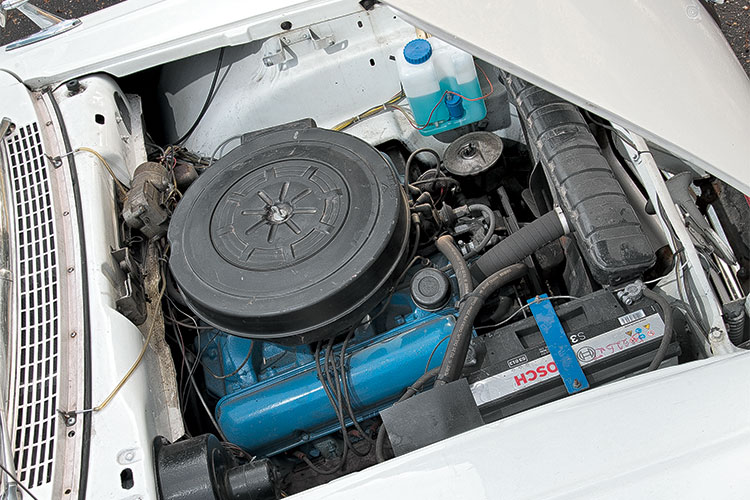
The two-ton Skyliner pulls away smoothly and shifts imperceptibly into third gear around 40 km/h. The V8 rumbles contentedly under the hood and forgives almost any mistreatment – even accelerating from idle in third gear. As Americans like to say: there is no replacement for displacement.
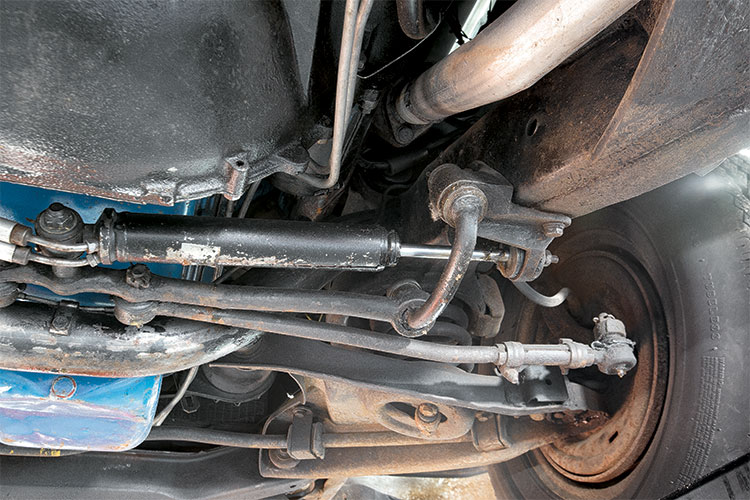
The suspension is very soft – on large bumps the body noticeably shakes, and on waves there’s a swaying motion. Still, the Skyliner isn’t sloppy: it holds its line decently, and body roll in turns isn’t excessive. The steering feels absolutely “dead” near center, but unexpectedly fills with reactive force through turns – the result of relatively weak power steering assistance. Later, in the sixties, American manufacturers made power steering much stronger and effectively killed off any steering feel. On the Skyliner, it’s just barely enough. When the car is stationary, the power steering often “bites,” so old-school habit dictates turning the wheel only after starting the engine.
Interestingly, the car’s handling character barely changes with the roof position: raising it shifts weight distribution only slightly, reducing the rear axle load by just 2.4%.
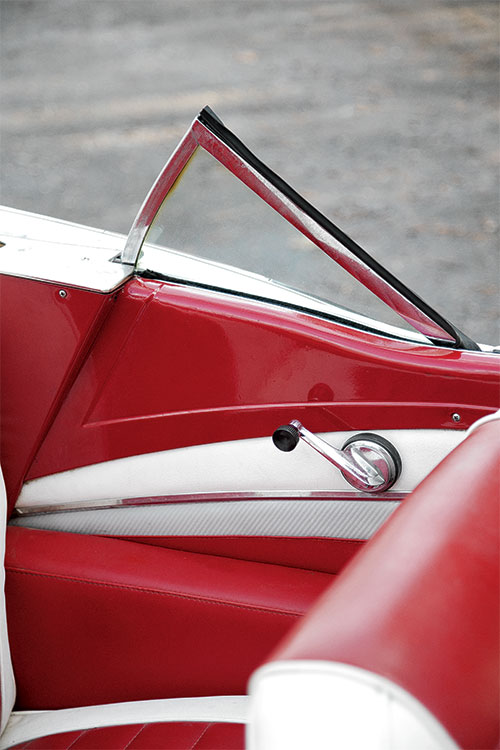
Aerodynamics are surprisingly decent – with the top down at 80 km/h (about 50 mph), even with the side windows lowered, the wind only ruffles the hair on top of your head, though rear passengers already find it uncomfortable.
Pricing and Market Position
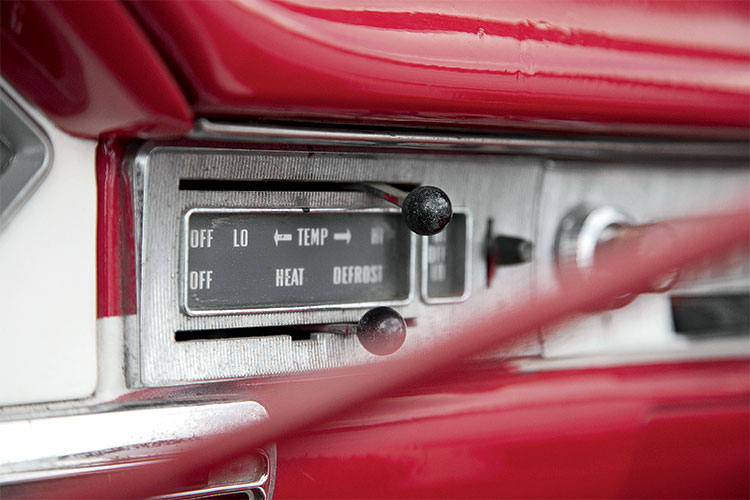
The coupe-convertible wasn’t especially expensive, starting at $2,942 for the base version – only about 1.5 times the price of the most affordable Ford Custom sedan. Our test car, equipped with the five-liter engine, automatic transmission, radio, heater, power steering, and power brakes, was priced at $3,464. For comparison:
- Ford Thunderbird (sporty two-seater): from $3,408
- Base Lincoln: from $4,649
Sales Figures and the Skyliner’s Decline
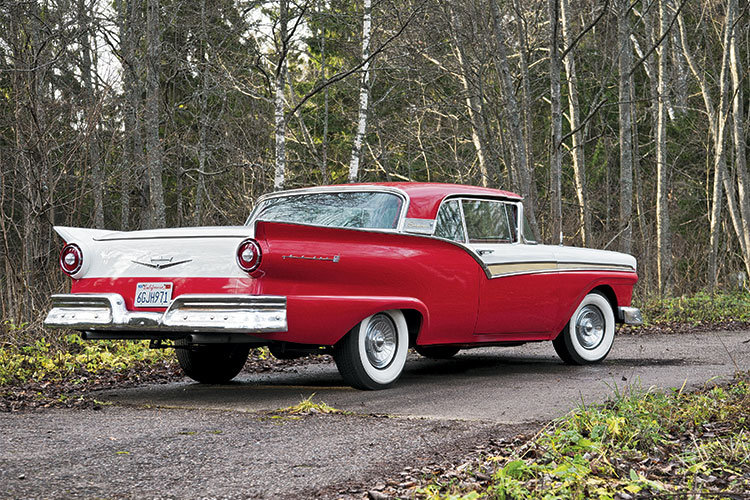
Despite a shortened six-month sales run due to a late launch, the 1957 model year sold 20,766 units and drove significant showroom traffic. But interest in the complex, temperamental design cooled quickly:
- 1957: 20,766 units sold
- 1958: 14,713 units sold
- 1959: 12,915 units sold, after which the coupe-convertible was discontinued
The Skyliner’s Legacy
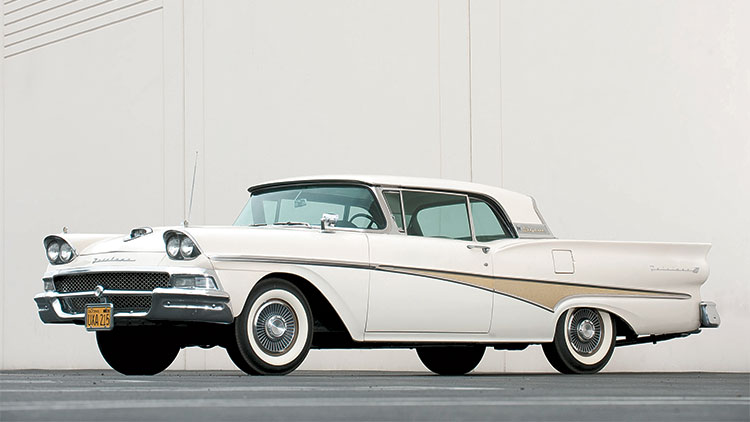
The Ford Fairlane 500 Skyliner was ahead of its time. No manufacturer ever again produced a full-size, four-seat convertible with a hard folding roof after Ford discontinued the model. The next mass-produced coupe-convertible of the “new wave,” the Mercedes SLK, wouldn’t appear until 1996 – nearly forty years later.
Ford Fairlane 500 Skyliner: Full Specifications
- Car: Ford Fairlane 500 Skyliner
- Body type: Two-door coupe-convertible
- Seating capacity: 6
- Curb weight: 1,920 kg
- Engine: Gasoline, carburetor
- Placement: Front, longitudinal
- Cylinders: 8, V-shaped
- Displacement: 5,115 cc
- Cylinder diameter / piston stroke: 96.5 / 87.4 mm
- Compression ratio: 9.7:1
- Number of valves: 16
- Max power: 245 hp / 180 kW at 4,600 rpm (SAE)
- Max torque: 437 Nm at 2,600 rpm
- Transmission: Automatic, 3-speed
- Gear I: 2.40
- Gear II: 1.47
- Gear III: 1.00
- Reverse: 2.00
- Final drive: 3.56
- Drive: Rear-wheel drive
- Front suspension: Independent, spring, with double wishbones
- Rear suspension: Dependent, leaf spring
- Brakes: Drum
- Tires: 8.00-14
- Fuel tank capacity: 66 liters
Photo by Stepan Schumacher
This is the translation. You can read the original article here: Игорь Владимирский протестировал первый в мире массовый купе-кабриолет Ford Fairlane 500 Skyliner

Published July 19, 2023 • 10m to read