
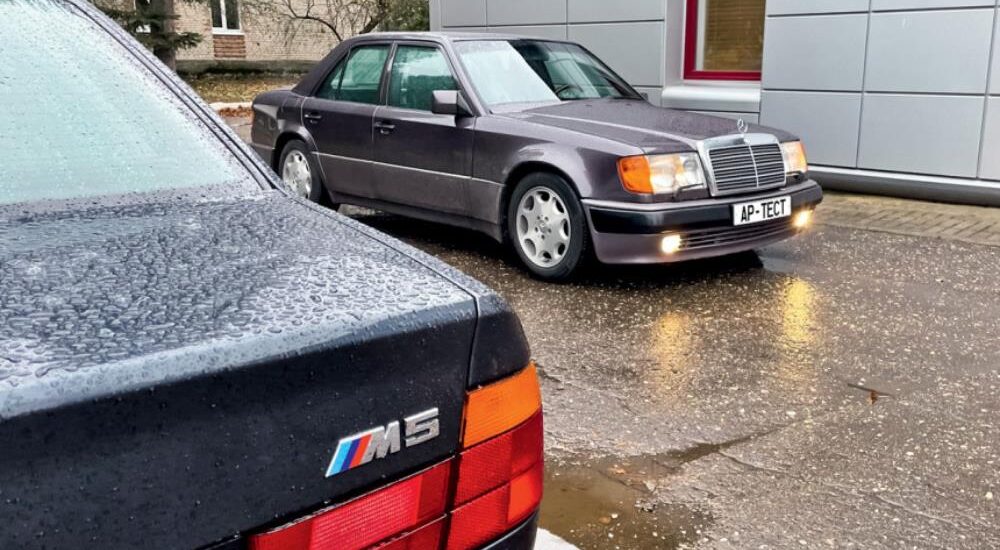

When Mercedes introduced the W124, BMW was quick to respond with the E34, heralding its own masterpiece, the M5. Stuttgart’s counter, the 500 E, marked the beginning of a fascinating rivalry between two distinctly different super sedans, both sharing a surprising origin: each model began its life on a truck chassis.
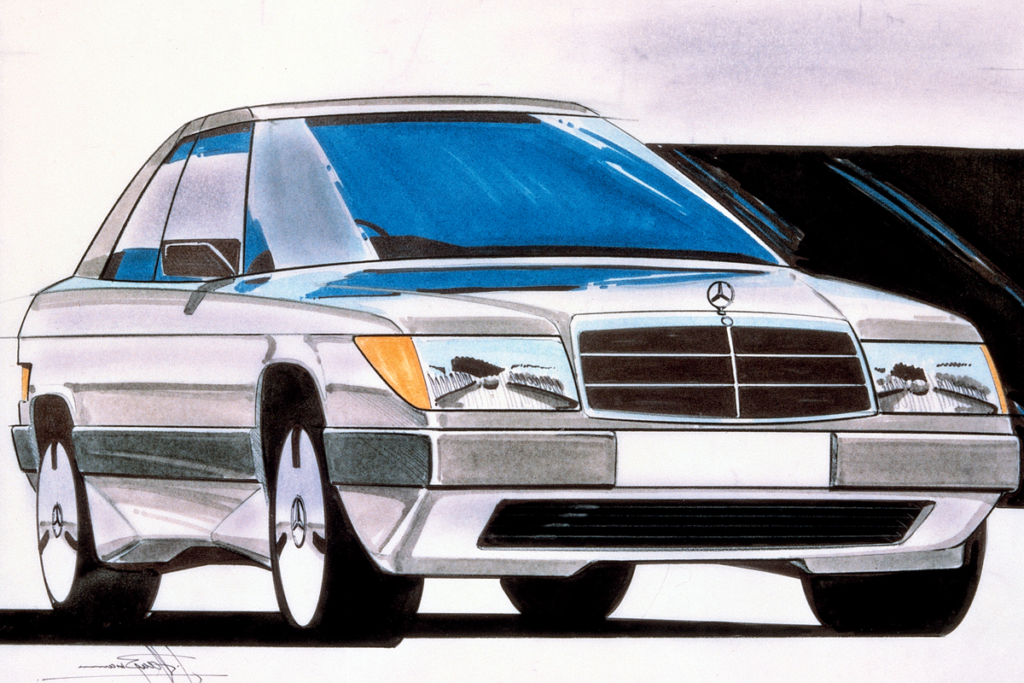
The W124 project began in 1977, with the initial design crafted by Peter Pfeiffer and Josef Gallitzendörfer, and was finalized by the head of the styling center, Bruno Sacco.
Munich Spends a Decade Chasing Stuttgart
The 1980s saw BMW fervently striving to surpass Mercedes. Stuttgart was formidable, forcing Munich to double its efforts just to keep pace. To get ahead, BMW needed something extraordinary — and delivered it in 1986 with the debut of the E32 “Seven”, then astonished the automotive world again a year later with the V12-powered BMW 750i. The challenge now was to repeat that success with the “Five”.
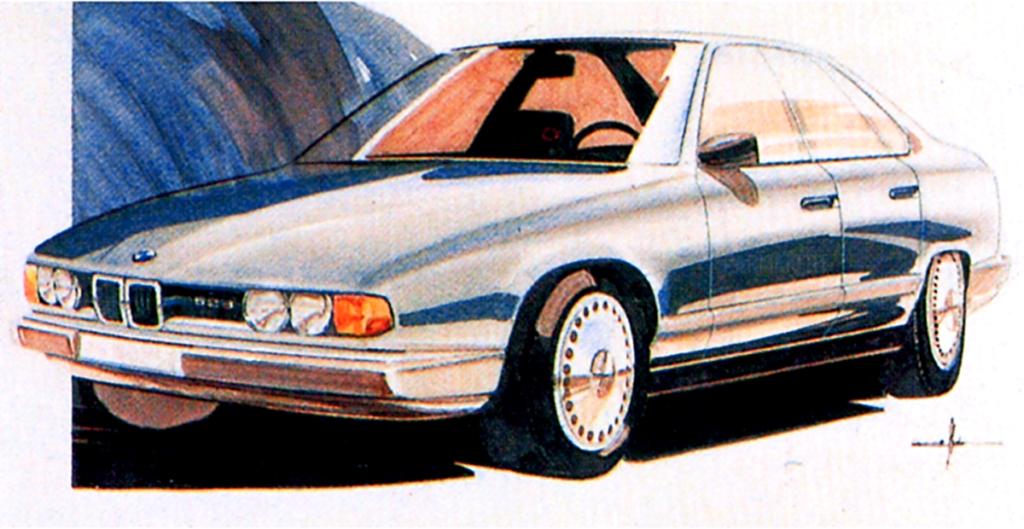
The Italian genes of the E34 were sketched in 1982 by Ercole Spada. The work on the “Five” was continued by Jay Mays, and completed under the guidance of Klaus Luthe.
The E34, Aimed at a Single Target
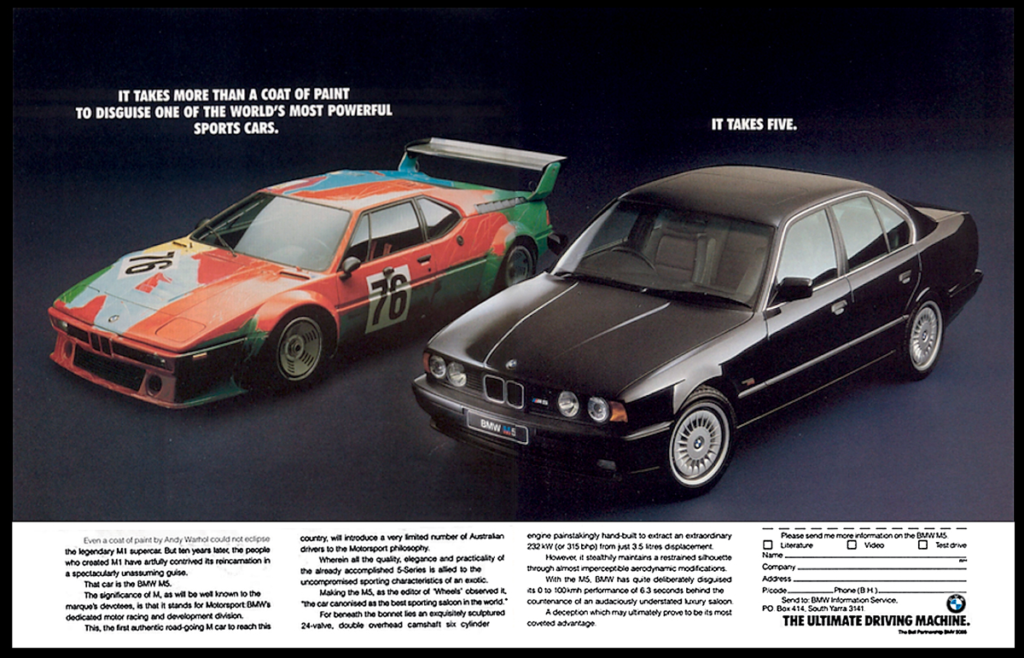
Launched in 1988, the E34 sedans were laser-focused on one target: the outstanding W124. Four years after its debut, the Mercedes still epitomised the zenith of automotive engineering.
240 Pages, and the W124 on Almost Every One
During our retrospective testing I spent several days with a unique dealer catalogue, the BMW Praxis, made to train sales staff on the new “Five”. This 240-page bible of the E34 covers every minute detail and design decision of the car. It is packed with insights found nowhere else, and it commands a price of 30,000 rubles — a testament to its value. The W124 is mentioned on very nearly every page, which tells you something about the scale of the obsession.
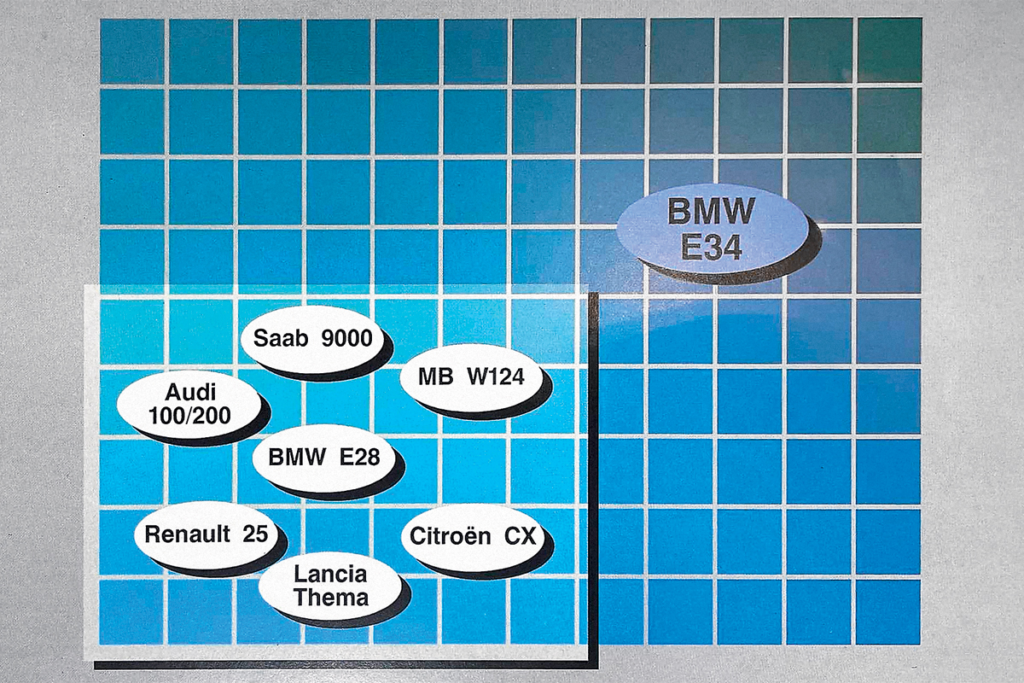
The balance between functionality (vertical axis) and aesthetics (horizontal axis) as perceived by BMW. It turns out that Lancia is the least practical, while Audi is deemed the least beautiful.
The Battle Began With Market Share
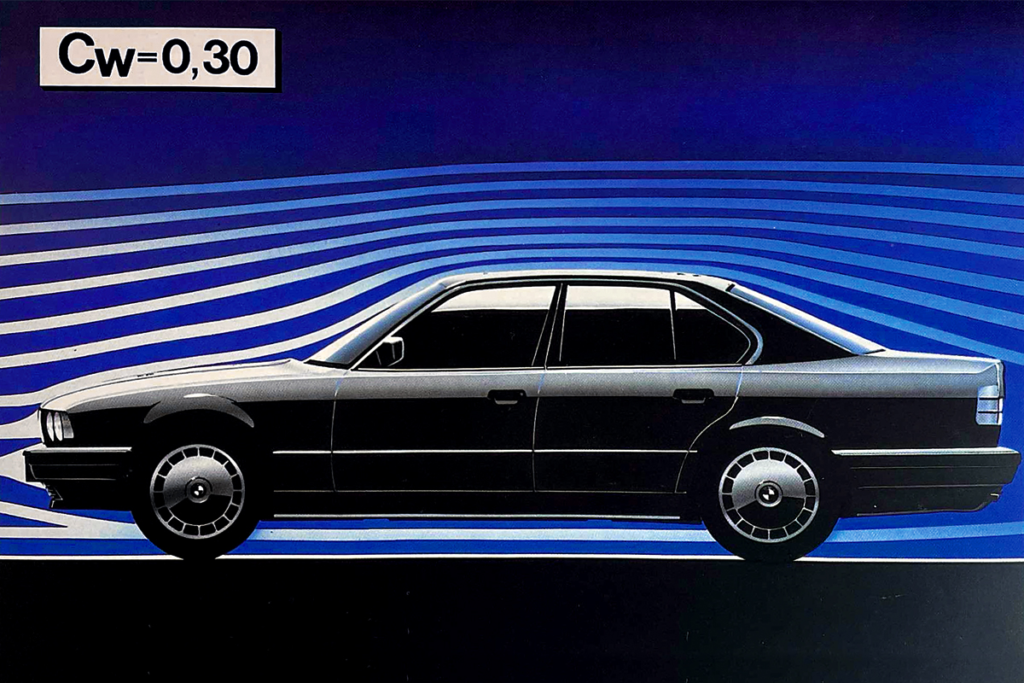
It started with marketing, and with BMW’s detailed comparisons of market share profession by profession. The “Propeller” resonated more with middle managers, the “Star” found favour among top executives and freelancers. BMW also boasted of its engineering, claiming a significant aerodynamic improvement over its predecessor and a drag coefficient of 0.30 while preserving the iconic negative slant of its nostrils. And it hinted, not very subtly, that the figures could have been better still — competitors like Mercedes, after all, reached their best numbers on narrower tires.
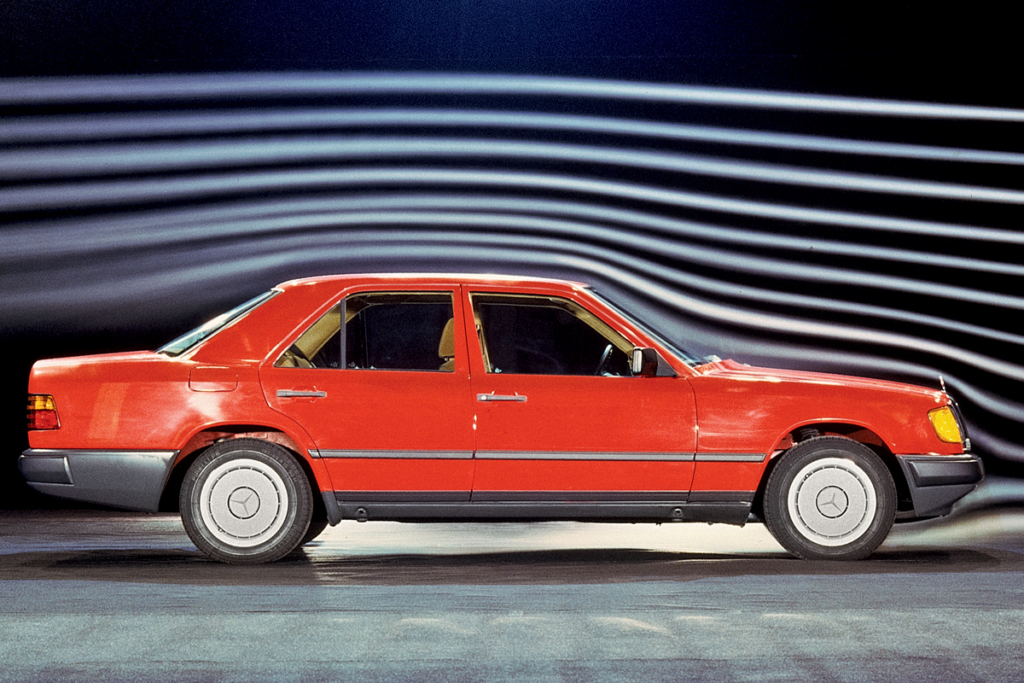
It’s evident how differently companies worked with the front end. For Mercedes, the headlights and grille act as an aerodynamic tool that helps reduce lift. For BMW, the headlights are primarily the face of the brand. Nevertheless, the BMW Praxis catalog provides intriguing figures: to overcome air resistance at a speed of 180 km/h, the E34 needs 64 hp, and at 200 km/h, it requires 87 hp. This is 20% less than its predecessor, the E28, with a similar shark nose.
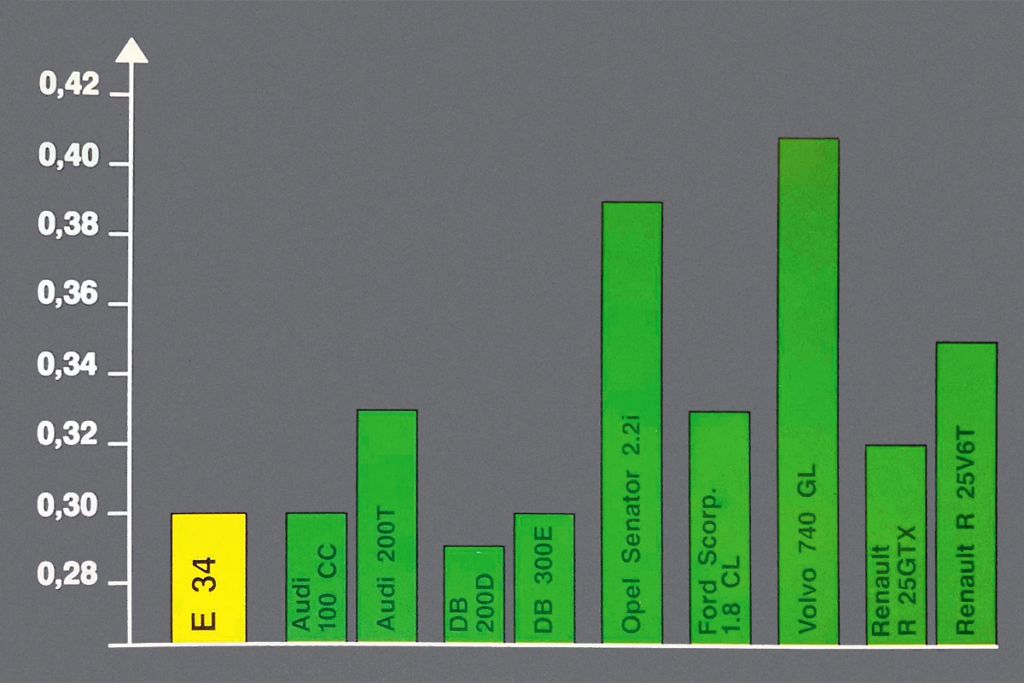
The aerodynamics of both classics and contemporaries. To catch up with Mercedes, BMW pulled employees from Audi.
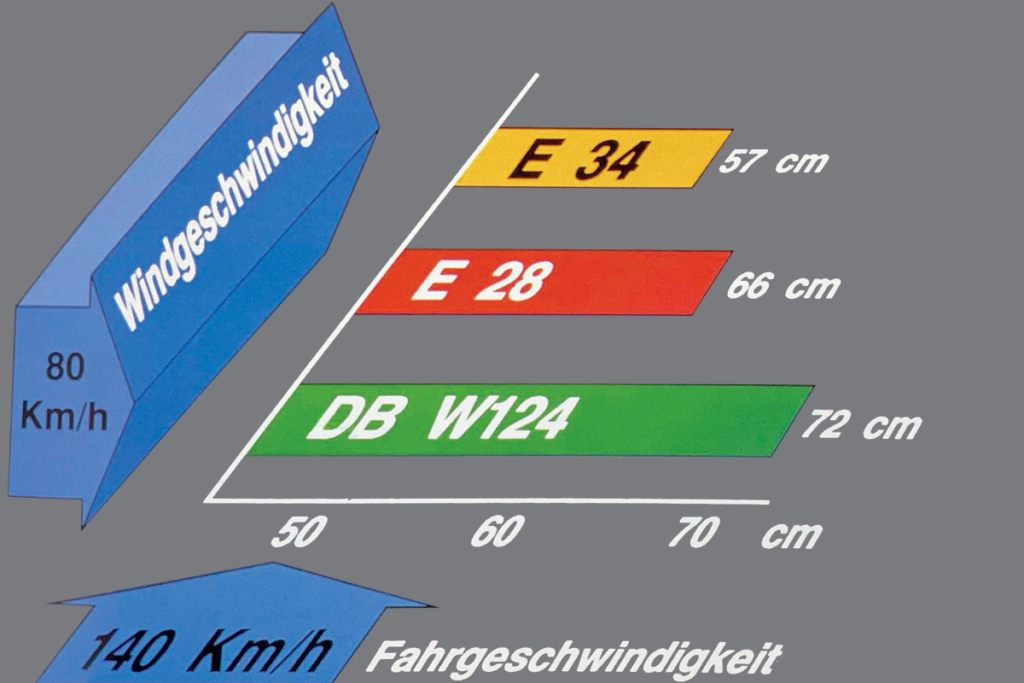
Another reason to highlight superiority over Mercedes: in side winds, the E34 drifts less than the W124.
Wipers, and a Heated Lock
BMW matched the innovative Mercedes wiper system, which cleaned 86% of the glass, by extending its own wipers’ reach and adding a mechanism at the base to improve how the blade sits at low speed. It also introduced a neat trick for cold climates: pull and hold the door handle, and a heater in the lock switches on.
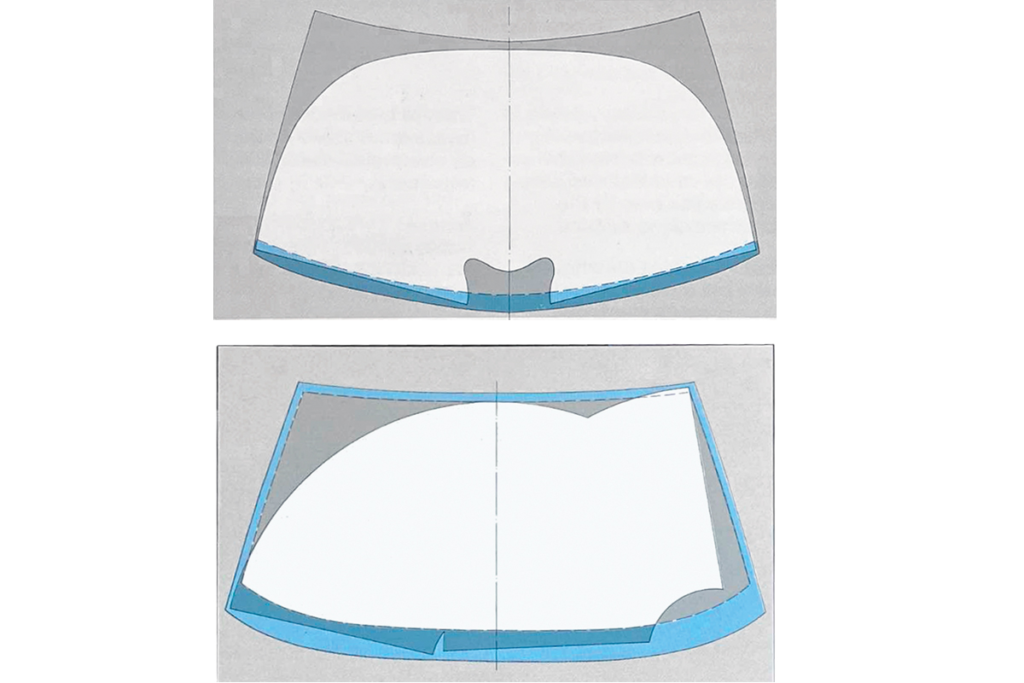
Mercedes’ wiper reaches the top corners and provides a record windshield cleaning area for the automotive industry. BMW insists that the upper left corner is more important for visibility at traffic lights.
Headrests, Traction Control, Suspension
From folding rear headrests worked by servos instead of springs, to a more sophisticated traction control system that handled both loss of grip and sudden deceleration, BMW seemed determined not merely to compete but to lead. Every new feature on one car was aimed at outdoing the other, and BMW kept refining its designs in answer to whatever came out of Stuttgart.
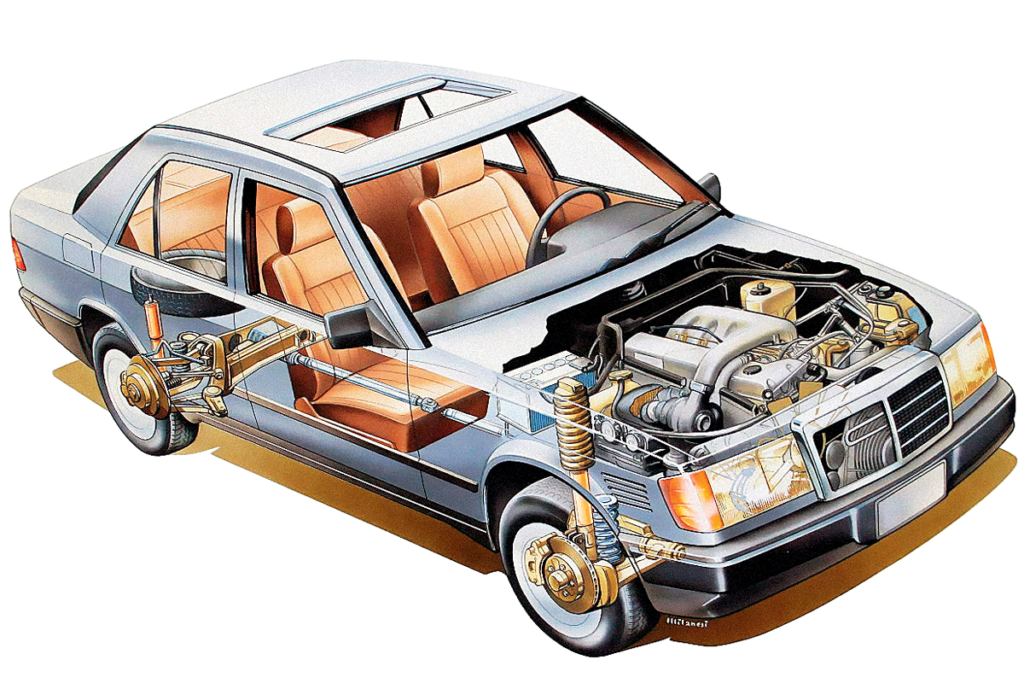
The main technical gem of the W124 chassis is the rear multi-link suspension, which appeared slightly earlier on the smaller sedans W201 and was subsequently installed on almost all Mercedes passenger cars. It has been copied by many other manufacturers. With modifications, this basic five-link scheme is still used today.
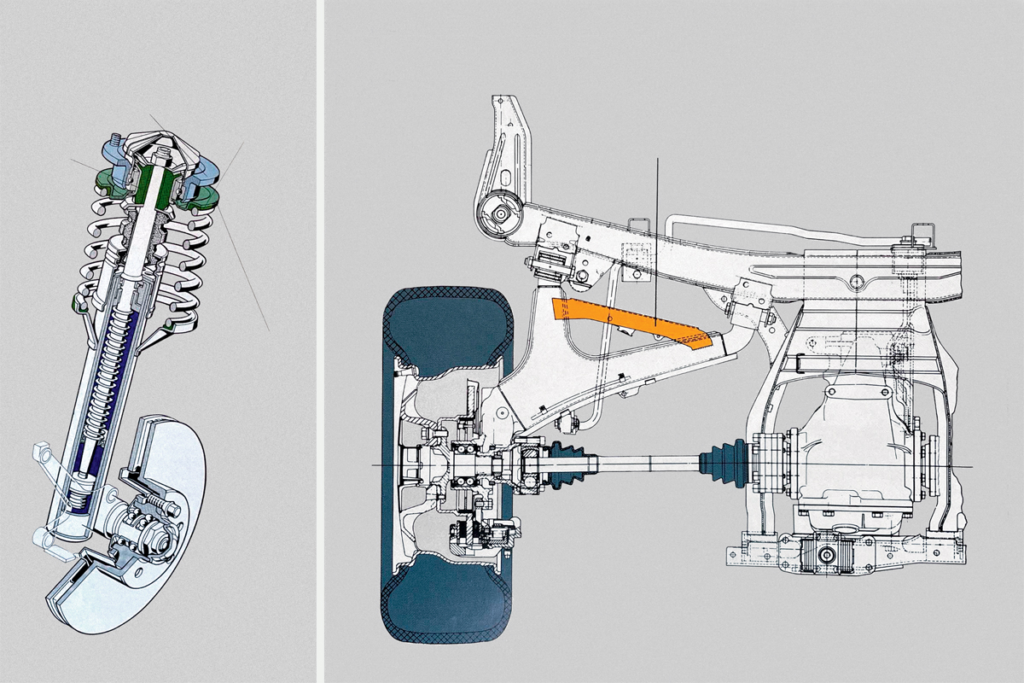
For all E34 versions above the BMW 525i and 524td, McPherson struts with separate spring and shock absorber mounts were provided. At the rear, oblique arms were reinforced with braces. This was the last “Five” with such an old-school rear axle. As an option, except for the M5, a stiffer Sport suspension was offered.
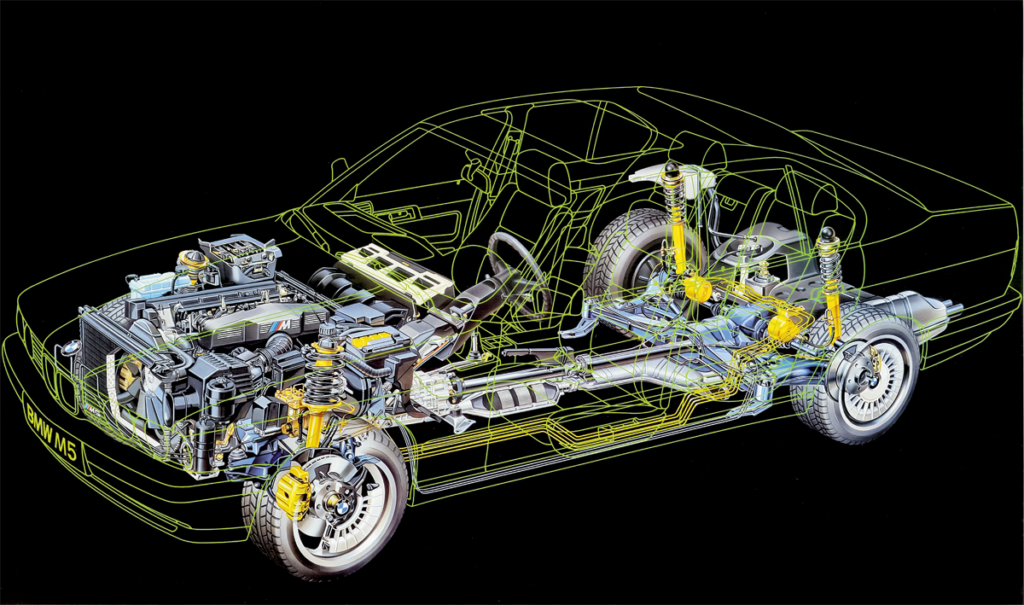
BMW’s comparable complex multi-link suspension only appeared in 1989 on the E31 coupe, and then on the “Seven” E38 and “Five” E39. But the M5 E34, even before the Mercedes 500 E was released, was standard equipped with rear shock absorbers featuring a hydraulic self-leveling mechanism to maintain constant wheel camber angles and clearance.
Why the M5 Was Tuned to Understeer
The catalogue even set out the reasoning behind the M5’s handling, describing a deliberate tuning towards neutral or slight understeer that would turn into oversteer under power — perhaps a nod to the drifty nature of the “124”.
The lineage of M5 engines is traditionally traced back to the “six” M88 of the BMW M1, although the true progenitor was the BMW 3.0 CSL. The M88/3 version without a dry sump was allotted to the E28 M5 in Europe, while the first engine labeled S38B35 was its “catalytic” version for America. The S38 engines on the E34 inherited an iron block and a 24-valve DOHC head.
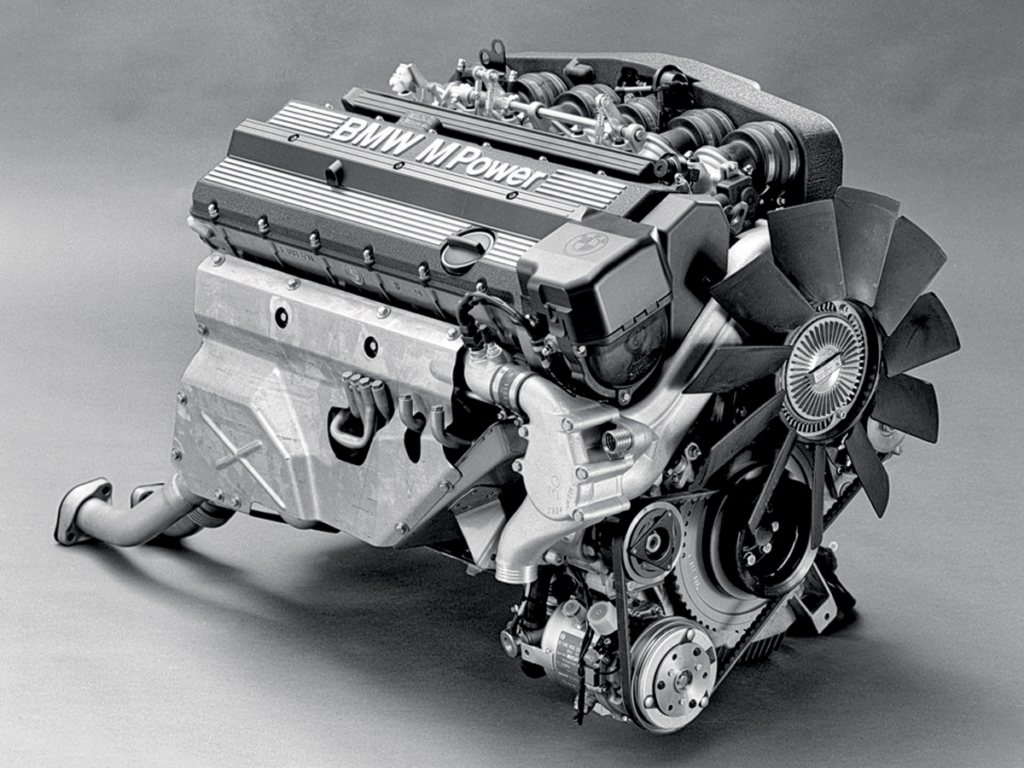
The S38B36 engine (315 hp) of the pre-facelift M5 actually had a displacement of 3535 cc, but was designated 3.6 to differentiate it from the predecessor engine with a displacement of 3453 cc on the M5 E28.
Who Actually Won
This tit-for-tat rivalry pushed the boundaries of automotive technology and laid bare just how competitive the two brands were. The E34 briefly edged ahead of the W124, but it never replicated the ground-breaking impact of the twelve-cylinder E32. Despite sharing a platform with the “Seven”, the “Five” was always in pursuit, adopting station wagon bodies, all-wheel drive and safety features that echoed innovations Mercedes had got to first. The BMW M5 remains a monument to that rivalry, and to how competition drives excellence.
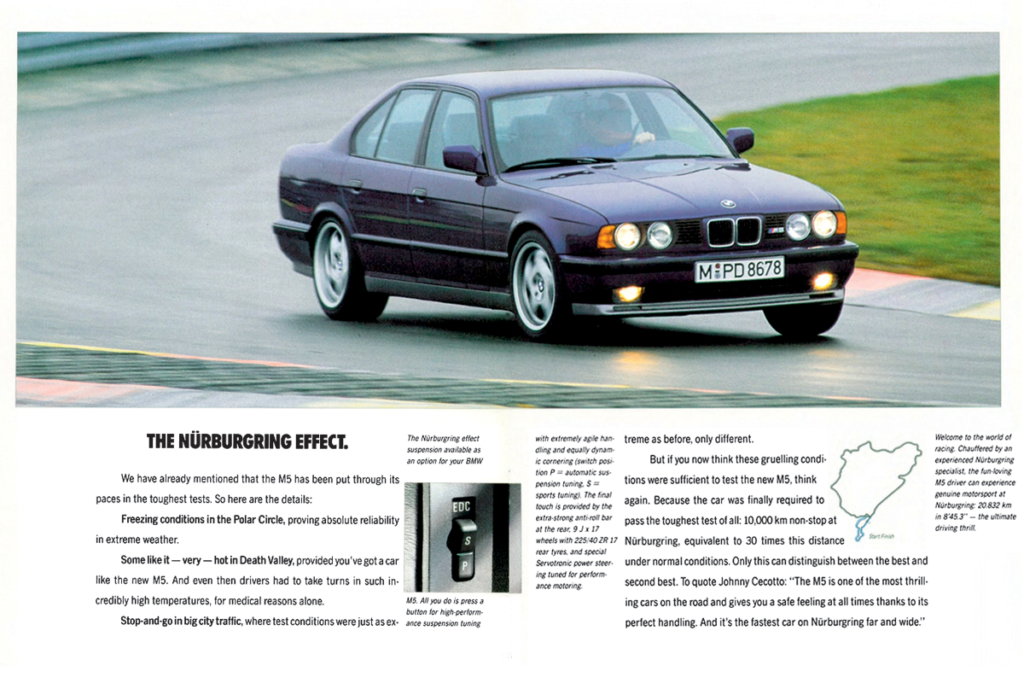
The Nürburgring effect means that during tests, the BMW M5 sedan with adaptive EDC shock absorbers completed a non-stop ten thousand kilometers on the Nürburgring’s “North Loop” and recorded the best time of 8’45.3″ (on a 20.832 km track).
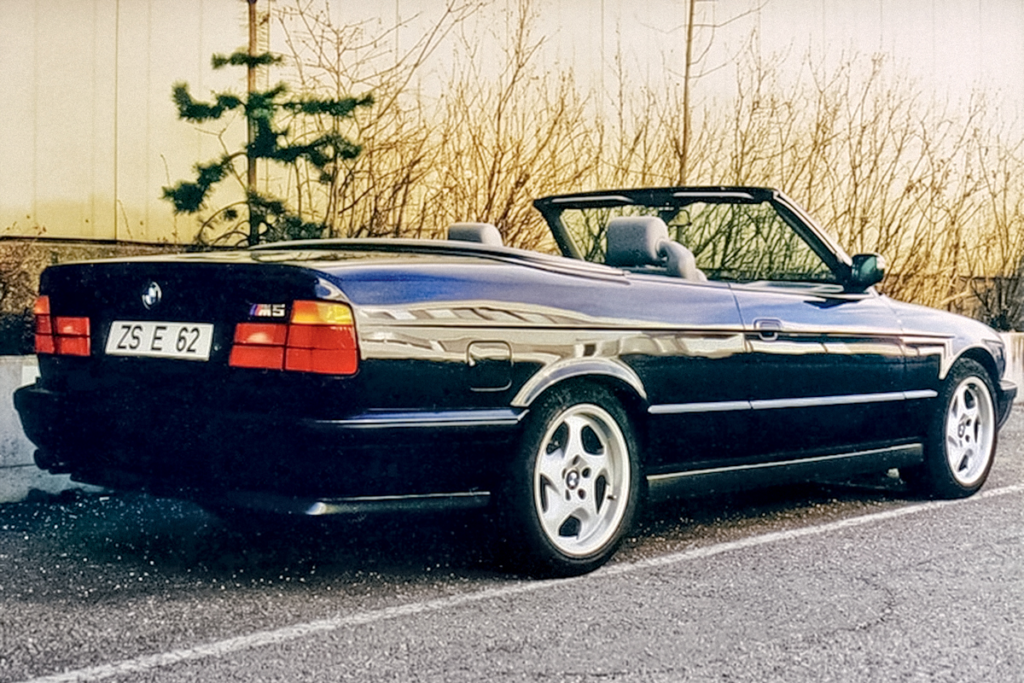
At the 1989 Geneva Motor Show, a convertible M5 with an E35 body was supposed to be shown, but a week before the premiere, BMW feared it would harm demand for the open M3 and canceled the project. The prototype was only unveiled in 2009.
Thirty Years On, Porsche Told Its Side
Three years ago, to mark the 30th anniversary of the Mercedes 500 E, Porsche’s press service released an interview with Michael Hölscher, the project leader for the Typ 2758, and his later podcast appearances shed more light on how the car was developed. He made clear that the sedan’s layout, the choice of engine and transmission from the 500 SL roadster, and its design and aerodynamics were all determined exclusively by Mercedes. Porsche’s task was principally to integrate those components into a W124 chassis that had never been designed to take a V8.
What Porsche Actually Did
That work required substantial adaptation: relocating the intake ducts, rerouting brake and fuel lines, altering the central tunnel, widening the track, and running a comprehensive driving test programme. Interestingly, Mercedes chose not to include Nürburgring tuning in the project — a reminder that here the client’s specification was what mattered, not Porsche’s instincts.
One notable innovation did come out of Zuffenhausen: the electronic engine management system. The 500 E was a pioneer for both companies, the first car either of them built with a CAN-bus system.
The Myth of the Wide Fenders
Hölscher also demolished the myth that the 500 E could not be built on the Sindelfingen line because of its excessively wide front fenders, supposedly designed by Porsche. Those fenders, he explained, were drawn by Mercedes designers who knew perfectly well what the assembly line could accommodate. Choosing to farm certain production stages out to Porsche rather than re-equip Sindelfingen was simply the cheaper option. Which raises an intriguing thought: perhaps Mercedes always meant this particular sedan to be assembled somewhere apart from the standard lines — much as BMW did.
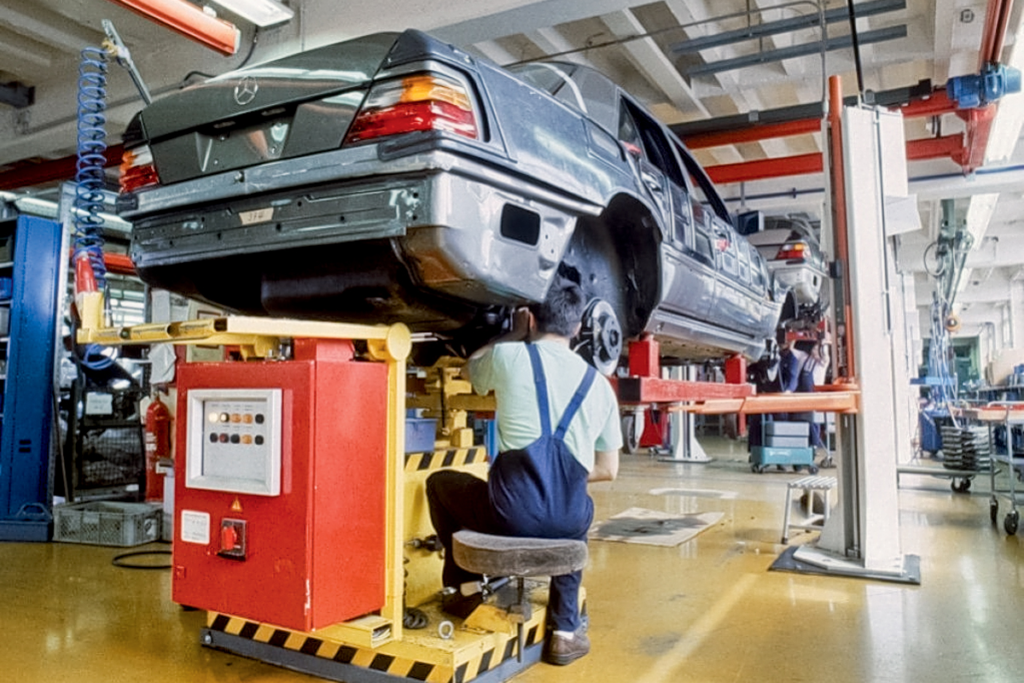
At the Porsche factory, Mercedes cars were assembled without a conveyor, on lifts, and carts. The VIN code of these cars should include the numbers 124.036.
Assembled in Three Places
In the end the Mercedes 500 E was assembled across three sites. Stamped body panels were trucked from Sindelfingen to Zuffenhausen, where Porsche added parts and built them into bodies in the Reutter Bau — named after the historic Reutter Karosseriewerk, the body shop that had worked with Ferdinand Porsche from 1906 and shaped the earliest Porsche bodies. The bodies then went back to Sindelfingen for painting, and back again to Zuffenhausen for final assembly in the Rössle Bau, previously home to production of the Porsche 959.
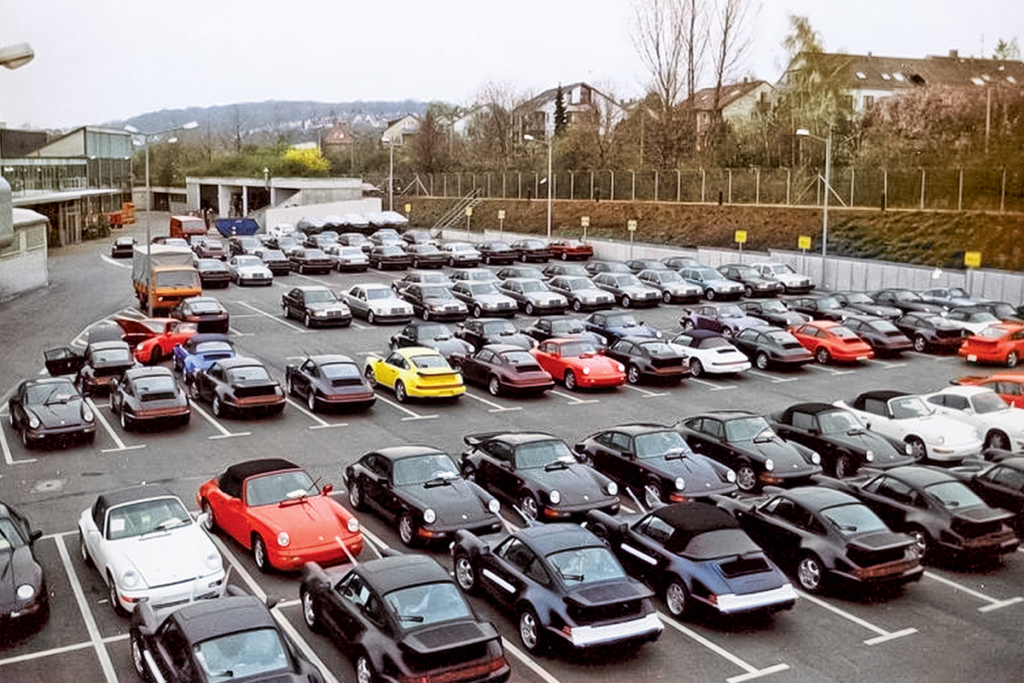
The early 90s, the finished products at the factory in Zuffenhausen: various Porsche 964s and forty Mercedes in the background.
Eighteen Days a Car
The logistics were considerable: it took 18 days to build each car. Even so, the process proved more efficient than BMW’s for the M5. Mercedes had initially planned for Porsche to produce ten cars a day, and demand was such that the rate doubled.
135,000 Marks, and What Came After
Priced above the S-Class at 135,000 Deutsche Marks, with demand and production peaking in 1992, the 500 E became the E 500 in the 1993 facelift that turned the whole “124” series into the E-Class. The engineering was unchanged, but the price rose to 146,000 Marks, sales fell away, and production ended in 1995. The less powerful 400 E, later the E 420, ran on until 1996 and in double the numbers.
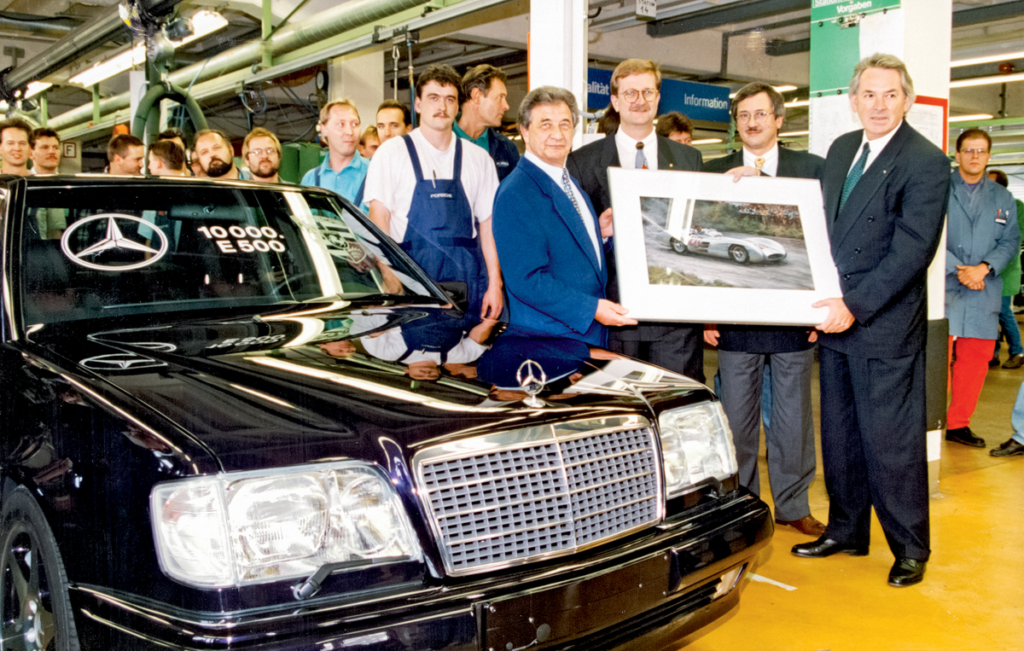
The 10,000th “Five-Hundred” Mercedes was produced in October 1994—already with the facelifted index E 500. After that, another 479 units were assembled. The car was gifted to Hans Herrmann, who raced for Mercedes in Formula 1 in the 50s, and in 1970 won the very first Le Mans for Porsche.
The Project That Steadied Porsche — and Gave Mercedes AMG
The project did more than fill a gap: it stabilised Porsche’s finances and set up later work such as the Audi RS2, where Porsche’s engineering influence was greater still. Michael Hölscher went on to contribute to the Carrera GT and the Porsche 918 Spyder before retiring in 2016.
And Mercedes, having discovered through the 500 E how lucrative performance models could be, decided in 1993 to keep this caviar of the car business to itself. The result was the first Mercedes C 36 AMG — and the beginning of everything that followed.
Photo: BMW | Mercedes-Benz | Sergey Znaemsky
This is a translation. You can read the original article here: Эхо друг друга: как создавались BMW M5 и Mercedes-Benz 500 E из нашего ретротеста

Published June 20, 2024 • 9m to read