
In an iconic BMW TV commercial, a jet-powered car races across a dried salt lake, slicing through the air, kicking up clouds of dust, and nearing a speed record. Suddenly, the pilot deploys a braking parachute, the car halts, and the sound of a door opening fills the air—a person in a jumpsuit appears on the screen, peering straight at us to check the camera lens. It turns out the entire race was captured through the “eyes” of a BMW M5 sedan, with a camera mounted on its door.
This is a classic advertising gimmick, but it truthfully conveys that the most intriguing vehicles in movies often remain behind the scenes. Among them are those engineered in Russia.
A Beast Bigger Than the Rossa
I met this technology under similar circumstances. Last summer I had the chance to ride in the Rossa track prototype — the one racer Roman Rusinov plans to put into production. Ten cylinders, 680 horsepower and an acre of carbon fibre. And yet the vehicle that turned up to film it in action was a still more formidable beast.
From a Dentist’s ML 63 to Mad Max
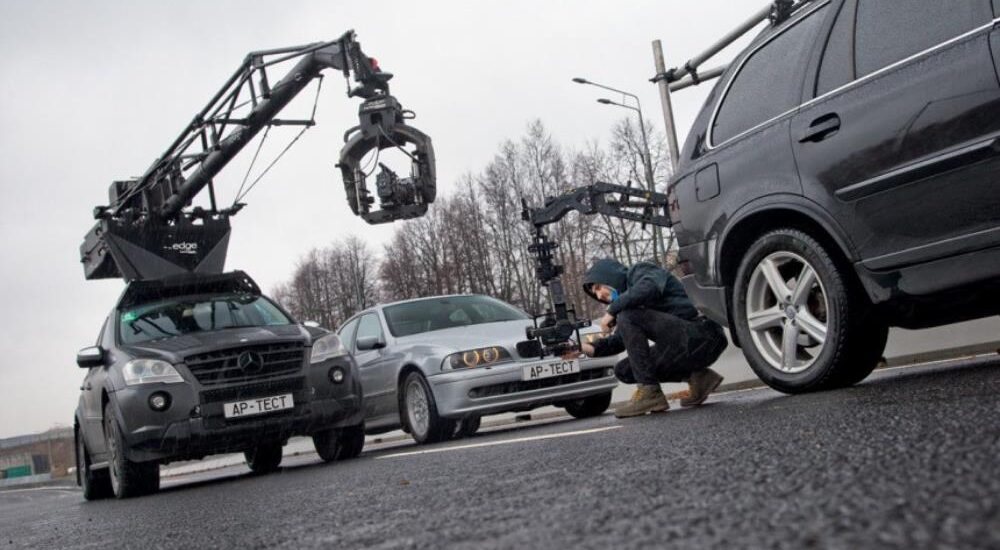
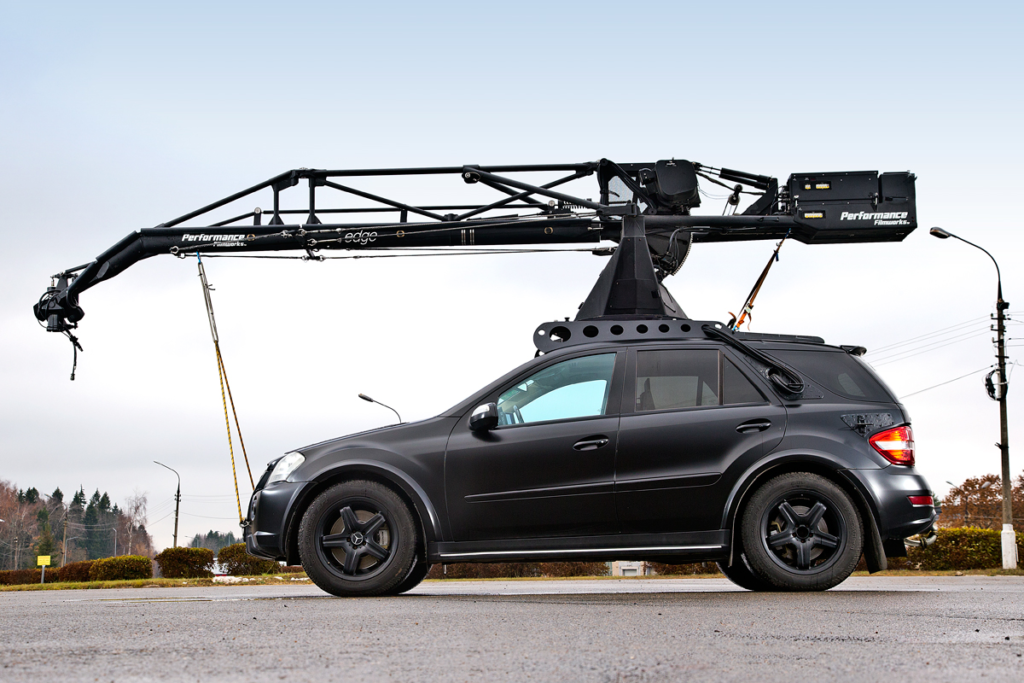
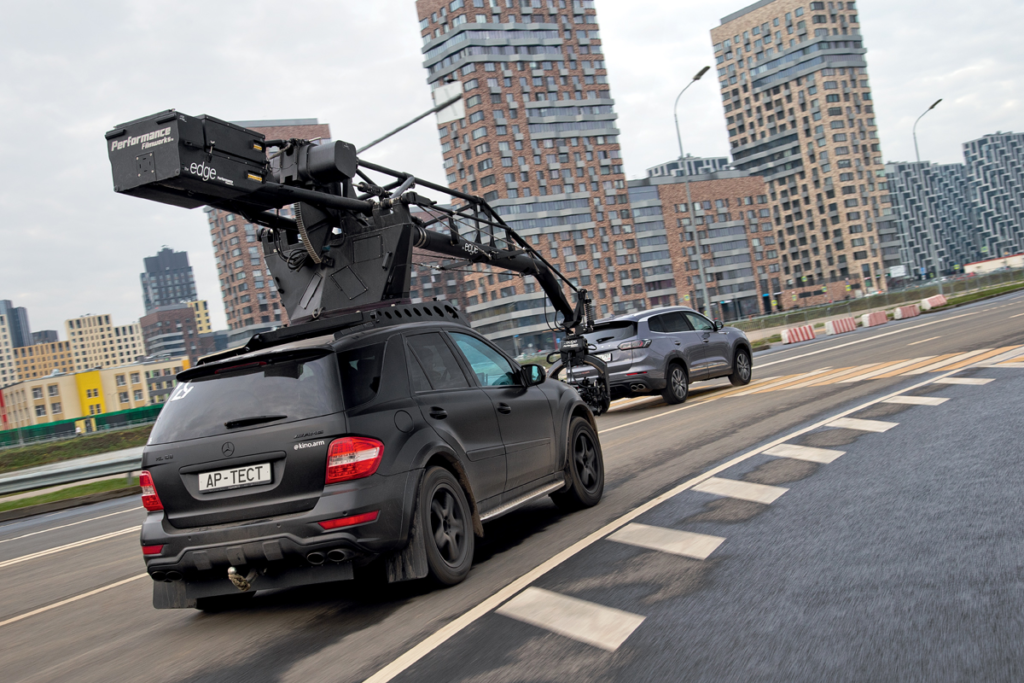
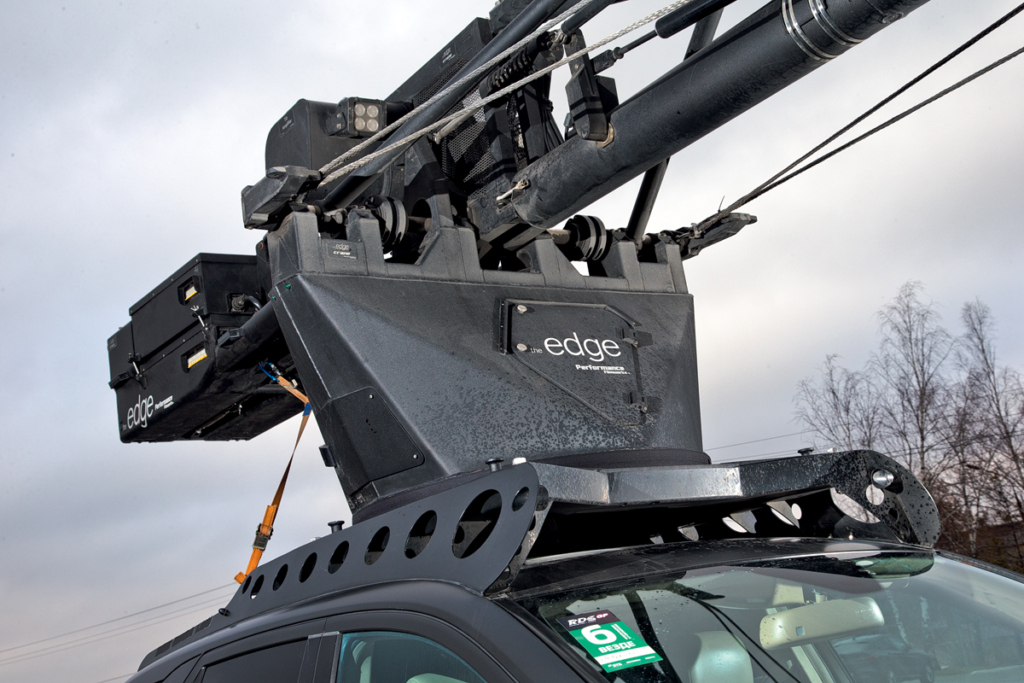
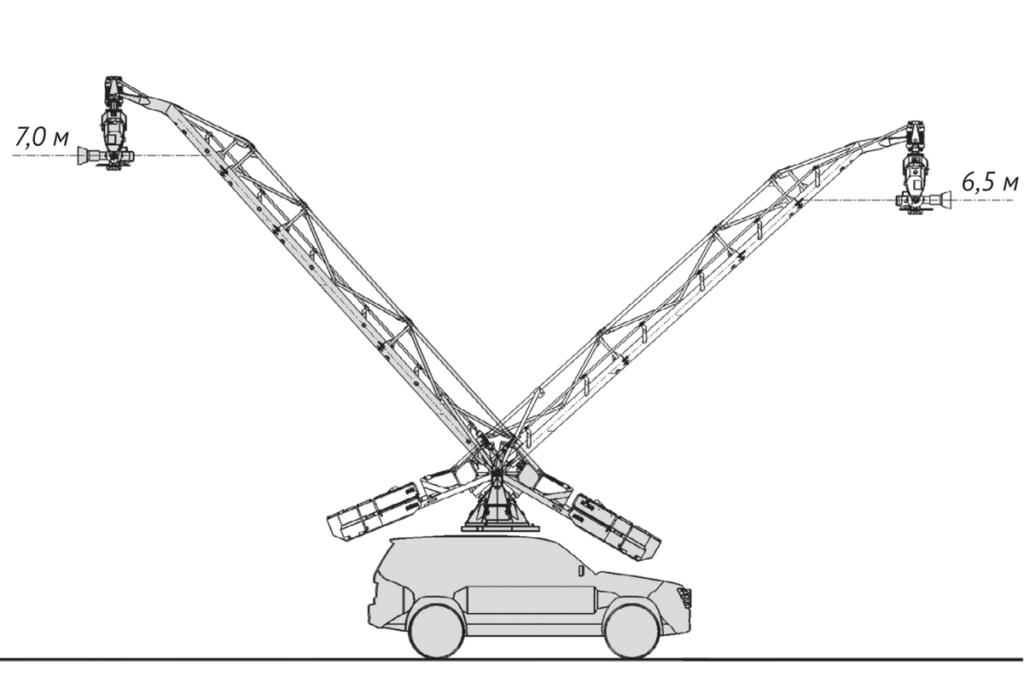
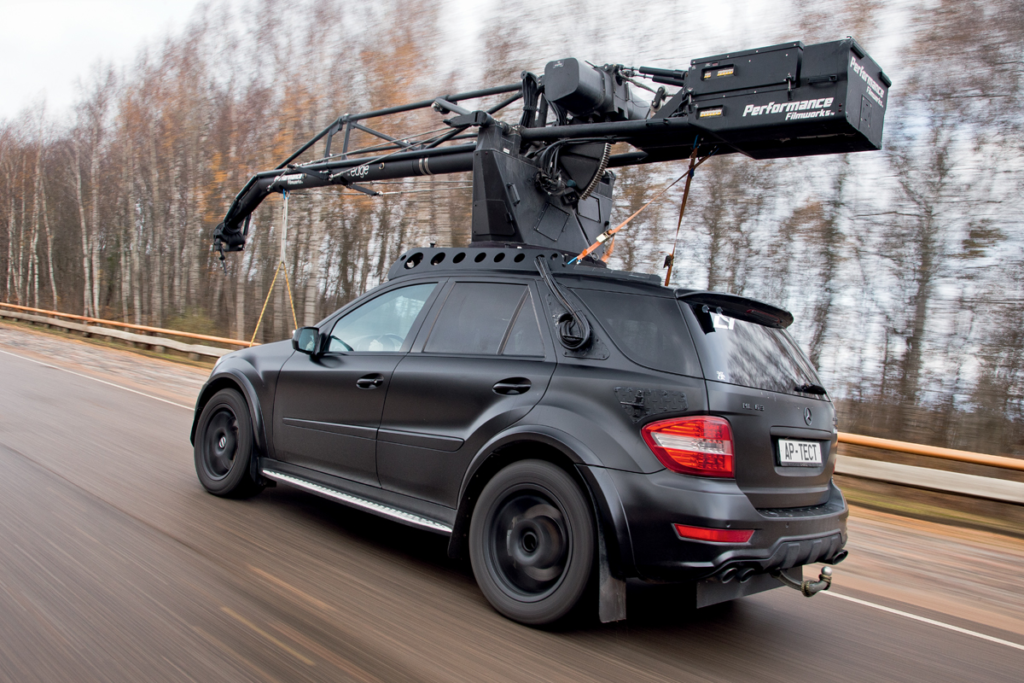
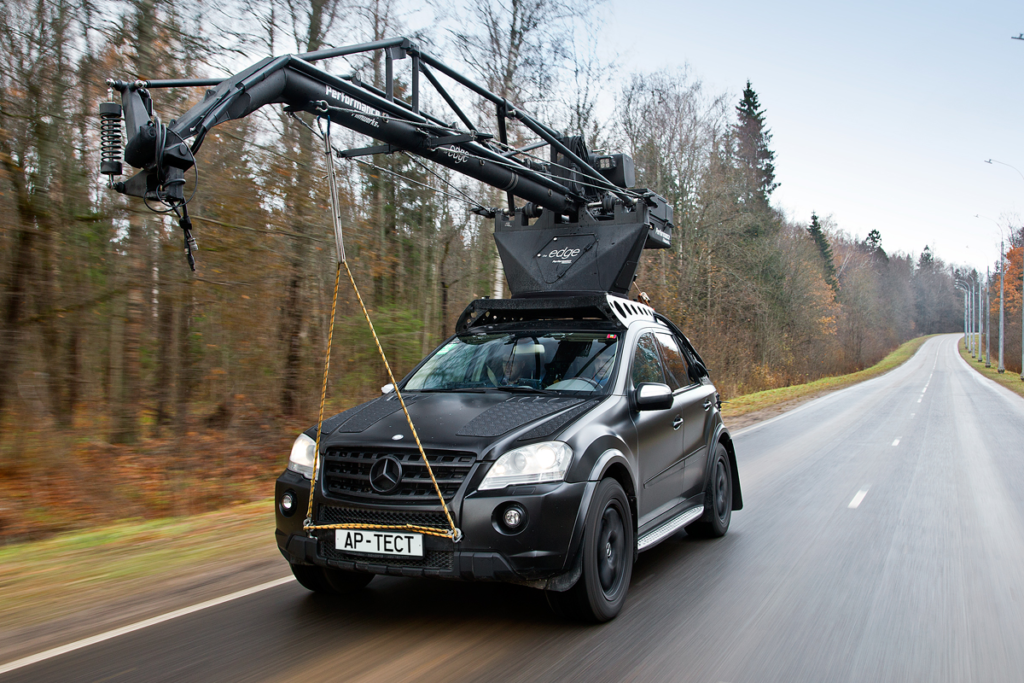
For most of its life it was a 2010 Mercedes-Benz ML 63 AMG of the W164 series, living with a Moscow dentist’s family. A couple of years ago it fell into the hands of filmmakers and underwent a transformation worthy of Mad Max. The body traded metallic paint for matte film, bristled with wires and brackets, and grew a tower with a boom out of its roof. This is a Russian Arm. The cladding may read “Performance Filmworks Edge Crane”, but in the film industry “Russian arm” refers to every automotive camera crane with a stabilised camera, much as “Xerox” came to mean photocopying.
King of the Film Set
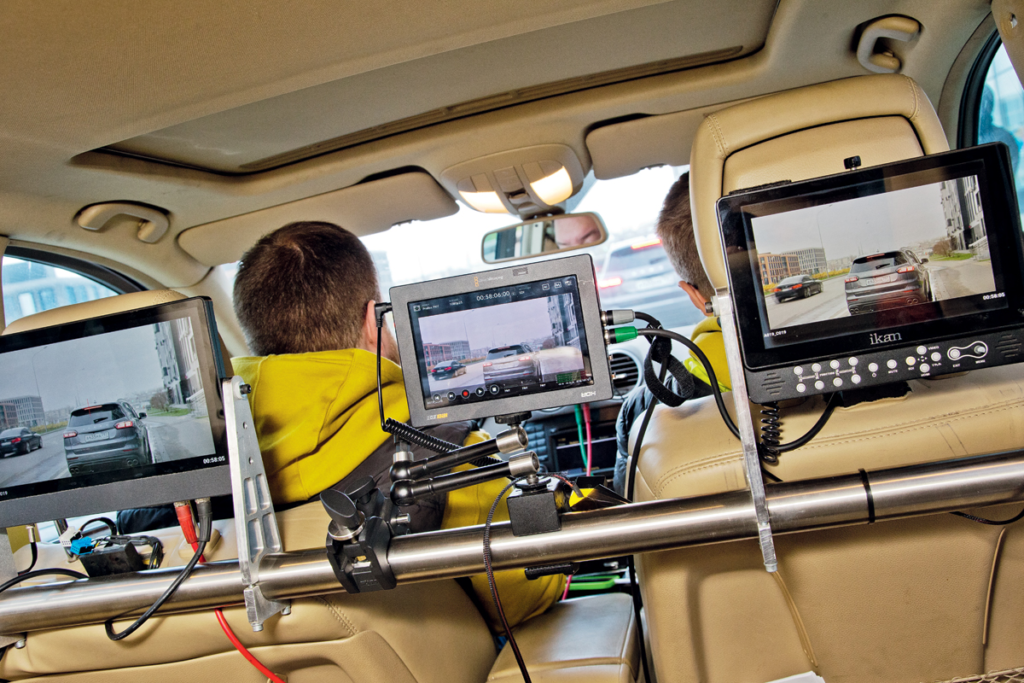
The Russian Arm is the king of the film set. It costs what many supercars cost — setups run to a million dollars — and a day of operation runs into hundreds of thousands of rubles. What impresses most is the scene just before shooting starts: three people climb into the cabin and two more into the trunk, each with a distinct job.
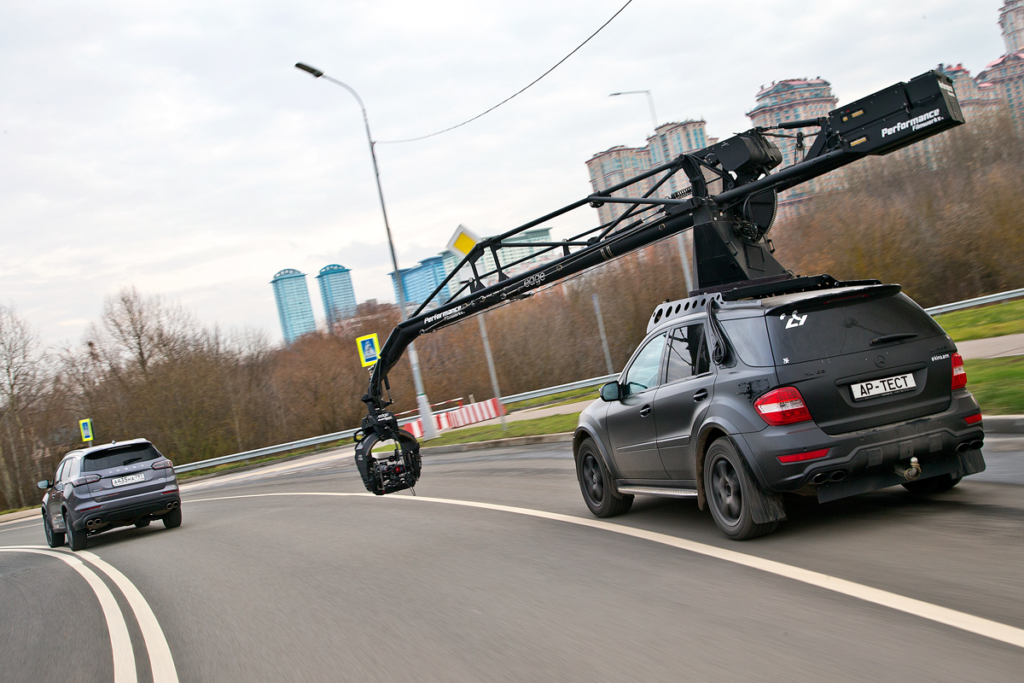
The Mercedes fires up, catches the hero car and begins to dance around it. They close, separate, swap places, sometimes charge at one another. The magic of the crane is that the camera on the end of the boom holds the frame, keeping its position whatever the Mercedes underneath it does. Sway, bumps, acceleration, the absence of asphalt — none of it reaches the shot; the crane car can run along the verge and the camera stays exactly where it was.
Swapping Roles — and Inviting a Volvo
That day gave me the idea of persuading the crane’s driver to swap roles, and making this remarkable machine the subject of a test rather than its author.
There are other kinds of camera car, though, and not all of them carry a tower. Vehicles with stabilised suspensions — steadicams, in effect — are used on sets very successfully. They are far simpler and cheaper, and can deliver almost the same effect. Or can they? At the end of last year I invited both the Edge Crane on its Mercedes and a more modest camera-car Volvo XC90 V8 to the testing ground.
The Hand of Tula
Why an ML, and Why This One
Form follows function, but with a film crane the function dictates not only the appearance but the make, model and specification of the vehicle underneath. Search for “Russian arm crane” and you mostly get pictures of cars based on the Mercedes ML and the Porsche Cayenne, in various generations — often the very first, still body-on-frame M-Class.
A crane needs a strong body, a spacious cabin, durable suspension and a powerful engine. Precise throttle control and good handling matter just as much. Which is why the old AMG versions of the W164 generation look almost purpose-built for the role. The 2010 model year was the last for the ML 63 AMG with the naturally aspirated 6.2-liter M156 V8, before the W166 generation moved to turbocharging.
150,000 km Before, 20,000 After
This Mercedes has had no special modification to its engine or transmission. It covered 150,000 kilometres in peace without serious trouble, and has added another 20,000 just as easily since being repurposed. Hardly a single element of the body, though, remains as it was.
Seven Rules for a Crane Car
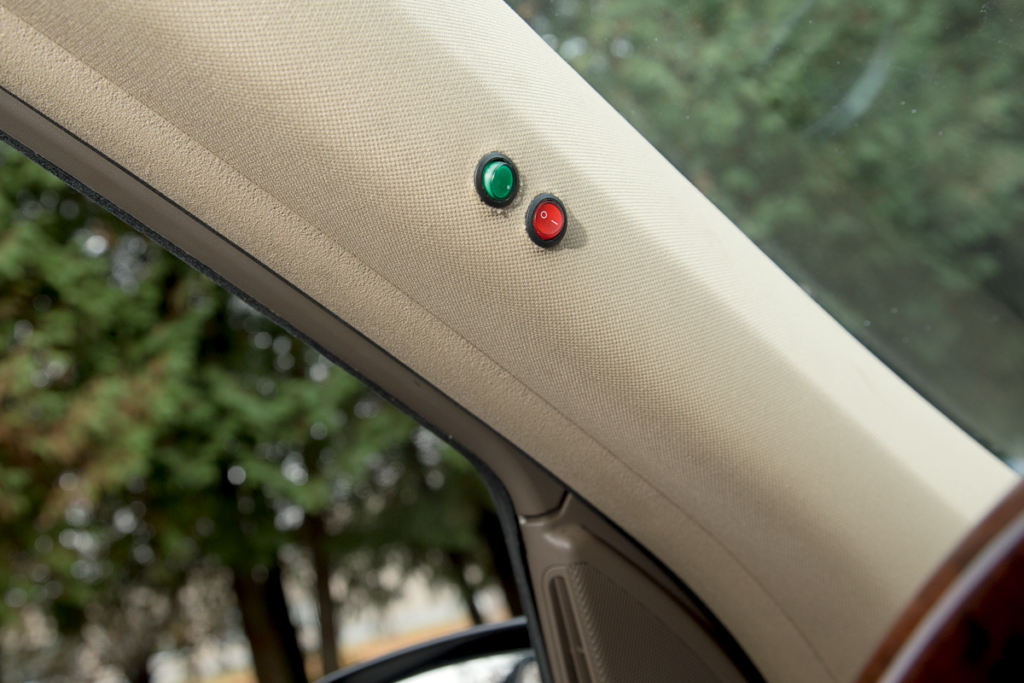
Rule number one: a vehicle with a crane must not reflect in the hero car, or cast glare or shadow on it. Hence matte film instead of factory paint — and, for the same reason, switchable rear lights and brake lights.
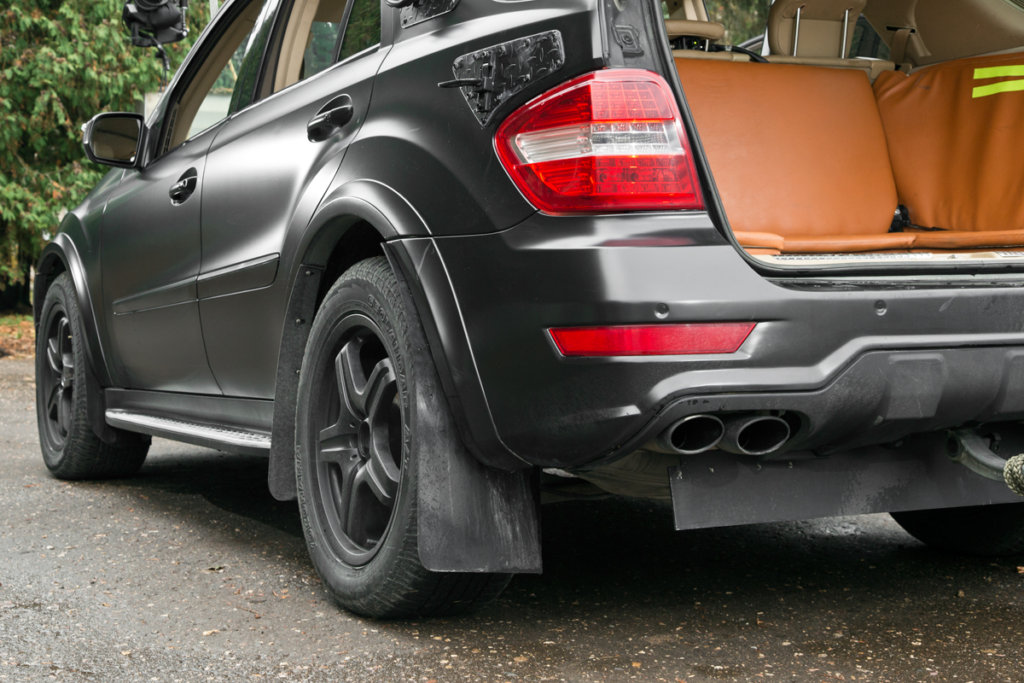
Rule number two: the crane car must not kick up dust, throw mud, lift snow or send exhaust into the frame. So along with wide mudguards under the rear bumper it gets a solid full-length skirt.
Rule number three: the boom and the tower have to be easy to reach. The hood is therefore reinforced with duralumin sheet so that a person can stand on it, and steps are fitted along the sides of the body.
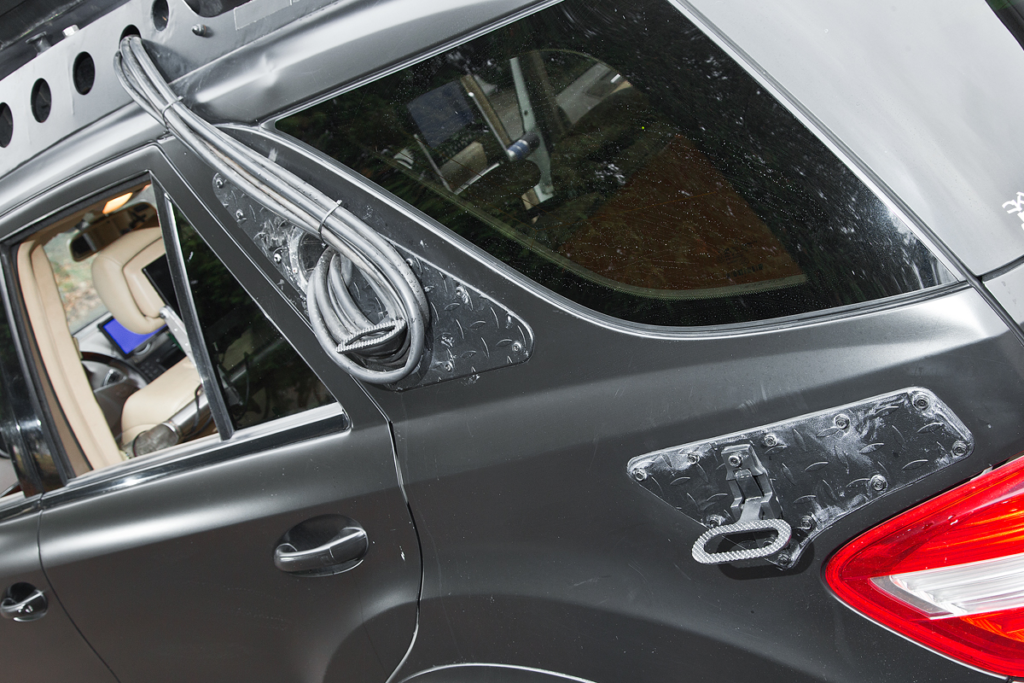
Rule number four: the crane must be light, strong, dismountable and compact. For a long-distance move, a three-person team has to strip the boom and all its accessories in one day and pack them into five containers. Assembly should take a day as well.
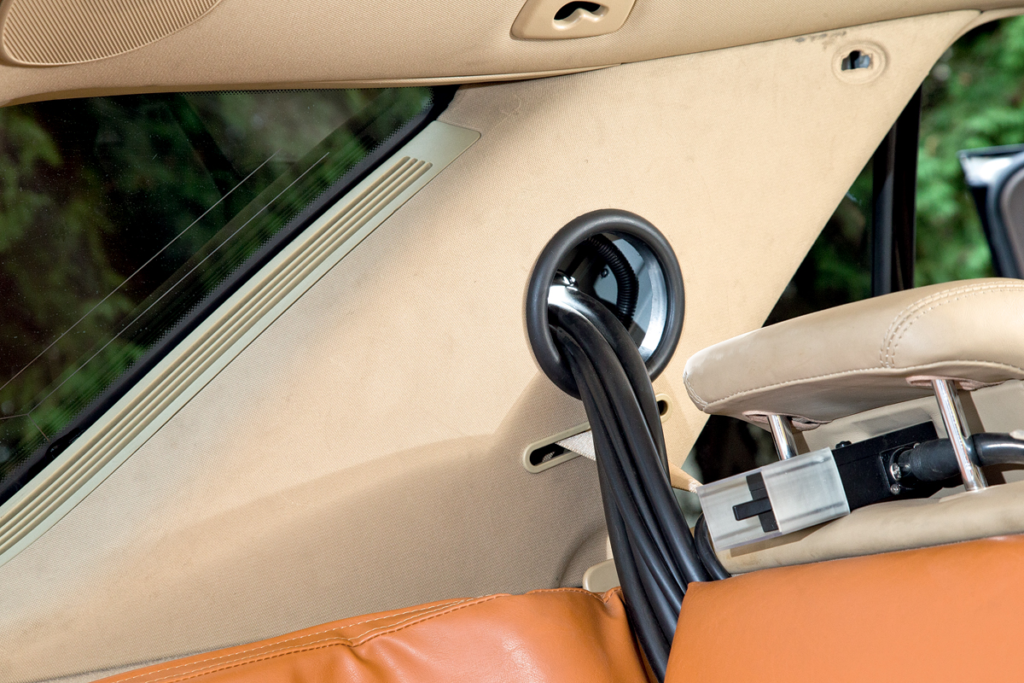
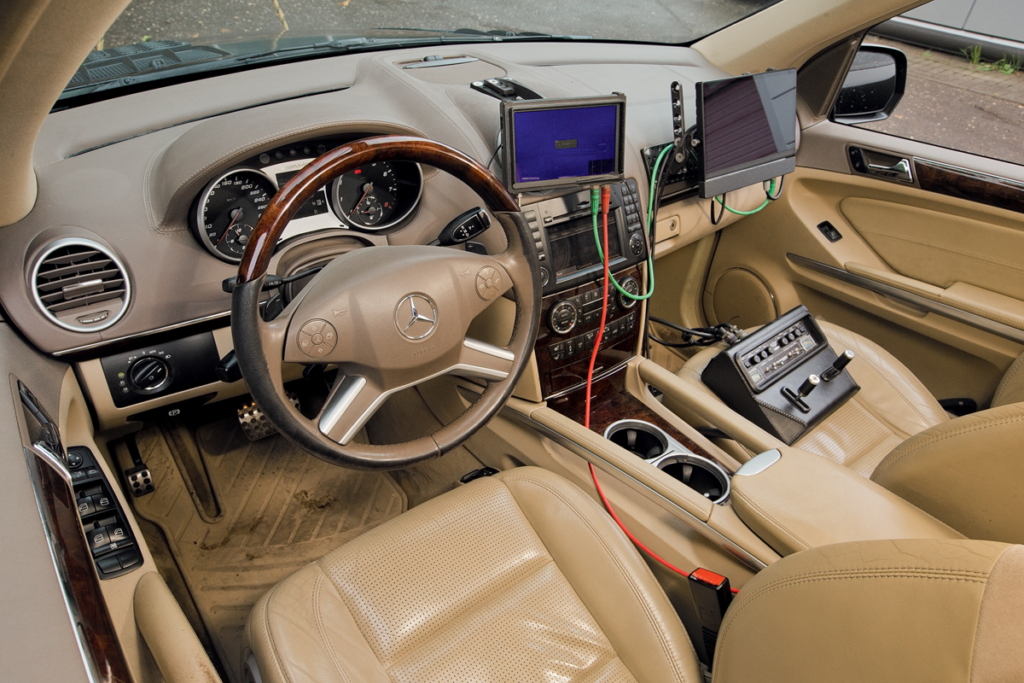
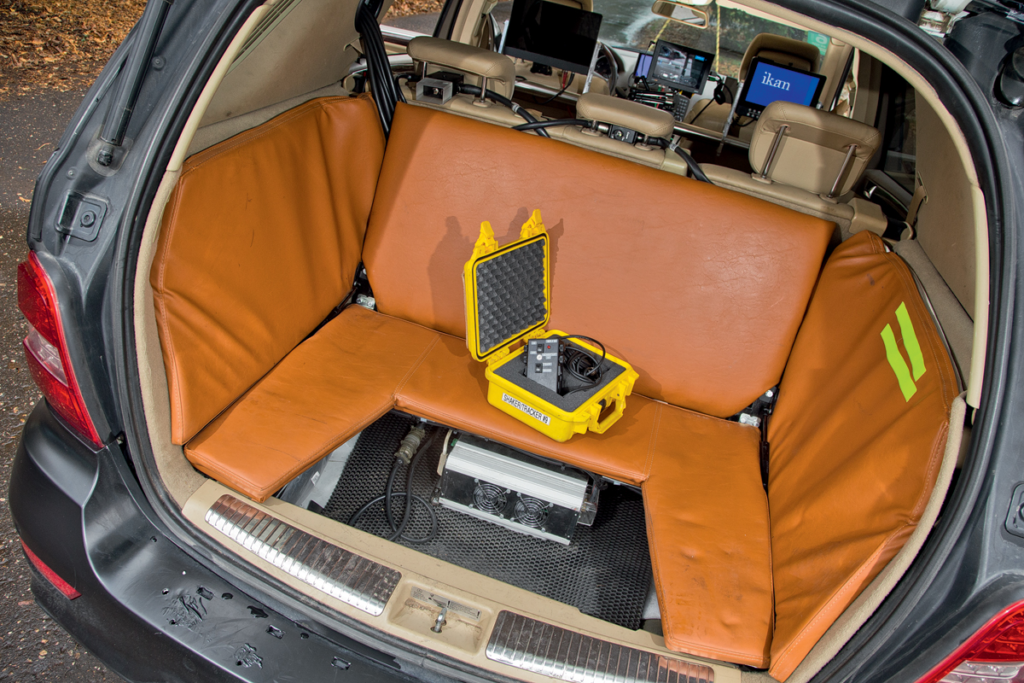
Rule number five: the crane must carry no unnecessary weight. Every kilogram on the roof raises the centre of gravity, spoils the handling and increases body roll. So the batteries and power units live in the cabin behind the rear bench, with a mass of signal and power cables running up to the roof through a hole in the body pillar.
Rule number six: there is no time to charge the crane’s batteries on set, so they are recharged continuously from the car’s own alternator through special power units that convert 12 V into the 70 V the crane needs.
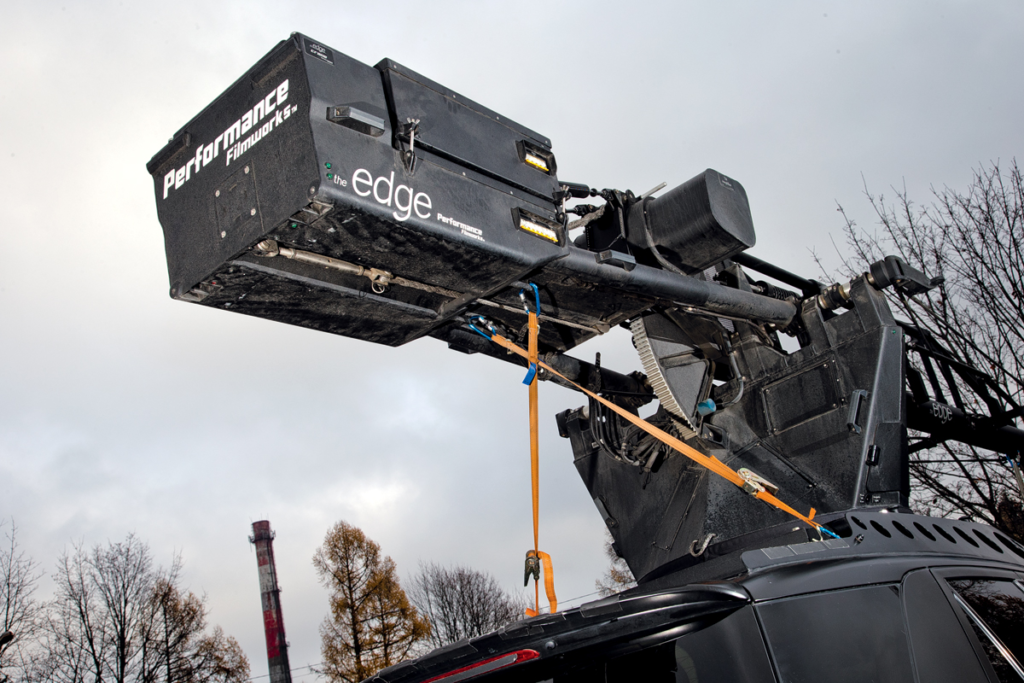
Rule number seven: a crane car needs a large trunk the crane operator and the focus puller can work from. So instead of a floor panel and a spare wheel there is a U-shaped bench in the luggage area.
Six Monitors, Two Joysticks, and Who Sits Where
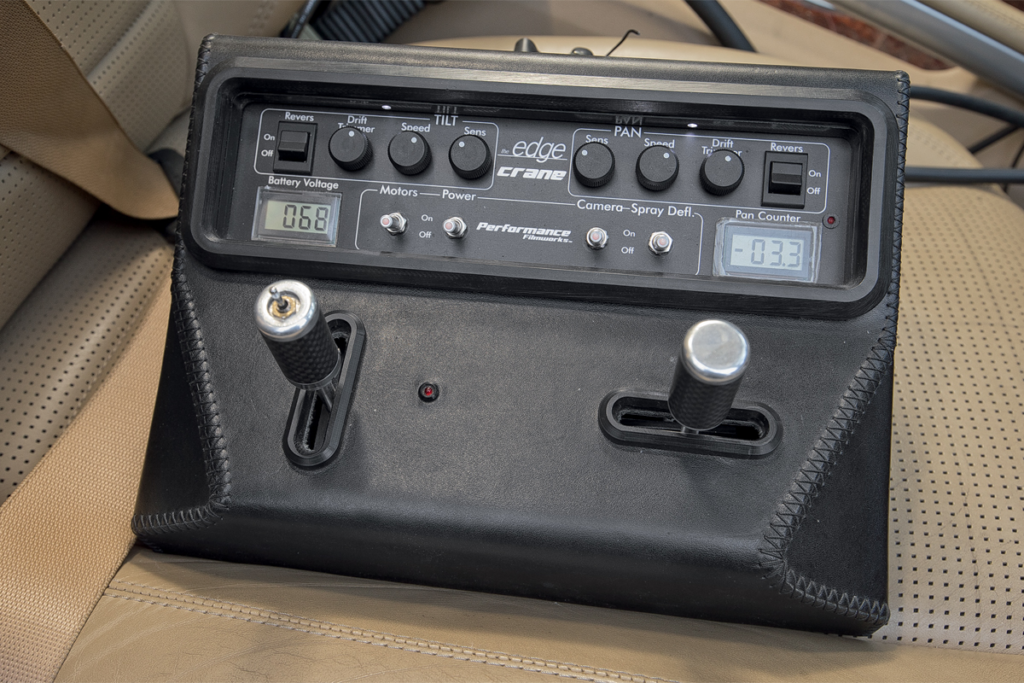
All told, the cabin’s equipment would out-screen any Chinese electric car: six monitors, plus two remote controls with joysticks. And this is practically the base specification.
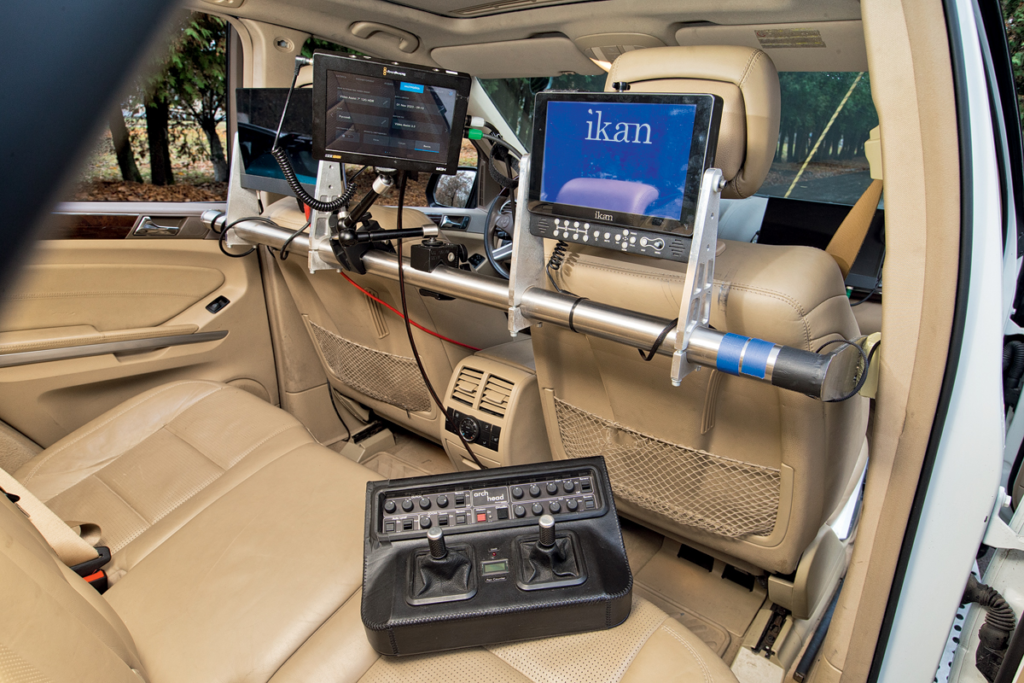
Behind the driver sits, almost always, the operator working the camera. The rest of the crew may swap around, but the team has to include a crane operator who handles the boom’s vertical movement and its rotation in azimuth, clockwise and counter-clockwise, a focus puller, and a director or assistant director.
Edge Crane, Engineered in Tula
The boom reads “Edge Crane”, the brand of the California-based company Performance Filmworks, which supplies film cranes for shoots and handles the development, modernisation and testing of this equipment and its accessories. This particular crane, though, was built by the Russian firm Leskov of Tula, the main engineering and manufacturing partner for Performance Filmworks. There are few Russian components beyond the structural elements, but the basic principles the crane works on are of domestic origin.
Gyroscopes Out of Bauman
The story of the Russian Arm phenomenon deserves a chapter of its own — look for it in the historical section. For now it is enough to remember that this crane works on gyroscopic indicator stabilisers, whose theory and practical application in the film industry were developed by the staff of the Bauman Moscow State Technical University. It began in the late ’70s, in the department of gyroscopes and gyroscopic systems at the faculty of instrumentation engineering.
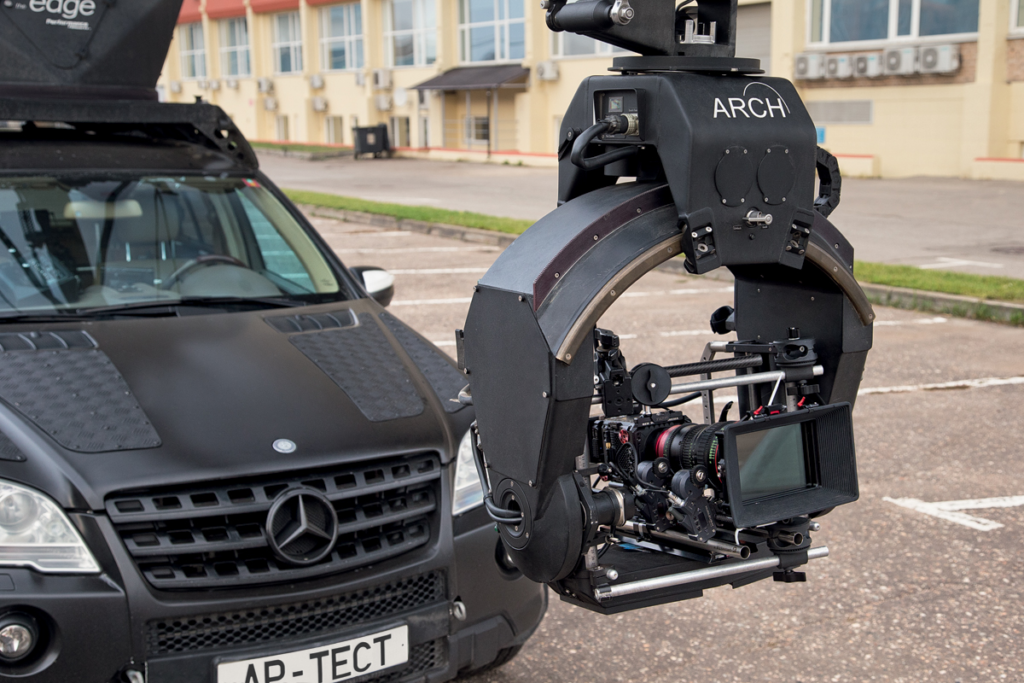
In the late ’90s the technology won recognition in Hollywood, and by the mid-2000s it had produced so many imitators that Russian Arm became the generic name for any remotely controlled camera crane on a car roof. Today the key developer, a former Bauman student, lives in the USA and is chief engineer at Performance Filmworks. In Russia, Leskov does the engineering, builds the cranes and occasionally converts the vehicles.
What a Gyrostabiliser Actually Is
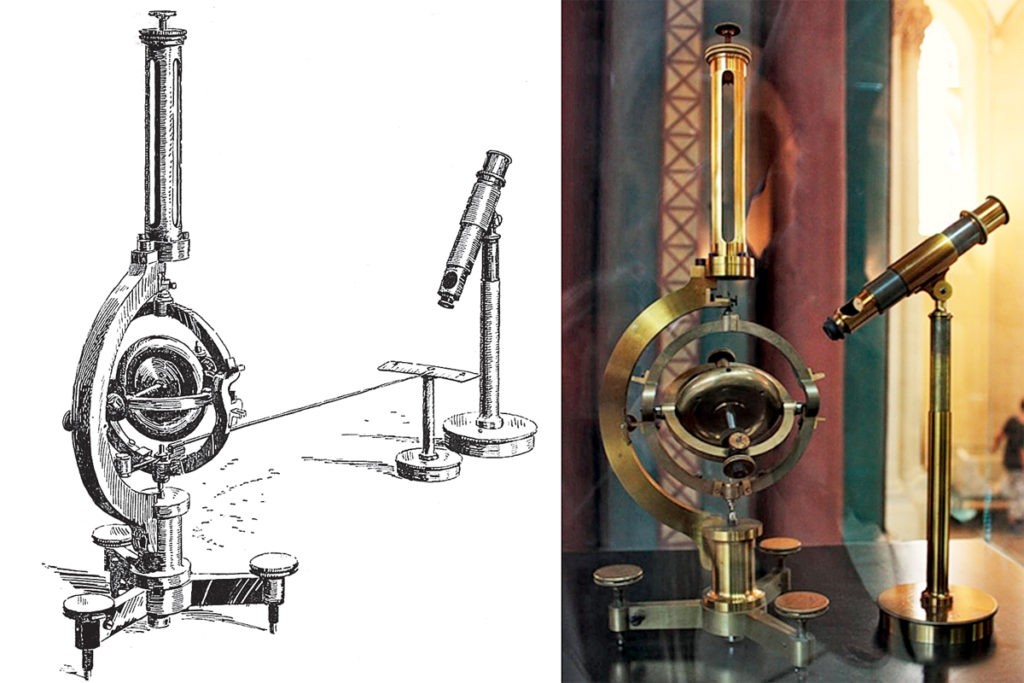
So what is really inside? Start with the gyrostabiliser. It is a device that works on the principle of a gyroscope — a spinning top. A rotor spun to very high speed tends to hold its original orientation in space, and the faster it spins, the greater the restoring torque back to that orientation. Put such a top in a frame with gimbals along all three axes and you have a gimbal suspension in which the rotor is completely free to keep pointing where it started.
From Foucault to Torpedoes — and Why the Spinning Rotor Gave Way
Attach an arrow to the inner frame of that gyroscope and you have the simplest version of the device with which the French physicist Jean Bernard Léon Foucault demonstrated the rotation of the Earth 172 years ago. Later the rotor was linked by rods to a steering mechanism, producing the gyrostabiliser that was being used on torpedoes by the end of the 19th century. In the 20th, gyroscopes became a crucial part of the navigation and orientation systems of very nearly every kind of vehicle, rockets included.
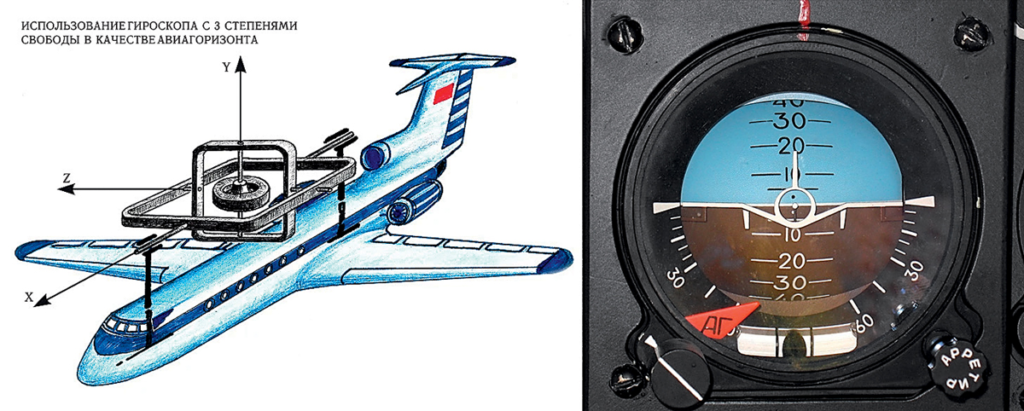
Gyroscopes with rotating rotors are heavy, bulky, fairly noisy and not always reliable, though. They need a drive to hold tens of thousands of revolutions per minute, and time to spin up. Which is why, since the mid-’90s, camera stabilisers have used fibre-optic or vibrating gyroscopes instead. The first are electronic sensors measuring angular velocity from the difference in time a light pulse takes to travel through a fibre-optic coil; the second do the same from changes in the direction of their vibration. Vibrating gyroscopes are the modern angular velocity sensors found in everything from hoverboards to smartphones.
What Is Inside the Edge
They are what sits in the stabilisers of the Edge film crane. Alongside them are tachometers, encoders, accelerometers, Hall effect sensors, potentiometers, measurement module assemblies with their own calculation algorithms, and other sensitive elements. The signals from all of them build a feedback loop that lets special drives compensate for vibration, sway, roll, impacts and every other unwanted effect.
2813 kg on the Scales
Modern electronics save a great deal of weight, and still, when we put the crane car on the scales, it read 2813 kg — half a ton more than the factory kerb weight, and right up against the permitted gross weight. Weight like that cannot help but affect the dynamics, and the best run to 100 km/h came out almost two seconds worse than the factory figure: 6.8 s against 5.0 s. But is it really the seconds we love the old naturally aspirated AMG for?
The M156 Is Still the Point
The engine’s charisma is a hundred per cent intact. This is a motor that makes you smile. The throttle connection is flawless, the pull is stunning and the sound unforgettable. The 6.2-liter eight revs easily to 7000 rpm, but it has a more important quality than that: even an ordinary trip at half throttle is filled with the pleasure of dealing with a genuinely big engine.
The 7G-Tronic automatic works perfectly here too. By this generation it could drop three gears at once, so the Mercedes can switch from calm cruising to hard acceleration almost instantly. This powertrain, put simply, knows how to do everything.
It is good enough that I found myself trying to remember whether there was ever a large seven-seat Mercedes with this engine. There was: the R 63 AMG. The same 510 horsepower, the same automatic, plus a family cabin. I will hold on to that thought.
Steering — and the Chase We Did Not Drive
Beyond the engine, the ML 63 AMG wins you over with a noble steering feel. It is fairly long-geared, a little over three full turns lock to lock, and not remotely lazy: no unnecessary heaviness, no artificial sharpness, but rich feedback and a clearly defined centre. Responses are quick and precise. An exemplary car. But what would happen if we imagined filming a chase and had to drive flat out?
“I’m not going to do a reshoot with this,” said Yaroslav Tsyplenkov the moment he saw the film crane. In fairness, emergency manoeuvres were never part of the test programme, because they can only be done with the tower switched on — that is, with almost the full crew aboard and the boom operator adjusting its position through every manoeuvre. Otherwise exactly what Yaroslav guessed would happen, would happen. And with the tower switched off, sharp manoeuvres are a bad idea anyway, because the mechanisms can be damaged.
The Suspension Is at Its Limit
You can feel, though, that the weight above the roof has increased body roll and that the suspension is struggling with the load. A vehicle like this needs air struts so the body does not sag under the crane, and here the airbags are already working at their limit. Whatever damper mode you select, the Mercedes rides hard and passes bumps through, even on 275/55 R20 tires that are fatter than the manufacturer specifies. It would have been hard to expect anything else: in service the Mercedes drives with a full crew, which adds roughly another 400 kg, and the work does not always happen on asphalt, which the AMG suspension was never prepared for.
So the next plans for this Mercedes are new airbags and even plumper 275/65 R18 tires, for more work on rough ground. Plus one very specific upgrade: reprogramming the ESP so that it no longer blocks left-foot braking. That is what gives perfect control of the car when filming at close quarters, and the standard calibration does not allow it.
Half a Day for One Simple Shot
A few days after the tests at the track I got to watch this crane working on a real shoot. The brief was very simple — move a car through ordinary streets, seen from different angles — and the process took almost half a day. The time goes into assembling the equipment and into the perfectionist execution of every frame. In short, the film crane does not make the work easier; it does the opposite. The reward is the quality of the picture. There are alternatives, though.
To check them, I borrowed a car for a day from an operator friend I work with regularly on shoots: a 2006 Volvo XC90 V8 with a custom-built manipulator.
Swedish Tail
A Rigid Bar and a Pantograph
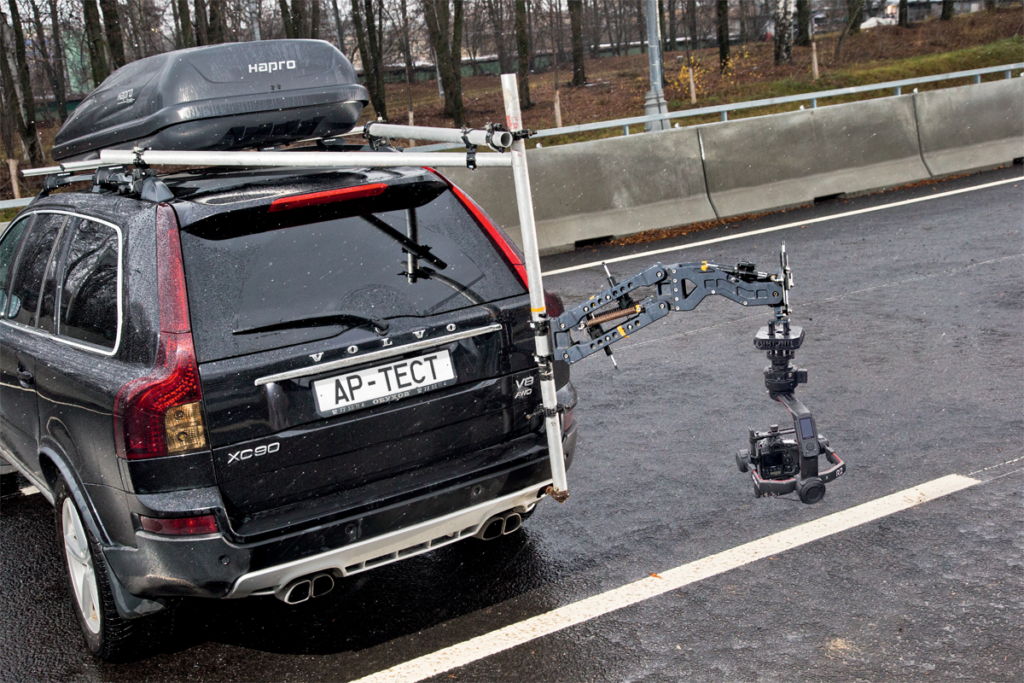
The initial requirements for the vehicle were much the same: a large, roomy crossover with a powerful engine. The concept of the filming equipment, however, is radically different. A powerful vertical bar is mounted rigidly between the roof rails and the towing eye, and a mechanical pantograph suspension is attached to it just as rigidly. It looks more like an arm than the Russian Arm does, but in capability it is a relatively simple steadicam. Only parallelograms, springs and dampers are involved. There is no stabilisation and no active movement, though it damps vibration well — in the vertical plane only. The main work is done by another part of the system.
A DJI Ronin 2 at the End
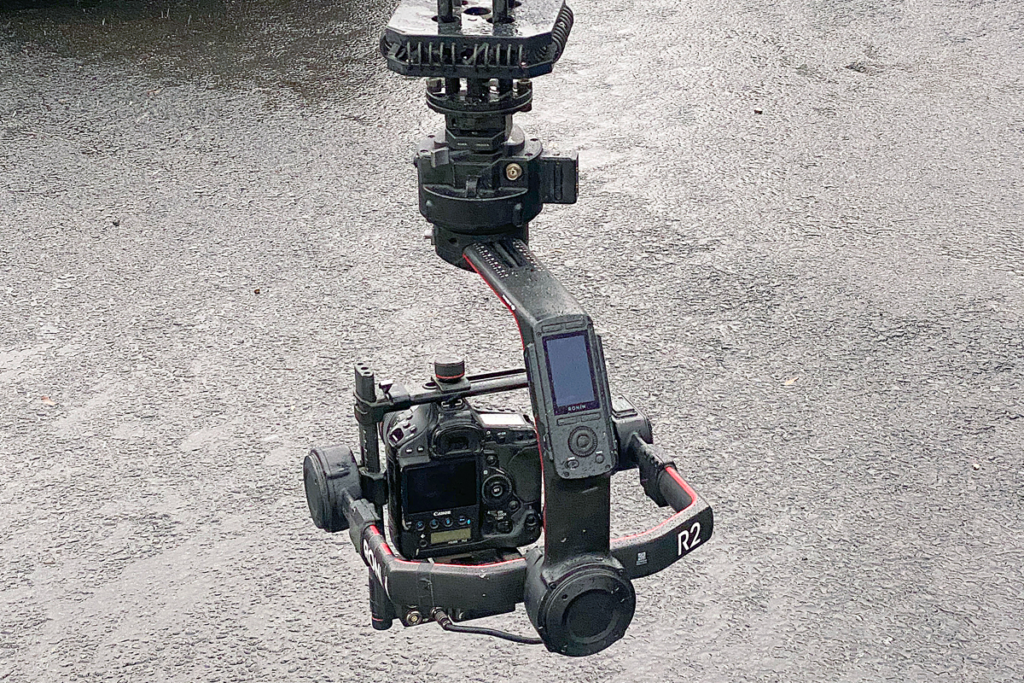
A DJI Ronin 2 stabiliser is mounted at the end of that arm, with its own gyroscopes, joints and servo motors. This camera mount has movement and stabilisation across three axes, so the operator can tilt the camera forward and back, lean it right and left, and pan a full 360 degrees around the vertical axis. To change the perspective, though — to move the camera higher, or further from the body — you have to stop and pick up a wrench.
Hundreds of Times Cheaper
But a tail like this is hundreds of times cheaper and tens of times lighter than a Russian arm. It puts no extra load on the suspension and does not spoil the dynamics. The crew needs only a driver and an operator. All the equipment can be taken off and left in the garage. And there is no need to register a change to the vehicle’s design.
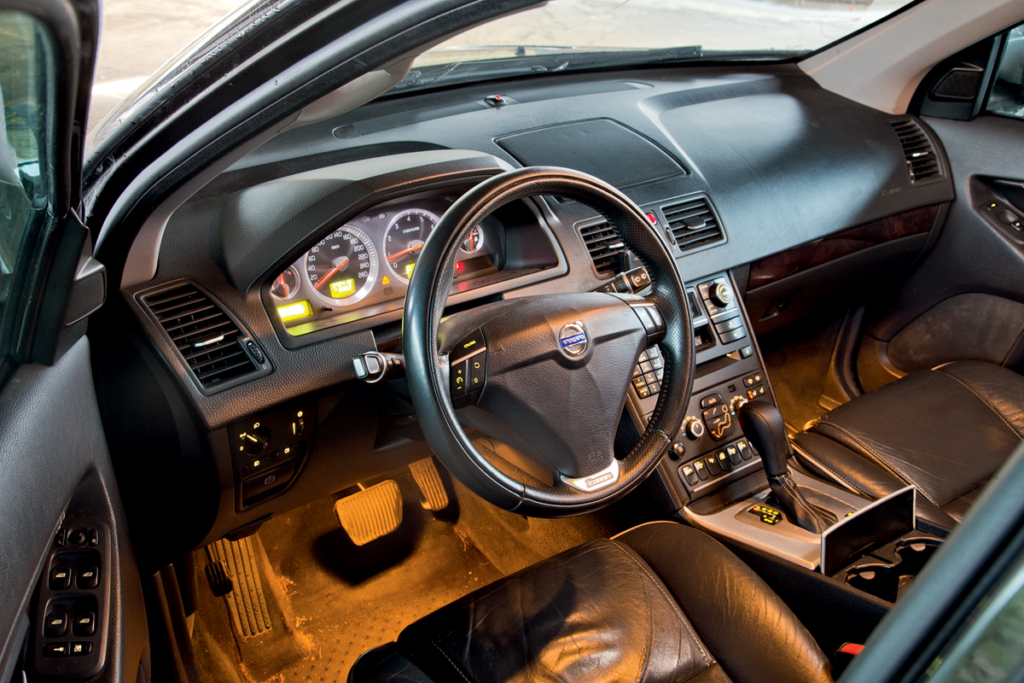
The only drawbacks are a limited choice of angles, blocked access to the trunk, and a slightly less smooth, slightly less Hollywood-quality picture, because the spring pantograph and the Ronin deal with vibration well but cannot entirely defeat their own slow vertical sway. Otherwise — why not a replacement for the Russian arm?
Driving the XC90
I enjoyed driving the Volvo too; this car knows how to charm. It has a cosy, rounded design and an equally rounded character. The XC90’s manners are a little yacht-like — a trait, apparently, inherited from the Yamaha DNA of its V8.
315 hp, Kept at Arm’s Length
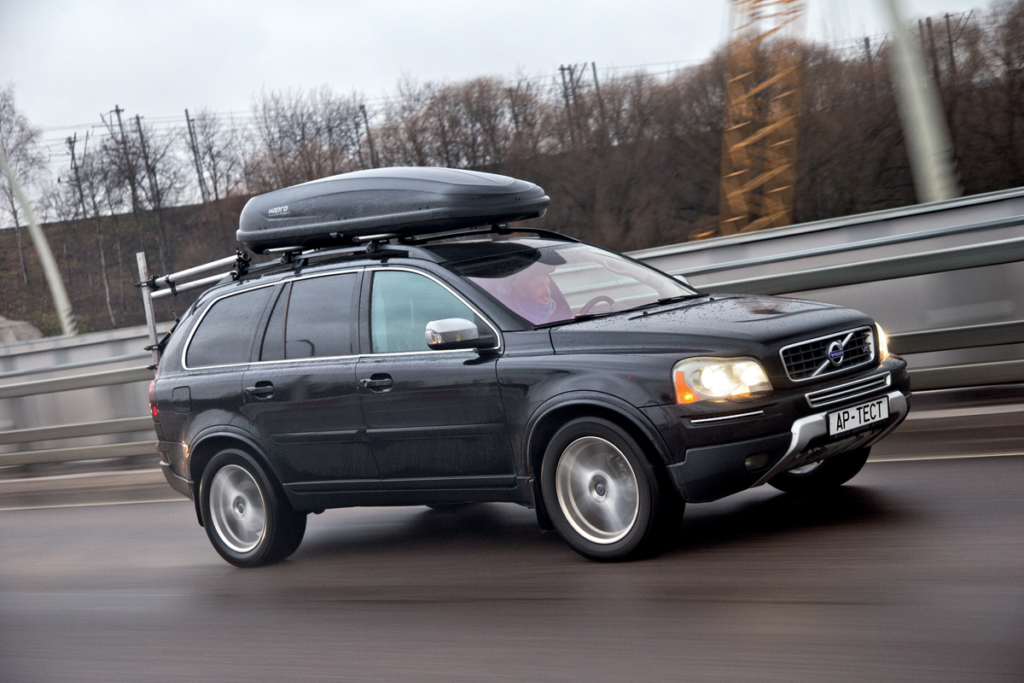
The rare layout — eight cylinders across the bay — and high specific output are a Volvo hallmark. From 4.4 liters it extracted 315 hp, comparable to the naturally aspirated BMWs of the same era. But that power is kept away from the driver: the sound is muffled, the throttle responses smoothed out. By the stopwatch the Volvo is a second slower than the Mercedes, at 7.9 s to 100 km/h on its best attempt, though this is plainly not its sport.
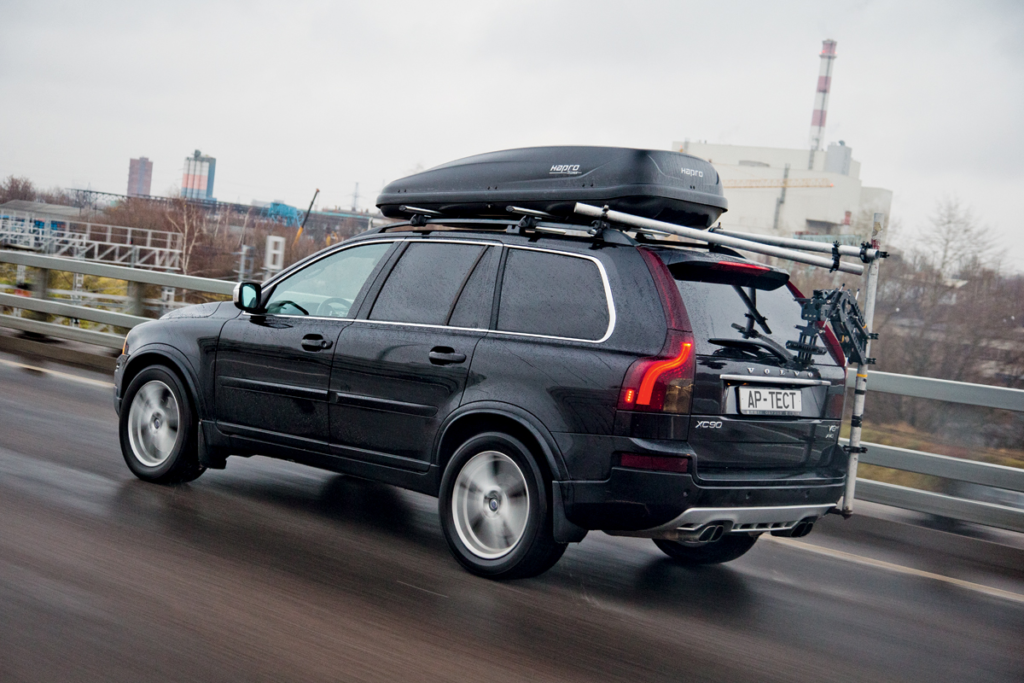
Chasing the filmed car and hanging centimetres off its bumper is not entertainment for an XC90 but work — and work for the driver too. Precise throttle control means using the automatic in manual mode.
The suspension, on the other hand, is supple and comfortable, and will probably stay that way for a long time. The XC90 V8 has plenty of other features that surprise owners unpleasantly on the reliability front, though, so I would not care to say which of these two camera cars is cheaper to run.
YouTube or Hollywood
What I do know is that as a camera car the XC90 with its tail rig handles 90% of automotive video work to a standard that will satisfy the average viewer of a short clip. The Russian Arm is what you need when you are shooting big cinema for the wide screen, with a serious budget and a need for complex but perfect imagery. That, in essence, is the difference between YouTube and Hollywood.
Photo: wikipedia.org | Dmitry Pitersky
This is a translation. You can read the original article here: Моторы закадра: ездим на кинокранах Mercedes-Benz ML 63 AMG и Volvo XC90 V8

Published October 10, 2024 • 13m to read