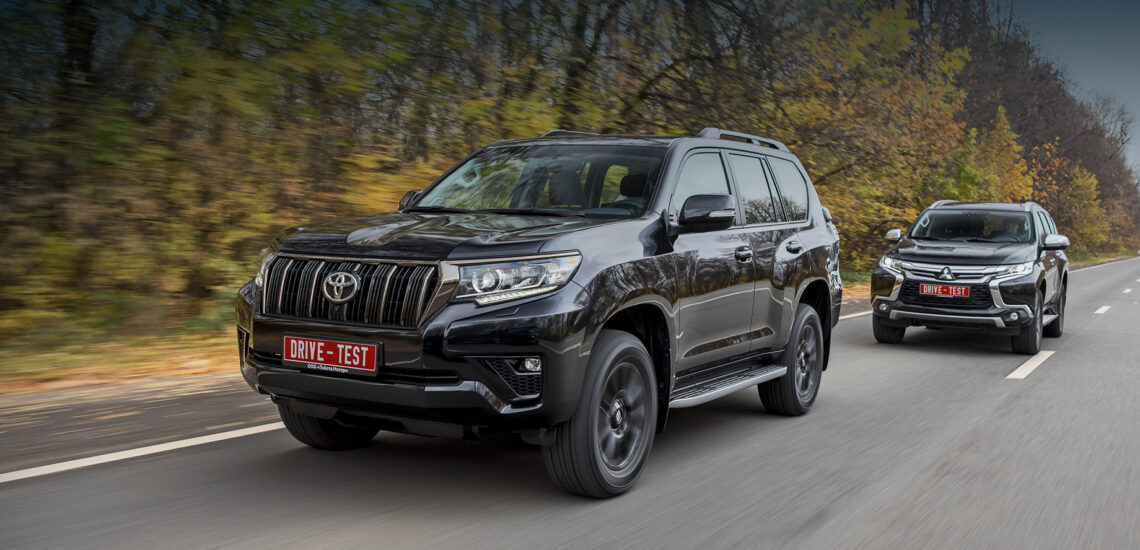

The Toyota Land Cruiser Prado has long been one of the most capable and respected body-on-frame SUVs on the market — but for years, its diesel engine held it back. Now, with an updated 200 hp 2.8-litre turbodiesel under the hood, does the LC150 finally have what it takes to leave the Mitsubishi Pajero Sport behind? We put the two head-to-head to find out.
A full comparative test this isn’t — I had the updated Prado for just ten hours. But with a Pajero Sport on hand as a reference, the comparison writes itself. Since these two body-on-frame SUVs last clashed in our 2017 test, Toyota has introduced the Fortuner and Mitsubishi launched a pickup-based Pajero Sport — formally moving them into different segments. Still, the Sport remains the most useful benchmark in this class.
How the Pajero Sport Still Sets the Bar
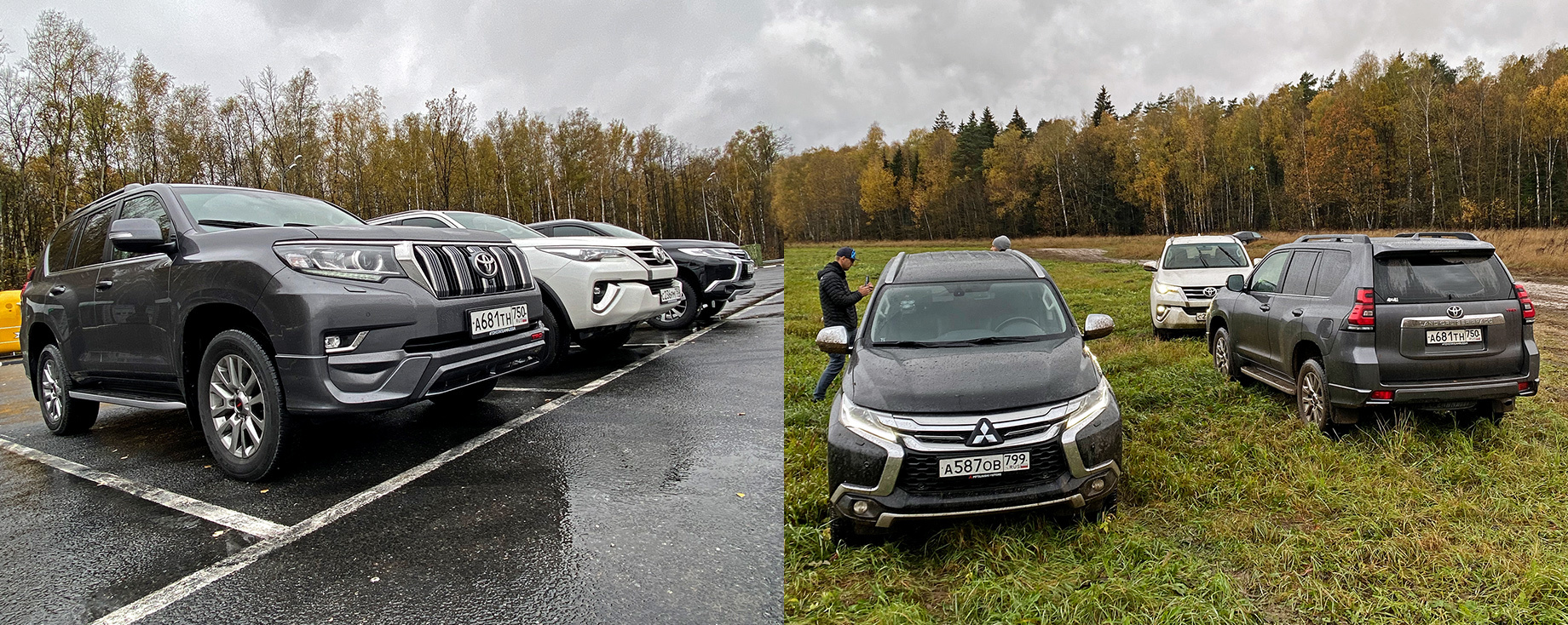
A preparatory blitz with all three contenders — the Pajero Sport, the pre-facelift Prado, and the Fortuner — made one thing clear: despite its age, the Mitsubishi remains formidably capable. Key strengths of the Pajero Sport include:
- Best-in-class measured dynamics — the 180 hp engine is tightly tuned and surprisingly quick off the line
- Intuitive handling — confidence-inspiring even on Yokohama Geolandar A/T tyres with their noted directional sensitivity
- Smooth low-speed ride — the Pajero absorbs rough surfaces better than its rivals up to a point
- Honest manual gearbox mode — useful in off-road situations where precise control matters
- Aggressive traction control — one of the fastest-reacting systems in this segment
Where the Prado Has Always Won
Even before the engine update, the Land Cruiser Prado held clear advantages over its rivals in comfort and refinement. Compared to both the Pajero Sport and the Fortuner, the Prado delivers:
- A more spacious and functional interior — the most passenger-friendly cabin in this segment
- Superior acoustic comfort — noticeably quieter on smooth roads
- Better flat-road ride quality — a more composed and settled feel on motorways
- More informative steering — the wheel is light, but delivers better feedback than the competition
- Sales figures to match — the Prado sells almost twice as well as the Fortuner; the most popular trim is the 2.8 Prestige
The pre-facelift Prado’s one notable weakness: its Kinetic Dynamic Suspension System (KDSS), which uses hydraulic cylinders in the stabiliser links, made it feel stiff and choppy over sharp bumps — a frustrating trade-off for a car so polished in every other way.
What About the Fortuner?
Before focusing on the main comparison, it’s worth placing the Fortuner where it belongs. This is not a flattering picture:
- Rigid and loud — it shakes occupants on rough roads
- Surprisingly capable off-road at speed, thanks to its stiffer setup
- Has the most sensitive accelerator pedal of the three
- Rear jump seats (accessed via the fifth door, which has a servo) are largely symbolic
- Interior design is the most upbeat, but the driving position is genuinely uncomfortable
- Part-time four-wheel drive is simplistic compared to the Prado and Pajero Sport
The Fortuner costs roughly the same as the Pajero Sport, yet sells far worse — and it’s easy to see why. It is, however, what makes the Prado look like good value in context.
Acceleration Test: Updated 200 HP Prado vs Pajero Sport
The engine update — adding 23 hp and 50 Nm to reach 200 hp and 500 Nm — may look modest on paper for a 2.3-tonne SUV. In practice, the difference is more meaningful than the numbers suggest.
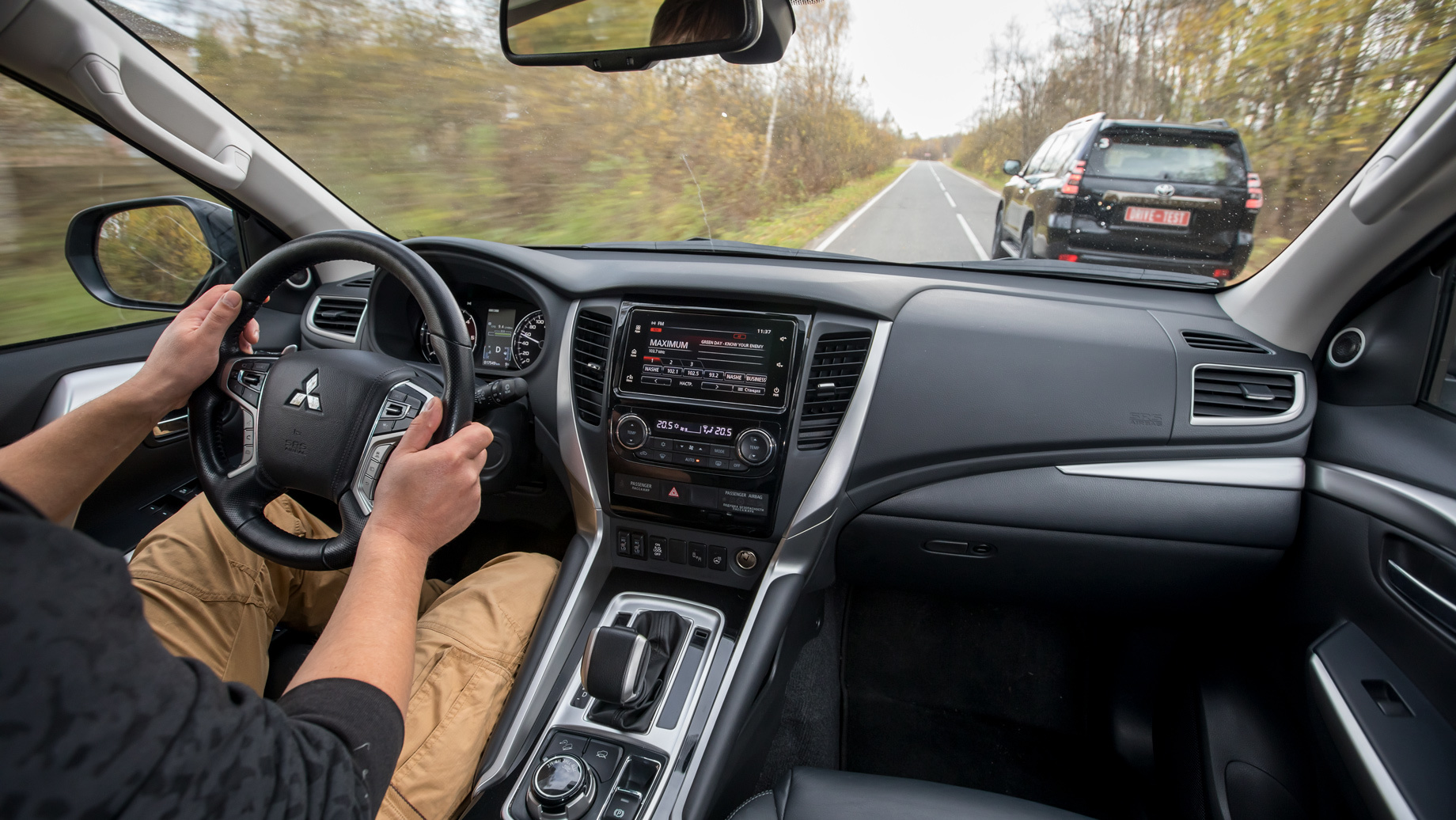
Measured on a test track with one driver and a full 87-litre tank, the updated Prado on Dunlop Grandtrek AT22 tyres consistently clocked:
- Toyota Land Cruiser Prado (200 hp): consistent 11.1 s to 100 km/h; best run of 10.7 s
- Mitsubishi Pajero Sport: best run of 11.5 s to 100 km/h
- Official Prado figure (Germany, 204 hp rating): 9.9 s declared
- Official Pajero Sport figure (Russia): 12.3 s declared — achievable in rear-wheel drive on dry roads
Where the Prado used to trail well behind in a drag race, it now edges ahead. The gap is not vast, but the direction of travel has flipped — and that matters.
Engine and Gearbox: How They Differ
The performance gap is largely explained by how each engine and transmission delivers its power. The Prado’s 1GD-FTV four-cylinder diesel has a clear technical advantage in usable torque range:
- Prado peak torque: available from 1,600 to 2,800 rpm — nearly a third of the full working range
- Pajero Sport peak torque: arrives at around 2,500 rpm, a narrower window
- Prado gearbox: six-speed automatic — fewer shifts, less time lost between ratios
- Pajero Sport gearbox: eight-speed automatic — smoother changes overall, but a noticeable jerk when shifting into second
- Pajero Sport first gear ratio: a very short 4.85:1, which means an early upshift and a brief hesitation before the car gathers momentum
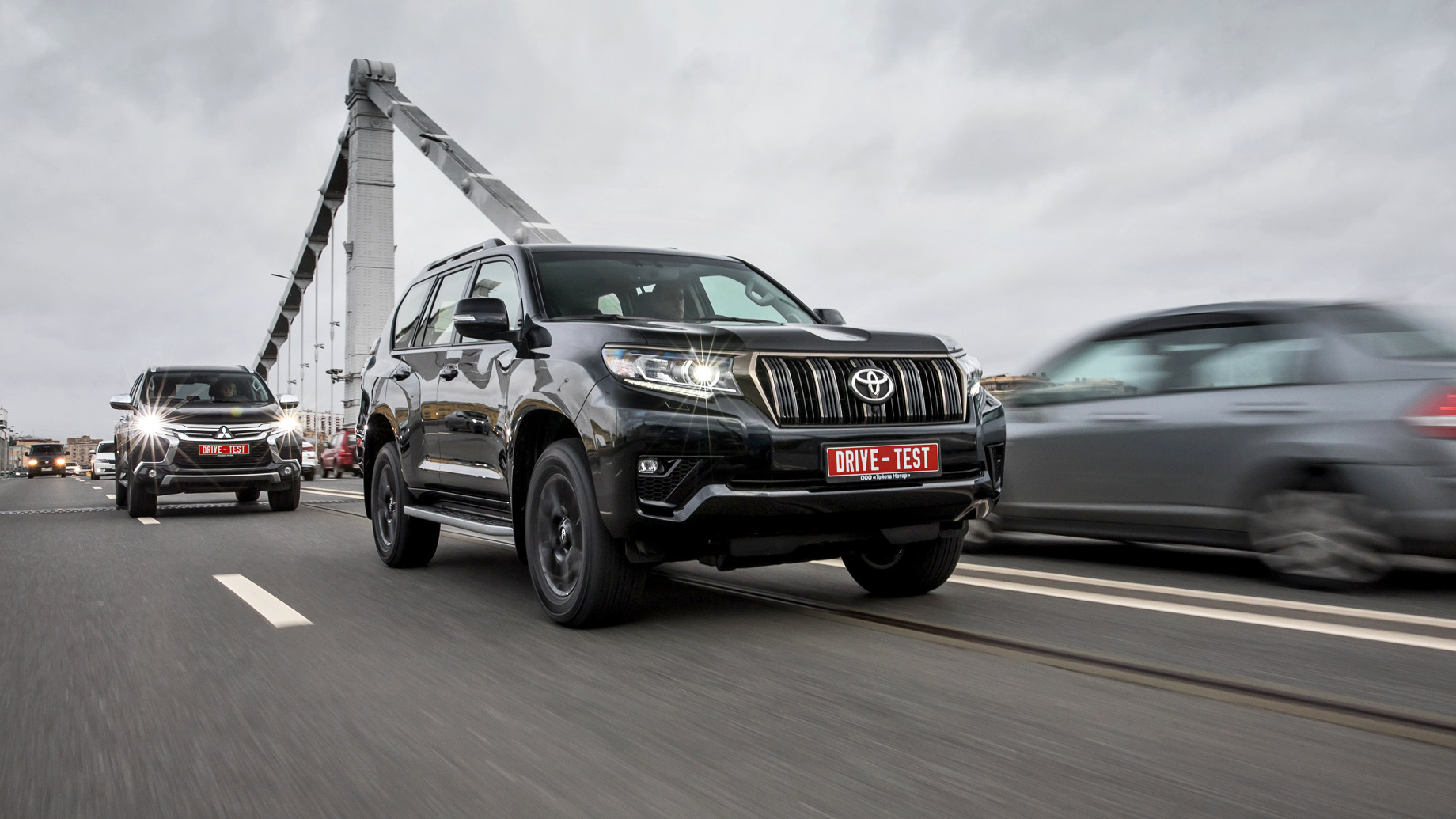
The Prado is also simply more responsive at partial throttle. The Pajero Sport requires a heavy right foot to prompt a reaction — it feels lethargic in everyday driving, with revs rising slowly and no sport mode to sharpen things up. The Prado’s accelerator is more linear, though the torque converter still sits in a grey zone at light loads. Neither car is sharp in the way a performance SUV would be — but the Prado is clearly the more pleasant of the two to live with in traffic.
Engine Refinement: Quieter or Just Relatively Better?
The updated 200 hp diesel did not feel subjectively quieter or less vibration-prone at idle compared to the previous Prado engine — at least not in isolation. Colleagues claim there is an improvement, but confirming it would require a direct back-to-back drive. A few variables cloud the picture:
- The pre-facelift test car wore Bridgestone Dueler H/T tyres — more road-biased and acoustically quieter
- The updated Prado was tested on Dunlop Grandtrek AT22s — an all-terrain tyre that adds road noise
- Against the noticeably louder and more vibration-prone Pajero Sport engine, the Prado’s refinement stands out regardless
In any case, the subjective experience of the updated Prado is a genuine step forward: easier to place in city traffic, more confident on motorway overtakes, and no longer the diesel that owners quietly wished was a V6.
Off-Road: Prado in Its Natural Environment
Spending time in sticky clay after several rainy days is where the Prado earns its reputation. The LC150’s off-road toolkit is comprehensive:
- Low-range transfer case with a crawl ratio (granny gear)
- Front and rear differential locks
- Multi-mode traction control with a dedicated Crawl mode — highly effective
- Sport mode for the engine — sharpens throttle response in mud and ruts where delayed reactions cause stalls
- KDSS suspension — reduces body roll off-road, improving weight distribution control
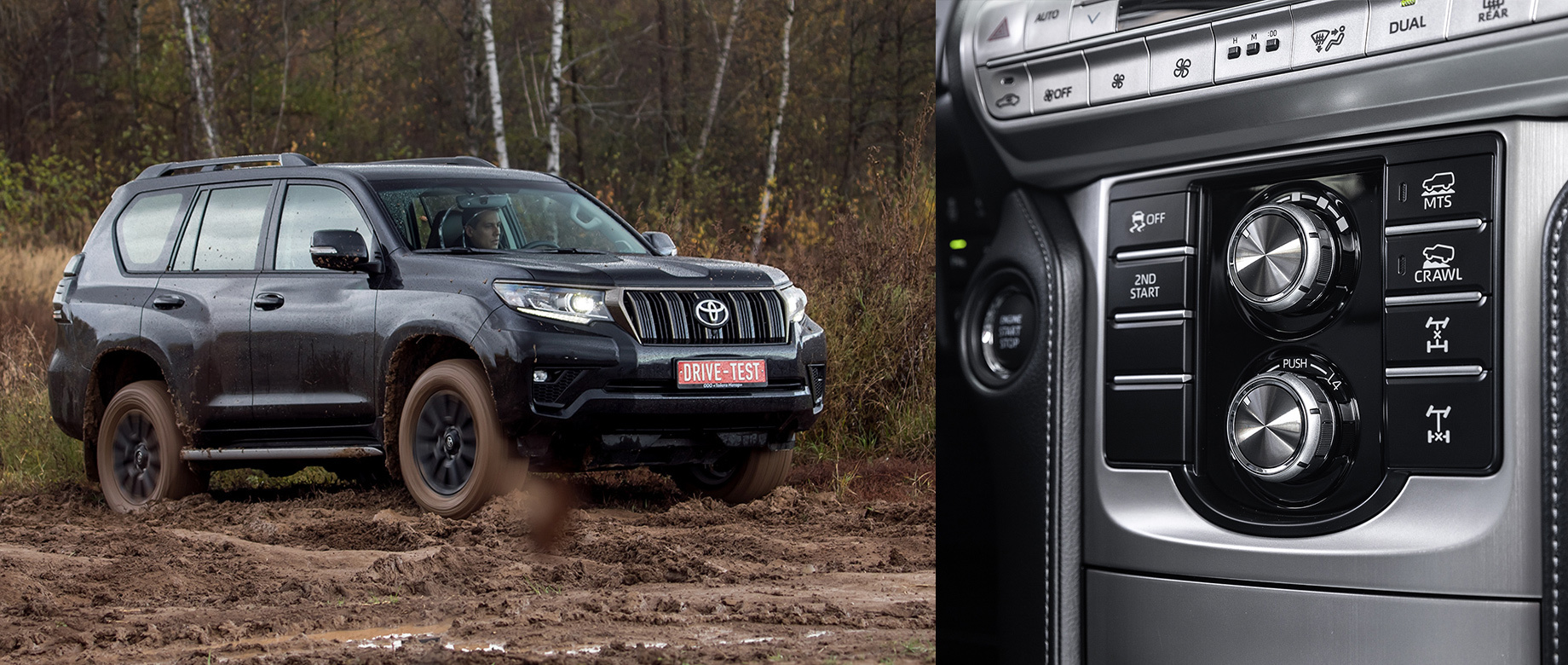
In extreme conditions — deep ruts, steep uphills, water crossings — the rear differential lock stayed disengaged to allow freer manoeuvring. The KDSS system, often criticised for its bump harshness on-road, proves its worth off it: the Prado swings less than a conventional setup, which makes weight distribution far easier to manage when traction is critical. Sport mode for the powertrain is arguably the most important setting in this environment. The urban throttle lag that makes the Prado feel soft in town becomes genuinely dangerous in deep mud — hesitate for a moment, and you’re stuck. With Sport engaged, response sharpens meaningfully.
The Pajero Sport, meanwhile, leans on its honest manual automatic mode and aggressive traction control algorithm to compensate. Both strategies work, but the Prado’s toolkit feels more complete and more configurable — befitting a car aimed squarely at serious off-road use.
Value for Money: Is the Prado Worth the Premium?
Here is where things get complicated. The updated Prado is a significantly better car than before — but the price gap between it and the Pajero Sport remains substantial. Whether the premium is justified depends on what you put alongside it:
- Prado vs Pajero Sport: the Prado’s advantages in space, refinement, and now throttle control are real — but they are not overwhelming enough to make the cost difference feel obvious
- Prado vs Fortuner: the Fortuner costs roughly the same as the Pajero Sport, and next to it, the Prado’s price feels far more reasonable — the quality, comfort, and off-road edge are immediately apparent
- Diesel vs petrol Prado: enough owners found the 177 hp diesel so lacking that they switched to the 249 hp V6 petrol — typically cheaper to buy — just to get adequate performance. The updated diesel should stem that trend
In a sense, the Prado is a pricing hostage. The Fortuner exists below it, and the Pajero Sport exists beside it — and the Prado has to justify its position against both simultaneously. The updated diesel makes that argument stronger, but not yet effortless.
Updated Pajero Sport: What’s Changed
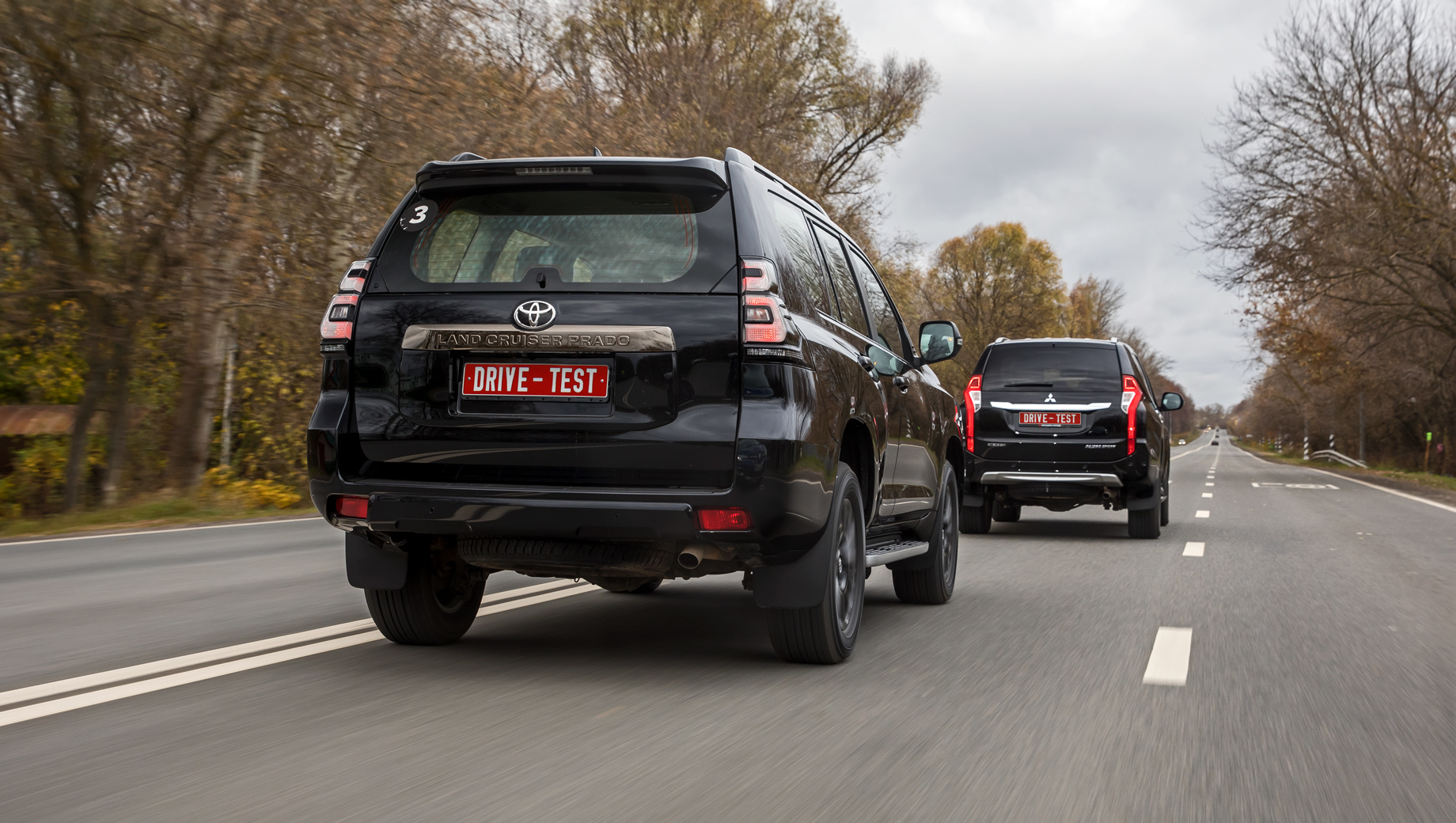
It is also worth noting that a refreshed Pajero Sport has arrived alongside the updated Prado. The changes are incremental but welcome:
- Digital instrument cluster — a visual upgrade over the old analogue dials
- Upgraded multimedia system — improved functionality, though the interface remains fully touch-based
- Revised climate control — physical knobs for temperature replace the previous buttons
- Auto Hold function — added to the electromechanical parking brake
- Power tailgate with a proximity sensor — a genuine convenience upgrade
Prices for the Pajero Sport are expected to rise modestly as a result. Whether the Fortuner 2.8 follows is uncertain — but any price increase on either car will work in the Prado’s favour by narrowing the perceived value gap.
Verdict: A Better Prado, but the Pajero Sport Still Has a Role
The 200 hp turbodiesel update is exactly what the Land Cruiser Prado needed. Before this engine, the diesel version had a real problem: it was so short on urgency that owners actively chose a less capable powertrain to escape it. That’s no longer necessary. The updated Prado is more dynamic in everyday driving, easier to manage in traffic, and more confident at motorway speeds — without giving up any of the comfort, space, or off-road ability that made it worth buying in the first place.
The Mitsubishi Pajero Sport, for its part, is not beaten into irrelevance. Its measured performance, off-road tenacity, and lower price keep it firmly in contention. For buyers who prioritise value and don’t need the Prado’s extra refinement, it remains a strong choice. But the Prado is finally what it should have always been — and that, for Toyota’s sales figures, is likely to matter.
This is a translation. You can read the original here: https://www.drive.ru/test-drive/toyota/5f92af16ec05c46063000254.html

Published July 28, 2022 • 9m to read