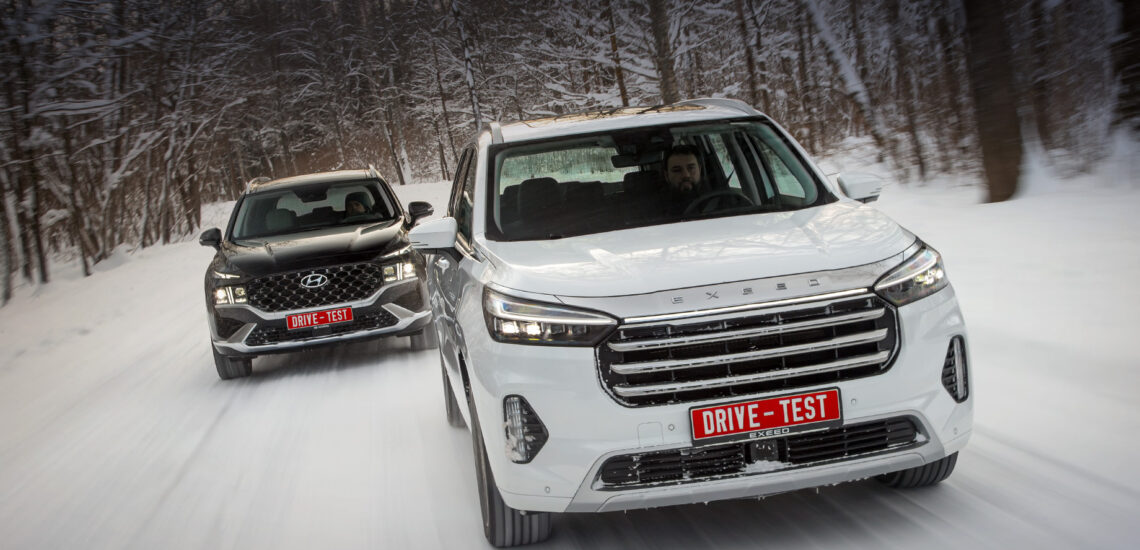

Shopping for a non-premium mid-size crossover? The Hyundai Santa Fe and Kia Sorento are obvious choices — but they come with a catch. With recommended prices between $39,000 and $45,500, both offer powerful engines and capable all-wheel-drive systems, even with a third-row seat. The problem? Dealers routinely add margins exceeding $13,000, and ordering one rarely comes with a firm delivery date or price. So what if a lesser-known brand offered more space, more seats — and saved you money? Enter the Exeed VX, a compelling alternative worth your attention.
Specs and Powertrain: How Do They Compare?
For the price of a mid-size SUV, the Exeed VX delivers a five-meter, seven-seat crossover. Our test car featured a 249 hp turbocharged 2.0-liter gasoline engine. We paired it against the Santa Fe 2.2 turbodiesel — the most torque-focused option in Hyundai’s lineup, which also includes 2.5 and 3.5 naturally aspirated petrol engines. The diesel produces around 50 hp less than the Exeed’s unit, but counters with superior torque: 440 Nm vs 385 Nm. Both crossovers share similarly matched drivetrains — dual-clutch gearboxes and a multi-disc clutch rear axle drive.
Exterior Design: Size vs Style
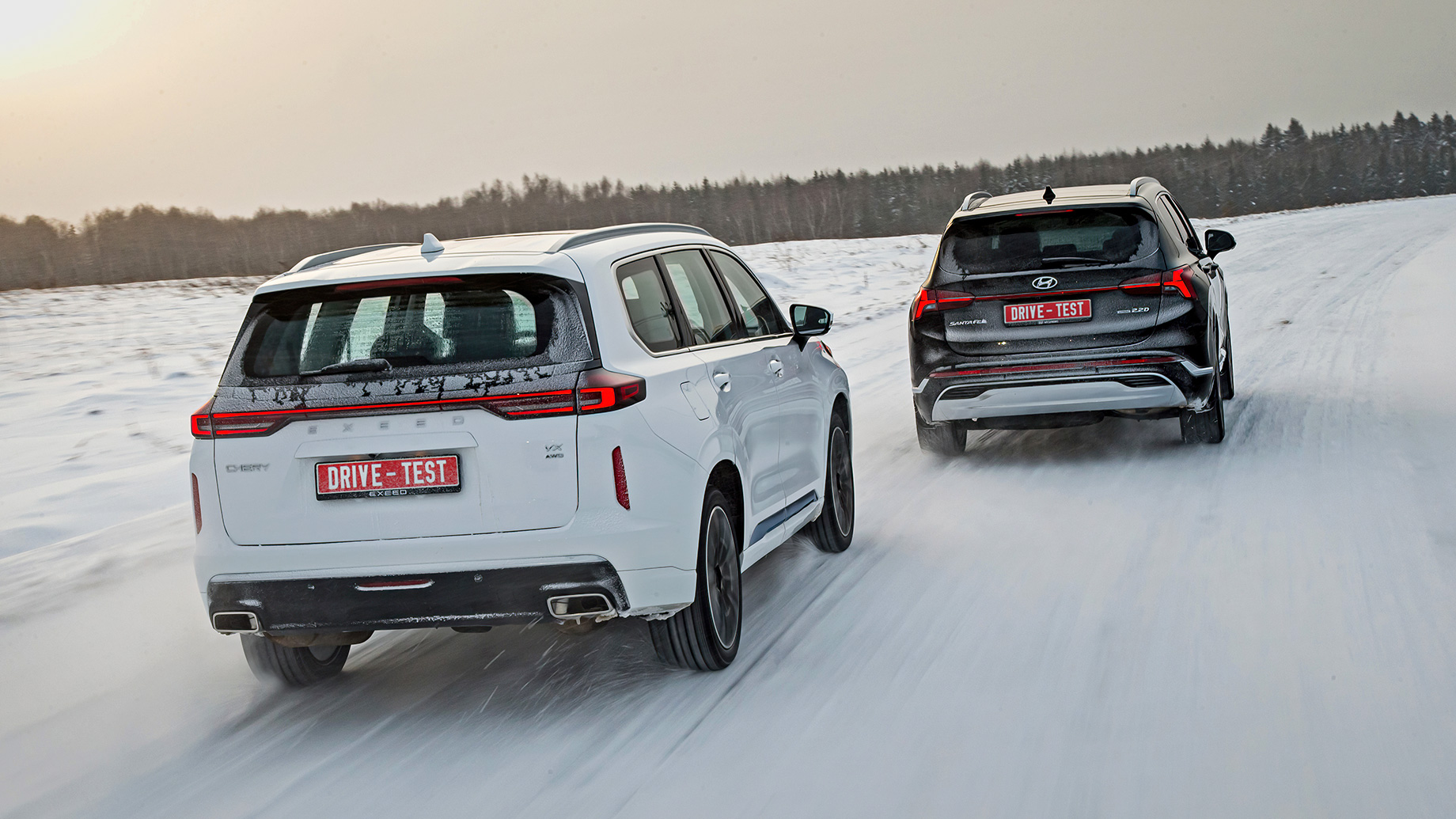
The Exeed VX sits tall on raised bumpers and sills — genuinely useful for ground clearance. Its sheer size pushes it close to Hyundai Palisade territory, but the styling doesn’t quite match. Flat side panels and a boxy rear hatch give it more of a raised minivan silhouette than a true SUV. Build quality is another concern: panel gaps are noticeably uneven across the body.
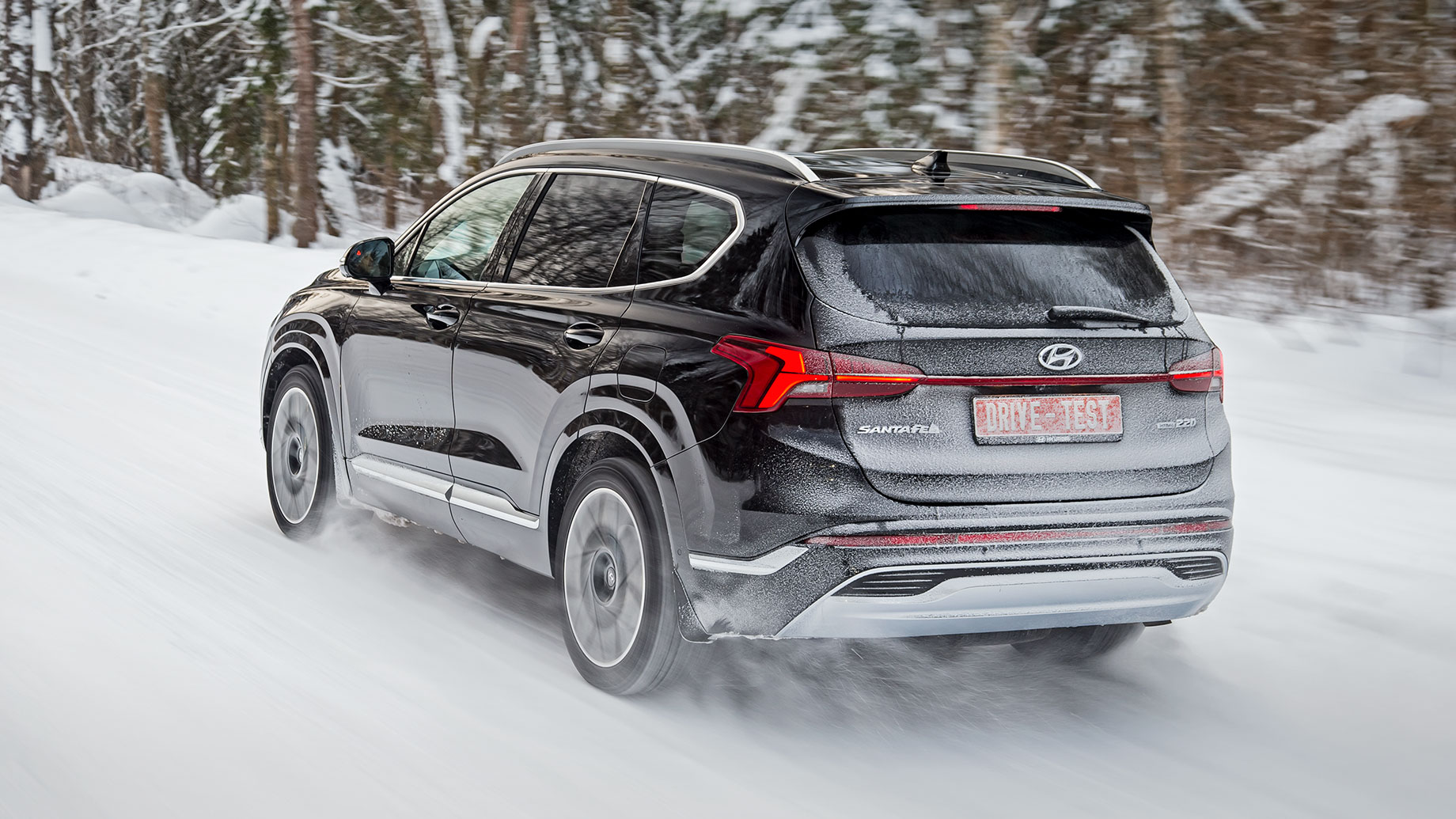
The Santa Fe makes a stronger visual impression. Highlights of the top-tier Calligraphy trim include:
- Striking double-deck LED optics
- Body-colored bumpers with sculpted arch protectors
- 20-inch alloy “throwing star” wheels
- Cleaner, more consistent panel fit and finish
Interior Quality and Ergonomics
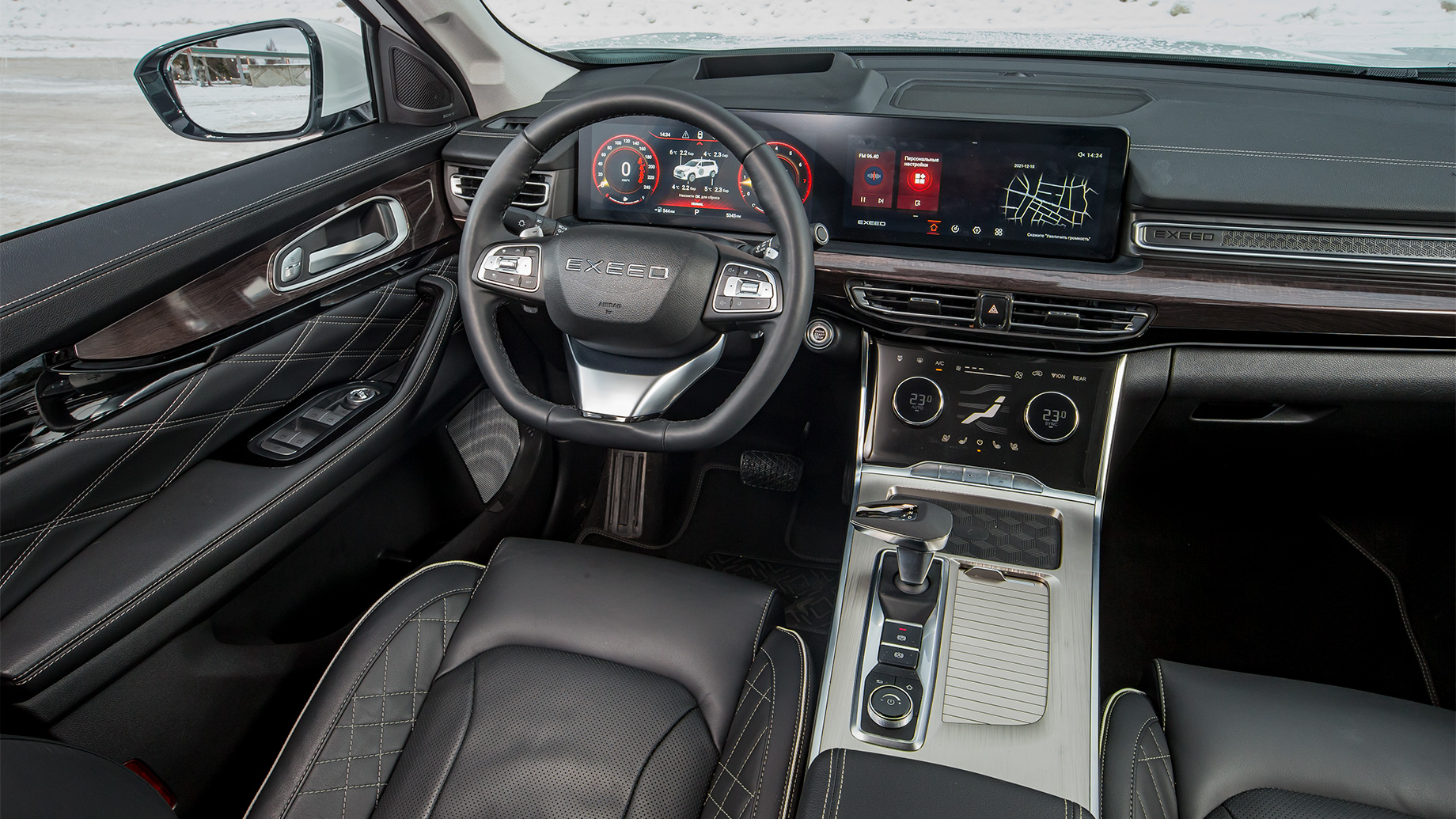
Step inside the Exeed VX and you’ll spot familiar influences — a dual 12.3-inch display setup under a single glass panel that echoes Mercedes-Benz, and a haptic climate control panel reminiscent of Land Rover (Chery does have a joint venture with the British brand, after all). It looks premium at first glance, but the ergonomics fall short:
- The central touchscreen is positioned too far from the driver
- No proper physical controls on the center tunnel — only back and home shortcut keys
- All touch surfaces respond with a noticeable lag
- Steering wheel buttons sit too close to the rim, leading to accidental presses
The driver’s seat itself is pleasant — low-mounted, solidly built, with subtle side bolstering and a comfortable profile. The wide door openings and upright A-pillars make entry and exit easy. Steering wheel adjustment range is modest but sufficient for most drivers.
The Santa Fe’s cabin tells a different story. The Calligraphy trim elevates the experience noticeably:
- Two-tone Nappa leather seat upholstery
- Real aluminum center console trim
- Alcantara headlining
- High-resolution dual displays with a premium image quality
- Support for both Apple CarPlay and Android Auto (the Exeed only supports Apple devices)
The Santa Fe’s steering wheel also adjusts across wider ranges, and the seat features a softer filling, better lumbar support, and a thigh extension — making it the more ergonomically refined option overall. The door pockets, however, are annoyingly narrow.
Passenger Space: Second and Third Row Comfort
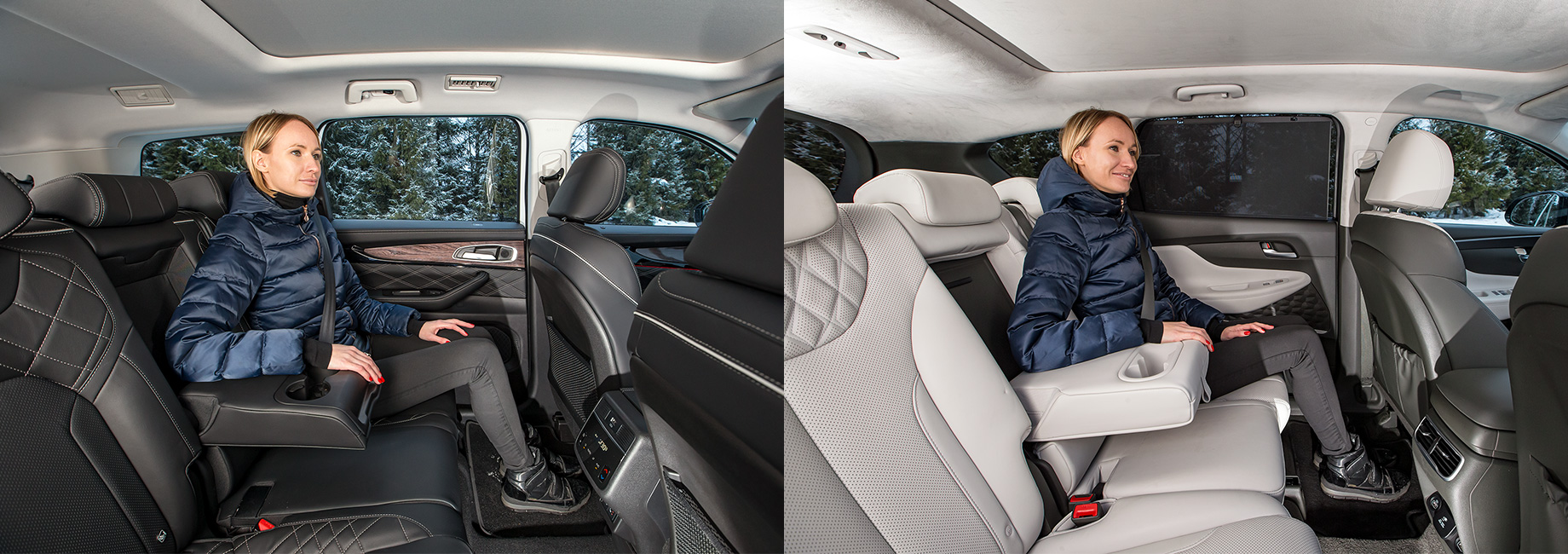
This is where the Exeed VX genuinely shines. The second row offers:
- Significantly more legroom and headroom than the Santa Fe
- A wider range of fore-aft seat adjustment
- Enough width to seat three adults comfortably
- A wide, low center tunnel that the middle passenger can rest their feet on
The seat cushion is comfortable, though the backrest is a touch too convex. The third row is the real surprise — it’s genuinely usable even for adults over 180 cm tall, with easy access and no unwanted contact with the front seats or ceiling.
The Santa Fe’s second row, on the other hand, has its own merits. The cabin width actually exceeds the Exeed’s, the floor hump is lower, and side window curtains are a nice touch. The seat itself is softer and more enveloping — we could have dozed off in it. But the third row is a different story. In the seven-seat Prestige and High-tech configurations, the back bench is cramped in every direction and forces passengers into an uncomfortable knees-up posture. The top Calligraphy trim doesn’t even offer a third row at all.
Performance and Driving Dynamics
On paper, the Exeed’s numbers look competitive — 0–100 km/h in 8.5 seconds, versus 9.2 seconds for the Santa Fe diesel. In practice, it’s a different picture. The Exeed’s robotized gearbox is so cautiously managed by the electronics that the Santa Fe is already pulling away before the VX has properly launched. The gap only grows from there.
The VX’s three driving modes each have significant drawbacks:
- Eco and Normal — throttle response is excessively delayed, only suitable for stop-and-go traffic
- Sport — more responsive, but overly aggressive; gear shifts are slow despite being smoother
Mid-range acceleration is equally telling. Triggering kickdown from 60 km/h, the Santa Fe pulls ahead immediately. Only above 120–130 km/h does the Exeed’s petrol engine start to close the gap.
The Hyundai’s four driving modes — Comfort, Sport, Smart, and Eco — are all usable in everyday driving. The eight-speed dual-clutch gearbox responds crisply, shifts rapidly, and Sport mode effectively limits top gear usage to keep the engine in its power band.
Ride Comfort and Off-Road Capability
Neither crossover excels at ride comfort — both transmit sharp impacts from cracks, joints, and larger potholes, and interior rattles appear on rough graded roads above 30 km/h. The Exeed rides slightly firmer across the board, though the difference isn’t dramatic. It also suffers more from body pitch and roll longitudinally and laterally.
One advantage for Santa Fe buyers: wheel size flexibility. Factory options include 17-inch wheels, which meaningfully improve ride compliance. The Exeed comes only with 19- or 20-inch wheels as standard — no softer option available.
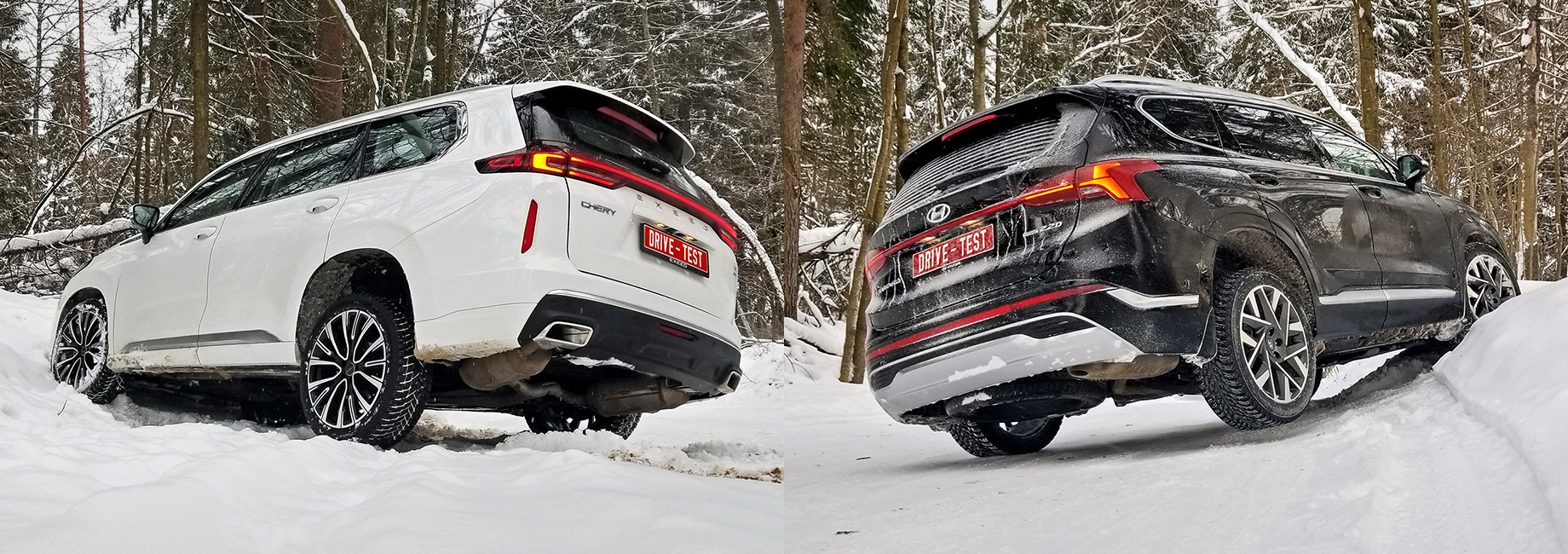
Off-road, both SUVs have notable limitations. The Exeed’s front axle tends to dig in on loose snow before the rear connects, and cross-axle situations become impassable. The Santa Fe has better geometric ground clearance and a smoother underbody, and its simulated inter-wheel differential lock works more effectively — but the rear clutch pack overheats alarmingly fast under sustained low-speed off-road use.
Handling: On-Road Feel and Steering
On tarmac, the Santa Fe is more composed — it changes direction readily, body roll is moderate, and braking is confident. The weakness is the steering, which offers little feedback and feels vague, a trait common to many Korean SUVs. The stability control system is non-switchable and tuned conservatively, leaving little room for spirited driving.
The Exeed actually impresses more on slippery surfaces, thanks to predictable AWD behavior and a stability system that can be fully disabled. Braking feel is decent, though the pedal travel is longer than ideal. On dry asphalt, however, the VX feels unfinished — soft, unsettled, and prone to torque steer that makes it feel like a second pair of hands is randomly interfering with the wheel.
Verdict: Should You Buy the Exeed VX Over the Hyundai Santa Fe?
The Exeed VX has real weaknesses — the powertrain needs recalibration, the steering and suspension require refinement, and ergonomics inside the cabin could be significantly better. Despite its size, it’s not particularly capable off-road without a properly tuned traction control system.
Yet it offers a genuinely compelling package for its asking price of $45,500:
- Seven full-sized seats with usable third-row space for adults
- A large, practical trunk
- A premium-looking interior with dual large displays
- Higher acoustic comfort than the Santa Fe
- A 7-year / 200,000 km warranty
The Santa Fe is the more polished, enjoyable car to drive — but the pricing tells a different story. At $45,500, you’re either stuck with the underpowered 2.5-liter in a well-equipped trim, or the strong diesel engine in a spartan Lifestyle configuration. The Calligraphy trim, which represents the Santa Fe at its best, climbs to $65,700. And across all trims, the Santa Fe still suffers from a rough ride, weak AWD, and imprecise steering.
If you can live with the Exeed’s quirks and don’t need a sports car, it offers more space and more warranty for significantly less money — and in today’s market, that’s a deal worth considering.
This is a translation. You can read the original here: https://www.drive.ru/test-drive/exeed/hyundai/61cc2ead6966c12d74e0e20a.html

Published February 17, 2022 • 7m to read