

We met Frank during a routine tire test, and I couldn’t resist asking: “Can I take it for a spin?” Growing up, a car like this was nothing but a dream for me!
This Mercury Marquis Brougham is the same age as me — 1977. I’ve lived long enough to fulfill my childhood dream, while the car has simply survived all these years, unscathed. Thanks to the rarity of snow in Texas, it even dodged the rust that usually claims cars this old.
A Brief History of the Mercury Marquis
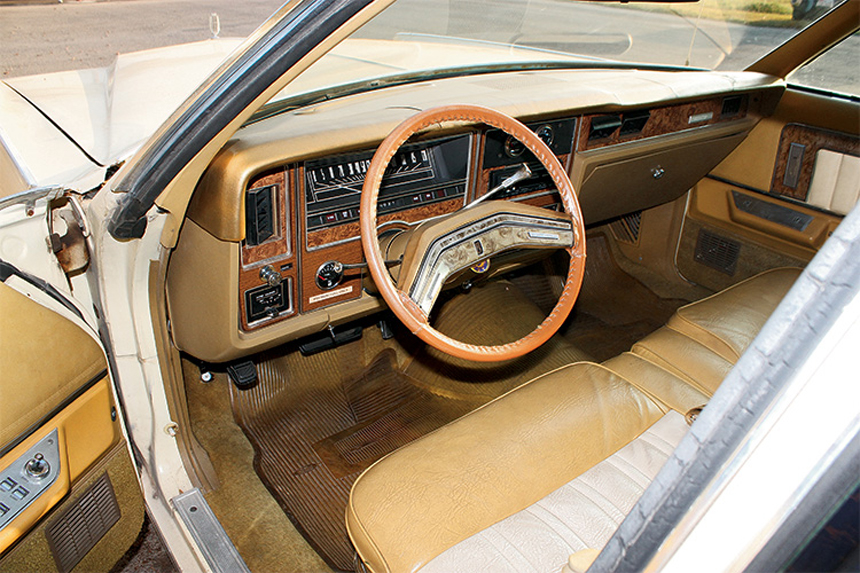
Its design is simple but noble. A standardized steering wheel, identical to those on many models of the Ford, Mercury, and Lincoln brands.
The roof is covered in vinyl that matches the body color. There isn’t much chrome decoration, but this nearly six-meter-long Marquis Brougham still looks grandiose. Here’s what made the third-generation Marquis (introduced in 1971) such a significant part of Mercury’s lineup:
- It accounted for nearly a third of all Mercury sales in the late 1970s.
- Americans bought around 140,000 units a year.
- Coupes made up 10% of sales, station wagons a quarter, and the rest were sedans like this one.
- The early-70s oil crisis effectively ended the era of traditional American “full-size” cars.
- By 1977, General Motors and American Motors had already stopped producing full-size sedans — only Ford, Lincoln, and Mercury held out, and only for two more years.
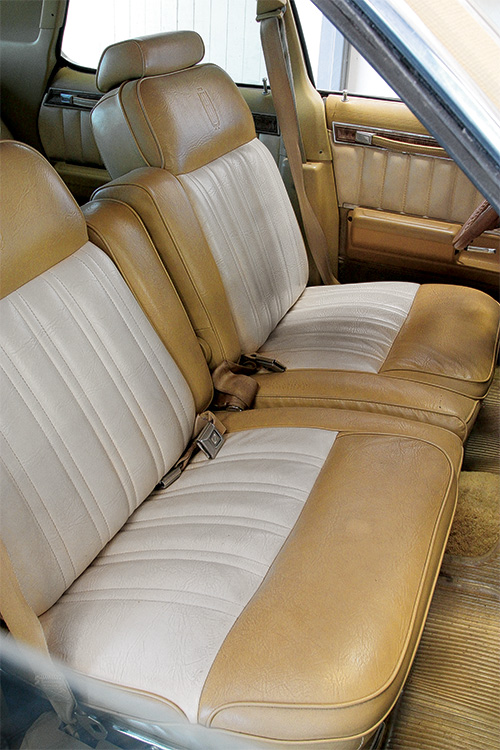
The seats are soft and uncomfortable – the curved ‘wheel-like’ backrest doesn’t support the shoulders.
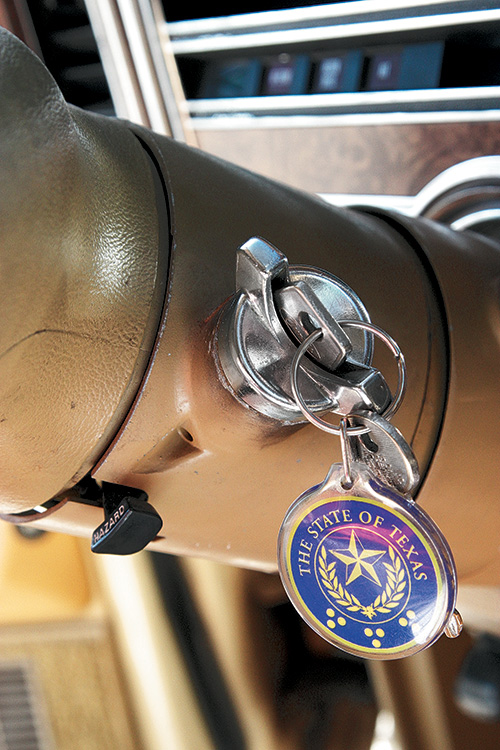
Turning the thick steering wheel is far more enjoyable than simply using a modest ignition key. The black ‘hat’, stretching downwards, serves as the emergency signal switch.
Engine and Performance: What Powered the 1977 Marquis
The only crisis-driven innovation for the 1978 Marquis lineup was a “small-capacity” 5.7-liter (145 hp) engine. With that engine, the dynamic qualities of the more than two-tonne vehicle fell to the level of a classic Lada: 0-100 km/h in 16.2 seconds. My test car, however, has the “right” engine for a Marquis:
- Engine: V8, 7.5 liters (460 cubic inches)
- Power: 202 hp
- Torque: 472 Nm
- 0-100 km/h: 12.5 seconds
Trim Levels, Pricing, and Factory Options
Out of three available trim levels, this Brougham — priced at $6,600 — was the mid-range model. Standard features on this trim included:
- Front seats with separate backrests and two armrests
- Electric clocks
- Remote control for the left rear-view mirror adjustment
- Mudguards on the rear wheel arches
Buyers could also add these factory options:
- Air conditioning — $580
- Cassette radio with auto-search — $200
- CB radio
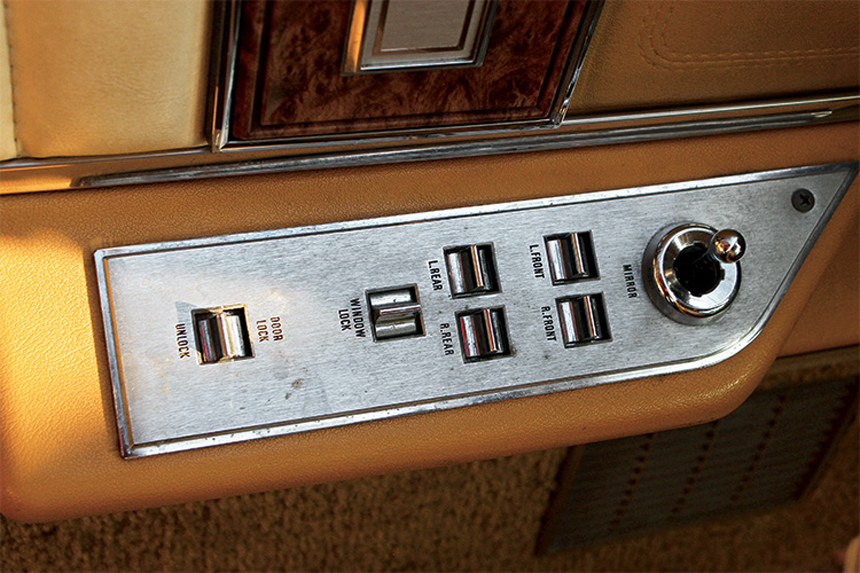
A robust joystick is used for manually adjusting the left mirror.
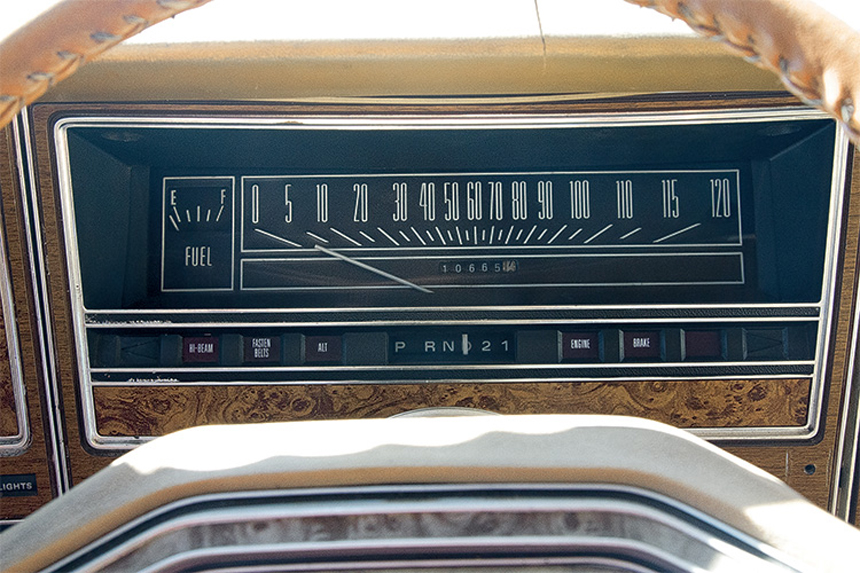
The straightforward rectangular style of the instruments is typical for the seventies.
Cargo Space and Rear Seat Comfort
The trunk lock is hidden under a sliding emblem, and there’s also an electric lock button inside the huge glove box. The declared cargo volume is a generous 643 liters, though I suspect this figure doesn’t account for the spare tire mounted on the “pedestal” above the fuel tank. Getting into the backseat takes some effort: the door opening at the top is narrow, and the seat is shifted back. But once you manage to slide in and stretch out on the deep velour carpet, leaning back on the soft couch, being human feels mighty proud — especially in America!
The doors feature monumental metal lighters and ashtrays. Seat belts are inertia-reel, but waist belts only. Looking outside can also be challenging, since the rear pillars are too wide.
The view from the driver’s seat, by contrast, is excellent. Thin pillars and a wide interior rearview mirror help (although this particular car skips the optional right exterior mirror). Ahead, there’s an enormous hood measuring roughly two by two meters, with the hood emblem as your “sight.”
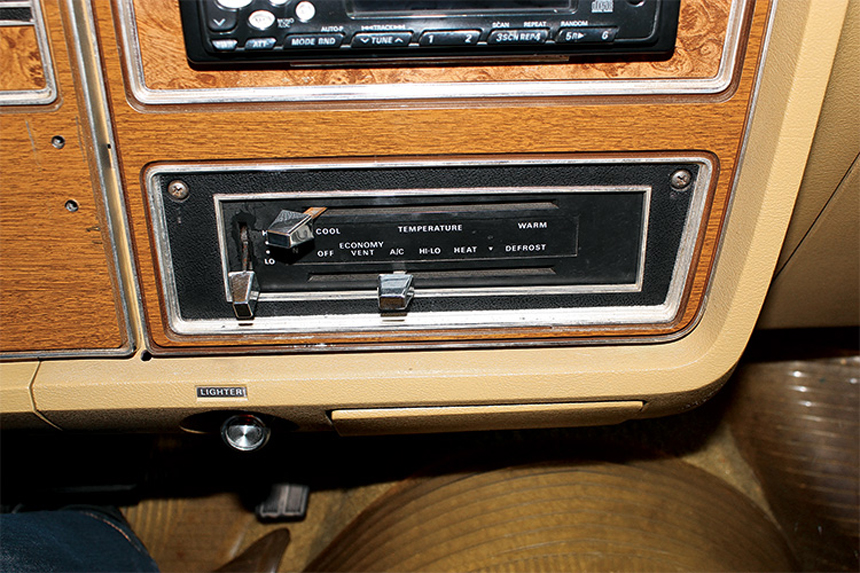
Airflow adjustment is specific: if the window steams up, move the lever to the Defrost position.
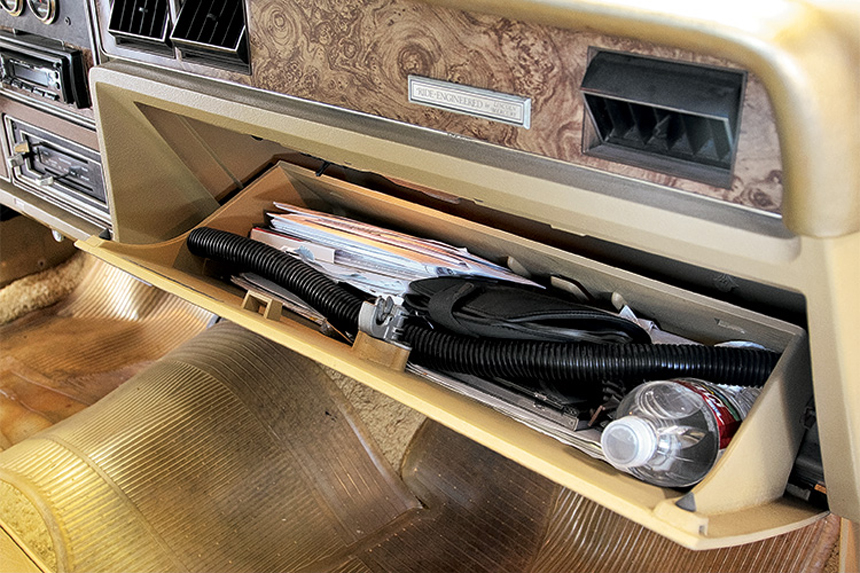
The glove compartment is as massive and wide as the Mercury itself.
Interior Design and Dashboard Layout
The imperial-style interior is, admittedly, primitive by modern standards. The “wood-like” plastic on the dashboard looks cheap, and screws are visible in the most conspicuous places. But your body relaxes on the springy couch, soft and creaky like a chair in front of the TV. Electric controls handle everything, including the height and tilt of the cushion — only the upper part of the backrest hangs unsupported. The center of the backrest features two folding armrests; fold them down, and you can seat a third passenger. However, the broad transmission tunnel restricts legroom, and only a non-retractable waist seat belt is provided.
Even for a tall driver, there’s enough room behind the wheel. I would have liked to tilt the steering column toward me, but the original owner of this Marquis skipped the optional six-position adjustment. The steering wheel, with its leather cover and metal cruise control buttons, is thin, with a small outer diameter of only 380 mm.
The speedometer numbers line up in a row, like on a “kopeck” (VAZ-2101), with the fuel gauge to the left. There are no other gauges on the factory dashboard. Originally, flip-digit electric clocks sat to the right of the panel, but the current owner has swapped them out for far more useful retro-style coolant temperature and oil pressure gauges. Otherwise, the equipment is luxurious even by today’s standards — though almost all of it, including tinted windows and cruise control, was optional. Electric window lifters in frameless doors, however, came as standard, and they’re notably quick, with metal rocker buttons that seem built to survive a nuclear war.
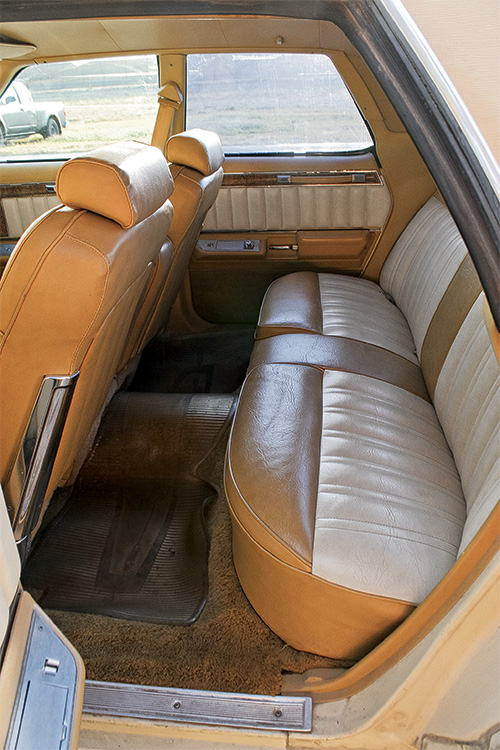
The back is very spacious and cozy, but there’s no central armrest, and only two safety belts, both waist-level.
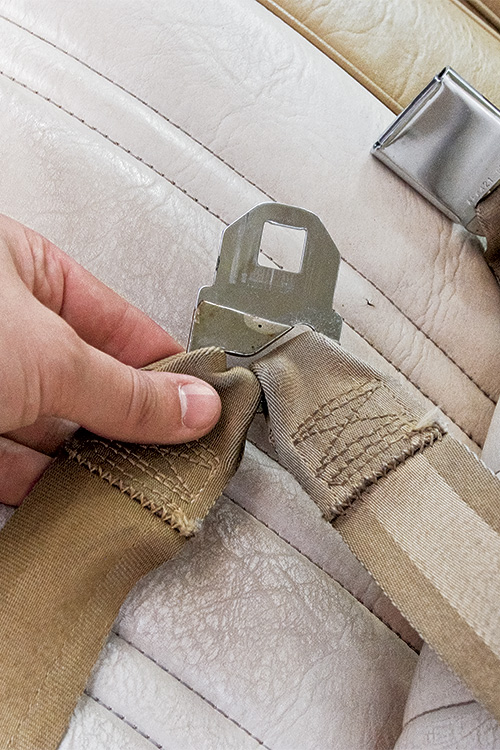
The front safety belts have two inertia reels each (one for each strap), and the locks resemble those found on airplanes.
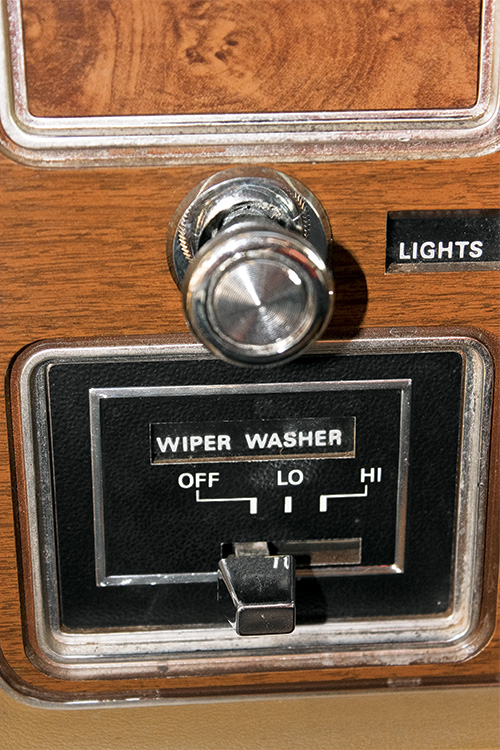
Provocatively cheap ‘wood-like’ plastic sits side by side with robust metal switches.
Starting the Marquis: Controls and First Impressions
To the left of the wheel is the light switch. Pull it all the way out to the second position, and the vacuum actuator opens the cast aluminum headlight covers with a quiet hiss. Turn it further, and the dome light and front footwell lighting (also an option) switch on.
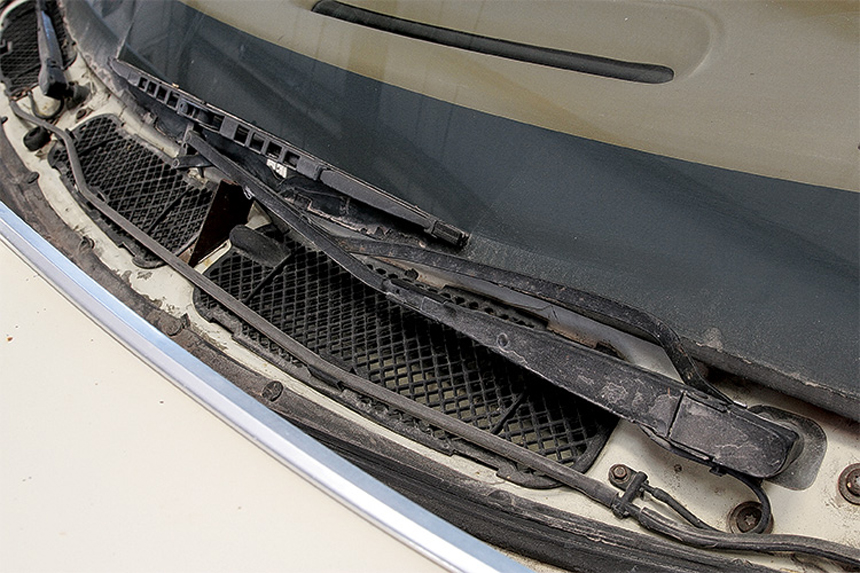
Just below is the heavy metal wiper lever. The left wiper uses a parallelogram mechanism that “carries” the brush toward the windshield pillar, and in the parking position, the brushes slowly crawl out of sight under the hood — an advanced solution for its time.
Starting the car means turning not a key, but the massive ignition lock’s knob, into which the key is inserted. The first thing to wake up is the oil pressure warning buzzer. If the engine is cold, you pull the “choke” lever to the right of the steering wheel — do you still remember what a carburetor air throttle is?
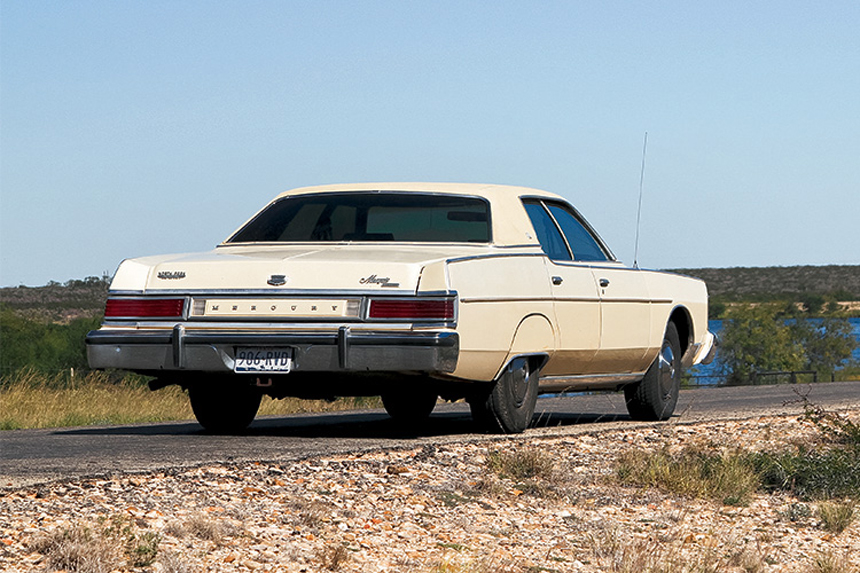
The Marquis’ engine purrs with a throaty, rumbling sound. The exhaust pipes extend to either side under the rear wings, and standing behind the vehicle, you can hear the alternating firing of the robust V8’s cylinders. Bang to the left, bang to the right — it’s rhythmic, measured, and each beat sends a delightful resonance pulsing through your chest.
I pull the automatic shifter toward me and down, aligning the little indicator on the dashboard with the letter “D.” We take off smoothly, and by the time we hit 20 km/h, it feels as if we’re either gliding or floating above the road.
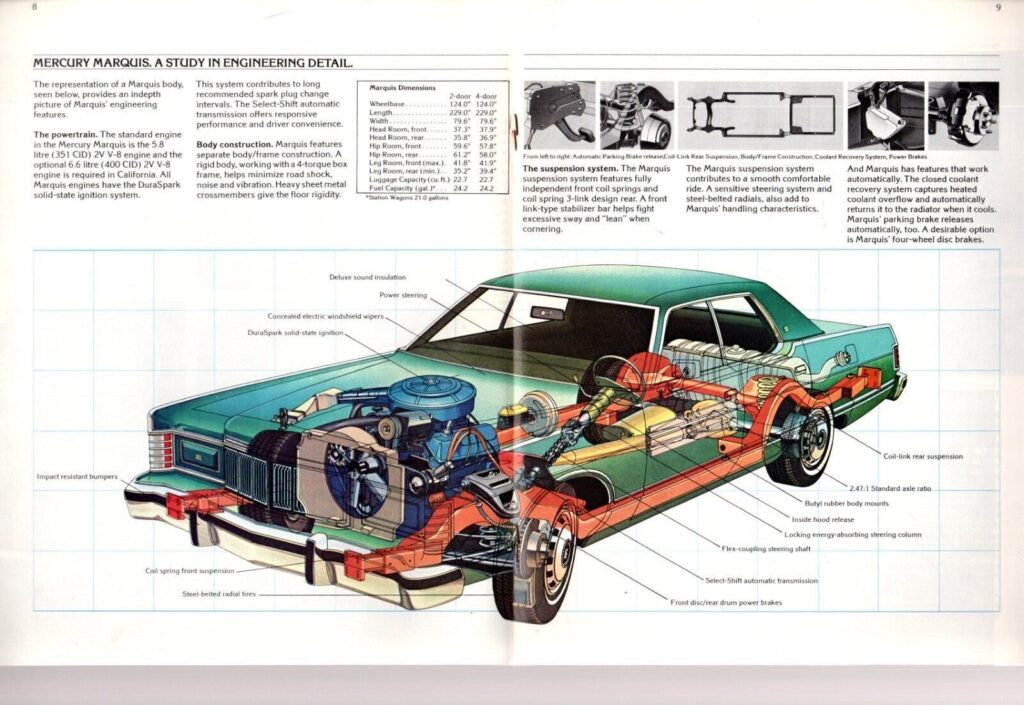
Stepping on the gas initially just amplifies the engine’s growl. Only after a brief pause does the three-speed Select-Shift automatic transmission channel torque to the wheels. Gear shifts are minimal — so “long” that first gear revs up almost to 100 km/h, and second gear reaches beyond 160 km/h. The smoothness is extraordinary, and the way the hood rises during acceleration is something to behold.
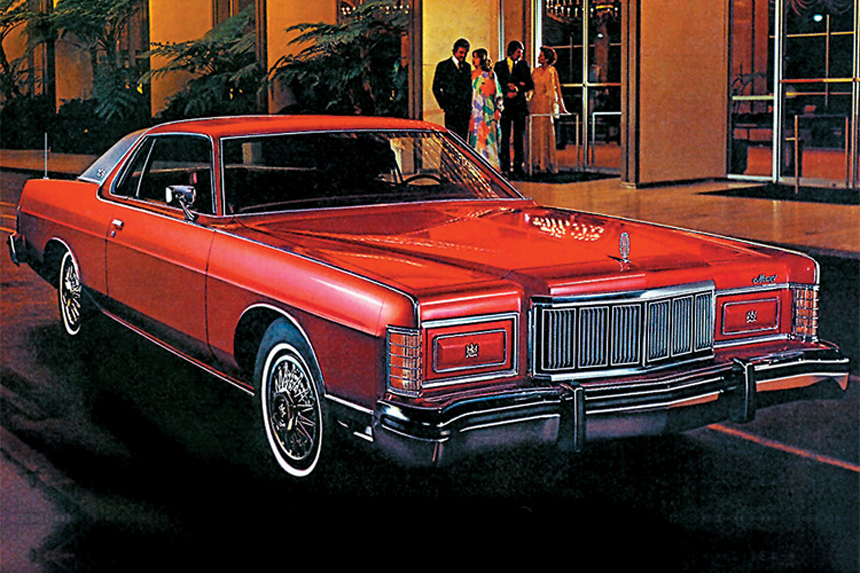
The coupe was $100 cheaper than the sedan, but today it’s valued one and a half times higher.
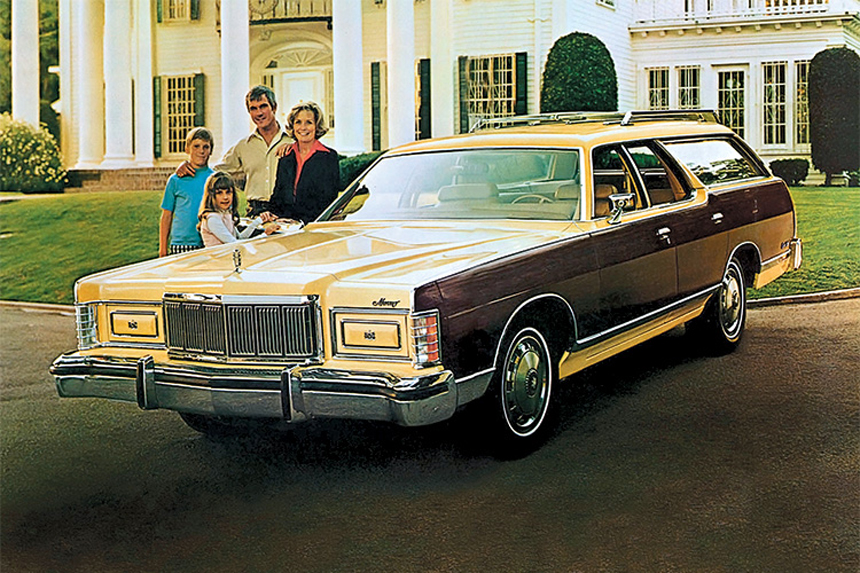
The Marquis Station Wagon was only offered in the simplest configuration, but for an extra cost, you could get it with ‘wooden’ side paneling.
Ride Quality, Handling, and Steering Feel
The road is flat, yet the Marquis sways softly in all directions — initially unsettling, but soon there’s a unique thrill to be found in it. American style, indeed! The suspension is incredibly soft; pressing down on the fender easily “sinks” the car by a few inches. For the Marquis, potholes simply do not exist, and the high-profile tires on modest 15-inch wheels swallow every joint and crack in the road.
Lock to lock, the steering wheel takes 4.2 turns, but the response is far “duller.” In a 90-degree turn, you almost have to rotate it a full round. Steering effort? Absent entirely — the wheel turns so lightly and lifelessly it feels as if the steering shaft isn’t connected to anything.
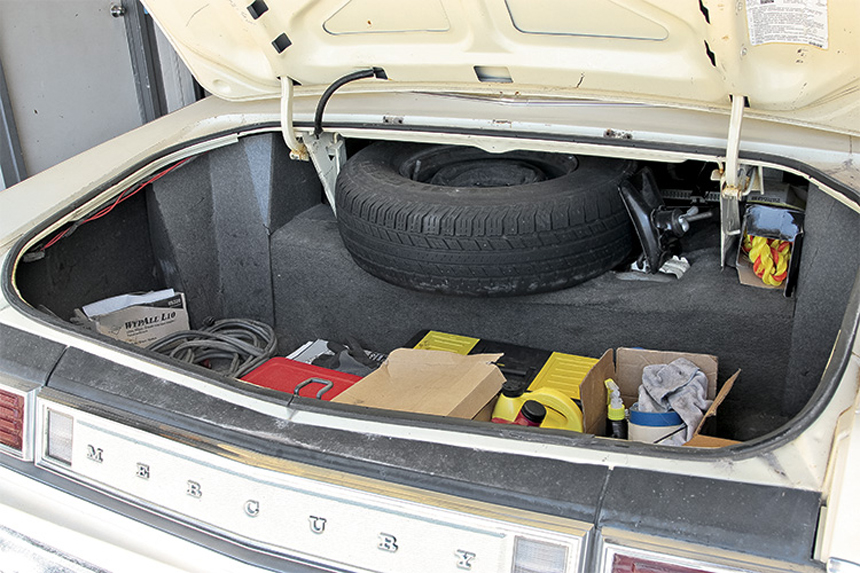
The trunk is senseless: it’s deep but short, and the loading height is massive.
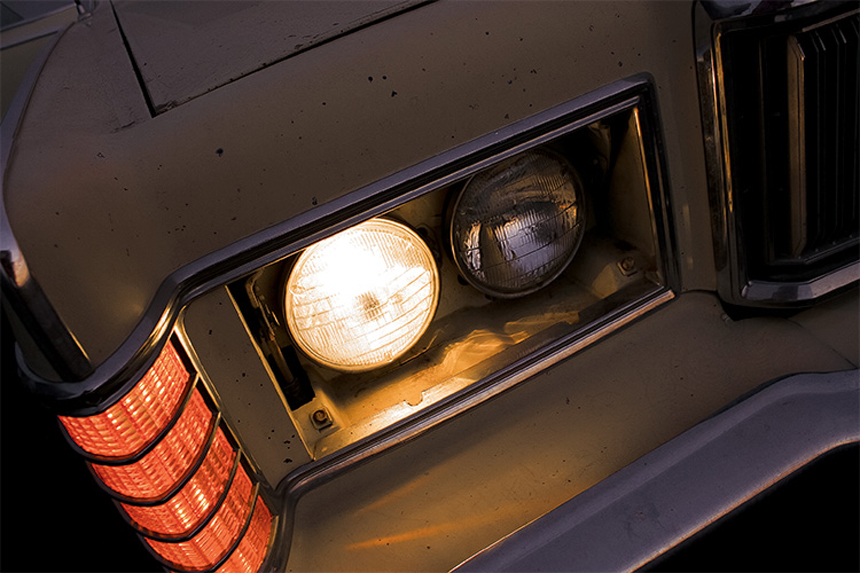
The cover opens when low or high beam is turned on; the lamps – headlights have a symmetric light distribution.
The Levitation Effect: What It’s Really Like to Drive
Flipping on the air conditioner with the lever on the right, a powerful blast of cold air hits your face and disconnects you from reality. You become completely detached from the car — any control input gets lost somewhere inside it and emerges a second or two later. Soon it feels as if there’s no car at all; you’re simply flying, carried by some magical force. Levitation!
Only turns bring you back to earth. The soft, “over-assisted” brake pedal must be pressed well in advance of a curve. The couch-like seats don’t hold your body well, and even at modest speeds, you find yourself leaning to the side. The tires squeal in protest, and the body rolls dramatically.
But then again, how many sharp turns are there in the US? This is the land of interstates, and now I understand why their lanes are so wide.
Why the Marquis Captures the Spirit of 1970s America
Just as one should drink local wine in each country, in America, one should drive its cars. The “United Automotive States” have changed little since the seventies. They still need vehicles that won’t tire your hands and legs with excessive effort, and suspensions that will swallow the roughly jointed, ridged concrete on the highways while only slightly swaying after the yellow “Rough Road” sign. On a “full-size” ride like this, there’s an undeniable urge to traverse America from coast to coast, stopping at single-story “cardboard” motels, dining on burgers and cola, and spending evenings at drive-in theaters.
How Much Does a Mercury Marquis Cost Today?
Riding alone or with a companion in a six-meter car is, admittedly, the pinnacle of egotism. It’s no wonder that as early as 1979, this Marquis was replaced by an entirely new, more compact and economical model. Today, one of these dreadnoughts from the 60s and 70s can be bought for surprisingly little. Remember how Danila Bagrov in “Brother 2” picked up a Cadillac De Ville for $500? That’s realistic. Here’s roughly what to expect on the current market:
- Average condition: $1,000–$2,000
- Pristine condition: $6,000–$7,000
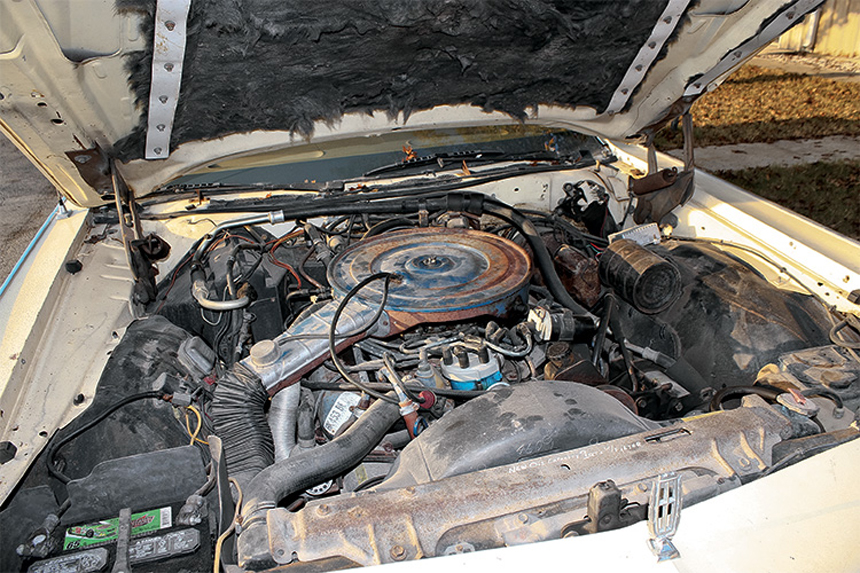
The V8 7.5 engine has plenty of room under the hood.
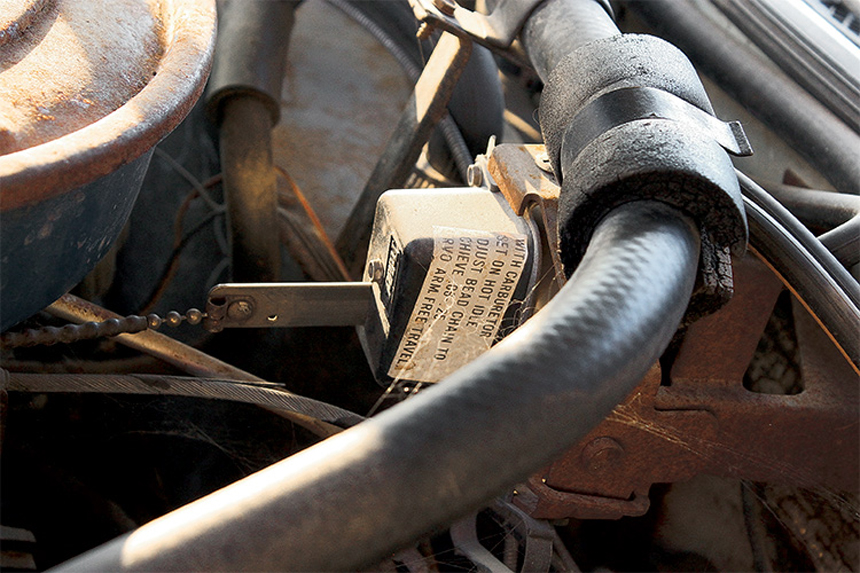
The cruise control has a mechanical vacuum actuator that pulls the throttle linkage by a chain.
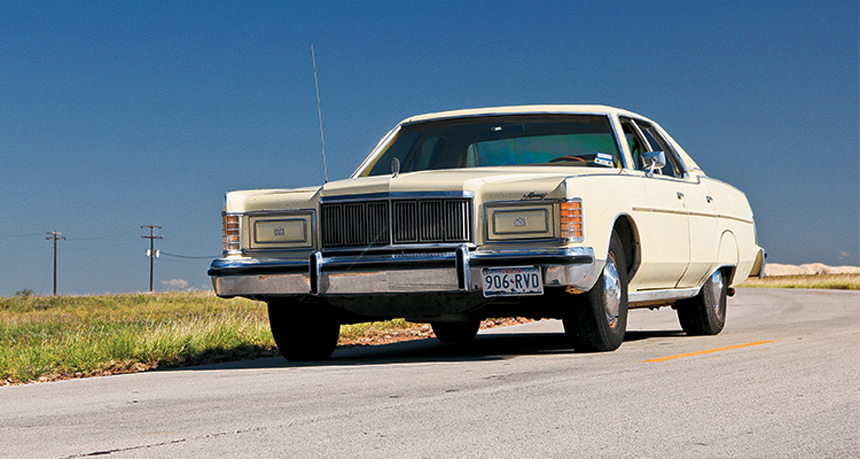
The advertisements boasted of superior aerodynamics – supposedly, the wipers are tucked under the hood, and the rear wheels are covered by shields. But in reality, the coefficient of aerodynamic drag (Cd) is as high as 0.53!
Photo by Nikita Gudkov
This is a translation. You can read an original article here: Никита Гудков поездил за рулем Mercury Marquis Brougham 1977 года выпуска

Published August 09, 2023 • 9m to read