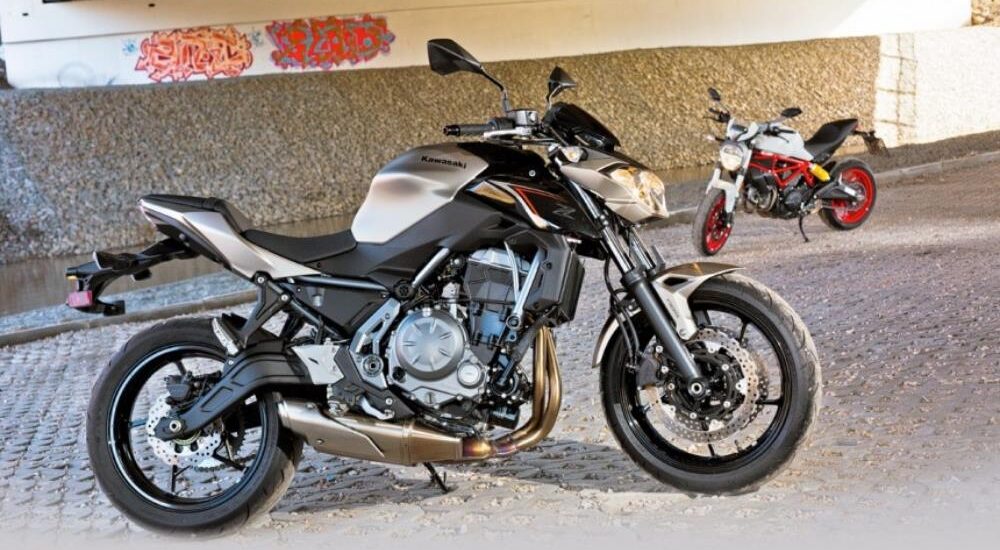

The Kawasaki Z650, the successor to the renowned “ER-6n,” is a name we’ve come to know. But is it better than its classmate, the Ducati Monster 797? Italy vs. Japan in the increasingly popular segment of mid-sized naked bikes.
Japan against Italy in the middleweight class
In all seriousness, the Kawasaki Z650 and Ducati Monster 797 make up one of the most popular pairs among novice riders, akin to the Polo and Solaris in the world of motorcycles. Notably, the Kawasaki is assembled in Thailand, while the Ducati hails from Europe — though there is a possibility that the 797 might be produced in Thailand soon as well, since “Italian” bikes are already being manufactured there for the Asian market.
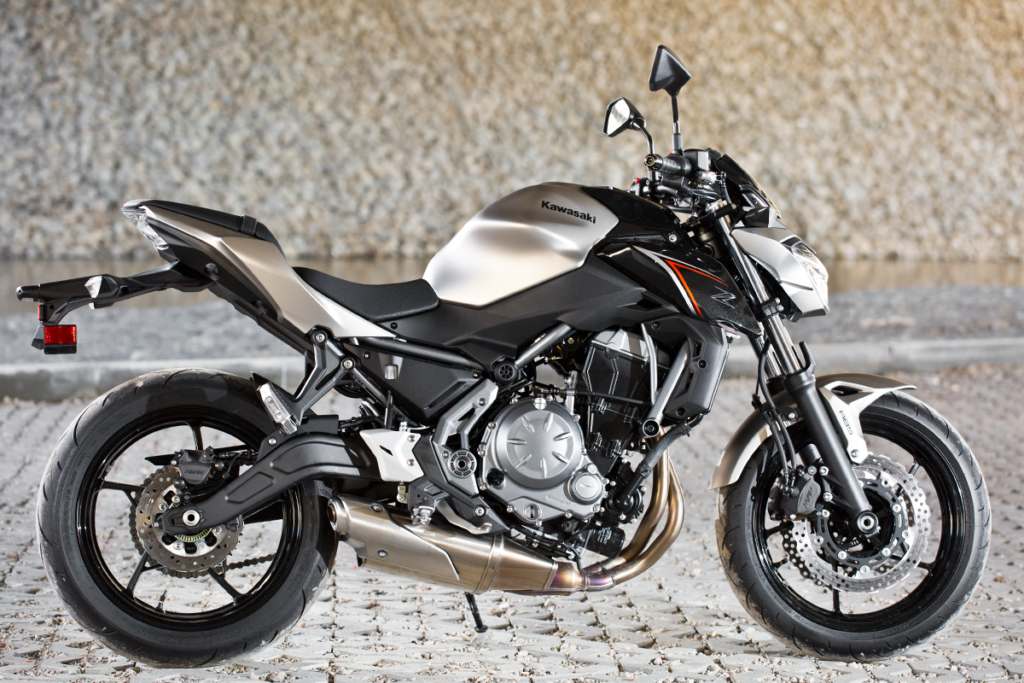
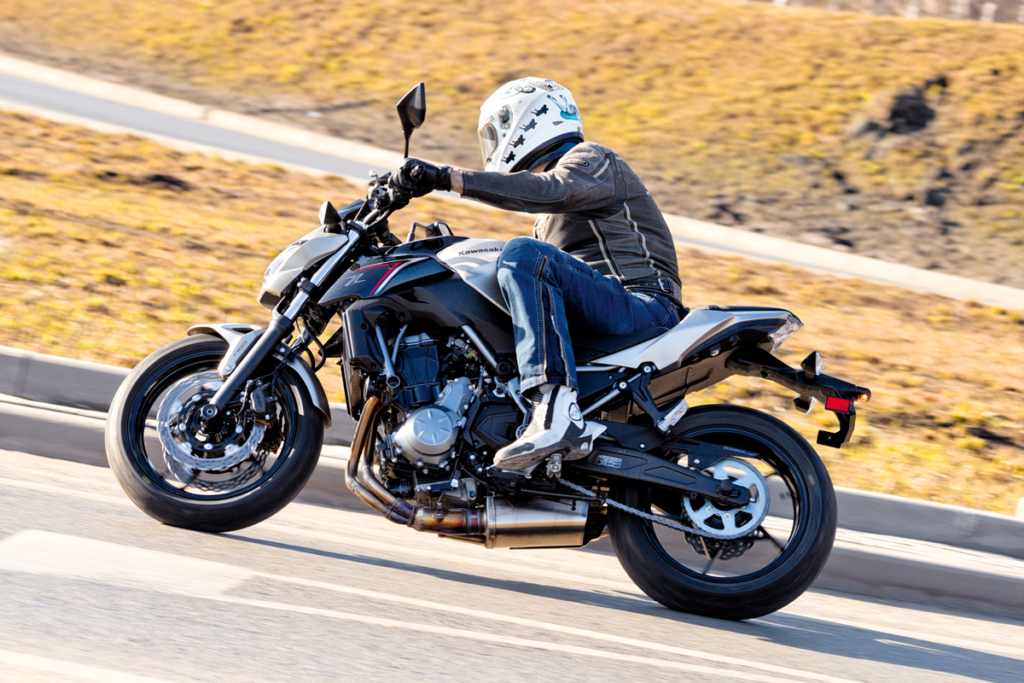
Kawasaki Z650
First impressions: size, mirrors and the pillion seat
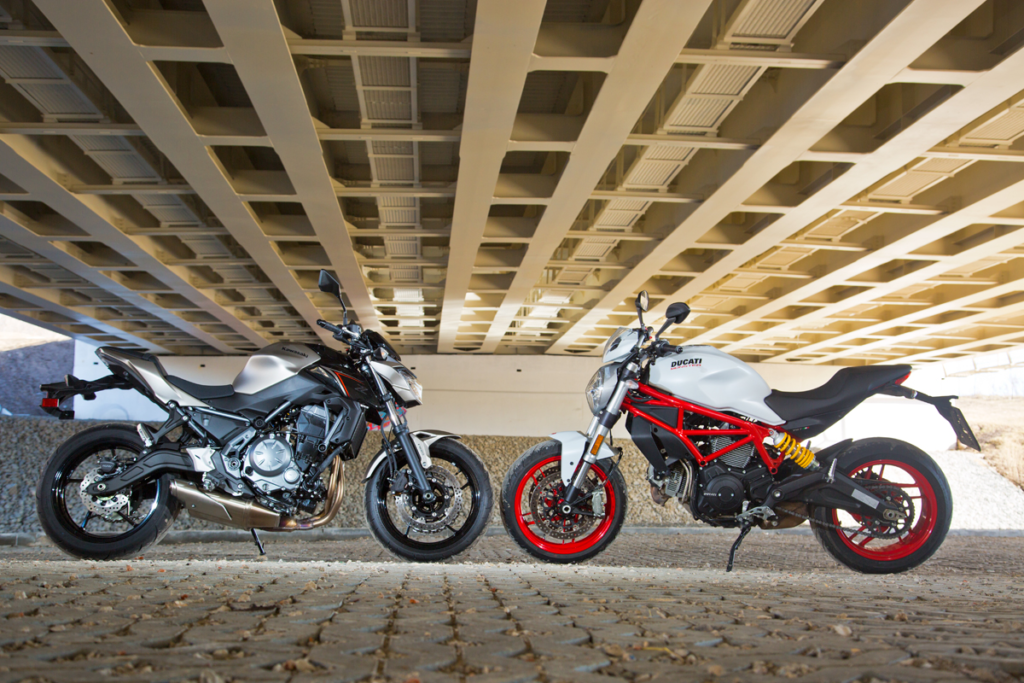
At first glance the Kawasaki appears more aggressive, while the Ducati opts for simplicity. Another significant difference is that the “Japanese” bike feels more compact, while the creation of Italian engineers is more spacious and comfortable. The Ducati has the beginnings of a fairing, but the Kawasaki has the better mirrors: they give a clearer view and, importantly, they fold, unlike the massive fixed Italian ones.
Interestingly, not even the official website gives the width of the Ducati 797, so we had to break out the measuring tape. The result: 800 mm, which is 25 mm more than the Z650. Those 25 millimeters can make a difference in dense traffic, especially compared with the slim Kawasaki Z650, which seems like a yoga master enduring a lifetime under the scorching sun.
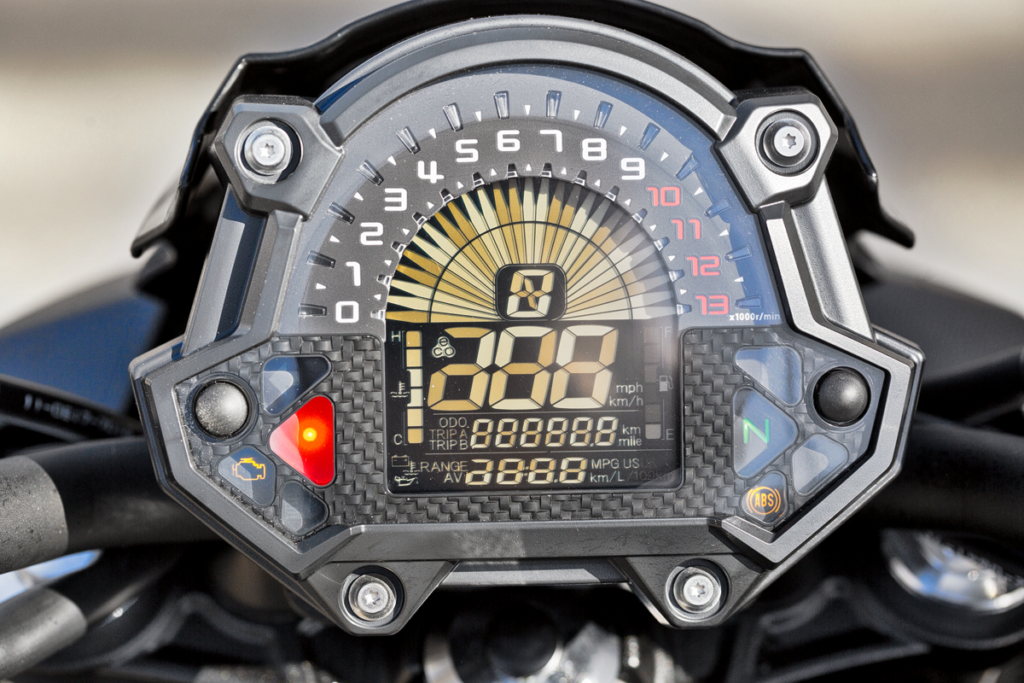
The Kawasaki instrument panel is far from an art masterpiece, but all the necessary information is presented clearly and understandably.
Both bikes have abbreviated tails — stylish, but impractical for carrying luggage, which you will have to place either behind the passenger seat or over the passenger’s shoulders. Speaking of the latter, the Japanese have left very little legroom for the passenger, and sitting there is almost as uncomfortable as on a sportbike. The Ducati 797, on the other hand, is more welcoming for the passenger.
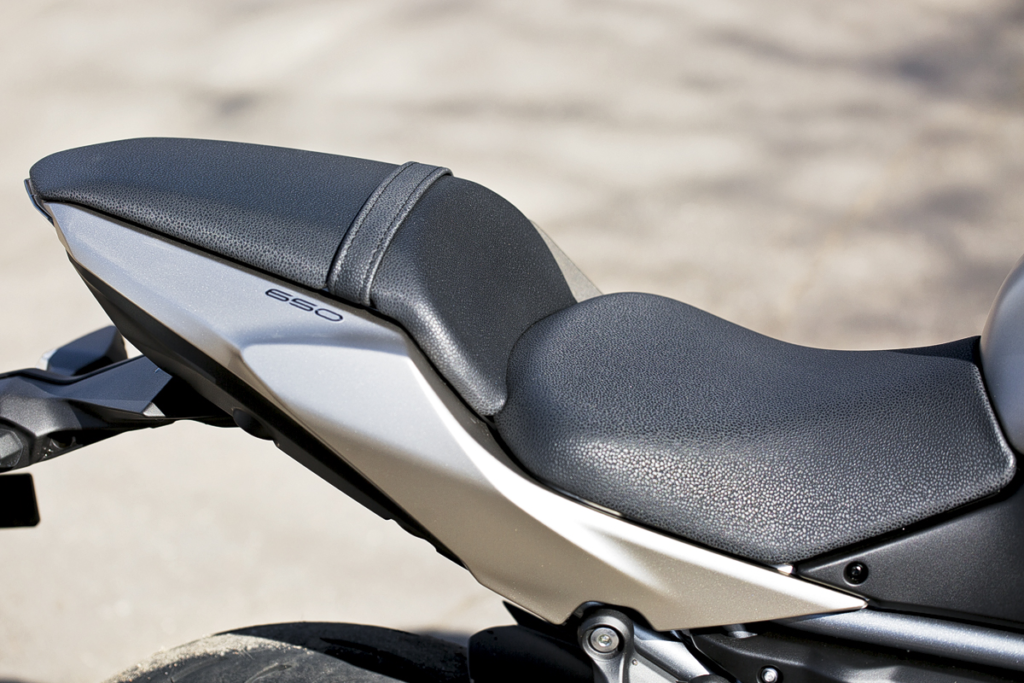
The seat is decent, but the rider should be no taller than 180 cm, and the demands for the passenger seat are stricter — a maximum of 165 cm.
Two twins with long histories
These motorcycles have twin-cylinder engines. The Z650 houses a parallel twin, essentially the reincarnation of the engine from the sportbike Kawasaki GPZ 500 — a true long-liver that remained on the market from 1987 to 2009. Ducati, with its signature L-twin desmodromic air-cooled engine, has if anything regressed. The Monster family owes its existence to designer Miguel Galluzzi, who completely stripped down the Ducati 888 sportbike in 1991, and it is believed that he formulated the essence of the whole series in one line: “All you need on a motorcycle is a seat, tank, engine, two wheels, and handlebars.”
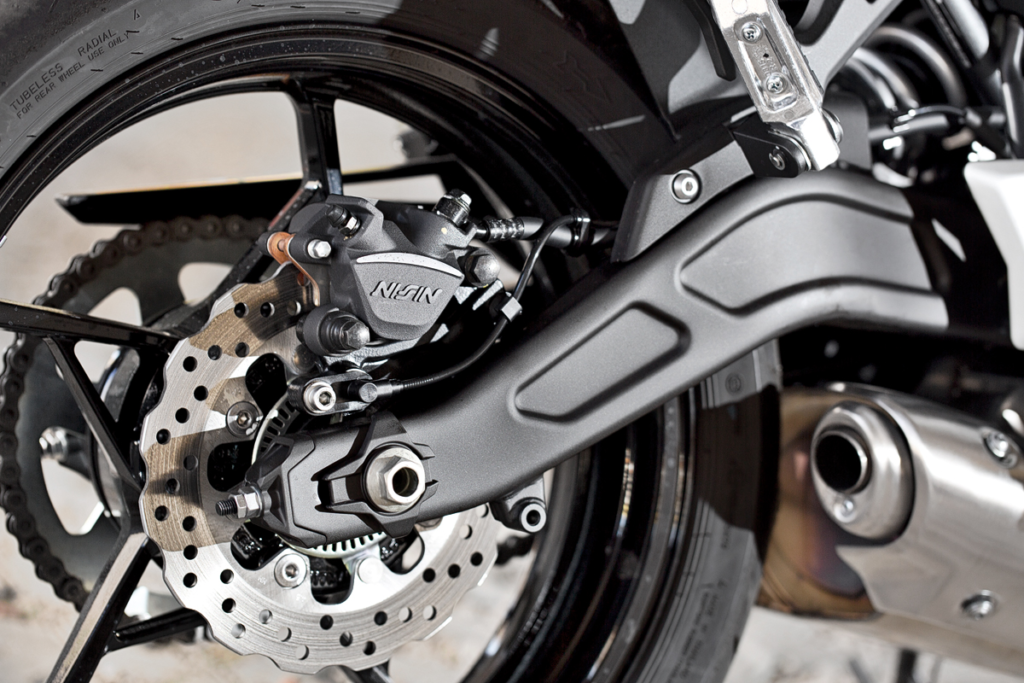
The asymmetric swingarm conceals an ultra-compact exhaust, allowing for further reduction in dimensions below the waterline.
What the Monster used to be
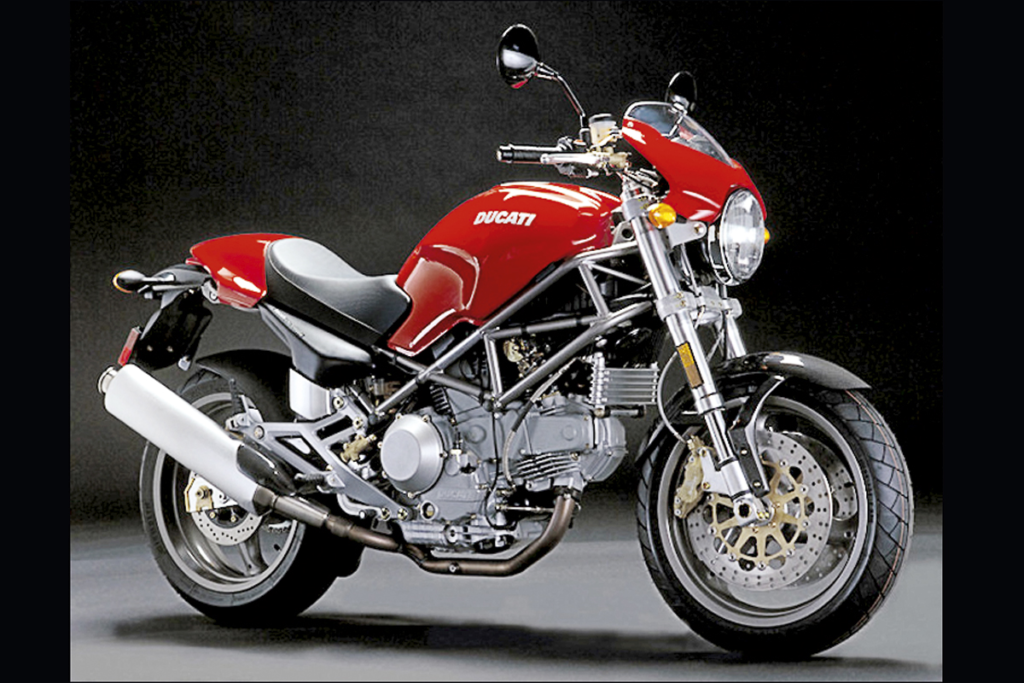
But what do we have after decades? Take a look at the 1994 Ducati 900 Monster — and at our current candidate. An air-cooled engine, the same 73 hp, and a top speed of 200 km/h. And most importantly, no simplifications.
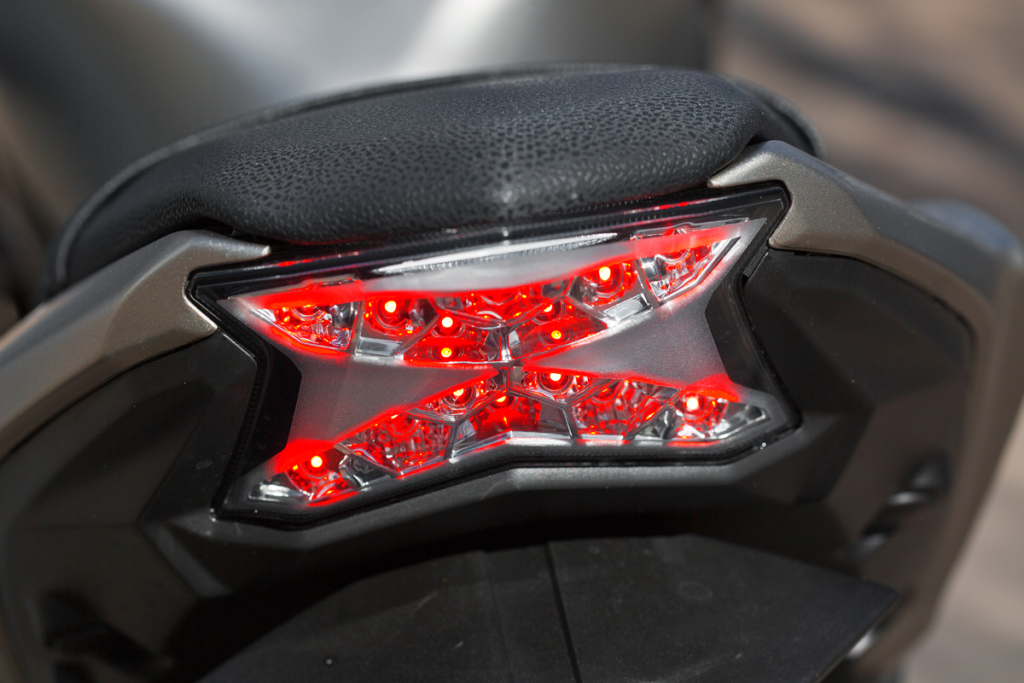
The present-day 797 is merely a shadow of its incredibly beautiful ancestors. The boundaries of the classes have shifted, though: back then the 900 was the pinnacle, whereas this 797 is only the entry level. Perhaps that is why we should not be too upset about the cut-down second throttle in the fuel system and the absence of adjustment on the fork. But I can’t help myself — it is the cable clutch that really bothers me. Ducati clutches have always been hydraulic!
And why, for heaven’s sake, can they not bring back the classic round headlight without these questionable design quirks? Ducati is, above all, about beauty, mood and emotions. Only then the machinery.
Speaking of which, things aren’t all smooth on that front either.
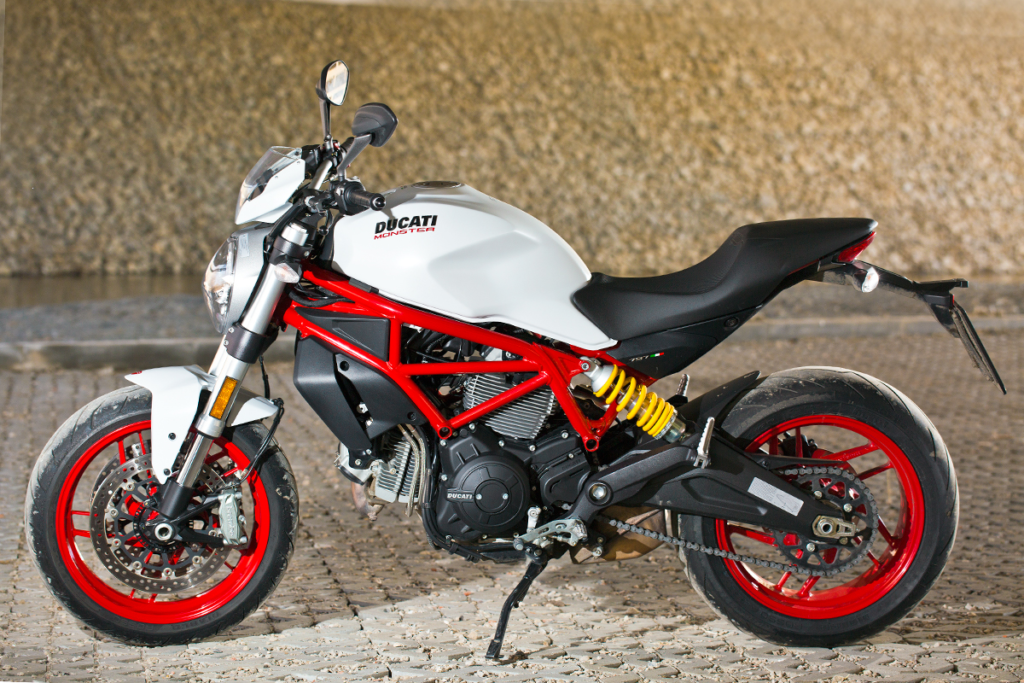
Ducati Monster 797
On the road: where did the five horsepower go?
So where is that supposed 5-horsepower advantage over the competition? It seems to exist only on paper. In reality both motorcycles effortlessly reach speeds of up to 180 km/h, performing almost equally, with the Ducati Monster having a slight edge. The maximum speed indicated on the speedometers is identical too, at 205 km/h, which translates to an actual 190 km/h. In the mid-range of the Z650’s tachometer, however, you will find significantly more torque and elasticity, while the Italian air-cooled engine only truly awakens above 6500 rpm. That seems counterintuitive, since the Ducati 797 has a notable 154 cc advantage in displacement.
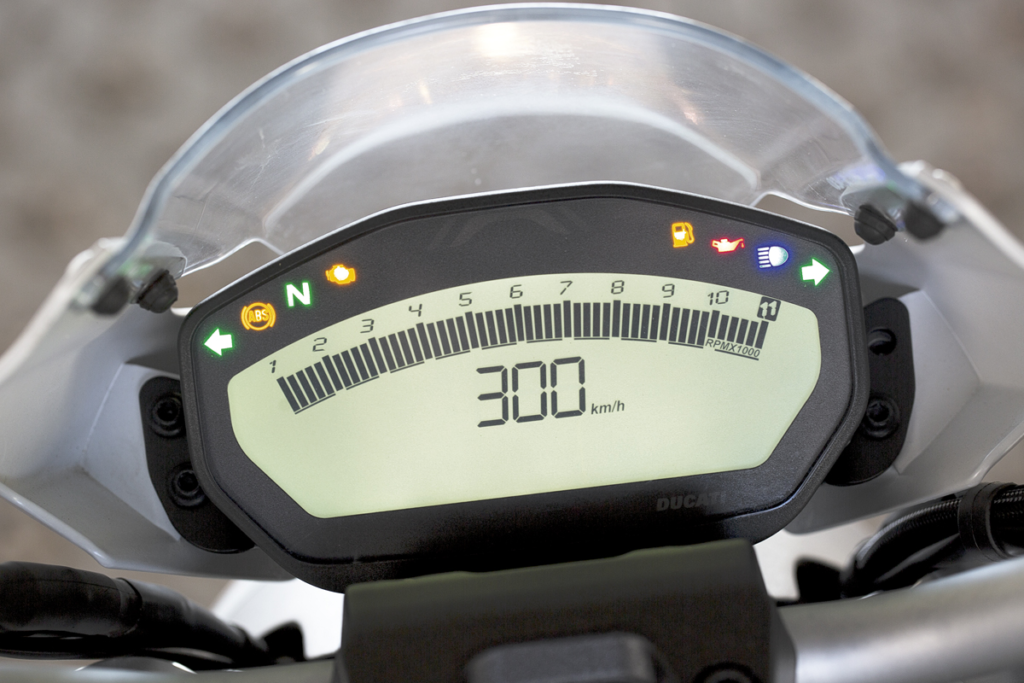
Ducati has almost nothing on the dashboard. There is not even a fuel gauge – the reserve light does that job.
The exhaust note
And then there is the matter of sound. Italians are usually indifferent to noise regulations, but this time they may have overdone it: the stock exhaust on the Ducati is meek and quiet, like a student at the back of the classroom trying to blend in and avoid being called up to the board. The “Zed”, in contrast, raises questions about how the Japanese managed to obtain certification. Its stock exhaust delivers a powerful, resonant sound, more reminiscent of the refined tone of an expensive straight-through system. Some of your neighbors might start to resent you, while others will simply try to catch you and bring you down.
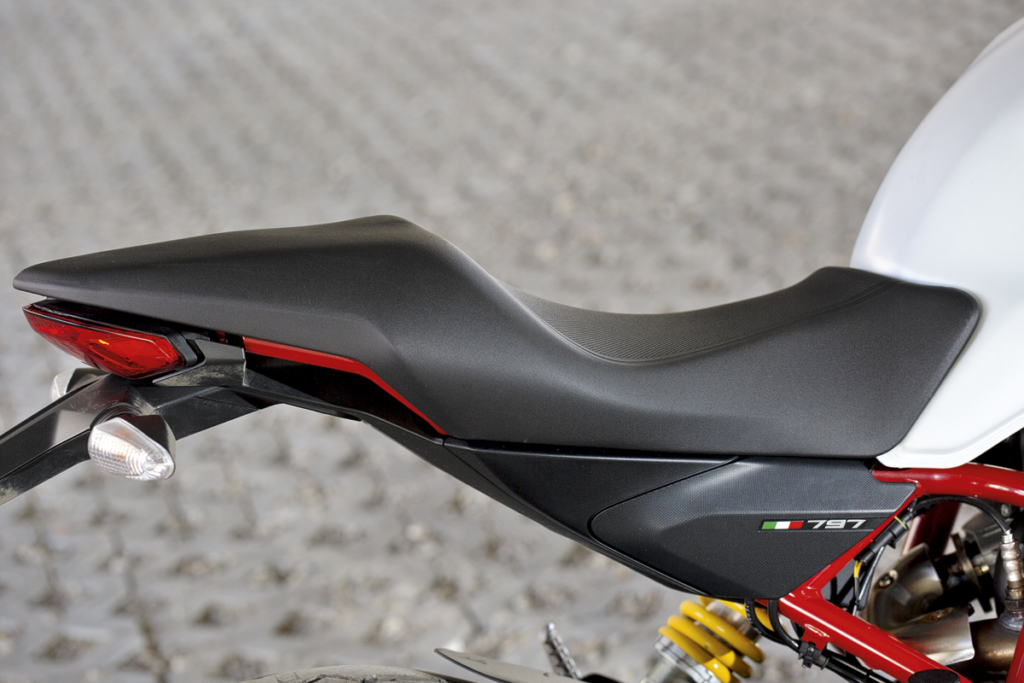
In contrast to what the competitor offers, the seat here is noticeably more accommodating for taller individuals.
Brakes, handling and the city
In the city the Kawasaki feels more agile, but it falls short in braking potential. More precisely: in most cases the Z650’s brakes are sufficient, while the Ducati 797’s radial Brembo calipers with 320 mm brake discs seem somewhat excessive for everyday civilian life.
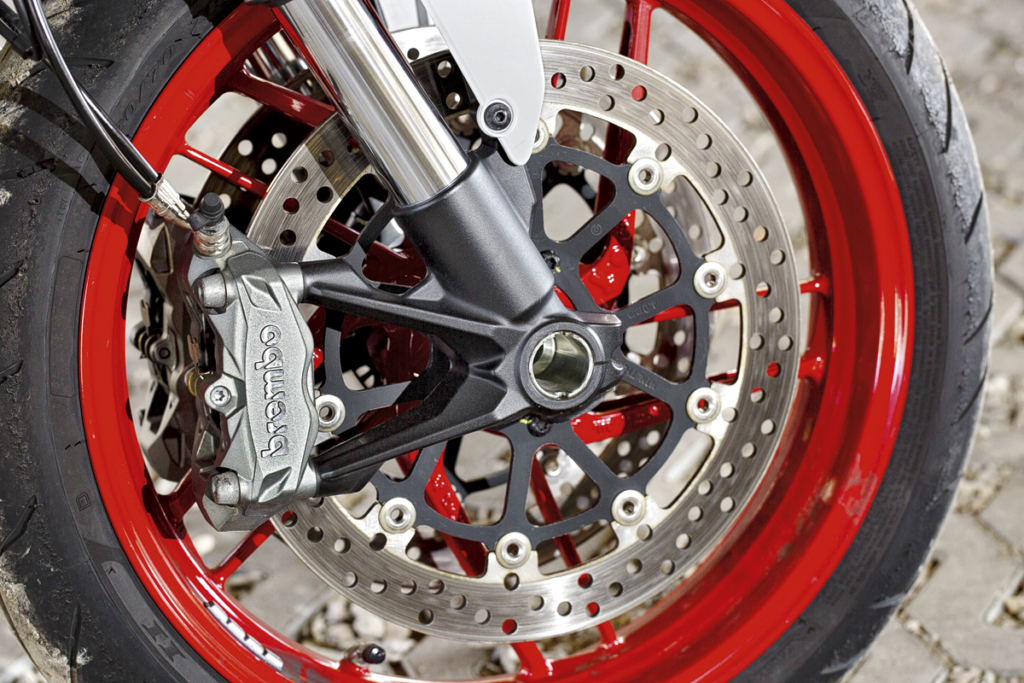
Radial four-piston Brembo calipers and 320 mm discs would adorn a 200-horsepower sportbike.
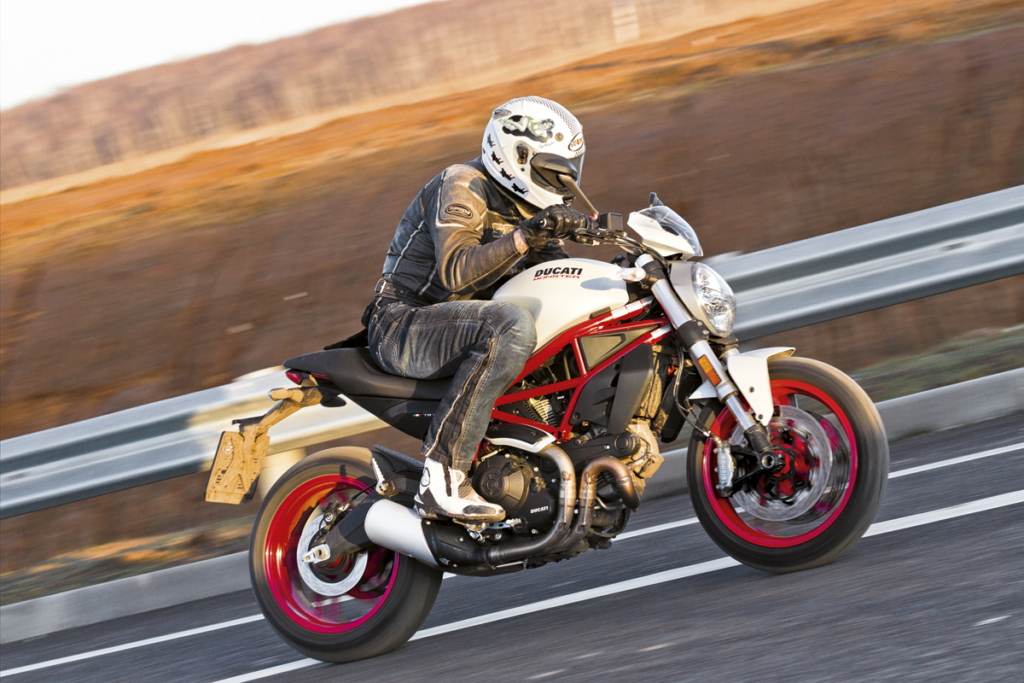
In the “handling” category, Ducati leaves the “Japanese” contender no chance whatsoever. This is partly due to the 180 mm rear tire, against the Z650’s 160 mm. Whether it is quick maneuvers, sharp changes of direction, or consistency in cornering, the smaller Monster surprisingly matches the skills of its older sibling, and one could even draw parallels with sportbikes.
The Kawasaki Z650, on the other hand, is simply a good, somewhat leisurely roadster. The handling deficiency I mentioned will only be noticeable on the racetrack, where both competitors are more exceptions than everyday guests. In the city it is the Ducati’s significantly reduced steering angle that becomes apparent after the first five minutes of the ride. That’s inconvenient — just like the sudden occurrence of a “false neutral” between fifth and sixth gears. Even the main neutral occasionally goes on an unpredictable siesta, and finding it on the first try becomes a stroke of luck.
Gearshift and vibration
The process of changing gears on the Kawasaki, in contrast, is well refined. Interestingly, both motorcycles feel similar in terms of shifting smoothness, with the Monster being slightly stiffer. Vibrations are almost non-existent: Kawasaki’s engineers addressed them during the engine’s design phase, whereas Ducati retained some, possibly more for marketing reasons.
The verdict
So, if you don’t have a passion for Italian motorcycle classics, I don’t have compelling arguments in favor of the Ducati 797 for you. Even with the slightly increased price of the Kawasaki Z650 compared to last year — 531,000 rubles against 509,000 — it remains significantly cheaper than the Ducati, which asks 599,000 rubles for entry into the world of Italian nakeds. It’s no surprise that the “precise handling and Italian quirks” shelf looks empty, while there’s a line at the “plain, trouble-free Japanese everyday life” department.
And why do I dislike waiting in lines?
Specifications
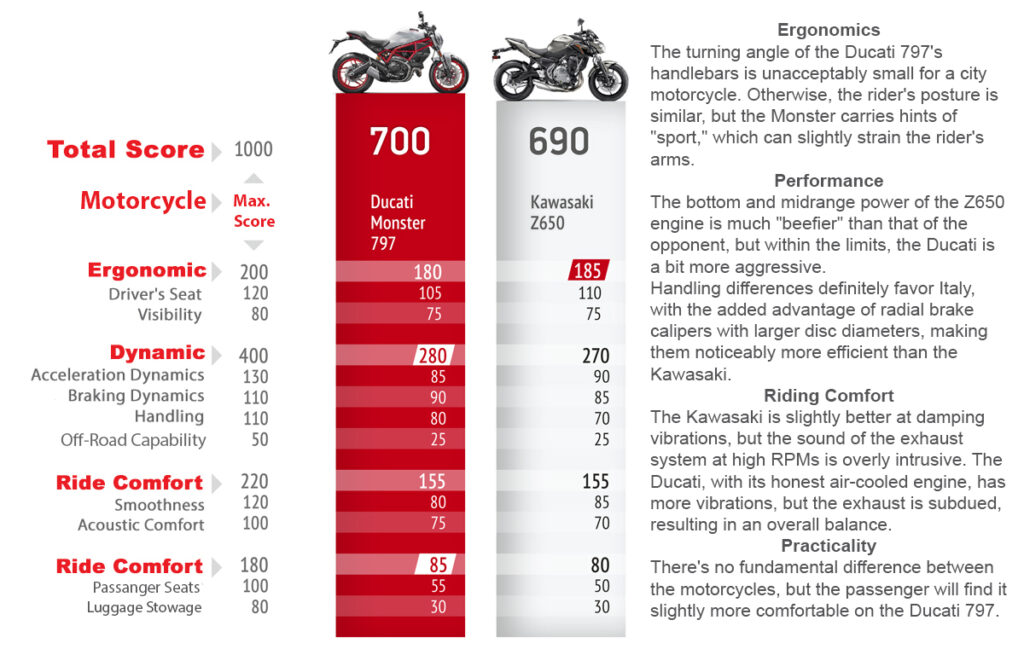
Total score – 1000
Ducati Monster 797 – 700 of 1000
Kawasaki Z650 – 690 of 1000
Ergonomics
Total score – 200
Ducati Monster 797 – 180 of 200 (Driver’s Seat – 105 of 120, Visibility – 75 of 80)
Kawasaki Z650 – 185 of 200 (Driver’s Seat – 110 of 120, Visibility – 75 of 80)
Dynamic
Total score – 400
Ducati Monster 797 – 280 of 400 (Acceleration Dynamics – 85 of 130, Braking Dynamics – 90 of 110, Handling – 80 of 110, Off-Road Capability – 25 of 50)
Kawasaki Z650 – 270 of 400 (Acceleration Dynamics – 90 of 130, Braking Dynamics – 85 of 110, Handling – 70 of 110, Off-Road Capability – 25 of 50)
Ride comfort
Total score – 220
Ducati Monster 797 – 155 of 220 (Smoothness – 80 of 120, Acoustic Comfort – 75 of 100)
Kawasaki Z650 – 155 of 220 (Smoothness – 85 of 120, Acoustic Comfort – 70 of 100)
Ride comfort
Total score – 180
Ducati Monster 797 – 85 of 180 (Passenger Seats – 55 of 100, Luggage Stowage – 30 of 80)
Kawasaki Z650 – 80 of 180 (Passenger Seats – 50 of 100, Luggage Stowage – 30 of 80)
Ergonomics
The turning angle of the Ducati 797’s handlebars is unacceptably small for a city motorcycle. Otherwise, the rider’s posture is similar, but the Monster carries hints of “sport,” which can slightly strain the rider’s arms.
Performance
The bottom and midrange power of the Z650 engine is much “beefier” than that of the opponent, but within the limits, the Ducati is a bit more aggressive. Handling differences definitely favor Italy, with the added advantage of radial brake calipers with larger disc diameters, making them noticeably more efficient than the Kawasaki.
Riding Comfort
The Kawasaki is slightly better at damping vibrations, but the sound of the exhaust system at high RPMs is overly intrusive. The Ducati, with its honest air-cooled engine, has more vibrations, but the exhaust is subdued, resulting in an overall balance.
Practicality
There’s no fundamental difference between the motorcycles, but the passenger will find it slightly more comfortable on the Ducati 797
| Parameter | Kawasaki Z650 | Ducati Monster 797 |
|---|---|---|
| Dimensions (mm) Length Width** Height Wheelbase Seat Height Ground Clearance | 2055 775 1080 1410 790 130 | N/A* 800 N/A* 1435 805 N/A* |
| Fork Rake/Front Fork Offset (degrees/mm) | 24/100 | 24/90 |
| Frame | Tubular, high-strength steel | Tubular, high-strength steel |
| Curb Weight (kg) | 187 | 193 |
| Number and Arrangement of Cylinders | 2, inline | 2, V-twin |
| Cylinder Bore/Stroke (mm) | 83.0/60.0 | 88.0/66.0 |
| Compression Ratio | 10.8:1 | 11:1 |
| Displacement (cc) | 649 | 803 |
| Number of Valves | 8 | 4 |
| Max Power (hp/kW/rpm) | 68/50.2/8000 | 73/54/8250 |
| Max Torque (Nm/rpm) | 65.7/6500 | 67/5750 |
| Transmission | 6-speed, multi-plate slipper clutch, chain | 6-speed, multi-plate slipper clutch, chain |
| Front Suspension | Telescopic, Ø 41 mm fork tubes, 125 mm travel | Inverted telescopic, Ø 43 mm fork tubes, 130 mm travel |
| Rear Suspension | Monoshock, adjustments: spring preload; 130 mm travel | Monoshock, adjustments: spring preload and rebound; 130 mm travel |
| Front Brake | Two 300 mm discs, 2-piston calipers | Two 320 mm discs, 2-piston radial calipers |
| Rear Brake | 220 mm disc, 1-piston caliper | 245 mm disc, 1-piston caliper |
| Max Speed (km/h) | 200 | 200 |
| Front Wheel | 120/70-17″ | 120/70-17″ |
| Rear Wheel | 160/60-17″ | 180/55-17″ |
| Fuel Tank Capacity (liters) | 15 | 16.5 |
| Fuel Type | Petrol (AI-95—98) | Petrol (AI-95—98) |
* N/A — no data
** At the handlebar
Photo: Nikita Kolobanov
This is a translation. You can read the original article here: Kawasaki Z650 и Ducati Monster 797: беспроблемные будни с «японцем» против нескучных причуд «итальянца»

Published December 28, 2023 • 9m to read