
No, this isn’t the infamous car from the popular movie known by the feminine name “Christine.” That car was a model from a year later, dressed up more luxuriously, and entirely a product of fiction. Stephen King, the author behind the novel that inspired the film, wasn’t deeply knowledgeable about cars. He penned his book beginning in the middle, adding the start, the end, and many details only later, which resulted in a vehicle that was more fantastical than real. But the resemblance is there…
1957 Plymouth Savoy KP-31-2 Sport Coupe
“You resemble her, like a sister, But, of course, you are not her—unfortunately.” — Maxim Leonidov
Why King chose a Plymouth
Stephen King revealed in an interview that he was searching for a car with a striking appearance for the main character of his first “automotive” novel, one that hadn’t yet achieved “cult” status among American readers. That is why he dismissed a 1957 Chevrolet as “too legendary.” He chose the Plymouth Fury instead, largely because of its apt name, which perfectly matched the malevolent beauty he envisioned.
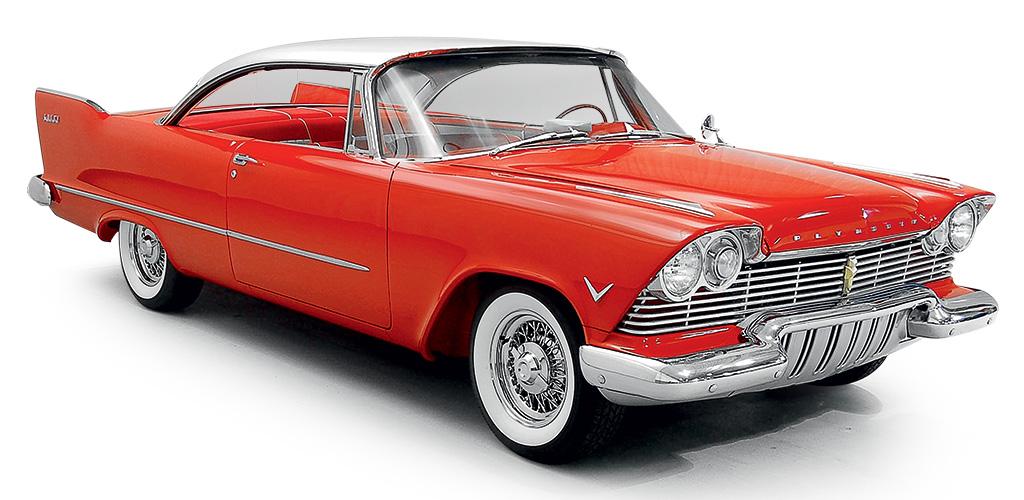
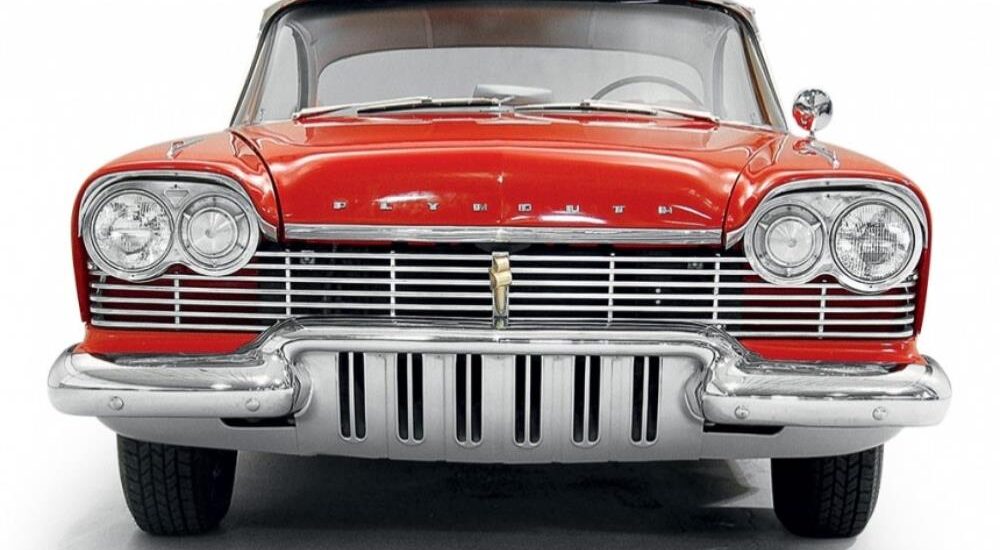
The 1957 model is easily recognizable by its headlights of different diameters and vertical slots below the bumper. Less obvious is the vertical decorative element in the center of the faux radiator grille—a highly stylized image of the sails of the Mayflower, the ship of the American Pilgrims—but it too is a characteristic feature of the 1957 Plymouth vehicles.
The Fury of the novel could not have existed
King may have picked the right car and, in doing so, inadvertently elevated it to cult status, especially after the film’s release. But the Plymouth Fury as described in his novel did not and could not exist. In 1957 and 1958 the Fury was available only as a two-door, the priciest in its series, and solely in light beige — which matters, given the “Red Autumn” body color mentioned so often in the novel and shown in the film.
Any dissatisfied owner could of course repaint their car, but in the movie the vehicle is shown on the assembly line already in its red-and-white scheme. To create that incorrect portrayal, the filmmakers built a massive assembly line set inside an abandoned furniture factory: filming at the Chrysler plant was not an option, and the equipment there had long since been modernized — the film was shot in 1983, after all.
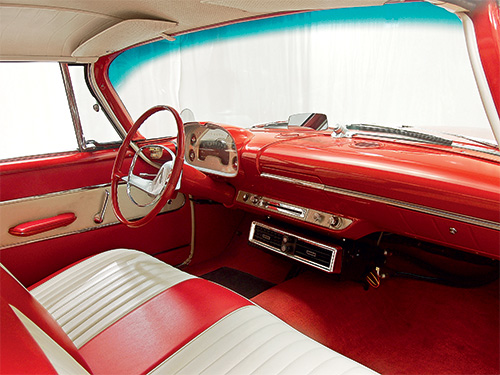
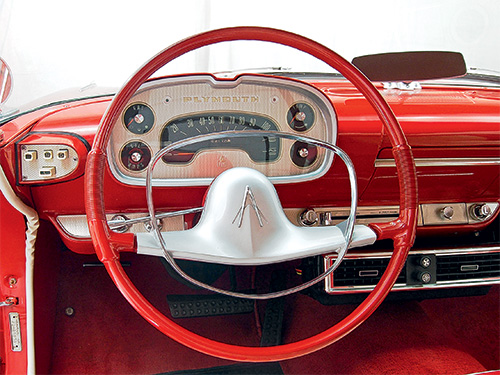
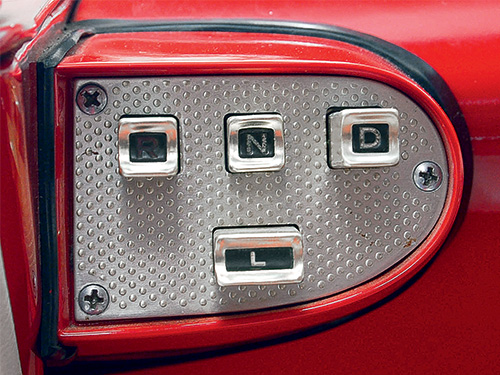
The front bench seat is spacious and comfortable, but offers no lateral support (and where would it come from?). There are too many gauges on the dashboard to compare with “cat’s eyes.” The button-operated transmission selector to the left of the steering wheel lacks a “Park” position.
Our car is a Savoy, not a Fury
Our illustrations feature not the top-tier Fury but the more economical Savoy, which was available in a red-and-white color scheme in 1957 — not 1958, as several specific front-end design elements make clear. For the cover of his first book’s edition, King posed next to such a car, even though the narrative described a completely different vehicle.
Where the author’s imagination outran the hardware
“Well, ‘you resemble her, like a sister’—it’s easy to mix them up…” As the author continues his description of the “car with a bad character,” though, he piles on absurdities, demonstrating his lack of familiarity with the subject and ultimately complicating the narrative to the point of being unfilmable.
Doors that lock themselves
Consider the dramatic scene where the car suddenly locks all its doors on its own — a feature generally activated from the driver’s door, which wasn’t available on this model. King describes a dramatic clicking as “soldiers” drop down on the doors simultaneously. How could that be filmed, when no such feature existed in Plymouth cars at the time? To block a door you simply pushed the handle inward, and pulled it to unlock. The filmmakers had to show these “soldiers” on a completely different brand of car for the emotional effect.
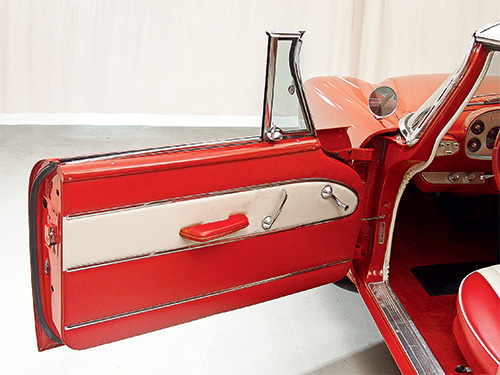
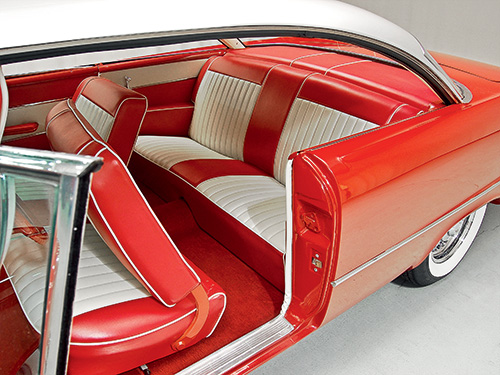
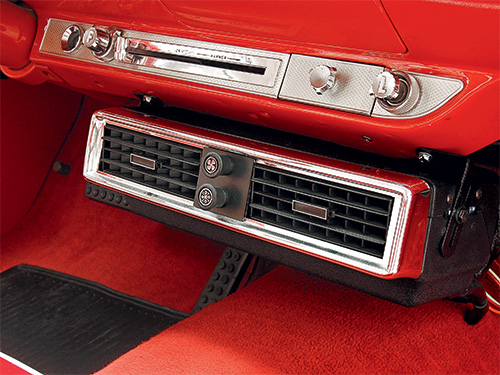
Even on the less expensive 1957 Plymouth models, the interior trim was quite elaborate. There are no “soldiers” on the top edge of the doors. This particular example is equipped with an air conditioner suspended under the front panel; above it is the control motor for the standard heater.
A “hydromatic” lever in a Chrysler
Or take King’s reference to a “hydromatic gearbox lever” that shifts itself out of park. What lever, and what “hydromatic,” on a Chrysler product — when those were features of General Motors, or of some Ford models under emergency circumstances? Chrysler’s transmissions were named Turboflite and operated by a neat button panel under the driver’s left hand, with no “park” position at all. King would have benefited from browsing old Plymouth brochures for a semblance of accuracy. Instead he created a chimera with an unclear engine, a foreign transmission, button-operated door handles (similar to those on a Volga GAZ-21 not introduced until 1962) and two extra doors.
What the film had to drop
Some of the author’s imagined features had to be discarded when his prose was translated into the language of cinema. How could they convey the terror of a girl locked inside, watched by the dashboard lights, green and round, “like a cat’s eyes”? The dashboard had four round dials plus a horseshoe-shaped speedometer gauge — not quite the setup to evoke a “staring” effect on actress Alexandra Paul, who portrayed the terrified schoolgirl.
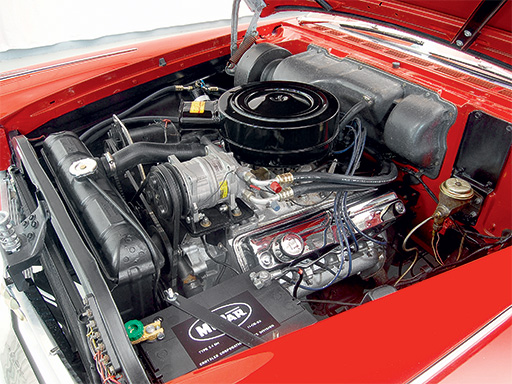
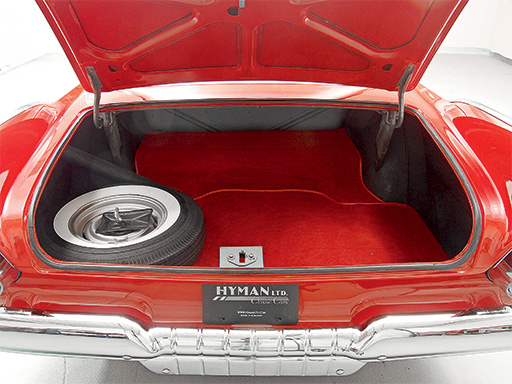
The engine in this example is a V-shaped, 8-cylinder, with a displacement of 4.93 liters and a power output of 215 horsepower. The trunk is extensive and spacious, but quite flat.
Filming a car that repairs itself
Replicating the car’s supernatural abilities — free will, autonomous movement and a self-repair feature when reversing — proved challenging, but it was handled creatively. More than two dozen identically prepared Plymouths were used in filming. Some appeared to drive with no visible driver, thanks to opaque film over the windows or a stunt driver lying flat under a seat imitation, with the controls moved under the dashboard.
Others showcased the car’s regenerative capabilities through a simple trick called “reverse motion”: running the filmed footage backwards made it appear as though cracked glass was healing itself. Not all the cars survived. One was fitted with hydraulic jacks inside the cabin that literally crumpled it from within; on screen it looked as though a car nearly flattened by a sanitation truck had resiliently “unfolded” back into shape, to the amazement of the audience. It could not be said of this film that “no cars were harmed during the making.”
Now try finding a 1957 or 1958 Plymouth Fury in the correct beige color — all you’ll find are red-and-whites, styled “à la Christine.” And it is not just the Fury models: take another look at our illustrations.
The magical power of art indeed!
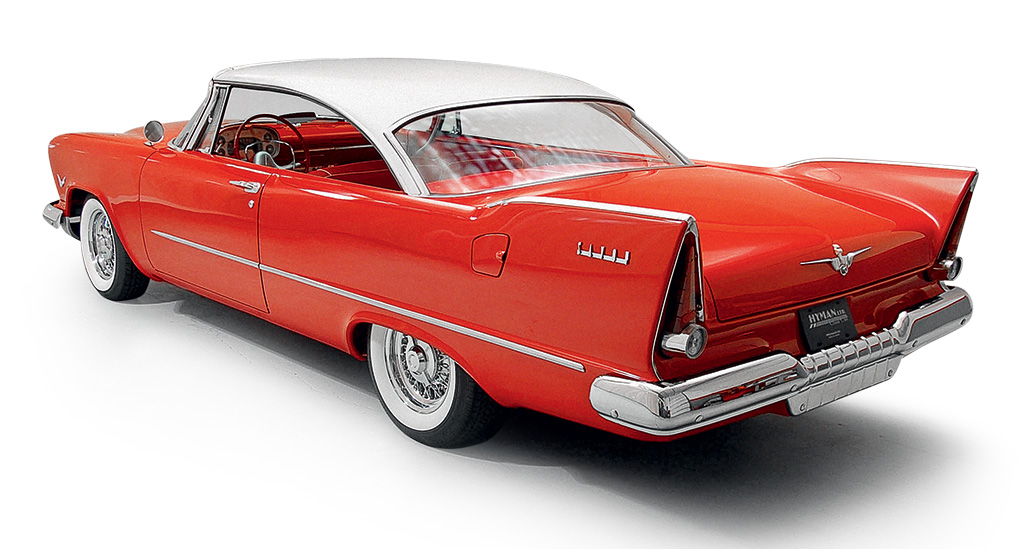
The car’s color scheme is very much “Christine-esque”: “Toreador” red lacquer on the body (not the ostentatious “Red Autumn” like Stephen King’s!), “Iceberg” white on the roof. However, the wide longitudinal inserts on the sides are absent, replaced by a narrow molding: this is, after all, just a Savoy, not a Belvedere.
Photo: Sean Dugan, Hyman Ltd.
This is a translation. You can read the original article here: Plymouth Savoy 1957 года — почти как в романе Стивена Кинга

Published September 11, 2024 • 6m to read