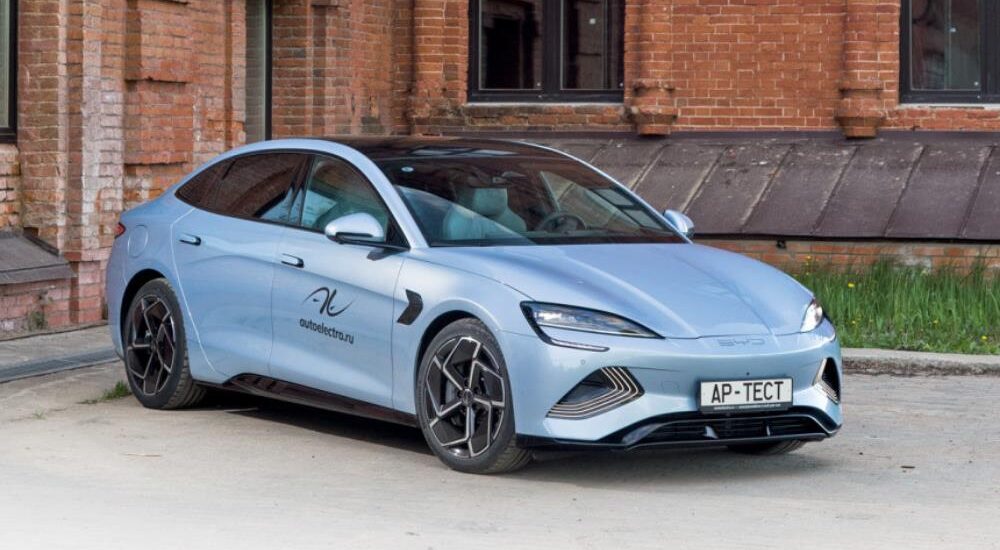

The BYD Seal is China’s answer to the Tesla Model 3 — a sleek electric sedan promising 650 km of range from an 82.5 kWh battery, and a 0-100 km/h sprint of just 3.8 seconds according to the badge on its trunk lid. We took the dual-motor, all-wheel-drive BYD Seal to the track and the road to see how its real-world acceleration, range, braking, and handling stack up against the numbers on paper.
Design: A BYD Seal That Doesn’t Look Like a Typical Chinese EV
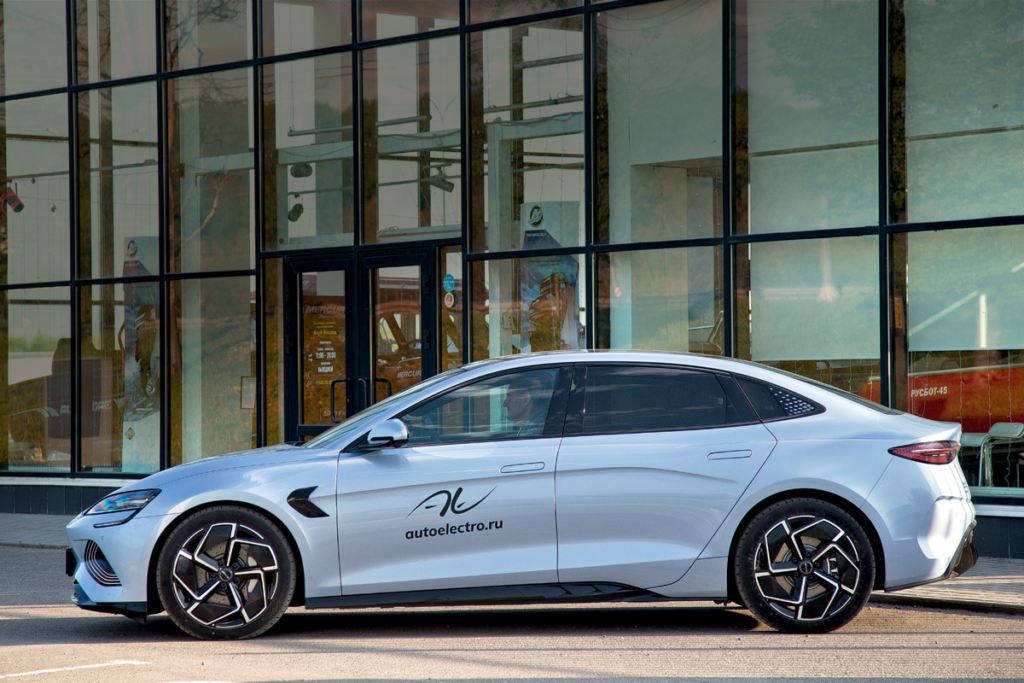
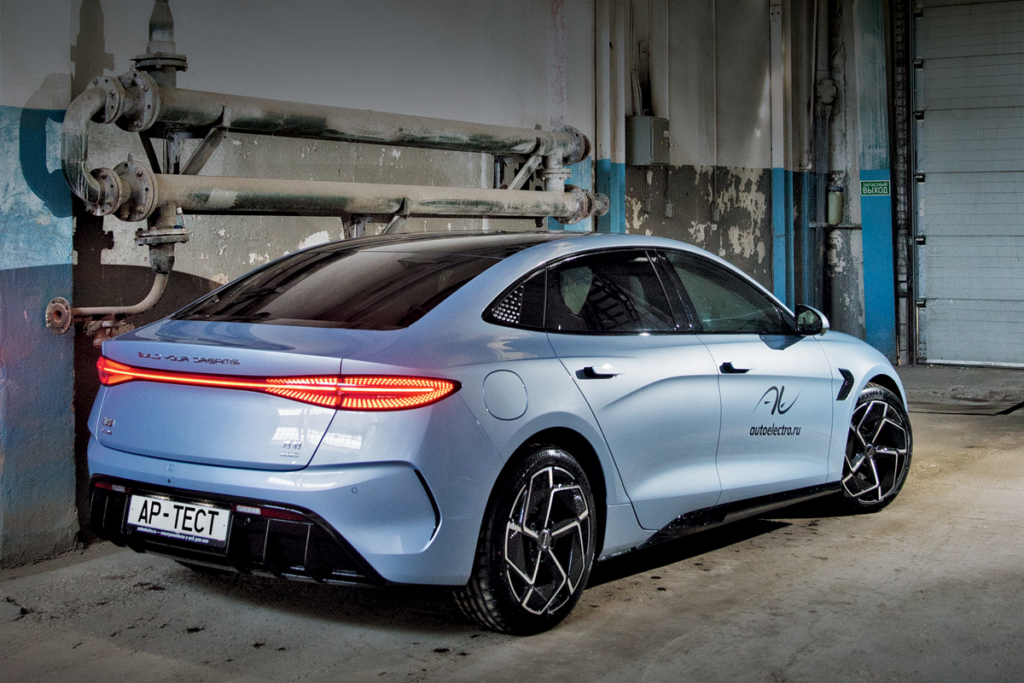
I swear, this is the most beautiful Chinese car I’ve ever had the pleasure of driving. Bravo, Wolfgang Egger! Yes, that’s the same Egger who had the chance to work at both Alfa Romeo and VW Group, and since 2017 has been leading the designers at BYD.
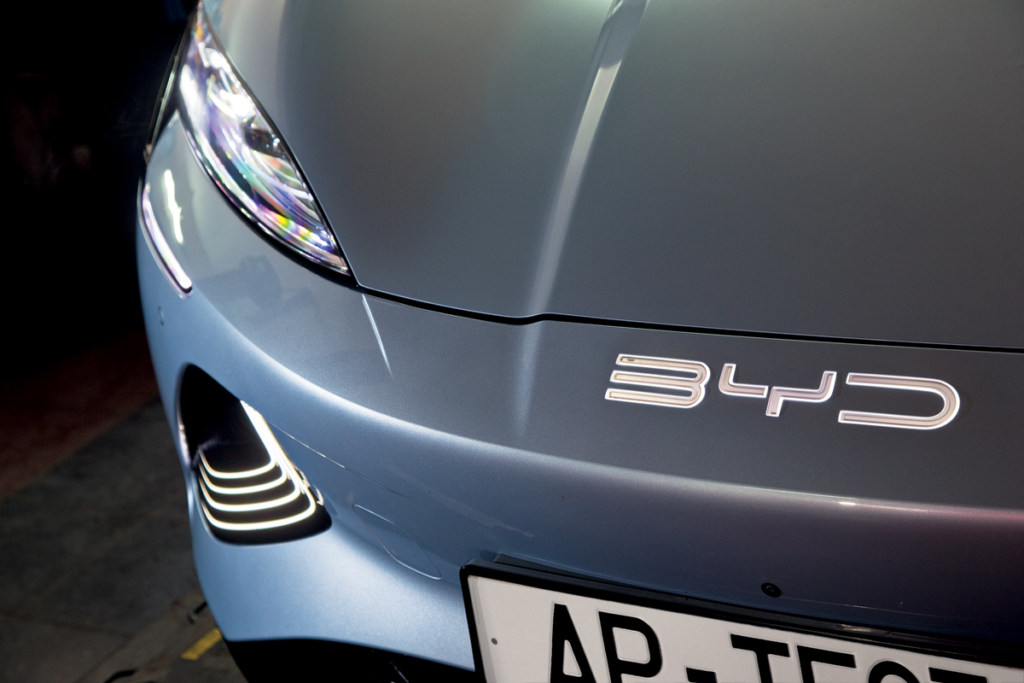
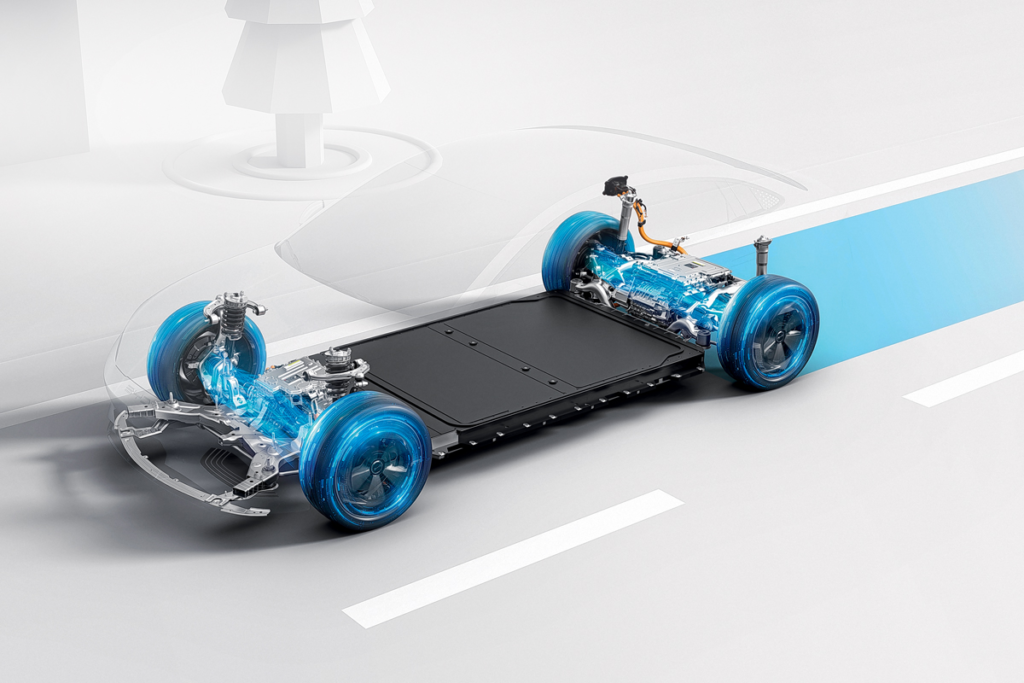
Just take a closer look at these “Faraday lines” at the corners of the front bumper — they evoke associations with both magnetic fields of induction, as they are usually depicted in physics textbooks, and patterns of seashells. The rear lights, filled with “pixels” of LEDs, are also mesmerizing. One might assume that the Seal is merely a design modification of the BYD Han EV sedan that we are already familiar with, especially since they have the same wheelbase — 2920 mm. However, while the Han is built on the DM3 platform, which also allows for a hybrid version, the Seal is an uncompromising electric car with a new, 800-volt e-platform 3.0 architecture and a more complex suspension system. For example, at the rear, there is a sophisticated kinematics with five arms for each wheel.
Battery and Platform: The Blade Battery and CTB Architecture
The main feature of the construction is the lithium iron phosphate Blade series battery, with flat power elements housed in a sturdy case. This is integrated into the body’s power structure — the so-called CTB (cell-to-body) architecture. Tesla is actually moving toward a similar scheme for its Model 3 and Model Y, using an integrated battery built around larger 4680 cells instead of the previous 2170 format. Key benefits of this design include:
- A lower center of gravity, which improves active safety and cornering stability
- Stronger passive safety, contributing to a maximum five-star rating in China’s C-NCAP crash tests
- Exceptional torsional rigidity of 40,500 Nm/degree, thanks to the battery pack doubling as a structural element
Interior and Comfort: Seats, Cabin Materials, and Tech
The CTB construction allowed for lowering the seats by 10 mm, but even after this, there is no sensation of a low racing position behind the wheel. The battery has its thickness, which cannot be ignored: even with the seat lowered to the bottom, I can see the hood. From the perspective of visibility, this is even a plus. The seat itself, with an integrated headrest, is universal — the semi-circular backrest holds quite well in turns, but does not impose stiff side support bolsters. Both front seats feature:
- Electric adjustment, including seat cushion angle and lumbar support
- Full seat heating
- Ventilation, including through the backrest
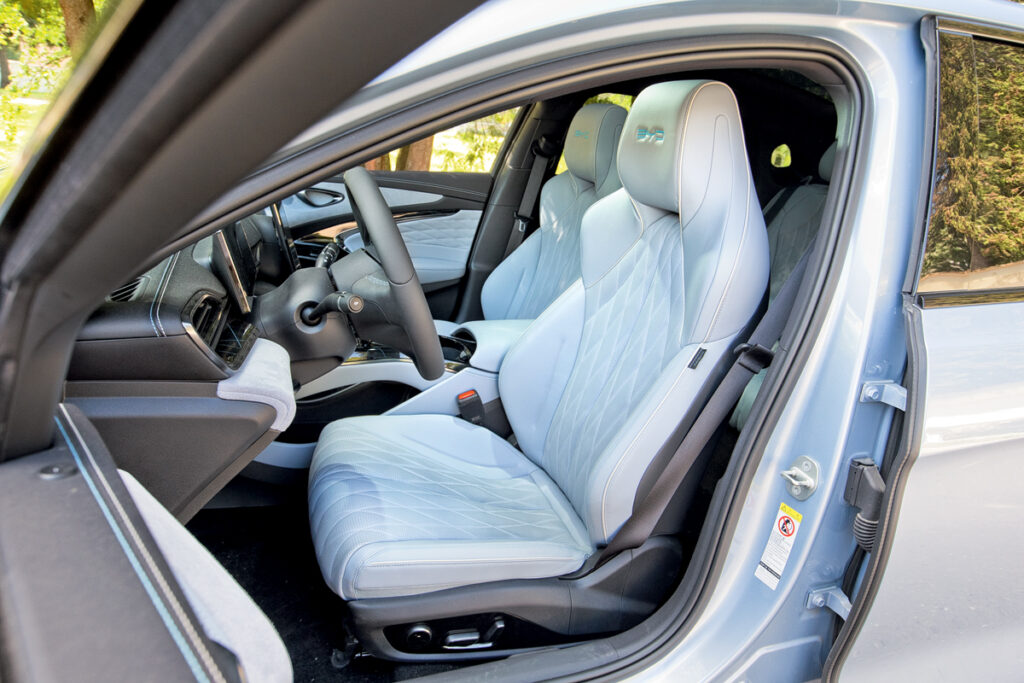
The anatomically-designed seat is unobtrusively comfortable, with electric adjustments for the angle of the seat cushion and lumbar support.
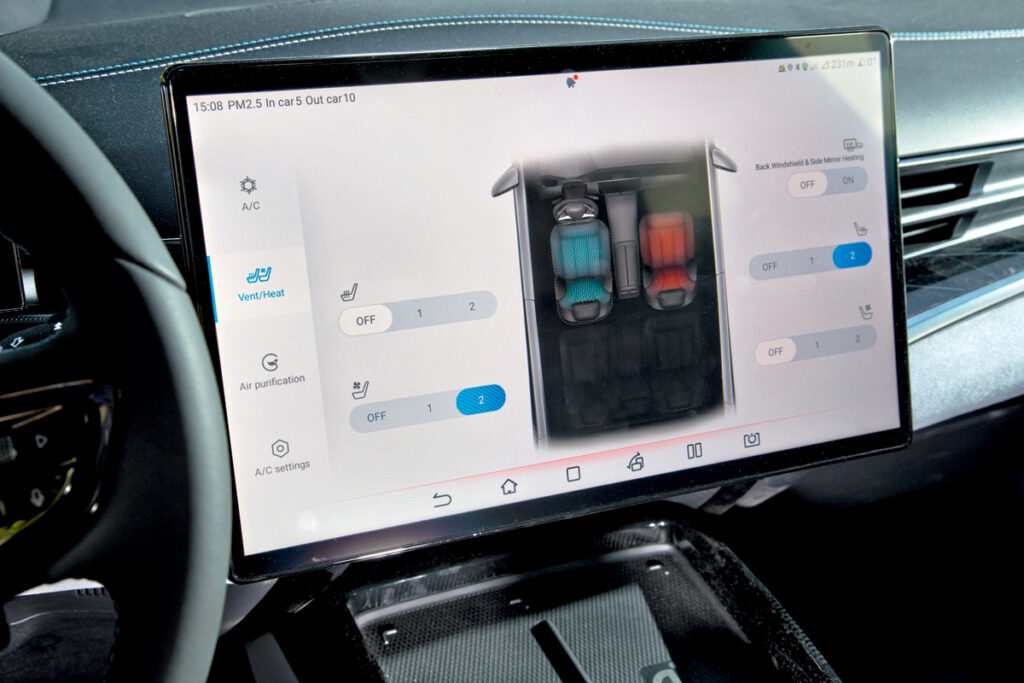
Heating and ventilation, which can be enabled through the menu, cover the entire area of the front seats.
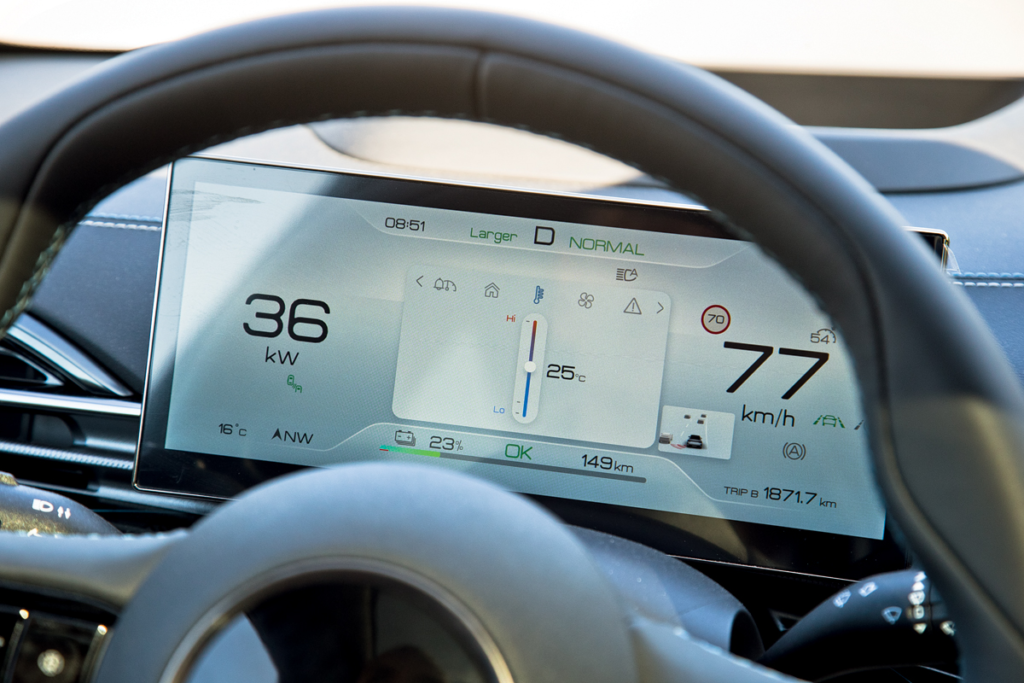
The steering wheel has mechanical adjustments and a pleasingly chunky rim with a very neat flat seam of leather trim. The instruments, of course, are fully digital, but the design options are limited to just two layouts. However, the top version has a head-up display. And in the center of the panel, of course, is BYD’s “signature dish” — a huge swiveling “TV” with a 15.6-inch diagonal, complete with excellent graphics and an Android operating system.
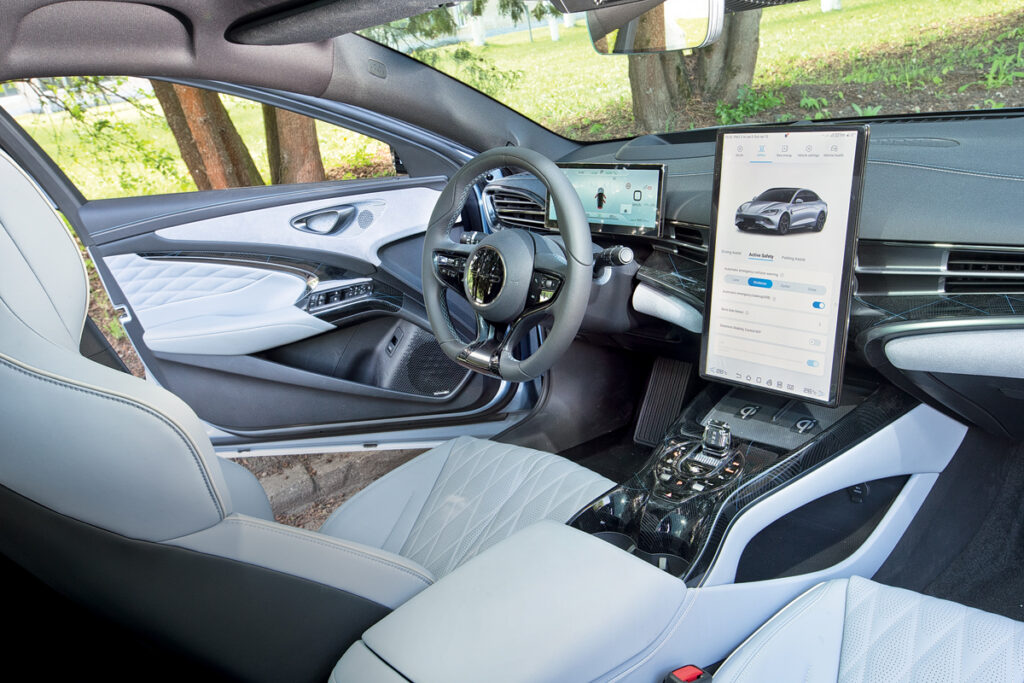
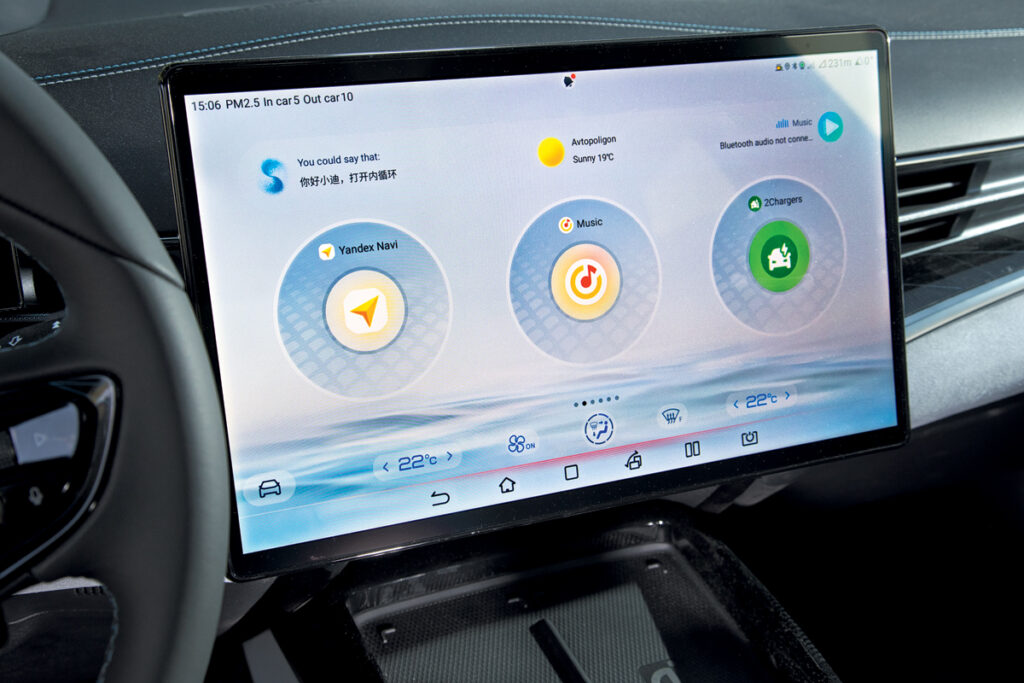
Climate control is fully electronic and dual-zone. The artfully integrated vents in the front panel have no physical knobs — their direction can only be changed through the menu. The available airflow modes include:
- Avoid mode — raises the air stream toward the ceiling
- Facing mode — directs airflow straight at your face
- Swing mode — smoothly cycles the airflow direction automatically, similar to a home split-system air conditioner
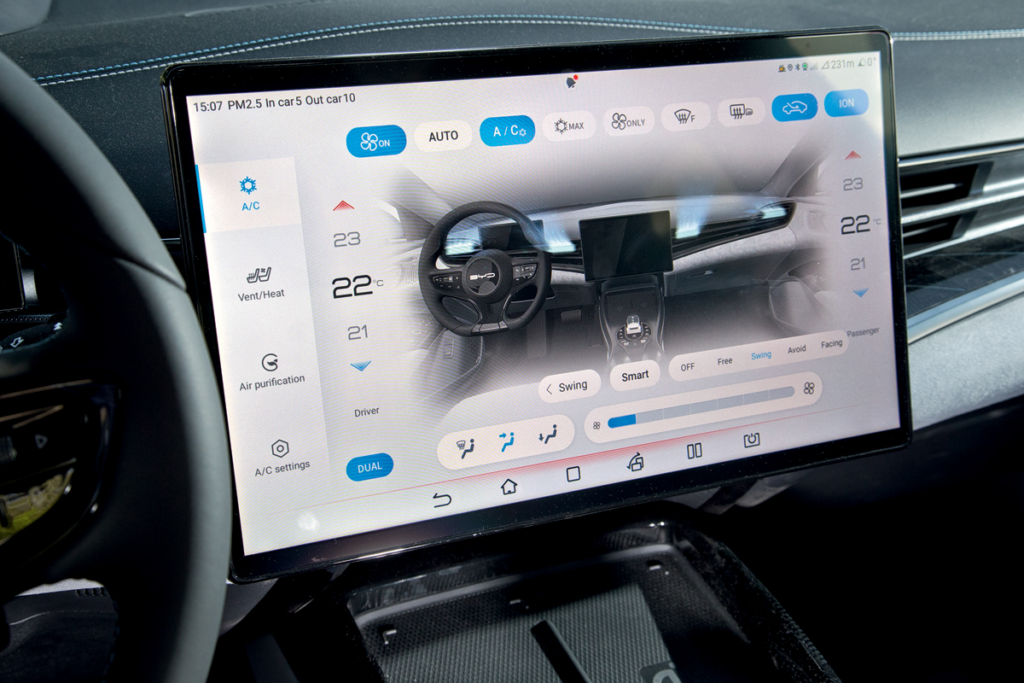
Unfortunately, among the hotkeys for climate control, there is no recirculation activation. By the time you navigate through the menu and select the appropriate icon, you would have already breathed in impurities. An auto-recirculation mode would solve this, but instead, the menu only offers automatic activation of the PM2.5 fine particle filter.
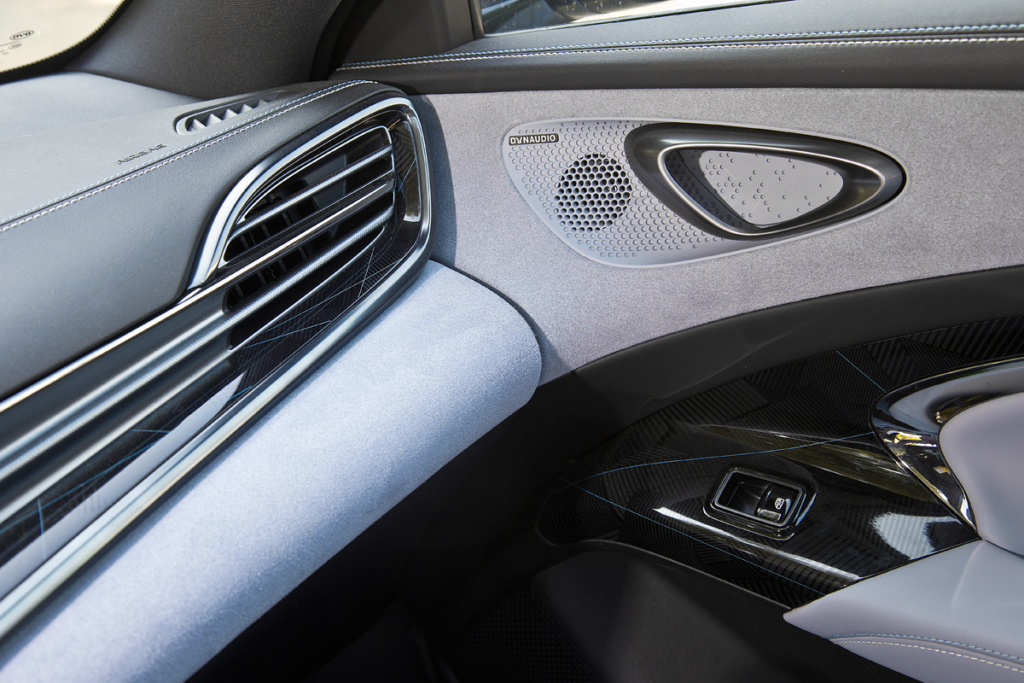
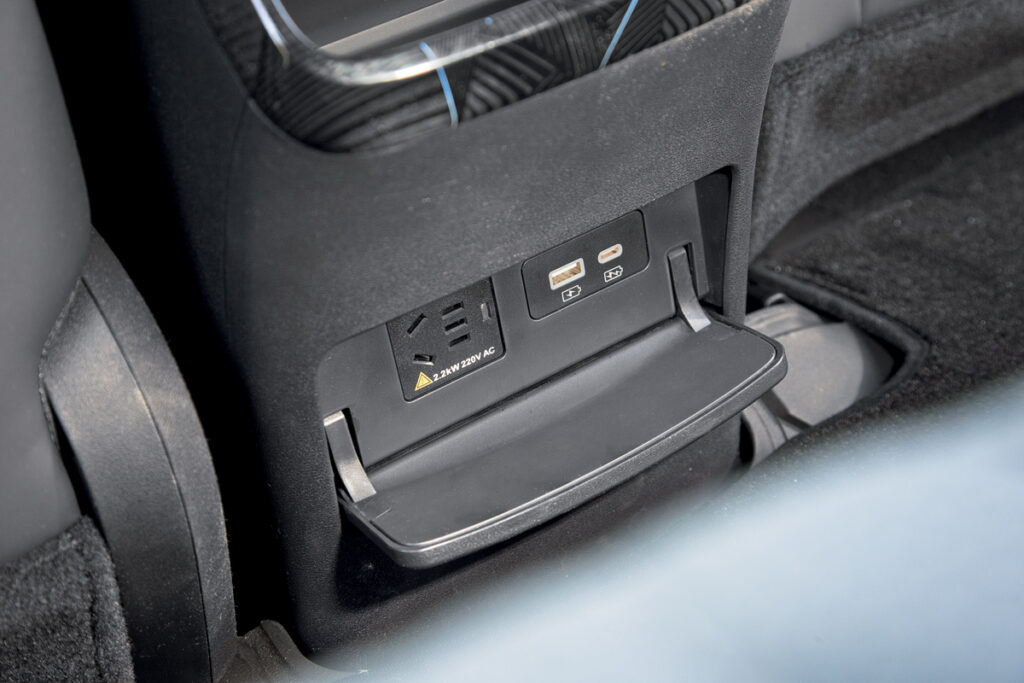
As for cabin finish, there are no complaints: soft plastics, genuine or artificial leather are everywhere, with inserts of blue Alcantara on the front panel and doors. Even the small details are handled with German-level meticulousness — rubber liners in the door handle recesses, cup holders, and USB ports (both USB-A and USB-C are available) with contour lighting.
What’s most delightful in the back seats is the clear sky overhead: the panoramic roof extends almost to the rear window. There is also ample legroom — I’m sitting “behind myself” with an eight-centimeter gap. However, I didn’t find any multimedia extras in the rear armrest, like in the Han — only cupholders. But that’s how the Seal is designed: it’s more of a driver’s car than a passenger’s car. And that means it’s time to hit the start button!
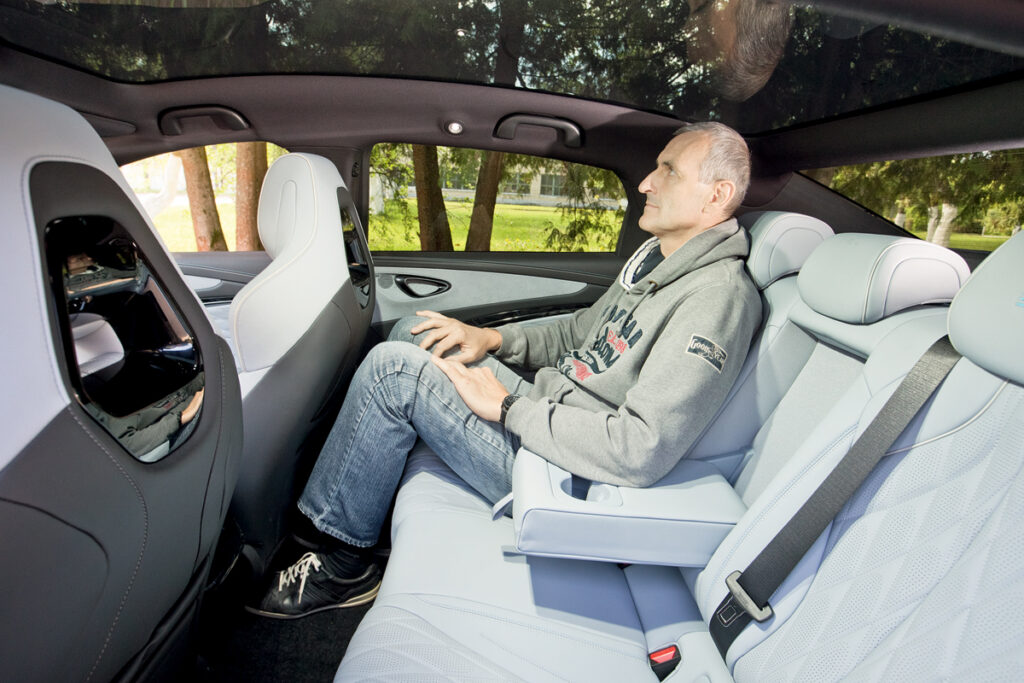
There is a lot of knee room, but if the front seat is lowered all the way down, there is nowhere to put your feet.
In the center of the front panel is a 15.6-inch swivel display, and below it are two induction charging pads for smartphones.
BYD Seal 0-100 km/h Acceleration: Track Test Results
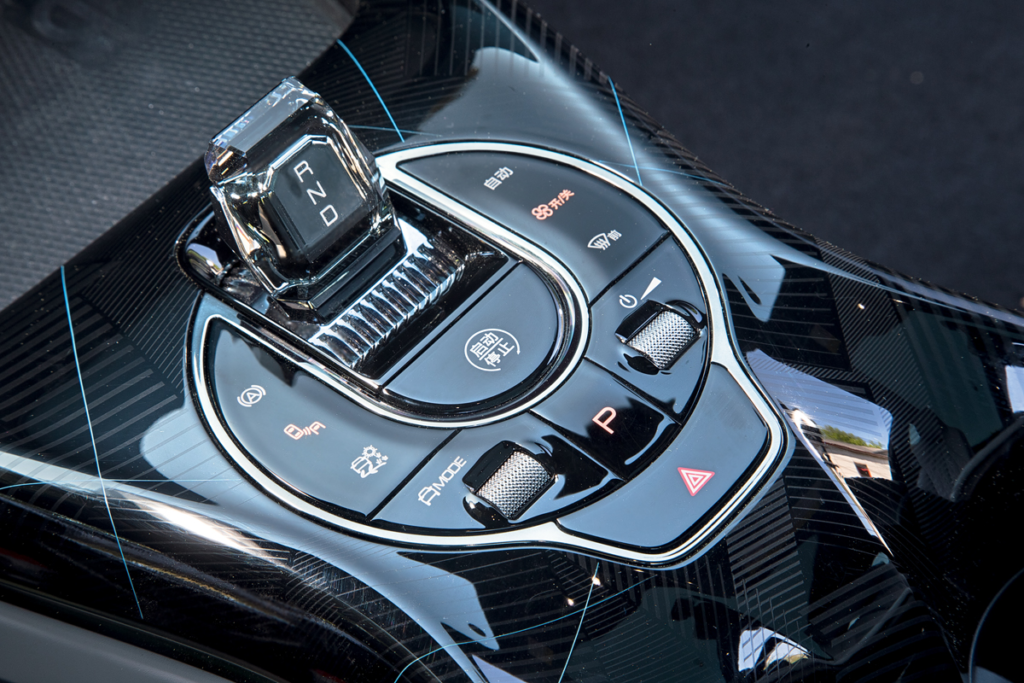
To engage “drive” mode, you need to give the “crystal” flag selector a short tug — and you can begin a silent acceleration. I am already prepared for the fact that BYD cars are finely tuned in terms of throttle control: there are no jerks, everything is smooth, but very forceful.
Acceleration to 62 mph (100 km/h)? The onboard telemetry shows the promised 3.8 seconds, however, our GPS measuring device VBox is more realistic: 4.13 seconds. The BYD Han also similarly “rounded up” its results. But that’s forgivable. What’s worse is that this result could not be repeated on consecutive runs: on the third and fourth attempts, the rate of speed gain after 50 mph (80 km/h) decreased, pushing the time to almost five seconds. Battery charge wasn’t the issue — there was more than 80% remaining. Most likely, the electronics limit power output according to an algorithm, possibly tied to battery or inverter temperature, even though the outside temperature was an ideal 66.2°F (+19°C) for testing.
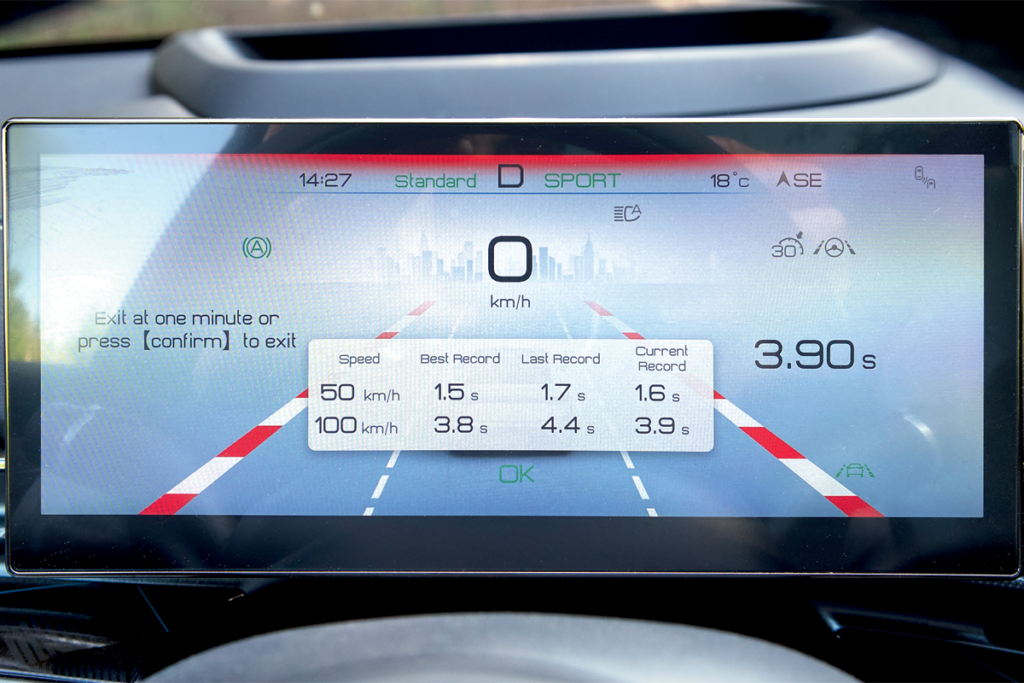
After a break, we drove in standard modes and repeated the acceleration test — it didn’t help. 0 to 62 mph (100 km/h) came in at 4.73 seconds. That’s not quite Porsche Taycan 4S territory, which hits 62 mph (100 km/h) in 4.1 seconds — five times in a row — before easily climbing to 155 mph (250 km/h). For the BYD Seal, even 124 mph (200 km/h) is out of reach: there’s plenty of power (530 hp combined from two electric motors!), but the electronic limiter cuts off acceleration at 118 mph (190 km/h).
Here’s a summary of our measured acceleration figures:
- 0–50 km/h: 1.8 seconds
- 0–100 km/h: 4.1 seconds
- 0–150 km/h: 8.7 seconds
- 60–100 km/h (D mode): 1.9 seconds
- 80–120 km/h (D mode): 2.6 seconds
- Top speed: electronically limited to 190 km/h
Braking Performance and Tires
The brakes are all good here: the heavy electric sedan comes to a stop with confidence, aided by the latest Continental SportContact 7 tires in a 235/45 R19 size. Our measured braking distances:
- From 100 km/h (62 mph): 35.9 m (117.8 ft), at a deceleration of 10.7 m/s²
- From 150 km/h (93 mph): 81.0 m (265.7 ft), at a deceleration of 10.7 m/s²
Handling: How Does the BYD Seal Drive in Corners?
However, the sporty ambitions end at braking: the BYD Seal is far from being a Porsche in terms of handling. And not even a Volkswagen.
You would think that with such a low center of gravity, near-perfect weight distribution, and a sophisticated rear suspension, the Seal should stick to the asphalt in corners. But when driving at a faster pace, you can feel the heaviness and body roll — and, most importantly, in most turns, you have to adjust the steering to correct the trajectory. It’s hard to gauge the angle at the entry of a turn and carry it through the entire curve without additional steering input: under load, the car tightens its line, forcing you to unwind the wheel. There is also a lack of responsive, sharp handling.
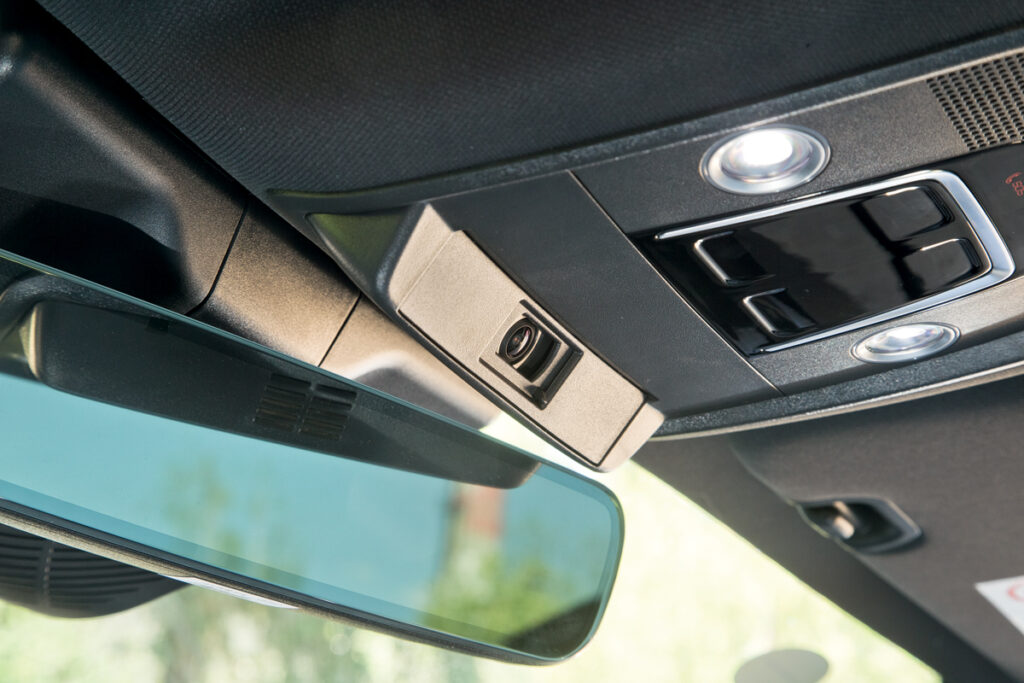
On the overhead console is a typical BYD light and sunroof touch control unit, which Seal does not have.
There is also a “tracking” camera for the rear passengers.
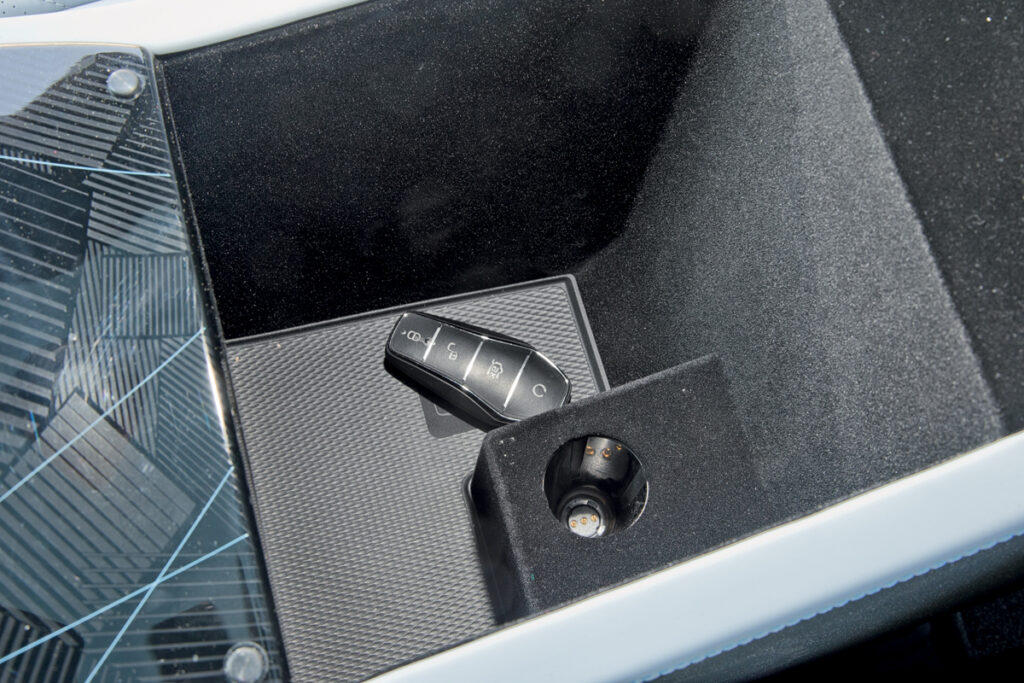
In the armrest box there is a socket for charging… a karaoke microphone!
That said, these flaws only surface during aggressive driving — in standard modes, the handling feels quite reasonable, and there’s no sense of excessive sharpness on a straight road. Add to this excellent ride smoothness (the Seal soaks up small bumps very well, only slightly swaying at high speed) and outstanding noise insulation, thanks to double-glazed front doors. All of this makes clear the Seal isn’t built for racing, but for relaxed daily driving — which is the right approach, since most EV owners drive in eco mode to stretch battery range, using only a fraction of the available power. Push the accelerator aggressively, though, and the Seal’s consumption spikes to a hefty 37.4 kWh per 62 miles (100 km).
Real-World Range: BYD Seal’s 650 km Claim vs. Reality
So how does the BYD Seal perform in everyday driving? With one passenger and a fully charged battery, instead of the promised 404 miles (650 km), the Seal managed to travel just 242 miles (390 km). For the final 9 miles (15 km), BYD limited output — even with the pedal floored, power didn’t exceed 16 kW on the wattmeter, capping speed at 43 mph (70 km/h). This is the same range-preservation algorithm used on the BYD Yuan Plus crossover.
Charging Speed: DC Fast Charging and AC Home Charging
On the positive side, after completely depleting the battery, the Seal started charging from a fast DC terminal without any issues. During charging, power fluctuated between 82-88 kW, which is respectable. Toward the end of the session, the figures on the display began to taper off — first to 40 kW, then to 20 kW. In total, charging the battery from 0 to 100% took 1 hour and 10 minutes.
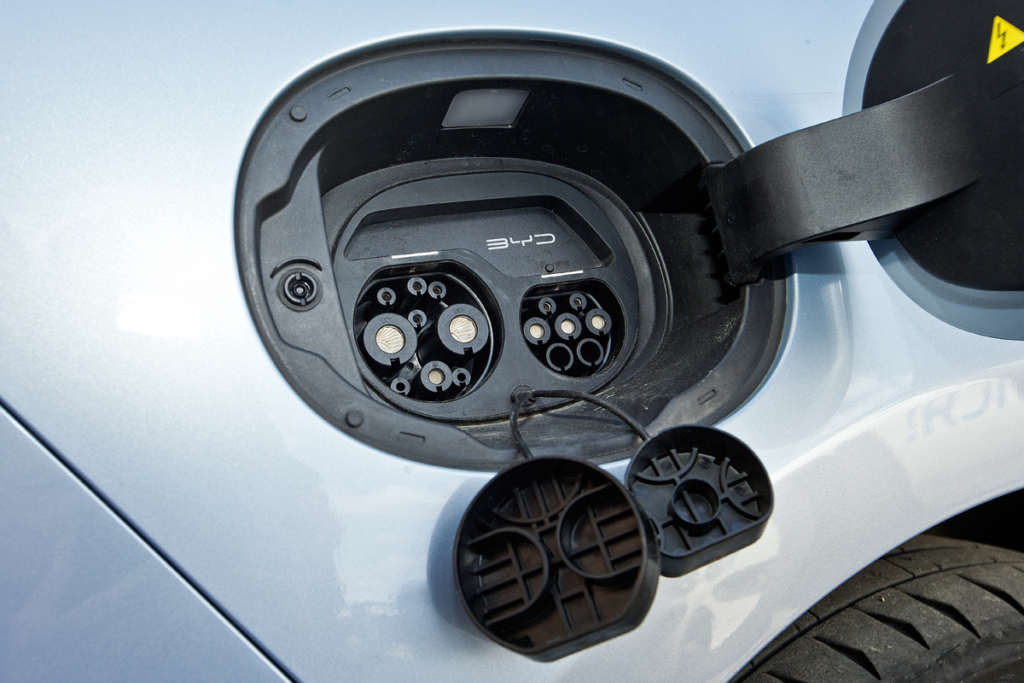
I also tried AC charging via a home-style terminal. Everything works, but like other Chinese EVs, the Seal uses only one phase out of three, capping AC charging power at 7 kW.
Pricing, Warranty, and Sales in China
Buying a car without an official warranty is, of course, concerning. But Autoelectro is ready to supply spare parts within a month.
In China, the Seal comes with a warranty of six years or 150,000 kilometers. Pricing highlights include:
- The basic rear-wheel-drive version with 204 hp costs 189,800 yuan — 18% cheaper than a comparable Tesla Model 3
- The dual-motor all-wheel-drive version with 530 hp costs 279,800 yuan — 16% cheaper than its Tesla counterpart
This pricing reflects the ongoing price wars in China’s EV market: after Tesla cut prices, BYD made a counter-move. In the first quarter of this year, 42,782 Tesla Model 3 sedans were sold in China, compared with 19,573 buyers who chose the BYD Seal.
Dimensions, Weight, and Weight Distribution
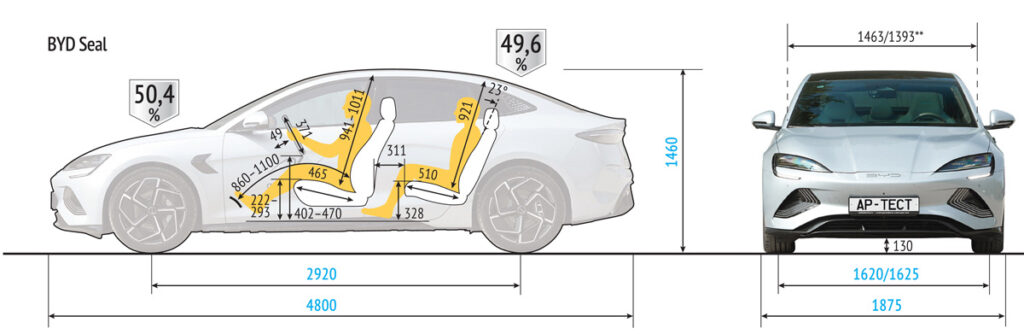
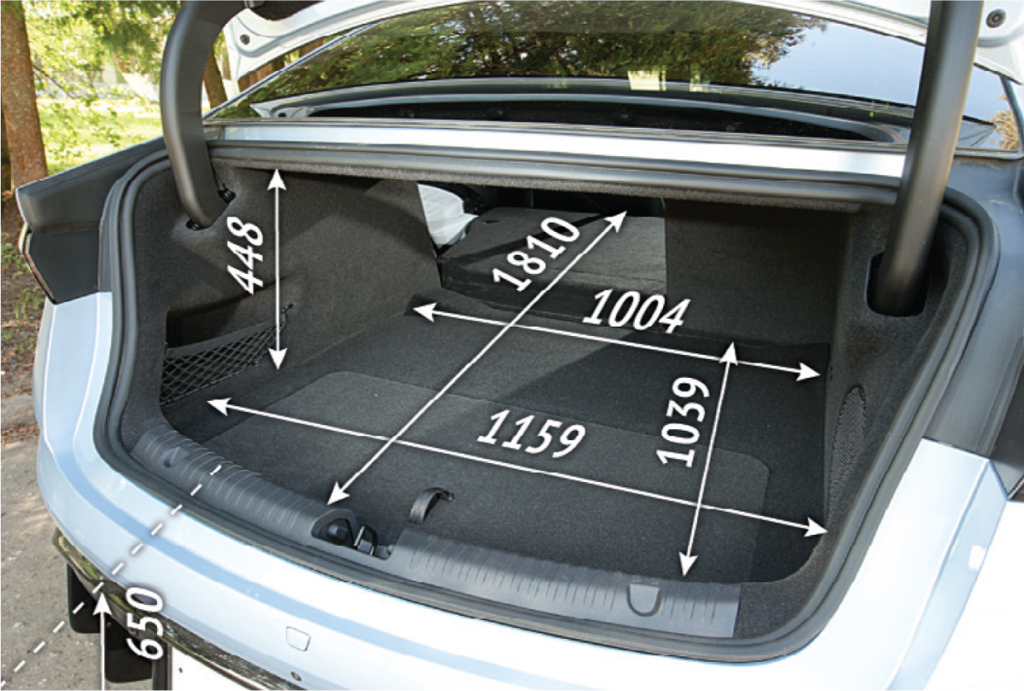
Manufacturers’ data are highlighted in blue/Autoreview measurements are highlighted in black. Dimensions are in millimeters.
**Interior width at shoulder level in the first/second row of seats.
Photo by Dmitry Pitersky
Expert group: Andrey Mokhov
This is a translation. You ca read the original article here: BYD Seal и 530 сил: наш тест и замеры на полигоне

Published July 12, 2023 • 11m to read