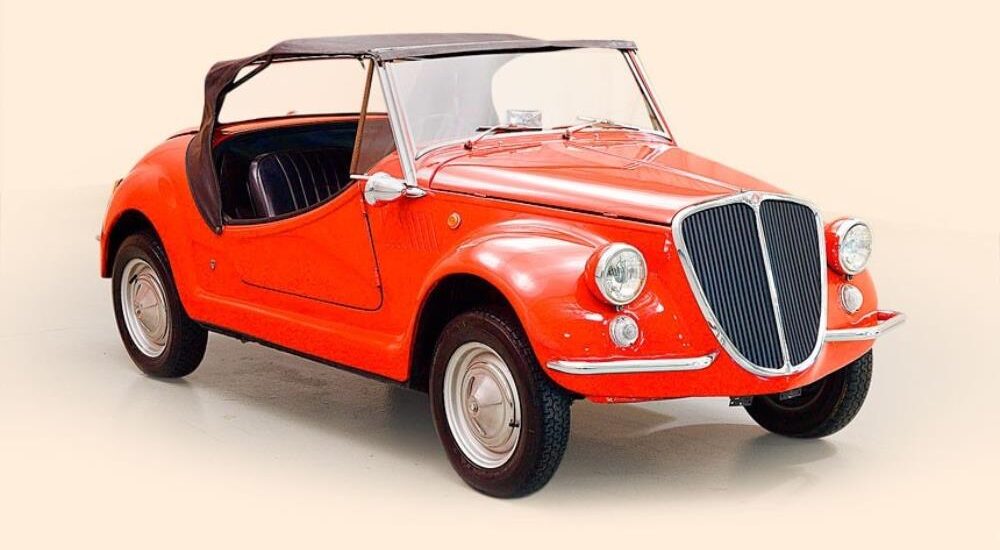

No, the multinational Fiat S.p.A. did not roll this particular car off its production line. It came instead from the workshop of Signor Alfredo Vignale, built from components of the popular Fiat Cinquecento. The workshop stood in Grugliasco, next to the Fiat Mirafiori plant, and the car was made there between 1967 and 1971 — painstakingly, in small batches, by hand. At the same time Vignale was building limited runs on the Fiat 850, Fiat 124 and Fiat 125.
From Farina Apprentice to His Own Marque
Alfredo Vignale’s story starts in 1913 in Grugliasco, and his training was at Stabilimenti Farina, one of the great names of Italian bodywork. Establishing his own venture in 1948, he catered mostly to bespoke requests from major Italian and international automakers. From exhibition models destined for the global auto shows to bespoke creations for discerning private clients, Vignale’s craftsmanship earned acclaim across the automotive industry. The client list was the industry itself — Cisitalia, Ferrari, Volvo, Lancia, Alfa Romeo, Maserati and, of course, Fiat.
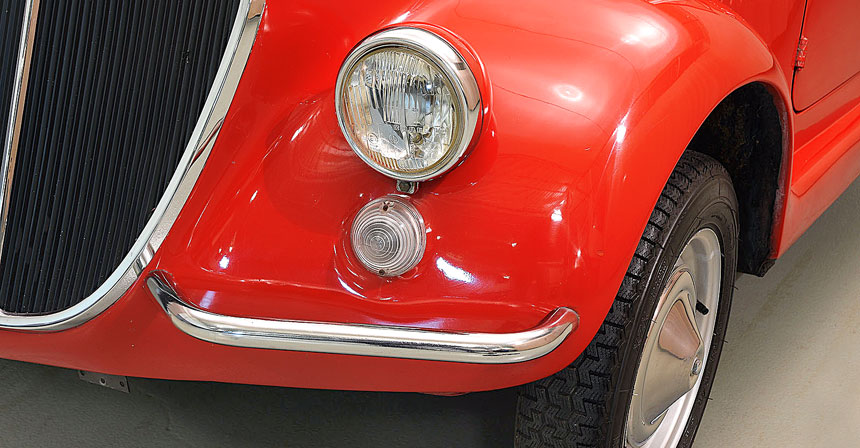
The front design is dominated by a large and eye-catching false radiator trim. Behind it, however, no radiator is found – and there is none on the car at all, neither in front nor in back.
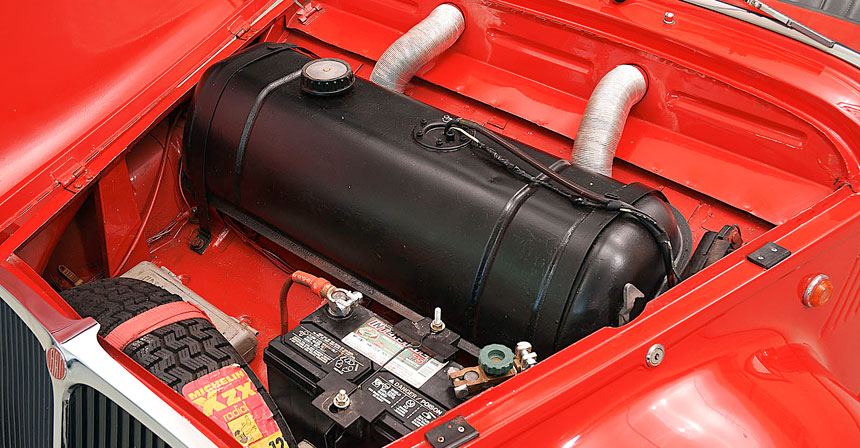
This is what the decorative false radiator actually hides behind itself.
By the early 1960s he wanted to stop subcontracting and put his own name on a car. He moved the operation closer to Mirafiori to shorten the supply line, and began with the Fiat 850, drawing sleek open and closed bodies for it. The Fiat 124 and Fiat 125 got sports bodies called Evelyne and Samantha. And on the chassis of the little Fiat 500 he built this two-seat roadster.
A Radiator Grille With No Radiator
The Fiat 500 carries its engine at the back, so the grille on the Gamine’s nose cools nothing at all. It is a deliberate quotation of pre-war styling, of the sort Lancia and Fiat’s own Balilla wore, and behind it stands the spare wheel, mounted vertically. The curved side doors borrow from vintage British tourers, though there are no wind-down windows. The windscreen is flat rather than curved, with triangular vents in the pillars to deflect spray in inclement weather. The car’s practicality was limited, but its aesthetic charm was undeniable — an embodiment of Vignale’s artisanal vision.
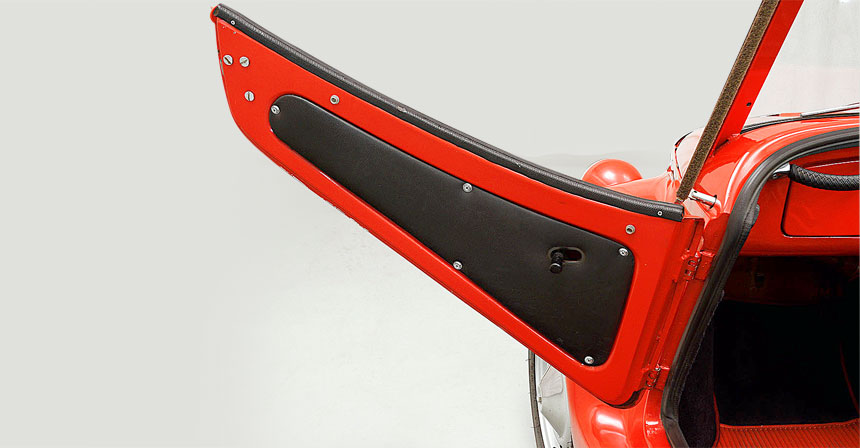
It would be quite possible to do without doors on such a small car. But they still exist – however, there are no handles on them at all.
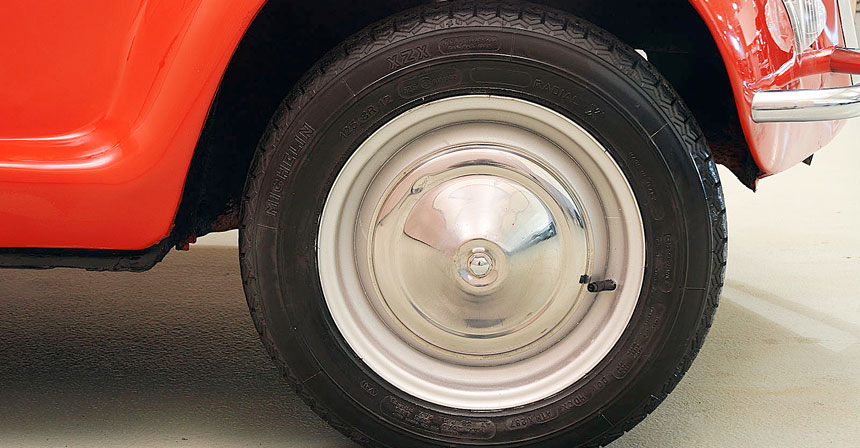
The wheel caps probably should have been made spoked for greater effect, but this would have significantly increased the cost of the car.
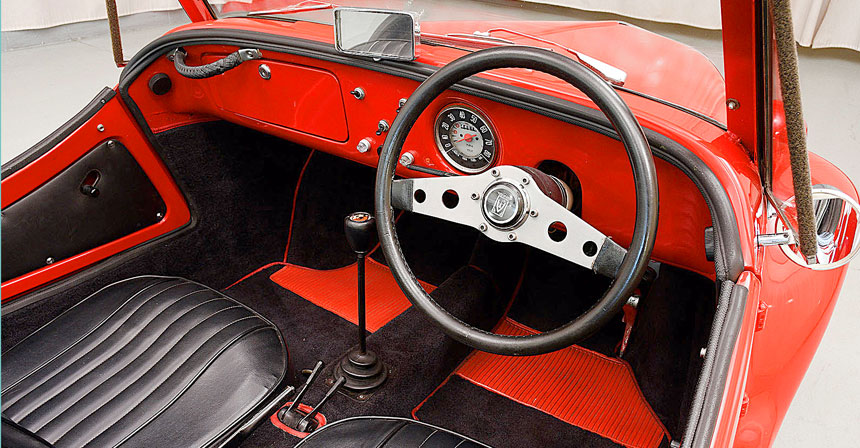
The cockpit of the car is simple and unsophisticated: nothing superfluous.
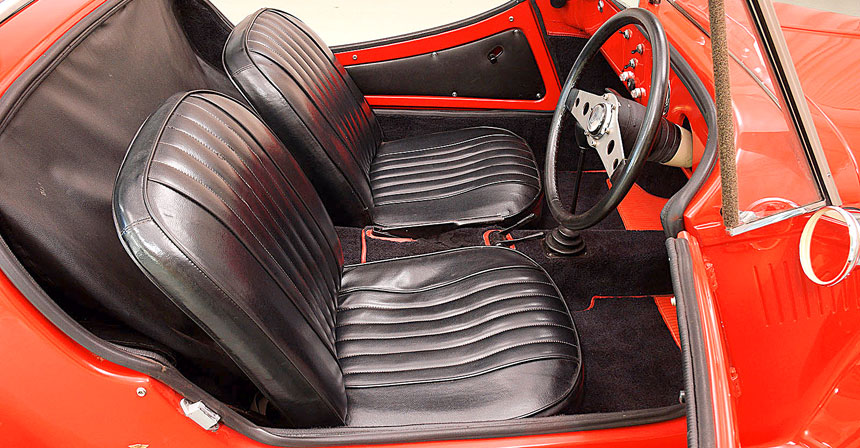
The seats, however, are quite comfortable and are also not afraid of moisture.
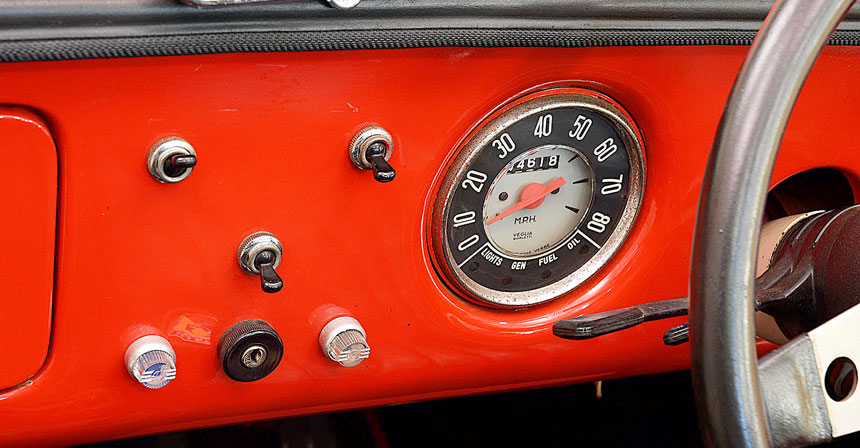
The number of instruments on the front panel is kept to a minimum: a single dial contains everything you need.
Why the Gamine Outsold Its Sisters
Indeed, this petite car could not boast much in terms of practicality. It might be seen as the whimsy of a master — especially given its name, which translates from French as “mischief-maker” or “rascal”. Such a lighthearted view is challenged, though, by the fact that it outstripped its coupe-bodied “sisters” in production volumes. While Samantha and Evelyne saw just over a hundred units each, the Vignale Gamine surpassed them with around three hundred destined for the British car market alone. In total, it is estimated that somewhere between 400 to 450 were produced. (Unfortunately, more accurate data has not been preserved.)
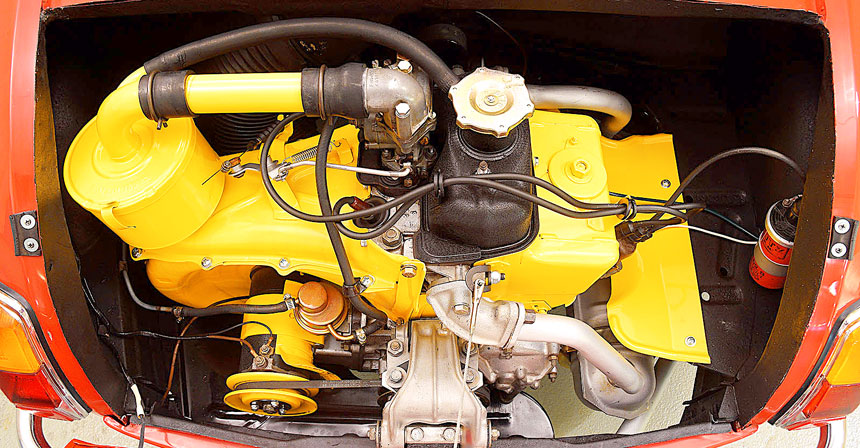
The small motor fits comfortably under the trunk lid. However, the slots on this cover clearly indicate that underneath there is an engine compartment, and not a trunk at all.
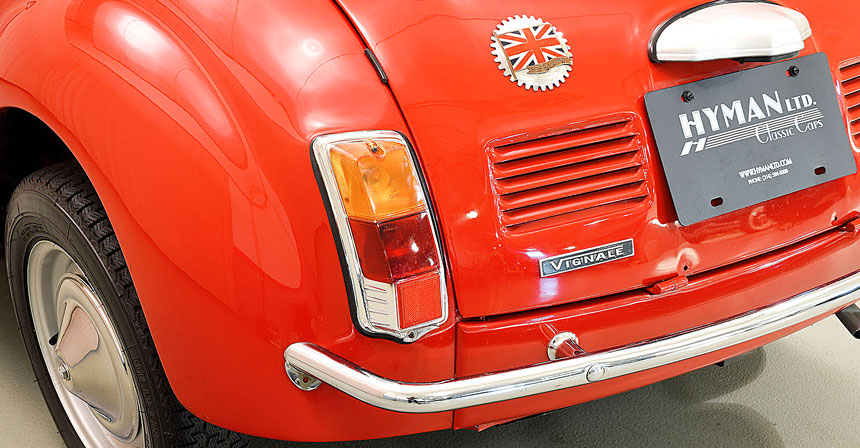
The rear bumper is completely devoid of any practicality – as, indeed, are the front “halves”. The tail lights, for their part, are large and clearly visible.
What Went Wrong
Firstly, it offered only two seats — against the four of the base Fiat 500 — and it was notably slower. Secondly, its handling left much to be desired. The relatively high cost of the car also played its part: demand fell short of expectations, and that ultimately led Alfredo Vignale to halt automotive production altogether. In the autumn of 1969 his entire business was acquired by Alejandro de Tomaso, who intended to produce his Pantera on these premises. Tragically, by the end of November, just as the ownership transfer concluded, Signor Alfredo died in a car accident, crashing in his personal Maserati. Thus another chapter in the history of Italian bodywork came to a close.

This example was clearly intended for use in countries with left-hand traffic.
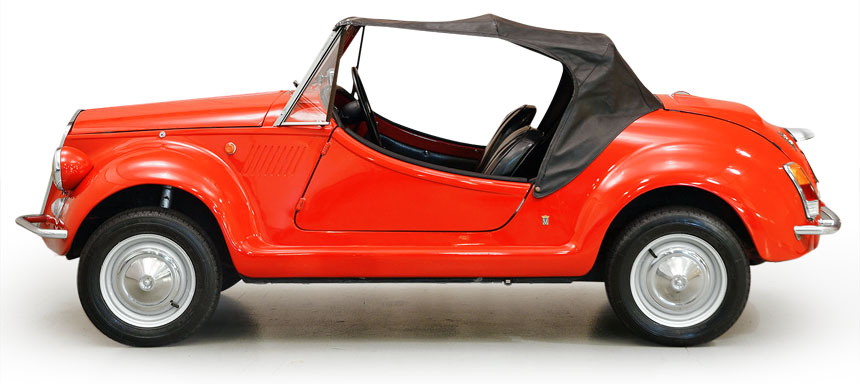
The profile of the car is dashing – both with the top up and with the top down. However, in both cases there is practically no protection from external conditions.
One Car’s Way to Honolulu
The car in these photographs is right-hand drive. It was ordered through the company’s London branch and found its first owner there; the paperwork puts the purchase in 1969, at £645. A year later that owner moved to Karachi, Pakistan, and took the car with him. From there it journeyed via Melbourne, Australia, to Hawaii, landing in Honolulu. Despite its extensive travels, this particular specimen arrived in remarkably good condition.
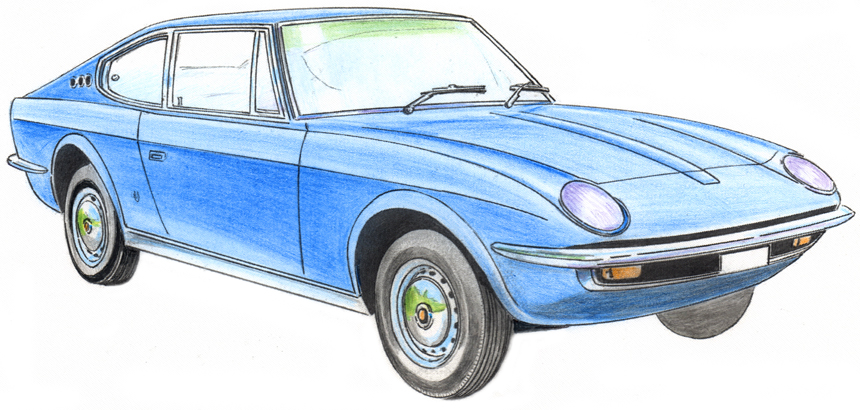
“Gamine” is still “boy”. And here are the “girls”, his sisters: Samantha…
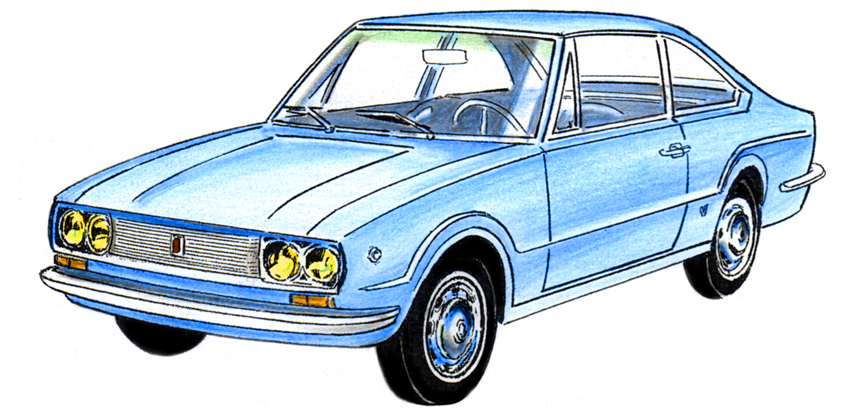
… and Eveline
Fiat Vignale Gamine: The Key Facts
- Built by: Carrozzeria Vignale, Grugliasco — not by Fiat
- Years: 1967 to 1971, by hand, in small batches
- Basis: the Fiat 500 Cinquecento, engine at the rear
- Body: two-seat open top, no wind-down windows, no external door handles
- The grille: decorative only — the spare wheel stands behind it
- Production: roughly 400 to 450 in total, about three hundred of them to Britain
- Sisters: Samantha on the Fiat 125 and Evelyne on the Fiat 124, a little over a hundred each
- This example: bought new in London in 1969 for £645; now in Honolulu by way of Karachi and Melbourne
Frequently Asked Questions
Is the Gamine a Fiat? Only underneath. The mechanical parts are Fiat 500, but the car was designed and built by Alfredo Vignale’s workshop in Grugliasco, and Fiat S.p.A. had no hand in it.
Why does a rear-engined car have a radiator grille? Because it is not a radiator grille. It is styling, a nod to pre-war cars such as Fiat’s Balilla, and the space behind it holds the vertically mounted spare wheel.
How many were made? Between 400 and 450 by most estimates, with around three hundred going to the British market. Exact records no longer exist.
What does the name mean? It comes from French, roughly “mischief-maker” or “rascal”.
Why did production stop? Two seats instead of four, modest performance, indifferent handling and a high price together kept demand below expectations. Vignale sold the business to Alejandro de Tomaso in the autumn of 1969.
Photo: Sean Dugan, www.hymanltd.com
This is a translation. You can read the original article here: Шалунишка: Fiat Vignale Gamine 1969 года в рассказе Андрея Хрисанфова

Published May 02, 2024 • 6m to read