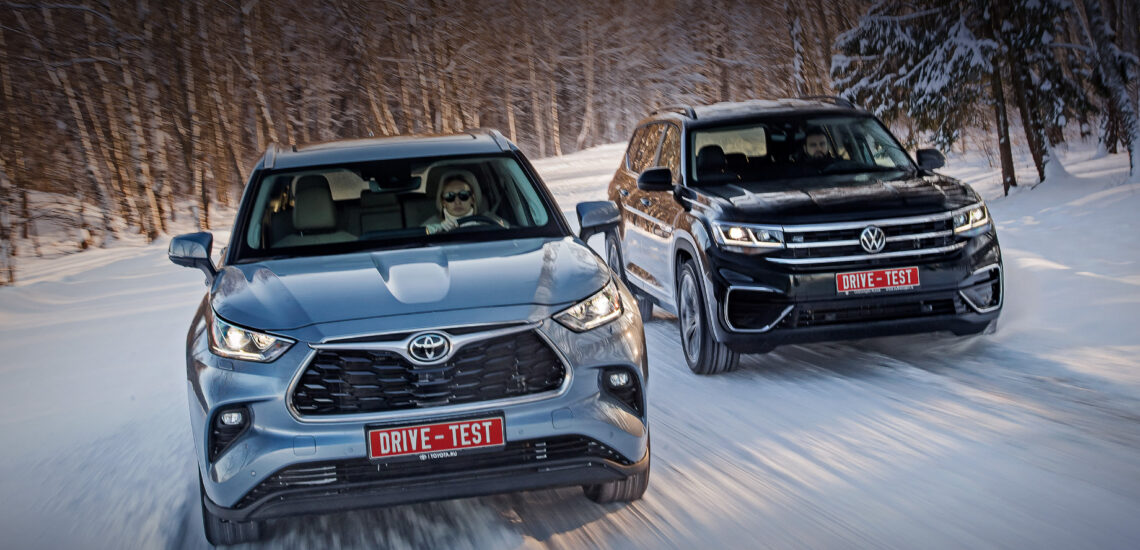

When it comes to seven-seat, all-wheel-drive SUVs, few matchups are as revealing as the Toyota Highlander vs. the Volkswagen Teramont. The Highlander is one of the most expensive options in its class, starting at $55,000 — while rivals typically cost $4,000–$11,000 less. Yet Toyota sold 264,128 Highlanders in a single year. Brand loyalty, or something more? We put it head-to-head with the Volkswagen Teramont, which found 162,437 buyers in the same period, to find out.
Exterior Design and Build Quality
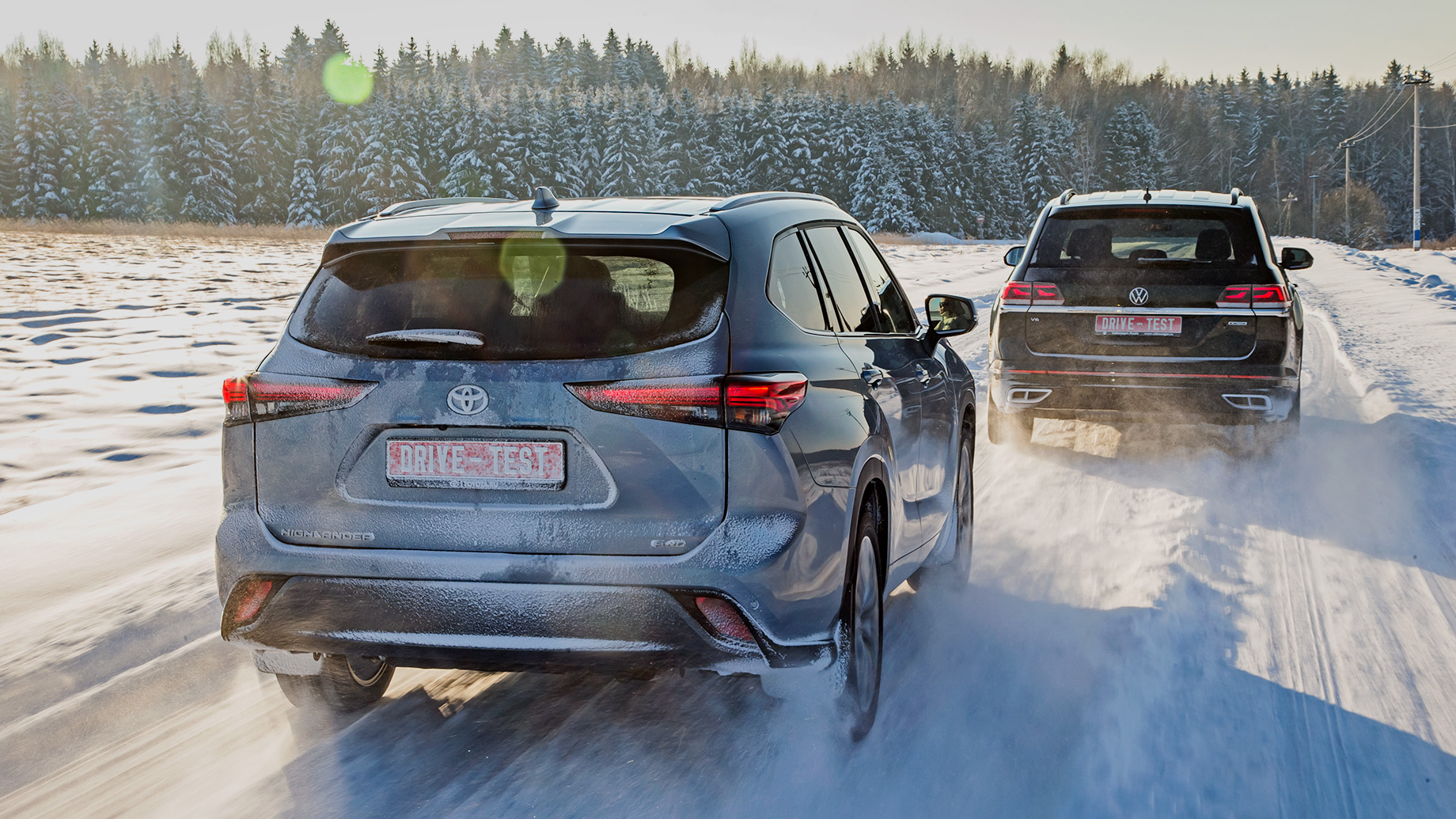
First impressions count — and the two SUVs couldn’t be more different when it comes to fit and finish. The Highlander is built at Toyota’s Princeton plant in the USA, and build quality is unfortunately not its strong suit. Panel gaps are large across almost all body panels, most noticeably around the trunk door, rear fenders, and bumper. There’s enough space between the hood and the LED headlights to fit half a finger. For a $55,000 vehicle, that’s a hard pill to swallow.
The Teramont makes a much stronger first impression. Its angular body with chrome detailing looks as though it was carved from black marble. The R-Line Sports package adds visual aggression with:
- A front bumper with enlarged air intakes
- A rear pseudo diffuser for a sportier stance
- Wide 21-inch alloy wheels (versus the Highlander’s 20-inch)
One caveat: the quad exhaust outlets are purely decorative — chrome surrounds with no actual openings behind them. A small but telling detail on an otherwise sharp-looking SUV.
Front Row Interior: Comfort, Ergonomics, and Materials
Both SUVs offer easy front-door access with low, clean sills that stay protected when the doors close. However, their cabin philosophies are very different.
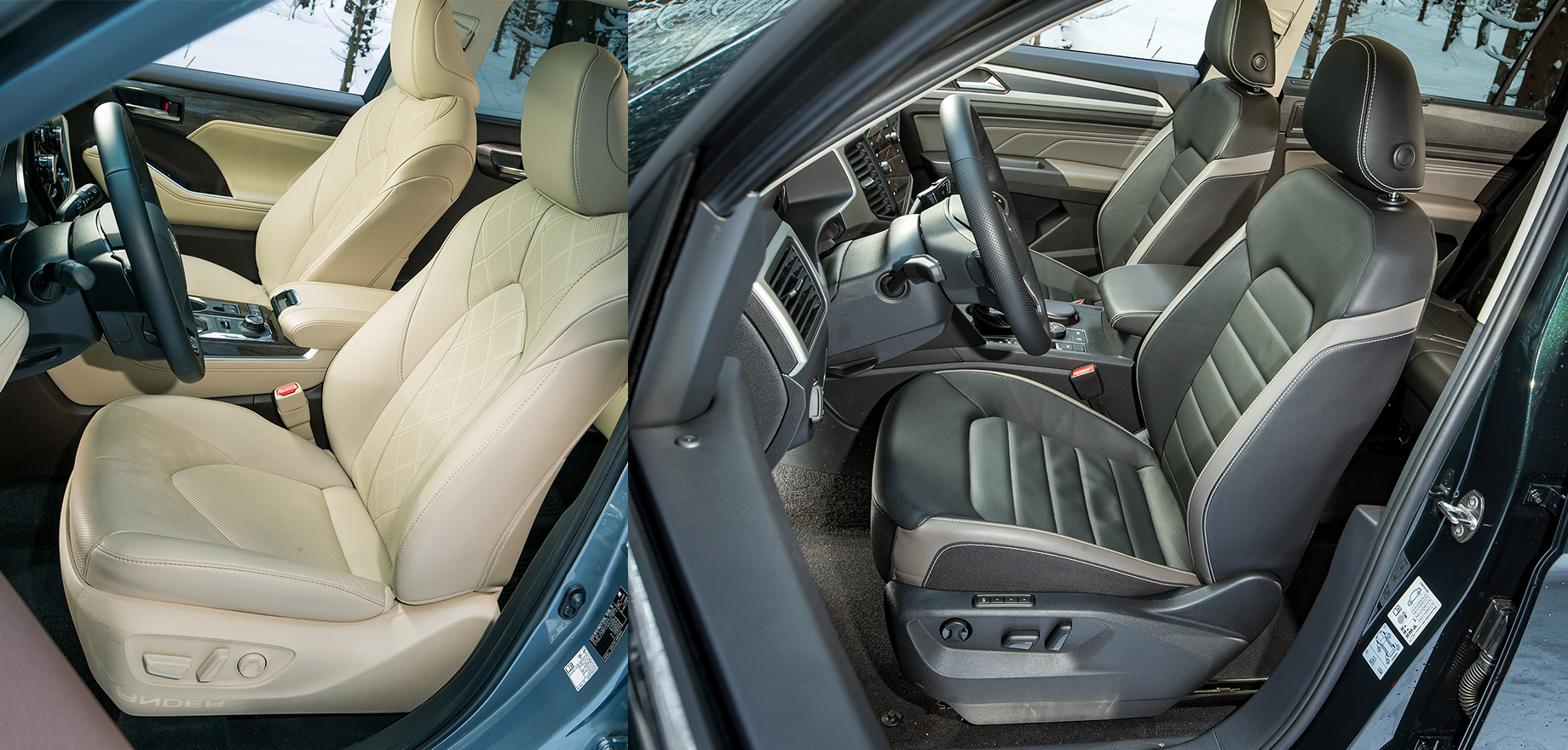
The Highlander favors a relaxed driving position — the steering wheel sits at a gentle angle, placing you slightly closer to it with legs more bent. The soft, generously padded seat with wide, pliable bolsters is genuinely comfortable for long drives. Interior quality largely justifies the price tag:
- High-quality plastics throughout the cabin
- Real leather trim on door panels
- Stitching with genuine thread
That said, the Highlander interior isn’t without flaws. A cheap wood-imitation trim and a cluster of outdated-looking physical buttons let the side down. Ergonomically, the steering wheel heating button is buried next to the all-round camera controls rather than sitting logically on the climate unit. The central touchscreen also suffers from sluggish response to touch inputs, slow swipe recognition, and an awkward position that places it slightly too far from the driver.
The Teramont takes a decidedly sportier approach. Dense seat padding and firm lateral bolsters hold the driver firmly in place, while the thin-spoked steering wheel is mounted more vertically — encouraging a more engaged driving posture. The lower seating position and more extended leg angle reinforce that dynamic feel without forgetting this is still a family crossover.
Interior materials in the Teramont feel closer to the budget Polo than a premium SUV. However, its ergonomics are excellent — consistent, logical Volkswagen layout throughout — with one minor exception: the gear lever shifts from D to S mode with a vague, imprecise action. The multimedia system isn’t the latest generation and screen resolution disappoints, but it still outperforms Toyota’s more dated infotainment. Both systems could pair with smartphones more seamlessly.
Second and Third Row: Passenger Space Compared
The Teramont is longer than the Highlander with a greater wheelbase, and that translates into meaningfully more rear passenger space. With the driver’s seat adjusted to a height of 5’9″, here’s what rear passengers can expect:
- Volkswagen Teramont: 5.91 inches of knee clearance, 5.51 inches of headroom
- Toyota Highlander: 4.33 inches of knee clearance, 1.57 inches of headroom
The Teramont’s second row is also wider for three abreast, offers a greater range of fore/aft adjustment, and features a reclining backrest. Both vehicles come well-equipped back here, including:
- Dedicated rear climate control
- Heated second-row seats
- USB charging ports
- Window curtains
Where the Highlander fights back is seat comfort. Its second-row cushion — soft leather wrapped over plush padding — is noticeably more comfortable than the Teramont’s firmer alternative. For long journeys as a rear passenger, the Highlander wins on comfort alone.
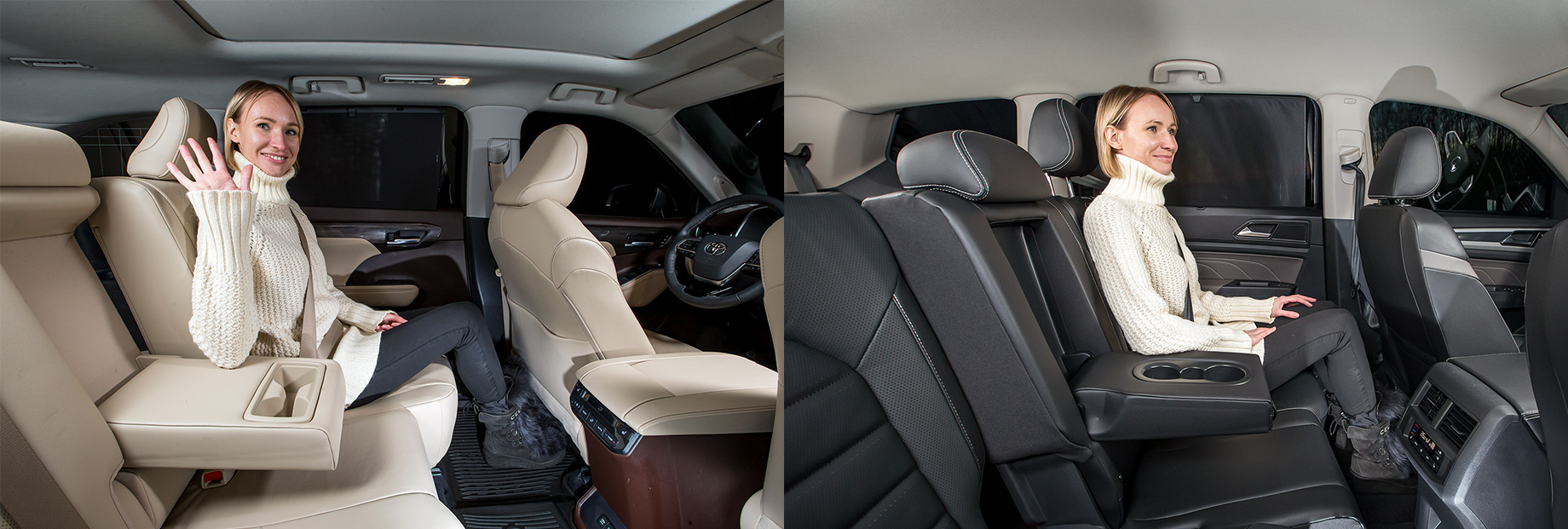
The third row is where the Highlander struggles most. Even with the second row slid forward, legroom is cramped. Headroom is barely adequate, and the low, knees-raised seating position makes any journey back there uncomfortable. The Teramont’s third row is far more usable — easier to access, with decent space in all directions and a more natural seat angle.
Engine Performance and Fuel Efficiency
Both crossovers are powered by naturally aspirated V6 engines producing 249 hp each. Torque figures are nearly identical:
- Volkswagen Teramont: 360 N·m of torque
- Toyota Highlander: 356 N·m of torque
In a turbocharged era, neither engine breaks new ground — but both do their jobs well. They rev willingly, deliver strong pull from 2,500 rpm through the entire range, and stay capable on the open road.
In real-world performance, however, the Highlander is clearly the quicker of the two. Despite weighing nearly as much as the Teramont, it pulls away convincingly from a standstill and continues to build its lead up to 80 mph. In rolling accelerations — from 37 to 62 mph and from 50 to 75 mph — the Toyota consistently leaves the Volkswagen behind.
Fuel economy also favors the Toyota. The Teramont consumes an extra 2–3.5 liters per 62 miles under comparable driving conditions. Add to that the fact that the Highlander runs on standard AI-92 fuel while the Teramont requires premium AI-95, and the running cost difference becomes significant over time.
Transmission and On-Road Handling
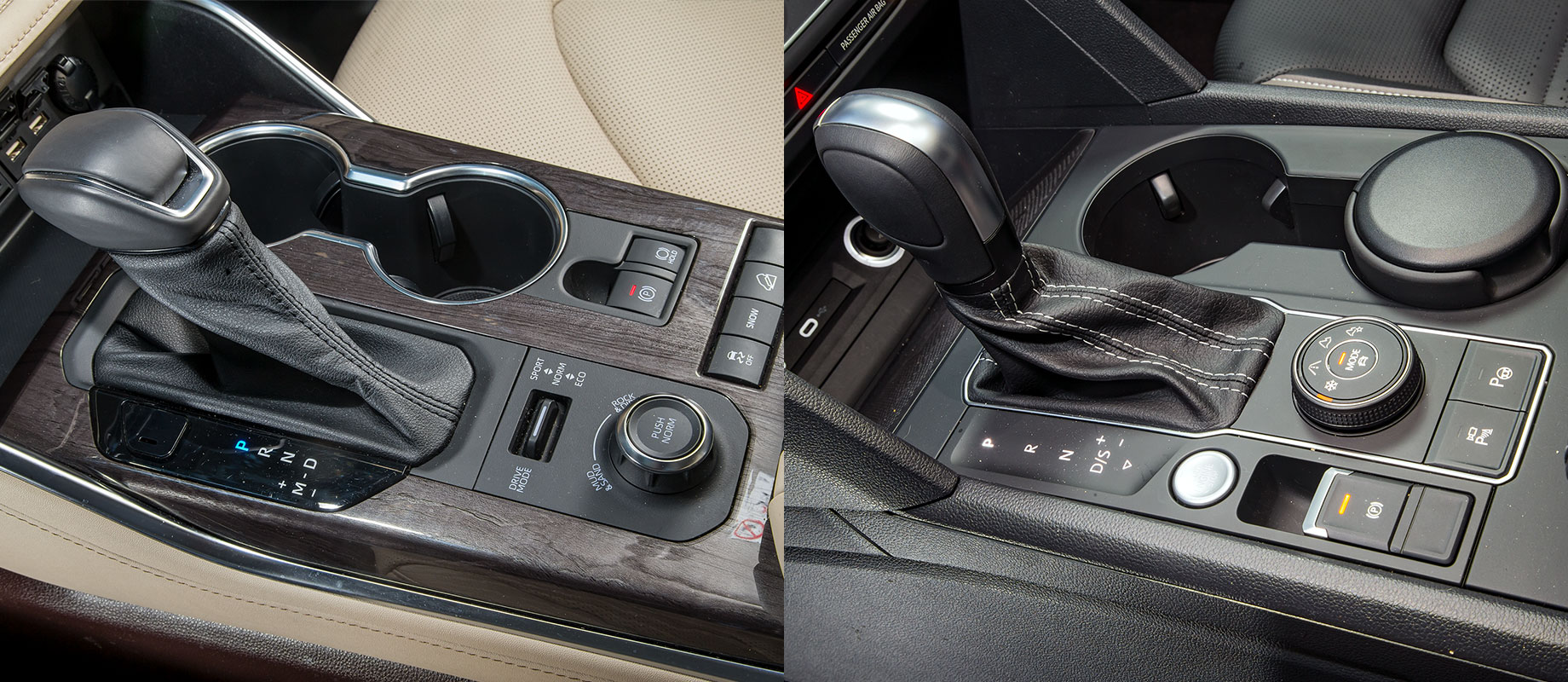
Both vehicles use the 8-speed Aisin AWF8F45 automatic gearbox, well-tuned in both applications. A light throttle tap prompts a quick single downshift; a firm press drops multiple ratios — say, from 8th to 4th — with minimal hesitation. In the Highlander, you rarely notice the absence of a dedicated Sport mode. In the Teramont, Sport mode exists but is seldom needed, though holding gears longer on a twisty road is a welcome option.
On those twisty roads, the Teramont genuinely impresses for a vehicle of its size. Despite its five-meter length, it offers:
- Natural, communicative steering feel
- Controlled, moderate body roll through fast corners
- Strong high-speed stability through long arcs
- Predictable, confidence-inspiring handling on snow via the Haldex V all-wheel-drive system
The one blemish is a brake pedal with more travel than ideal — though outright stopping power is not in question.
The Highlander is less engaging to drive. Steering feel is artificial, the stability control operates permanently with no option to reduce intervention, and the all-wheel-drive setup feels uninspiring in spirited driving. The brake pedal also demands more effort than expected, leaving a lingering sense of weak deceleration even in everyday use.
Ride Quality and Suspension
This is one of the most decisive differences between these two SUVs — and it doesn’t favor the Teramont. Its suspension is tuned firmly, perhaps overly so. Average road imperfections produce sharp vertical jolts, and larger potholes send the two-ton body into noticeable shaking. Uncomfortable side-to-side body movement on broken surfaces is unsettling for passengers, and vibration from the wheels travels through the floor. Only fine road texture goes unnoticed.
The Highlander handles rough surfaces far more composedly. On a road riddled with potholes, it feels softer, better absorbed, and considerably less fatiguing. It also performs better on unpaved gravel roads, handling rough terrain smoothly and without bottoming out. Two practical notes: opting for 18-inch wheels over 20-inch will improve ride comfort further, and the engine bay lacks proper underbody protection — something to bear in mind on rougher terrain.
Off-Road Capability
For buyers who venture off the tarmac occasionally, the Teramont has the advantage:
- Better geometric ground clearance angles
- More capable and configurable off-road assistant
- Handles wheel articulation without needing off-road mode engaged
- Standard underbody skid plate protection
The Highlander, without its off-road mode active, struggles with wheel spin on uneven surfaces — the free wheels simply spin rather than transferring power effectively. It also lacks the underbody protection the Teramont comes fitted with as standard.
Final Verdict: Toyota Highlander or Volkswagen Teramont?
Both SUVs make a strong case — in different ways. Here’s the bottom line:
Choose the Toyota Highlander if:
- Ride comfort and long-journey refinement are your top priorities
- You want stronger engine performance and lower fuel costs
- A cozier, more premium-feeling interior matters to you
- You value the Toyota reliability reputation and are willing to pay for it
Choose the Volkswagen Teramont if:
- Passenger space — especially rows two and three — is a priority
- You prefer a more engaging, sporty driving experience
- A larger, more practical interior layout and bigger boot suit your needs
- You want comparable equipment at a lower price point
- You’re open to the turbocharged four-cylinder engine (quicker and more economical) and smaller wheels (for a more comfortable ride)
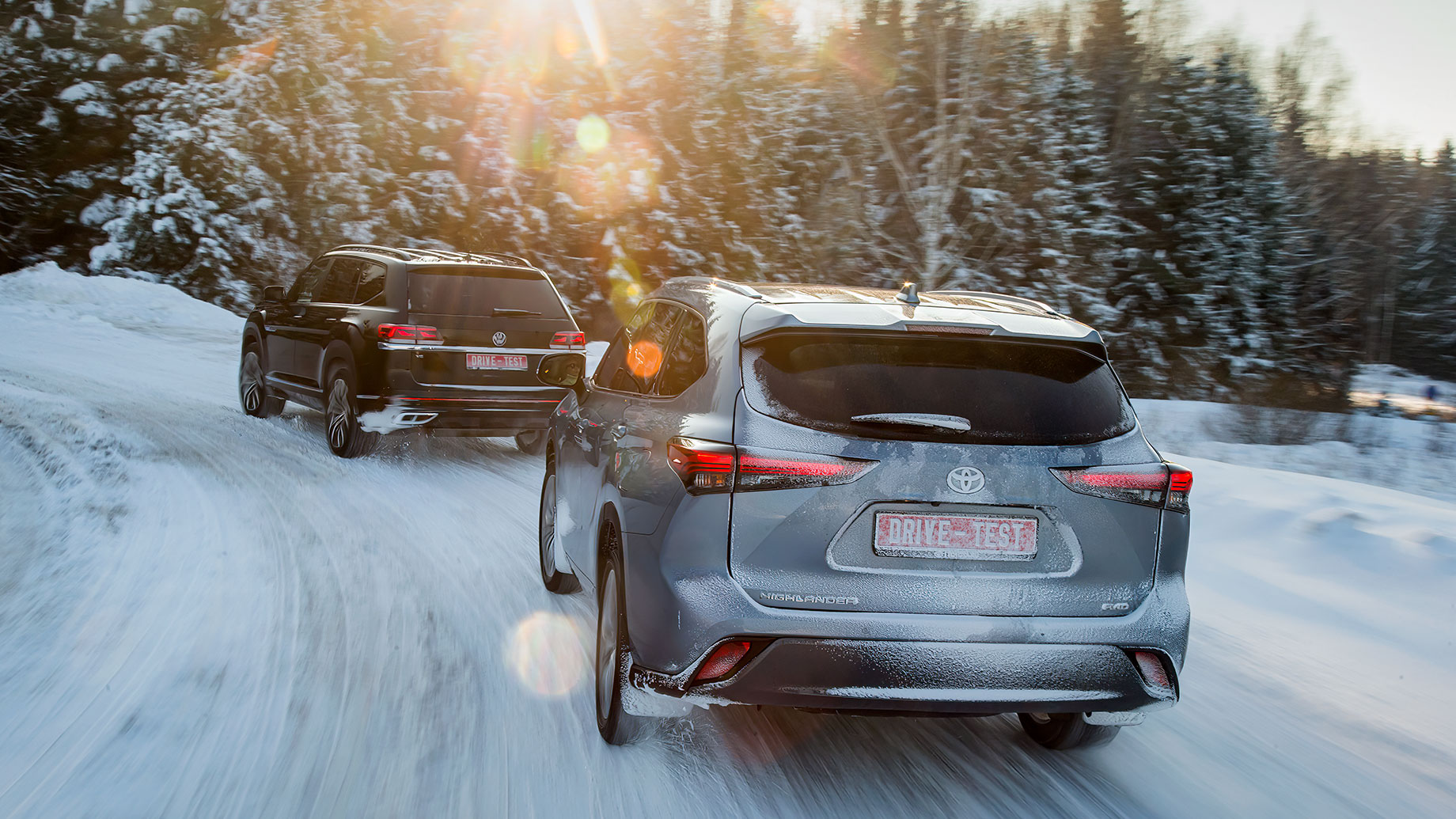
As a family SUV, the Highlander edges ahead on overall balance — better ride comfort, more refined interior, and stronger real-world performance. But the Teramont’s extra passenger space, lower starting price, and genuine driver involvement make it a compelling alternative that deserves serious consideration. Neither is flawless — but both offer something the other simply can’t match.
This is a translation. You can read the original here: https://www.drive.ru/test-drive/toyota/volkswagen/61c1fda3eb24dd878b21eeb7.html

Published February 24, 2022 • 8m to read