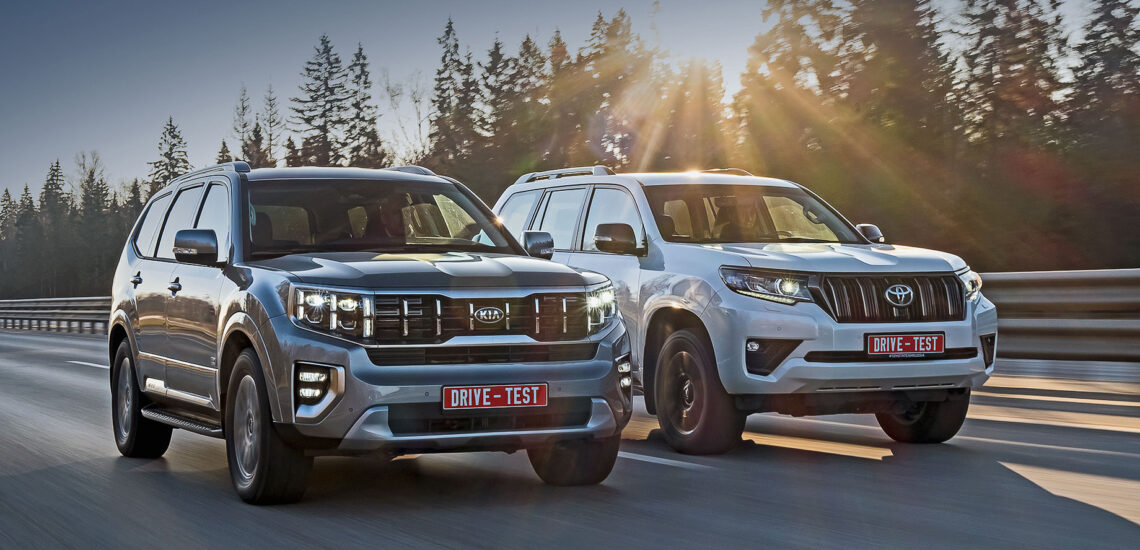

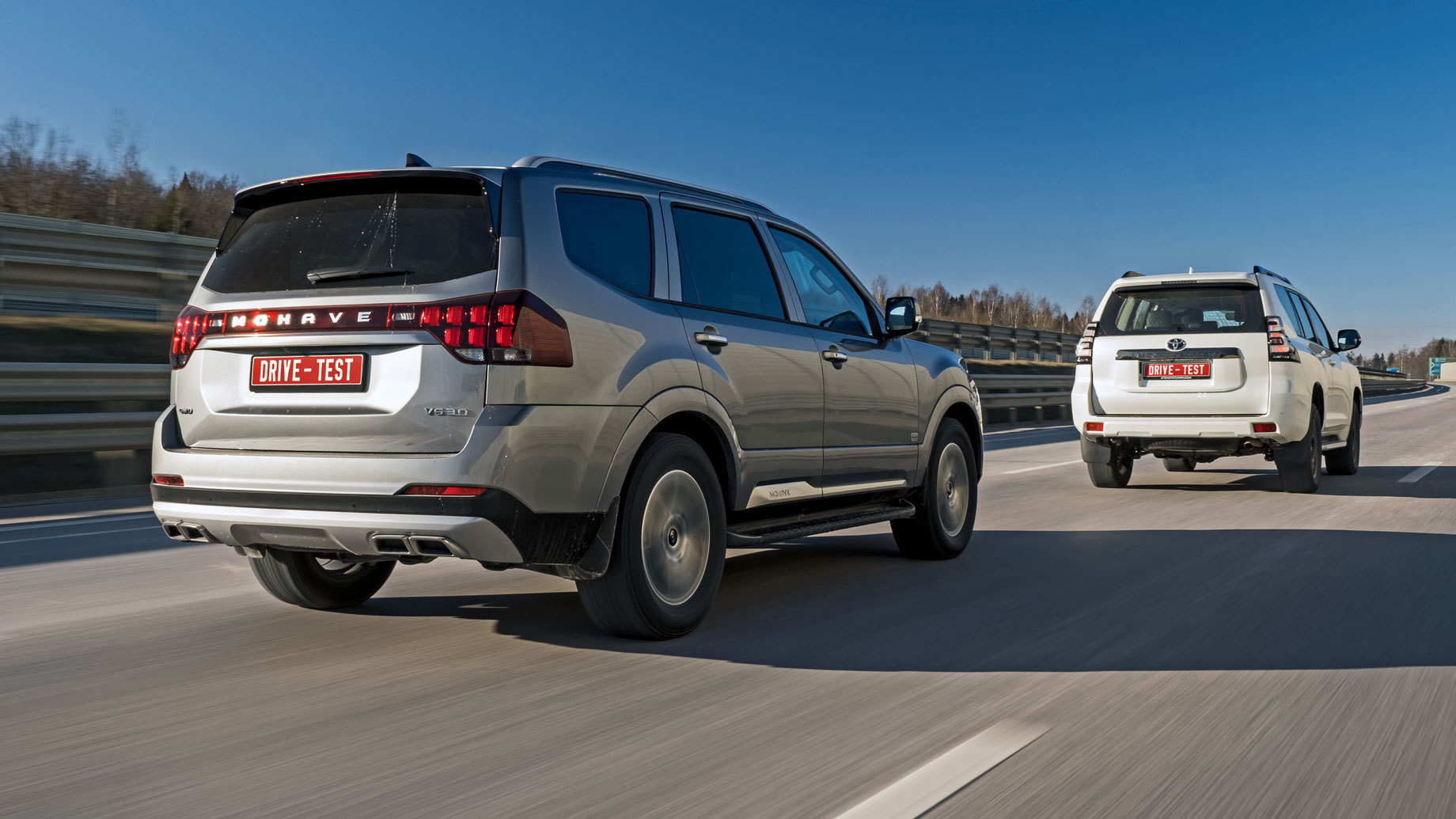
Let’s get one thing straight: these two SUVs are direct competitors, regardless of how KIA’s marketers position them. The frame-built Mohave may officially sit below the Prado in the brand’s lineup, but retail reality tells a different story. After interviewing six dealers from each brand, we found that as the first hundred Mohave units sold out, the market markup reached $17,700 — the same premium being charged for a spot in line for a scarce Porsche Cayenne.
The test Prado 2.8 Prestige is nearly identical to the one featured in our previous frame SUV comparison. Equipped with adaptive KDSS stabilizers, this Toyota won’t leave the dealership for less than $88,500, despite an official price tag under $74,000. The Mohave Prestige maintains a roughly $8,800 gap below that. Comparing these two top-spec versions makes it easier than ever to see which SUV delivers more for the money.
Interior Space and Passenger Comfort
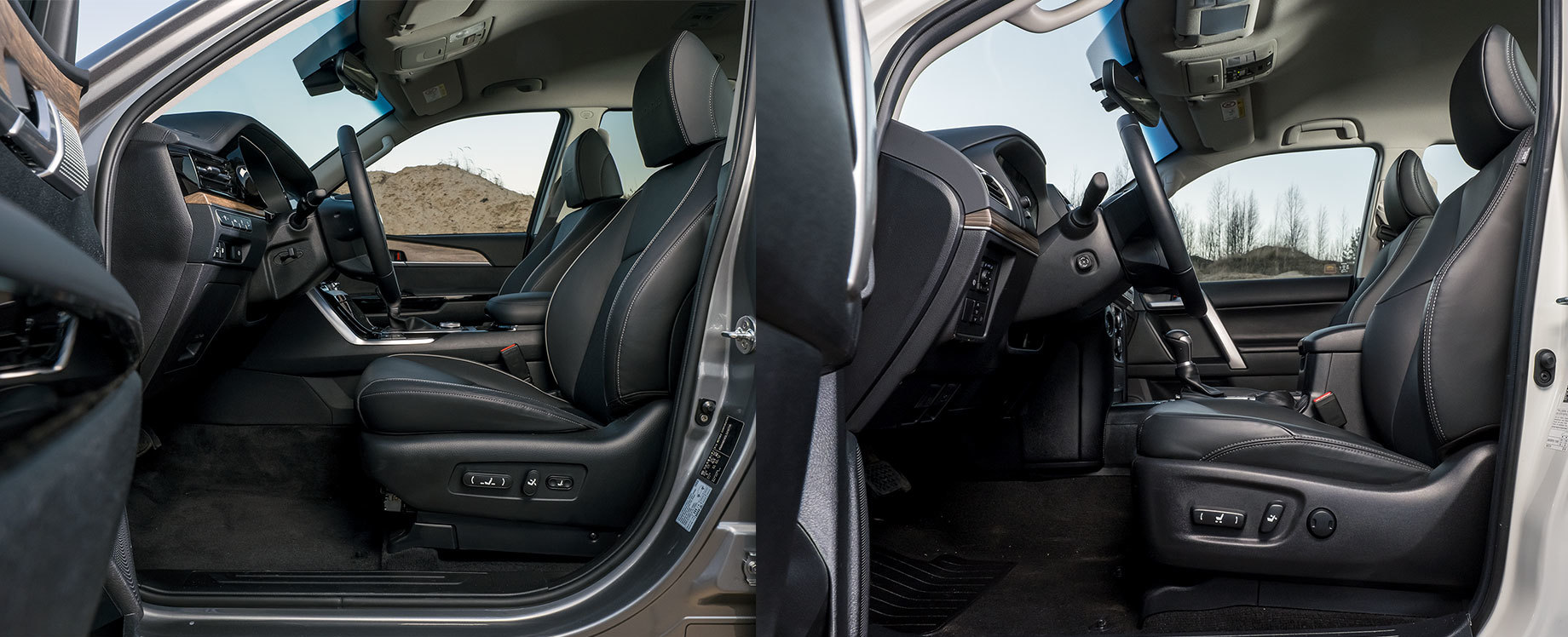
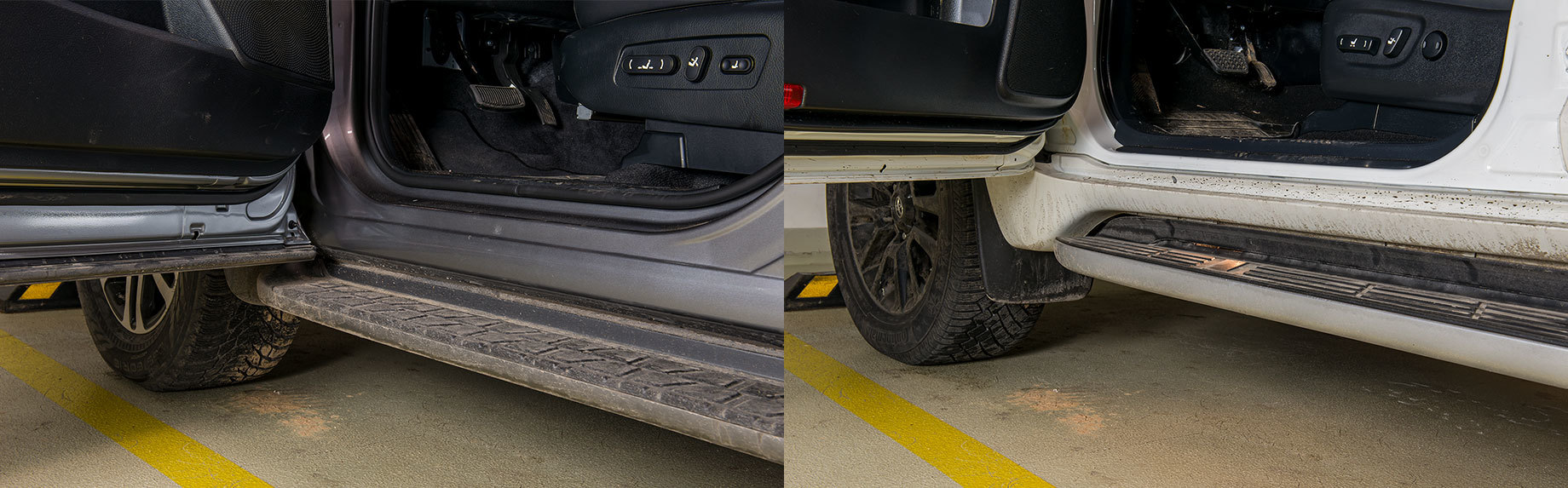
The Mohave isn’t just nominally a seven-seater — it actually lives up to the claim. At 6’1″, there’s a comfortable knee margin in both the second and third rows, thanks to a wheelbase that’s 4.5 inches longer than the Toyota’s. Here’s how the two cabins compare:
- Kia Mohave: Wider door openings, generous door angle, slightly wider shoulder room, more modern interior design, genuine 7-seat capacity
- Toyota Prado: More headroom, more knee space in front, better seat ergonomics, and third-row seating only available in the top-spec Black Onyx (priced around $85,000 MSRP, retailing near $97,000)
On pure value for seating capacity, the Kia wins outright.
Engine and Powertrain Performance
Most Prado buyers opt for the 2.8L 1GD-FTV diesel, which gained a bump to 200 hp after its 2016 restyling. The Mohave, meanwhile, runs a 3.0L turbodiesel V6 from the S-II series, rated at 249 hp and paired with an 8-speed Hyundai Powertech automatic. In our opinion, this powertrain is the Mohave’s single biggest advantage.
The V6 diesel — often overlooked within the Hyundai-KIA lineup — is impressively refined:
- Minimal vibration at idle and under load
- Crisp throttle response, especially in Sport mode (idle climbs to 2,000 rpm)
- Smooth, logical gear changes up to 2,000 km on the odometer
- Engine braking available without switching to manual mode
- Deep, pleasant exhaust note with no harsh synthetic edge
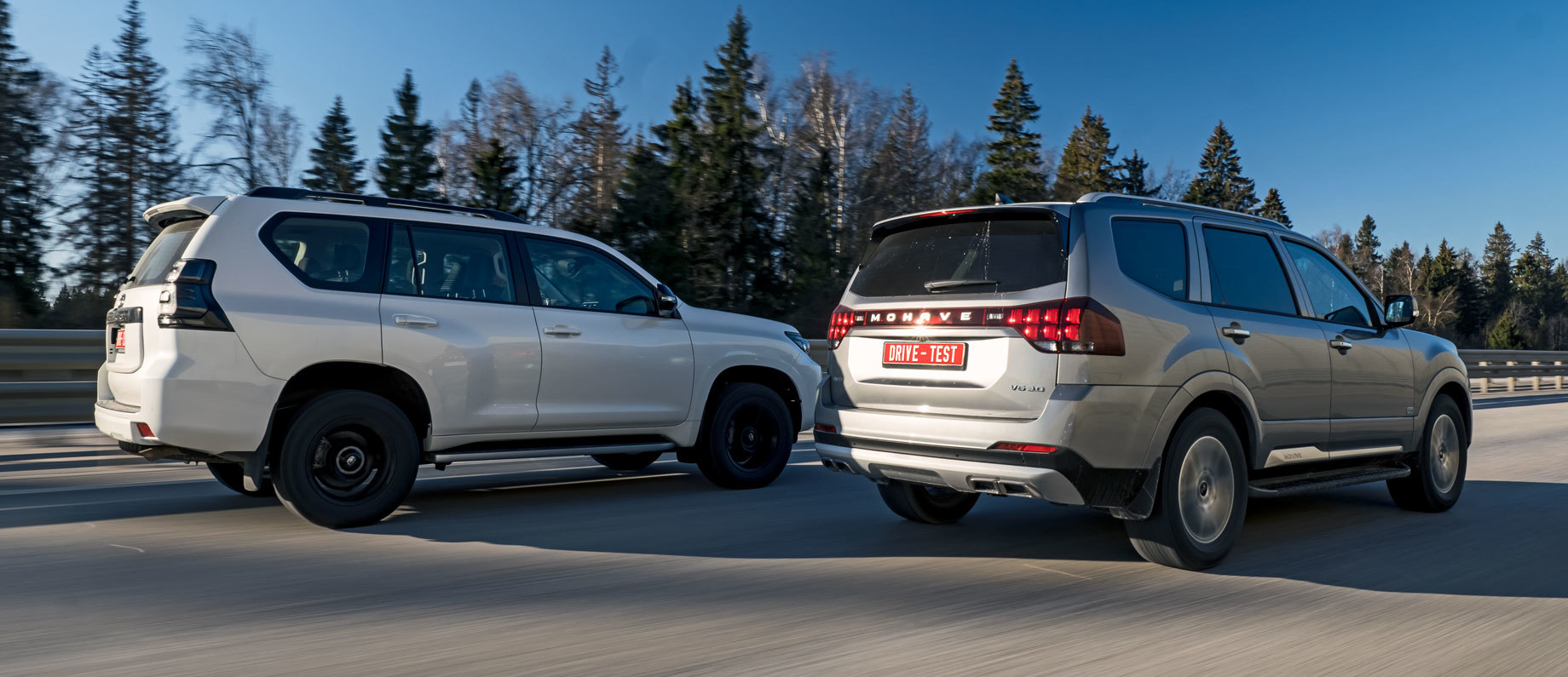
The numbers bear this out. Both vehicles weigh approximately 2.3 tons with a driver, but the difference in feel is stark. The Mohave’s advantage breaks down as follows:
- Engine displacement advantage: 204 cc more than the Prado’s 2.8L
- Power advantage: ~49 hp more
- Torque advantage: ~49 Nm more
- 0–100 km/h (62 mph): 8.5 seconds (Mohave) vs. 11.1 seconds (Prado)
The Prado’s four-cylinder diesel, by contrast, feels strained. Throttle responses are non-linear, the torque converter doesn’t lock in lower gears causing rpm to drift, and the engine vibrates noticeably under load below 1,500 rpm. Engine braking requires switching to manual mode. For a vehicle at this price point, the dynamics simply don’t match the asking price.
Tires, Braking and Handling
Both SUVs run 265/60 R18 winter non-studded tires — but different ones. The Mohave wears Nokian Hakkapeliitta R3 SUV, while the Prado rides on Continental VikingContact 7. The tire choice meaningfully shapes each car’s character:
- Prado (VikingContact 7): Quieter cabin, better smoothing of asphalt micro-profile, but softer tread compromises handling and straight-line stability. Braking on fresh snow and wet pavement is concerning — stopping distance from 60 mph exceeds 164 feet
- Mohave (Hakkapeliitta R3): Noisier and stiffer, but noticeably more grip. Front-to-rear traction on snow is a pleasant surprise for a vehicle this heavy, and the ABS calibration is well-matched to the tire behavior
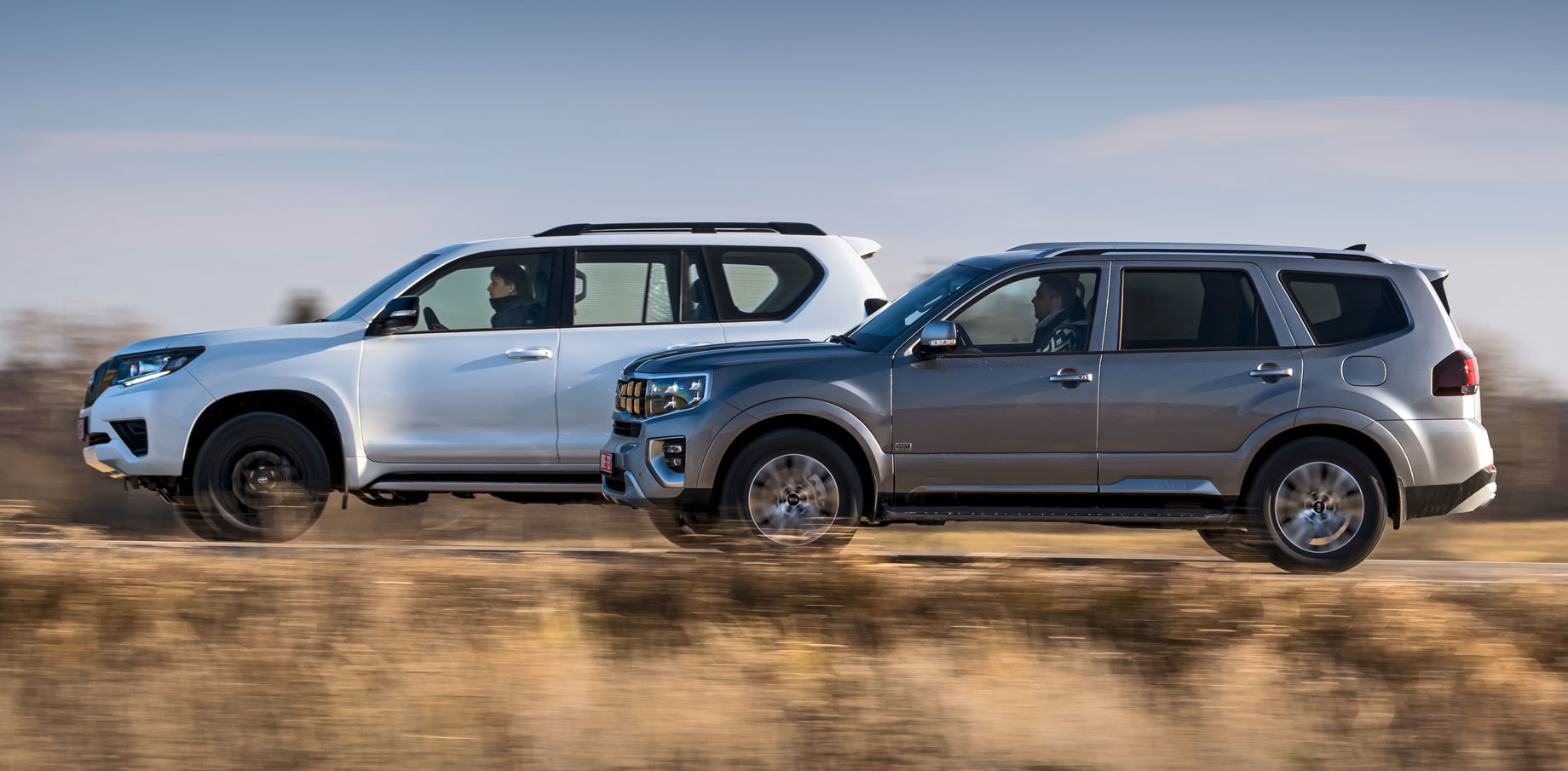
Steering feel also differs between the two. The Mohave actually requires more wheel lock in corners — about 3.2 turns lock-to-lock versus 3.0 for the Toyota — but the electric power steering is lighter, cleaner, and more informative. The result: despite more body roll, the Mohave feels more responsive and confident on fast roads, holds its lane better in ruts, and actively resists unintended lane changes. Its lane-keep assist is on by default after startup — though like most of its driver aids, it’s on the chatty side with its warning tones.
Long-Distance Comfort and Ride Quality
The Mohave’s 82-liter tank promises a cruising range of over 435 miles — an enticing figure for road trips. But real-world long-distance comfort is more complicated. Here’s the honest breakdown:
- Mohave seat: Soft with lateral support but poor anatomical contouring — uncomfortable over long stints, especially with a fixed steering column
- Both cars: Steel springs (no air suspension), similar ride quality on smooth asphalt, shared dislike of road joints and short-wave surfaces
- Prado (with KDSS): More sensitive to road camber, stiffer impacts, but better at rounding off the peaks of vertical acceleration
- Mohave: Sharper reactions to surface imperfections, collects road noise across a wider range of situations
The speed bump test tells the full story. The Prado’s comfortable limit over a speed bump is noticeably higher. With the Mohave, discomfort sets in above 25 mph, with a practical limit around 18 mph. The worse the road surface, the more the Toyota pulls ahead. It’s worth noting that Toyota offers a more comfortable alternative: the Elegance Plus trim without KDSS is softer and cheaper — a rare case where spending less actually improves quality of life.
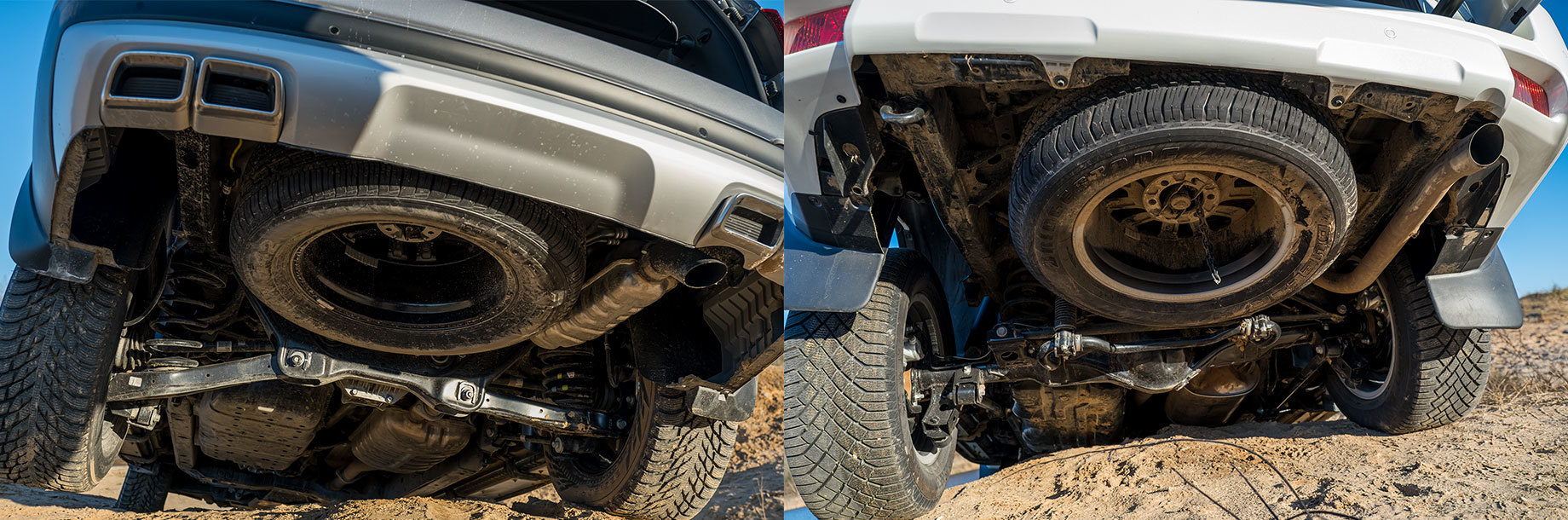
Off-Road Capability
This is where the gap between the two vehicles becomes most obvious. The Prado holds a clear structural advantage off-road:
- Toyota Prado: Permanent all-wheel drive with Torsen center differential, lockable center and rear differentials, greater ground clearance, better approach and departure angles, rear tow hook integrated into the bumper, factory towbar available with wiring
- Kia Mohave: Electronically controlled multi-plate clutch AWD (no manual 4H lock in current spec), 50% locking rear LSD only, longer wheelbase increases risk of high-centering, no factory towbar option (towing officially not supported in type approval)
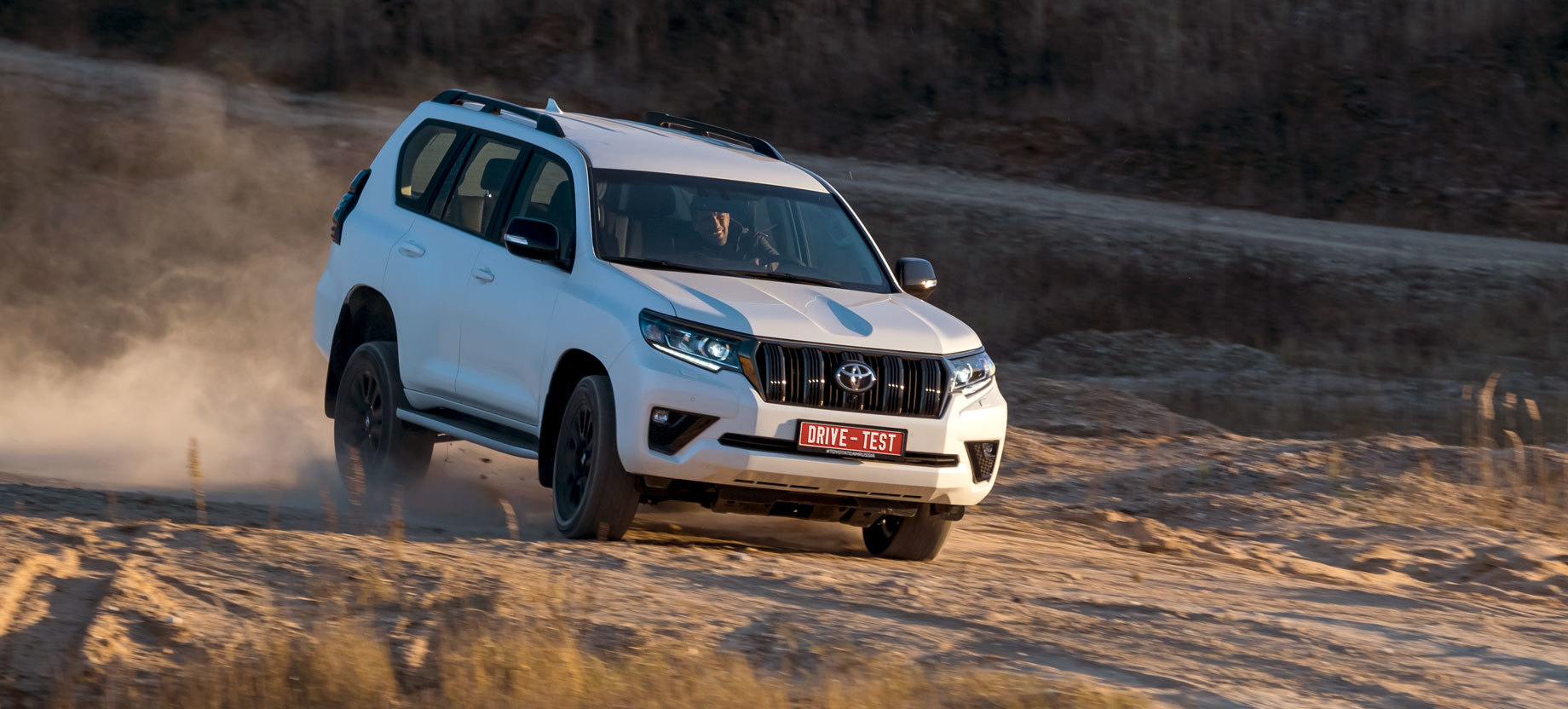
A cautionary tale from testing: at low speed in a sandpit near Ruza, the Mohave’s rear bumper was torn clean off by an overlooked concrete parapet. The insurance repair estimate from KIA came to $1,330, covering eight replacement parts and eleven labor items — including a torn fender liner. The Mohave’s long rear overhang is a genuine liability in technical off-road situations, and many owners wisely fit aftermarket towbars as a protective measure.
Resale Value and Value for Money
Despite its shortcomings, the Mohave holds its value surprisingly well on the used market. Restyled three-year-old examples range from $41,500 to nearly $50,000 depending on mileage — respectable figures for a Korean SUV. The V6 turbodiesel has earned a strong reputation for reliability, which underpins residual values.
The Prado, predictably, commands more: used examples start from $50,000 and climb from there. But the premium reflects something real — greater off-road versatility, factory towing capability, a broader accessories ecosystem, and a cabin reputation that’s earned over decades.
Verdict: Which One Should You Buy?
The Mohave makes a compelling case on paper — and partly in reality. Its engine is genuinely excellent, its highway dynamics are confidence-inspiring, and it offers real seven-seat practicality at a lower price. But it’s ultimately a city-biased machine: push it off the beaten track or into the wrong chair for eight hours, and the illusions start to crack.
It’s also worth asking: does a frame SUV make sense for buyers who won’t use its off-road potential? The Kia Sorento covers similar bases for less money. And if the Telluride — with its unibody construction, transversely mounted engine, and clutch-based rear drive — ever gets a diesel to match the V6’s performance, the Mohave’s reason for being becomes even harder to justify.
The Prado is a more contradictory vehicle. It’s harder, noisier, and slower. But it’s also honest — it doesn’t pretend to be something it isn’t. Where the road runs out, where the terrain gets serious, it earns its price. The buyers who choose it — and they consistently do — aren’t paying for specs on a sheet. They’re paying for simplicity, sincerity, and the knowledge that it’ll get them out of wherever they drive in.
This is a translation. You can read the original here: https://www.drive.ru/test-drive/kia/toyota/5fbe7fcdec05c4314700006e.html

Published August 04, 2022 • 8m to read