
You’ve probably come across a phrase like “a continuously variable transmission is installed on the car” while browsing car catalogs or scanning a spec sheet. Everyone knows what a manual gearbox is, and most drivers have long since made peace with the classic automatic. But a variator — also known as a CVT (continuously variable transmission) — still draws blank stares. That’s surprising, because it’s far from new.
A Brief History of the CVT Transmission
Here’s a fact that tends to catch people off guard: the variator wasn’t invented by Honda, Toyota, or even Mercedes-Benz. The first patent for a continuously variable transmission was granted in the late 19th century — and the original concept goes back even further. Leonardo da Vinci sketched out the principle as early as 1490.
The first practical car fitted with a CVT, however, didn’t arrive during the Renaissance. It took another five centuries. In the 1950s, DAF — a Dutch brand then producing both trucks and passenger cars — became the first manufacturer to install a variator commercially. Volvo followed with its own version, and CVT technology has been gaining ground ever since.
What Is a Variator? CVT vs. Automatic Transmission
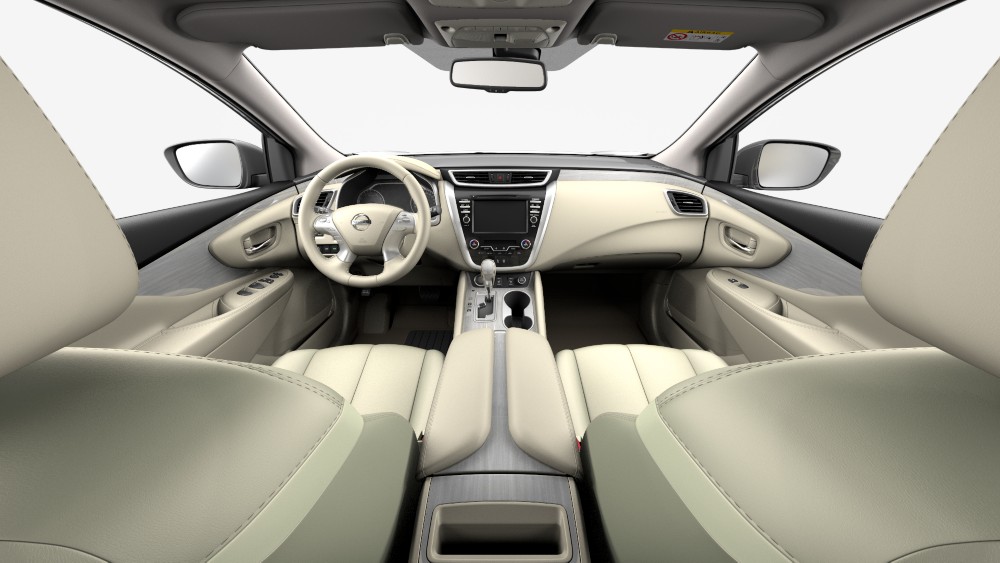
In simple terms, a variator is a type of automatic transmission — but one that works on an entirely different principle. From the driver’s seat, a CVT-equipped car looks identical to one with a conventional automatic:
- Two pedals — gas and brake
- A gear selector with the familiar P, R, N, D positions
- No clutch pedal, no manual gear changes required
But under the hood, the story is completely different. A traditional automatic has a fixed set of gears — first, second, third, and so on. A CVT has no fixed gears at all. Instead, it continuously and seamlessly adjusts the gear ratio as the car accelerates or decelerates. The result? No jerks, no jolts, no perceptible gear shifts — just smooth, uninterrupted power delivery.
Types of CVT Transmissions
Not all variators are built the same way. There are several main designs in use:
- V-belt with adjustable pulleys — the most common type, found on the majority of CVT-equipped cars
- Chain-type CVT — used by Audi, offering high efficiency and torque capacity
- Toroidal CVT — a less common but mechanically elegant design using rollers between toroidal discs
The V-belt pulley system is the one most drivers will encounter, so let’s take a closer look at how it works.
How Does a V-Belt CVT Work? A Simple Explanation
Picture two pencils lying parallel to each other, connected by a stretched elastic band. Spin one pencil, and the other follows at the same speed. Now imagine the pencils have different diameters — one rotation of the larger one forces the smaller one to spin twice. That’s the core idea behind a V-belt variator.
In a real CVT, this is achieved with two adjustable pulleys:
- Each pulley consists of two conical halves facing each other, tip to tip
- A V-shaped belt runs between the pulleys, gripping them along its ribbed edges
- When the cone halves move apart, the belt drops toward the center and runs along a smaller radius
- When the cones close together, the belt rides along a larger radius
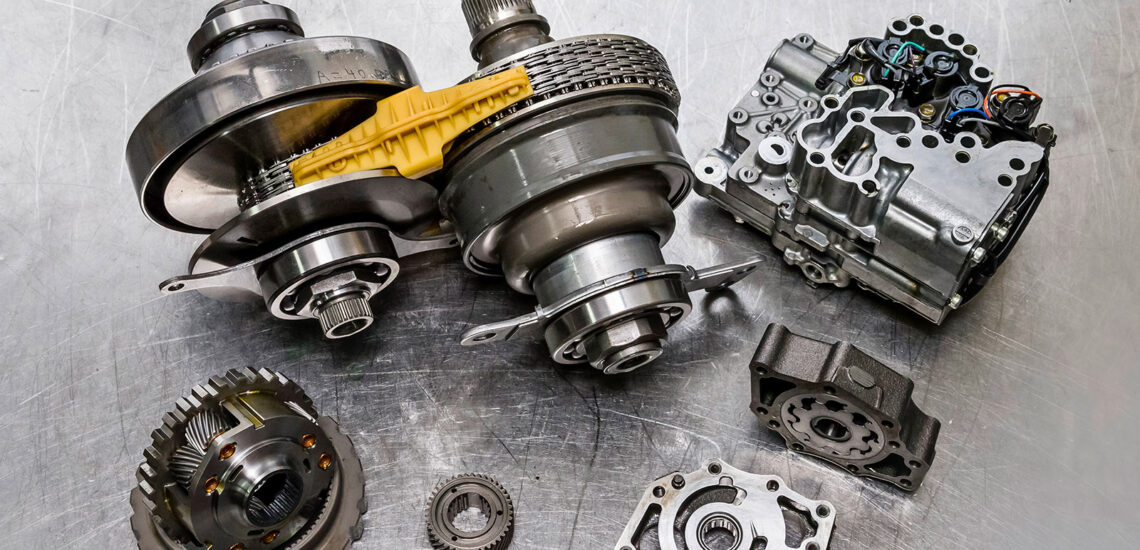
A hydraulic system (or another servo mechanism) moves both pulleys synchronously — as one opens, the other closes. One pulley sits on the drive shaft (from the engine), and the other on the driven shaft (to the wheels). By continuously varying the effective diameter of each pulley, the transmission changes its gear ratio across a very wide range, with no steps and no interruptions.
All that’s needed to complete the package is a unit for reverse gear — typically a simple planetary gear set — and the CVT gearbox is ready to go.
What Kind of Belt Does a CVT Use?
A standard rubber drive belt would disintegrate within a few thousand kilometers under CVT operating conditions. The belts used in variators are purpose-engineered components. There are two main designs:
- Steel push belt — a set of layered steel bands on which hundreds of thin, trapezoidal steel plates are mounted. The plates push against each other, allowing the belt to transmit force even on the compressive side — something a rubber belt simply cannot do
- Steel chain — a wide, flat chain that contacts the pulley cones along its edges rather than its face. This is the design used in Audi’s CVT systems (marketed as Multitronic)
Audi’s chain-type CVT uses a special transmission fluid that changes its viscosity under the extreme pressure at the contact points, allowing the chain to transmit significant force with minimal slip — even across a very small contact patch.
What Does Driving with a CVT Feel Like?
The driving experience depends on how the CVT’s control program is tuned, but the most common behavior during hard acceleration goes like this: you press the throttle to the floor, the engine climbs to the rpm range of maximum torque — and stays there throughout the entire acceleration run, maintaining a steady, consistent note while the car builds speed.
Some drivers find this unfamiliar at first. The engine sound doesn’t rise and fall the way it does with a stepped gearbox; instead, it holds at one pitch while the car accelerates. It’s been compared to the drone of a vacuum cleaner — effective, but different from what most drivers are used to.
That said, many manufacturers tune their CVTs to simulate the feel of a traditional gearbox, with engine revs rising progressively as speed increases. Some models go further and offer:
- Virtual gear steps — typically 6 or 8 electronically defined ratios, between which the CVT shifts sharply, mimicking a classic automatic
- Manual sequential mode — allowing the driver to select virtual gears via paddle shifters or a lever
- Automatic downshifting — when climbing a hill or slowing down, the CVT intelligently shifts to a lower ratio to maintain torque, regardless of throttle position
Advantages of a CVT Transmission
- Infinite gear ratios — the engine always operates in its most efficient or most powerful range, depending on demand
- Smooth acceleration — no gear shifts means no torque interruption and no jolts
- Better fuel economy — by keeping the engine in its optimal operating band, CVTs can reduce fuel consumption compared to traditional automatics
- Strong low-speed performance — especially useful in stop-and-go urban traffic
- Lower cost than premium automatics — CVT units are generally less expensive to manufacture than high-end torque-converter automatics
Disadvantages of a CVT Transmission
- Power limitations — traditional CVTs weren’t designed for high-torque, high-power applications, which is why performance and large luxury cars have historically stuck with conventional gearboxes
- Higher maintenance costs — CVT-specific transmission fluid is more expensive than regular ATF, and belt replacement (every 100,000–150,000 km) is an additional service item
- Unfamiliar driving feel — the constant-RPM acceleration sensation takes getting used to
- Oil change intervals — CVT fluid typically needs replacing every 40,000–50,000 km depending on the model
How Powerful Can a CVT Get?
CVTs started life on small city cars — and for a long time, that’s where they stayed. The mechanical demands of a belt-based transmission made high power outputs a challenge. But engineering has moved on considerably.
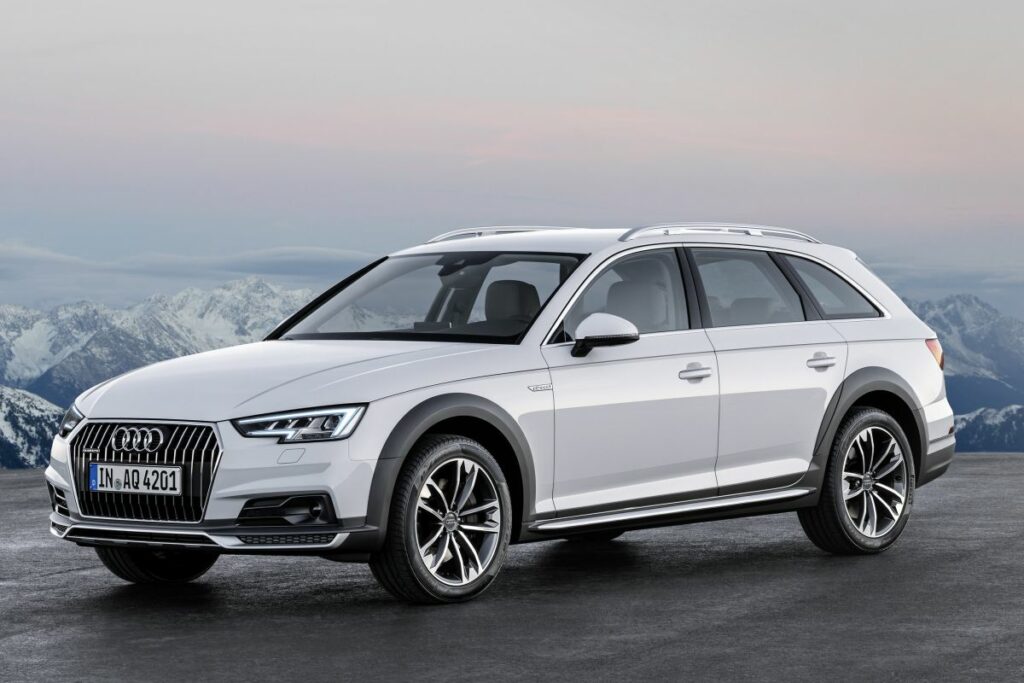
Audi’s Multitronic chain CVT, fitted to the A4 2.0 TFSI, handles 200 hp without issue. Nissan pushed further with the X-Tronic CVT in the Murano — a full-size crossover with a 3.5-litre V6 producing 234 hp. These are no longer niche, low-power applications.
CVT vs. Automatic Transmission: Which Is Better?
Classic automatic transmissions have been fighting back with more gears — 8-speed units are now standard on many executive and premium cars, chasing the same efficiency and performance balance that CVTs offer by default. Ten- and twelve-speed automatics have appeared in trucks and performance vehicles.
But the CVT holds a structural advantage that no stepped gearbox can replicate: the number of ratios is infinite. No matter how many gears engineers add to a traditional automatic, there will always be a gap between each one. The CVT has no gaps. For everyday driving — commuting, fuel efficiency, smooth city traffic — it remains one of the most practical and underrated transmission choices on the market.
This is a translation. You can read the original here: https://www.drive.ru/technic/4efb330200f11713001e32e2.html

Published February 10, 2022 • 7m to read