
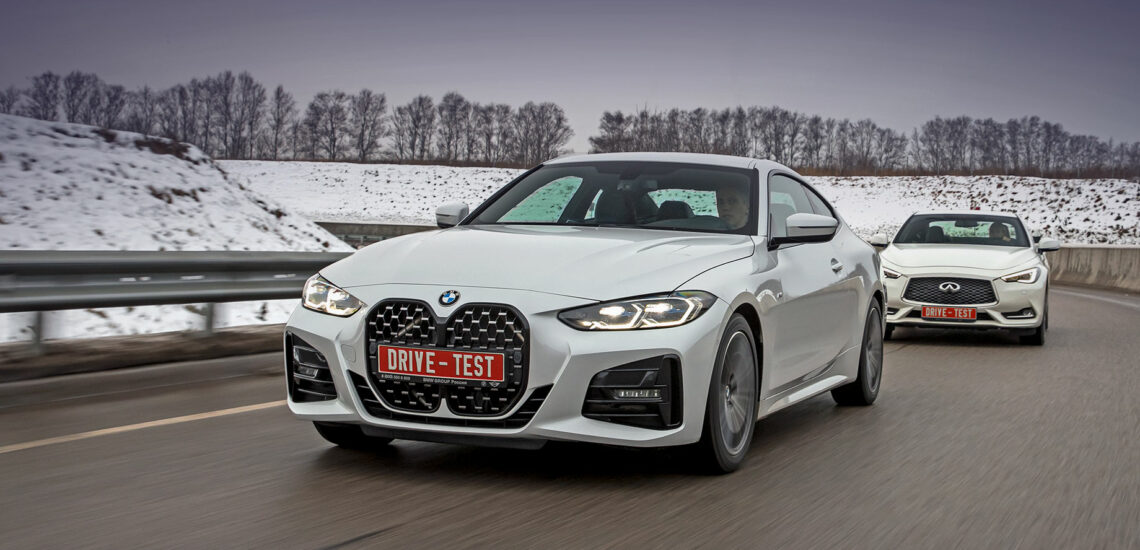

The Infiniti Q60 is a car with surprisingly little market presence — and it’s not entirely clear why Infiniti agreed to pit it against a segment leader. But we’re glad they did, because the BMW 4 Series genuinely needs context. Finding a worthy German competitor for it is harder than it sounds.
Under the Hood: Engines and Drivetrains Compared
Although the Mercedes C-Class isn’t present in this test, its influence is still felt — because under the Infiniti Q60’s hood sits a 2.0-litre M274 turbocharged engine producing 211 hp, the same unit found in the pre-facelift Mercedes C 200. Most Benz models in this segment are 200 hp all-wheel-drive affairs. The Infiniti, however, pairs this engine with its own seven-speed automatic transmission, sending torque exclusively to the rear wheels.
One of the first questions raised before this test was why a 190 hp diesel BMW was being matched against a petrol-powered Q60. The answer is simple: the press fleet’s only alternative was the M440i xDrive with 387 hp — far too powerful to make for a fair comparison against anything short of an AMG C 43.
Diesel remains the backbone of BMW’s lineup, and for good reason:
- The 420d delivers 400 Nm of torque at a modest price premium over the entry-level 420i’s 300 Nm
- Fuel consumption during testing averaged just 7.1 litres/100 km, versus 11 litres for the Q60
- All options — including M packages — are available for the diesel variant
Exterior Design: Controversial but Effective
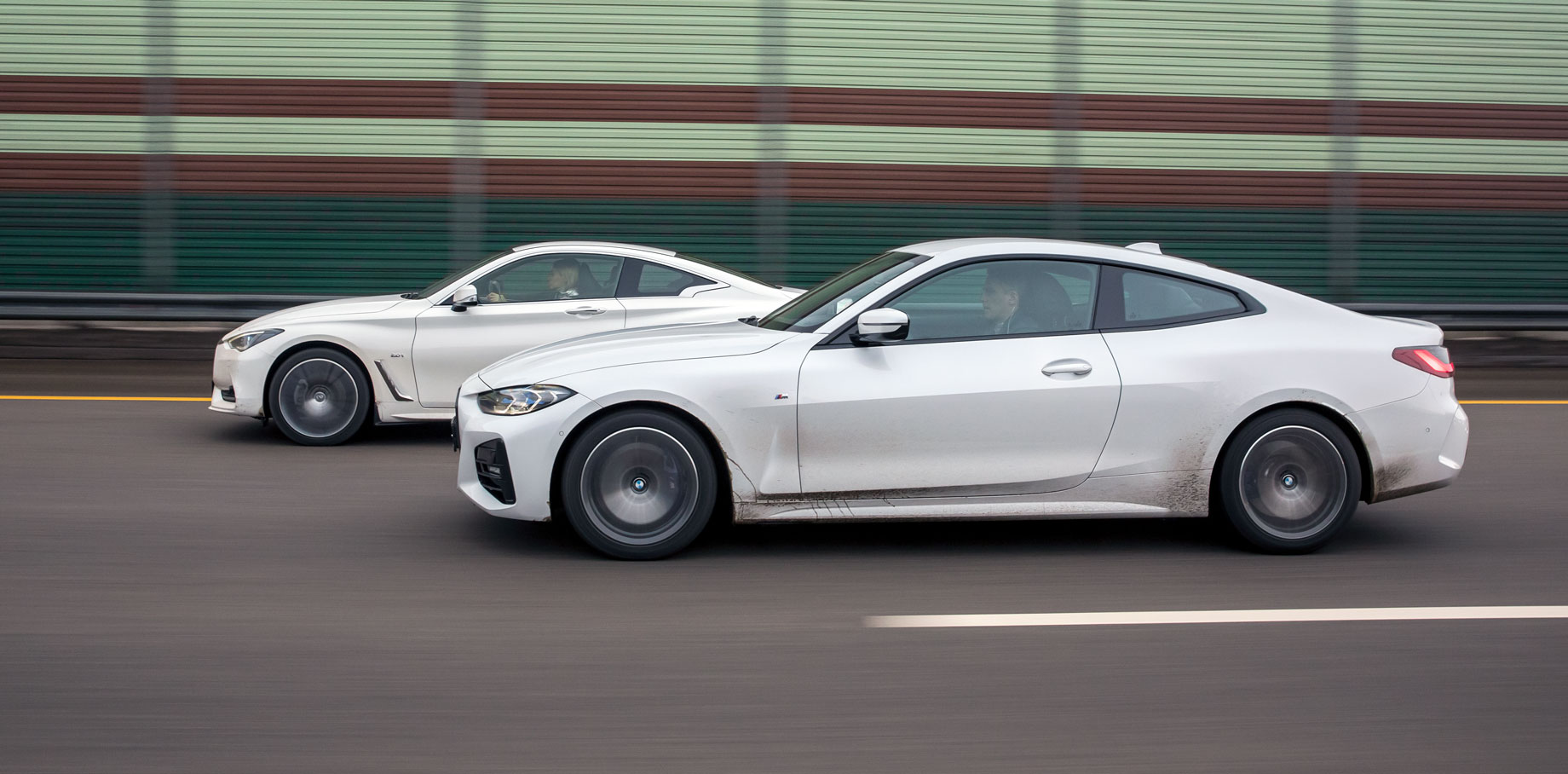
Few modern BMWs have sparked as much debate online as the 4 Series — yet the numbers tell a different story entirely. In December 2020 alone, Europe registered 1,175 BMW 4 Series coupes versus just 386 Mercedes C-Class units. Whether you love or hate the design, BMW’s designers achieved exactly what they set out to do: draw attention to a niche model. The Infiniti, by contrast, generates neither controversy nor magnetism — though its understated, non-aggressive styling is arguably more timeless.
The Case for a Rear-Wheel Drive Coupe
Having owned a BMW 3 Series coupe (E92, 330i) for 11 years — including as a dedicated winter car — there’s a strong appreciation here for what this body style offers that often goes unrecognised:
- Comfortably seats four adults with more rear space than many larger saloons
- A large, well-shaped boot that handles everyday practicality with ease
- Minimal showiness — these are driver’s cars, not showpieces
- BMW’s flexible service intervals are particularly cost-effective for lower-mileage owners
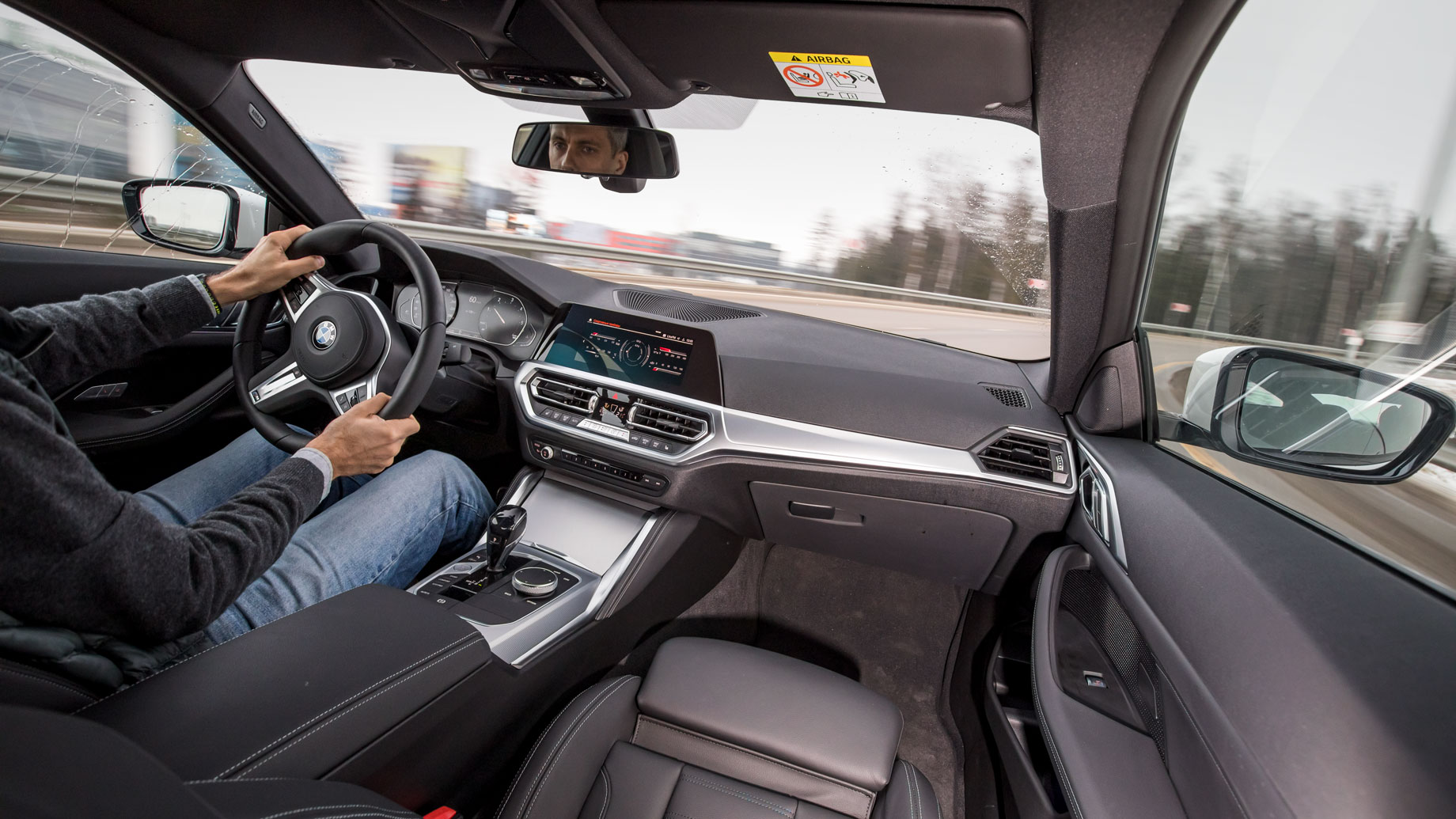
The test car — a white 420d with rear-wheel drive — was chosen specifically for its optional needle-dial instrument cluster. A lovely touch, though the M Sport Pure package pushes the price higher than the spec truly warrants.
Ride Quality: Run-Flat Tyres Are the BMW’s Biggest Enemy
The G22-generation 4 Series (G22 index) marks a return to firmer ride quality after the softer F32 predecessor — and even the new 3 Series sedan has lost some of its legendary smoothness. The coupe’s suspension is stricter still, especially with the M package fitted.
The test car runs 18-inch Continental VikingContact 7 SSR run-flat tyres in a single size (225/45 R18 front and rear) from BMW’s factory accessories programme. The verdict on run-flats is unambiguous:
- The 420d transmits road imperfections to the cabin with excessive fidelity
- Short-wave vibrations and joint impacts are far more intrusive than they should be at this price point
- BMW engineers note that larger tyre profiles on run-flats can actually worsen the ride due to the reinforced sidewall area
- The best upgrade any 4 Series owner can make is replacing run-flat tyres with conventional ones as soon as possible
The electronically controlled strut chassis in its current state feels tuned more for US market tastes — where sportiness is often equated with stiffness — rather than European road conditions.
Seats and Interior Comfort
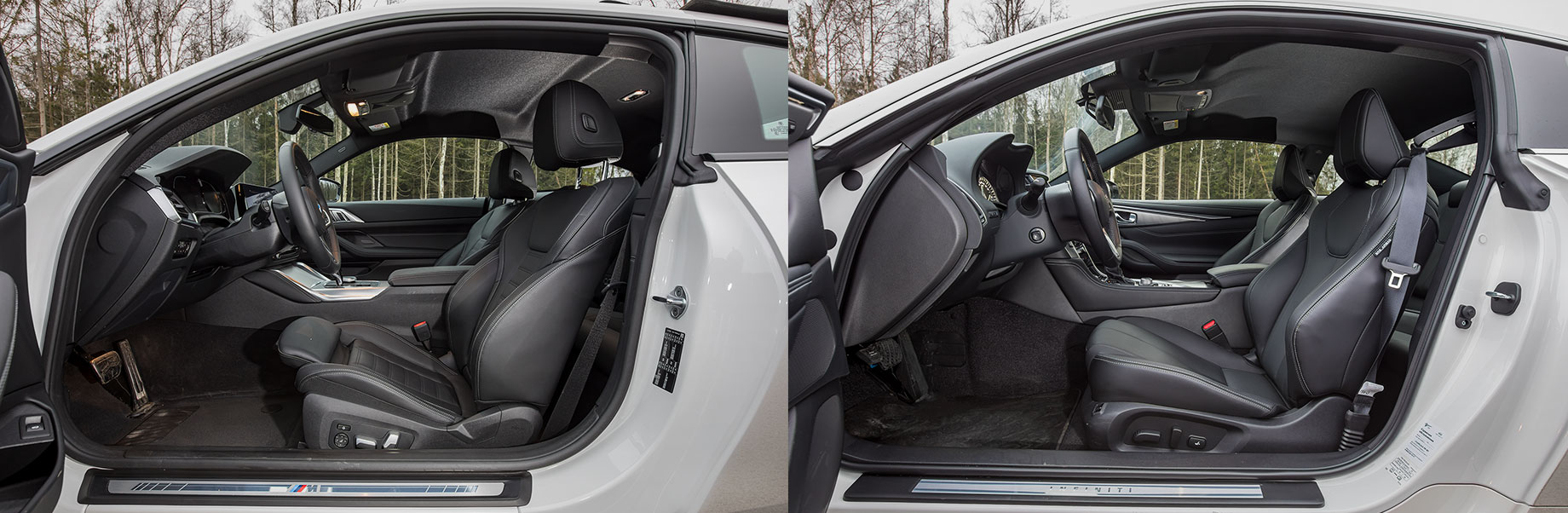
BMW seats have historically needed no break-in period. That tradition stumbles with the G22’s newly developed Sport seats:
- The backrest is unusually rigid and poorly profiled for long-distance comfort
- Squab bolsters are positioned wider than BMW’s traditional standard
- The firm padding compounds the already stiff suspension feel
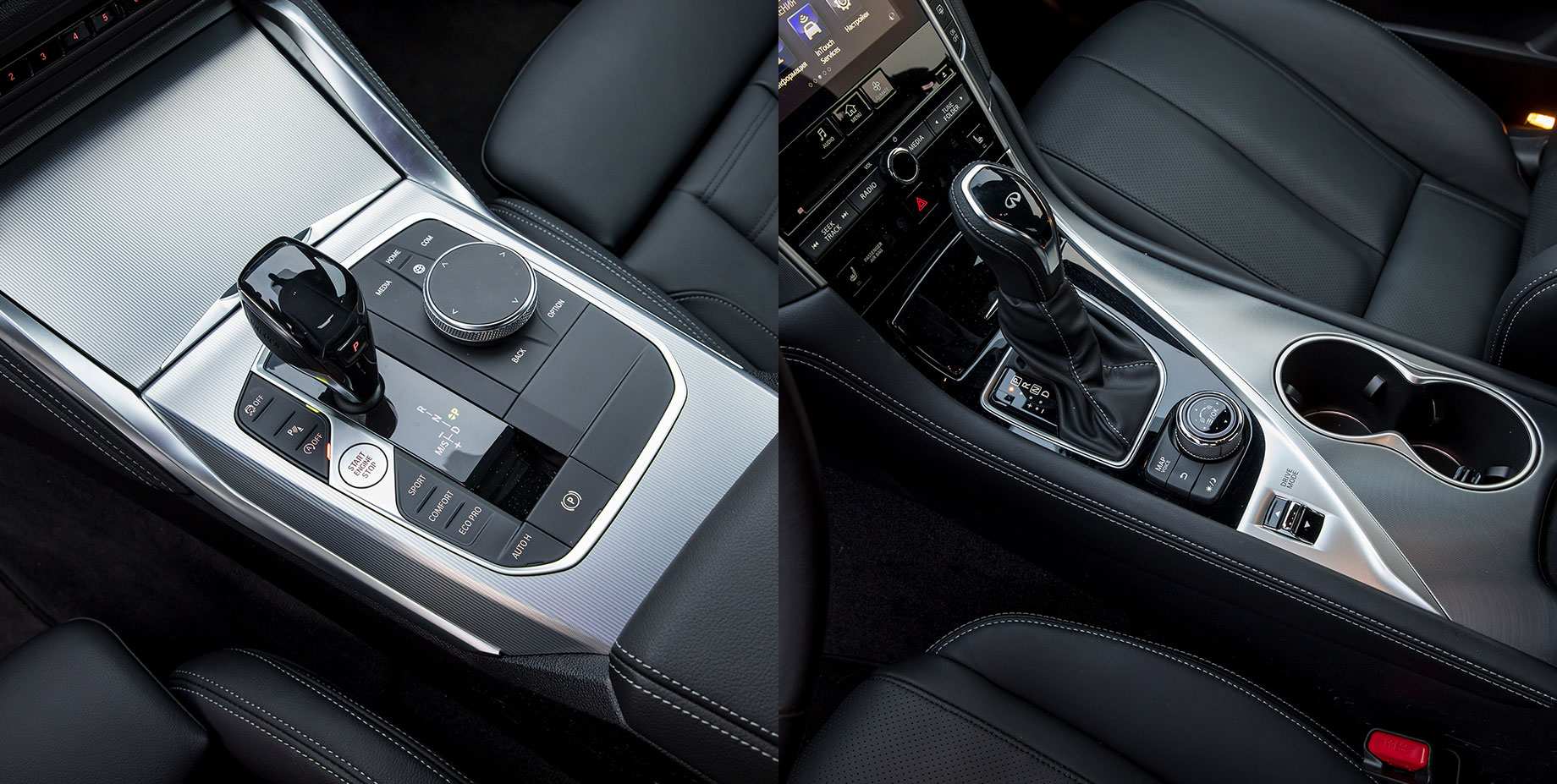
For longer journeys, the Infiniti Q60 is the more comfortable choice — its seat distributes weight more evenly, even if steering wheel reach adjustment is more limited. That said, the Infiniti’s interior falls short in other important areas: its multimedia system is two generations behind, and the car was supplied in a single trim level, meaning buyers must accept two low-resolution screens with no alternatives.
Ride Character: Q60 vs 420d on Real Roads
The Infiniti was tested on the same Michelin X-Ice winter tyres (245/40 R19) that accompanied it from the dealer. While the Q60 is also firm over larger bumps and road joints, its passive shock absorbers are more thoughtfully calibrated:
- No secondary vibrations or high-frequency tremors through the body
- The steering wheel is almost completely isolated from road disturbances, making the ride feel more composed than it technically is
- A sophisticated double-wishbone front suspension (versus the BMW’s MacPherson struts) contributes to a more controlled feel over sharp impacts
The trade-off is steering feedback. The Q60’s electrohydraulic power steering tends toward numbness — acceptable in urban driving, but a genuine problem at higher speeds or on unstable surfaces. Even under wheel slip, the steering weight barely changes, making it difficult to read the contact patch.
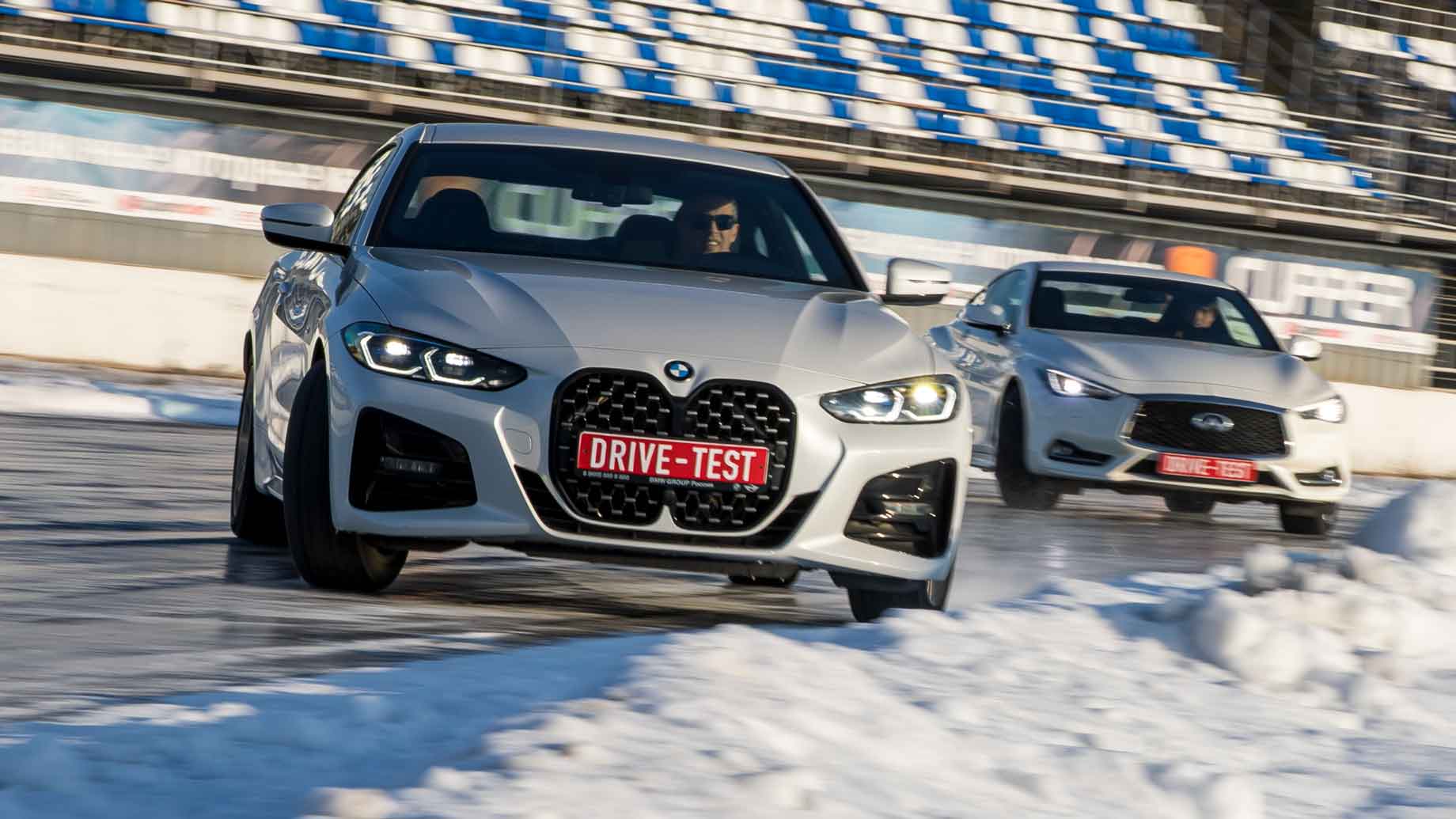
Handling and Driver Engagement
Getting behind the BMW’s wheel after the Infiniti is genuinely revelatory. Despite using an electric power steering system with variable gear ratio, the 420d’s feedback is in a different league. Key dynamic advantages of the BMW include:
- Significantly stronger driver-to-tyre connection through the steering wheel
- Faster cornering pace, primarily thanks to confidence-inspiring feedback — not just superior kinematics
- Neutral handling arc with well-calibrated elastokinematics
- Electronic differential lock simulation that gives the driver more control during slides
- Shorter steering rack for quicker corrections during oversteer
Performance measurements were taken in challenging winter conditions on studless tyres. The results:
- BMW 420d best 0–100 km/h run: 7.5 seconds
- Infiniti Q60 trailed by approximately one tenth of a second on the best run
- The BMW’s average across runs was marginally quicker
- The Q60 is both heavier and produces 50 Nm less peak torque
On the Ice Track: Where Chassis Philosophy Becomes Clear
Both coupes made their way to a recently rebuilt all-season autodrome — which had been unexpectedly flooded and then frozen overnight. The ice surface turned out to be a remarkably effective test environment.
The BMW 420d on ice:
- Instant throttle response with minimal lag between input and chassis reaction
- Stable, predictable oversteer with a generous slip angle before correction is needed
- Electronic differential lock makes slides manageable and progressive
- Short steering ratio simplifies correction of skids significantly
The Infiniti Q60 on ice:
- Throttle response is damped at low revs, with a sudden torque surge above 2,000 rpm that’s difficult to modulate
- The seven-speed gearbox prioritises smooth shifts over speed, which complicates low-speed ice control
- Nearly three full steering wheel turns lock-to-lock demands anticipation and physical commitment
- More drift-prone, but the risk of a full spin is elevated if the angle becomes too steep
- Once a rhythm is established, exit from slides is gentler than in the BMW
- Works better at higher speeds on ice, where throttle response becomes more linear
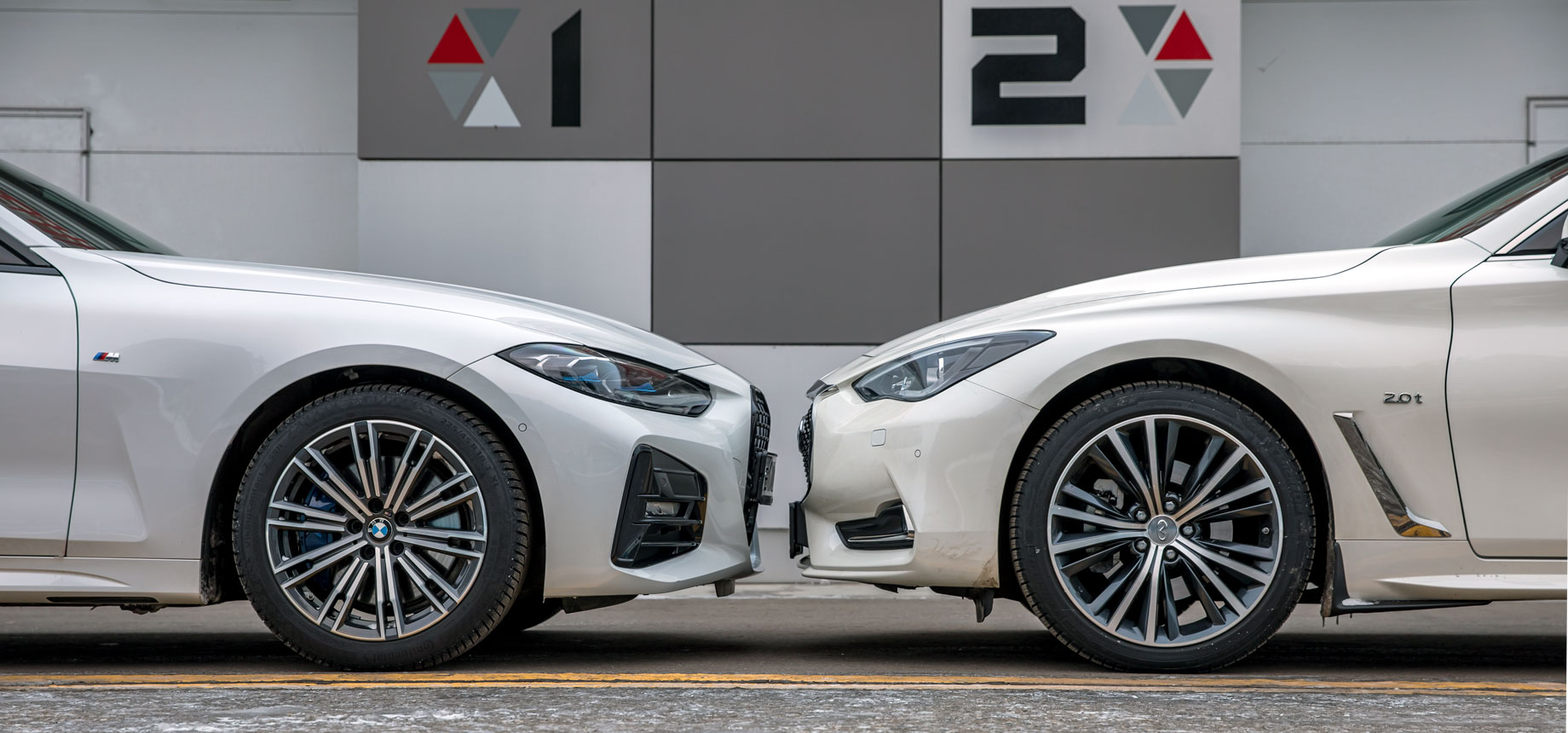
The Infiniti’s Engine Problem — and a Deeper Issue
Opting for the Mercedes-sourced M274 turbo-four engine is, bluntly, a mistake. This powertrain has a well-documented history of technical problems even in Q50 sedan applications, and chip tuning offers no meaningful remedy. Its only genuine virtues:
- Relatively low noise and vibration levels
- Decent refinement, if unremarkable character
The deeper issue is that the Q60 project’s real ambition was centred on the 400 hp twin-turbo V6 variant with drive-by-wire steering. That version proved too expensive, too synthetic, and ultimately uncompetitive. What remains is a mass-market model assembled from mismatched parts, where an accomplished chassis is undermined by an outdated engine, numb steering, and an interior stuck in the previous decade. The whole is significantly less than the sum of its parts.
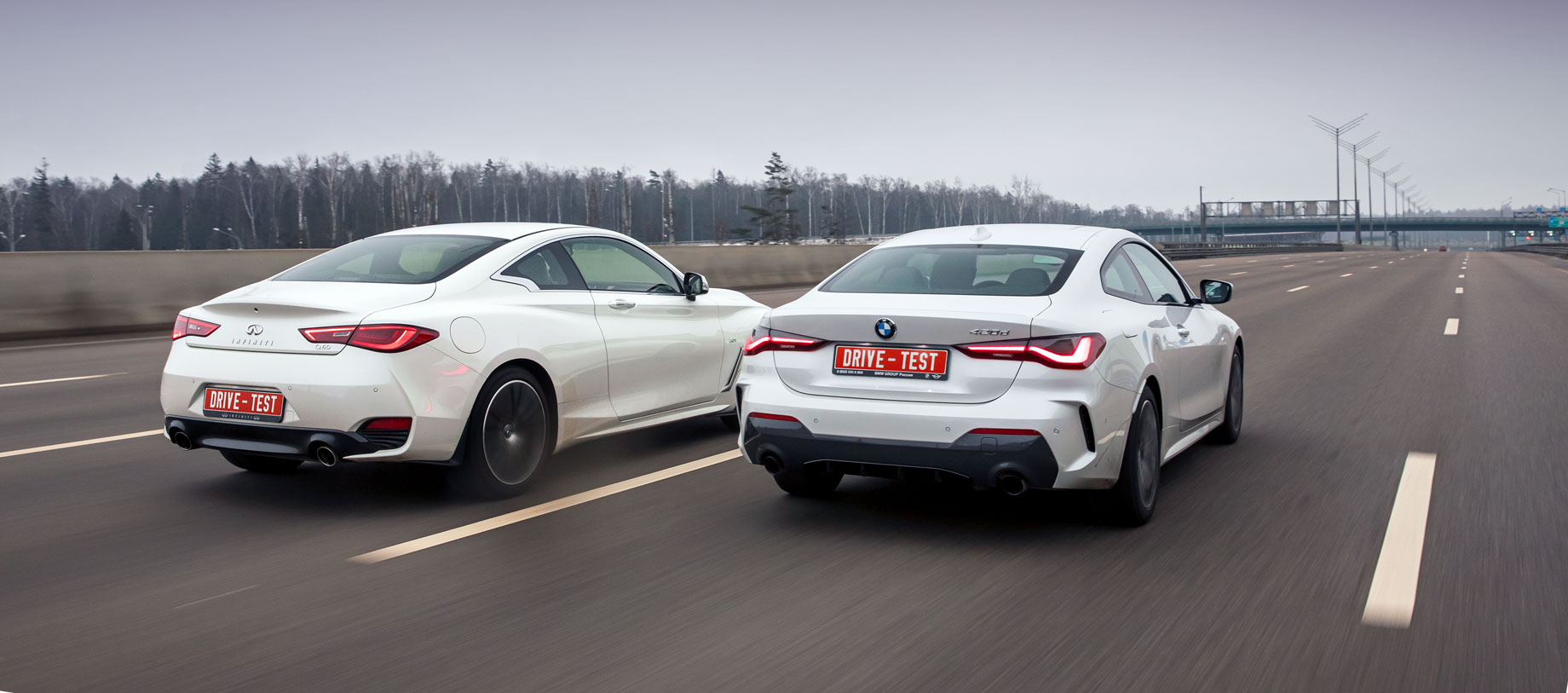
Verdict: BMW 420d Wins, With Caveats
The BMW 420d coupe is the clear winner of this comparison — but it’s not without reservations. It rewards its driver with genuine feedback, refined diesel performance, a practical and well-designed interior, and strong real-world dynamics. The diesel powertrain, in particular, makes a compelling case as a long-term ownership proposition.
To get the most from the 420d, buyers should consider:
- Ditching run-flat tyres at the earliest opportunity — this single change transforms the car
- Skipping or carefully reconsidering the M Sport package — the standard chassis with conventional dampers is better suited to daily use
- Testing the Sport seats extensively before committing — they divide opinion sharply
- Targeting near-base specifications — the closer to standard the build, the better the price-to-satisfaction ratio
The Infiniti Q60, despite its well-sorted passive suspension and genuinely pleasant on-road character on smooth surfaces, is let down by technology that felt dated at launch and a powertrain that simply doesn’t suit the car. It remains a handsome, inoffensive choice for unhurried city driving — but nothing more.
This is a translation. You can read the original here: https://www.drive.ru/test-drive/bmw/infiniti/5fe9e41f39b028cb85530314.html

Published July 14, 2022 • 8m to read