

This article is a continuation of our Porsche Taycan road test series — not a standalone review. Winter Lapland presents conditions too unique to ignore: roads are either pure ice or packed snow, and speed limits top out at 50 mph. The Porsche Taycan 4S tested here came equipped with the optional 800-volt 93 kWh battery — the same unit found in the Turbo and Turbo S — rather than the standard 79.2 kWh pack. With temperatures forecast to drop to -10°C overnight, we left the car at the hotel overnight without charging to put its cold-weather credentials to a genuine test.
Cold-Weather Battery Performance: What Porsche Engineers Say
Porsche engineers claim the Taycan can operate in temperatures as low as -50°C. That said, there are some important caveats for extreme cold:
- Below -15°C, Porsche strongly recommends keeping the Taycan plugged in while parked.
- The colder it gets, the more energy is consumed heating the battery before driving.
- After a cold start, the battery needs a few minutes to warm up enough to deliver full power to the motors.
In practice, we weren’t able to test a truly cold start ourselves — the car was pre-warmed and unplugged an hour before handover, for “logistical reasons.”
Real-World Winter Range: How Far Can the Taycan 4S Go?
One notable omission in the Taycan’s otherwise impressive screen setup: there’s no dedicated power balance display. You can’t easily see how much range is being consumed by heated seats, mirrors, or other accessories. Here’s what our real-world test revealed:
- We covered approximately 90 miles at a relaxed pace in Normal driving mode.
- Cruising at 50–55 mph, the projected maximum range came out to around 180 miles.
- That’s roughly 20% less than what a colleague recorded in summer conditions — but still a respectable figure for an electric sedan in sub-zero temperatures.
Cabin Comfort and Winter-Ready Features
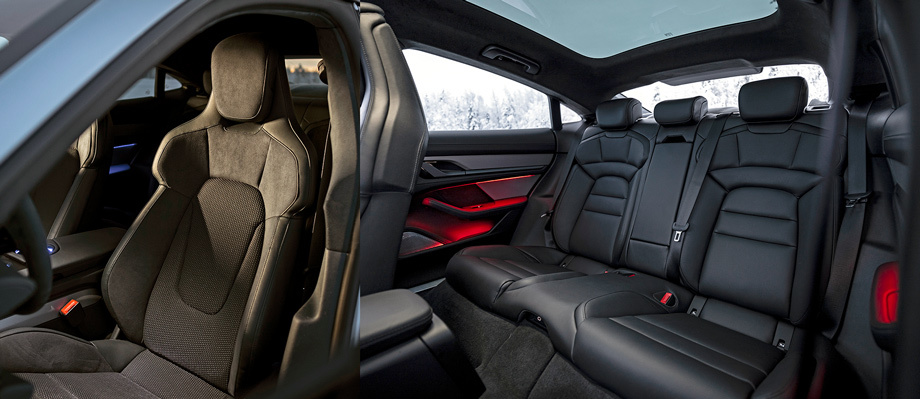
Despite the freezing conditions outside, the Taycan 4S kept its occupants warm and comfortable throughout. Here’s how its winter features held up:
- Heating and preheating systems worked effectively and kept the cabin consistently warm.
- Matrix LED headlights lit up dark polar roads with impressive clarity.
- Rear-view camera washer successfully cleared snow buildup from the lens.
- Door handles are designed with a protruding lower edge, making them easy to grip even when frozen.
- Windshield heating is notably absent — a real omission in winter driving conditions.
- Windshield wipers tend to freeze more than usual, lacking the warm airflow you’d get from a traditional engine bay.
Switching to Range mode has an immediate, noticeable effect: the headlights dim and the heater operates in energy-saving pulses rather than continuously.
Drive Modes, Battery Temperature, and Power Output
The Taycan 4S manages battery temperature differently depending on the selected drive mode — and this has a direct impact on available power. Here’s how the modes compare:
- Normal mode: The 8 kW electric heater stays off; a heat pump recycles waste heat from the motors and inverters to warm the cabin. Battery temperature stays modest at around 5–10°C (40–50°F).
- Sport mode: Battery is actively heated to 20–25°C (68–77°F) for greater performance. Available power: 435 hp (79.2 kWh) or 490 hp (93 kWh).
- Sport Plus mode: Same battery heating as Sport, but more aggressive throttle and stability mapping. Launch control unlocks the full 530 hp (or 571 hp with the large battery) — but only for a 2.5-second burst.
Winter Tyre Performance and Ride Quality on Ice
After a 30-minute fast charge to 85%, we headed to the ice tracks. The Taycan 4S was fitted with 20-inch Goodyear UltraGrip Performance tyres — non-studded, modified for the Taycan’s low rolling resistance requirements. Key observations:
- Grip on ice was surprisingly strong for a European-type hard winter tyre.
- The tyres are notably noisy and not particularly comfortable.
- On broken winter roads, the Taycan’s stiff body transmits tyre rumble and small bumps into the cabin — the same issue noted during summer testing.
Ice Driving Dynamics: Drifts, Stability Control, and Handling
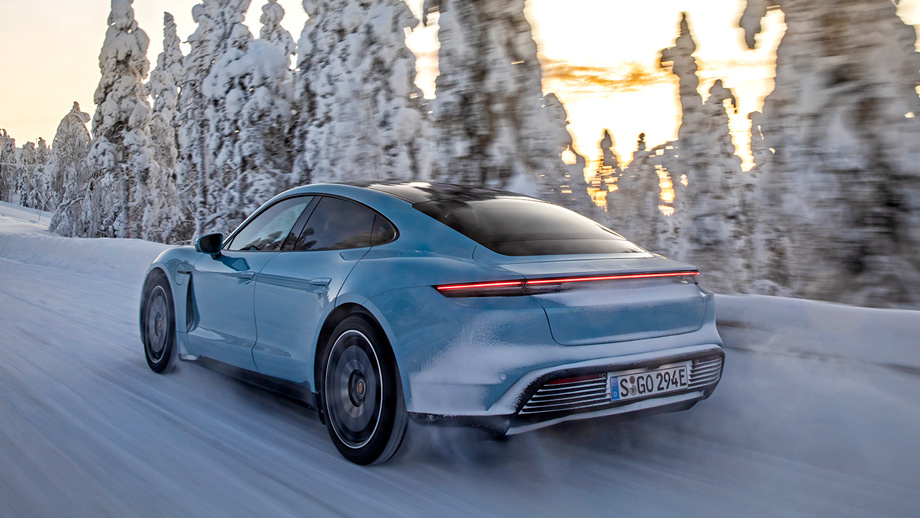
One of the Taycan’s biggest advantages over rival electric cars is the ability to fully disable the stability control system via a dedicated (if awkwardly placed) button. Once the electronics are off, the Taycan on ice behaves like any classic Porsche — responsive, adjustable, and rewarding. Here’s what stood out:
- Ice removes the low centre-of-gravity advantage, but the Taycan’s weight of over two tonnes actually becomes a tool — helping redistribute load and balance the car through corners.
- In Sport mode, slides are progressive and easy to manage.
- Sport Plus mode is sharper and less forgiving — more demanding, but rewarding for experienced drivers.
- The front motor can be given more torque to actively pull the car out of drifts beyond 90 degrees — an impressive and unique capability.
The One Catch: Energy Consumption While Having Fun
Spirited driving on ice comes with a steep energy cost. With the Taycan 4S in full drift mode, electricity consumption tripled — meaning a full battery would last only around 68 miles of hard driving. It’s also worth noting that the optional synthetic engine sound, played through the speakers alongside the natural electric whirr, is unlikely to win over committed petrolheads.
Against combustion-powered sports cars, the Taycan 4S in this environment feels like a gifted prodigy who’s arrived at a gentlemen’s club: technically brilliant, capable of almost anything — but lacking that raw, visceral authenticity. Winter conditions, if anything, make that contrast more apparent.
This is a translation. You can read the original here: https://www.drive.ru/test-drive/porsche/5df378e3ec05c4c7180000ad.html

Published April 20, 2023 • 5m to read