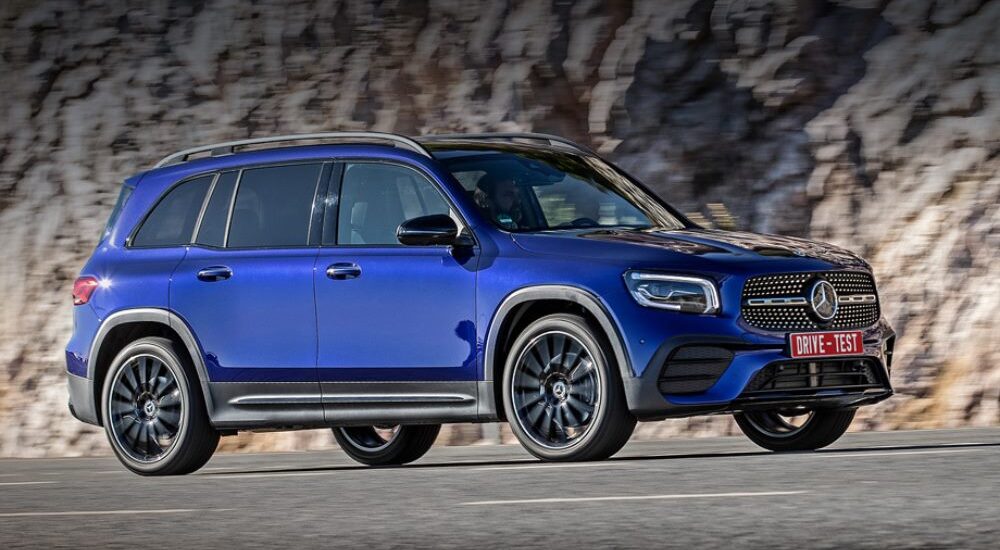

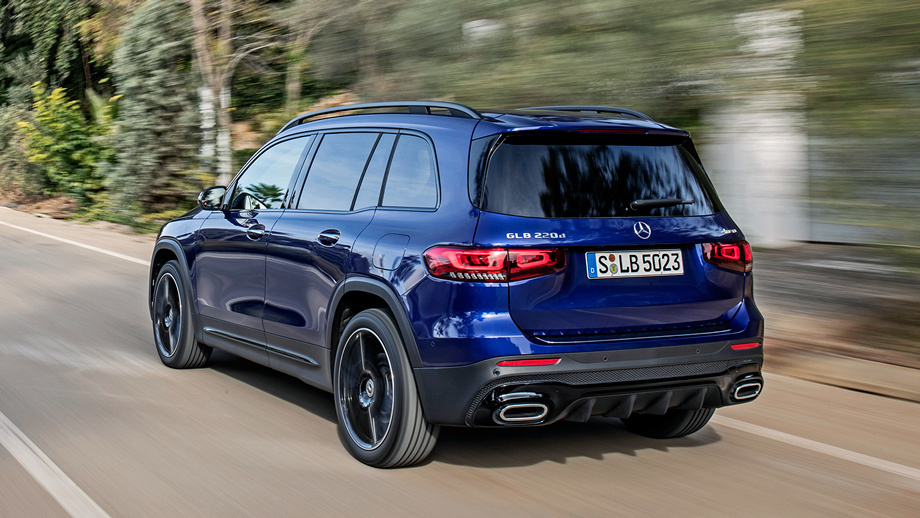
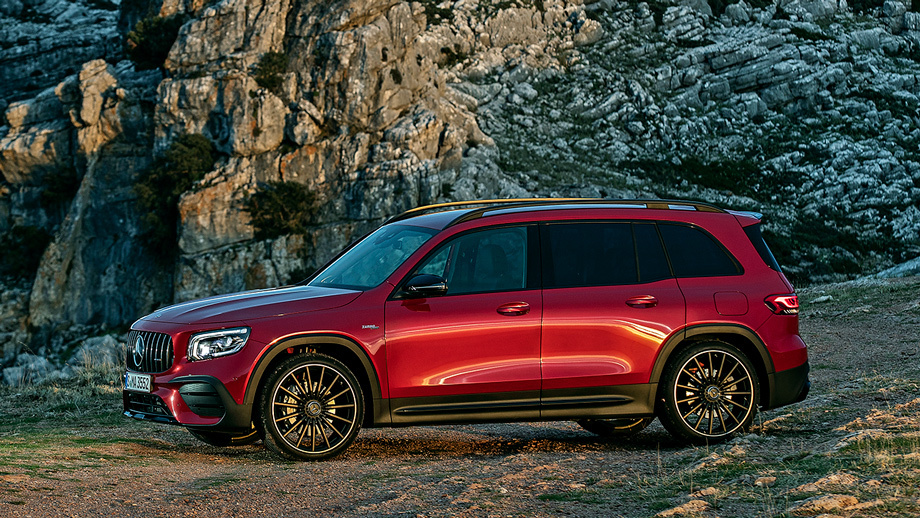
In camouflage, the Mercedes-Benz GLB looked like a miniature G-Class, thanks to its low windshield slope and high roof. It also recalls the GLK, discontinued five years ago. That said, the overall design is somewhat undercut by a stylistically unjustified break in the window sill line, and the car lacks a single consistent mood: the front is neat and purposeful, while the rear feels too playful. Still, seen live from 16 feet away, the GLB is distinctive enough not to be mistaken for the closely related GLC, which is only 1.3 inches longer. Structurally, the two are quite different, since the GLB uses a transverse-mounted engine — making it the largest model built on the compact A-Class platform.
Designed for Families: Space, Seating, and Safety
The GLB isn’t simply a size compromise between the GLA and GLC crossovers — it’s built with a clear family-focused mission. That’s reflected in its tall roofline and near-vertical rear wall. Key practical features include:
- Optional seven-seat configuration available on any trim
- 28.5 gallons of cargo space remaining even with all seats in use
- Two Isofix child-seat mounts on the second row, plus a third-row mount
- A smart sensor in the front passenger seat that automatically disables the airbag when a rear-facing child seat is detected
In theory, that means room for up to five young children on board — or four kids plus their parents.
Third-Row Comfort and Practicality
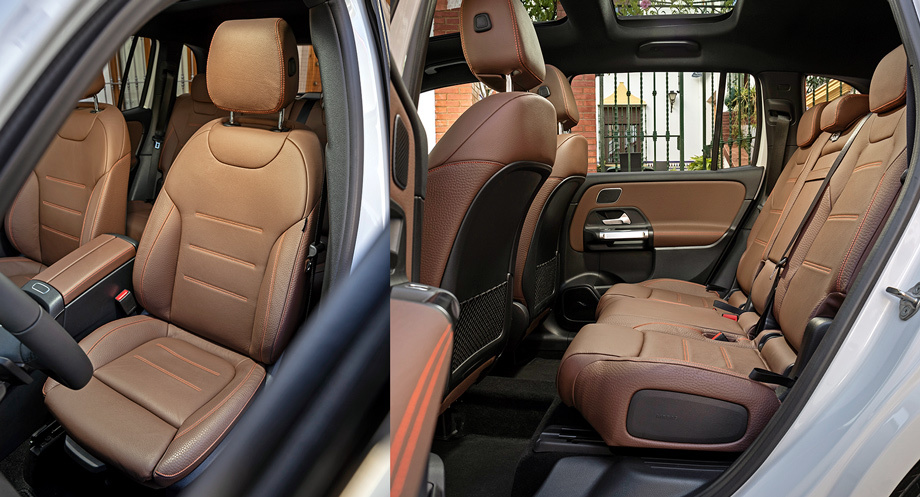
The third row comes equipped with curtain airbags, belt pretensioners, cup holders, and USB-C ports. However, space back there is limited — comfortably fitting only passengers up to 5’6″ tall, meaning it’s best suited for children rather than adults. Even then, second-row passengers need to slide forward to make room, since that row can move 5.5 inches and its backrests adjust as well.
Second-Row Space: Generous but Firm
Pushed all the way back, the second row offers impressive legroom — a passenger matching the reviewer’s 6’1″ height sits behind an equally tall driver with a four-inch knee margin. The tradeoff is comfort: the flat, hard bench seat feels closer to a military Gelänvagen bench than typical Mercedes upholstery. A few other quirks reinforce that no-frills feel:
- No third climate zone is offered
- Ceiling grab handles sit too high to use comfortably
- Door handles are awkwardly positioned
- Entry and exit are hindered by a tall floor podium housing the sliding rail mechanism
Interior Design and Ergonomics
The front panel design keeps frivolity to a minimum — the silver crossbar ahead of the front passenger could almost pass for a handrail, though this is still no G-Class. Seating position leans closer to a passenger-car feel, at least in the firm sport seats fitted to the test cars. Ergonomic quirks carried over from the A-Class persist too: the left footrest sits too high, and the tunnel-mounted touchpad tends to catch your arm by accident. On the plus side, the compact windshield is cleaned almost entirely by the wipers — the left blade reaches nearly to the pillar, and the right one sweeps into its corner cleanly.
Engine Lineup: Petrol, Diesel, and AMG Power
The GLB’s powertrain lineup takes an almost off-road approach to variety. Among Mercedes’ compact models, it’s the only one offered in Russia with a choice of two diesel outputs. The full lineup includes:
- GLB 200 d — 150 hp diesel, all-wheel drive
- GLB 220 d — 190 hp diesel, all-wheel drive
- GLB 180 d (Europe only) — 116 hp diesel, budget-focused
- GLB 200 — base petrol engine, single-axle drive, likely detuned from 163 hp in Europe to around 150 hp for other markets
- GLB 250 4MATIC — 224 hp petrol, all-wheel drive
- Mercedes-AMG GLB 35 — 306 hp performance flagship
The reviewer tested the AMG GLB 35 as well — but let’s start with the more mainstream, marketable versions first.
Driving the GLB 250 4MATIC
Riding on 20-inch Bridgestone Alenza 001 tires, the GLB 250 4MATIC drives with genuine Mercedes character. Acceleration feels assertive and precise, though the dual-clutch automatic occasionally pauses briefly while deciding which of its eight gears to select. Smooth absorption over rolling waves pairs well with the firmer, controlled response of the adaptive dampers on sharper bumps. Grip on asphalt is excellent, and the progressively weighted steering rack delivers confident, predictable feedback.
Driving the GLB 200 d 4MATIC
The GLB 200 d 4MATIC arguably impresses even more. Its soft, smooth torque delivery is usually more than sufficient, which keeps the automatic transmission relaxed and cooperative. The diesel engine is only really audible under acceleration, and otherwise runs quieter than the supercharged petrol engine’s whine. Overall cabin acoustics are impressively refined. Adaptive dampers are available here too (an option across the range), tuned to smooth out bumps even more effectively — reassuring news for parents with car-sick-prone kids in the back. The 19-inch Michelin Latitude Sport 3 tires add confident handling through corners while staying composed on light off-road terrain.
Off-Road Capability
Off-road, the GLB benefits from well-considered body geometry: a flat underbody and short overhangs. Ground clearance measured slightly lower than advertised — 7.4 inches versus the claimed 7.8 — but the bigger limiting factor is simply knowing an automatic transmission is doing the work under heavy load. All-wheel-drive versions can be equipped with the Offroad Technik package, adding a hill-descent assistant and a dedicated off-road drive mode. The system is well calibrated: the GLB climbs a 50% grade with ease, with a claimed maximum capability of 70%.
Behind the Wheel of the Mercedes-AMG GLB 35
As the quickest model in the lineup, the AMG GLB 35 may feel restrained to anyone familiar with Mercedes-AMG’s “forty-five” series of compact performance cars. Exhaust pops are muted, the suspension stops short of feeling aggressive, and the soft-rimmed steering wheel carries only moderate weight. Even with launch control engaged, the GLB 35 hesitates slightly off the line. Still, compared to the standard versions, both its elasticity and the grip from its low-profile tires stand out — and the extra drive-mode control panels on the steering wheel are a genuinely nice touch.
Final Verdict: Where the GLB Fits
Direct competitors are hard to pin down — the GLB sits somewhere between the Audi Q3 and Q5, or the BMW X1 and X3. Its optional seven-seat layout could be a deciding factor in Mercedes’ favor, though the tight rear passenger space may put some buyers off. Ultimately, its strongest selling point remains the design itself, with those unmistakable off-road G-Class styling cues. So the real question is: do you want to drive a car that looks this formidable?
This is a translation. You can read the original here: https://www.drive.ru/test-drive/mercedes/5ddd40b0ec05c40e70000232.html

Published May 04, 2023 • 6m to read