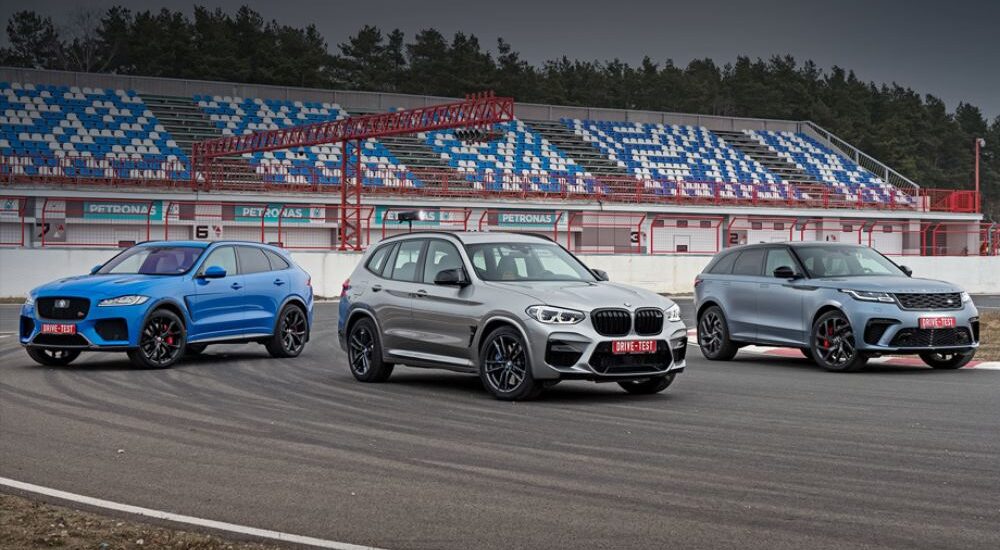

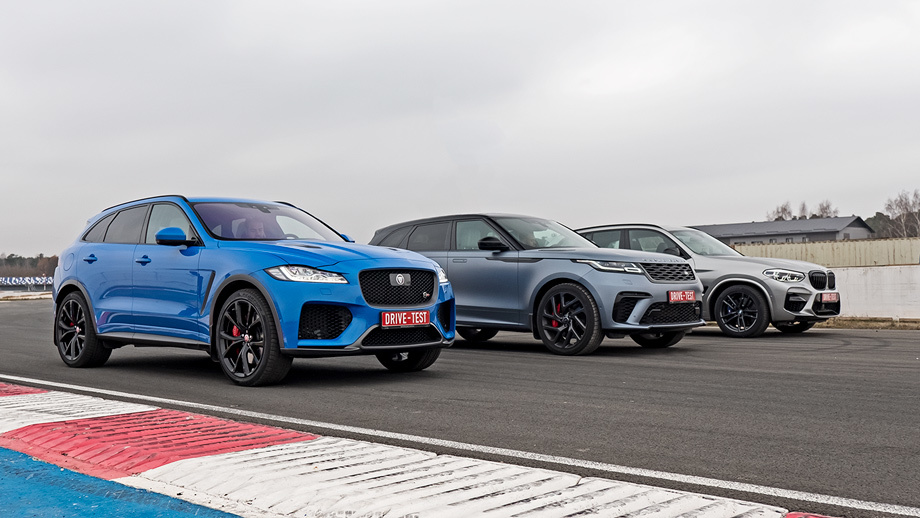
This comparison test pits three high-performance crossovers against each other: the BMW X3 M, the Jaguar F-Pace SVR, and the Range Rover Velar SVAutobiography Dynamic Edition. The Jaguar and Range Rover share the same platform and the same engine — a supercharged 5.0-liter V8 producing 550 hp, built at Ford’s Bridgend plant in Wales. That engine’s days are numbered: production at Bridgend ended in autumn 2020 when Jaguar Land Rover’s supply contract expired, likely marking the end of the road for eight-cylinder supercharged Jaguars and Range Rovers. The next generation of hot “British” SUVs may rely on six-cylinder power instead — and the BMW X3 M, already running a straight-six, shows that this transition doesn’t have to be a downgrade.
0-60 mph: How the Three Crossovers Compare
Despite giving away nearly 100 kg to the SVR, the 510-hp BMW X3 M matches the heavier Jaguar’s 4.3-second sprint to 60 mph. The Range Rover Velar, heavier still, needs an extra 0.2 seconds. Key takeaways from testing on winter tires with a single driver:
- BMW X3 M: 4.3 seconds to 60 mph, matching its official spec despite winter tires
- Jaguar F-Pace SVR: 4.3 seconds to 60 mph, on par with the lighter X3 M
- Range Rover Velar SVA: roughly 4.5 seconds to 60 mph
These numbers deserve some context. German performance cars tend to be picky about non-standard tires, and in this test the winter rubber was narrower than the factory-spec summer tires. There’s also a huge range of drivetrain and throttle settings to experiment with, and the sport program chosen here for the X3 M may not have been the fastest option available. In short: in this particular test, cylinder count didn’t translate into a straight-line speed advantage.
Sound and Acceleration Feel: V8 Drama vs BMW Efficiency
Numbers aside, the SVR feels like the most dynamic car off the line. Its V8 snarls hard under load, barks on every upshift, and pops loudly on lift-off, with the supercharger whine buried beneath the exhaust theatrics. That soundtrack adds a reckless edge to every acceleration run — the kind that makes you want to floor it even when there’s no need to. It’s little wonder the Jaguar felt like the drag-strip favorite among testers. If six-cylinder engines really are the future for these “British” SUVs, this V8 growl is exactly what enthusiasts will miss most.
The Velar sounds a touch more restrained but still plenty dramatic — especially compared to the BMW, whose exhaust note can feel almost artificially muted. All three cars use exhaust bypass valves that add drama on demand. One notable difference: the X3 M remembers its exhaust valve setting even after a restart, while the SVR and SVA default back to a quieter tone at the first opportunity, such as when switching driving modes.
The fundamental character difference comes down to this: the British duo make acceleration itself the event, while the BMW makes the result the point — you glance down and you’re already doing 90 mph before you feel it. The German car disguises its speed; its rivals wear it proudly, which makes everyday driving on public roads more entertaining — and, in the case of the SVA, more comfortable too. Its air suspension is firmer than a standard Velar’s, but next to the tightly wound M, the Range Rover still feels like a civilian car.
Ride Comfort: Air Suspension vs Sport-Tuned Springs
The Velar shrugs off small road imperfections almost entirely, though larger transverse bumps trigger noticeable unsprung-mass movement — likely a side effect of those enormous 22-inch wheels. Even in Sport mode, the Velar’s chassis stays composed, though that setting doesn’t really suit the car’s stately character.
The Jaguar, lacking air suspension, rides stiffer than a standard F-Pace thanks to its firmer springs. In Dynamic mode there’s almost no give at all — every imperfection sends the car bouncing. Fortunately, the multimedia system lets you separate settings: dial back the dampers while leaving engine, gearbox, and steering in Sport. As for the steering itself, it’s best left in Comfort — accuracy doesn’t suffer, and the wheel turns more easily.
The BMW X3 M shows little difference between Sport and Sport Plus — both are firm to the point of harshness, bouncing over small bumps with pronounced vertical motion. Switch to Comfort, though, and the car transforms into something genuinely pleasant: firm, but not punishing.
Track Performance and Handling at the Limit
On a flat, freshly laid test track in Myachkovo, used here to explore handling limits rather than lap times, the X3 M’s aggressive Sport mode comes into its own, sharpening turn-in without becoming unpredictable.
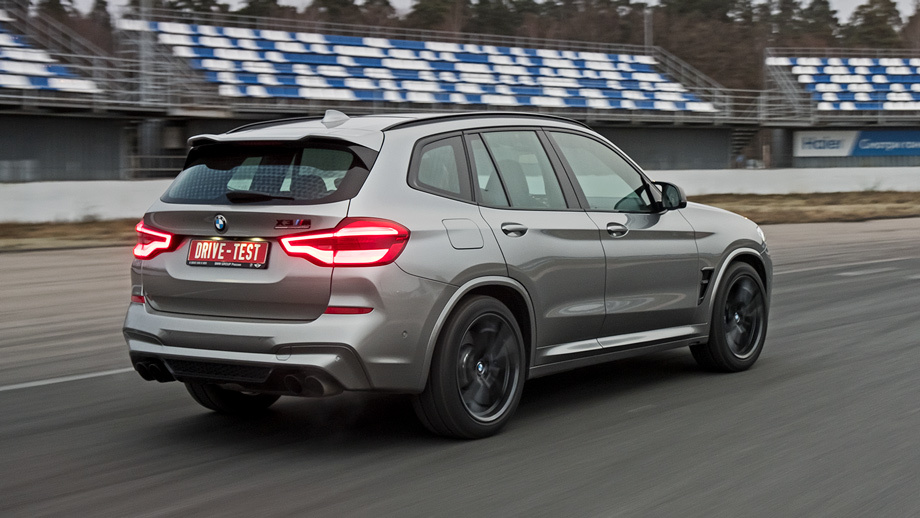
Body roll is noticeable, and the BMW does push its nose wide early in corners, occasionally sliding a touch prematurely on throttle release. But these behaviors develop progressively, giving the driver time to read and correct them. Switching off the extra steering weight in Sport mode helps here too — the result is a light, moderately quick rack (2.2 turns lock-to-lock) with a thick rim, good feedback, and a natural buildup of effort with steering angle and load.
Notably, this test car wasn’t even running its intended staggered tire setup (255/40 R21 front, 265/40 R21 rear) — instead it wore matching 255/45 R20 winter tires all around. Combined with Pirelli Scorpion Winter tires that aren’t at their best on cold, dry pavement, this made the drift-happy 4WD Sport mode all the more impressive: by shifting torque rearward, the electronically controlled M differential makes power slides both accessible and easy to control — easier than in either rival.
The two “British” crossovers, despite their own smart differentials, lack a comparably playful drift mode and are reluctant to slide under power on dry roads. Getting a slide started generally requires briefly lifting off to unload the rear axle first:
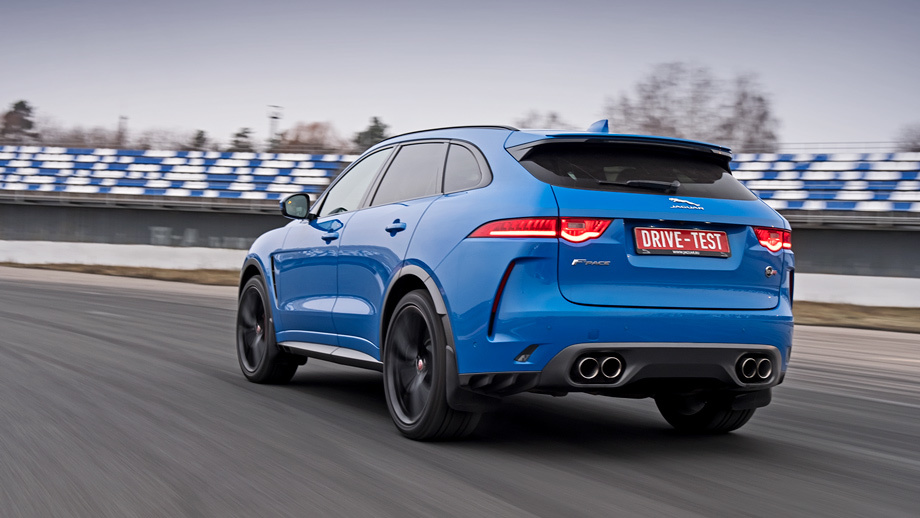
- Jaguar F-Pace SVR: Once provoked, the Jaguar slides eagerly — the challenge is catching it. Because torque shifts unpredictably between axles (as if using a mechanical interaxle limited-slip setup), holding a steady drift angle takes real skill.
- Range Rover Velar SVA: Similarly reluctant to break traction without deliberate provocation, prioritizing stability over playfulness.
- BMW X3 M: The most predictable and easiest of the three to slide and hold at will.
The steering ratios on both British crossovers are identical, with just over two-and-a-half turns lock-to-lock, but the power assistance is tuned differently. The Jaguar’s steering resists more but delivers cleaner feedback; the Velar’s is lighter but slightly less transparent. The Velar also doesn’t dive into corners the way the Jaguar does — it rolls first, then settles into an arc a beat later, sometimes needing a mid-corner correction.
Overall, both British models feel noticeably less composed than the BMW at the limit. Beyond lateral roll, longitudinal pitch under acceleration and braking is a bigger issue for both — the soft Velar squats and rears up under full throttle, and surprisingly, the stiffer F-Pace SVR isn’t much better. It’s still a heavy SUV at heart, and the V8’s weight clearly affects front-to-rear balance: both cars tend to push wide at the limit when cornering speed is pushed too hard.
Everyday Driving and Character
Back on public roads at a more relaxed pace, the personalities of the two co-platformed British SUVs diverge sharply. The Velar settles into its role as a comfortable, slightly numb-steering “truck” — soft ride, wide seats, and a hushed exhaust that doesn’t disturb cabin silence. The SVR, by contrast, feels like a five-door version of Jaguar’s old XKR sports coupe: sharp, eager, and always keeping the driver engaged. It doesn’t cling to the road so much as invite you to spin it like a top at the next roundabout if you’re careless with the throttle.
Braking Performance on Winter Tires
Tire matchups: the Jaguar rides on the same Pirelli winter tires as the X3 M, while the Velar wears Continental ContiCrossContact Winter rubber. Braking results from 60 mph:
- Range Rover Velar SVA: Best in test — 129.9 feet from 60 mph
- Jaguar F-Pace SVR: About 3.2 feet longer than the Velar
- BMW X3 M: The longest stopping distance, 7.8 feet behind the Velar
All three cars have a noticeably long brake pedal travel, though this civilian-feeling pedal tuning feels most out of place in the performance-focused M.
Cabin Comfort, Visibility, and Ergonomics
Noise isolation is solid across the board, with engine (or exhaust, when the valves are open) as the dominant sound. At higher speeds, wind noise becomes more noticeable in both British models. Forward visibility is compromised in all three by thick A-pillars, made worse in the Jaguar and Range Rover by wipers that leave an uncleared strip near the driver’s side pillar.
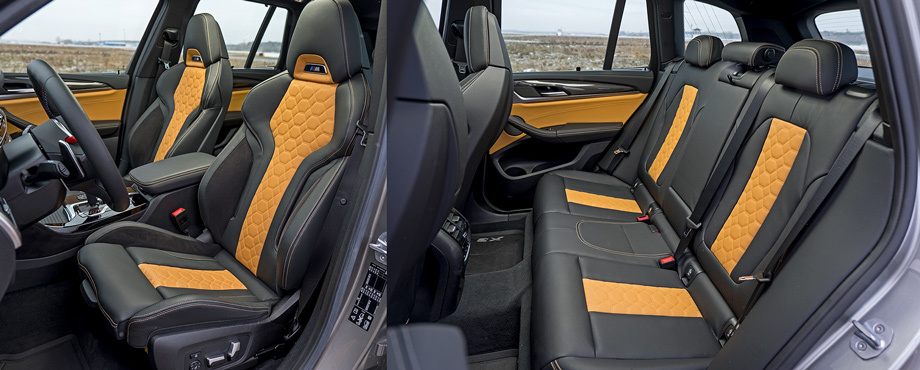
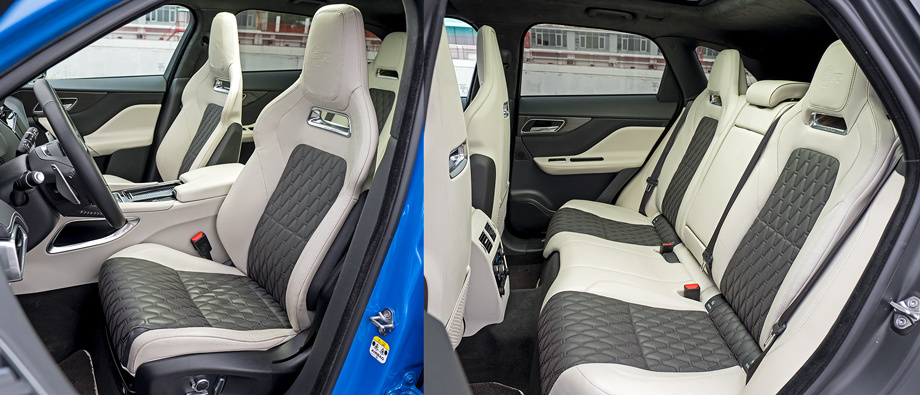
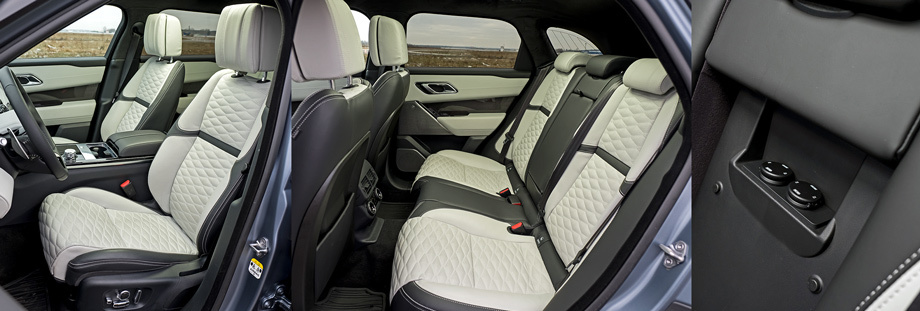
The Range Rover’s high seating position makes its size easiest to judge from behind the wheel, and — somewhat surprisingly — its seats, shared with simpler Velar trims, are the most comfortable and easiest to adjust of the three. Even in its lowest position, the driver’s seat still offers a clear view of the hood, reinforcing the sense of driving something substantial. The tradeoff is ergonomics: the abundance of touchscreen controls makes the Velar the most complex cabin to operate.
By comparison, the BMW feels like a conventional passenger car inside, with intuitive controls for secondary functions. The Jaguar splits the difference, offering more physical buttons than the Velar, though seat heating is still buried in a slow-to-load menu. Its bucket-style seats promise a sporty driving position but actually place the driver noticeably higher than in the BMW.
Off-Road Capability
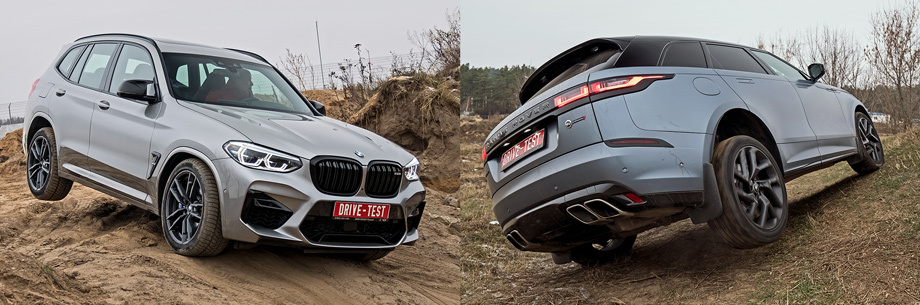
Unsurprisingly, the Velar is the most capable off-roader of the three:
- Air suspension with adjustable ride height improves ground clearance and approach/departure angles
- Good axle articulation for uneven terrain
- Terrain Response 2 system effectively manages traction across surfaces
Testing didn’t go deep off-road, but the more demanding the terrain, the bigger the Velar’s advantage would likely become. The gap with the Jaguar would widen further still, since the SVR has no off-road drive modes and can’t adjust its ground clearance. The BMW X3 M, while riding higher than the SVR, matches the Range Rover’s on-road composure within the limits of its geometry, thanks to traction control that convincingly mimics a locking differential.
Verdict: Which Performance Crossover Should You Buy?
None of these three cars is a rational purchase — all are indulgent by nature, though the BMW is the most restrained of the bunch. Outwardly modest by performance-SUV standards, the X3 M gives little away beyond its oversized brakes, which quietly warn stoplight racers not to take it lightly. But in this company, technical competence alone doesn’t win hearts. The M is the most capable in extreme conditions, the quickest through corners, and arguably the easiest to live with day to day — but it’s also the least characterful of the three. At this price point, buyers want more personality.
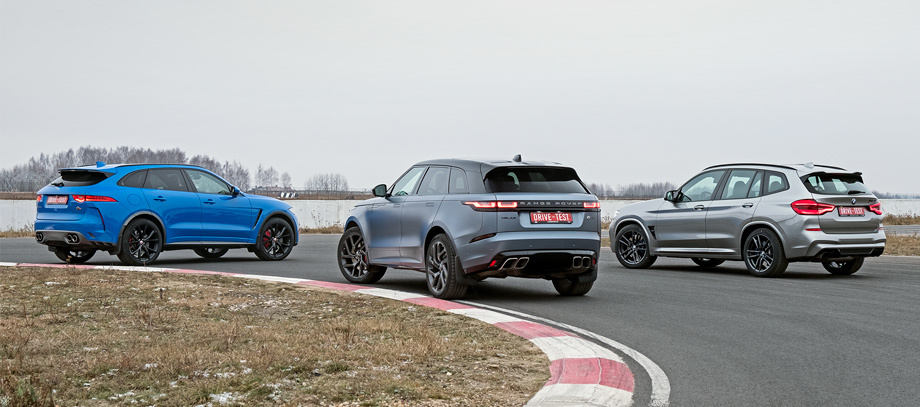
The loud, brash SVR sits at the opposite end of the spectrum: for all its noise and drama, it’s still slower than the BMW, and its interior doesn’t feel like it justifies the price tag. The Velar, meanwhile, is quieter than the SVR and easier to live with day to day, while still feeling more emotionally engaging than the BMW — a sort of American-flavored take on the sport crossover formula. It fits a bigger, more expressive lifestyle better than the precise but slightly cold X3 M. It’s not a rational choice by any measure, and it comes with its share of questionable design decisions — but this is fundamentally a purchase driven by the heart, not the spreadsheet.
Final Take
All three of these performance crossovers are eccentric in their own way, but the Range Rover Velar SVAutobiography Dynamic Edition stands out as the most well-rounded — and arguably the only one in its lineup truly worth the premium. Its off-road talent will likely go unused by most owners, but its striking design and characterful V8 don’t require any compromise to enjoy. Bottom line: if you’re choosing between these three, it’s safe to go with the most expensive option.
This is a translation. You can read the original hre: https://www.drive.ru/test-drive/bmw/5de911a4ec05c4a07900000f.html

Published April 27, 2023 • 11m to read