
Hey, road trippers and gadget gurus! Our friend, the tech blogger Wylsacom, had a clear goal: find out how Apple’s Crash Detection would react when a Tesla Model S crashes. Along the way, we put the car itself through the wringer in our ARCAP crash test — and uncovered some serious findings about how a “repaired” Tesla holds up. Here’s everything we found, from the airbags to the iPhones riding along for the test.
What Is Apple’s Crash Detection?
Crash Detection is a safety feature built into newer Apple smartphones, including the iPhone 14. It uses onboard sensors to monitor sudden changes in motion and speed:
- Accelerometer and gyroscope — track changes in velocity and phone orientation during a collision
- Barometer — monitors atmospheric pressure changes as the car crumples into an obstacle
For this test, one iPhone 14 was mounted on the front panel with its sensors working overtime the moment impact occurred.
Meet the Tesla: A 2013 Model S With a History
Our test subject was a 2013 Tesla Model S — and not a pristine one. This particular car had already survived an accident before we got our hands on it, which made it a fascinating case study for our crash test.
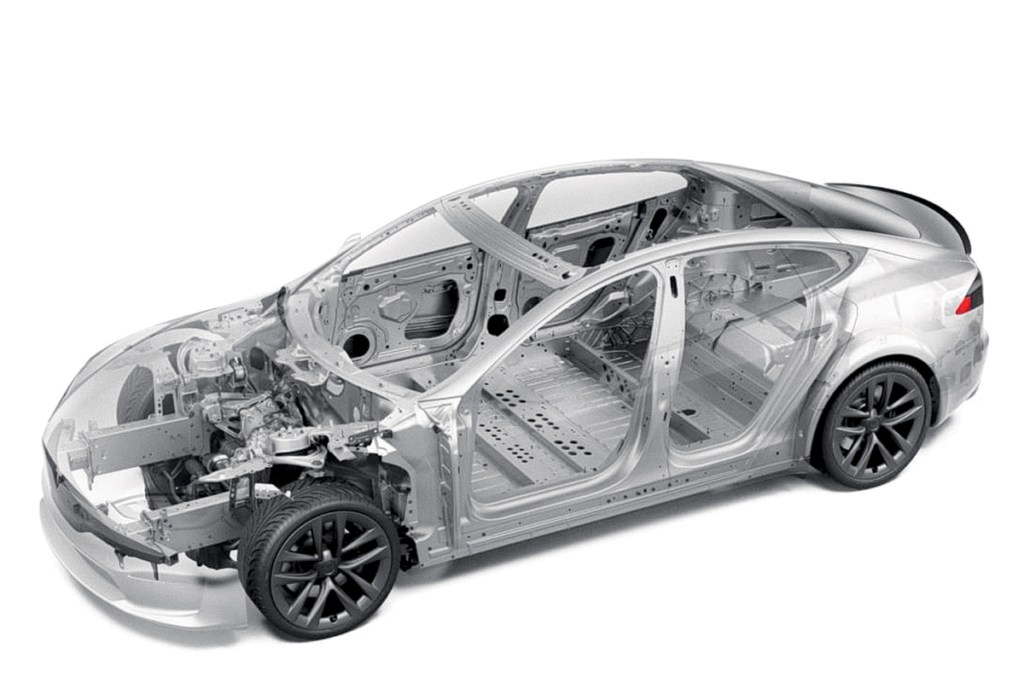
This Tesla also marked a first for our crash test series: an aluminum-bodied vehicle.
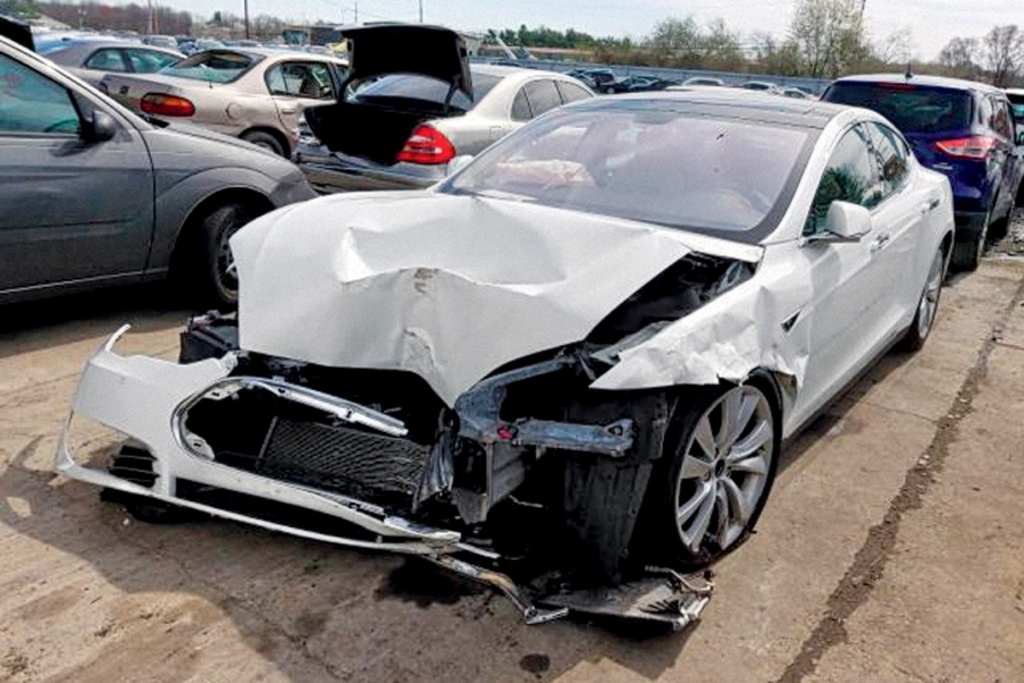
We’ve been crash-testing used cars since the 1990s, so smashing vehicles to check their safety isn’t new to us. But this Tesla Model S stood out. A little detective work — checking the VIN on Copart — revealed that this car had survived a nasty head-on collision, likely with a tree or a pillar, at around 23,176 miles (37,300 km). The impact struck almost dead-center, right between the longerons.
Tesla’s Battery Protection: Titanium Armor and Side-Impact Risk
Regular cars usually absorb front-end collisions with the engine bay, which can wreck the engine and spread damage through the rest of the car. Tesla is different — there’s a trunk up front instead of an engine. That means side impacts are the real Achilles’ heel for a Tesla, especially where the traction battery sits under the body. A severe side impact can compromise the battery pack’s integrity and, in a worst-case scenario, lead to a fire.
Tesla later reinforced the underbody and battery pack with titanium plating on newer models. Our test car, a pre-2014 Model S, predates that upgrade and doesn’t have this extra armor.
That backdrop adds an extra layer of anticipation to our test — we’re not just watching how the car’s structure holds up, but also what happens to that unprotected battery.
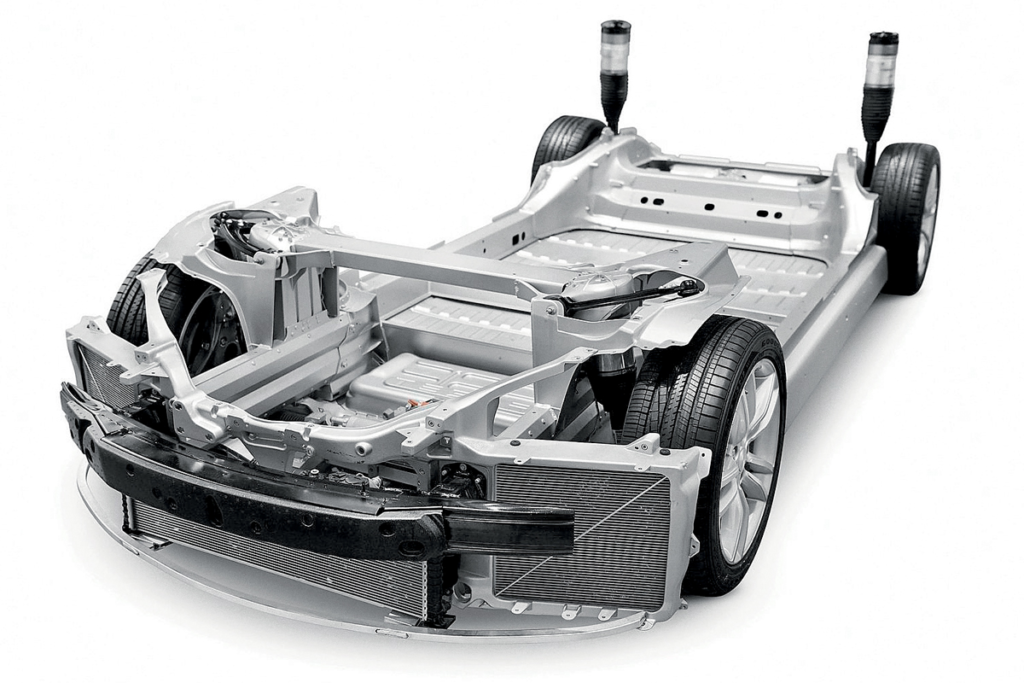
From the auction photos, the earlier accident wasn’t a total disaster. The front axle’s cross beams and the cabin’s frame stayed untouched. The windshield didn’t even crack, though all four front airbags deployed as intended.
The Repair Job: What Was Fixed — and What Wasn’t
Our Tesla went in for repairs after that first crash, and the results were a mixed bag. Some issues were purely cosmetic:
- Mismatched paint — the repainted panels looked like a patchwork quilt, with colors that didn’t quite match
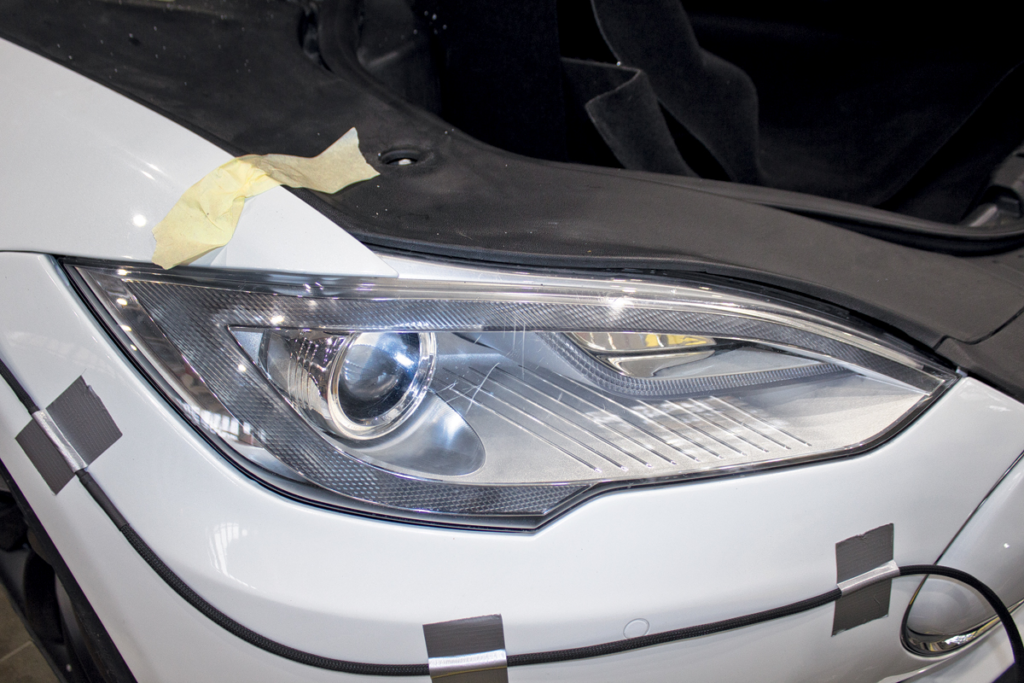
- Different fasteners — a discerning eye could spot mismatched hardware on the aerodynamic covers under the front compartment
- Uneven panel gaps — the spacing between headlights, hood, and bumper wasn’t consistent, though early Model S units were known for factory inconsistencies too
But other issues were far more concerning for occupant safety:
- Seatbelt pre-tensioner not replaced — the driver’s pre-tensioner, already triggered in the prior crash, was left in its post-accident state instead of being swapped for a working unit
- Faulty inertia reel — the seatbelt’s inertia reel, meant to lock the belt in place during an impact, wasn’t functioning correctly either
We understand that sourcing new belts and pre-tensioners from Germany or the US can be difficult, but a wide range of second-hand parts could have solved the problem. Ideally, after airbags deploy in a crash, the safety system control module (around 800 euros), the front impact sensor (around 100 euros), and the wiring harnesses should all be replaced with new components.
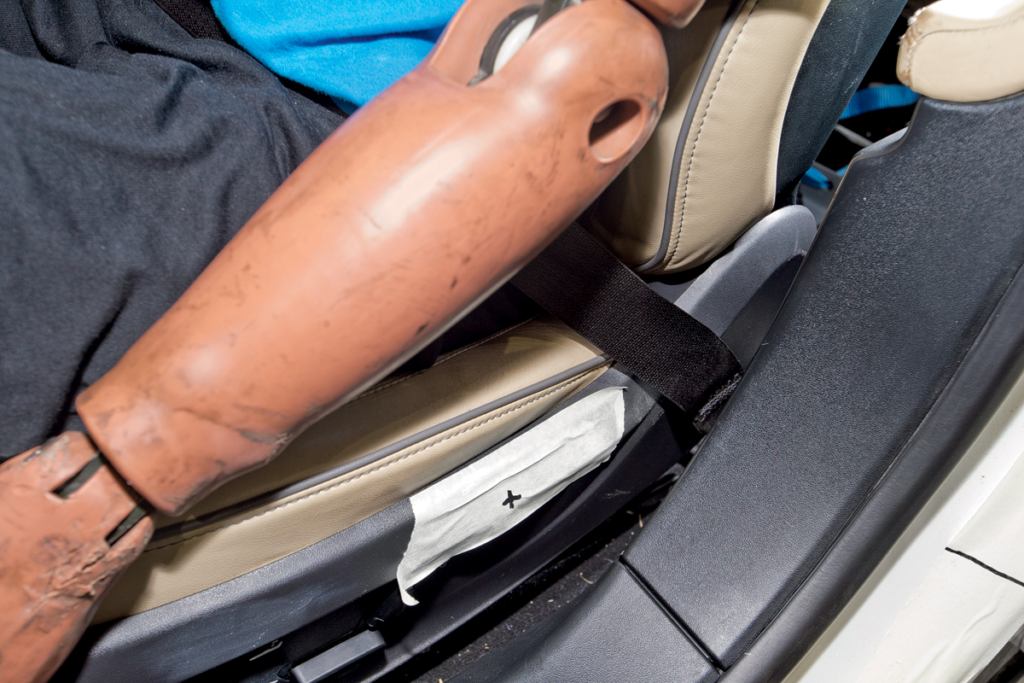
The airbags installed in our Tesla carried markings identifying them as used parts sourced from a salvage dealer — not brand new, but genuine airbags nonetheless. The big question: would they actually work?
The seatbelt concern loomed large too. If it failed, the driver dummy’s head risked hitting the ceiling near the sun visor, potentially bending the neck and damaging the Hybrid III dummy’s expensive sensors. To avoid unnecessary damage to that equipment, test site specialists left the dummies’ necks uninstrumented for this run.
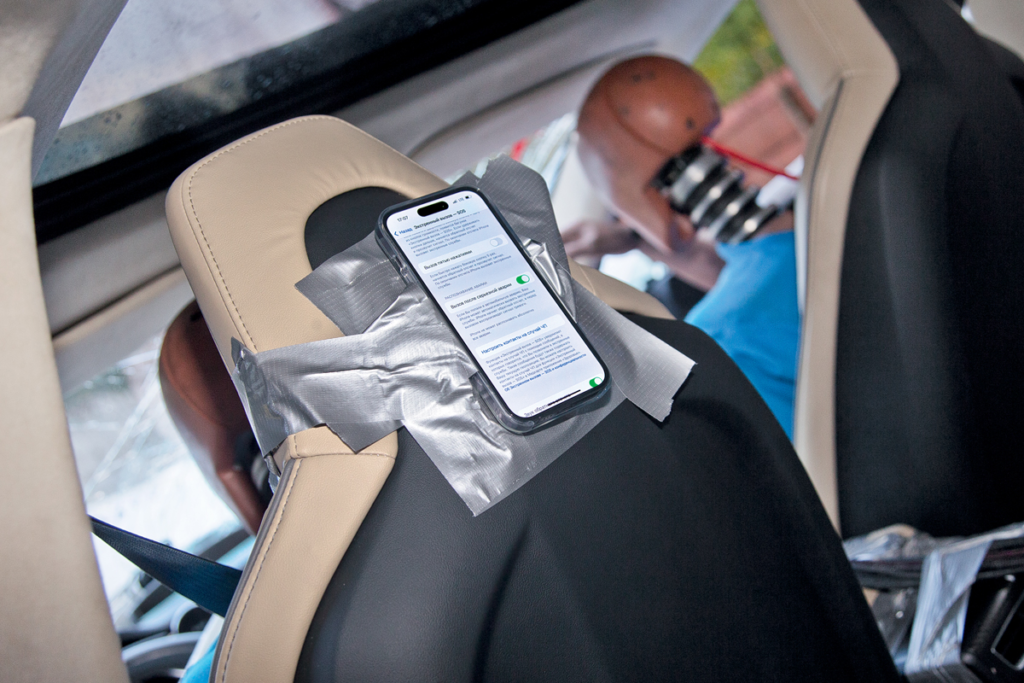
Two iPhones rode along for the test. One iPhone 14 was mounted on the front panel deflector with a standard magnetic holder, positioned to see where the impact would send it flying. A second iPhone 14 Pro was taped securely behind the driver’s seat headrest, with the plan to check its display through the open rear window right after impact.
The Crash: Impact and Airbag Deployment
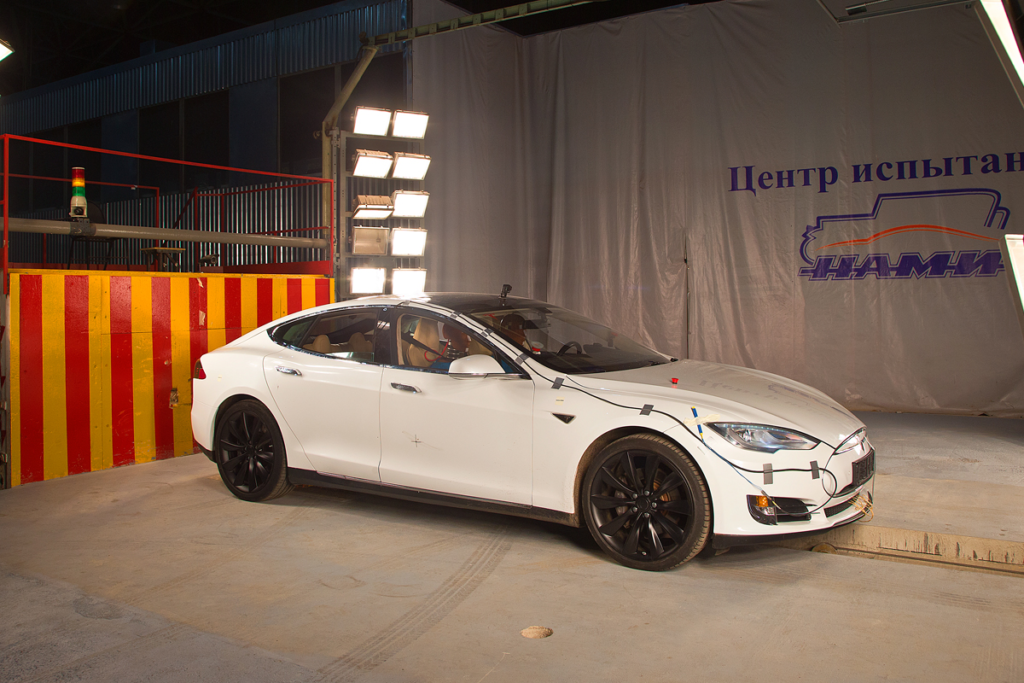
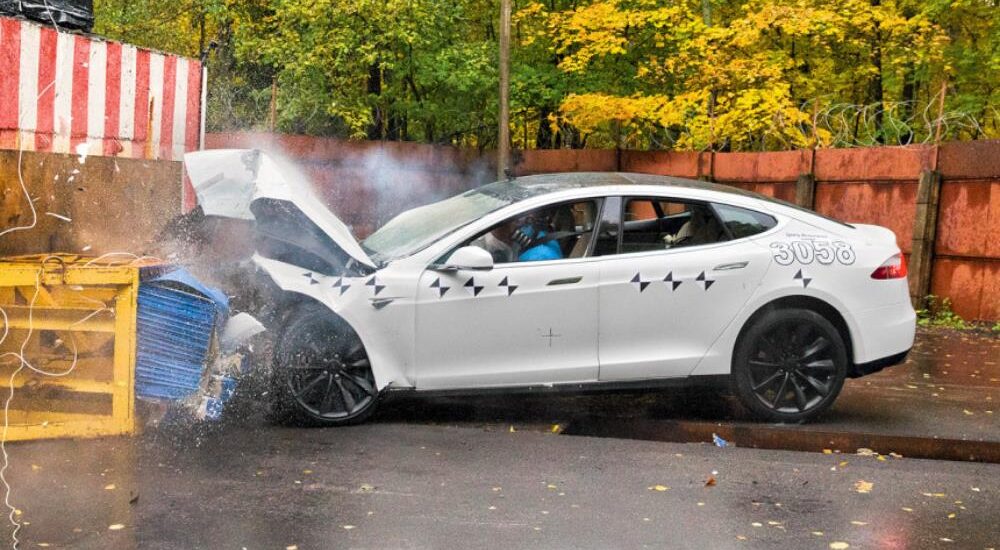
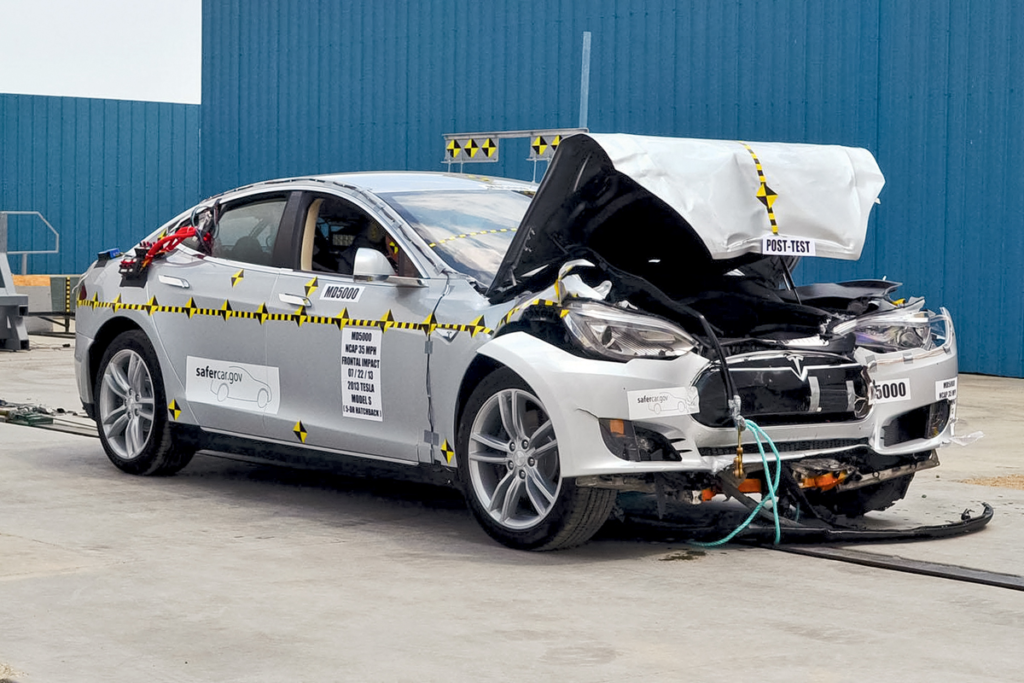
With batteries checked and the transmission in neutral, the Tesla accelerated to 64.2 km/h (39.9 mph) with the whir of the catapult, then struck the deformable barrier head-on. The impact left a good portion of the bumper cladding behind and sent the car retreating slightly through a haze of airbag pyrotechnic smoke.
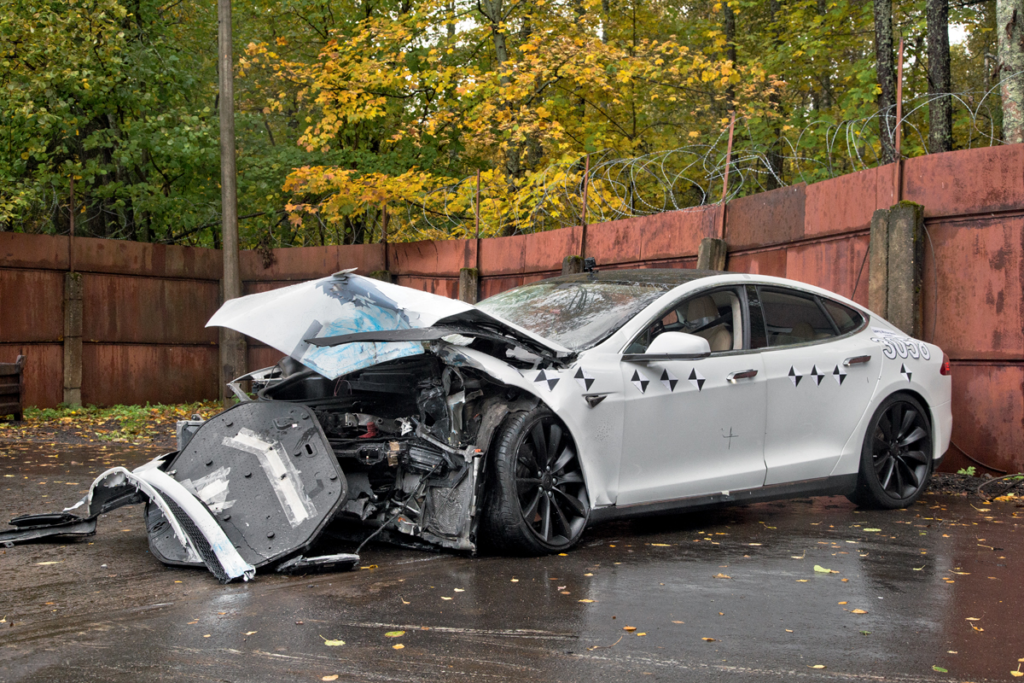
All four front airbags deployed as expected. But there was a notable problem with the passenger-side airbag: it deployed with enough force to push out the windshield in front of it — a windshield that had already survived deployment of the factory airbag once before. Worse, the passenger-side airbag didn’t cushion properly. It flattened, and the right dummy’s head made direct contact with the front panel.
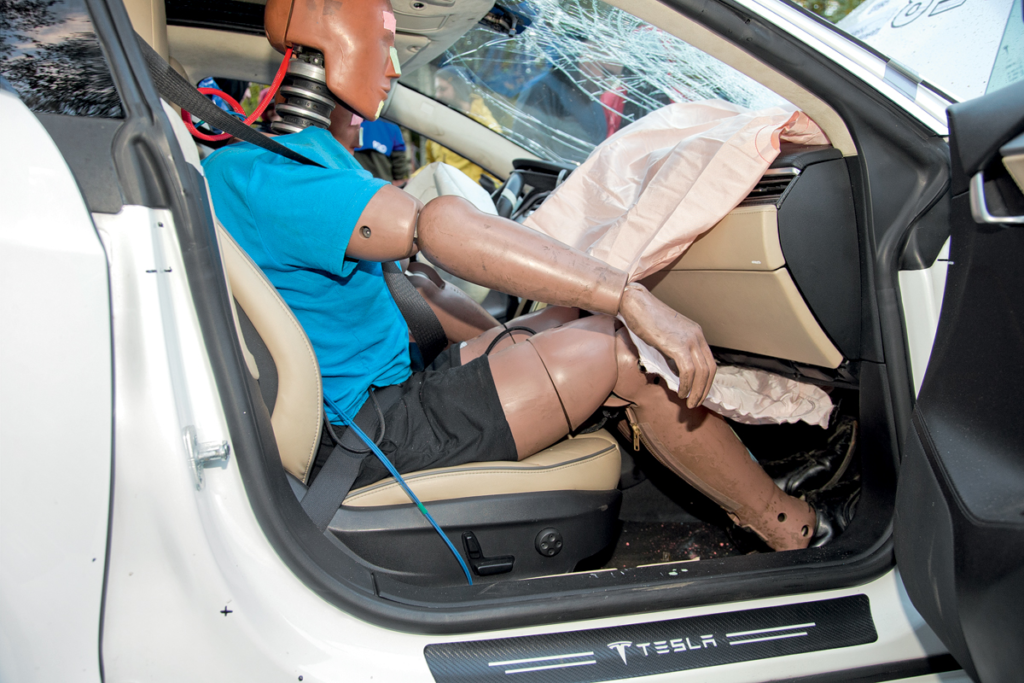
Peak deceleration hit a staggering 81.3g, with an average of 76.5g over three milliseconds. For context, anything over 72g starts entering territory where the risk of serious injury escalates, with 88g marking the upper limit.
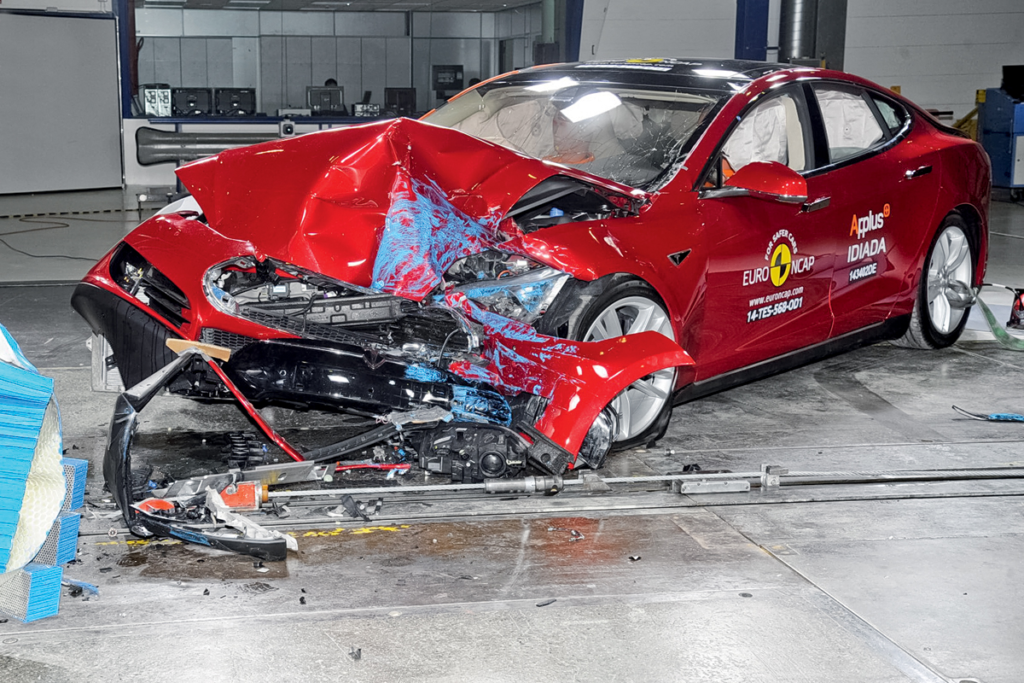
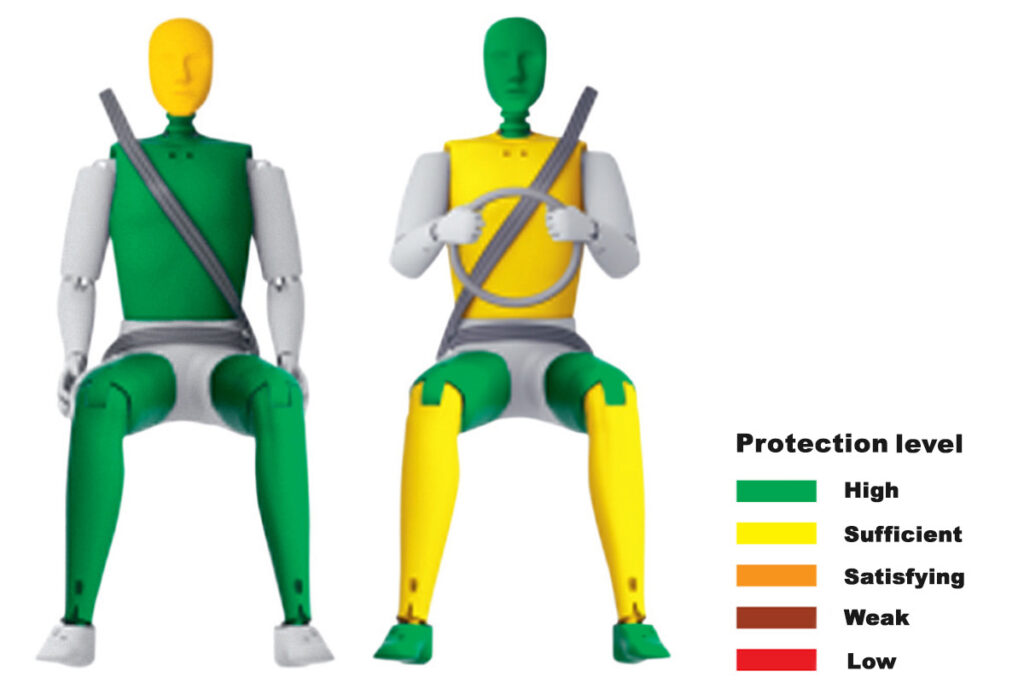
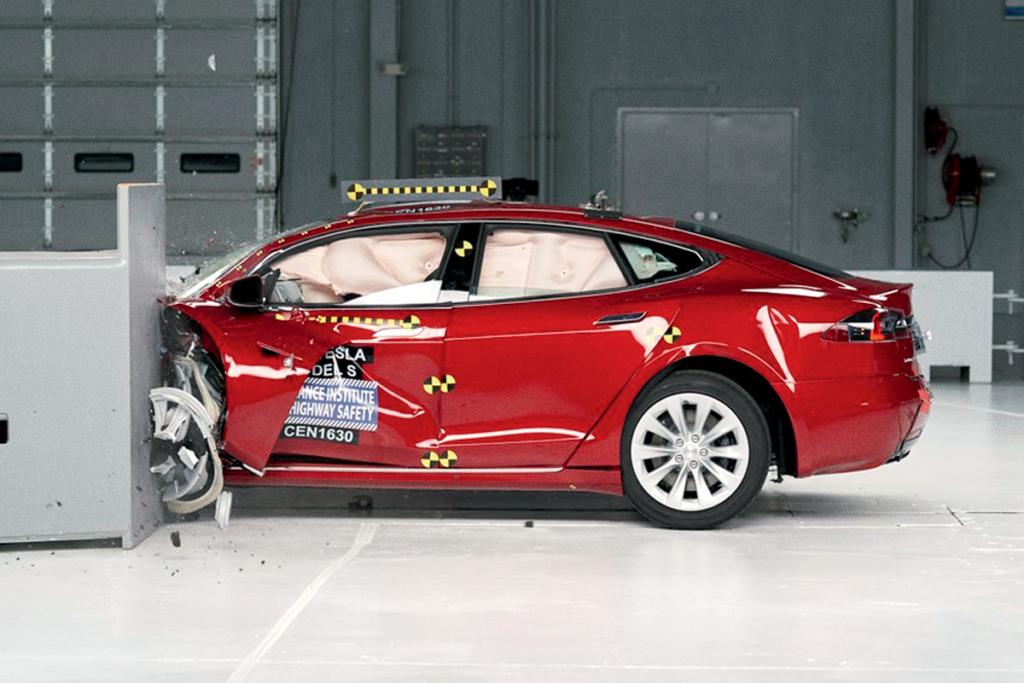
This isn’t the first time this issue has surfaced. During Euro NCAP’s 2014 testing of the Model S, a similar passenger airbag problem showed up. At the time, the dummy’s sensor readings didn’t cross into the danger zone, but points were still deducted for passenger head protection.
Tesla later updated its software in response to those findings — which raises a key question for our test car: what software version is actually installed, and how compatible is it with non-native, salvaged airbag modules? These are unknowns that add real complexity to interpreting our results.
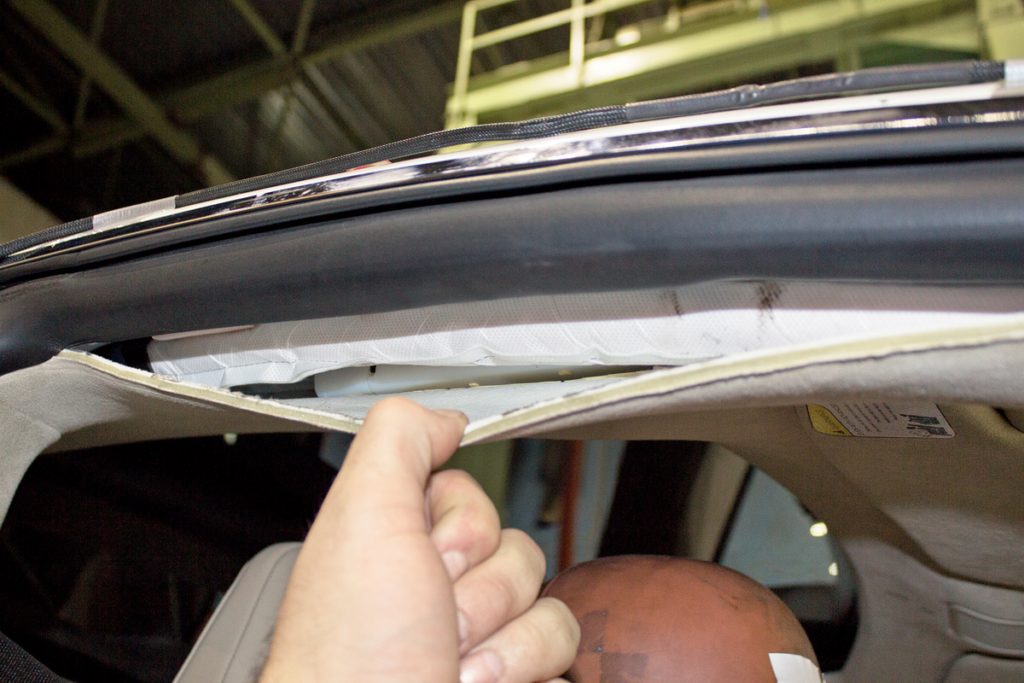
It’s also worth noting that the inflatable side curtains never deployed — not in the original American accident, and not in our test — even though similar frontal crash tests by Euro NCAP, IIHS, and NHTSA have shown them deploying.
Crash Test Results: Head, Chest, and Injury Criteria
Passenger side: the right seatbelt’s pyrotechnic pre-tensioner worked efficiently. The passenger dummy’s calibrated rib deformation measured just 14 mm — well below the 22 mm safety threshold, and actually the lowest reading ever recorded in the history of these crash tests. Impact loads on the thighs, knees, and shins also stayed within safe limits, suggesting injuries in these areas likely wouldn’t require medical treatment.
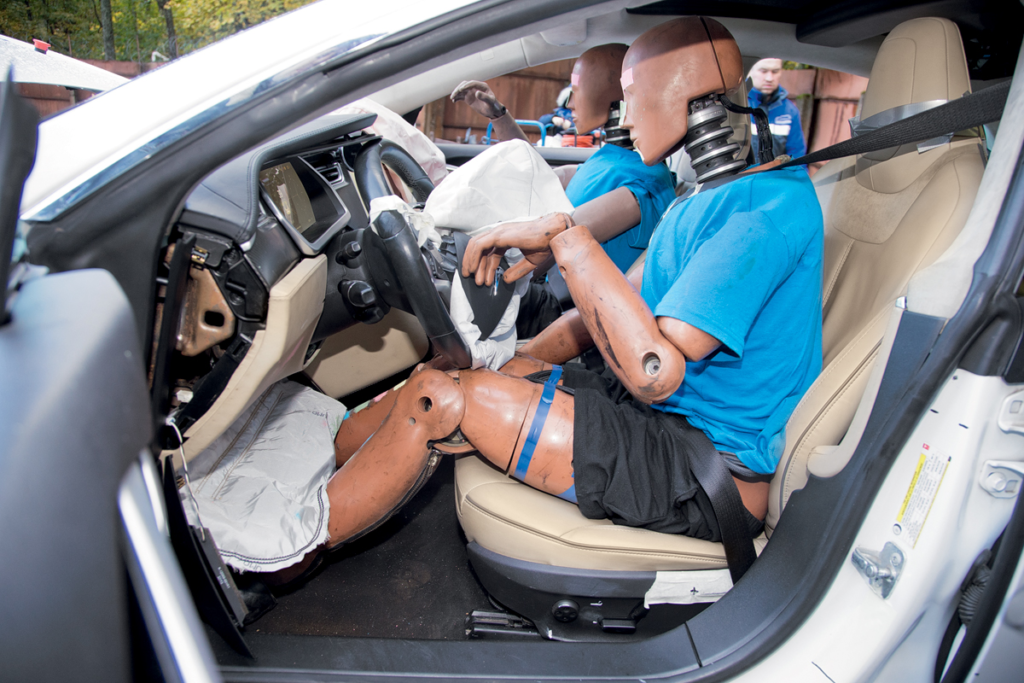
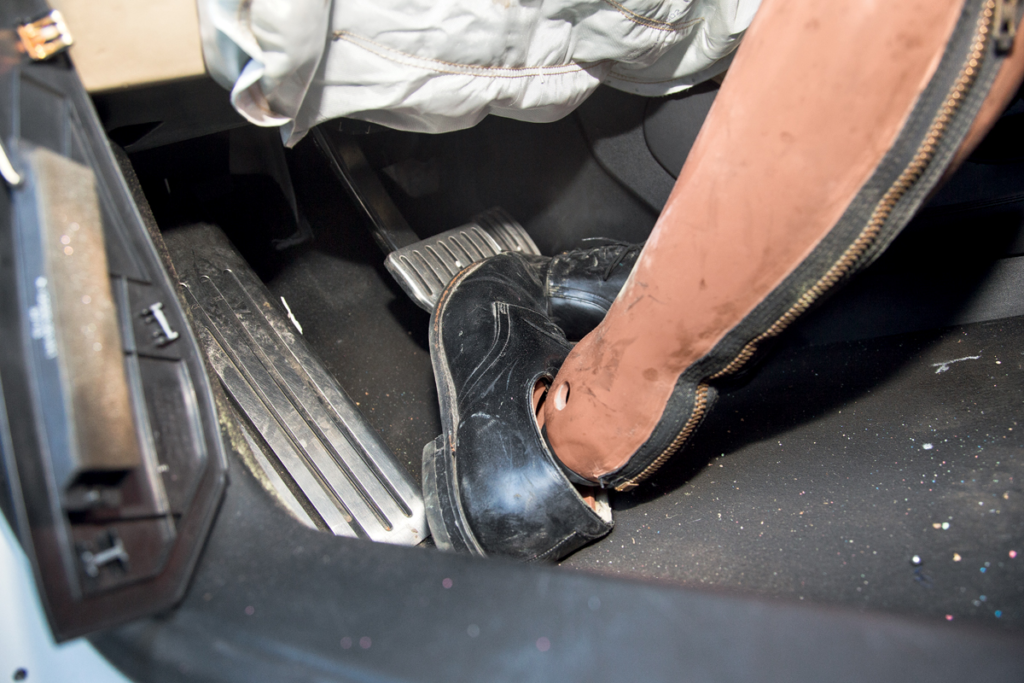
Driver’s side, lower body: the dummy fared well below the waist — the floor stayed intact, pedal displacement was minimal, and the knee airbag deployed effectively.
Driver’s side, upper body: here’s where things went wrong. The driver’s seatbelt failed to function at all. As a result, the driver dummy struck the steering wheel forehead and chest first, bending the rim at the top. The steering wheel itself was displaced 50 mm (1.97 in) sideways and nearly 70 mm (2.76 in) inward.
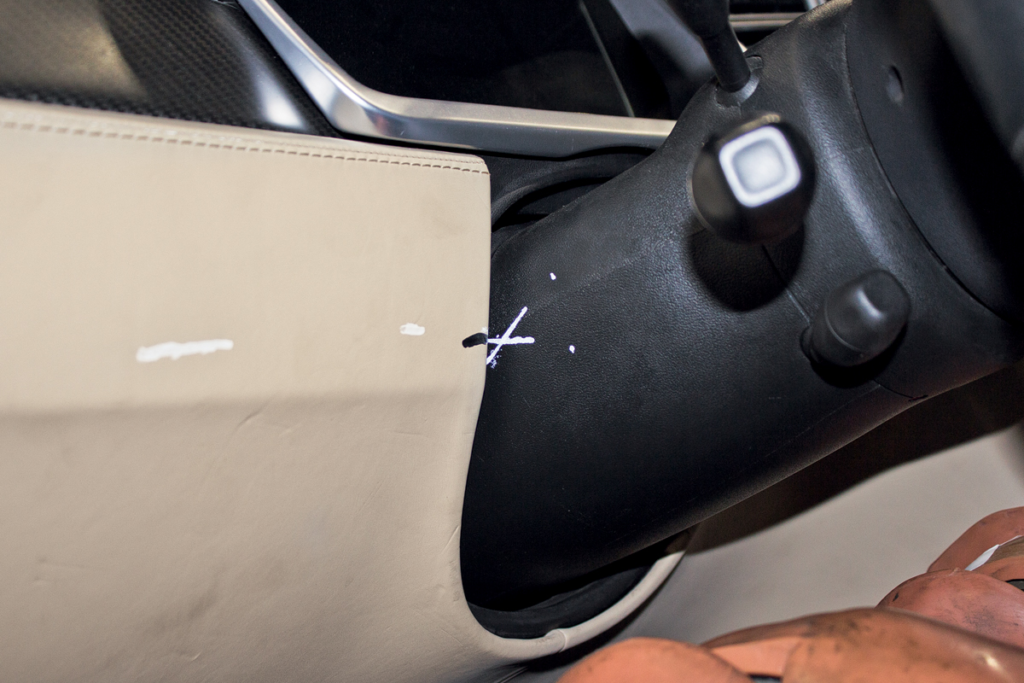
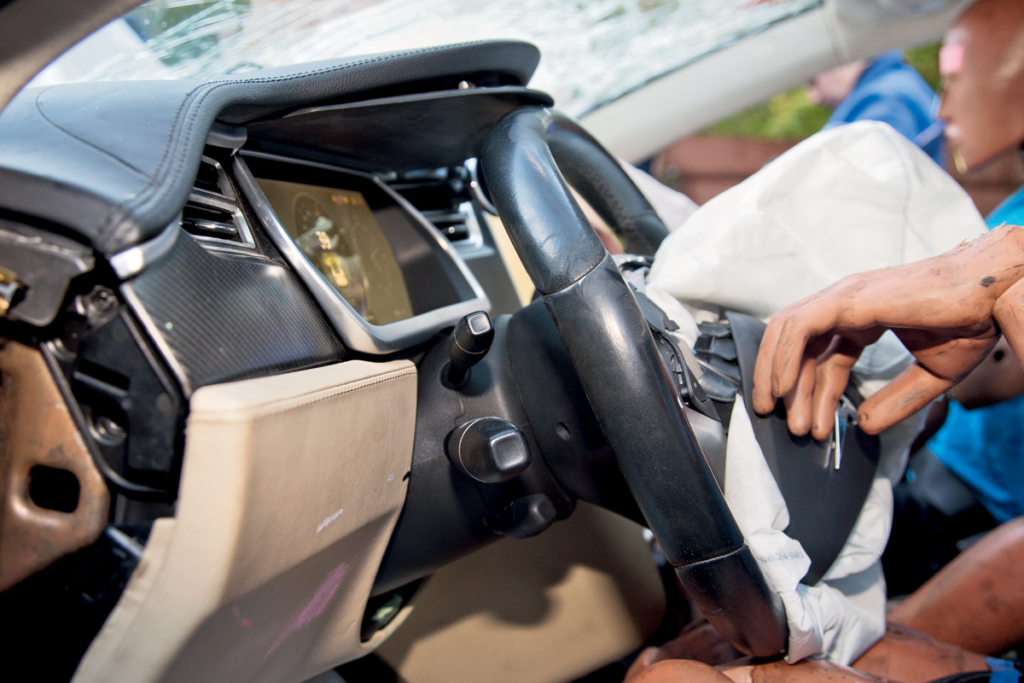
The seatbelt failure led to more severe rib deformation for the driver, measured at 26.9 mm. Peak head deceleration also ran high at 84g, though the average over three milliseconds was more moderate at 65.2g. Here’s how the key injury metrics compared between driver and passenger:
- Head Injury Criterion (HIC): driver 629, passenger 576 — both well below the critical threshold of 1000
- Peak head deceleration: driver 65.2g (3ms average), passenger 76.5g (3ms average) — both under the 72–88g danger zone
- Chest compression: driver 27 mm, passenger 14 mm — against a regulatory limit of 22 mm for the driver position
- Maximum femur load: driver 0.66 kN, passenger 0.61 kN — far below the 3.8–9.07 kN regulatory limits
- Neck bending moment: not measured, since dummy necks were left uninstrumented to protect the sensors
So what saved the driver from more severe injury despite the seatbelt failure? The answer lies in the car’s structural and interior design, covered next.
Structural Performance: How the Cabin Held Up
The vehicle’s structure performed well overall. Despite shifting 3–4 mm, the door opened without significant effort — an important factor for occupant escape after a collision. A crease appeared on the windshield pillar, but the deformation didn’t meaningfully reduce the door opening, and the driver’s footwell stayed essentially untouched by structural changes. Both the cabin’s protective cage and the energy-absorbing longitudinal members — which, notably, had been previously repaired — held up well.
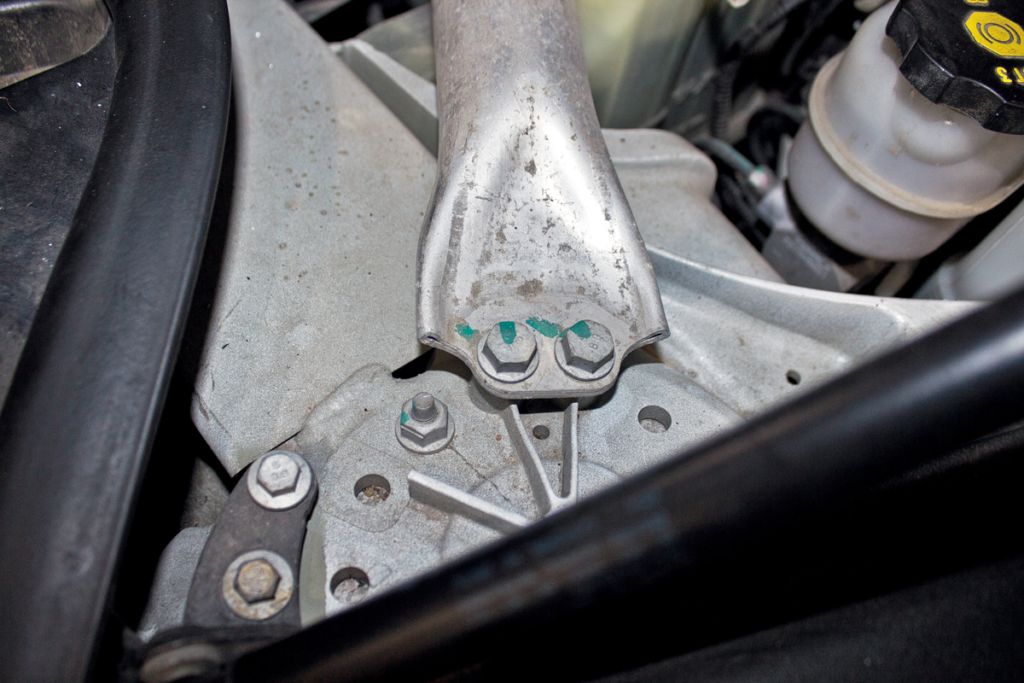
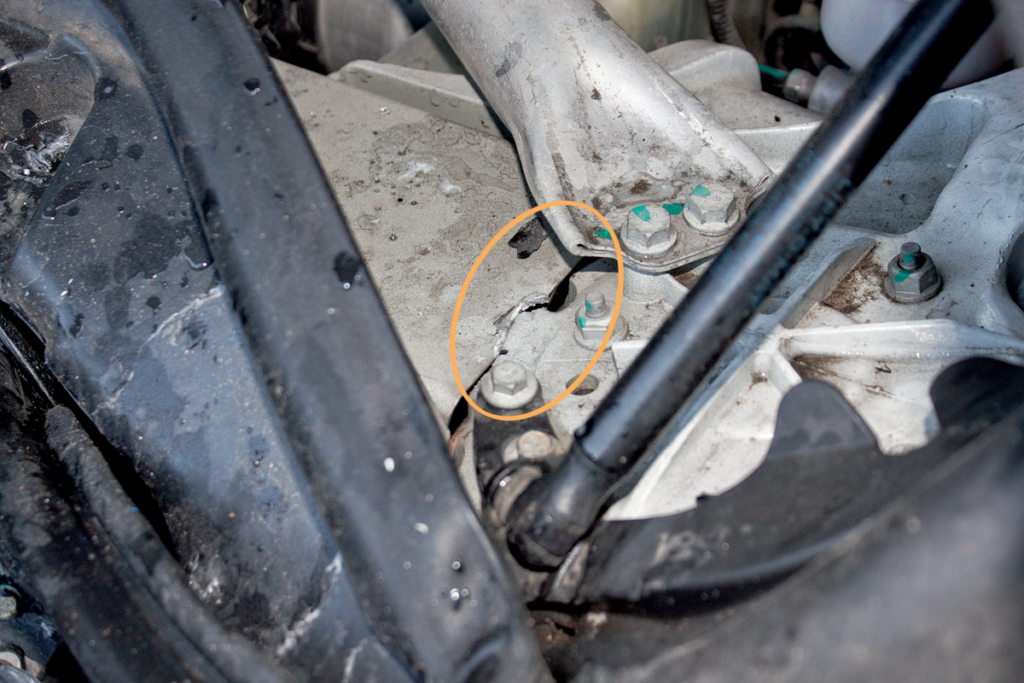
The Tesla Model S uses removable longitudinal members bolted to the body, which makes repairs possible in theory. But securing them properly requires a careful gluing process before final assembly — skilled work that demands knowledge of the right adhesives for aluminum bodies. Areas prone to temperature-driven metal deformation use a more flexible glue, while a denser red glue provides a firmer grip, as with the longitudinal members. Argon welding adds another layer of complexity: stronger alloys go into the power structure and subframes, while more ductile alloys are used for the body panels.
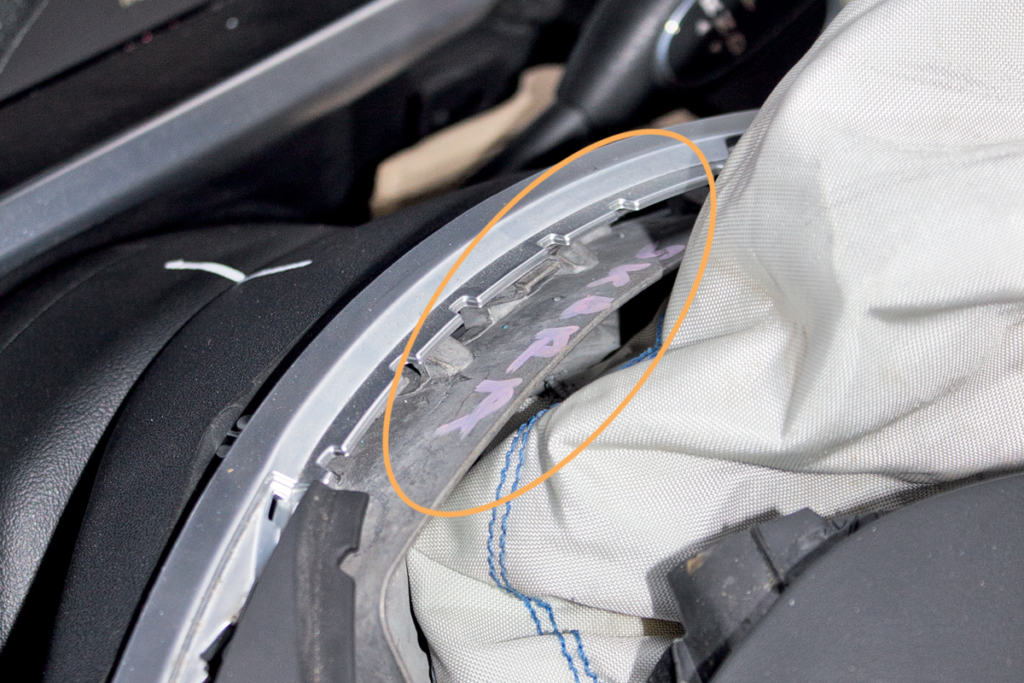
Even after a non-official repair, the Tesla Model S withstood a standard frontal collision with 40% overlap remarkably well. The interior’s passive safety design played a major role here. Under American federal technical requirements (FMVSS 208), vehicles must pass oblique frontal crash tests with unbuckled dummies at speeds up to 48 km/h (29.8 mph). Our results show how the flexible steering wheel, smooth front panel, and deployed airbags — including the knee airbag — protected the driver from more severe injury, even without a working seatbelt. It’s a strong reminder of just how much crash-worthy interior design contributes to overall vehicle safety.
ARCAP Score: How This Repaired Tesla Compares
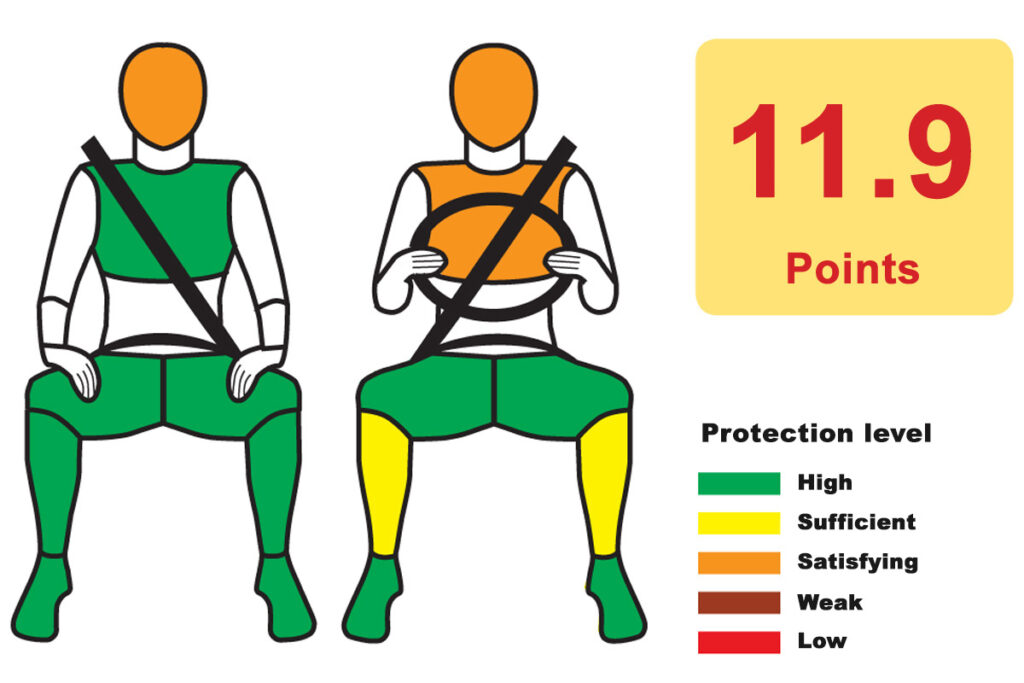
Even after sustaining prior damage and undergoing non-standard repairs, this Tesla Model S still achieved a solid level of passive safety: 11.9 points out of a possible 16, earning three stars out of four. That puts it in the same league as vehicles like the Ford Focus I and the Lada Vesta SW Cross in the ARCAP rating system.
- Head protection: 2.9 points (driver)
- Chest protection: 3.3 points
- Knees and thighs: full marks (green)
- Shins and feet: 3.7 points, due to slightly elevated loads on the driver
- Deductions: one point each for airbag penetration and for direct driver chest contact with the steering wheel
- Total score: 11.9 out of 16 (neck protection not scored, since no data was collected)
Keep in mind that points and star ratings should be read relatively, not absolutely — a vehicle’s weight and size play a major role in real-world crash outcomes. The Tesla Model S is considerably larger and nearly twice as heavy as cars like the Lada XRAY Cross or Volkswagen Polo sedan, which affects how it behaves in a collision.
So it wouldn’t be fair to directly compare the Tesla Model S’s safety to that of much smaller, lighter cars based on crash test scores alone. Still, despite the test’s lack of strict scientific rigor, it clearly illustrates how much a high-end car like the Tesla Model S can lose in safety performance — a 17% drop, in this case — due to past damage and non-official repairs.
That said, given how resilient and repairable the Tesla Model S body proved to be, it’s entirely plausible this vehicle could be restored and put back on the road once again.
What About the iPhones and Crash Detection?
As for the iPhones — neither one fared well. Both iPhone 14 models involved in the test failed to activate Crash Detection after impact.
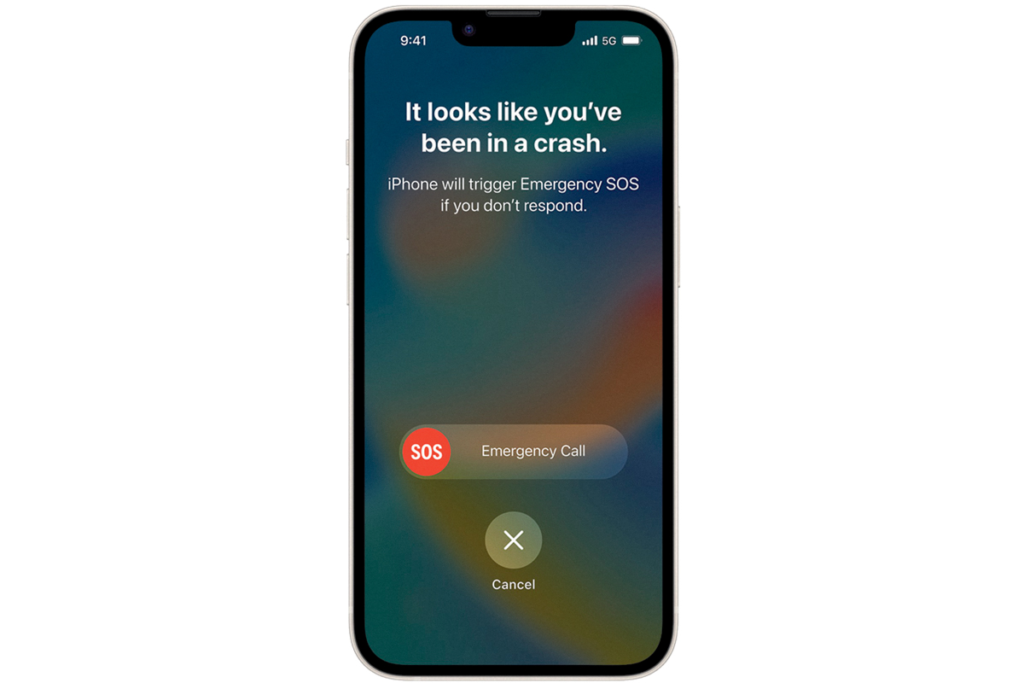
In theory, both phones should have displayed a message reading “It looks like you’ve been in a crash” for ten seconds. If the user doesn’t respond, the device automatically calls emergency services.
So why didn’t Crash Detection trigger? A few possibilities:
- Cabin pressure changes: the system may look for a sudden pressure shift caused by airbag deployment, but all the windows were open during this test, which likely altered the internal pressure dynamics
- Calibrated impact patterns: the feature may be tuned to specific acceleration signatures or impact types that didn’t match this crash scenario
- False-positive tuning: Apple has had to balance sensitivity carefully, since false positives have been reported during activities like roller coaster rides — showing how difficult it is to make a system sensitive enough to catch real crashes without over-triggering
Like most new technologies, Crash Detection will likely improve with future iterations, becoming more reliable at detecting real crashes and delivering timely assistance.
Final Thoughts
This crash test is a reminder that safety components like airbags and seatbelts are only as good as the condition they’re kept in. A previously repaired vehicle can still perform admirably — but as we saw with the driver’s seatbelt failure, unofficial repairs and skipped part replacements can leave dangerous gaps, even in a car engineered as well as the Tesla Model S.
You can watch the full video of our crash test on the Wylsacom channel.
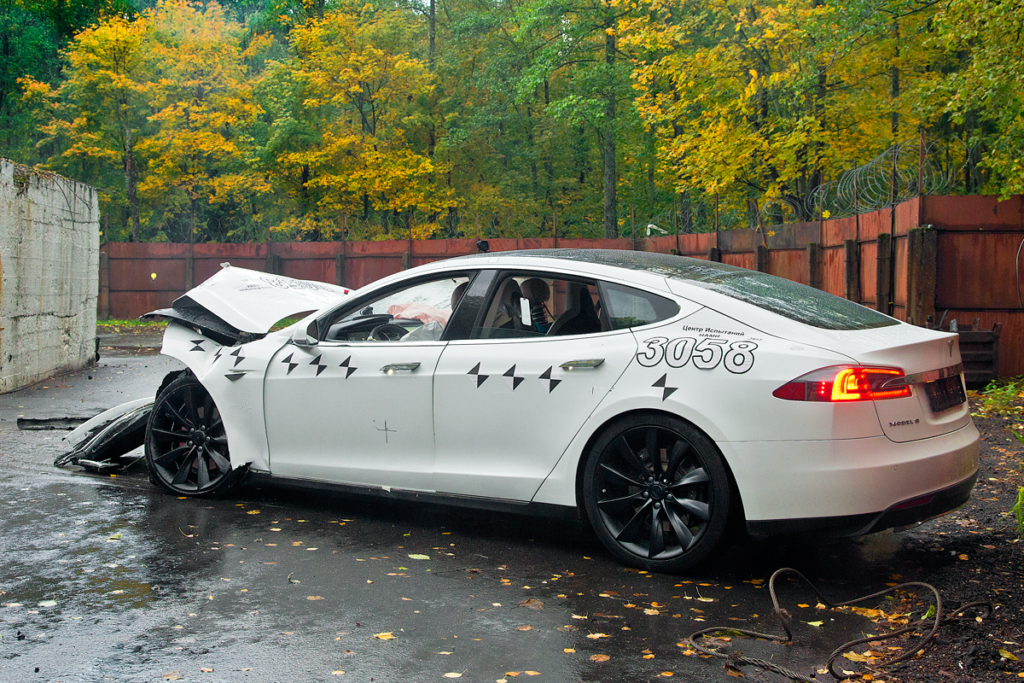
Photo by IIHS | NHTSA | Dmitry Pitersky | Ilya Khlebushkin | Euro NCAP committee
This is a translation. You can read the original article here: Краш-тест восстановленной после аварии Tеслы Model S — есть запас прочности?

Published July 26, 2023 • 14m to read