
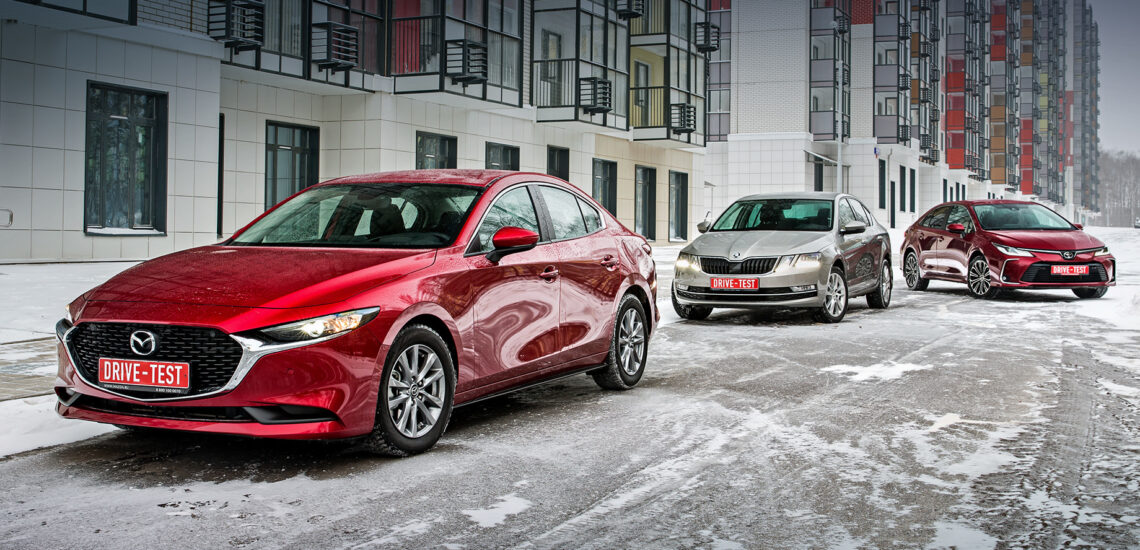

C-class passenger cars have become the underdogs of the automotive world. Despite the enduring success of the Škoda Octavia, the segment is shrinking significantly faster than the overall market. As we kick off this three-way comparison test, one question looms large: is this the last time we’ll see a test like this? Fortunately, models like the Mazda 3 sedan are keeping the segment alive — even if the numbers suggest it will sell only a few hundred units per year. To give the Mazda proper context, we’ve brought along the winner of our previous sedan test, the Toyota Corolla.
Meet the Contenders: Three Sedans, Three Philosophies
Once Mazda’s most popular model, the Mazda 3 has become a niche offering — and the fact that Mazda’s local representative office hasn’t abandoned it deserves genuine respect. As a result, only a single configuration is available, paired with one or two option packages and a naturally aspirated 1.5-liter engine producing 120 hp. The Toyota Corolla matches that power output, also offering no performance upgrades — though it does provide a broader choice of trim levels.
The Škoda Octavia, meanwhile, plays a completely different game. Its popularity is backed by real substance:
- Three engine options and multiple gearbox choices
- Near-full à la carte configuration flexibility
- A liftback body with a 500+ liter trunk — more practical than a sedan by definition
- A turbocharged 150 hp 1.4 TSI engine available at the same price as the top Japanese D-segment rivals — thanks largely to localized production
We opted for that 1.4 TSI Octavia for this test.
Exterior Design: Predatory, Modern, or Aged?
The Mazda 3 clearly wins on visual drama. The sedan variant, in particular, looks lighter and more harmonious than the hatchback. The only real blemishes are the visually cheap optics with conventional DRL and marker light bulbs — LED running lights are reserved for top-spec hatchbacks — and a slightly mismatched fuel filler flap that sits recessed relative to the body panel. Otherwise, panel gaps and overall build quality are near-flawless.
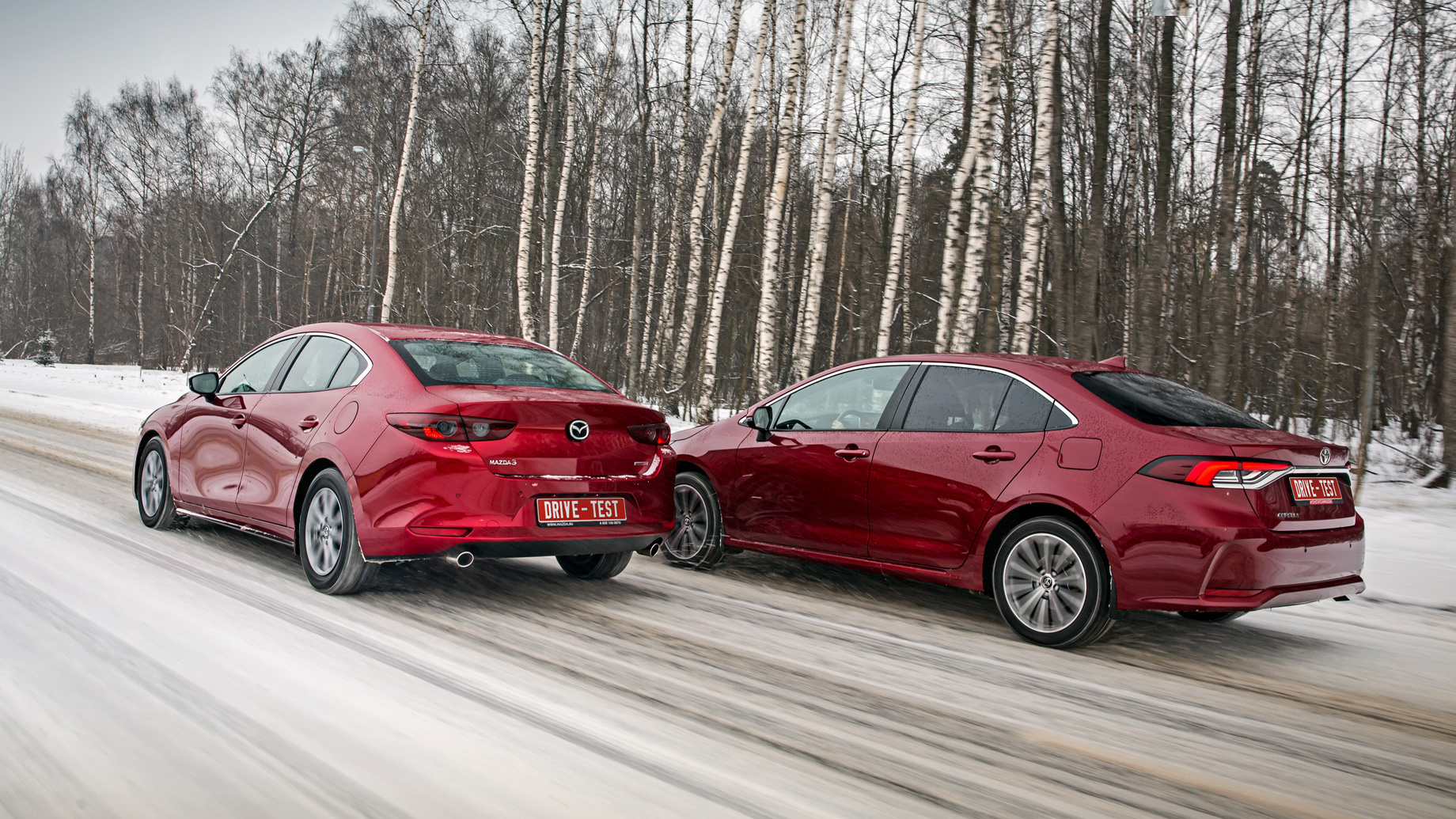
The Corolla is far from boring, but its more ornate styling feels less pure. By contrast, the Mazda 3 proves that a restrained, minimal design can feel 100% distinctly Japanese. The aging Octavia shows its years most visibly on the outside, though it remains inoffensive.
Interior Quality and Infotainment: Where Each Car Shines
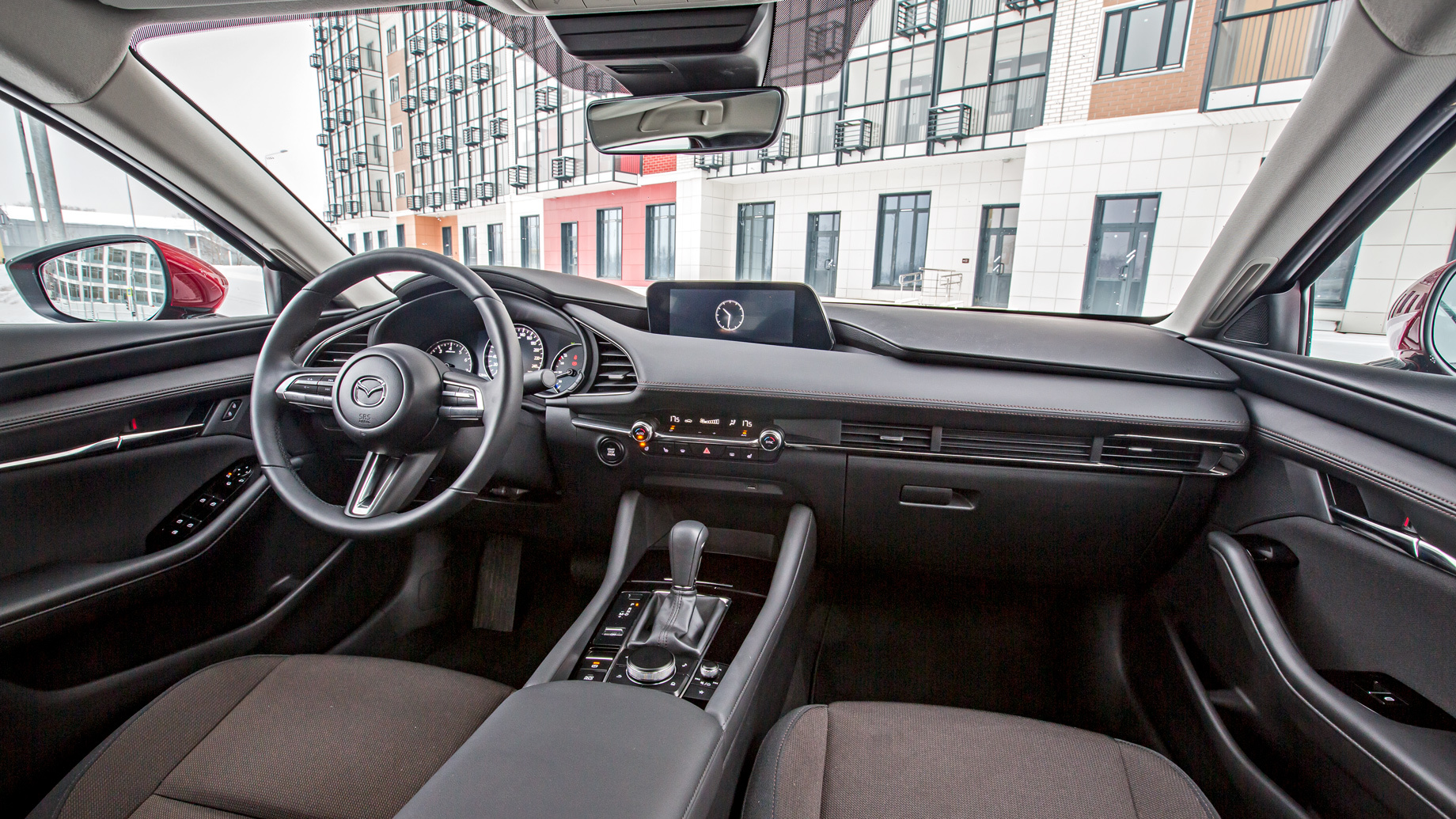
Step inside the Mazda 3 and you’ll find one of the most genuinely pleasant cabins in its class. The surfaces are sculpted with real intention — low-slung, sporty, and modern without feeling cold. Highlights include:
- An elegantly integrated infotainment display that doesn’t dominate the dashboard
- A large digital speedometer that sets the benchmark in this test
- A standard head-up display projecting key data onto the windshield
- Auto-mode power windows on all four doors
- Illuminated buttons throughout the cabin
The screen position is a little low for navigation use, but all other functions are easy to access. The one real frustration is the climate control — it tends to swing between too hot and too cold with little middle ground.
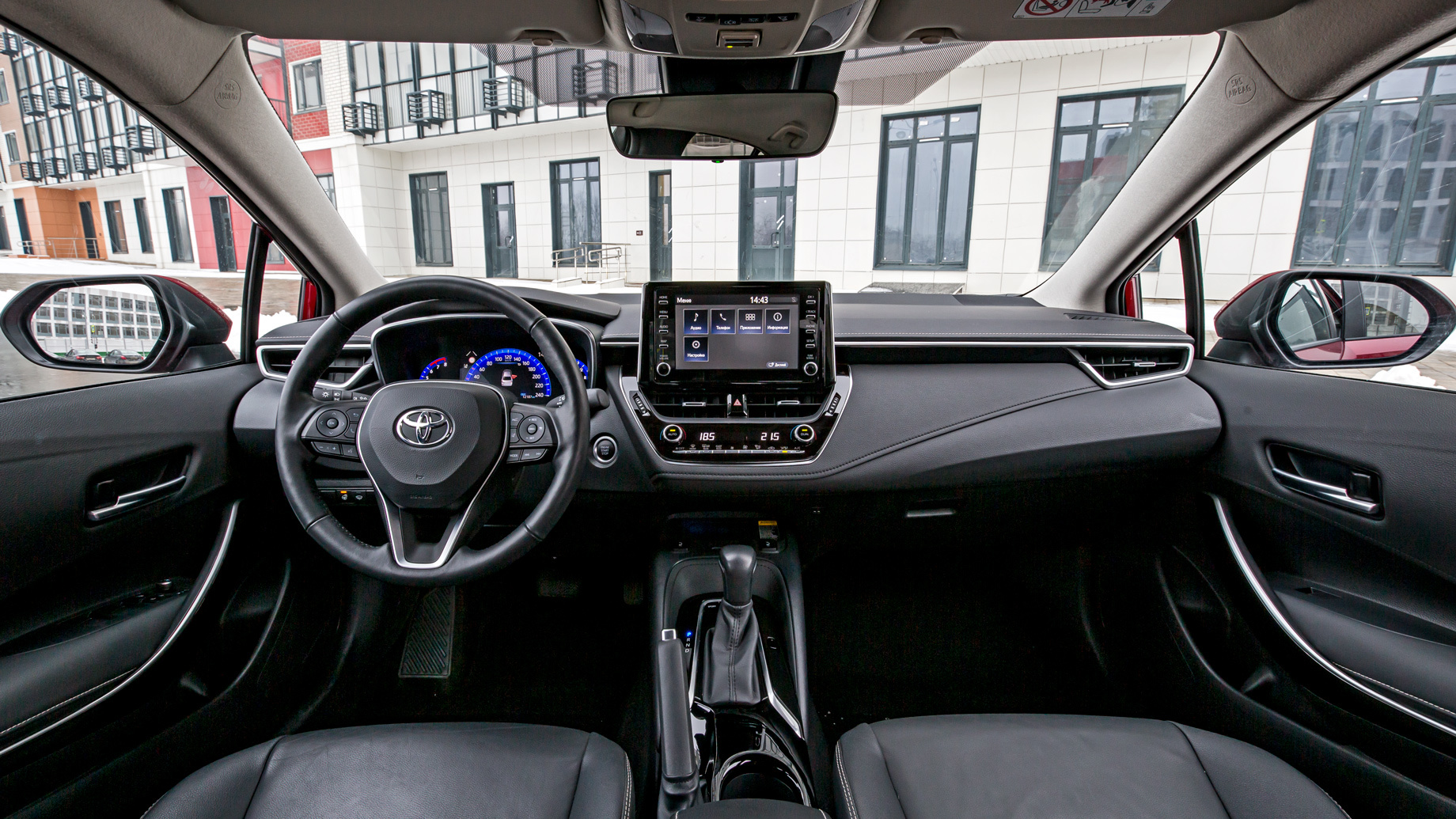
The Toyota Corolla’s interior is arranged around a central display, but only 2020 models with Android Auto and Apple CarPlay make full use of it. Our test car was a previous-year model — the instrument graphics feel dated and the media system functionality is modest. The instrument panel is unnecessarily colour-coded in blue or red depending on the drive mode. On the positive side, all buttons are illuminated, and the interior is more spacious than it looks.
The Octavia’s cabin is the oldest of the three, and its age shows — particularly in the trim material choices. That said, it compensates with thoughtful practicality:
- Soft-lined glove boxes and door pockets
- Clothes hooks and multiple USB sockets as standard
- A configurable electronic instrument panel
- Auto-mode power windows on all doors
- The largest and most usable trunk in the test
Rear Seat Space and Passenger Comfort
Rear-seat practicality is a clear differentiator between these three cars. Here’s how they stack up:
- Škoda Octavia: The most generous in terms of legroom and headroom. The trunk is in a class of its own. Knee room in the rear matches the Corolla, but feet have more space to breathe and the headliner is noticeably further away.
- Toyota Corolla: Surprisingly spacious inside despite its proportions. Rear passengers have adequate knee room, and taller occupants won’t feel immediately cramped.
- Mazda 3: The tightest of the three. A 6’3″ passenger seated behind a tall driver will struggle to sit upright and will inevitably press their knees into the seatback. The Mazda is best treated as a driver’s car with occasional rear passengers.
Driver’s Seat Ergonomics and Visibility
The Mazda puts you in a low, sporty seating position — the kind that makes winding roads feel purposeful. The fabric seat holds you firmly through corners, though the absence of lumbar support adjustment is a notable omission. In the Škoda, the driving position is also comfortable, but some drivers find the height difference between the brake and accelerator pedals awkward — especially noticeable in bulky winter footwear. The armrests are also firmer than ideal.
The Toyota seats you noticeably higher, which aids forward visibility thanks to slim A-pillars positioned well forward. However, this advantage disappears in winter slush, when the wiper sweep area feels narrow due to the windshield’s distance from the driver. The rear view mirror is also partially obscured by rear headrests. In the Mazda, rearward visibility is limited by the low glasshouse. The Octavia offers the most balanced all-round visibility.
Driving Dynamics: Which Sedan Is Most Fun?
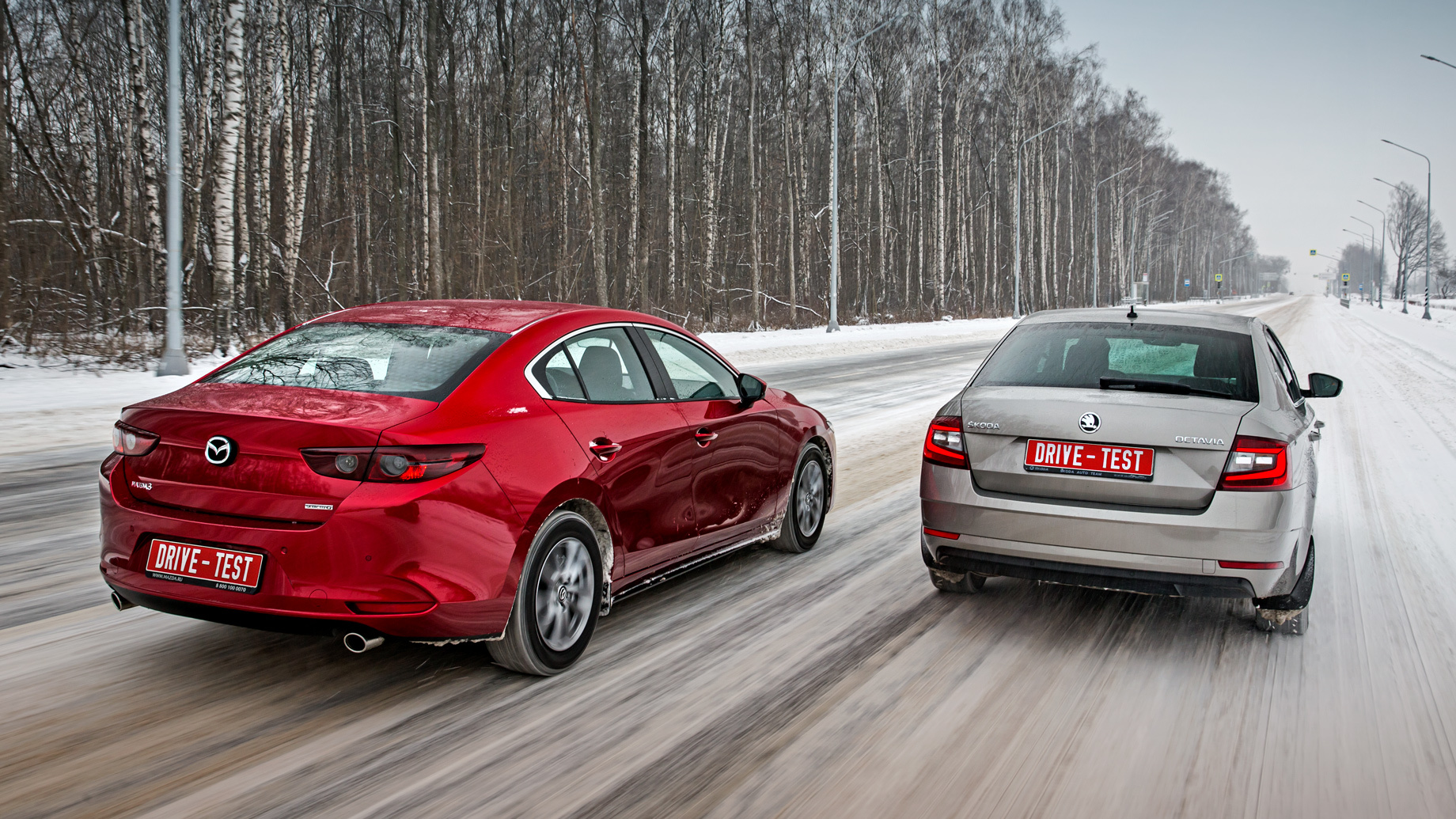
The Mazda 3 is the most engaging car in slow urban conditions. Its automatic gearbox is tuned in a deliberately sporty manner — shifts are crisp, almost mechanical in feel, occasionally accompanied by a slight jolt. Traction control is well-calibrated for a 120 hp car. Braking feels short-stroke but intuitive and progressive. Steering feedback is accurate with appropriately small steering angles. At the limit, the chassis tends toward understeer, but body roll is impressively controlled. The 16-inch tires absorb minor bumps quietly, though larger imperfections generate noticeable noise.
The Škoda Octavia offers the outright performance advantage. The turbocharged engine provides meaningfully more power, and the dual-clutch gearbox is nearly as responsive as the Mazda’s. You can genuinely feel the pace advantage in traffic. However, the chassis is the weakest of the three dynamically — at the limit it feels numb and unresponsive. The steering is light and transparent but offers little communication. Ride quality is the roughest of the group: every ripple and wave reaches the cabin, and larger bumps produce an uncomfortable low-frequency resonance. On the plus side, it is the quietest of the three cars at highway speeds.
The Toyota Corolla is the sleeper of the group. Its CVT transmission feels unhurried at moderate pace — throttle responses are slightly lazy, and while it develops “stepped” behavior when pushed, the claimed 1.5-second acceleration advantage over the Mazda to 60 mph is impossible to feel in practice. Braking requires the longest pedal travel of the three. However, the Corolla delivers the most sophisticated dynamic balance:
- Ride quality is the smoothest — only large potholes cause real discomfort
- Steering is the sharpest of the three, with minimal lag
- A rear multi-link suspension (versus the semi-independent beams on the Mazda and Škoda) helps the Corolla maintain confident balance through fast, slippery corners
- It’s the most rewarding car to drive quickly on a winding, low-grip road
Road and Wind Noise: A Key Weak Spot
Noise levels are worth discussing separately, as they vary considerably between the three cars:
- Toyota Corolla: The noisiest of the three. Non-studded winter tires (Bridgestone VRX in our test) generate a strong road rumble from as low as 6–12 mph, becoming genuinely intrusive between 37–50 mph. Wind and road isolation are both below average.
- Mazda 3: A step quieter than the Corolla, with a similar mix of tire and engine noise. The engine is smoothed out at high revs but remains audible under hard acceleration.
- Škoda Octavia: The clear winner for cabin quietness. Wind, road, and external noise penetration are all lower than its rivals, and the turbocharged engine practically disappears at highway cruise.
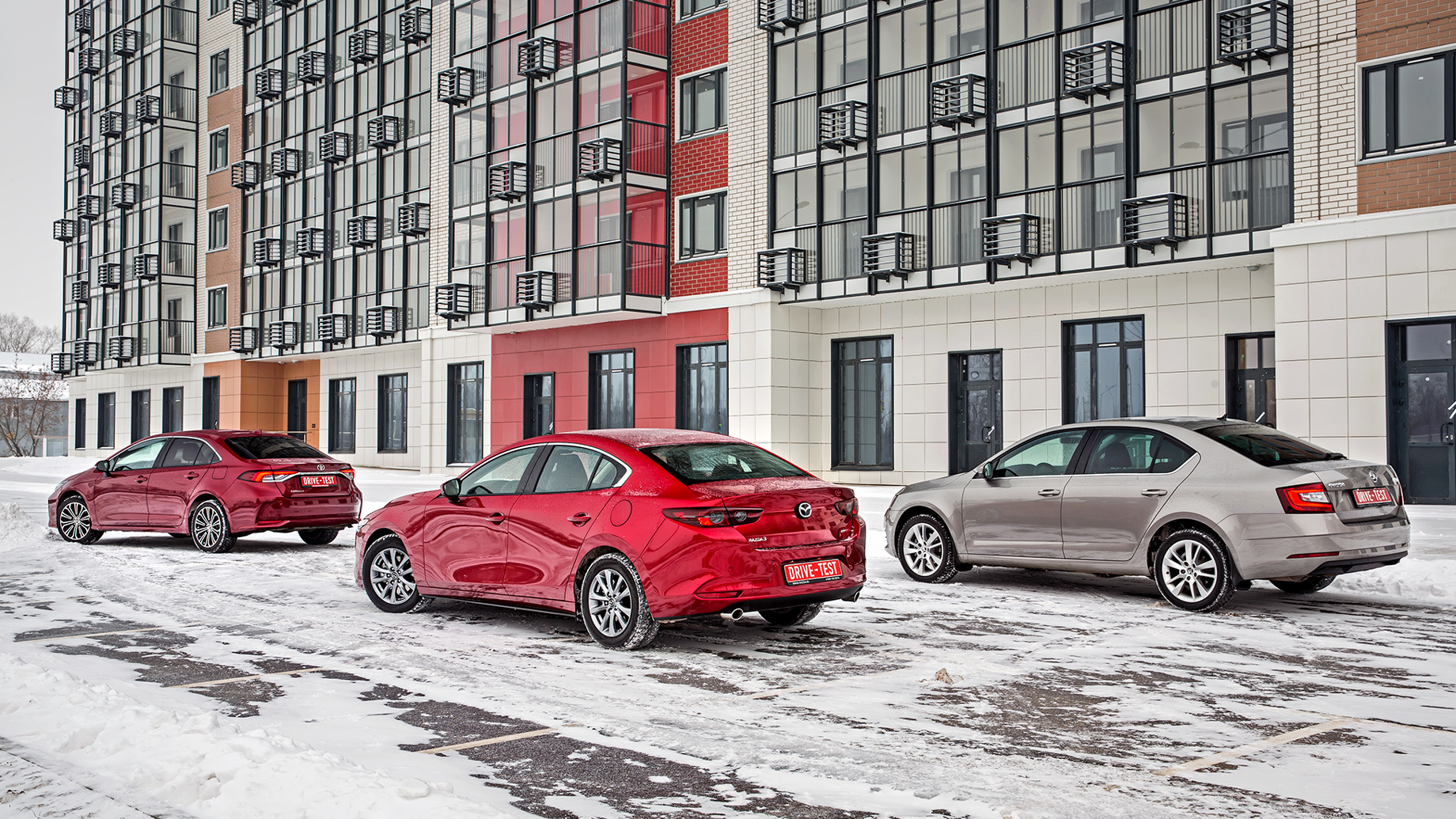
Verdict: Which C-Class Sedan Should You Buy?
After driving all three back-to-back, here’s how each car earns its place:
- Škoda Octavia — Best Value: For the same price as the Japanese competition, you get more power, a quieter cabin, greater practicality, and the most flexible spec options. City drivers who rarely push their car may not even notice the firm ride. The one caveat: the new-generation Octavia has replaced physical controls with touch interfaces, which are far less user-friendly in cold weather — making the outgoing model arguably the smarter buy right now.
- Toyota Corolla — Best All-Rounder: The most modern-looking of the three, with the smoothest ride and a surprisingly spacious interior. It’s also the most dynamically capable at the limit. The main issue is road noise — Corolla engineers still have work to do here.
- Mazda 3 — Best Driver’s Car: Irrational, beautiful, and utterly charming. The Mazda 3 sedan won’t top a spreadsheet comparison — but it’s the car you’ll actually look forward to driving every morning. If you spend most of your time navigating city streets, its sharp brakes, precise steering, and tactile gearbox will reward you constantly.
The C-class sedan segment may be in decline, but these three cars prove it still has something genuinely worthwhile to offer.
This is a translation. You can read the original here: https://www.drive.ru/test-drive/mazda/skoda/toyota/5e577415ec05c41e40000064.html

Published February 02, 2023 • 9m to read