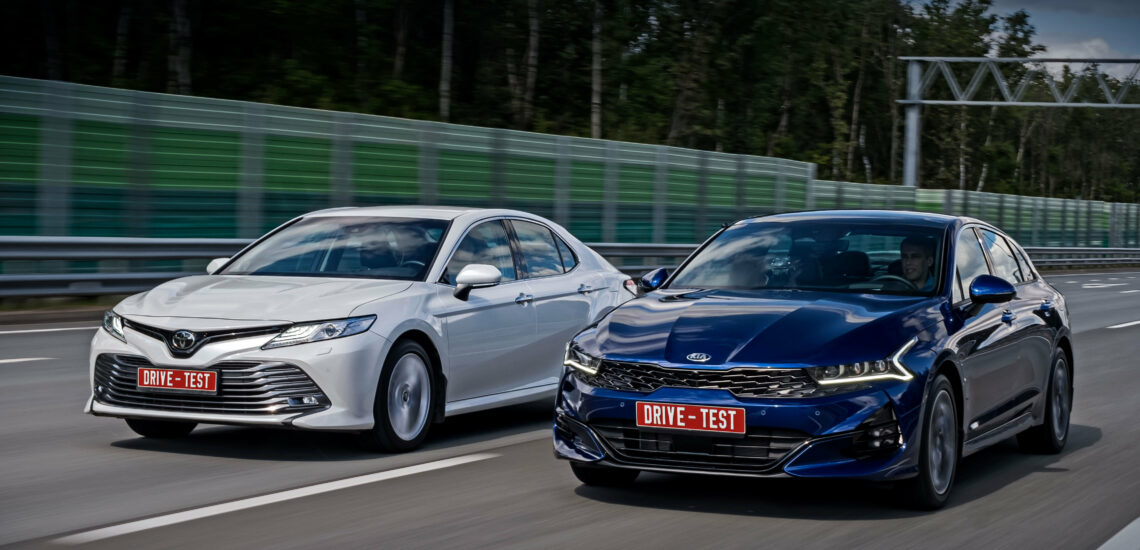

Two of the most competitive midsize sedans on the market go head-to-head: the all-new Kia K5 2.5 takes on the perennial best-seller, the Toyota Camry. And lurking in the background is the Hyundai Sonata — the K5’s platform-sharing sibling. Unlike the Camry’s relationship with other TNGA-based models, the bond between the K5 and Sonata runs much deeper, from interior layout to driving character. Yet the K5 carves out its own identity, positioning itself squarely against Toyota’s bestseller.
From Optima to K5: How Kia Took on the Camry’s Dominance
The Kia Optima quietly earned its place in the midsize sedan segment, growing its market share from just 4% to an impressive 34% in 2019 — all while the Camry held a commanding 45% of the class. That kind of momentum doesn’t vanish overnight, and the K5 is built to carry it forward. What makes Kia’s story particularly compelling is its ability to thrive during downturns — a strategy that has repeatedly paid off. The Camry, however, is no pushover: historically, the worse the market, the larger Toyota’s slice of it.
Engine and Transmission: Where the K5 2.5 Has a Technical Edge
Kia made a bold statement with the K5’s powertrain — going global rather than cutting corners for local markets. Here’s how the two rivals stack up under the hood:
- Kia K5 2.5: Smartstream 2.5 naturally aspirated engine (Theta III family), 194 hp, with added direct injection — 8-speed automatic transmission (HMG in-house design)
- Toyota Camry 2.5: 181 hp naturally aspirated engine — has not yet received an eight-speed gearbox
The K5’s eight-speed gearbox is a genuine advantage in this class, offering smoother power delivery and better fuel efficiency across the rev range.
Design and Styling: Bold Korean Flair vs Japanese Restraint
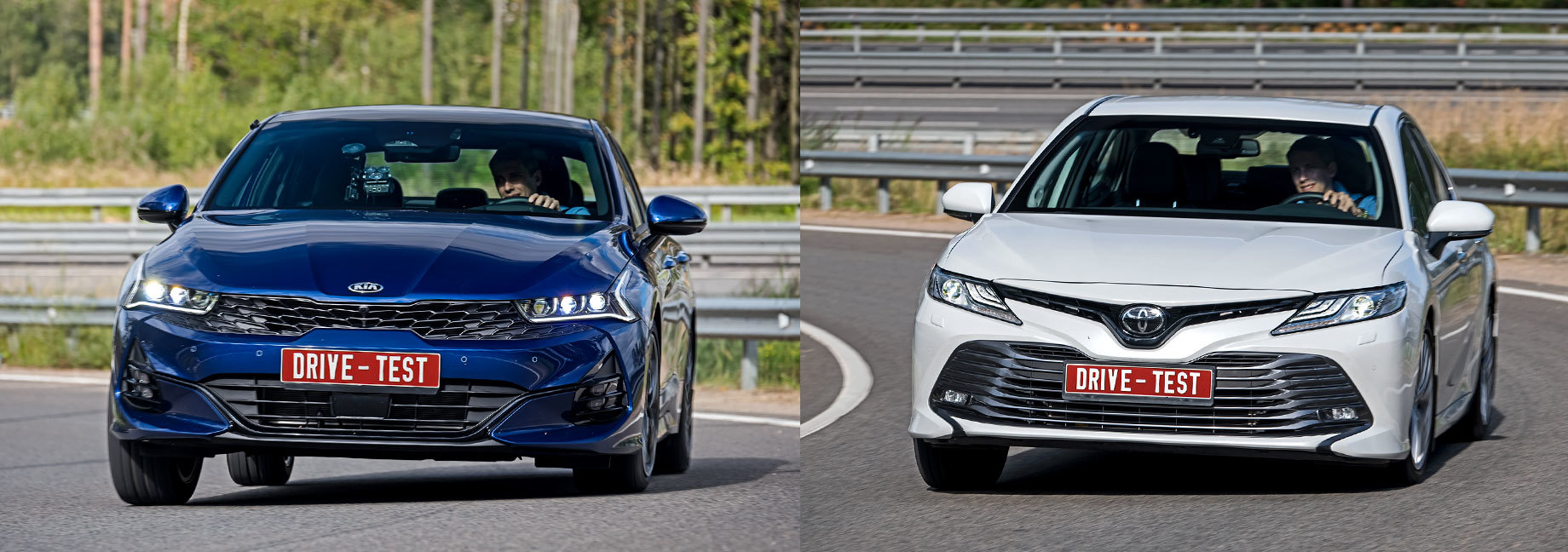
The K5’s exterior is nothing if not attention-grabbing. The signature radiator grille — officially dubbed the “tiger smile” — features a cell pattern said to mimic sharkskin texture. The result is a fascia so bold it looks like the tiger ate the shark. The reverse tilt of the grille drew comparisons from our co-driver Robert to the iconic Mitsubishi Galant “Eighth.” Whatever the reference point, one thing is clear: park a K5 next to the Camry, and the Toyota virtually disappears from view.
Interior Quality and Technology: K5 Pulls Ahead on Features
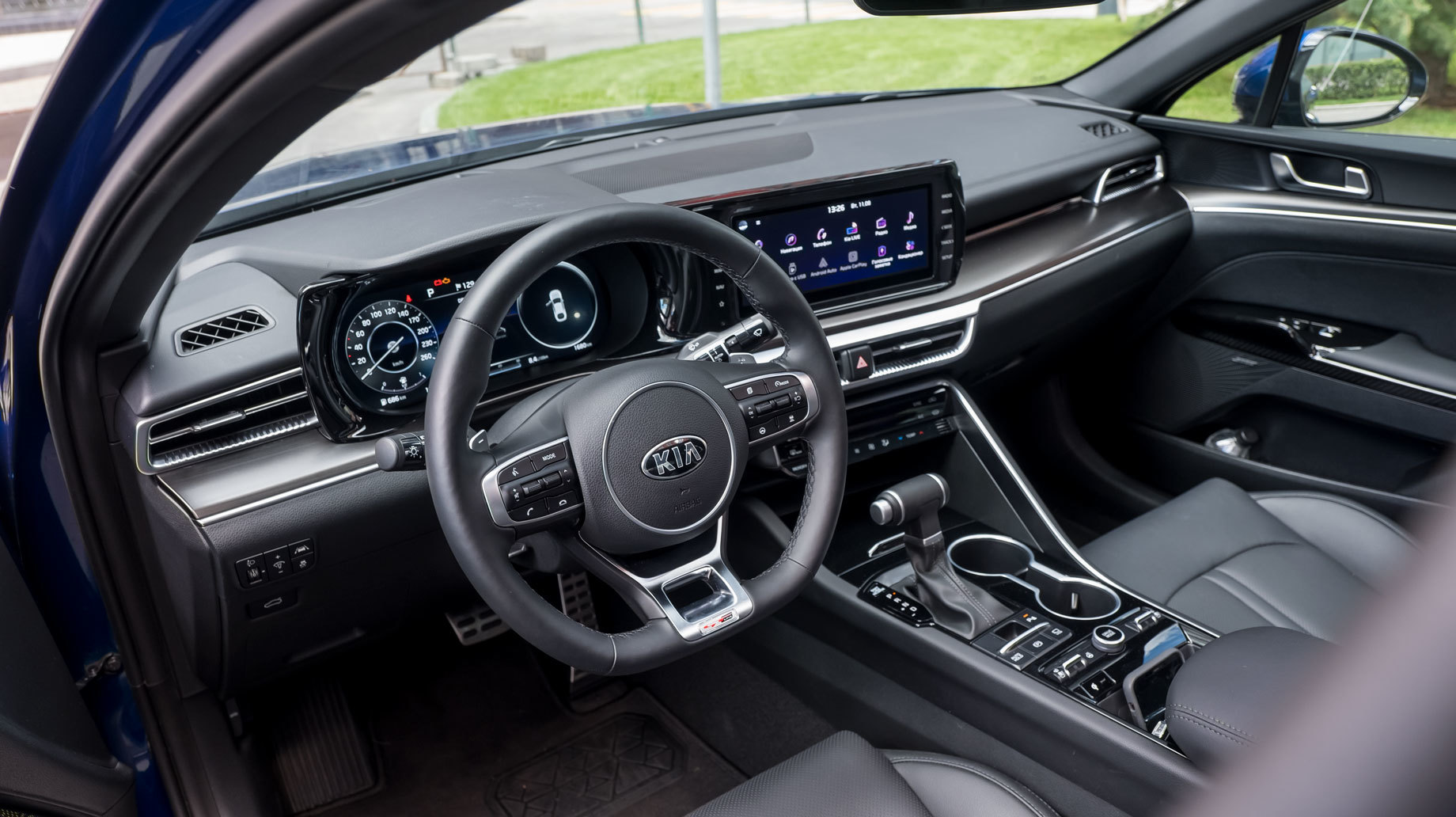
Step inside the K5, and you’re immediately in gadget territory. Compared to both the outgoing Optima and the Camry, the cabin feels like a leap forward in tech and design. Key interior highlights include:
- Dual 10-inch displays combined with intuitive touch panels
- Driver-focused cockpit with a two-level center console angled toward the driver
- Horizontal design architecture with sharper plastics than the Sonata
- A well-fitted, sporty steering wheel that adjusts close to the driver
- Firm, supportive seats that keep you alert and engaged
The Camry’s interior tells a different story — not worse in material quality, but noticeably more conservative. The multimedia system lags behind, and the fittings feel simpler. On the comfort side, however, the Toyota fights back: you sit lower, and the softer seat distributes pressure more evenly on long drives.
Ride Quality and Noise: Camry’s Smoothness Remains the Benchmark
The K5 improves on the Optima in steering precision and body control, but it comes at a cost: the ride is noticeably stiffer. In everyday driving, here’s what to expect from each:
- Kia K5: More composed over large bumps than the Sonata, but transmits more road noise and vibration into the cabin — speed bumps require a significant slowdown to avoid harsh impacts
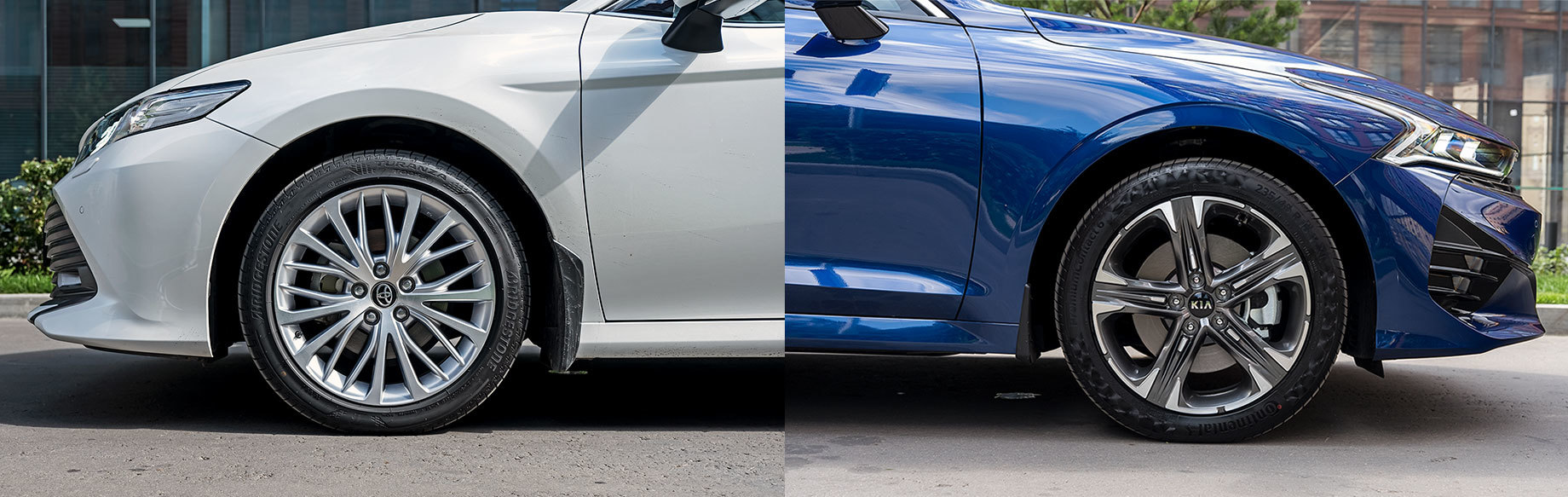
- Toyota Camry: Noticeably quieter and smoother, even on the same 18-inch Bridgestone Turanza T005 A tires — a more comfortable daily companion
Performance and Acceleration: Closer Than the Numbers Suggest
On paper, the K5 2.5’s 194 hp should make short work of the Camry’s 181 hp — but real-world testing paints a more nuanced picture. The K5 refuses to launch aggressively regardless of how the pedals are worked, which means the claimed 0–100 km/h time of 8.6 seconds stays firmly on paper. Racelogic data put the actual figure at over 9.5 seconds. Meanwhile, the Camry — despite its heavily damped throttle response — matched its official figures at a parallel start, edging ahead with a brief initial lag before pulling level.
Where the K5 genuinely excels is throttle precision: the accelerator delivers far more nuanced control than the Camry’s vague, rubber-band-like pedal feel.
Handling and Dynamics: Safe and Predictable vs Alive and Rewarding
This is where the philosophies of these two sedans diverge most sharply.
The Kia K5 prioritizes confidence and consistency:
- Calm, predictable steering responses at all speeds
- Moderate body roll with no front-end push at the limit
- Excellent grip from Continental Premium Contact 6 tires
- Artificial steering feel that grows disproportionately with lateral load
- An open-book driving experience — easy to master from the first kilometer
The Toyota Camry is the more involving driver’s car:
- Lively, communicative steering with genuine feedback
- Rapid body roll that settles into a natural, progressive arc
- Rear suspension that actively plays along in corners
- More demanding to drive quickly, but more rewarding when you do
- Greater scope for skilled drivers to develop a real relationship with the car
Pricing and Trim Levels: Value Depends on What You’re Looking For
The K5 holds the title of the largest sedan in its class by dimensions — though only by millimeters — and also comes in at the lowest base price. However, the entry-level trim with air conditioning and a plastic steering wheel rim is really only suitable for fleet or rental use. A few pricing notes worth knowing:
- The popular 2.0 Comfort trim has risen in price over the outgoing Optima, and comes with an 8-inch multimedia display (Apple CarPlay/Android Auto supported)
- The Luxe configuration is where 17-inch wheels first appear on the 2.0 engine
- The GT Line trim — once a top seller — has seen a substantial price increase, making its value proposition harder to justify
- For the same GT Line money, the 245 hp turbocharged Optima GT remains available — and is arguably the most exciting car in the segment
It’s also worth comparing the K5 directly against the Sonata before committing: for a small premium, the Sonata 2.0 Comfort already includes 17-inch wheels as standard, making it potentially better value at that price point.
Verdict: Which Midsize Sedan Should You Choose?
The K5 is a polished, well-rounded evolution of the Optima — richer in technology, sharper in design, and more precise in its dynamics. It appeals strongly to buyers upgrading from the outgoing model, or those cross-shopping with premium options like the Mazda 6. The Camry, meanwhile, remains the segment benchmark for a reason: it’s smoother, quieter, more comfortable on a daily basis, and — surprisingly — more engaging when pushed. If you want a tech-forward statement sedan, the K5 makes a compelling case. If you want the most well-rounded all-rounder in the class, the Camry is still hard to beat.
This is a translation. You can read the original here: https://www.drive.ru/test-drive/kia/toyota/5f32e268ec05c43668000004.html

Published September 29, 2022 • 6m to read