
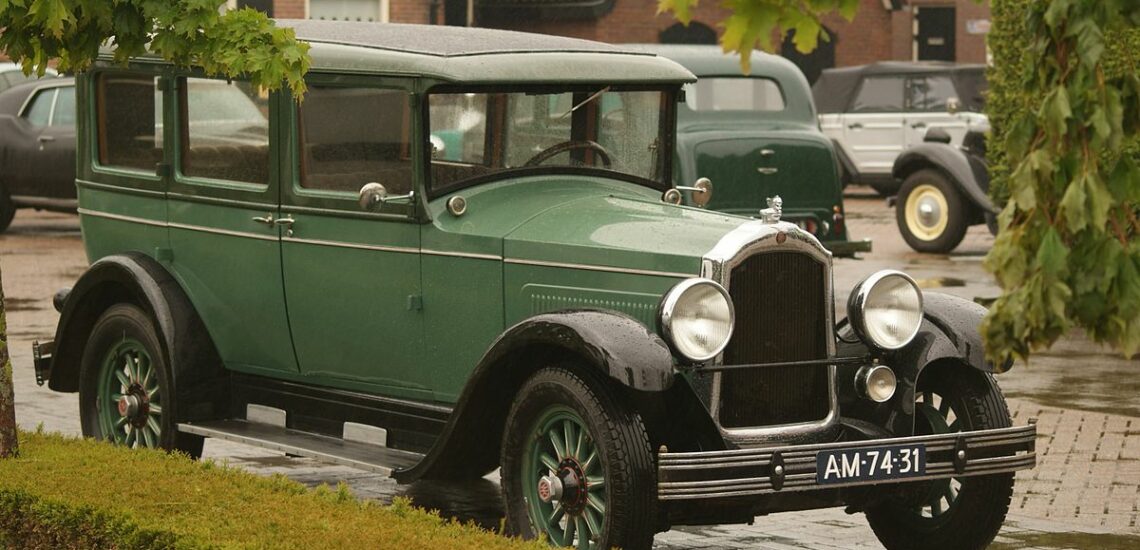

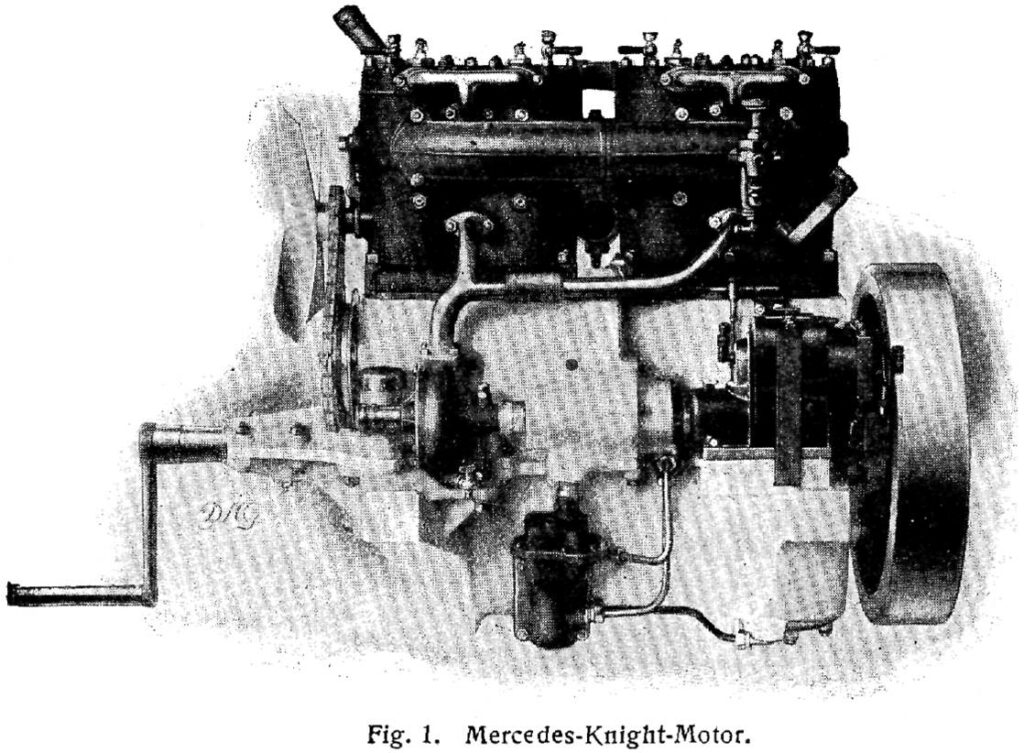
Between 1903 and 1905, American inventor Charles Knight developed a radical alternative to the conventional internal combustion engine — one that would go on to power some of the most prestigious automobiles in the world. Instead of traditional poppet valves, Knight’s engine used a concentric pair of sliding sleeves fitted inside the working cylinder, with the piston moving within them. Each sleeve featured large cutout windows that, as the sleeves moved up and down, periodically aligned with inlet and outlet ports in the cylinder wall. The sleeves were driven by a crank mechanism and a dedicated eccentric shaft, replacing the conventional camshaft entirely.
The Silent Knight: Debut at the 1906 Chicago Auto Show
At the 1906 Chicago Auto Show, Knight and his business partner Lyman Kilbourne unveiled the Silent Knight — a car powered by a four-cylinder, 40-horsepower valveless engine. True to its name, the vehicle’s standout quality was its remarkably low noise level compared to the combustion engines of the era. While buyers were initially slow to take notice, the automotive industry was captivated. In the years that followed, the Silent Knight triggered a wave of sleeve-valve engine development on both sides of the Atlantic — a wave that wouldn’t fully recede until after World War II.
Global Adoption: Who Used Knight Sleeve-Valve Engines?
Knight’s sleeve-valve design was licensed and produced across the United States, the United Kingdom, and France. Knight himself spent several years working directly with European manufacturers during the late 1900s before returning to America. Among the notable automakers that equipped their vehicles with sleeve-valve engines were:
- Daimler
- Mercedes
- Willys
- Peugeot
- Voisin
- Panhard-Levassor
As the technology spread, engineers began to iterate on Knight’s original concept. A notable example came from the Scottish manufacturer Argyll, which developed a single-sleeve variant where one movable sleeve simultaneously shifted axially and rotated partially around the cylinder’s longitudinal axis — handling both intake and exhaust on its own, without a second sleeve.
Advantages of the Knight Sleeve-Valve Engine
Compared to conventional valve-based four-stroke engines of the time, Knight engines offered several meaningful performance and durability benefits:
- Larger gas exchange ports — the generous inlet and outlet windows improved airflow and engine breathing.
- Better performance at high RPM — traditional poppet valves required increasingly stiff springs at high speeds, increasing friction losses; sleeves had no such limitation.
- Higher power output — the combination of improved gas exchange and reduced friction allowed Knight engines to produce more power than comparable valve engines of the era.
- Superior longevity — well into the 1920s and even the 1930s, Knight’s sleeve-valve mechanisms outlasted conventional valve-train systems by a significant margin.
Why Did Knight Engines Fall Out of Favor?
Despite their early promise, sleeve-valve engines had a set of persistent shortcomings that conventional engine technology gradually overcame. As poppet-valve designs improved rapidly throughout the mid-20th century, Knight’s approach struggled to keep pace. Its core weaknesses included:
- Cylinder sealing issues — maintaining an airtight seal with moving sleeves proved consistently difficult.
- Running-in problems — the inner sleeve and piston rings required extensive break-in periods and were prone to early wear.
- Lubrication challenges — delivering adequate oil to all moving surfaces inside the cylinder was a persistent engineering hurdle.
- Excessive oil consumption — a direct consequence of the lubrication demands, making these engines costly and impractical to run.
These drawbacks ultimately pushed sleeve-valve engines out of mainstream automotive production. Although independent inventors continued refining the concept throughout the 20th century, the design never made a commercial comeback — its later applications limited to niche uses such as miniature motors for model aircraft.
This is a translation. You can read the original here: https://www.drive.ru/technic/50a0d58ab721423821000055.html

Published October 14, 2021 • 4m to read