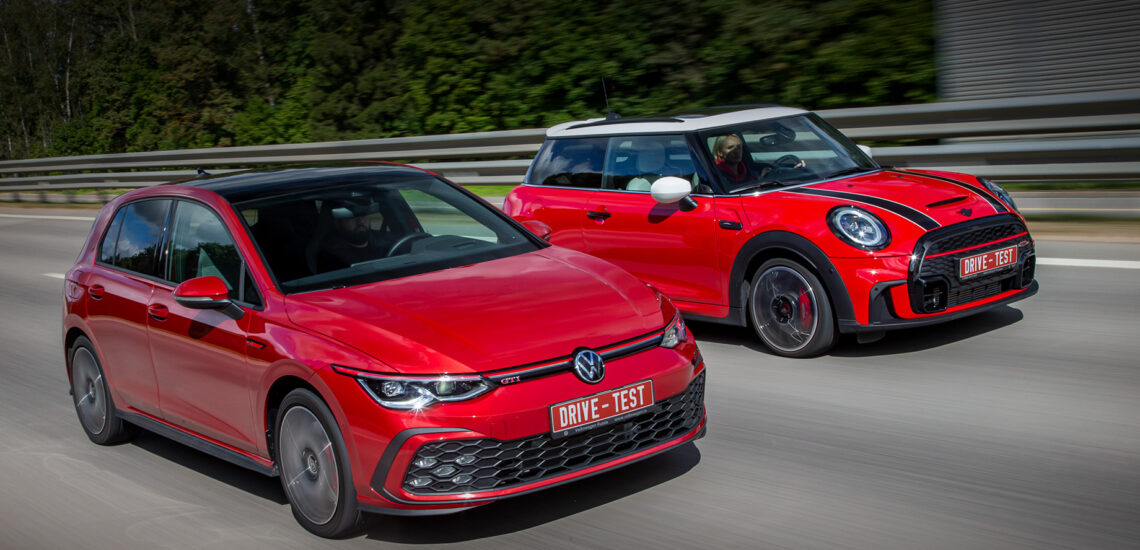

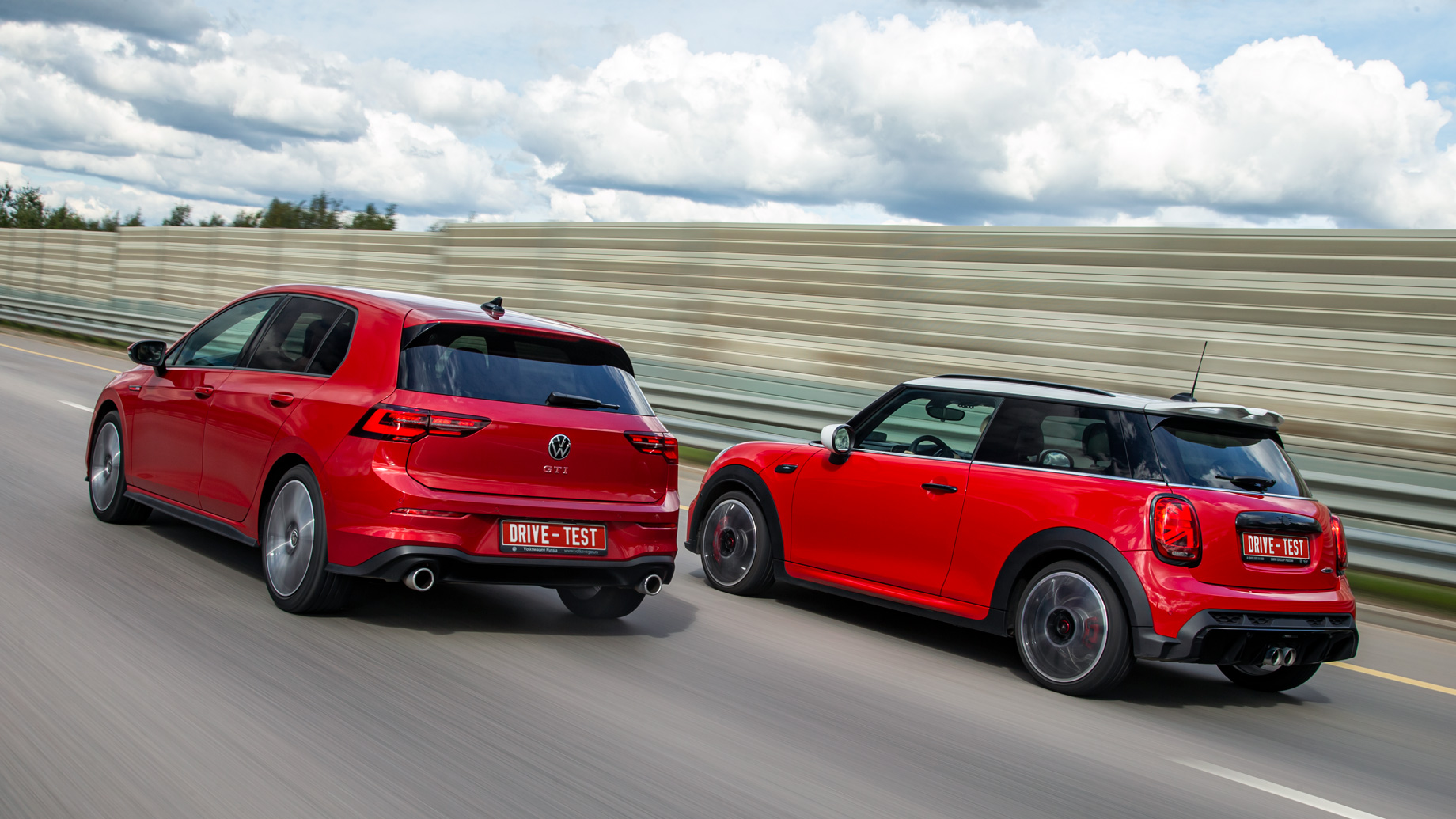
The Golf GTI has barely changed its character in decades — and that’s a compliment. Even in its eighth generation, Volkswagen’s iconic hot hatch remains the responsible, well-rounded choice. We paired it against the three-door Mini John Cooper Works: a car with a similar engine output, comparable dynamics, a nearly identical starting price, and the same stubborn resistance to radical change. But that’s where the similarity ends. If the GTI plays the role of the reliable hero, the Mini JCW is the unhinged villain — and it wouldn’t have it any other way.
Performance Specs at a Glance
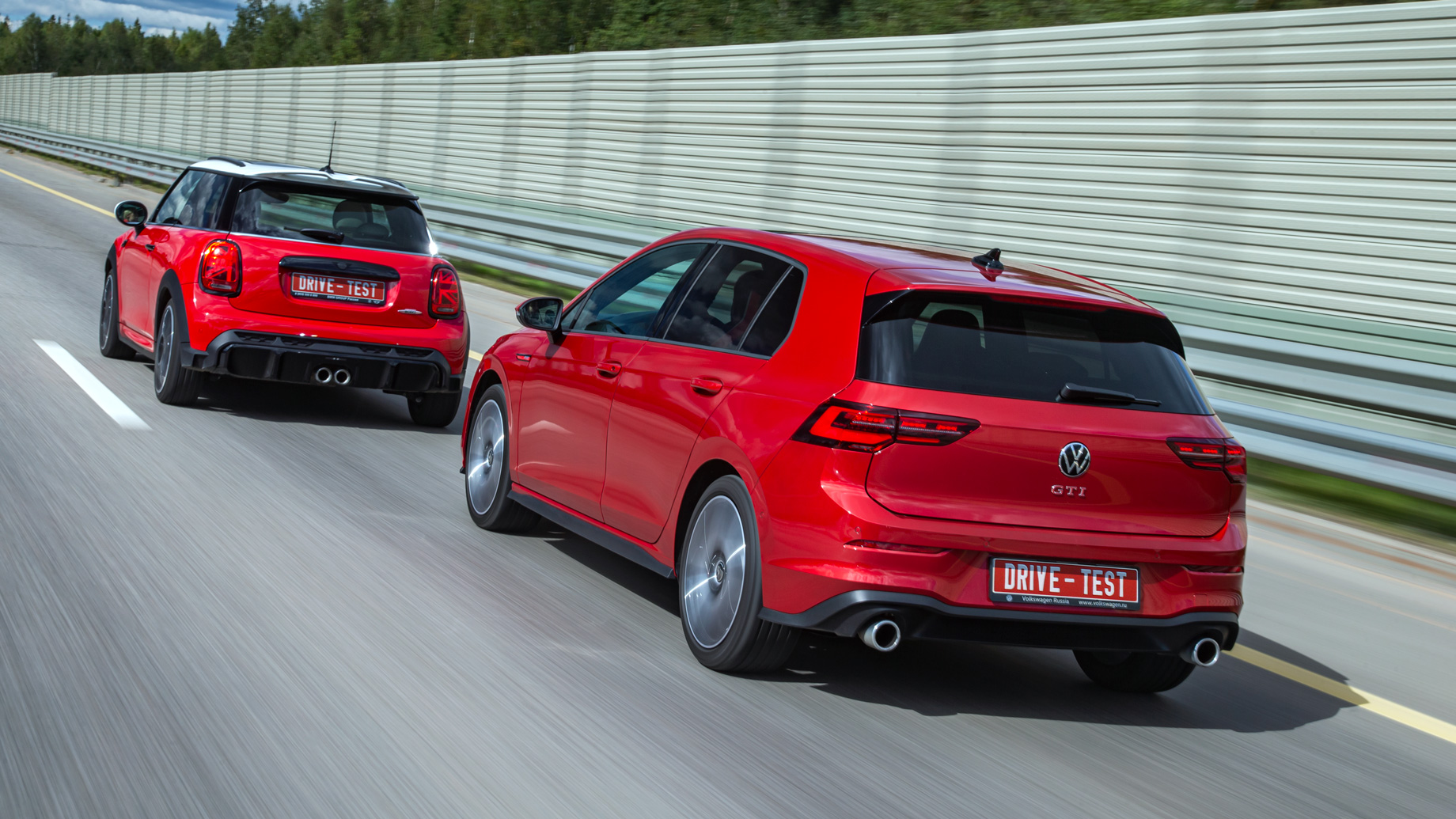
- Volkswagen Golf GTI: 2.0-liter turbocharged engine, 245 hp, 370 N·m torque, 0–100 km/h in 6.5 seconds
- Mini John Cooper Works: 2.0-liter turbocharged engine, comparable output, 0–100 km/h in 6.0 seconds
- Both feature lowered sport suspensions, large alloy wheels, and sport-tuned exhaust systems
- Both are priced in a similar bracket, making this a genuine head-to-head rivalry
Interior and Ergonomics: Old School vs New School
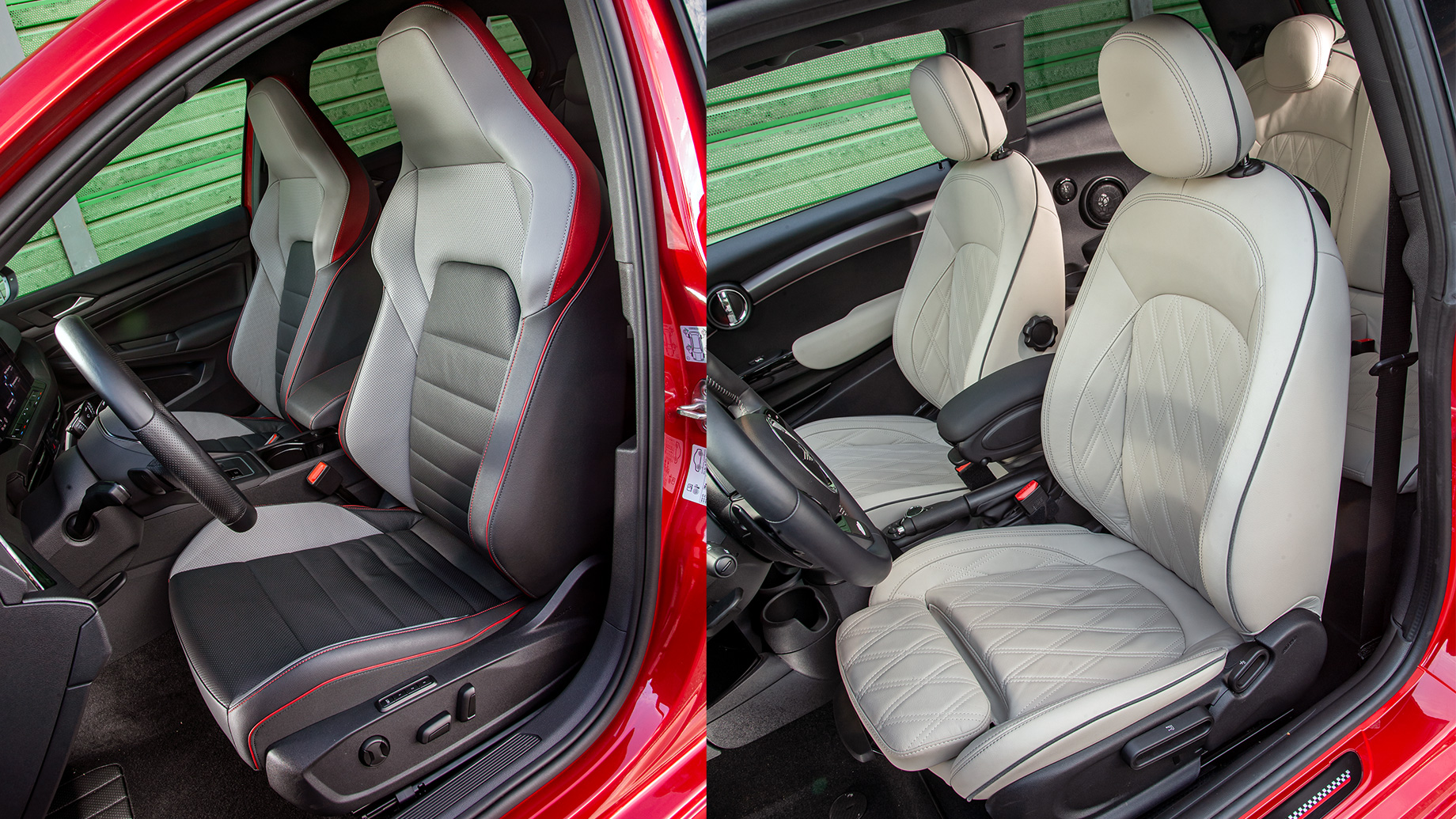
Settle into the Golf GTI and everything feels considered. The seating position is spot-on, adjustment ranges for both the steering wheel and driver’s seat are generous, and outward visibility is excellent. The sporty seats are well-shaped but padded with a relatively soft material, so you won’t feel crushed by the side bolsters on long journeys. Volkswagen also made a real effort to retain physical buttons on the dashboard — though climate control and heated seat controls still ended up buried in the multimedia menu. A frustrating oversight in an otherwise polished cabin.
Step into the Mini JCW and it’s like stepping back a decade — in the best possible way. The cabin is full of tactile charm:
- Physical toggle switches, buttons, and air conditioning knobs throughout
- Leather seats with diamond-shaped stitching that feel bespoke and characterful
- A partially virtual dashboard that blends analogue and digital cues
- A narrow, upright windshield and prominent A-pillars that reinforce the retro feel
Ergonomics aren’t quite as refined as in the Golf — visibility is marginally worse and the steering column adjusts through a narrower range — but even larger drivers will find a comfortable position. The driver’s seat, shared with the Cooper S, supports the body and hips well, and the backrest does a better job of holding the shoulders than the GTI’s chair.
How the Volkswagen Golf GTI Drives
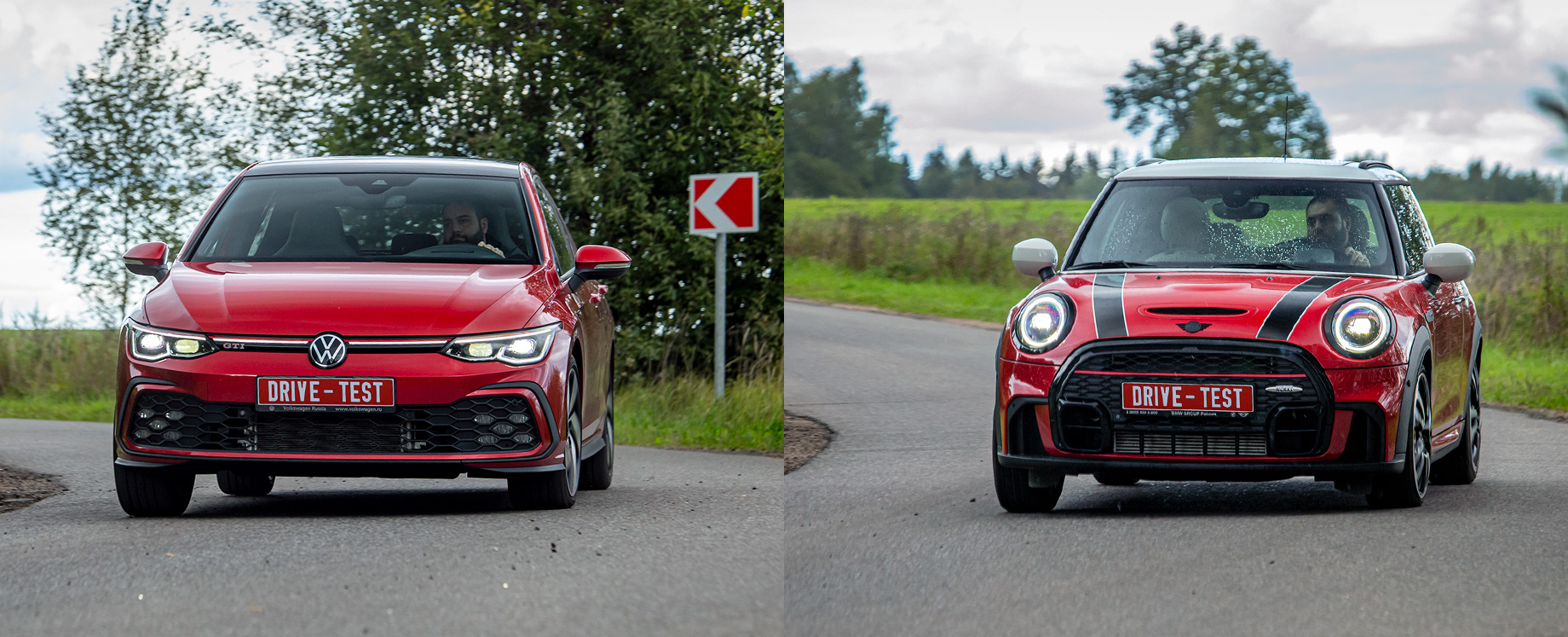
Press the engine start button — now a rectangle among a row of similar controls rather than the satisfying round button of old — and the GTI wakes up with a muffled, composed hum. Even on a cold start, the exhaust note is understated. This car is not here to show off.
From the first few meters, the Golf GTI surprises with its refinement:
- In Comfort mode, throttle response is deliberately soft and progressive
- The DSG DQ381 dual-clutch gearbox shifts smoothly and hunts for the highest gear even in city traffic
- The suspension — lowered by roughly 13 mm versus a standard Golf — absorbs road imperfections well and handles serious potholes without drama
- The steering is light and clean, with no vibration transferred from bumps or ruts
Switch into Sport mode and the GTI sharpens up noticeably — the steering weights up, the gearbox holds gears longer, and the engine becomes more eager. Overtaking on open roads is where this mode really shines: a quick kickdown and the GTI surges forward with genuine force. On a track-style launch control run, it reached 100 km/h in 6.5 seconds — just one tenth off the official figure.
Through corners, the GTI is quick and precise without being demanding. The electronically controlled front differential works seamlessly with the stability system, allowing confident, early throttle application mid-corner. Compared to the previous generation, the GTI holds its line longer before sliding — a sign of maturity, even if it comes at the cost of some old-school playfulness.
How the Mini John Cooper Works Drives
The Mini JCW makes no effort to ease you in. The moment you start the engine, it announces itself with a sharp bark and a throaty exhaust note that rumbles through the cabin. Even pulling out of a parking space requires effort — the steering is heavy and immediately communicative. The suspension is firm to the point of feeling geological: every crack, stone, and seam in the road is transmitted directly to the driver.
And yet, on the right road, the JCW is utterly exhilarating:
- Body roll and dive are almost non-existent — the suspension feels set up on rigid mounts
- Steering response is immediate and direct, like remote-controlling a go-kart
- The thick-rimmed steering wheel loads up progressively, giving clear warnings when the front tyres approach their limit
- In Sport mode, the engine lunges forward from even the slightest throttle input
- A full-throttle run to 100 km/h takes just 6.0 seconds — half a second quicker than the GTI, and it feels every bit of that gap
In Green and Mid modes, the turbocharged 2.0-litre pulls strongly from low revs and responds well to the accelerator without being aggressive. Sport mode transforms the character entirely: the throttle becomes a hair-trigger, the gearbox reacts instantly, and the exhaust pops and crackles on overrun. The JCW doesn’t just go fast — it goes fast with theatrical conviction.
The Mini JCW’s Compromises: What You Give Up
Living with the JCW every day is a different story. Comfort is not a priority — it’s barely even an afterthought. On anything but smooth tarmac, the experience can become genuinely wearing:
- The firm suspension transmits every road imperfection with relentless clarity
- Wind noise around the A-pillars is noticeable at speed
- Low-profile run-flat tyres generate constant road noise
- The exhaust is never truly quiet — it grumbles, pops, and rumbles even in relaxed driving
- On rutted or grooved roads, the steering can be pulled sharply off-course, demanding constant correction
This isn’t a car that softens its edges to please the masses. It is exactly what its creators intended — and that clarity of purpose is something to respect, even when you’re craving a smooth motorway cruise it simply cannot provide.
Verdict: Which Hot Hatch Should You Choose?
By the end of our day together, our photographer Nastya had firmly decided she was done with the Mini — give her the Golf. Fair enough. But even after a long day’s work, I found myself happily taking the JCW home. Rough, aggressive, relentless and deeply satisfying — call it Stockholm syndrome if you like, but the Mini JCW has a magnetic pull that’s hard to explain rationally. It demands a specific kind of driver: someone who sees its uncompromising nature not as a flaw, but as the entire point.
Here’s how the two stack up for different buyers:
- Choose the Volkswagen Golf GTI if you want a genuinely sporty daily driver that doesn’t sacrifice comfort, refinement, or practicality — a car that does everything well, every single day
- Choose the Mini John Cooper Works if you prioritise driving thrills above all else, love a car with a strong personality, and are prepared to tolerate its rough edges in exchange for an experience that few hot hatches can match
- Neither car has a direct rival in its price bracket — though the Skoda Octavia RS, with its 190 hp turbo engine and similar equipment, is available from around $24,000 for those seeking a more practical alternative
The GTI is the sensible choice. The JCW is the memorable one. Both are brilliant — just for very different reasons.
This is a translation. You can read the original here: https://www.drive.ru/test-drive/mini/615dc1c660cb1e548987bb3c.html

Published April 28, 2022 • 6m to read