
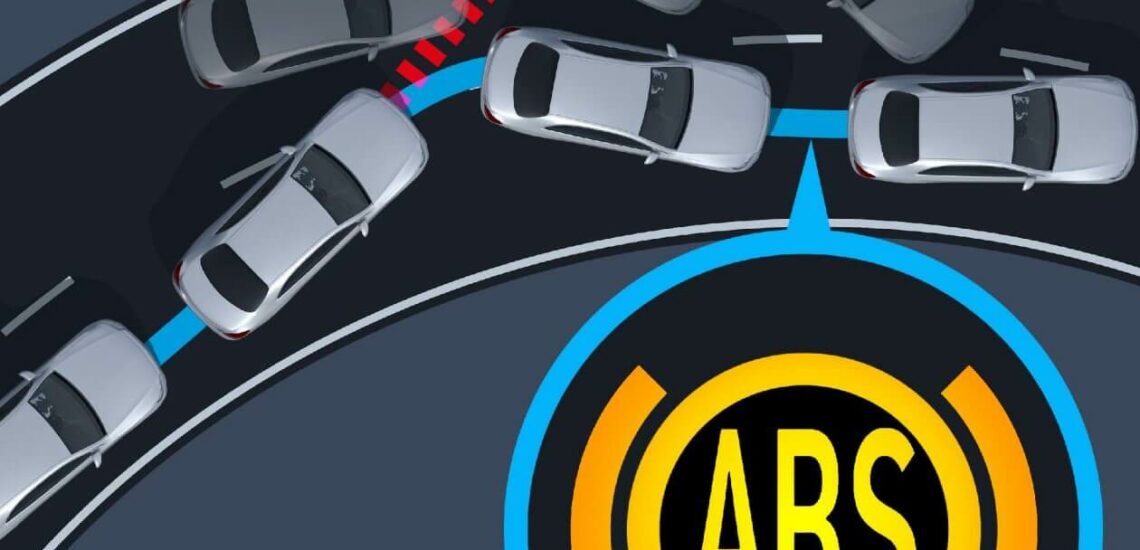

Imagine having to swerve around a sudden obstacle while braking hard. It sounds manageable — press the brake, turn the wheel, correct the trajectory. But there’s a critical point where pressing the pedal too hard causes the wheels to lock up, and from that moment, everything changes.
What Happens When Your Wheels Lock Up?
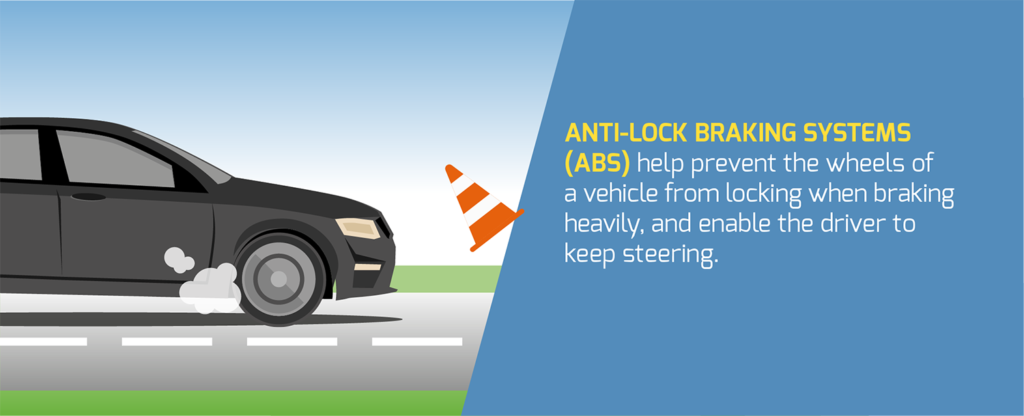
When wheels lock during emergency braking, two very different scenarios can play out — depending on whether your car has an Anti-Lock Braking System (ABS) or not.
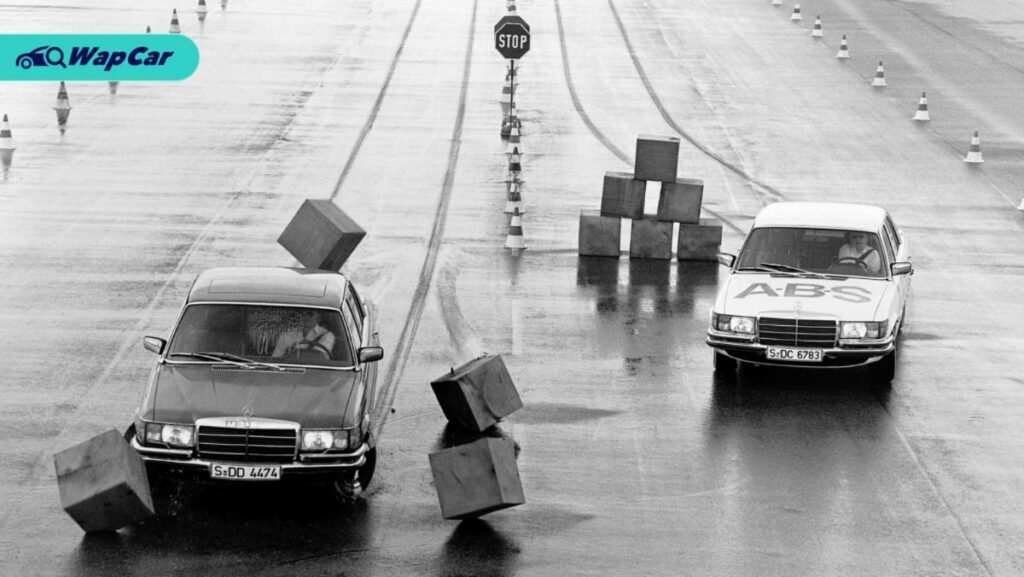
Without ABS: No matter how hard you turn the steering wheel, the car won’t change direction. Locked, skidding wheels completely rob the driver of the ability to maneuver — the vehicle simply plows straight ahead, as if the steering wheel were disconnected. Only an experienced driver can recover by briefly releasing the brake pedal and using controlled, pulsed braking to regain control.
With ABS: The driver simply needs to press the brake pedal firmly and steer normally. The system handles the rest.
Wheel lock-up is also dangerous because it can cause the vehicle to skid or veer sideways — especially in these situations:
- Mixed road surfaces under different wheels
- Significant load shifts on axles from a previous maneuver
- Mismatched tires between axles
- Lateral forces from a road camber or collision
In any of these cases, correcting the trajectory once the wheels are locked is nearly impossible.
How ABS Reduces Braking Distance
Increased braking distance is one of the most serious consequences of wheel lock-up. The reason comes down to basic physics: static friction is greater than sliding friction. To stop as quickly as possible, the ideal brake pressure keeps wheels rotating right on the edge of locking — not fully locked.
This is measured by a value called relative slip, which ranges from 0% (the wheel rolls freely with no slipping) to 100% (the wheel is completely locked). Research has shown that maximum braking efficiency is achieved at 15–20% slippage — meaning the braked wheel rotates 15–20% slower than a free-rolling wheel at the same car speed. ABS electronics continuously maintain this optimal slip value by rapidly locking and unlocking the wheels during a stop.
A Brief History of ABS Technology
The dangers of locked wheels weren’t widely addressed until the 1970s. The pioneer was Mercedes-Benz, which partnered with Bosch to develop the first production ABS system, introduced on the Mercedes S-Class in 1978–1979. The fundamental operating principles established then have remained largely unchanged — only refined with modern electronics.
How Does an Anti-Lock Braking System Work?
ABS regulates wheel rotation speed by adjusting pressure in the brake lines. Here’s the process step by step:
- Each wheel has a sensor that sends electrical pulses to the ABS control unit at a frequency proportional to the wheel’s rotation speed.
- If a wheel’s rotational speed approaches zero during braking, the control unit signals the hydraulic modulator to reduce pressure in that brake line.
- An electric valve bleeds pressure, redirecting excess brake fluid to a hydraulic accumulator.
- The pressure drops until the wheel regains grip and spins back up to speed.
- ABS then rapidly increases pressure again to decelerate the wheel.
- This cycle repeats until the car stops or the driver eases off the pedal.
Modern 4-channel ABS systems monitor and adjust braking force for each wheel independently — a significant improvement over early systems that applied braking changes to all wheels simultaneously.
Can You Replicate ABS with Manual Pulse Braking?
Some drivers ask: why not just pump the brakes manually? On cars without ABS, rhythmic braking can help avoid obstacles during emergency stops — you brake until the wheels lock, then release briefly to steer, then brake again. It’s a valid technique, though it significantly increases stopping distance.
The problem is human limitation. No driver — regardless of skill or experience — can pulse the brakes as quickly or precisely as ABS electronics. The system can lock and unlock each wheel approximately 15 times per second, which is simply beyond human capability.
ABS, EBD, and Brake Assist: How They Work Together
In most modern vehicles, ABS works alongside complementary systems that further improve braking safety:
- EBD (Electronic Brake-force Distribution) — Measures and adjusts braking intensity for each individual wheel. It allows safe braking in corners or on mixed road surfaces by detecting differences in wheel rotation speed and reducing braking force on wheels with less traction.
- Brake Assist — Detects a sudden, sharp press of the brake pedal (a sign of panic braking) and automatically builds full pressure in the brake lines, compensating for a driver who brakes too hesitantly in an emergency. It does not interfere with normal, everyday braking.
It’s worth noting: on cars with ABS, you should press the brake pedal firmly to the floor during emergency stops. The system is designed to handle full pedal input — don’t hold back.

The Limitations of ABS: When It Can Work Against You
ABS is not a universal solution. There are specific conditions where standard ABS can actually result in longer braking distances compared to non-ABS vehicles:
- Ice with studded tires — Studs deliver maximum grip only at high slip rates, when they dig into the ice like claws. ABS prevents this by releasing the wheels before the studs can bite, reducing their effectiveness.
- Snow-covered roads — On deep snow, locked wheels push a wedge of compacted snow in front of them (the “plow effect”), which actually shortens stopping distance. ABS prevents this build-up by keeping the wheels rotating.
- Loose surfaces (sand, gravel, clay) — The same principle applies: locked wheels dig in and build resistance. ABS eliminates this advantage.
- Rough or uneven roads — If a wheel momentarily lifts off the ground during braking and locks up, ABS may misread it as a skid and reduce pressure across other brake lines unnecessarily, causing the car to sway and increasing stopping distance. A well-maintained suspension minimizes this risk.
The key takeaway: on icy, snow-covered, or unpaved surfaces, a car without ABS can sometimes stop in a shorter distance. This is why some winter driving scenarios call for different techniques or specialized ABS calibrations.
Is ABS Worth It? What the Statistics Say
Modern ABS technology continues to evolve. Advanced systems can now read multiple sensor inputs, adapt to the type of road surface, and apply different braking algorithms accordingly. The overall picture remains clear:
On dry and wet road surfaces, a properly calibrated ABS system — combined with a well-maintained vehicle — can reduce braking distance by up to 20% on average, while preserving the driver’s ability to steer and maneuver throughout the stop. In emergency situations, those extra meters can make all the difference.
This is a translation. You can read the original here: https://www.drive.ru/technic/4efb331400f11713001e38cb.html

Published December 16, 2021 • 6m to read