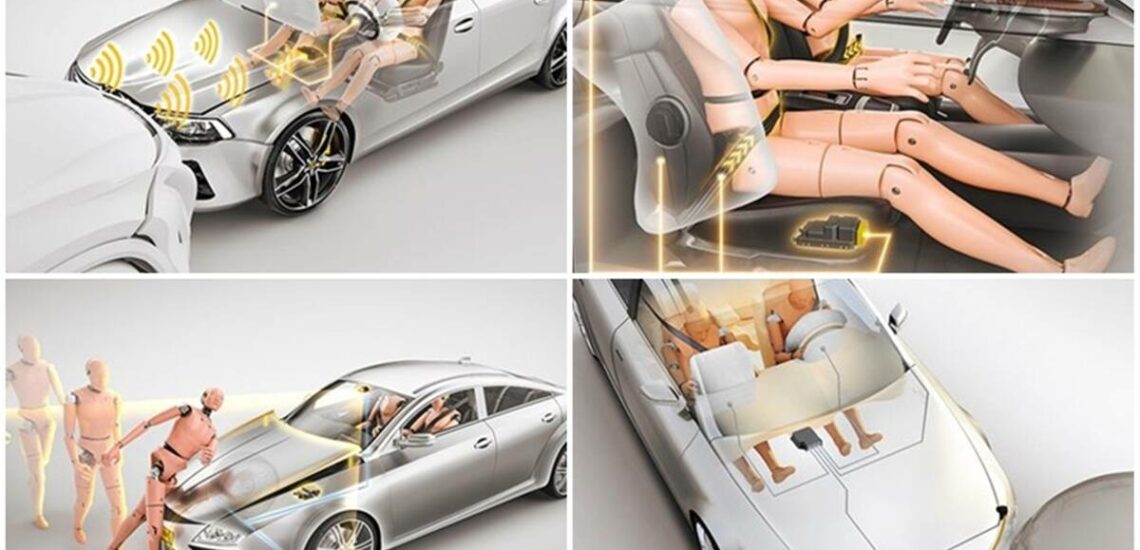

Automotive safety is conventionally divided into two types — active and passive. Active safety refers to the systems and devices that help a car avoid a collision in the first place. Passive safety, on the other hand, is the car’s ability to protect the lives and health of its occupants when an accident does occur. Every modern vehicle relies on a combination of key passive safety systems, including seat belts, airbags, and crumple zones, to minimize injury during a crash.
What Happens to a Car and Its Passengers During a Collision?
In a frontal collision, the car crumples and comes to an abrupt stop — but the passengers keep moving forward by inertia, hurtling toward the steering wheel, dashboard, and windshield. It may seem like there isn’t enough room inside the cabin to build up dangerous speed, but the forces involved are staggering. Deceleration can reach tens of g, making the impact equivalent to jumping from the top of a high-rise building.
To keep occupants alive and uninjured in a serious accident, their speed must be reduced as gradually and smoothly as possible — much like the way multi-layered mats are used to cushion falls from height. Achieving this inside a car requires the body structure to do two seemingly contradictory things at once: be rigid enough to protect occupants, and flexible enough to absorb crash energy.
Crumple Zones and the Rigid Safety Cell
Modern car bodies solve this challenge through a two-part design philosophy:
- Rigid passenger cell: The structural frame surrounding the driver and passengers is built to be as stiff as possible. It uses ultra-high-strength steel, and reinforcing bars are built into the doors to prevent them from collapsing inward on impact.
- Programmed deformation zones: The front (engine compartment) and rear (trunk) sections of the car are engineered to crumple in a controlled way, absorbing and dissipating crash energy before it reaches the cabin.
This approach is a relatively recent development. Older vehicles had no such engineering — the entire body crumpled uniformly, meaning the cabin was just as likely to collapse as the bumper. Today, it’s common to see a modern car with a completely destroyed front end while the passenger compartment remains largely intact.
The engine also poses a serious risk in a head-on collision. To prevent it from being pushed into the cabin — which could be fatal — modern cars use specially designed engine mounts and firewall structures that direct the engine downward and away from occupants in the event of a severe crash.
Rear Impacts and Head Restraints
Rear-end collisions carry their own serious risks — most notably, whiplash and neck injuries caused by the sudden snapping back of the head. Two generations of head restraint technology have been developed to address this:
- Standard head restraints: Limit rearward head movement to prevent hyperextension of the neck.
- Active head restraints: Automatically move forward the moment a rear impact is detected, providing instant support to the head and virtually eliminating dangerous movement.
Seat Belts: The Most Important Passive Safety Device
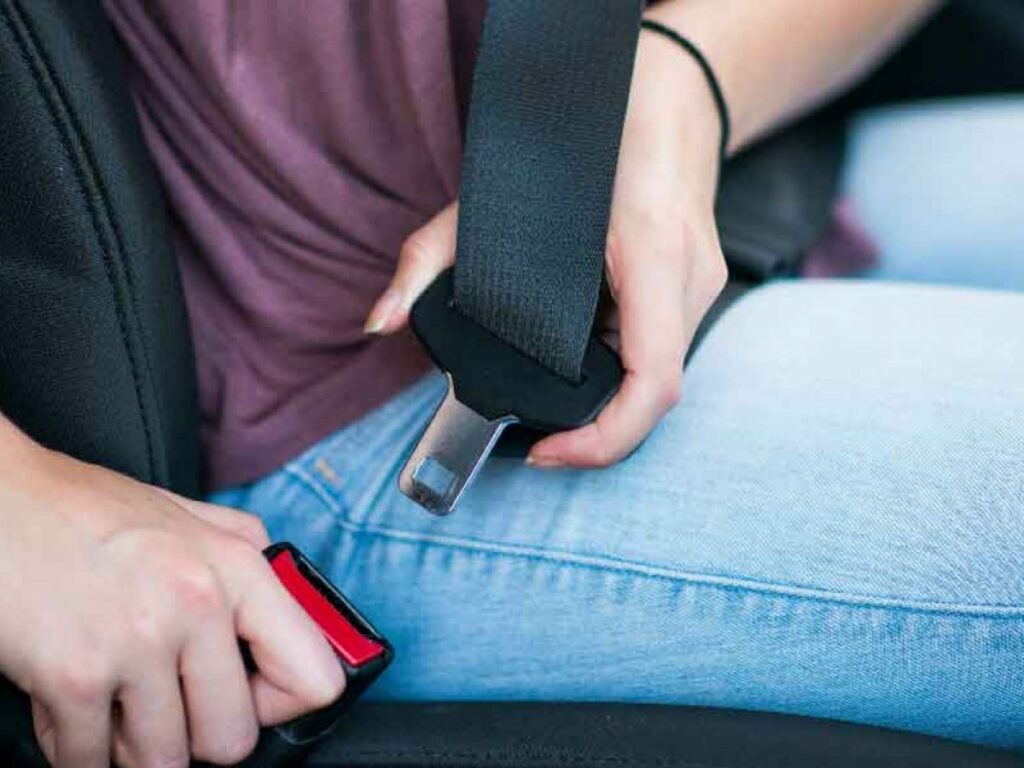
When it comes to protecting occupants during an accident, no device is more fundamental than the seat belt. Borrowed from aviation, seat belts have evolved significantly since their introduction to the automotive world. Here’s how that evolution unfolded:
- Two-point belts: The earliest automotive seat belts held the passenger across the belly or chest at a single point of tension. Better than nothing, but far from ideal.
- Three-point belts: The now-universal design that distributes crash forces more evenly across the chest, shoulder, and lap, dramatically reducing the risk of spinal and internal organ injuries. Its combination of effectiveness and ease of use made it the standard for civilian vehicles worldwide.
- Multi-point belts (4-, 5-, and 6-point): Used in motorsport to hold the driver firmly in the seat under extreme conditions, though too restrictive for everyday driving.
Modern seat belts are far more sophisticated than a simple strap. Key innovations include:
- Inertia reels: Allow the belt to move freely under normal conditions, automatically adjusting to any body size and letting the wearer shift position comfortably — but locking instantly when a sudden deceleration is detected.
- Pyrotechnic pretensioners: Small explosive charges that detonate in a crash, yanking the belt tight in milliseconds and pulling the occupant firmly back into the seat before impact forces take hold.
Airbags: The Second Line of Defense
Airbags are arguably the second most important passive safety invention after seat belts. The concept — inflating a folded bag in the fraction of a second during a collision — was first patented in 1953, though the technology to make it work reliably wouldn’t exist for another two decades.
How Does an Airbag Work?
The key to making an airbag effective is speed. Engineers tested various inflation methods before settling on a pyrotechnic system, which remains the standard today. Here’s how it works:
- Crash sensors detect a collision and trigger an electrical current in milliseconds.
- The current heats a compact tablet of sodium azide (NaN3) — a crystalline compound — past 330°C.
- The sodium azide decomposes rapidly into nitrogen gas and sodium metal.
- The released nitrogen gas inflates the airbag in just 0.025 to 0.05 seconds (25 to 50 milliseconds).
- The bag cushions the occupant and then deflates almost immediately, allowing them to move freely after the crash.
One side effect of this rapid inflation in an enclosed space is a sharp pressure spike that can cause eardrum damage or concussion. Manufacturers manage this risk by limiting the airbag’s deployment speed and using bags of relatively small volume, though some risk remains depending on the individual and the vehicle size.
A Brief History of the Airbag
Contrary to popular belief, airbags didn’t originate with European luxury brands. In the mid-1970s, Ford and General Motors fitted over 12,000 cars with airbag systems — the first large-scale deployment in automotive history. However, these early American airbags were designed to replace seat belts rather than complement them, which proved disastrous. An airbag deploys toward an unbelted occupant at 270–300 km/h, and documented cases of cervical vertebrae fractures caused by the airbag itself prompted manufacturers to abandon this approach.
It was Mercedes-Benz, working in partnership with Bosch, that revived and refined the concept. In 1980, Mercedes became the first manufacturer to offer airbags as standard equipment on a production car — the S-Class — with a critical design principle: airbags must work together with seat belts, not instead of them. This insight transformed airbag technology into the life-saving system we know today. In fact, many vehicles are still designed so that airbags won’t deploy at all unless the occupant is buckled up.
Modern Airbag Systems: Beyond the Steering Wheel
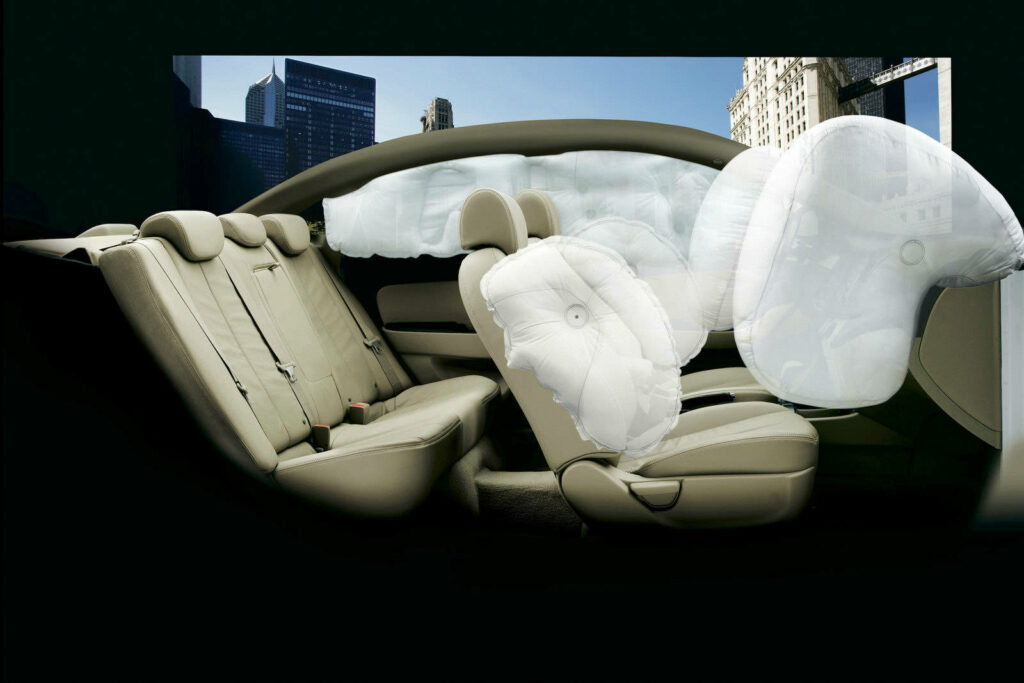
Today’s airbag systems go far beyond a single bag in the steering wheel. A comprehensive modern setup typically includes:
- Frontal airbags: For driver and front passenger, protecting against head and chest injuries in forward collisions.
- Side airbags (seat-mounted): Built into the sides of front seats to protect the torso during a side impact.
- Curtain airbags: Deployed from the roof rail to protect the heads of front and rear passengers. Unlike frontal airbags, curtain airbags maintain pressure for several seconds to provide protection throughout a rollover event — and to prevent unbelted passengers from being ejected.
- Knee airbags: Increasingly common, these protect the knees and legs from dashboard intrusion.
- Rear passenger airbags: Some manufacturers now include airbag protection for back-seat occupants as well.
The future of airbag technology is equally promising. Engineers are developing systems that can deploy airbags moments before a collision is detected — rather than during it — reducing the severity of the impact. Safety systems are also being trained to recognize individual occupant data (height, weight, seating position) to optimize airbag deployment for each specific person in the seat at the time of a crash.
The Bottom Line: Passive Safety Only Works When You Use It
No matter how advanced the passive safety systems in your vehicle are — crumple zones, pretensioner belts, multi-stage airbags, curtain systems — they are all engineered around a single fundamental assumption: that the driver and every passenger are wearing their seat belts. Without that, the effectiveness of all these technologies drops dramatically, and in some cases they become dangerous rather than protective. Always buckle up. Every trip, every time.
This is a translation. You can read the original here: https://www.drive.ru/technic/4efb330700f11713001e337d.html

Published January 20, 2022 • 7m to read