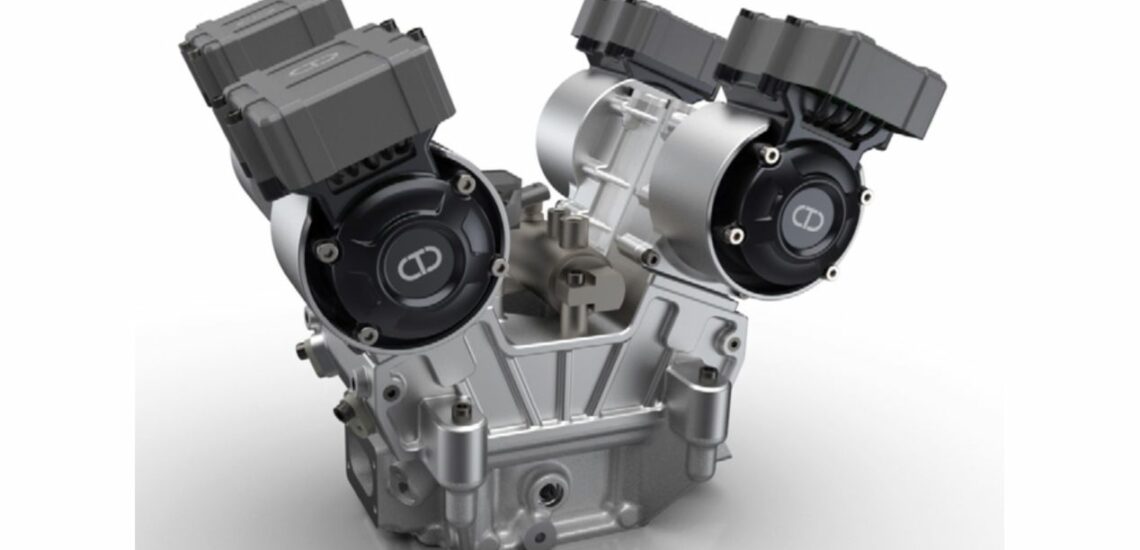

Variable valve timing is widely recognized as one of the most effective ways to improve internal combustion engine (ICE) efficiency. Modern engines commonly adjust gas distribution phases at intake and/or exhaust, and some go further by varying valve lift height. However, these systems still operate within mechanical constraints — shifting camshafts by a few degrees or switching between cam profiles. Intelligent Valve Actuation (IVA), developed by British company Camcon Automotive, eliminates those limitations entirely, offering complete and programmable freedom over valve control.
How Does Intelligent Valve Actuation Work?
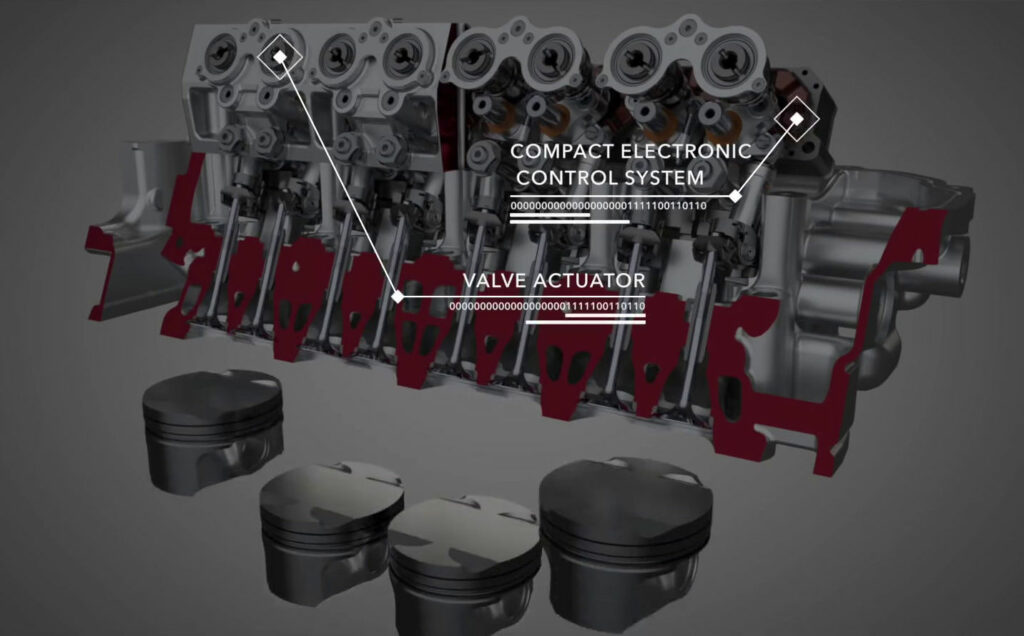
Unlike conventional systems, IVA assigns a dedicated camshaft to each individual valve. Instead of rotating continuously, each camshaft only turns when the valve needs to open or close — alternating direction with each actuation. The connection between camshaft and valve uses a desmodromic valve control mechanism, meaning both opening and closing strokes are mechanically driven rather than relying on a return spring.
This architecture enables a level of precision and flexibility no conventional system can match. With IVA, engineers and programmers can:
- Open valves significantly faster than in a traditional ICE
- Hold valves nearly stationary at any position mid-stroke
- Open a valve twice within a single piston stroke
- Change cylinder firing order entirely through software
- Define a unique valve lift and closing profile for each individual cylinder
- Modify any of these parameters in real time while the engine is running
Thermodynamic Flexibility: Any Cycle on Demand
One of the most remarkable capabilities of IVA is its ability to switch between thermodynamic cycles on the fly. A conventional ICE fitted with IVA can implement any of the following cycles simply by updating the software:
- Otto cycle — the standard gasoline engine cycle
- Miller/Atkinson cycle — for improved thermal efficiency at partial load
- Homogeneous Charge Compression Ignition (HCCI) — for cleaner, more efficient combustion
- Spark Controlled Compression Ignition (SPCCI) — Mazda’s production variant of HCCI
- Two-stroke cycle — for higher power density
- 12-stroke cycle — a super-efficient mode for low-load driving
The 12-stroke cycle deserves special attention. It builds on the long-established concept of cylinder deactivation, but with a critical difference: in a conventional ICE, electronics shut down a fixed set of cylinders for extended periods, causing uneven thermal distribution. With IVA, all cylinders remain active, but each one fires once every three working strokes — or once every 12 cycles. This keeps all cylinders at their normal operating temperature while dramatically reducing fuel consumption at light loads.
IVA vs. Other Camless Valve Technologies
Camcon Automotive is not the first to pursue fully variable valve control. Several major players have explored similar concepts over the years:
- General Motors and Ford — early research programs into fully variable valve actuation
- Ricardo and Lotus Engineering — engineering studies and prototype systems
- FreeValve / Qamfree — a fully camshaft-free system originally developed at Koenigsegg and continued through the FreeValve and Qoros partnership
Where systems like Qamfree remove the camshaft entirely, Camcon took the opposite approach: giving every valve its own dedicated camshaft. This preserves the mechanical reliability and precision of cam-driven actuation while delivering the programmability of a fully electronic system.
Efficiency Gains and Road to Production
The performance and efficiency results from IVA prototypes are promising. According to Camcon Automotive’s developers:
- CO₂ emissions could be reduced by 15–20% compared to a conventional engine
- Prototype testing on a turbocharged 2.0-litre four-cylinder engine demonstrated a 7.5% fuel economy improvement
- Fuel consumption of a gasoline IVA engine would be broadly comparable to a diesel engine
- Series production IVA systems would be less expensive than a hybrid powertrain
Camcon Automotive is offering two paths to market: supplying manufacturers directly with IVA actuator kits and engine adaptation hardware, or partnering with existing automotive component suppliers. The company predicts that IVA-equipped production vehicles could arrive within five years of commercialization.
This is a translation. You can read the original here: https://www.drive.ru/technic/5be19fd7ec05c4bb5c00003d.html

Published September 16, 2021 • 4m to read