
Many drivers assume that an “automatic transmission” refers to a single unit — but it actually combines two key components working in tandem: the gearbox itself and the torque converter. Understanding how these parts interact helps you get the most out of your vehicle and recognize potential issues before they become costly repairs.
What Is a Torque Converter and How Does It Work?
The torque converter sits between the engine and the gearbox, replacing the clutch pedal found in manual transmissions. It consists of three main rotating components:
- Impeller (pump wheel) — rigidly connected to the engine’s crankshaft; spins whenever the engine runs.
- Turbine wheel — connected to the gearbox input shaft; driven by pressurized transmission fluid.
- Reactor (stator) — positioned between the impeller and turbine; can either rotate freely or lock via an overrunning clutch depending on operating conditions.
Torque is transmitted from the engine to the gearbox through pressurized automatic transmission fluid (ATF). The impeller throws fluid onto the turbine blades, and the precisely shaped blade geometry creates a continuous circulation loop. Crucially, there is no rigid mechanical connection between the engine and the drivetrain — which is exactly what allows the engine to keep running while the car is stationary with a gear engaged, and what contributes to the characteristic smooth take-off of an automatic vehicle.
Torque Multiplication: The Role of the Reactor
A basic hydraulic coupling can only transmit torque — it cannot amplify it. That’s where the reactor comes in. When stationary, the reactor redirects returning fluid from the turbine back into the impeller at an optimized angle, increasing the fluid’s velocity and kinetic energy. The result: the torque delivered to the turbine shaft can be one and a half to two times higher than what the engine itself produces at that moment.
Picture a real-world scenario: the gear is engaged, you’re holding the brake, and the engine is idling. The turbine is stationary, yet the torque acting on it is already multiplied. Release the brake, and the car moves off smoothly. Acceleration continues until the wheel torque balances the road resistance.
Hydraulic Clutch Mode and Torque Converter Lock-Up
As vehicle speed increases and the turbine’s rotational speed approaches that of the impeller, the reactor unlocks and begins to spin freely alongside the other two components. At this point the torque converter switches to hydraulic clutch mode, reducing internal losses and improving efficiency.
To push efficiency even further, modern torque converters include a lock-up clutch (friction clutch). When conditions are right, this clutch physically locks the impeller and turbine together, eliminating fluid slippage entirely and bringing transmission efficiency close to 100%.
The system is also self-regulating. If you begin climbing a hill and vehicle speed drops, the reactor automatically slows, fluid circulation speed increases, and torque output rises — sometimes enough to handle the gradient without the gearbox needing to downshift at all.
The Multi-Speed Gearbox: Planetary Gear Sets
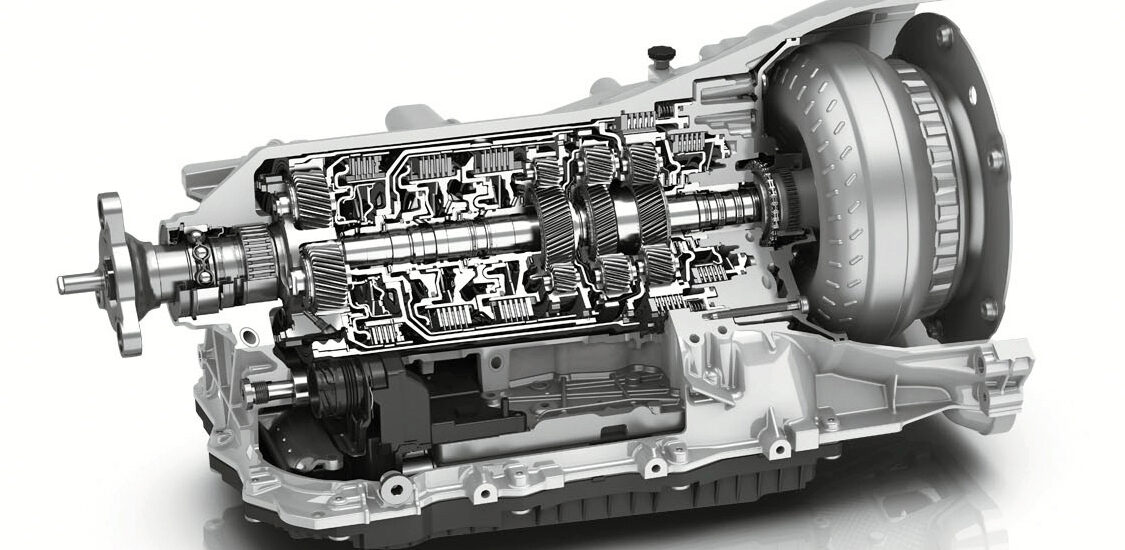
Because the torque converter alone cannot cover the full range of speed and torque ratios needed for real-world driving, it works in combination with a multi-speed planetary gearbox. Unlike traditional gear sets, a planetary gear set contains several elements that interact simultaneously:
- Sun gear — the central gear driven by the input shaft.
- Planet gears — smaller gears that orbit the sun gear, mounted on a carrier.
- Planet carrier — holds the planet gears and often serves as the output.
- Ring gear (annular gear) — the outer gear that meshes with the planet gears.
By selectively rotating or locking different elements using friction bands and friction packs (the automatic transmission equivalent of synchronizers and lockup clutches in a manual gearbox), the planetary set can produce a wide range of gear ratios — both forward and reverse.
How Gears Are Engaged: Hydraulics and Electronics
Gear changes in an automatic transmission work as follows:
- A dedicated hydraulic pump builds pressure in the transmission fluid circuit.
- The transmission control unit (TCU) analyses data from multiple sensors to determine the optimal gear.
- Electromagnetic solenoid valves direct fluid pressure to the appropriate friction clutch or band.
- The hydraulic tappet engages the clutch, locking the corresponding planetary gear element.
One major advantage over manual gearboxes is that gear changes happen with virtually no interruption in torque delivery — one gear engages almost simultaneously as the previous one releases. Any remaining jerkiness is further softened by the torque converter acting as a natural damper.
Note that transmissions with a sport-oriented calibration deliberately sharpen gear changes for faster acceleration. While this saves fractions of a second, it also accelerates clutch wear and places greater stress on the drivetrain overall.
Adaptive Driving Modes: How Electronics Optimize Your Drive
Early automatic transmissions were controlled entirely by hydraulics. Modern units retain hydraulics only as the actuating layer, with electronics handling all decision-making. This enables a broad range of driving programmes:
- Economy / Normal mode — upshifts occur early, keeping engine speeds low and minimising fuel consumption.
- Sport mode — the transmission holds gears until peak torque (and then peak power) RPM is reached before upshifting, maximising acceleration at the expense of fuel economy.
- Winter / Snow mode — the car pulls away in second gear to reduce wheel spin on slippery surfaces; gear changes are gentler.
- Adaptive mode — the TCU continuously analyses throttle inputs, braking habits, and driving style, dynamically blending economy and performance settings in real time.
In practice, if you drive calmly and smoothly, the system keeps the engine out of high-load zones — a noticeable benefit at the fuel pump. Sharpen your throttle inputs and the system immediately recognises that spirited driving is required, shifting to a sportier calibration without any manual input from the driver.
Semi-Automatic Mode: Tiptronic, Steptronic, and Autostick
An increasing number of vehicles offer a semi-automatic (manual override) mode alongside full automatic operation. In this mode, the driver requests gear changes via the selector, steering-wheel paddles, or steering-column buttons — while the control system carries out the actual shift. Different manufacturers brand this feature under their own names:
- Tiptronic (Porsche / Audi / Volkswagen)
- Steptronic (BMW)
- Autostick (Chrysler / Dodge)
The electronics still impose safeguards — the system will refuse to engage a gear it considers unsuitable for the current speed or load — but the driver gains the ability to anticipate the road ahead and pre-select gears rather than waiting for the automatic logic to react.
Tuning, Self-Diagnostics, and Limp-Home Mode
Modern automatic transmissions can be tuned by reprogramming the engine control unit (ECU) and the transmission control unit. Enthusiast tuning typically adjusts the RPM points at which gear changes occur and compresses the shift time to improve acceleration performance.
On the reliability side, today’s control units continuously monitor clutch wear by tracking hydraulic pressure data. By correlating pressure readings with expected values, the system can predict friction disc condition and flag maintenance needs before a failure occurs. Fault codes are logged whenever a component behaves outside its expected parameters.
If a serious fault is detected, the transmission enters emergency (limp-home) mode:
- All gear changes are disabled.
- A single fixed gear — typically second or third — is engaged.
- Performance is severely limited, but the vehicle remains driveable at low speed.
- The mode is designed to get you to a workshop safely, not to continue normal driving.
Automatic Transmission Modes Explained
Understanding what each selector position does helps you drive more efficiently and avoid unnecessary wear:
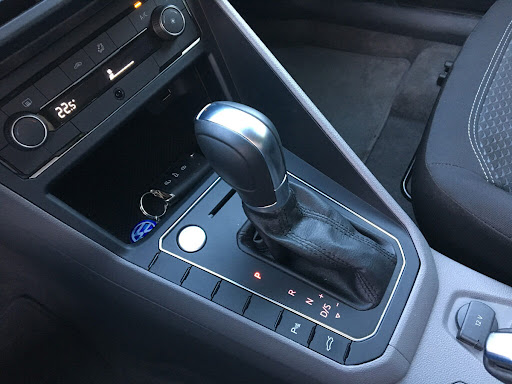
P — Park. All gears are disengaged and the output shaft is mechanically locked by the parking pawl. The engine’s rev limiter activates at a lower threshold than during driving to protect the drivetrain from unnecessary stress.
R — Reverse. Engages reverse rotation of the output shaft.
N — Neutral. The engine and drive wheels are disconnected. The vehicle can coast freely and can be towed without lifting the drive axle.
D / Drive. Normal forward driving with fully automatic gear selection.
S / Sport / PWR / Power / Shift. The most dynamic and fuel-hungry mode. The transmission holds each gear until maximum torque — and then maximum power — RPM is reached. The engine is always kept in its optimal performance range. Fuel economy takes a back seat.
Kick-down. A mode triggered by flooring the accelerator pedal, commanding an immediate downshift for aggressive overtaking or merging. The combination of a lower gear ratio and maximum engine output produces a strong surge of acceleration. On older transmissions, a physical detent or “click” at the end of the pedal travel was required to trigger kick-down; modern units detect it electronically.
Overdrive (O/D). Enables the highest gear ratio to keep engine RPM low during motorway cruising. Efficient for long-distance driving, but engaging it during spirited driving or towing noticeably reduces available power.
Norm. A balanced default mode. Upshifts occur at moderate engine speeds — neither as early as Economy nor as late as Sport.
1 / L / Low, 2, 3 (manual hold gears). Prevents the gearbox from shifting above the selected gear. Useful in situations where maintaining a specific gear is important:
- Descending steep mountain roads (engine braking)
- Towing a trailer or another vehicle
- Deep mud, sand, or off-road terrain
- Situations requiring sustained high engine torque without upshifting
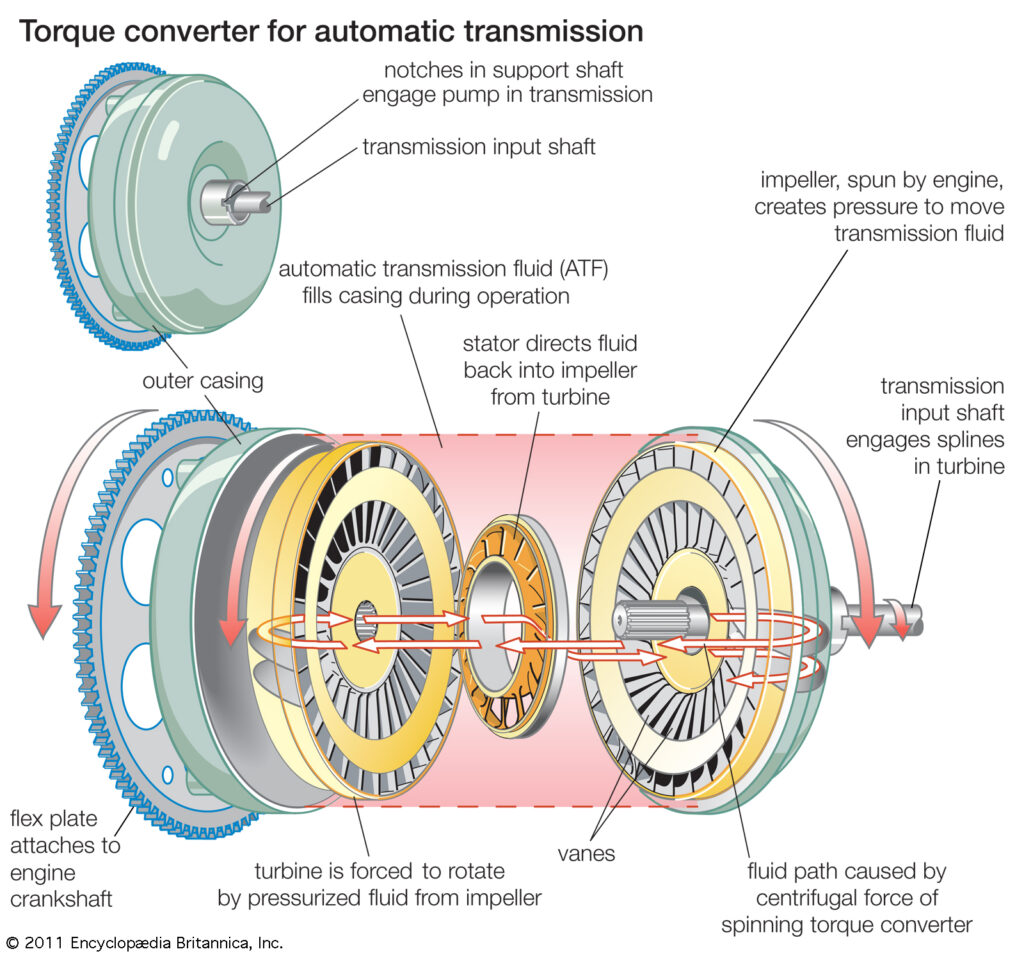
– notches in support shaft engage pump in transmission
– transmission input shaft
– outer casing
– flex plate attaches to engine crankshaft
– turbine is forced to rotate by pressurized fluid from impeller
– automatic transmission fluid (ATF) fills casing during operation
– stator directs fluid back into impeller from turbine
– vanes
– fluid path caused by centrifugal force of spinning torque converter
– impeller, spun by engine, creates pressure to move transmission fluid
– transmission input shaft engages splines in turbine
W / Winter / Snow. To minimise wheel spin on low-grip surfaces, the vehicle pulls away in second gear. Gear changes are smoother and occur at lower RPM, though acceleration will feel more subdued.
+ / − (manual shift). Allows the driver to manually increment or decrement gears using the selector, steering wheel buttons, or paddle shifters. The control system still overrides requests it considers unsafe — for example, a downshift that would cause the engine to over-rev. Shift speeds in this mode typically match the Sport programme calibration. The primary benefit is the ability to anticipate corners, gradients, or overtakes and pre-select the right gear rather than waiting for the transmission to react.
Automatic Transmission Maintenance and Longevity
A well-maintained automatic transmission — regardless of type — is capable of lasting well beyond 200,000 kilometres. Achieving that service life comes down to two things: regular fluid changes and periodic inspection by a qualified technician. Neglecting ATF intervals is the single most common cause of premature transmission failure, as degraded fluid loses its ability to lubricate, cool, and actuate the clutch packs effectively.
This is a translation. You can read the original here: https://www.drive.ru/technic/4efb330d00f11713001e3660.html

Published December 30, 2021 • 9m to read