
This article started out as a straightforward technical guide — something like “everything you ever wanted to know about all-wheel drive but didn’t know who to ask.” The plan was to explain how an open differential differs from a visco-coupler or a Haldex unit, what a self-locking differential actually does, and why any of it matters. But the deeper we dug into the history, the more surprising it became. The first passenger car with permanent all-wheel drive was built in the Netherlands more than a hundred years ago. And in 1935, a four-wheel-drive American racing car came astonishingly close to changing the course of world history.
Why does a passenger car need all-wheel drive at all? In the 21st century the answer looks obvious: better traction, less wheelspin on slippery surfaces, better composure under power. Four driven wheels are simply better than two. Yet the industry took a surprisingly long time to act on that. Ask any automotive historian and they will tell you the all-wheel drive era for mass-market cars began in 1980 with the Audi Quattro, with a couple of rare forerunners — the 1966 British supercar Jensen FF and the 1972 Subaru Leone 4WD. A real specialist will add that the early four-wheel-drive Subarus were not permanent all-wheel drive at all. They were part-time. And that distinction turns out to be the whole story.
Part-Time 4WD: A Stop-Gap Solution
Driving one axle only some of the time is a compromise, and not an elegant one for a road car. The term “part-time 4WD” comes from the world of SUVs and off-road trucks. In this layout one axle drives permanently and the other is rigidly connected on demand — but that rigid connection can only be used off the road. On tarmac the system has to be disengaged entirely.
Why a Rigid Connection Fails on Tarmac
- When a car turns, the front wheels travel a longer arc than the rear wheels and must therefore rotate faster.
- With a rigidly connected all-wheel drive system, traction at the front wheels is reduced while torque at the rear increases.
- In some cases the front wheels can generate braking force rather than driving force — adding resistance and making the car harder to steer.
- On loose surfaces like mud or snow this is manageable, but on tarmac it causes severe drivetrain binding and handling problems.
Through a corner every wheel follows its own arc and has to turn at its own speed. That is why permanent all-wheel drive needs three differentials: two between the wheels of each axle, and one between the axles themselves, so that front and rear can rotate independently of each other.
The Part-Time Cars: From the GAZ-61 to the Subaru Leone
Rigidly connected all-wheel drive did reach a few road-going cars in spite of all this, though they were closer to off-road trucks in character. In the USSR the GAZ-61 “Emka” — a four-wheel-drive saloon with a six-cylinder engine and a part-time front axle — entered small-batch production as early as 1938. After the war the same idea appeared in the off-road GAZ-M72 “Pobeda” and the Moskvitch-410. The 1972 Subaru Leone 4WD followed exactly the same logic: built for rough going, taller than the front-wheel-drive Subarus, with a rear axle the driver engaged by hand.
The Subaru Leone 4WD Station Wagon (1972–1979) was a four-wheel-drive adaptation of a front-wheel-drive platform, with a manually connected rear axle. Key specifications included:
- Engine options: 1.4-litre (72 hp) or 1.6-litre (80 hp)
- Body styles: station wagon, saloon, and pickup truck
- Rear-wheel drive engagement: manual on manual-transmission cars; automatic via a multi-disc friction clutch on automatics
- This part-time arrangement continued on all four-wheel-drive Subarus until 1989
The core problem with part-time drive is that it is useless on the paved roads where most cars spend most of their lives — and yet the car carries the weight of a transfer case, a second driveshaft and a whole extra axle assembly everywhere it goes. Converting a part-time system into a full-time one takes exactly one more component: an inter-axle differential inside the transfer case.
Full-Time All-Wheel Drive: How It Works and Why It Matters
Three Differentials, One Principle
The inter-axle differential is the key to permanent all-wheel drive. The two inter-wheel differentials let the left and right wheels of each axle turn at different speeds through a corner. The inter-axle differential does the same job between the front axle and the rear. A car with all three can run permanent all-wheel drive on any surface without binding the drivetrain or blunting the handling.
Simple enough in theory — yet until the early 1980s the industry considered full-time all-wheel drive unnecessary on a road car. The received wisdom was that turning a second pair of wheels and everything attached to them on dry tarmac only added noise and fuel consumption.
What the Quattro Proved
The Audi Quattro changed that thinking for good. By spreading engine torque across all four wheels all the time, a full-time system:
- Leaves a larger grip margin available for handling lateral forces in corners
- Significantly improves stability when accelerating or braking mid-corner
- Reduces the risk of sudden oversteer or understeer triggered by throttle inputs
The Audi 80 Quattro of the late 1980s shows how refined the layout became. The Quattro architecture is more compact than the rival Ferguson Formula transmission. From 1984 Audi fitted the Torsen self-locking differential — a purely mechanical device that responds to the torque on each output shaft rather than to a difference in wheel speed. Unlike a visco-coupler, the Torsen locks only under traction, never under braking, which makes it fully compatible with ABS and steadier during deceleration.
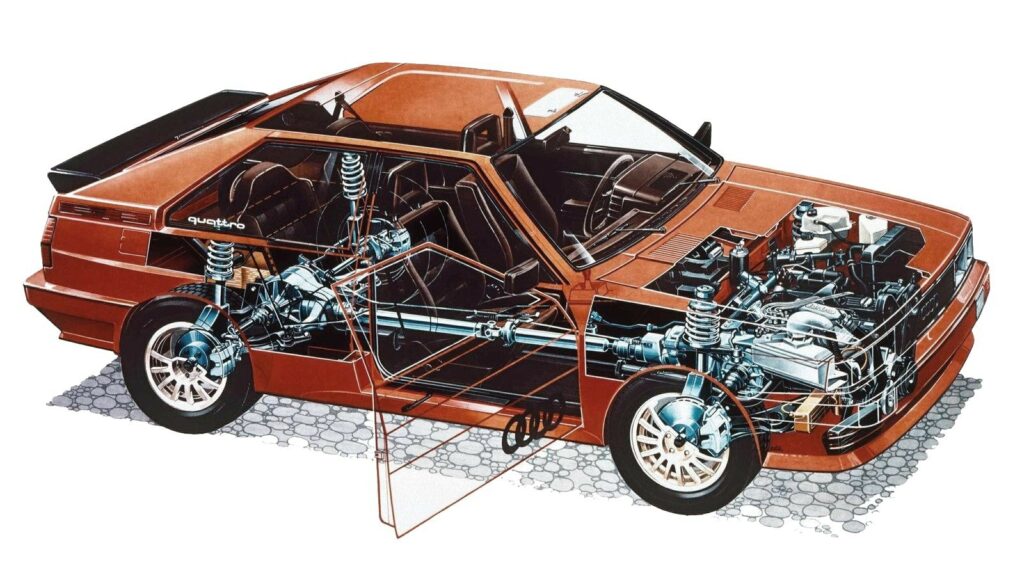
It is worth noting that the Range Rover (1970) and the Russian Lada Niva (1976) are generally credited as the first mass-produced vehicles with an inter-axle differential — but both are firmly off-roaders. The Audi Quattro’s claim is specifically to be the first among passenger cars.
Early Four-Wheel Drive Racing Cars: From Spyker to Bugatti
Did racing car designers explore full-time all-wheel drive before the Quattro era? Emphatically yes — and the story runs back much further than most people expect.
Porsche’s Four-Wheel-Drive Experiments
Ferdinand Porsche’s first post-war project was a four-wheel-drive racing car: the Cisitalia 360, mid-engined, with a 1.5-litre twelve-cylinder engine. Its front-wheel drive was part-time, though — the driver engaged it on the straights and switched back to rear-wheel drive before the corners.
Porsche had in fact built a four-wheel-drive vehicle far earlier than that: an electric car with four individual wheel motors, dating from 1900.
The Spyker 60 HP, 1902
The real shock for automotive historians is the 1902 racing car built by the Dutch manufacturer Spyker. At a time when even brakes were fitted only to the rear wheels, this car had genuine full-time all-wheel drive, inter-axle differential included.
Spyker had been founded in 1880 by the Spijker brothers as a maker of horse-drawn carriages. Their first car appeared in 1900, and two years later, working with the Belgian designer Joseph Valentin Laviolette, they produced the four-wheel-drive Spyker 60 HP racing car (1902–1907). Its specification was extraordinary for the period:
- Three differentials — inter-axle and both inter-wheel
- Three separate braking mechanisms — two on the rear wheels, one on the front driveshaft
- A four-wheel drive system that would not be matched in concept for decades
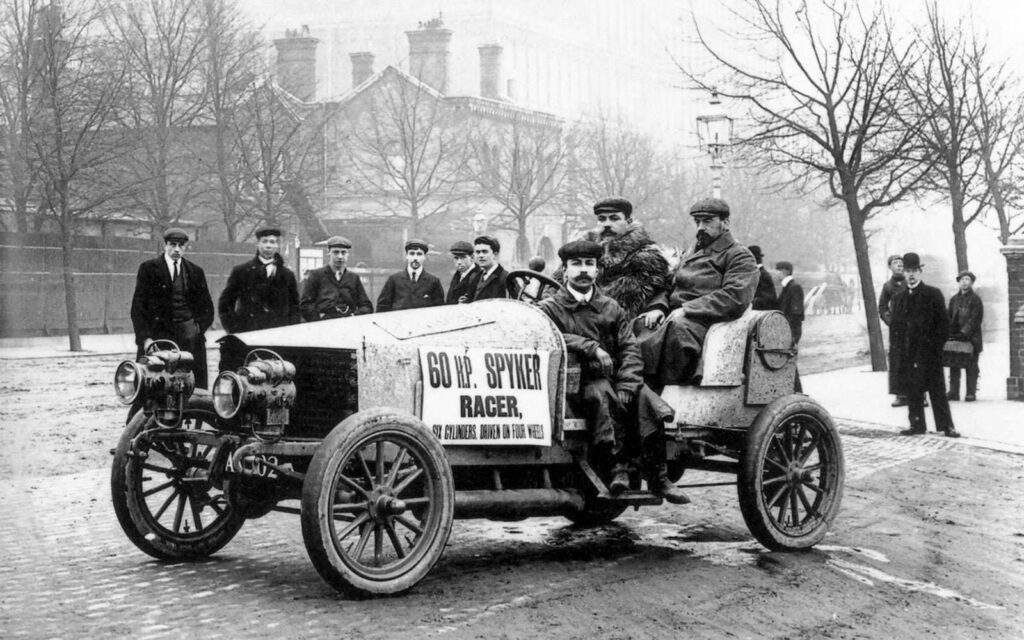
The full-time four-wheel drive concept is, then, well over a century old. Not many four-wheel-drive Spykers were built — they were enormously expensive and never achieved much in competition. Two more ambitious projects followed in the early 1930s.
Bugatti Tipo 53 and Miller FWD
The Bugatti Tipo 53 began with the Fiat engineer Antonio Pichetto, who put the idea to Ettore Bugatti in 1930. Three cars were finished in 1932, each with:
- A 300 hp supercharged straight-eight engine
- Full-time all-wheel drive with three differentials
- A transfer case and inter-axle differential integrated with the separately mounted gearbox
- Drive shafts for both axles positioned on the left side of the car
- An independent front suspension on a transverse spring — unusual for Bugatti
The Tipo 53 outpaced contemporary rear-wheel-drive cars through gravel corners, but it steered appallingly heavily: the front driveshafts used ordinary Cardan joints rather than constant-velocity joints. The three cars competed until 1935.
The Miller FWD came about partly because the American designer Harry Miller had studied a front-wheel-drive Bugatti bought specifically to be taken apart. Inspired by what he found, Miller developed his own four-wheel-drive chassis with sponsorship from the FWD truck company. One of the four-wheel-drive Millers led the 1934 Indianapolis 500 before mechanical trouble dropped it to ninth.
A Near Miss at AVUS, 1935
These cars are also attached to one of the strangest “what if” moments in motoring history. During a race at the AVUS track in Berlin in 1935, a four-wheel-drive Miller was running third when its straight-eight engine failed catastrophically and threw debris towards the grandstands. Adolf Hitler was in the stands that day. Had even a small fragment reached him, the course of the Second World War — and of world history — might have been entirely different.
The Ferguson Formula: The AWD System That Changed Everything
The Problem With an Open Centre Differential
To follow the next chapter it helps to go back to a fundamental limitation of the open inter-axle differential. An open differential lets one axle spin freely while the other receives no torque at all. If the rear wheels lose grip completely, the fronts can stand still while the rears spin — and the differential does nothing to stop it.
The SUV world’s answer was positive locking: the driver engages a mechanism that rigidly locks the differential gears, turning differential drive into a solid connection. Early Range Rovers used it, so did the Lada Niva and dozens of other off-roaders — and so did the first-generation Audi Quattro, which needed the driver to lock the centre differential by hand until 1984. But a manual lock is another compromise. It has to be released on hard surfaces, and it offers nothing at all if a wheel starts spinning unexpectedly on a slippery road.
Rolt, Dixon and Harry Ferguson
The first automatic self-locking inter-axle differential was the work of the British racing driver and engineer Tony Rolt. With his friend and fellow racer Fred Dixon he had run the Rolt/Dixon Developments workshop before the war; afterwards the two became fascinated by what permanent all-wheel drive might do. They built an experimental four-wheel-drive testbed called the “Crab,” and in 1950 joined forces with Harry Ferguson — the successful tractor manufacturer — to form Harry Ferguson Research.
Ferguson was not after a racing car. He wanted a genuinely safe road car: one whose wheels would neither spin under acceleration nor lock under braking. Rolt and Dixon set out to design it from nothing — body, transmission and powertrain alike — with the experienced designer Claude Hill, formerly of Aston Martin, as chief engineer. The experimental Ferguson R4 saloon was finished after six years of work, and its specification was remarkable for 1956:
- Permanent all-wheel drive with a self-locking inter-axle differential
- A flat-four engine
- Disc brakes on all four wheels
- The Dunlop MaxaRet electromechanical anti-lock braking system, adapted from aviation
Inside the Ferguson Formula Transfer Case
The heart of the Ferguson Formula transmission was an ingenious self-locking mechanism inside the transfer case. Besides the differential, the unit held an extra gear set, two ball overrunning clutches and two packs of friction discs. In normal running these elements idled quietly. But as soon as one axle’s wheels began to slip — producing a difference in output shaft speeds — one of the clutches engaged, squeezing its friction pack against the differential gears and turning differential drive into a solid connection on the spot.
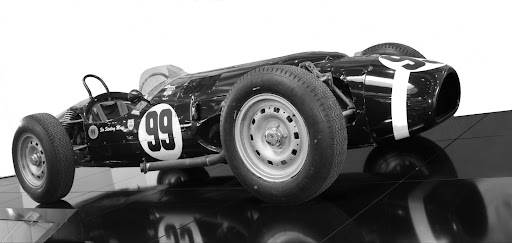
A second prototype, the 1962 Ferguson R5 estate, was better still. Autocar’s testers noted that it reached the limits of adhesion at speeds that seemed almost impossible. Even so, no manufacturer would put the Ferguson into production; the complexity and the cost were too much.
The Jensen FF Goes on Sale
In 1962 Tony Rolt persuaded the management of Jensen Cars to adapt the Ferguson Formula transmission for their forthcoming CV8 coupe and its 300 hp Chrysler V8. Three years later an experimental four-wheel-drive Jensen CV8 FF was running.
In 1966 the Jensen Interceptor replaced the CV8, and alongside the standard rear-wheel-drive coupe Jensen offered an all-wheel-drive version wearing a discreet “FF” badge — for “Formula Ferguson.” The Jensen FF became the world’s first production car to combine a self-locking inter-axle differential with ABS. Key specifications included:
- 6.3-litre Chrysler V8 big-block engine producing 325 hp
- Three-speed TorqueFlite automatic or four-speed manual gearbox
- Asymmetric torque split: 63% to the rear axle, 37% to the front — to preserve rear-wheel-drive handling character
- Single-channel Dunlop MaxaRet ABS
- Rack-and-pinion power steering and disc brakes all round
- Top speed of 212 km/h; 0–100 km/h in 7.7 seconds; kerb weight approximately 1,800 kg
- UK price in 1968: approximately £6,000 — similar to the cheapest Rolls-Royce
- Total production: 318 cars (1966–1971)
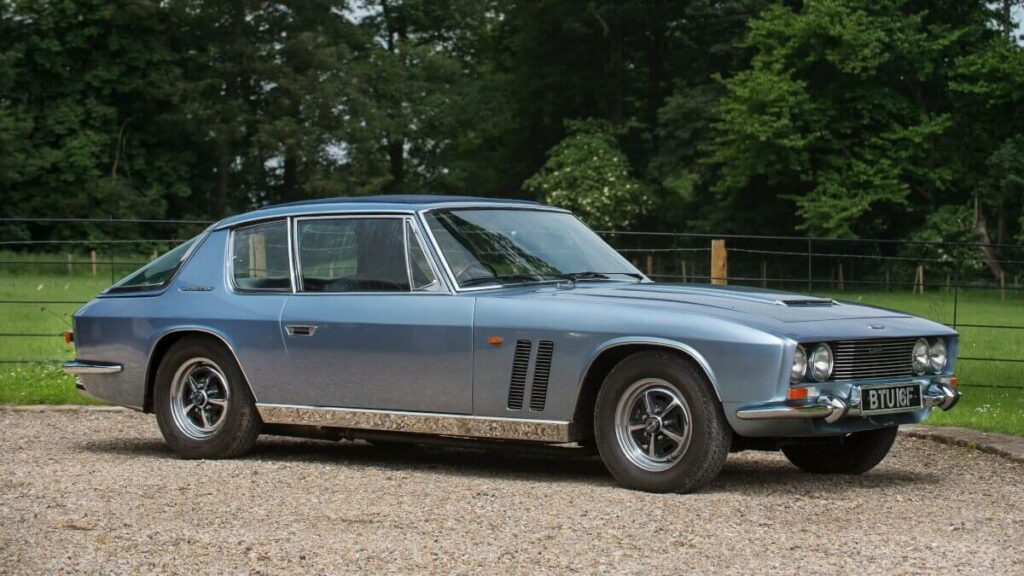
Every motoring journalist of the era praised the Jensen FF’s stability and what they described as “an almost unlimited traction margin on wet asphalt.” Harry Ferguson never saw the car: he died in 1960.
Why the Ferguson Formula Mattered
Why spend so long on the Ferguson Formula? Because Harry Ferguson Research was the first organisation anywhere in the world to treat all-wheel drive primarily as a tool of active safety rather than as an answer to off-road traction.
The asymmetric torque split was a deliberate move against the unpredictability that dogs symmetrical systems. Give a rear-wheel-drive car too much throttle in a slippery corner and it oversteers, predictably. Do the same in a front-wheel-drive car and it understeers, predictably. Do it in a symmetrical all-wheel-drive car and the answer depends on which axle happens to have the worse grip — which is ambiguous, and dangerous. By biasing torque rearwards, the Ferguson Formula gave the Jensen FF something close to rear-drive behaviour in most conditions.
The Invention of the Visco-Coupler
The Ferguson mechanism had one real limitation: its overrunning clutches worked in binary, on-off fashion. The jump from open differential to full lock was instantaneous, and that could create an ambiguity of its own at the moment of engagement. What was wanted was a mechanism that could vary the degree of lock smoothly.
In the late 1960s Tony Rolt and Derek Gardner — later the chief designer of Tyrrell’s Formula 1 cars — started experimenting with the silicone fluid used in viscous fan drives. The result was the visco-coupler: a cylindrical housing filled with silicone fluid, holding alternating packs of friction discs connected to each output shaft.
How a Visco-Coupler Works
- Under normal conditions, with all wheels rotating at similar speeds, the disc packs barely move relative to each other and the coupler has no effect on the differential.
- When one axle begins to slip, its output shaft spins faster, causing the disc packs to rotate relative to each other and shear the silicone fluid.
- The shearing increases temperature and pressure inside the coupler, dramatically raising the fluid’s viscosity.
- This viscosity increase causes the discs to drag against each other, progressively braking the faster-spinning shaft and partially or fully locking the differential.
FF Developments and the AMC Eagle
Having patented the visco-coupler, Tony Rolt set up FF Developments (FFD) in 1971 to sell all-wheel drive transmissions commercially. The early work was unglamorous: four-wheel-drive Bedford vans for the British forestry service, a batch of Ford Zephyr FF police cars, Opel Senator 4×4 saloons for the British military mission in Berlin.
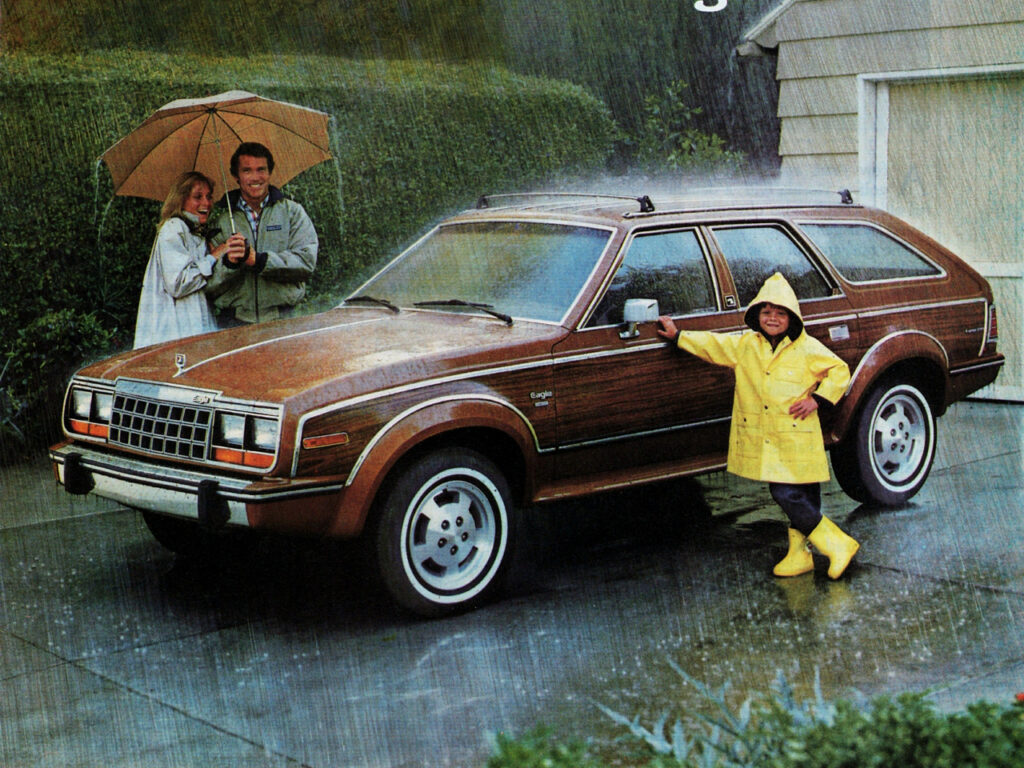
FFD’s most significant production job was the transmission of the AMC Eagle (1979–1988) — a raised all-wheel-drive version of the AMC Concord saloon, on bigger tyres, with a 75 mm body lift. The Eagle was the first production car anywhere to lock its inter-axle differential with a visco-coupler. It was conceived as a mild off-roader rather than a performance car, yet its transmission architecture is the direct ancestor of some of the most celebrated fast all-wheel-drive cars ever built, the early Subaru Impreza WRX and the Mitsubishi Lancer Evolution among them.
Self-Locking Differentials: From Torsen to Electronic Control
Audi’s Packaging Trick
When the Audi Quattro entered production in 1981 — two years after the AMC Eagle — it used a conventional open inter-axle differential with a manual positive lock. The elegance of Audi’s solution was in the packaging. The longitudinal engine pointed straight at the rear axle, and the inter-axle differential went directly into the gearbox: the secondary shaft was made hollow and the front driveshaft was routed through it. Ferdinand Piëch’s team chose a symmetrical 50:50 split between front and rear.
The Torsen Differential
In 1984 the manual lock levers finally disappeared from Audi cabins, replaced by the Torsen — TORque SENsing — self-locking differential. Its advantages are worth listing:
- It is entirely mechanical — no electronics, fluid, or driver input required
- It responds to changes in torque on the output shafts rather than to speed differences, meaning it can react before wheelspin actually begins
- Unlike a visco-coupler, it locks only under traction, not braking, making it fully ABS-compatible
- Locking and unlocking is smooth and continuous, with no binary transitions
Having proved itself on fast cars, the Torsen was picked up by SUV engineers chasing car-like handling. It is used today in the Range Rover, the Volkswagen Touareg, the Porsche Cayenne and the Toyota Land Cruiser Prado.
Group B and the Rally Arms Race
Back in the 1980s the Quattro’s rally dominance set off an all-wheel drive arms race. Within a few seasons these four-wheel-drive rally cars had all appeared, each using FFD visco-coupler technology in its self-locking differentials:
- Peugeot 205 T16
- Austin Metro 6R4
- Lancia Delta S4
- Ford RS200
Stuart Rolt, Tony’s son, managed FFD’s relationships with the rally teams through those years.
In the early 1990s the AZLK factory in Russia also came to FFD, wanting an all-wheel-drive rally version of the Moskvitch 2141. Built around the same three-differential layout as the Ford RS200, the experimental car handled with remarkable predictability in extreme conditions. Testing turned up a principle that still holds: adjust the locking stiffness of each visco-coupler individually and the balance of the car moves with it.
- Stiffer rear inter-wheel differential → more oversteer tendency
- Stiffer front or inter-axle differential → more understeer and stability
Electronic Control Arrives
That tunability is exactly why modern WRC cars use electronically controlled multi-disc clutch packs rather than passive visco-couplers in all three differentials. Hydraulic actuators and an onboard computer vary the lock of each differential in real time — releasing the clutches on turn-in so the car rotates freely, then clamping them progressively as the driver accelerates onto the straight, for maximum traction without understeer.
Two manufacturers pioneered electronically controlled differentials in road cars:
- Mercedes-Benz 4Matic (1986, W124 E-Class): Three electronically controlled clutches sequentially connected the front axle, then locked the inter-axle differential, then locked the rear differential as conditions required. The system was effective but overly complex, and the electronics could cause the front wheels to connect and disconnect noticeably on loose surfaces.
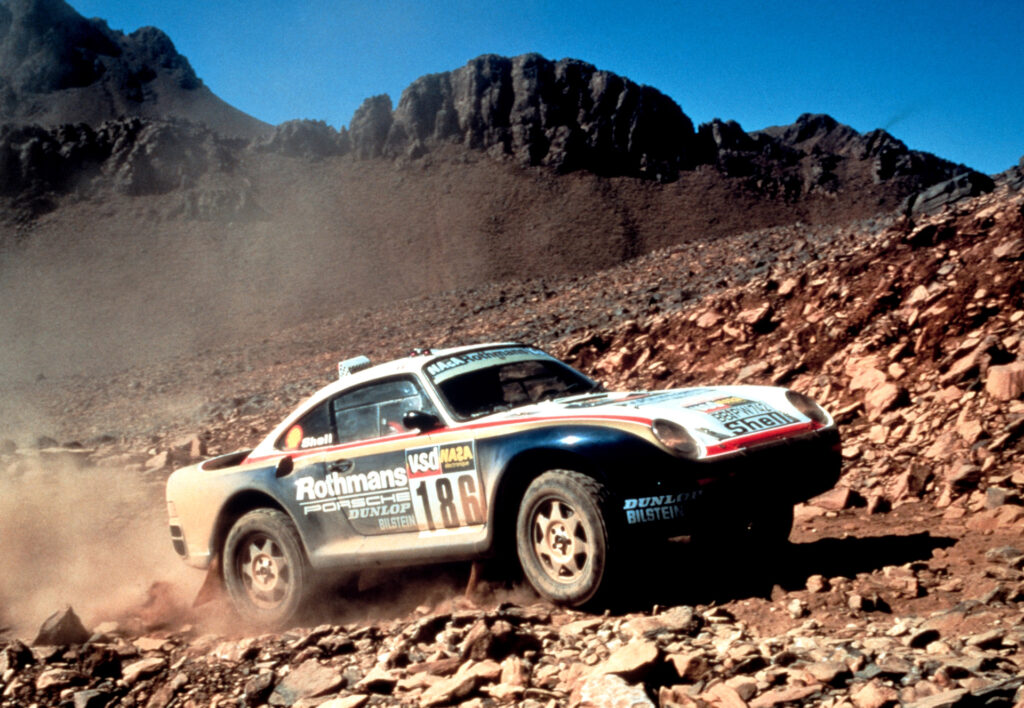
- Porsche 959 (1986): Two electronically controlled clutches operating across four selectable driver modes. The 959’s system was more sophisticated and better suited to high-performance use.
Replacing the Differential: Haldex and Simplified AWD Systems
The Visco-Coupler on Its Own
While rally engineers pushed self-locking differentials as far as they would go, the designers of ordinary passenger cars went the other way — deleting the inter-axle differential altogether and putting a visco-coupler in its place. The 1985 Volkswagen Golf II Syncro was the first European passenger car to do it, with a transmission developed by engineers from GKN, which had acquired FFD in 1969.
For mass production the simplification paid off:
- The all-wheel-drive model shared most components with the standard front-wheel-drive version, reducing manufacturing cost and complexity
- Under normal conditions, the car drove identically to a front-wheel-drive car
- When the front wheels slipped, the visco-coupler could transfer up to 70% of torque to the rear within approximately 0.2 seconds
The delay, however, created a handling liability. A car behaving like a front-wheel-drive one, pushing wide at the nose, could shift abruptly to rear-biased behaviour the moment the coupler engaged — and catch its driver out. Japanese manufacturers tried various answers, including fitting more couplers: the 1988 Nissan Sunny/Pulsar used three, one to engage the rear drive and one to lock each inter-wheel differential. The Mazda Concerto 4WD went further still, replacing both the inter-axle and the rear inter-wheel differential with visco-couplers.
The Haldex Clutch
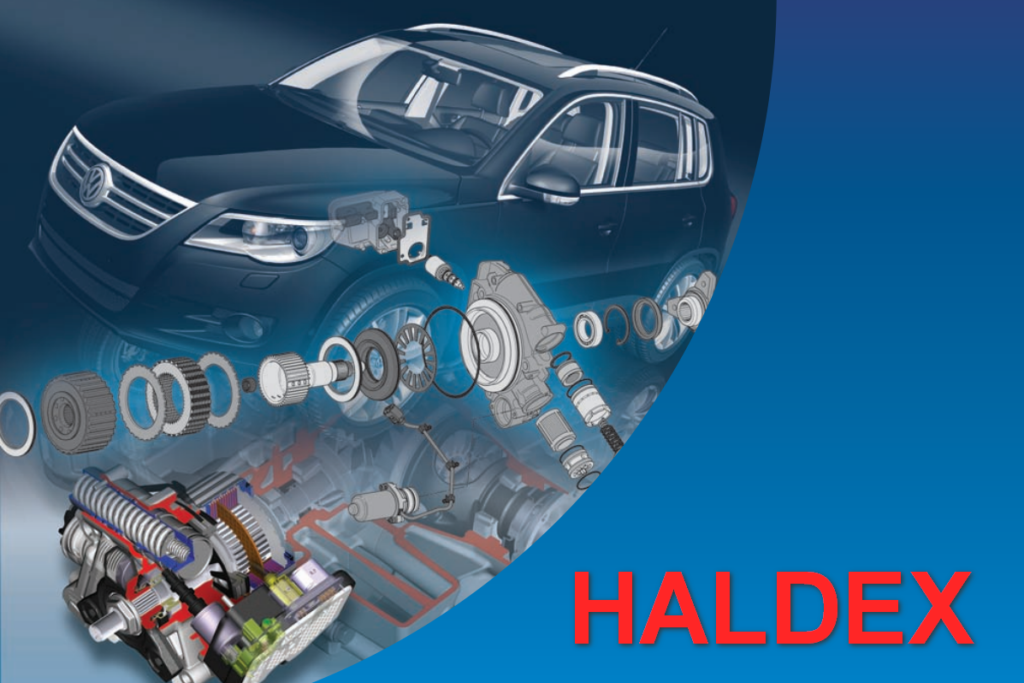
The next step replaced the visco-coupler with an electronically controlled hydraulic multi-disc clutch — far faster, and far more precisely controllable. The best-known example is the Haldex coupling, which took over from the visco-coupler on the Volkswagen Golf IV and its platform siblings. It works like this:
- Face cams detect any rotational speed difference between front and rear shafts
- Rollers riding over the cam surfaces push pistons in ring cylinders, pumping hydraulic fluid
- Fluid pressure compresses the multi-disc clutch pack, transferring torque to the rear axle
- A solenoid valve, controlled by the vehicle’s electronics, can release pressure at any point — allowing infinitely variable torque distribution
Most all-wheel-drive cars and crossovers on sale today use some version of this electronically controlled clutch, whether it is Haldex on Volkswagen Group cars, Honda’s VTM-4 or BMW’s xDrive. Modern clutches act quickly enough that the engagement delay has become imperceptible in ordinary driving, and the calibration now matters more than the hardware: the Golf 4Motion and the Audi A3 Quattro use mechanically identical transmissions, but different software gives the Volkswagen a symmetrical split while Audi sends 60% of torque forwards for a more familiar front-drive character.
AWD Technology Today: Which System Is Best?
Part-time systems with a manually engaged second axle have mercifully vanished from passenger cars. What remains divides into three families, each with its merits:
- Full-time AWD with a self-locking inter-axle differential (visco-coupler as in Subaru, Torsen mechanical as in Audi A4/A6/A8 Quattro and Volkswagen Phaeton, or electronically controlled clutches as in Mitsubishi Lancer Evo): the most sophisticated and rewarding systems, capable of genuinely improving handling on both road and track when properly calibrated.
- Full-time AWD with an open inter-axle differential (as in Mercedes-Benz 4Matic): relies on anti-slip electronics to compensate for the lack of self-locking. Effective on the road, but mechanically less proactive.
- Part-time rear drive via a controlled clutch (Haldex, as on Volvo, Saab, and various Volkswagen Group crossovers): the most common layout in modern crossovers — cost-effective, light, and increasingly capable thanks to faster electronics.
Torque Vectoring, and What Comes After
The dominant trend in advanced all-wheel drive is torque vectoring: not merely dividing torque between the axles, but actively varying it between the left and right wheels of an axle. The Mitsubishi Lancer Evolution X is the state of the art — its S-AWC system pairs an electronically controlled centre differential (ACD) with an Active Yaw Control (AYC) rear differential that can move torque from one rear wheel to the other. Extra gear sets shift the balance proactively, before grip is lost, instead of reacting once a wheel is already spinning.
In practice the real-world differences between modern systems keep narrowing as the control electronics improve. A well-calibrated Haldex crossover now delivers stability that a mechanical Torsen would have been admired for a generation ago. That is the direction of travel — and the endpoint may well be the electric car with four individual wheel motors, each metering out its own torque with no mechanical drivetrain at all. Which brings the story neatly back to Ferdinand Porsche’s electric four-wheel-drive car of 1900.
This is a translation. You can read the original here: https://www.drive.ru/technic/4efb336400f11713001e4f54.html

Published November 04, 2021 • 20m to read