



Reports on the risks — and even outright dangers — of mass adoption of bioethanol as a vehicle fuel have been filling the world press for years. One authoritative voice raises concerns; another, equally credible, pushes back. The debate is fierce enough to cause real confusion. How can it be that leading economies are investing billions in energy strategies that, if the skeptics are to be believed, are environmentally and economically reckless? Let’s cut through the noise and examine the actual pros and cons of bioethanol.
The Main Criticism: Greenhouse Gas Emissions During Production
Opponents of burning ethanol in internal combustion engines make a compelling case. They don’t dispute that vehicle exhaust becomes significantly cleaner when running on ethanol — that much is true. Their main concern lies in the production process itself, which releases large quantities of carbon dioxide. By this logic, the environmental gains at the tailpipe are cancelled out upstream, rendering the green credentials of bioethanol little more than marketing spin.
Are they right? The answer is: partly. Ethanol production does release greenhouse gases in volumes comparable to those associated with conventional petrol combustion. But here’s the critical nuance — for every litre of ethanol produced from plant matter, the CO₂ released is roughly equal to the amount those same plants absorbed through photosynthesis during their growth. Bioethanol production is, in essence, reverse photosynthesis: plants capture CO₂ from the air using sunlight, and that carbon is returned to the atmosphere when the fuel is burned.
The Case for Bioethanol: Key Environmental and Energy Advantages
When viewed through this lens, bioethanol is effectively carbon-neutral as a greenhouse gas source. It won’t improve the atmospheric situation, but it won’t worsen it either — which already puts it ahead of refined petroleum products. Beyond carbon neutrality, bioethanol offers several important advantages:
- Positive energy balance: Depending on the feedstock used, bioethanol yields between 1.24 and 8 times more energy than is consumed in its production. By contrast, the energy balance of petrol and diesel — once you factor in exploration, extraction, transport, and refining — falls well below 1.
- High octane rating: Ethanol has an octane number of 105, enabling use in higher-compression engines that extract more power and efficiency from each combustion cycle.
- Significantly reduced emissions in purpose-built engines: Vehicles engineered from the ground up to run on ethanol can achieve approximately 80% lower carbon emissions overall, and around 30% lower CO₂ specifically.
- Cleaner exhaust: Compared to petrol combustion, ethanol produces a noticeably cleaner exhaust profile, reducing particulate and toxic compound output.
The Drawbacks of Bioethanol: What You Need to Know
Bioethanol is not without its weaknesses. Understanding these is essential for an honest assessment:
- Lower energy density: Burning one litre of ethanol releases approximately 34% less energy than burning the same volume of petrol. In practical terms, this means higher fuel consumption — particularly in vehicles that weren’t originally designed to run on ethanol.
- Flex-fuel inefficiency: Multi-fuel vehicles (marketed under names like Flex Fuel, Flexifuel, BioFlex, or Tri-Flex) burn ethanol inefficiently because their compression ratios cannot be adjusted on the fly. A car that performs well on standard petrol will consume noticeably more fuel on E85 (85% ethanol, 15% petrol) and deliver poorer performance.
- Limited cost savings: While bioethanol is generally cheaper than petrol, the price gap is not dramatic. When higher consumption is factored in, the financial benefit can shrink considerably — or disappear entirely.
- Incompatibility with traditional engines at high blends: Engines designed exclusively for high-ethanol fuel cannot accept petrol — the lower octane rating causes detonation, which can cause serious engine damage.
Bioethanol in Practice: The Case of Brazil
To understand bioethanol at scale, Brazil is the most instructive example. Scarred by the 1973 fuel crisis, the country launched a comprehensive biofuel programme in 1975 that has since become deeply embedded in its national energy strategy. Today:
- 4.5% of Brazil’s total land area is dedicated to sugar cane cultivation
- The country produces over 20 billion litres of ethanol annually
- Brazil is effectively energy self-sufficient, meeting its fuel and electricity needs largely through sugar cane processing
- The majority of Brazilian passenger vehicles are capable of running on high-ethanol fuel blends
However, Brazil’s bioethanol success story has a significant shadow: the ongoing clearance of Amazon rainforest to make way for new sugar cane plantations. Destroying the world’s most important carbon sink in the name of green fuel is, at best, a deeply contradictory policy — and one that deserves far greater scrutiny than it typically receives.
Bioethanol in the United States: Corn-Based Challenges
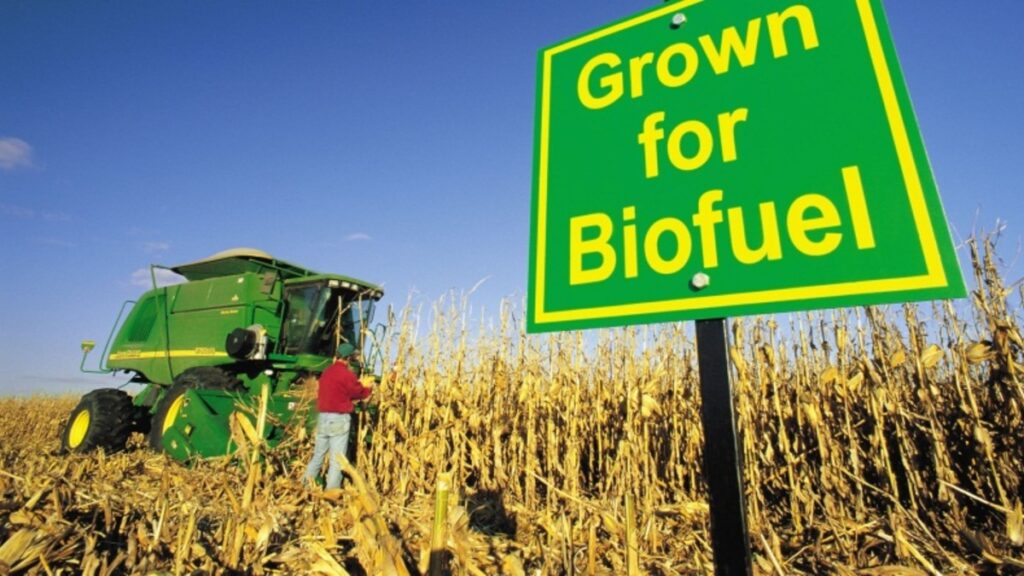
The United States has made substantial investments in ethanol, with research funding alone exceeding $12 billion in recent years. Unlike Brazil, the US relies on corn as its primary feedstock — a less efficient raw material that results in higher production costs and a lower energy yield compared to sugar cane.
Despite this, ethanol programmes are actively promoted across many states. In states like Illinois — a major corn producer — new fuel standards have mandated that petrol contain at least 10% ethanol, a proportion considered safe for conventional engines.
The Limits of Bioethanol: Why a Full Transition Isn’t Realistic
For all its promise, bioethanol faces one insurmountable constraint: land. Even assuming 100% refining efficiency, transitioning the United States entirely from oil to ethanol would require cultivating 75% of the planet’s total agricultural land with fuel crops. In other words, the maths simply don’t support a complete global switch to ethanol engines.
This raises a serious ethical dimension as well. As demand for corn and sugar cane rises, farmers naturally redirect land toward those crops — land that might otherwise be used to grow food. For millions of people in food-insecure regions, scaling up biofuel production is not an abstract policy debate; it has real consequences for food availability and pricing.
Bioethanol and the Politics of Energy
No analysis of bioethanol would be complete without acknowledging the political dimension. Biofuel programmes are not purely scientific or economic initiatives — they sit at the intersection of agricultural policy, energy security, and the interests of powerful industries.
It’s worth approaching the most vocal criticism with measured scepticism. The history of corporate lobbying against inconvenient science — from tobacco to climate change — suggests that not all opposition to biofuels is driven by genuine environmental concern. Some of it may reflect the interests of those whose business models depend on continued fossil fuel dominance.
Biofuel programmes, when well-designed and responsibly implemented, can offer genuine benefits. The key is ensuring that their rollout is guided by science and the public interest — not by industry lobbying or short-term political calculations.
This is a translation. You can read the original here: https://www.drive.ru/technic/4efb331a00f11713001e3994.html
Country guides

Published December 09, 2021 • 6m to read