
A hybrid car combines an internal combustion engine (ICE) with an electric motor, resulting in lower fuel consumption and reduced exhaust emissions. The more efficient the hybrid system, the more powerful the batteries it requires — and, consequently, the higher the price tag. Here’s everything you need to know about how hybrid cars work and what sets them apart.
Mild Hybrids vs. Full Hybrids: What’s the Difference?
Depending on the role the electric motor plays in the powertrain, hybrids are divided into two main categories: mild and full.
- Mild hybrids use the electric motor as a helper to the internal combustion engine. A well-known example is the Honda Insight hatchback. The electric motor assists during acceleration but cannot power the car on its own.
- Full hybrids can travel a certain distance on electric power alone, without the ICE running at all. The Lexus RX 400h is a classic example of this type.
There is also a third, loosely defined category sometimes called microhybrids — a marketing term used to describe vehicles with a start/stop system. However, this is essentially just an advanced generator, not a true hybrid setup, since no electric motor transmits torque to the wheels.
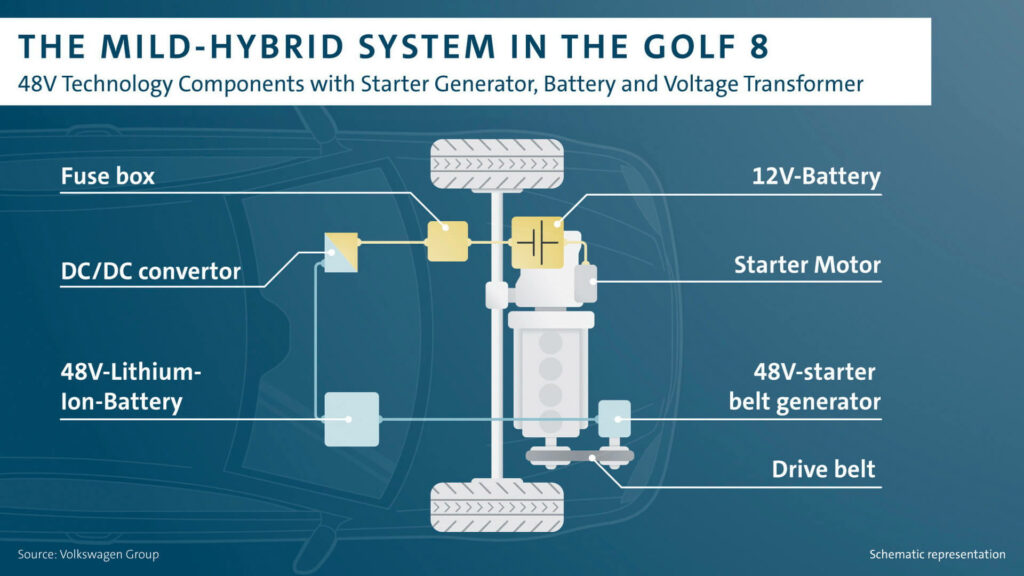
48V Technology Components with Starter Generator, Battery and Voltage Transformer
– Fuse box
– DC/DC convertor
– 48V-Lithium-lon-Battery
– 12V-Battery
– Starter Motor
– 48V-starter belt generator
– Drive belt
The 3 Main Hybrid Powertrain Schemes
Hybrid powertrains come in three fundamental configurations: series, parallel, and series-parallel. Each has distinct characteristics, advantages, and typical use cases.
1. Series Hybrid
The series hybrid is the oldest configuration, invented in 1899 by Ferdinand Porsche. In this scheme:
- The wheels are driven entirely by an electric motor.
- A small-displacement ICE rotates a generator to produce electricity — it never directly drives the wheels.
- No traditional gearbox or high-output combustion engine is needed.
- Large-capacity batteries (typically nickel metal hydride) are required.
This scheme is less common in passenger cars today but is widely used in quarry dump trucks, buses, and locomotives.
2. Parallel Hybrid
Patented in 1905 by German engineer Henri Pieper, the parallel hybrid is by far the most widely used configuration today. It is the foundation of nearly all mild hybrid vehicles. Key characteristics include:
- A powerful electric motor (typically 10–15 kW) assists the ICE during acceleration.
- The electric motor also recovers and stores energy through regenerative braking.
- A CVT (Continuously Variable Transmission) or planetary gear is typically used.
- Power sources include lithium-ion or lithium polymer batteries.
- Smaller battery capacity is needed compared to series hybrids, keeping costs lower.
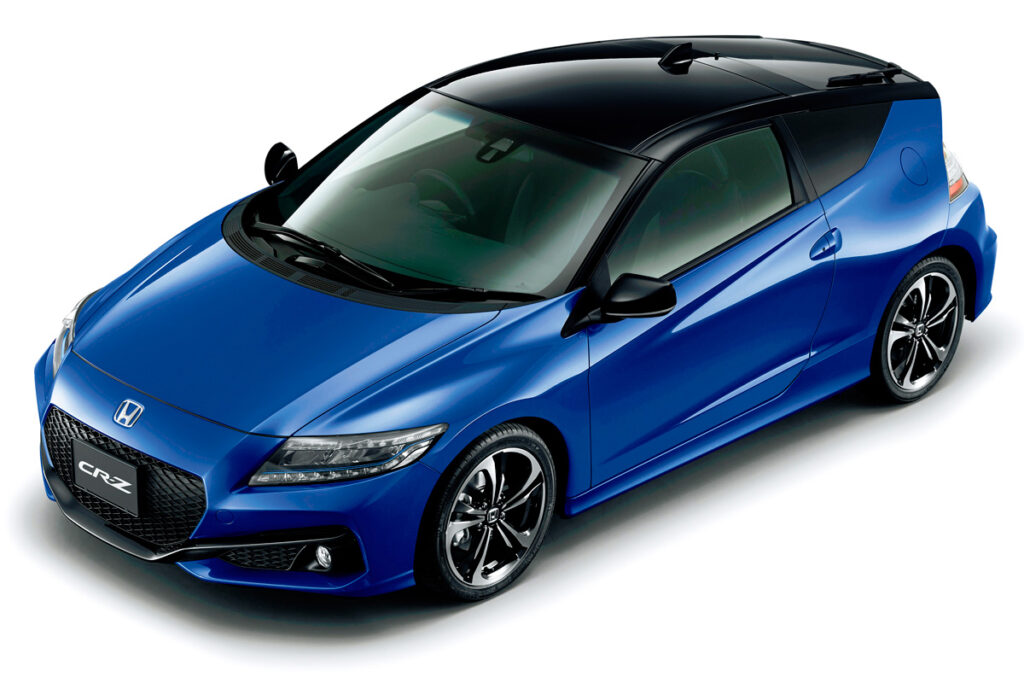
Honda took a unique approach by equipping its CR-Z gas-electric coupe with a six-speed mechanical gearbox. Some automakers are also exploring supercapacitors, which can deliver very high power output for brief periods, as an alternative to conventional batteries.
3. Series-Parallel Hybrid
The series-parallel configuration combines elements of both schemes and is best exemplified by the Toyota Prius and Lexus models with the “h” designation, all powered by Toyota’s proprietary HSD (Hybrid Synergy Drive) system.
How it works:
- A planetary transmission allows the ICE and electric motor to work together or independently.
- The ICE drives the wheels while simultaneously powering a generator.
- No traditional gearbox is needed — instead, onboard electronics regulate the speed of the motors and generator.
- The result is an ECVT (Electro Continuously Variable Transmission), offering smooth and efficient power delivery.
What Kind of Engines Do Hybrid Cars Use?
The vast majority of hybrid vehicles use gasoline engines, many of which operate on the Atkinson cycle — a design featuring a shorter compression stroke that improves thermal efficiency and reduces emissions. This makes gasoline-electric hybrids excellent performers in terms of both fuel economy and environmental impact.
So why aren’t diesel-electric hybrids more common? A few key reasons:
- The largest hybrid market — North America — has historically had low adoption of diesel passenger vehicles.
- Diesel engines are more expensive to produce than gasoline ones, which would push the already significant hybrid price premium even higher.
- Gasoline-Atkinson cycle engines already achieve outstanding efficiency when paired with an electric motor.
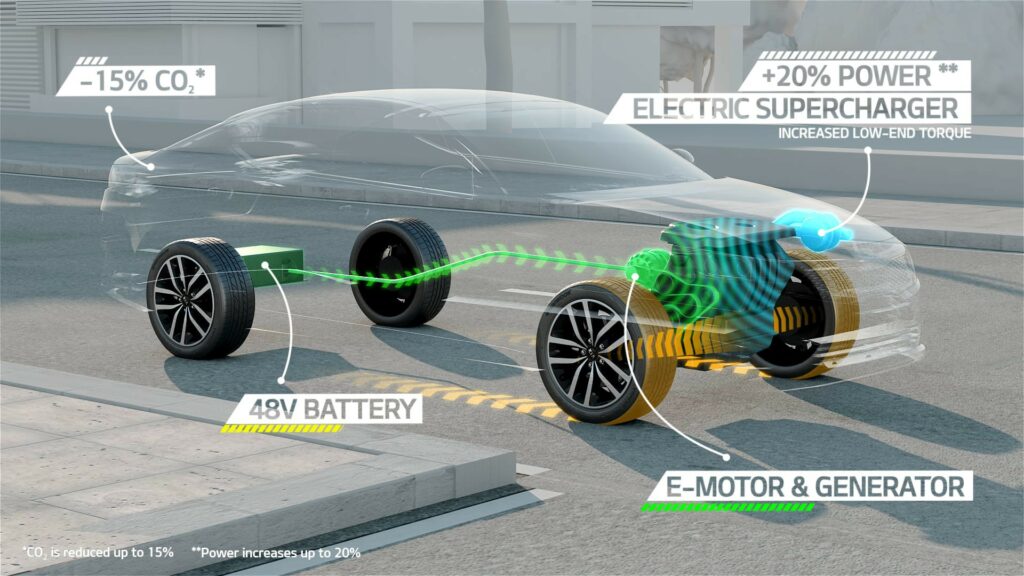
-15% CO₂
+20% POWER ELECTRIC SUPERCHARGER (INCREASED LOW-END TORQUE)
48V BATTERY
E-MOTOR & GENERATOR
This is a translation. You can read the original here: https://www.drive.ru/technic/4efb336400f11713001e4df5.html

Published November 11, 2021 • 4m to read