
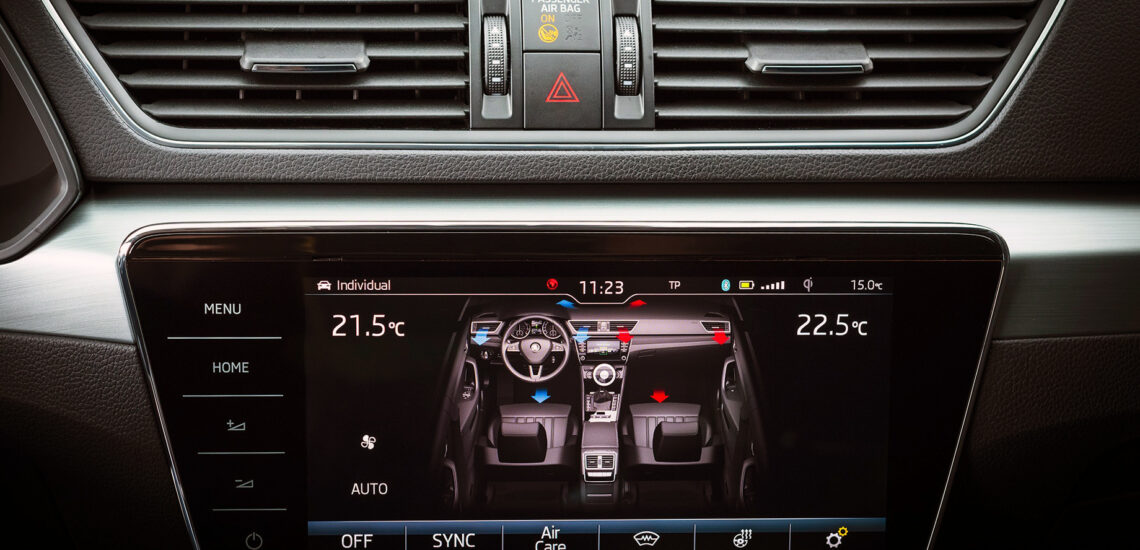

A proper microclimate inside your car is not just about comfort — it’s a matter of road safety. When cabin temperature rises from 25 °C to 35 °C, a driver’s reaction time increases by around 20%. SEAT has even noted that an overheated driver poses a risk comparable to someone with a blood alcohol content of 0.5 ppm. On top of that, modern climate control systems help keep windows clear and fog-free. Understanding how to use them correctly can make every journey safer and more comfortable.
How Much Energy Does Car Climate Control Actually Use?
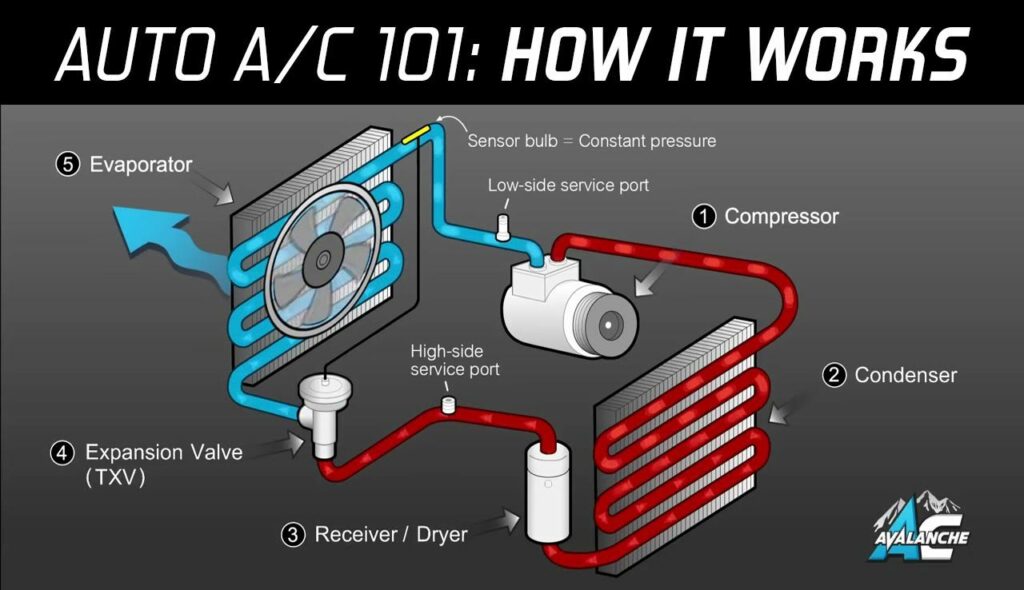
Here’s a surprising fact: car heaters and air conditioners can reach 8–10 kW of power, yet maintaining a comfortable body temperature actually requires 50–100 times less energy. The bulk of that energy goes toward heating or cooling the car itself — the body panels, dashboard, seats, and interior trim — not just the air around you.
One particularly efficient solution is seat heating or ventilation. Since roughly one-third of a passenger’s body surface is in contact with the seat, heating or cooling the seat directly delivers a noticeable effect at a fraction of the energy cost. Regardless, the climate system still needs to supply at least 5 to 10 cubic metres of fresh air per minute, depending on the size of the vehicle.
What Is the Ideal Temperature for a Car Cabin?
The most comfortable cabin temperature is generally between 18 and 22 °C — but that’s an average. Human physiology actually prefers a slight temperature gradient from floor to ceiling:
- The floor area should be 5–8 °C warmer than the head zone — warm feet and a cool head is the natural physiological ideal
- In winter, direct hot air downward toward the feet and legs
- In summer, direct cool air toward the central vents — this cools the chest, back, and arms most effectively and also helps cool the rear cabin
Understanding Your Climate Control Temperature Settings
The number on your automatic climate control panel is not a precise cabin temperature in degrees Celsius — it’s more of a comfort index. Manufacturers calibrate these settings differently by region and brand, which can cause confusion when switching cars:
- A European car (e.g. Volkswagen) set to 20–22° may feel the same as a Japanese car (e.g. Nissan) set to 22–24°
- If you’ve switched brands and suddenly feel cold at your usual setting, the calibration difference is likely the cause
- Adjust your comfort index based on how you actually feel, not on the number itself
How Air Direction Controls Actually Work
Manual air direction control is more of a guide than an absolute setting. Even with a direct mechanical lever set to “legs,” some air will always be redistributed. Here’s how it typically breaks down:
- 80–90% of airflow goes in the direction you’ve selected
- 10–20% is always directed toward the windshield and side windows to prevent fogging and maintain a comfortable temperature gradient between layers
Today, virtually all climate systems are powerful enough to handle this split efficiently. The real difference between an average and a premium climate control system lies in how well it manages these subtle air distribution nuances automatically.
Dual-Zone vs. Single-Zone Climate Control: What’s the Difference?
Separate (dual-zone) climate control is a genuine advantage — but not all systems sold under that name are equal. Here’s what to look for:
- Basic dual-zone systems — allow individual temperature adjustment for driver and passenger only
- Mid-range systems — also let you independently control the direction and intensity of airflow per zone
- Advanced systems — offer fine-tuned temperature layering, adjusting the temperature difference between head and foot level separately for each zone
The limitation of entry-level dual-zone systems: if the driver needs to defrost a side window, it may redirect heat away from the passenger’s foot area. More sophisticated systems eliminate these trade-offs entirely.
What Makes a Good Climate Control Interface?
The control panel is the face of any climate system. A well-designed interface should be:
- Logically laid out and usable while wearing gloves
- Informative in auto mode — displaying airflow direction and intensity, not just an “Auto” indicator light
- Quick to activate air recirculation — particularly important when driving behind heavily polluting vehicles on a highway, where closing the recirculation flap is the only reliable way to block exhaust fumes and soot from entering the cabin
Smart Sensors in Modern Climate Control Systems
Even entry-level automatic climate systems include a solar radiation sensor, since sunlight on skin directly changes our perceived temperature. More advanced systems layer in additional data sources to continuously fine-tune cabin conditions:
- Multiple solar radiation sensors (one per zone)
- Infrared sensors to detect fogging on the windshield and front side windows
- Air quality sensors
- CO₂ concentration monitors inside the cabin
- Navigation system integration — for example, pre-adjusting settings before entering a tunnel
- Temperature sensors at multiple points within the HVAC unit itself
In reality, cabin temperature is fluctuating constantly — but when the climate system is properly calibrated, you simply never notice it.
Common Climate Control Mistakes Drivers Make
In most modern cars, automatic climate control outperforms a driver managing things manually. Anyone who regularly uses taxis has likely experienced the full spectrum of climate control mismanagement. The most frequent mistakes include:
- Directing hot air upward instead of toward the feet and floor
- Turning the fan off completely — this effectively disables the entire climate system, since air exchange stops altogether
- Incorrect temperature distribution across the cabin, leading to driver fatigue and slower reaction times
Poor air circulation and wrong temperature layering are a direct path to driver fatigue — which, as mentioned above, has measurable and serious consequences for road safety.
The Golden Rule: Let Your Car’s Climate Control Do Its Job
The single most effective piece of advice for using climate control properly is this: set your comfort index, press Auto, and leave it alone. To help the system work at peak efficiency, follow these simple guidelines:
- Open all air vents — don’t block any deflectors
- Don’t obstruct the climate sensors
- Keep the windows and sunroof closed while the system is running
- If it’s mild outside and windows aren’t fogging, you can manually switch off the air conditioning compressor to save fuel
Modern compressors adjust their output smoothly and are far more efficient than they were 20 years ago — but physics still applies. Running the air conditioner will always add a few percent to fuel consumption. There’s no way around that.
How Modern HVAC Units Work — and What’s Improving
Modern HVAC (Heating, Ventilation, Air Conditioning) units — the systems that condition and deliver air to the cabin — are built for year-round compressor use. The traditional “heater valve” concept is largely obsolete: in most modern cars, coolant continuously circulates through the heater radiator in both winter and summer.
While the core structure of HVAC units hasn’t changed dramatically, steady engineering improvements have made them noticeably better:
- Quieter operation — thanks to brushless fan motors mounted on soft supports and special deflector coatings
- Start-stop system compatibility — evaporators with thermal accumulators (sealed tubes of liquid embedded in the core) maintain coolness briefly after the engine cuts out
- Advanced deflectors — newer designs allow adjustment of not just direction and intensity, but also the “focus” of the airflow
Why Heating a Modern Car Is Getting Harder
Counterintuitively, warming a modern car cabin is becoming more challenging — not easier. The more fuel-efficient and environmentally friendly modern engines become, the less waste heat they produce. To compensate, manufacturers use several strategies:
- Adjusted ignition timing to generate more engine heat when needed
- Partial air recirculation to retain warmth already inside the cabin
- Higher-quality soldered radiators for faster and more efficient heat transfer
- PTC (Positive Temperature Coefficient) electric heaters — now common in modern turbocharged and low-displacement engines
PTC heaters are not simple coil elements. They use doped polycrystalline ceramics based on barium titanate, and their power output automatically adjusts with temperature — operating at around 270 °C with efficiency exceeding 90%. Typical PTC heaters in passenger cars have a capacity of around 1–1.5 kW.
Climate Control in Electric Vehicles: Heat Pumps and Efficiency
The biggest wave of innovation in automotive climate control is being driven by the rise of electric vehicles, where energy efficiency is critical. To put it in perspective: just five minutes of operation of the Tesla Model S’s 6 kW heater is enough to consume roughly 3 km of driving range.
This has accelerated the adoption of heat pumps — essentially air conditioning systems running in reverse — which move heat rather than generate it, delivering far greater efficiency. EV manufacturers are also pushing efficiency in other ways:
- Automatic systems favour recirculation mode to avoid conditioning fresh outside air unnecessarily
- Some systems selectively disable air exchange in sections of the cabin where no passengers are seated
Final Thoughts: Press Auto — but Know Your System
Automation is one of the best things to happen to in-car climate control. When these systems are well-calibrated and left to manage themselves, they genuinely reduce driver workload and improve safety. The caveat is that fully capable, well-tuned climate systems tend to appear only in premium-segment vehicles. It’s not just about sensor count or heater power — it’s also about calibration, software, and accumulated manufacturer expertise.
So by all means, press Auto — but know the system you’re working with, and stay aware of how your car is actually managing your comfort.
This is a translation. You can read the original here: https://www.drive.ru/technic/5eb26b30ec05c4794c0000c3.html

Published August 26, 2021 • 8m to read