

When billionaire Bill Gates and Khosla Ventures decided to invest millions in EcoMotors — a company designing opposed-piston engines — the automotive world took notice. Opposed-piston engines have a long and storied history, yet they’ve remained largely absent from road transport. EcoMotors set out to change that with a fresh take on this overlooked technology.
What Is the OPOC Engine?
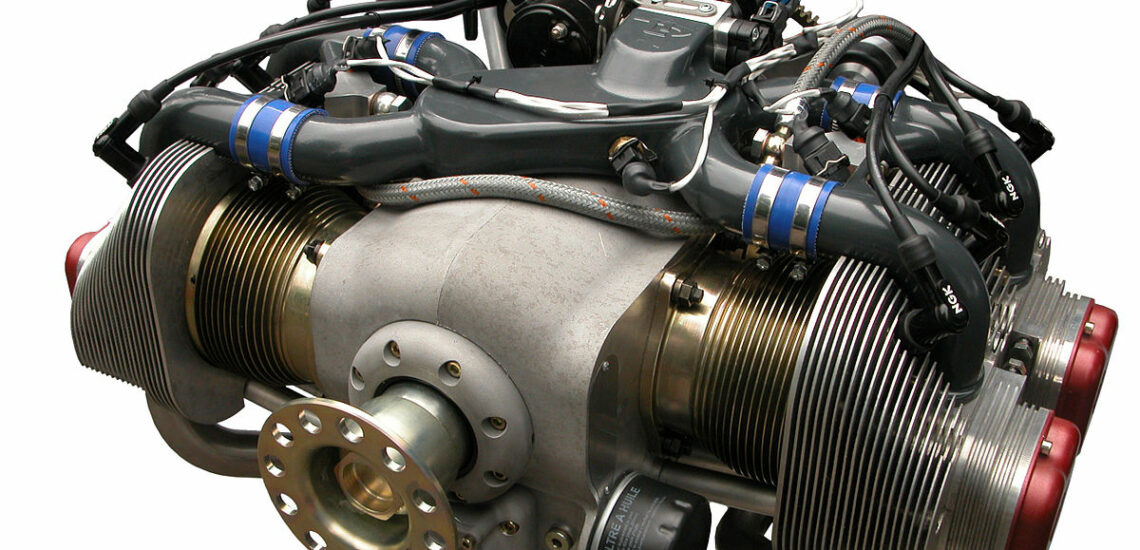
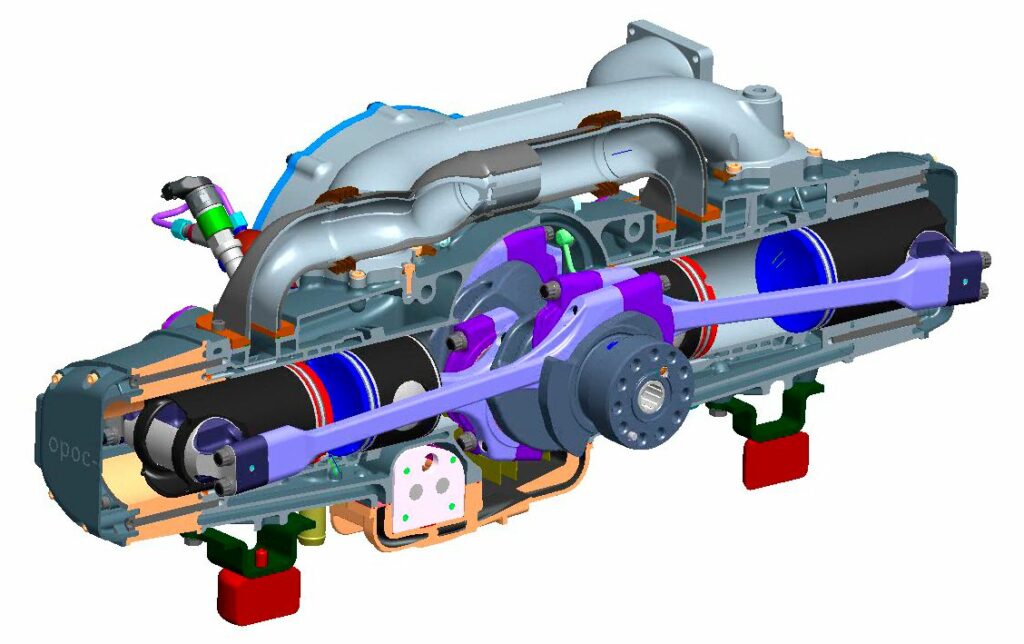
EcoMotors named its engine the OPOC — short for Opposed Piston Opposed Cylinder. The design features two cylinders, each housing two pistons facing each other. While the OPOC architecture is compatible with gasoline engines (including alcohol-fueled variants), EcoMotors has focused primarily on diesel applications.
How the OPOC Engine Works
The OPOC engine runs on a two-stroke cycle, meaning the opposed pistons in each cylinder complete a power stroke in a single crankshaft revolution. As the pistons travel toward their dead points, they uncover ports in the cylinder walls — one piston controls intake, the other controls exhaust. The port timing is carefully staggered so that the exhaust port opens slightly earlier and closes earlier than the intake port, which is essential for efficient gas exchange.
Eliminating cylinder heads, valves, and their associated actuation hardware has produced significant gains. According to EcoMotors, compared to a conventional diesel engine of equivalent power, the OPOC delivers:
- 50% reduction in friction losses
- 50% lower oil consumption
- 50% fewer total components
- 30–50% reduction in weight
- 2–4× smaller footprint under the hood
The Key Innovation: A Single Central Crankshaft
What sets the OPOC apart from earlier opposed-piston designs is its use of a single central crankshaft. Previous iterations required two crankshafts — one at each end of the engine — making them considerably larger and heavier. That bulk confined those older designs to diesel locomotives and ships. By consolidating everything around one central crankshaft, EcoMotors has made the opposed-piston format viable for a much broader range of vehicles.
The Electric Turbocharger: Solving the Two-Stroke Scavenging Problem
Like all two-stroke engines, the OPOC requires an external device to scavenge the cylinders when the ports are open. EcoMotors assigned this role to the turbocharger — but that introduces an obvious problem: a turbocharger is useless at startup before exhaust gases build up pressure.
The solution is an integrated electric motor mounted on the turbocharger shaft. This is not an entirely new concept, but EcoMotors was among the first to bring it to a production-oriented design. Here’s how it works:
- At startup: The electric motor draws from an onboard battery pack to spin the turbocharger and provide cylinder scavenging before the engine reaches operating speed.
- At cruise: The electric motor switches off, and the turbocharger operates conventionally.
- At high load: When exhaust flow is strong, the electric motor reverses role and acts as a generator, recovering energy and recharging the battery.
Performance Potential and Theoretical Advantages
The OPOC’s two-stroke architecture is theoretically capable of delivering twice the power-to-displacement ratio of a comparable four-stroke engine — though this ceiling hasn’t been reached in practice. Another mechanical advantage comes from piston travel: because two opposing pistons share the stroke distance, each piston only needs to travel half the distance of a conventional piston at the same engine speed. This translates directly into lower piston speeds and reduced friction losses.
EcoMotors also claims the OPOC’s combustion chamber geometry enables exceptionally thorough cylinder scavenging, further maximizing the efficiency of the two-stroke cycle.
Peter Hofbauer: The Engineer Behind the Engine
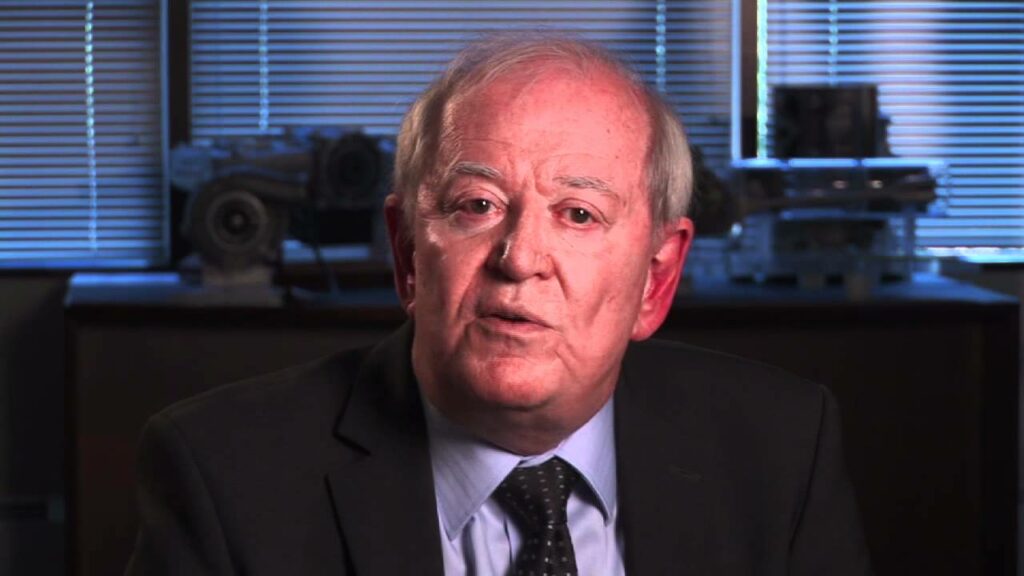
The OPOC owes much of its ingenuity to Peter Hofbauer, founder, chairman, and CTO of EcoMotors. Hofbauer spent over two decades leading advanced engine development at Volkswagen, where he was responsible for innovations including the VR6 — VW’s compact 15-degree narrow-angle V6 engine. He began conceptualizing the OPOC layout several years before founding EcoMotors in 2008, and his background lends considerable credibility to the project.
Real-World Specs: The EM100 Model
EcoMotors’ flagship diesel prototype, the EM100, has accumulated over 500 hours on a chassis dynamometer — enough to confirm that the core design functions as intended. However, the picture is more nuanced when it comes to claimed performance figures. At maximum output settings, the EM100 meets its power and torque targets only without emissions controls active. In that configuration, EcoMotors markets it primarily for military applications, where power-to-weight ratio takes precedence over exhaust compliance.
For civilian road vehicles, EcoMotors offers a differently tuned version of the same engine with the following specs:
- Output: 300 hp
- Torque: 746 N·m
- Fuel efficiency improvement: ~15% over conventional diesel
- Emissions: Compatible with standard road regulations in this configuration
While 15% may seem modest compared to the headline 45–50% efficiency claim, it still represents a substantial gain in an industry where engineers routinely fight for fractions of a percent.
Modular Design: Two Engines, One Powertrain
One of the most compelling aspects of the OPOC architecture is its modular scalability. EcoMotors proposes pairing two OPOC units into a single four-cylinder powertrain connected by an electronically controlled coupling. The system works like this:
- At low load: Only one module runs, operating in its most efficient range.
- At high load: The second module is engaged seamlessly via the electronic coupling.
- Vibration: Because the OPOC is inherently well-balanced, the reactivation of the dormant module produces minimal noise or harshness.
This is conceptually similar to cylinder deactivation in large V-engines — but with a crucial difference. In conventional cylinder cutoff systems, the deactivated pistons continue moving up and down, generating parasitic drag. In the OPOC modular setup, the inactive unit stops completely, eliminating that loss entirely. In the paired configuration, each module is rated at 240 hp, yielding a combined output of 480 hp, while reportedly achieving the maximum 45% fuel efficiency improvement and compliance with strict exhaust emissions standards.
What’s Next: The EM65 and Expansion Plans
EcoMotors has also drawn up a smaller sibling to the EM100: the EM65, a 75 hp two-cylinder unit that is lighter and more compact than the flagship diesel model. Unlike the EM100, the EM65 is planned as a gasoline-powered engine, opening the door to a wider range of applications:
- Light trucks and vans
- Passenger cars
- Hybrid-electric vehicles
The OPOC is still a developing technology, and many of EcoMotors’ boldest claims remain to be validated under real-world conditions. That said, the pedigree of its chief designer — a man who gave two decades to Volkswagen — offers meaningful credibility. It’s also worth noting that Hofbauer’s work on the OPOC echoes early Porsche engineering philosophy, a fitting echo given Ferdinand Porsche’s own foundational role in building the Volkswagen brand.
This is a translation. You can read the original here: https://www.drive.ru/technic/4efb337600f11713001e5522.html

Published October 21, 2021 • 6m to read