
At the dawn of the 20th century, when automotive engineering was advancing at full speed, a 10-liter engine could be either a single-cylinder unit or, say, a straight-eight. Back then, nobody batted an eye at a 23-liter straight-six or a seven-cylinder radial aircraft engine transplanted into a car.
As mass production scaled up and cost pressures intensified, everything fell into place. The single-cylinder engine became a relic of the past. Today, the average cylinder displacement in a conventional car engine sits between 300 and 600 cubic centimeters, with specific output ranging from around 35 hp/l in a naturally aspirated diesel to 100 hp/l in a high-performance gasoline engine. These are the sweet spots for mass-market production — venturing outside them simply isn’t economical.
So what does the modern engine landscape look like? Generally speaking:
- A 100 hp engine typically has four cylinders
- A 200 hp engine usually runs four, five, or six cylinders
- A 300 hp engine commonly uses eight cylinders
But how can those cylinders actually be arranged? What layout options do engineers have when designing a multi-cylinder engine? Let’s break it down.
Straight Engines: Simple but Increasingly Impractical
The number one question on any engine designer’s mind is how to simplify the design — keeping production costs low and maintenance straightforward. On that front, the inline (straight) engine wins hands down. Cylinders are arranged in a single row, and scaling up capacity is as easy as adding more of them.
Here’s how inline engine variants break down in practice:
- Two- and three-cylinder engines are relatively rare in cars, though the two-cylinder format is staging a comeback thanks to advanced fuel injection and turbocharging — the 85 hp turbocharged two-cylinder in the Fiat 500 being a prime example.
- The straight-four is the workhorse of the passenger car world, covering displacements from 1.0 to 2.4 liters.
- Straight-five engines are a more recent development. Mercedes-Benz pioneered the diesel five-cylinder in 1974 (the 300D on the W123 platform), followed by Audi’s two-liter gasoline five-cylinder two years later, then Volvo and Fiat joining in during the late 1980s.
- Straight-six engines, long a European favourite for their smoothness, have become increasingly rare. Their even longer sibling, the straight-eight, was effectively abandoned back in the 1930s.
Why Length Became the Problem
The reason for this trend is straightforward: the more cylinders you add, the longer the engine gets — and that creates serious packaging headaches. Fitting a straight-six transversely into a front-wheel-drive engine bay, for example, has only been pulled off in a handful of cases: the Austin Maxi 2200 (which required the gearbox to be tucked beneath the engine) and the Volvo S80 with its ultra-compact gearbox.

V-Shaped and Flat Engines: Compact but Complex
So how do you shorten an inline engine? The elegant solution: split it in half, place the two halves side by side, and drive a single crankshaft with both. That’s the essence of the V engine.
The most common V-engine configurations use an included angle of 60° or 90° between the cylinder banks. Push that angle all the way to 180° — cylinders pointing directly away from each other — and you get a flat engine, also known as a boxer engine (hence the B2, B4, B6 designations).
What You Pay for the Compactness
The trade-offs compared to a straight engine are significant:
- Two cylinder heads — each with its own gasket and manifolds
- More camshafts and a more complex valve-drive arrangement
- Greater width (especially for flat engines), which limits where they can be installed
- Higher manufacturing cost and more complex servicing
Because of these downsides, flat engines are used by only a small number of manufacturers — Porsche and Subaru being the most notable today.
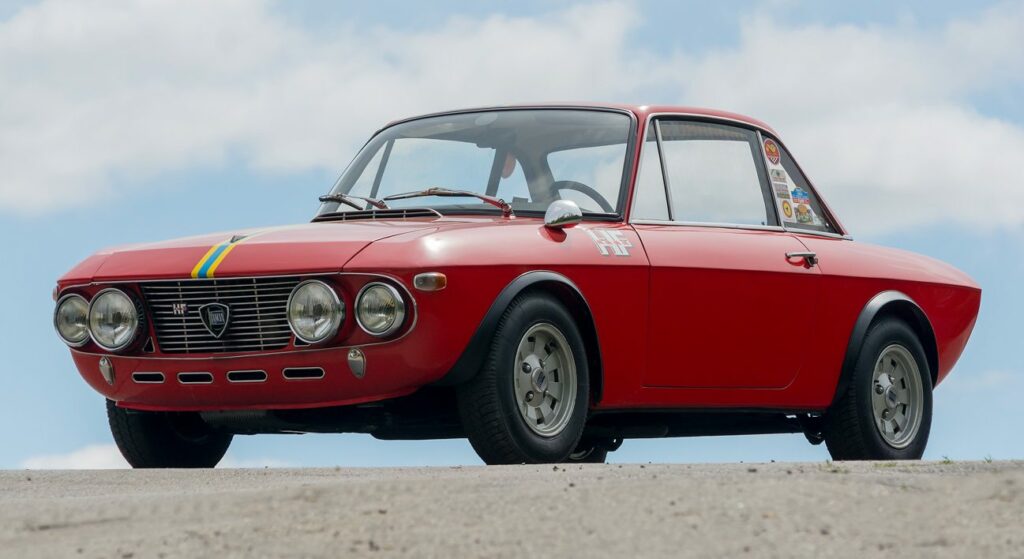
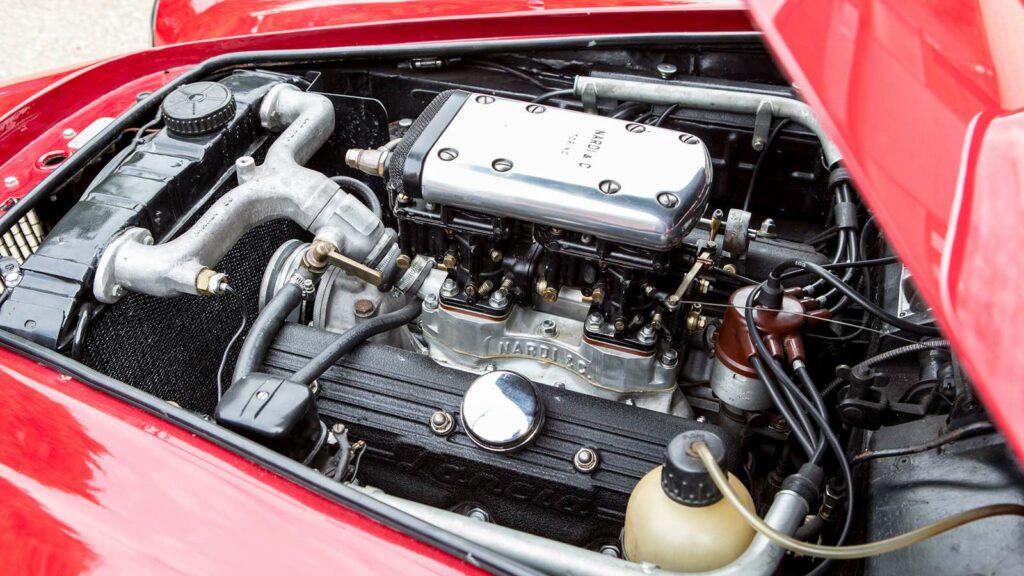
What about making a V engine even more compact by shrinking the included angle below 60°? It’s been done — the Lancia Fulvia of the 1970s ran a V4 with a mere 23° angle. But there’s a catch: the narrower the angle, the harder the engine is to balance. Which brings us to one of the most critical challenges in engine design.
The Engine:
– It uses a unique V4 engine design.
– The V angle is very narrow at just 23°.
– This allowed a single cylinder head for both banks.
– It sends power to the front wheels.
Engine Vibration: Forces, Torques, and How to Tame Them
No piston internal combustion engine is entirely free of vibration — it’s inherent to the design. But managing vibration is critical, not just for passenger comfort. Severe unbalanced vibration can physically destroy engine components, with all the catastrophic consequences that come with parts flying loose at high speed.
Where the Vibration Comes From
Where does engine vibration come from? There are three main sources:
- Uneven firing intervals — in some engine configurations, power strokes don’t fire at perfectly equal intervals, creating torque ripple. A heavier flywheel can help smooth this out.
- Piston inertia forces — as pistons accelerate upward and decelerate at the top of their stroke (and vice versa at the bottom), they generate inertial forces similar to what you feel when a car brakes or accelerates.
- Connecting rod geometry — the connecting rod doesn’t travel in a straight line, and the piston’s movement isn’t a perfect sinusoid, which introduces additional force components at multiples of crankshaft speed.
These higher-order inertial forces are generally negligible — except for second-order forces, which act at twice the crankshaft frequency and must always be accounted for. When inertial forces in adjacent cylinders act in opposite directions at a fixed distance from each other, they also generate torque couples, adding another layer of complexity.
The Two Ways to Fight It
Engineers have two main tools to fight these forces:
- Choose an inherently balanced configuration — arrange cylinders and crankshaft throws so that forces and torques cancel each other naturally.
- Add balance shafts — secondary shafts with counterweights that rotate in the opposite direction to the crankshaft, generating equal and opposite forces. These add cost and mechanical complexity but can fully neutralize problematic vibration modes.
Of all common engine layouts, only two are theoretically perfectly balanced: the straight-six and the flat-six. This is precisely why BMW and Porsche have held onto these configurations so fiercely — and why others have been reluctant to abandon them despite the packaging challenges.
Engine Balance by Configuration: A Practical Guide
Let’s look at how each major engine configuration fares in the real world when it comes to vibration and balance.
Two-Cylinder and V-Twin Engines
Two-cylinder straight engines (cranks in the same direction) behave similarly to a single-cylinder in terms of balance — both pistons rise and fall in phase. The Russian Oka used two counterrotating balance shafts to deal with first-order inertial forces, but second-order forces were left unchecked. Adding two more balance shafts would have been wholly impractical on such a small, affordable car.
Many two-cylinder engines — like the original 1957 Fiat 500 and the Indian Tata Nano — simply ran without any balance shafts, relying on compliant engine mounts to absorb the vibration. Cheap, simple, and acceptable for budget applications.
Two-cylinder engines with cranks at 180° (pistons moving in antiphase) offer better primary balance but can only achieve even firing intervals in two-stroke form — as used on pre-war DKWs and their descendants, the East German Trabant.
V-twin engines survive today almost exclusively on motorcycles — Harley-Davidson and its Japanese imitators being the obvious examples. The NAMI-1 stands as virtually the only car ever to use this layout. Counterweights on the crankshaft can bring it close to full balance, but even firing intervals remain out of reach.
Three, Four and Five Cylinders
Three-cylinder engines are worse balanced than a straight-four. Manufacturers like Subaru and Daihatsu fit balance shafts as standard; Opel’s decision to skip one in the Ecotec three-cylinder for the second-generation Corsa saved cost but earned the car a rough reputation with German automotive press after its 1996 debut — it was described as “absolutely impossible to drive around the city in variable modes.”
Straight-four engines — the most common layout in the world — have a free second-order inertial force that can only be neutralized by a balance shaft running at twice crankshaft speed. To cancel the resulting torque, a second counter-rotating shaft is needed. Expensive, yes — but Mitsubishi, Saab, Ford, Fiat, and Volkswagen Group brands have all used this setup when refinement demanded it.
Flat-four engines do slightly better than their inline counterparts — only a second-order torque couple remains, tending to yaw the engine around its vertical axis. Even so, both the air-cooled Beetle engine and Subaru’s boxer units have managed without balance shafts for decades.
Straight-five engines have compensated primary inertial forces but suffer from a rolling bending torque that constantly travels through the block — demanding an exceptionally rigid structure. Mercedes-Benz, Audi, and Volvo tackled this through refined engine mounts and counterweights (such as the supercharged 2.5 TFSI in the Audi TT RS), while Fiat’s engineers went further and used a full balance shaft.
One interesting footnote: almost all five-cylinder engines are essentially four-cylinder engines with one extra cylinder bolted on. This modular approach allows shared pistons, connecting rods, and valvetrain components — only the block, head, and crankshaft (with throws at 72° intervals) need to change.
V6 and V8 Engines
V6 engines that replaced straight-sixes share the same balance characteristics as a three-cylinder — which is to say, not ideal. The very first Mercedes-Benz V6 (the M112, with three valves per cylinder) addressed this with a balance shaft mounted in the valley between the banks. The PSA Group’s three-liter six-cylinder placed one in a cylinder head. Other manufacturers opted for careful crank pin offsetting — as seen on the Audi V6 — to minimize vibration without the added complexity.
V6 engines with a 90° included angle add another headache: inherently uneven firing intervals that a weighted flywheel can only partially smooth out.
V8 engines with a 90° bank angle and crankshaft throws in two mutually perpendicular planes are very well balanced. Even firing intervals are achievable, and only two residual torque couples remain — easily addressed by counterweights on the end journals of the crankshaft. This is a big part of why American engineers embraced the V8 so enthusiastically: they simply don’t tolerate vibration.
V4, V10 and the Exotic Layouts
V4 engines were rare and are now all but extinct in cars. The European Ford V4 (used in the Taunus, Capri, and Saab 96) and the Zaporozhets’ quirky V4 both required a balance shaft for first-order torque couples. Compactness and cost were the driving factors — balance was secondary.
V10 engines share the same balance characteristics as a straight-five. That didn’t stop the designers of Formula 1 engines, the Dodge Viper, or the Dodge RAM from using them — when you need the power, you manage the vibration.
As for the more exotic layouts: the flat-eight (as used in Porsche 917 racing cars) is effectively two flat-fours on a common crankshaft, while V12 and flat-12 engines reduce to two straight-sixes — explaining their exceptional smoothness.
VR6, VR5, and W-Engines: Volkswagen’s Packaging Masterstroke
We touched on narrow-angle V engines like the Lancia Fulvia earlier. For decades these were avoided — harder to balance than 60° or 90° layouts, with packaging gains that didn’t seem worth the trouble. Then the priorities shifted.
Two developments changed the game:
- Hydraulic engine mounts became widely available, dramatically suppressing vibration transmission regardless of the engine’s theoretical balance.
- Underhood space became increasingly scarce, making compactness a premium trait. Who would have imagined a modest hatchback hiding a 2.8-liter six-cylinder engine? Volkswagen made it happen.
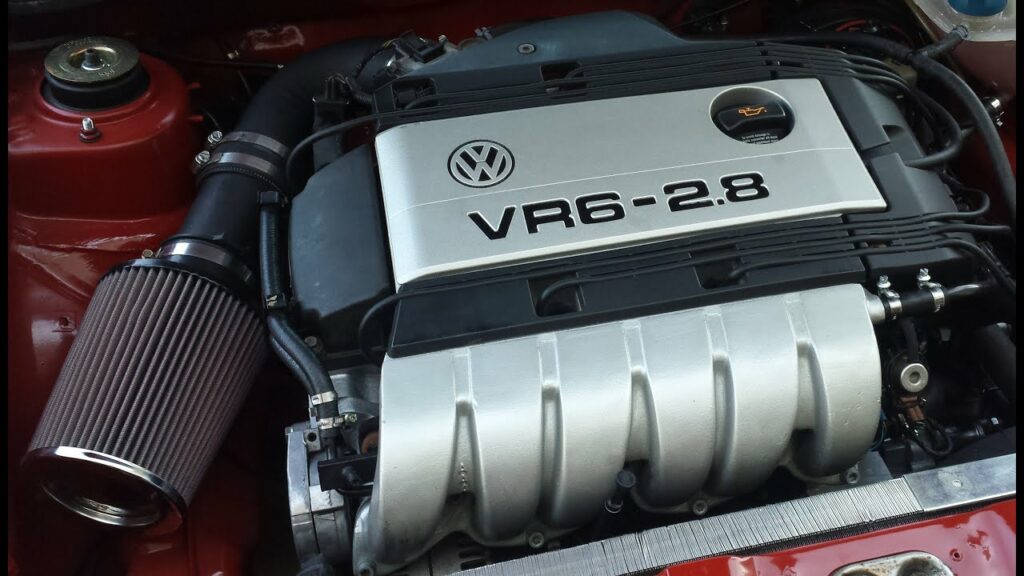
The Volkswagen VR6 — the “VR” standing for V-Reihen (V-inline) — takes the narrow-angle concept further than Lancia ever did, using just a 15° angle between banks. The result is so compact it effectively functions as an offset inline engine, and remarkably, it uses a single cylinder head for both banks. A 2.8-liter six-cylinder engine that fits where a conventional V6 wouldn’t — debuted in the third-generation Volkswagen Golf.
From the VR6 to the W16
From there, Volkswagen’s engineers ran with the concept:
- The VR5 arrived as the VR6 with one cylinder removed.
- The W8 combined two shortened VR units (four cylinders each) on a single crankshaft — fitted to the flagship Passat sedan.
- The W12 debuted in 1998 on the W12 Roadster concept: two VR6 engines mated at a 72° angle on one crankshaft.
- The W16 — with four turbochargers — powers the Bugatti Veyron to 431 km/h, making it the most extreme production application of this architecture.
Why didn’t these layouts exist before? Modern computer-aided design made them possible. Optimizing the included angle, crank pin positions, firing order, and balance characteristics across such complex geometries would have been practically impossible without the computational power available from the 1990s onward. The crankshaft of a W12 alone is a machinist’s nightmare — the kind of part that only makes sense when a computer has verified every tolerance.
What Actually Matters in Real-World Engine Design
If there’s one takeaway from all of this, it’s that theoretical balance is rarely the deciding factor when an engineer chooses an engine layout. The real priorities are:
- Packaging — does it fit in the engine bay?
- Weight and power density — what’s the best ratio for the application?
- Production cost — can it share components across a model range?
- Modularity — increasingly, manufacturers build entire engine families from a common piston and bore architecture, from three-cylinder economy units all the way up to twelve-cylinder flagships
Mercedes-Benz’s current engine lineup is a textbook example of the modular approach: a shared architecture underpins engines across vastly different power outputs and cylinder counts.
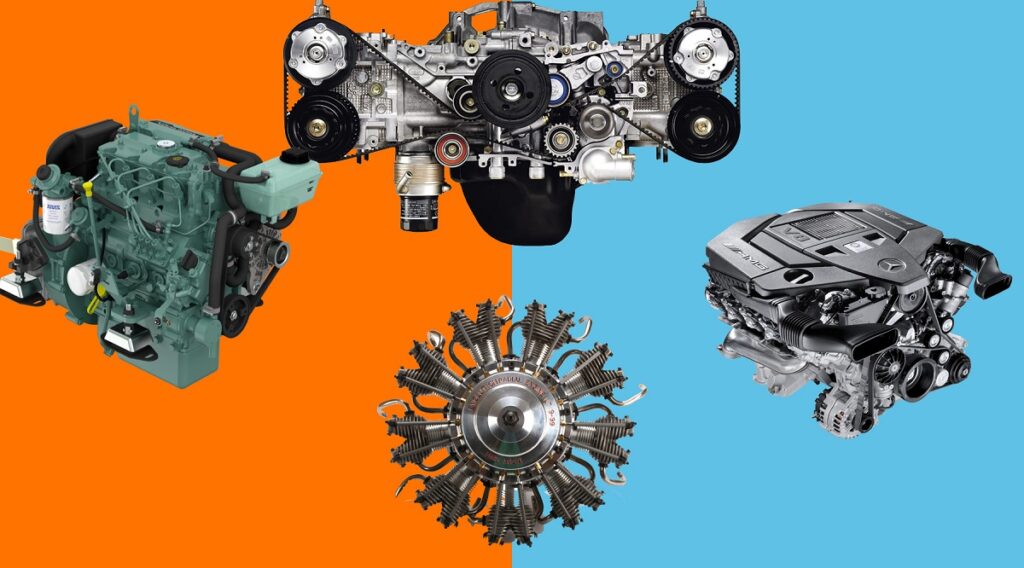
Flat (Boxer) Engine (Top): The cylinders lie horizontally and point away from each other in a 180-degree layout. Brands like Porsche and Subaru commonly use this setup for a lower center of gravity.
Radial Engine (Bottom): The cylinders are mounted in a circle around a central crankshaft, resembling a star. These were traditionally used in classic propeller airplanes.
Inline (Straight) Engine (Left): The cylinders are placed one after another in a single straight row. This is the most common design found in standard everyday cars.
V-Engine (Right): The cylinders are split into two rows angled toward each other, forming a “V” shape. This configuration allows for higher cylinder numbers (like V6 or V8) in a much tighter space.
Theoretical Balance Is Not Actual Balance
And as for vibration — it’s worth remembering that theoretical and actual balance are two very different things. Even a perfectly balanced straight-six will shake if its crankshaft assembly isn’t properly balanced or if its pistons and connecting rods vary noticeably in weight.
Real-world production tolerances and component deformation under load mean that no engine is ever as smooth in practice as the equations suggest. That’s why engine mount design — the way the powerplant is isolated from the rest of the car — is every bit as important as the layout itself. Sometimes more so.
Engine Configurations: The Key Facts
- Typical modern cylinder: 300 to 600 cubic centimeters, with specific output from about 35 hp/l in a naturally aspirated diesel to 100 hp/l in a high-performance gasoline engine
- Inline layouts: the simplest and cheapest to build, but length becomes a packaging problem beyond four cylinders
- V and flat layouts: shorter, at the price of two cylinder heads, more camshafts, extra width and higher cost
- Common V angles: 60° or 90°; open it to 180° and the engine becomes a flat, or boxer, unit
- Perfectly balanced in theory: only two layouts — the straight-six and the flat-six
- Narrow-angle V engines: the Lancia Fulvia V4 at 23°, and Volkswagen’s VR6 at 15° with a single cylinder head for both banks
- The extreme case: the four-turbo W16 that takes the Bugatti Veyron to 431 km/h
- What decides the layout: packaging, weight and power density, production cost and modularity — not theoretical balance
Frequently Asked Questions
Which engine layouts are perfectly balanced? Of the common ones, only the straight-six and the flat-six. That is why BMW and Porsche have held onto them despite the packaging difficulties they bring.
What is a boxer engine? A V engine opened all the way to 180°, so the cylinders point directly away from each other — hence the B2, B4 and B6 designations. Porsche and Subaru are the most notable users today.
Why did straight-eights disappear? Every added cylinder makes an inline engine longer, and the straight-eight was effectively abandoned in the 1930s. Even the straight-six is now rare, and fitting one transversely has been managed only in isolated cases such as the Austin Maxi 2200 and the Volvo S80.
What does the “VR” in VR6 stand for? V-Reihen, or V-inline. The 15° angle makes the engine behave like an offset inline unit, compact enough to put a 2.8-liter six into the third-generation Golf.
Do balance shafts solve vibration completely? They can fully neutralize particular vibration modes, but they add cost and mechanical complexity, so many engines go without them and rely on compliant engine mounts instead. In practice, mount design matters as much as the layout.
This is a translation. You can read the original here: https://www.drive.ru/technic/4efb337600f11713001e54e1.html

Published October 28, 2021 • 14m to read