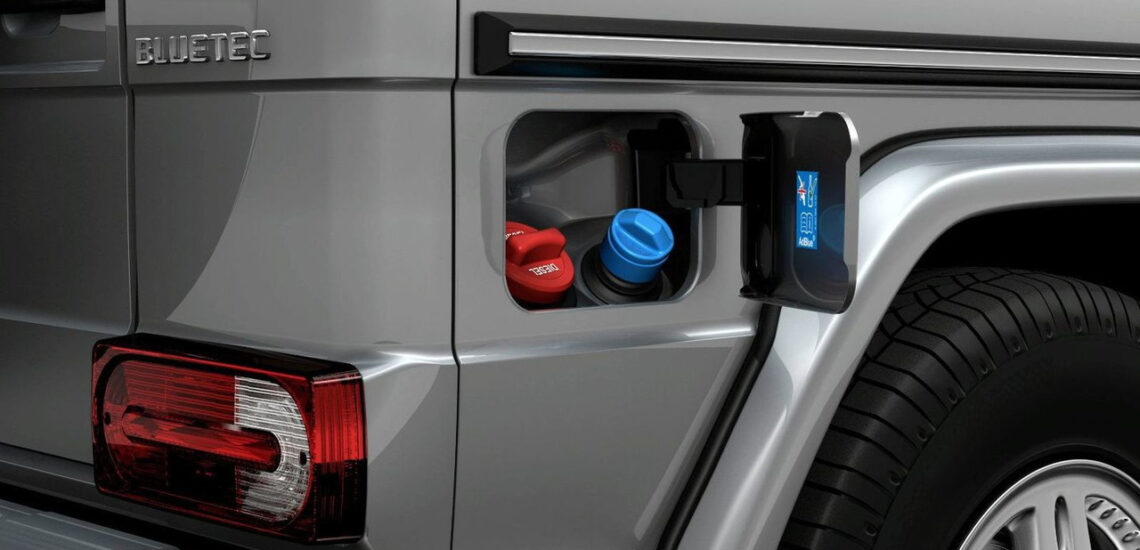

Automakers have long pursued cleaner, greener vehicles — experimenting with solar panels, electric and hybrid drivetrains, and hydrogen technologies. Some of these developments reached mass production; others never made it past the prototype stage. One technology that did make it to the assembly line — and made a real difference — is Mercedes-Benz BlueTec. While not a revolutionary leap, BlueTec is a highly effective exhaust gas cleaning system for diesel engines that has helped diesel cars meet some of the world’s strictest emissions standards.
Why Diesel Engines Need a Specialized Exhaust Cleaning System
Most modern gasoline-powered cars rely on a three-way catalytic converter — a relatively simple, affordable, and durable solution. Inside, platinum and palladium neutralize CO (carbon monoxide) and CH (hydrocarbons), while rhodium tackles NOx (nitrogen oxides). Through oxidation and reduction, these toxic components are converted into carbon dioxide (CO₂), nitrogen (N₂), and water vapor.
Diesel engines, however, present a fundamentally different challenge. Their combustion process produces not only CO, CH, and NOx, but also significant quantities of soot particles — fine carbon particulates known to promote cancer cell growth. What makes diesel exhaust especially tricky to clean is a key trade-off:
- Reduce soot → NOx levels rise sharply
- Reduce NOx → soot levels increase
- This balance shifts depending on engine operating mode, not just fuel mixture
This means that tackling diesel emissions requires a multi-stage cleaning system — something far more complex than a single three-way catalyst.
Early Attempts at Diesel Exhaust Treatment
Several major manufacturers — including Toyota, Citroën, and Mitsubishi — experimented with integrated diesel exhaust cleaning systems. Some of these solutions were technically impressive, but most suffered from the same set of problems:
- Excessive size and weight
- High manufacturing costs
- Complexity comparable to industrial oil refinery equipment
- Questionable viability for mass-market passenger vehicles
Engineers did manage to solve the soot problem relatively quickly and cheaply — through diesel particulate filters (DPF), now standard on most modern diesel engines. Combined with conventional oxidation catalysts to handle CO and CH, this addressed two of the three major pollutants. But NOx remained a stubborn problem, especially under high-load driving conditions where levels can spike far beyond Euro-4 or Euro-6 limits.
What Is Mercedes-Benz BlueTec?
BlueTec is Mercedes-Benz’s proprietary diesel exhaust aftertreatment technology. It was designed to bring diesel engines — including those originally built to Euro-3 standards — into full compliance with Euro-5 and even Euro-6 nitrogen oxide limits, with minimal changes to the engine itself. That’s a remarkable engineering achievement.
What many people don’t realize is that BlueTec is not a single system — it encompasses three distinct subtypes, each designed for a different vehicle type or market. All three were used across Mercedes-Benz and Chrysler vehicles.
BlueTec Type 1: Urea Injection for Trucks and Buses
DaimlerChrysler first introduced urea-based BlueTec technology in 2002, running prototype vehicles on European and American roads for several months of real-world testing. By early 2005, serial diesel trucks were equipped with the system. Buses followed, and eventually the technology migrated to passenger vehicles such as the Mercedes-Benz GL SUV and Mercedes E 320 CDI BlueTec.
This version of BlueTec works through the following process:
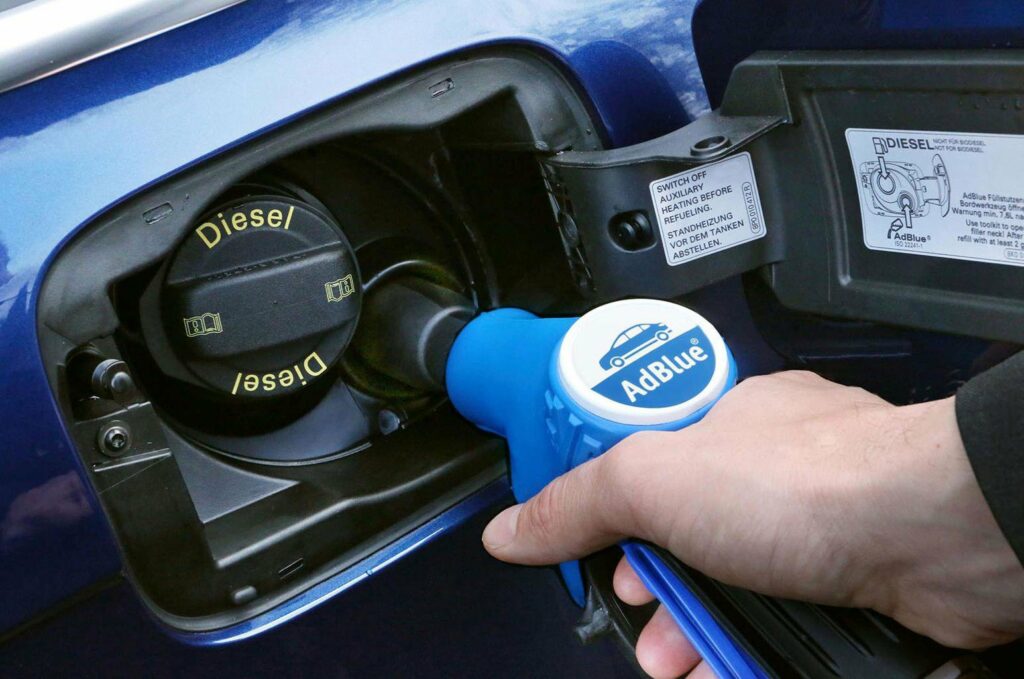
- AdBlue injection — A liquid reagent called AdBlue (an aqueous solution of urea — water plus ammonia) is injected directly into the exhaust stream
- SCR catalyst reaction — The exhaust-AdBlue mixture enters a Selective Catalytic Reduction (SCR) catalyst, where ammonia reacts with nitrogen oxides at around 250–300°C
- Harmless byproducts — NOx is broken down into harmless nitrogen (N₂) and water vapor; remaining harmful components are also oxidized
BlueTec Type 2: Advanced Multi-Stage System for the Vision GL 320
The version installed on the Vision GL 320 BlueTec SUV is more sophisticated, adding upstream filtration before the SCR stage. Its cleaning process works in four steps:
- Oxidation catalyst + particulate filter — Exhaust gases pass through a combined unit immediately after the exhaust manifold; platinum and palladium neutralize CO and CH, while the filter captures and oxidizes soot particles
- Mixing chamber — The semi-cleaned exhaust is blended with AdBlue reagent
- SCR catalyst — NOx is reduced to nitrogen and water, as in the truck version
- Clean exhaust released — Only after this multi-stage process do the gases exit the tailpipe
AdBlue Consumption and Maintenance
One of the practical advantages of the BlueTec urea system is surprisingly low AdBlue consumption. For passenger cars, AdBlue usage is approximately 0.1 liters per 100 km, meaning a standard 20-liter tank provides coverage for over 20,000 km — enough to top up at every scheduled service interval. Trucks consume proportionally more, but the principle is the same.
Limitations of the AdBlue-Based BlueTec System
Despite its effectiveness, the urea-injection version of BlueTec comes with several notable drawbacks:
- Fuel quality sensitivity — The system requires ultra-low sulfur diesel fuel and performs poorly with lower-grade fuel
- Added maintenance complexity — Refilling and managing the AdBlue reservoir adds another maintenance task
- Freezing point — AdBlue solution freezes at −11.5°C, making the system impractical in cold climates
For these reasons, AdBlue-based BlueTec systems are best suited to warmer climates where temperatures stay above −5 to −8°C — such as southern European countries and U.S. states like California, where emissions regulations are among the world’s toughest.
BlueTec Type 3: A Urea-Free Solution for Cold Climates
To address the freezing limitation, Mercedes engineers developed a third variant of BlueTec that eliminates the need for AdBlue entirely. This version is used on the Mercedes E320 CDI BlueTec sedan and estate models, sold exclusively in the United States.
Instead of liquid reagent injection, this system relies on electronically adjusted fuel injection across all operating modes, combined with a four-stage exhaust cleaning process:
- Platinum oxidation catalyst — Handles CO and hydrocarbon emissions
- Diesel particulate filter — Captures and burns off soot
- SCR catalyst #1 — Begins NOx reduction
- SCR catalyst #2 — Completes NOx reduction to meet California emissions standards (roughly equivalent to Euro-5)
The Future of BlueTec and Diesel Emissions Technology
At the time of its introduction, BlueTec firmly established Mercedes-Benz as the leader in clean diesel technology for passenger vehicles. Volkswagen was briefly part of a development consortium before withdrawing for undisclosed reasons. Whether other manufacturers will develop comparable systems remains to be seen — but BlueTec set the benchmark for what diesel exhaust treatment could realistically achieve at scale.
What BlueTec proved, above all, is that diesel engines can be made genuinely clean — not through engine redesign, but through intelligent multi-stage aftertreatment. That’s a legacy worth acknowledging.
This is a translation. You can read the original here: https://www.drive.ru/technic/4efb331400f11713001e3775.html

Published December 23, 2021 • 6m to read