
The performance quality of the engine — its efficiency, power, torque and operational economy — depends on many factors, including valve timing: that is, the timeliness of the intake and exhaust valves’ opening and closing.
What the valve timing actually sets
In a conventional four-stroke internal combustion engine the valves are actuated by camshaft cams. The profile of these cams determines the timing and the duration of the opening — in other words the width of the phases — as well as the stroke of the valves.
Phases can’t be changed in most modern engines, and the operation of such engines is not very efficient. The fact is that the behavior of the gases — the fuel mixture and the exhaust — in the cylinder, as well as in the intake and exhaust ports, varies depending on the operating mode of the engine. The flow velocity is constantly changing, and various kinds of vibration arise in the elastic gas medium, leading to useful resonance or, conversely, to parasitic losses. Because of this, the speed and efficiency of the cylinders’ filling are not the same under different engine operating modes.
Why fixed phases are always a compromise
For idling, narrow valve timing phases are appropriate, with late opening and early closing of the valves and no overlap — the period when both the intake and the exhaust valve are open. Why? Because that is how you exclude the discharge of exhaust gases into the intake manifold and the release of part of the combustible mixture into the exhaust pipe.
The situation changes a great deal at maximum power. As revs increase, the time the valves spend open naturally decreases, yet to provide high torque and power a much larger volume of gas has to be run through the cylinders than at idle. How do you solve such a difficult task? Open the valves a little earlier and increase the duration of their opening — in other words, make the phases as wide as possible. The overlap phase, meanwhile, is usually made wider the higher the rpm, for better scavenging of the cylinders.
So designers have to reconcile a number of mutually exclusive requirements and make difficult compromises when developing and fine-tuning engines. Judge for yourself: with the same fixed phases, the engine should have good traction at low and medium speeds and acceptable power at high speeds. And on top of that it should run steadily at idle, and be as efficient and environmentally friendly as possible. That’s the problem!
What designers can do once the phases move
These tasks have been as easy as shelling peas for designers for a long time: they are able to change the characteristics of the engine beyond recognition by shifting the valve timing phases and changing their width. Need to increase the torque? Okay. Increase the power? Of course. Reduce consumption? Not an issue. Sometimes, though, it turns out that you have to sacrifice some parameters in order to improve others.
Cam phasers: moving the phases
But what if the gas distribution mechanism could be taught to adapt to different engine operating modes? Easily done — and fortunately there are a lot of ways to do it. One of them is the phase shifter: a special clutch capable of turning the camshaft through a certain angle relative to its initial position, under the control of electronics and hydraulics. Such a system is most often installed on the intake side. As revs rise, the clutch turns the shaft in the direction of rotation, which leads to earlier opening of the intake valves and, as a result, to better filling of the cylinders at high engine speeds.
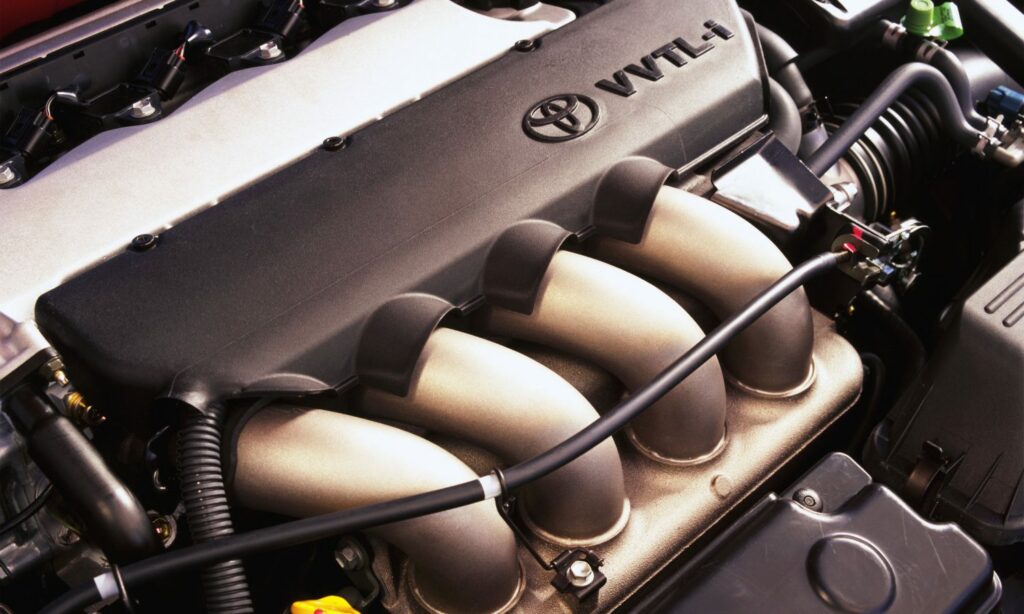
Widening the phases: Toyota’s VVTL-i
Irrepressible engineers didn’t stop there, and developed a number of systems that can not only shift the phases but also widen or narrow them. This can be achieved in several ways, depending on the design. In the Toyota VVTL-i system, for example, an additional cam with a modified profile comes into operation instead of the usual one after certain revolutions are reached (6000 rpm). The profile of this cam sets a different law of valve movement, wider phases and, incidentally, a longer stroke. With the crankshaft spinning up towards its maximum of about 8500 rpm, at around 6000-6500 rpm the engine seems to get a second wind, which is able to give the car a hard and powerful pick-up during acceleration.
Getting rid of the throttle
It is wonderful to change the timing and duration of the opening. And what if we try to change the height of the lift as well? That approach allows you to get rid of the throttle and shift the control of the engine’s operating modes to the valve train.
Why is the throttle valve harmful? It worsens the filling of the cylinders at low and medium speeds. A high vacuum is created in the intake tract under the closed throttle when the engine is running. What does that lead to? To high inertia in the rarefied gas medium, the fuel-air mixture; to a deterioration in the quality of the cylinder’s filling with a charge; to a decrease in engine output and in the response speed of the gas pedal.
The ideal option, therefore, would be to open the intake valve only for the time necessary to achieve the desired filling of the cylinder with combustible mixture. The engineers’ answer is a mechanical intake valve lift control system, in which the lifting height — and, correspondingly, the duration of the intake phase — changes according to how far the gas pedal is pressed. According to various sources, savings from the use of a throttleless control system can range from 8% to 15%, and the increase in power and torque from 5% to 15%. But even that is not the limit.
The electromagnetic valve train
Despite the fact that the number and size of valves have approached the maximum possible, the efficiency of filling and cleaning the cylinders can be made higher still. By what means? By the speed at which the valves open. Here the mechanical drive loses its ground to the electromagnetic one.
What is the other advantage of an electromagnetic drive? The law of valve lift — its acceleration at every moment in time — can be perfected, and the duration of valve opening can be changed within very wide limits. Following its programming, the electronics may leave unnecessary valves closed from time to time, or deactivate whole cylinders. What for? In the interests of economy: at idle, for instance, when driving at a steady speed, or when braking on the engine. Beyond these modes, the electromagnetic valve train is able to turn an ordinary four-stroke engine into a six-stroke one, right while it is running. We wonder how soon such systems will reach the assembly line.
Where the limit lies
It is probably no longer possible to increase the efficiency of the engine any further through valve timing alone. Getting still more power and torque from the same displacement, with lower consumption, will only be possible by other means — combined supercharging, say, or constructions that change the compression ratio, or other fuels. But that is a completely different story.
This is a translation. You can read the original here: https://www.drive.ru/technic/4efb330700f11713001e33f9.html


Published January 13, 2022 • 6m to read