

You’ve probably spotted a small “turbo” badge on an otherwise ordinary-looking car at some point. Manufacturers tend to place these emblems modestly — small in size, tucked in inconspicuous spots. To the uninitiated, it’s easy to walk right past. But to those in the know, it’s a signal worth stopping for. So what’s all the fuss about? Here’s the full story behind turbocharging — where it came from, how it works, and why it matters.
Why Engineers Needed More Power From the Same Engine
From the earliest days of automotive engineering, designers have been obsessed with one question: how do you get more power out of an engine? The laws of physics give a clear answer — engine power is directly proportional to the amount of fuel burned in each working cycle. More fuel burned equals more power. Simple enough in theory. But in practice, it’s far more complicated.
The key constraint is oxygen. Fuel doesn’t burn on its own — it burns as part of a fuel-air mixture. And that mixture must be balanced precisely, not estimated by eye. For a gasoline engine, the ideal ratio is roughly:
- 1 part fuel to 14–15 parts air, depending on operating mode, fuel composition, and other variables
This means that if you want to burn more fuel, you must also supply significantly more air. Conventional naturally aspirated engines draw air in through the pressure difference between the cylinder and the atmosphere. The result is a hard limit: the larger the cylinder volume, the more oxygen enters per cycle. American manufacturers of the mid-20th century took this to an extreme, producing massive-displacement engines with enormous fuel appetites. But was there a smarter way to push more air into the same cylinder volume?
The Invention of the Supercharger: Gottlieb Daimler’s Breakthrough
The answer came from a familiar name — Gottlieb Wilhelm Daimler, the same German engineer behind the DaimlerChrysler legacy. Back in 1885, Daimler developed a method to force more air into engine cylinders using a mechanically driven supercharger — essentially a compressor (fan) powered directly by the engine’s crankshaft, which pushed compressed air into the cylinders.
It worked. But it had one significant drawback: the compressor stole energy directly from the engine to power itself. Engineers knew there had to be a better way.
Alfred Büchi and the Birth of the Turbocharger (1905)
Enter Alfred J. Büchi, a Swiss engineer and inventor working at Sulzer Brothers, where he led diesel engine development. Büchi was frustrated on two fronts:
- Diesel engines of the era were large, heavy, and underpowered
- Mechanical superchargers robbed the engine of energy it needed to drive itself
In 1905, Büchi patented a radical solution: a charging device powered not by the engine’s crankshaft, but by its own exhaust gases. This was the world’s first turbocharger.
How a Turbocharger Works
The concept behind turbocharging is elegantly simple. Here’s the basic principle, step by step:
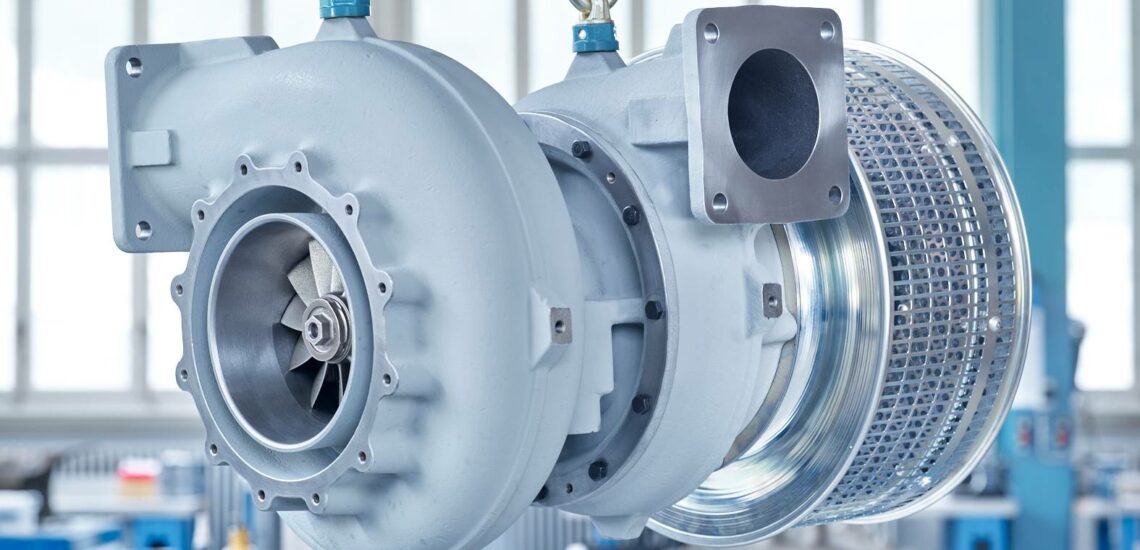
- Hot exhaust gases exit the engine and flow into the turbine housing
- These gases spin a bladed wheel — the turbine rotor — much like wind turns a windmill, but at extreme speed
- The turbine rotor is mounted on the same shaft as a compressor wheel
- As the turbine spins, it drives the compressor, which forces compressed air into the cylinders
- More air in the cylinders means more fuel can be burned — resulting in greater power output
The word “turbocharger” itself comes from the Latin roots turbo (vortex) and compressio (compression) — an apt description of what’s happening inside.
The Role of the Intercooler
There’s one more piece to the puzzle. As air passes through the compressor and is heated by the hot turbocharger components, it expands — meaning less oxygen fits in the same volume. To counteract this, turbocharged engines use an intercooler: a radiator placed in the air path between the compressor and the engine cylinders.
The intercooler’s job is straightforward but critical:
- It cools the compressed air before it enters the cylinders
- Cooler air is denser, meaning more oxygen molecules fit in the same space
- This allows even higher boost pressure — and even greater power gains
- It also helps prevent engine knock (premature detonation), especially in high-performance applications
Key Advantages of Turbocharging Over Natural Aspiration
The efficiency gains from turbocharging are substantial. Unlike a mechanically driven supercharger — which consumes engine power to operate — a turbocharger extracts energy from exhaust gases that would otherwise be wasted. Crucially, the turbine doesn’t slow those gases down significantly; it cools them instead, recovering energy in the process. The main benefits include:
- Only ~1.5% of engine energy is consumed by the turbocharger’s self-maintenance
- Higher power output from a smaller displacement engine
- Reduced friction losses due to a lighter, more compact engine
- Better fuel efficiency compared to a naturally aspirated engine of equivalent power
- Cleaner exhaust, particularly relevant for modern diesel engines
It sounds like the perfect solution — but turbocharging came with serious engineering challenges that delayed its widespread adoption for decades.
The Challenges: Extreme Heat, Speed, and Turbo Lag
Turbochargers operate in brutal conditions:
- Turbine rotors can spin at up to 200,000 RPM
- Exhaust gas temperatures can reach 1,000°C (1,832°F)
- Components must maintain structural integrity and precise tolerances under continuous thermal and mechanical stress
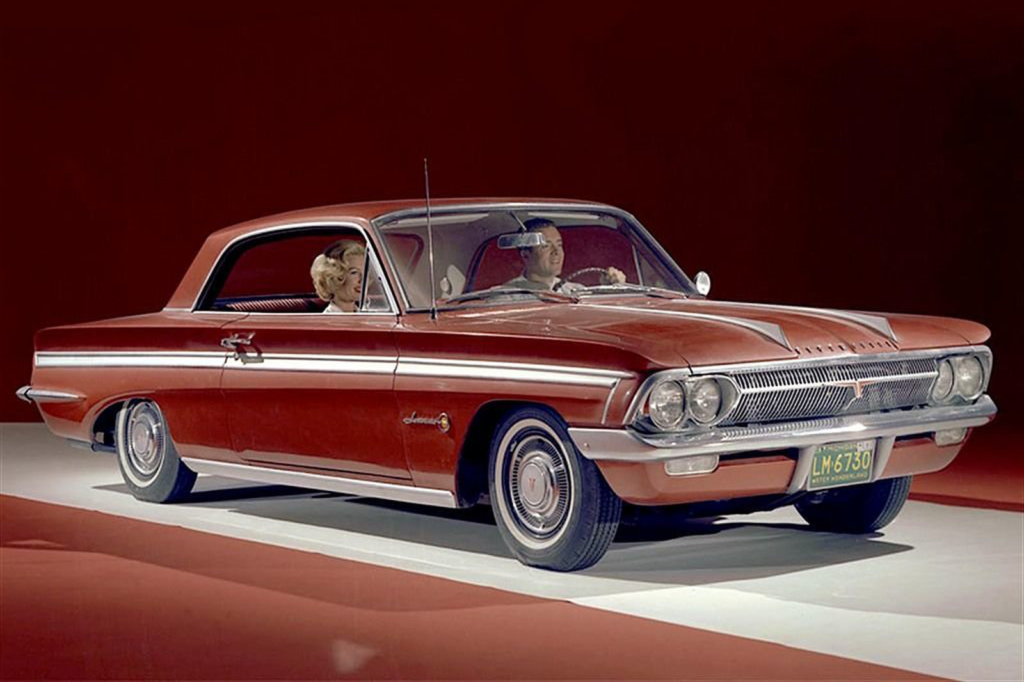
Because of this, turbocharging only became widespread during World War II — and initially only in aviation, where the engineering investment was justified. In the 1950s, Caterpillar successfully adapted the technology for its tractors, while Cummins developed the first turbodiesel truck engines. Turbocharged passenger cars didn’t arrive until 1962, when the Oldsmobile Jetfire and Chevrolet Corvair Monza were released almost simultaneously.
Beyond durability, there was another challenge unique to cars: turbo lag. At low engine speeds, exhaust gas volume is limited, so the turbine spins slowly and the compressor barely builds pressure. The engine may feel sluggish below 3,000 RPM, then suddenly surge with power above 4,000–5,000 RPM. The larger the turbine, the more pronounced the lag. Smaller turbines reduce lag but sacrifice peak power.
Modern Solutions: How Engineers Beat Turbo Lag
Over the decades, engineers developed several clever approaches to minimize turbo lag while preserving power gains:
- Sequential twin-turbo: A small, low-inertia turbocharger handles low RPM, while a larger unit kicks in at high RPM. Used in the legendary Porsche 959, and today found in BMW and Land Rover turbodiesels. Volkswagen gasoline engines use a belt-driven supercharger in place of the small turbo for even faster low-end response.
- Twin-scroll turbocharger: A single turbo with two separate exhaust inlets (volutes), each fed by a different group of cylinders. This keeps the turbine spinning efficiently at both low and high RPM, reducing lag without adding a second turbo unit. Common in straight-six and four-cylinder engines.
- Parallel twin-turbo: Two identical turbochargers serving separate cylinder banks. Standard in V-configuration engines, where each bank gets its own unit. BMW’s M division took this further with a cross-bank exhaust manifold on the X5 M and X6 M, allowing a twin-scroll compressor to draw gases from opposite cylinder banks in opposite firing phases.
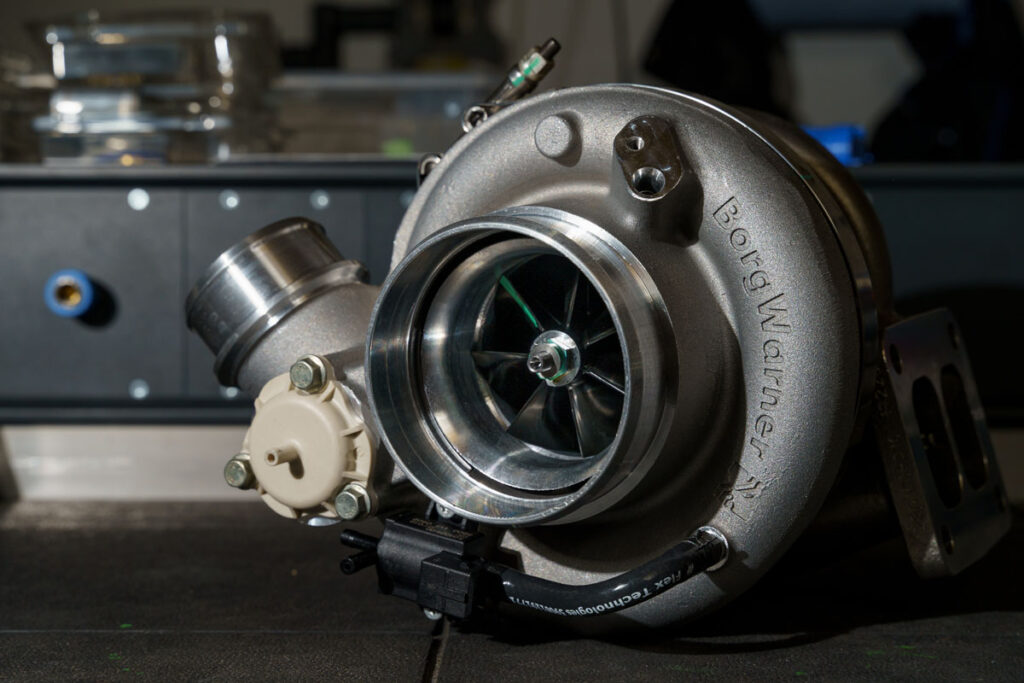
- Variable geometry turbocharger (VGT): Adjustable vanes inside the turbine housing change the flow path of exhaust gases depending on engine speed — effectively giving the turbo the right “size” at every RPM. First adopted on diesel engines (where lower exhaust temperatures made implementation easier), and eventually brought to gasoline engines by Porsche with the 911 Turbo.
Turbocharging Today: From Performance to Efficiency
What began as an aviation engineering challenge has become the dominant technology in modern automotive powertrains. Today, turbocharging is no longer just about performance — it’s central to fuel economy and emissions standards. Nearly every diesel engine on the market carries the “turbo” prefix as a given. And in the gasoline world, turbocharged small-displacement engines have largely replaced larger naturally aspirated units across mainstream, luxury, and performance segments alike.
The humble little badge on the back of an otherwise ordinary car tells a story spanning more than a century — from Büchi’s 1905 patent to the twin-scroll, variable-geometry systems of today. And that story isn’t finished yet.
This is a translation. You can read the original here: https://www.drive.ru/technic/4efb330200f11713001e3703.html

Published January 27, 2022 • 7m to read