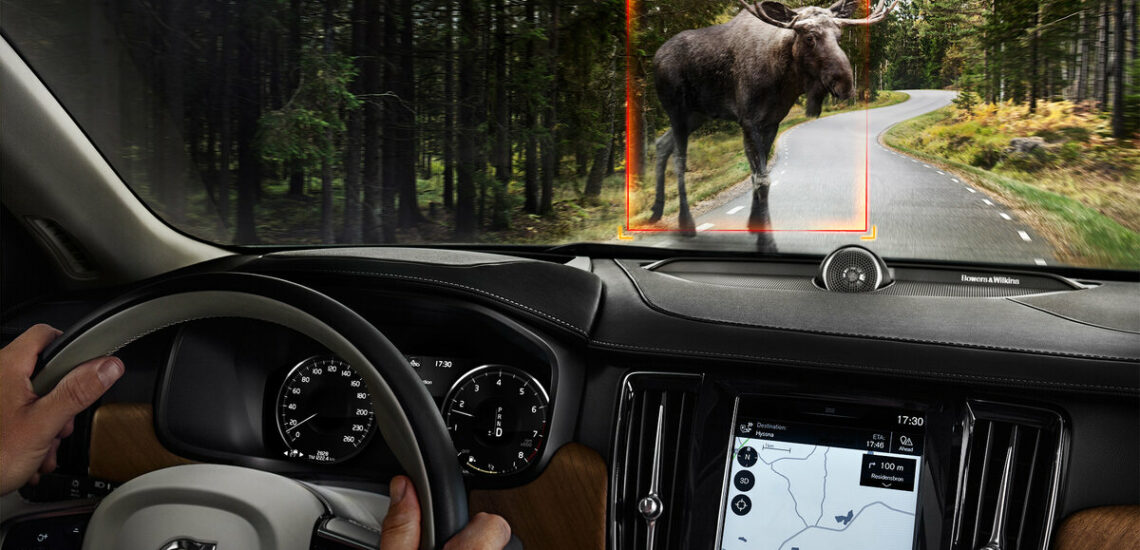

Picture yourself driving calmly along a highway, dense forest on both sides. A fox, a hare, a wild boar, or a hedgehog might dart onto the road — but none of these come close to the danger posed by a moose. A fully grown moose can stand three meters tall, weigh over half a ton, and its long legs mean that during a collision, the entire body often crashes directly into the cabin. Airbags are no match for that. The only real defense is a driver’s quick reaction — and a car designed to handle it. That’s exactly what the moose test is designed to measure: a vehicle’s handling and stability when performing a high-speed evasive maneuver.
What Is the Moose Test and Where Did the Name Come From?
The moose test gets its name from Scandinavia, where moose are a genuine road hazard. Even in small Finland, around ten people die every year in moose-related accidents. These animals most commonly appear on rural roads — exactly where vehicles travel at top speed.
The term “moose test” was officially coined by journalists at the Swedish magazine Teknikens Värld in 1997. However, the underlying concept is much older. Since around the 1970s, a formal evaluation known as the evasive manoeuvre test (Undanmanöverprov) had been used to assess tire grip and track performance. Over time, this evolved into an informal but widely recognized standard for testing car stability during extreme maneuvers. Volvo was among the first manufacturers to routinely run all its models through this test — specifically simulating sudden encounters with large animals like moose and wild boar crossing the road.
Moose Test Conditions: How the Test Is Performed
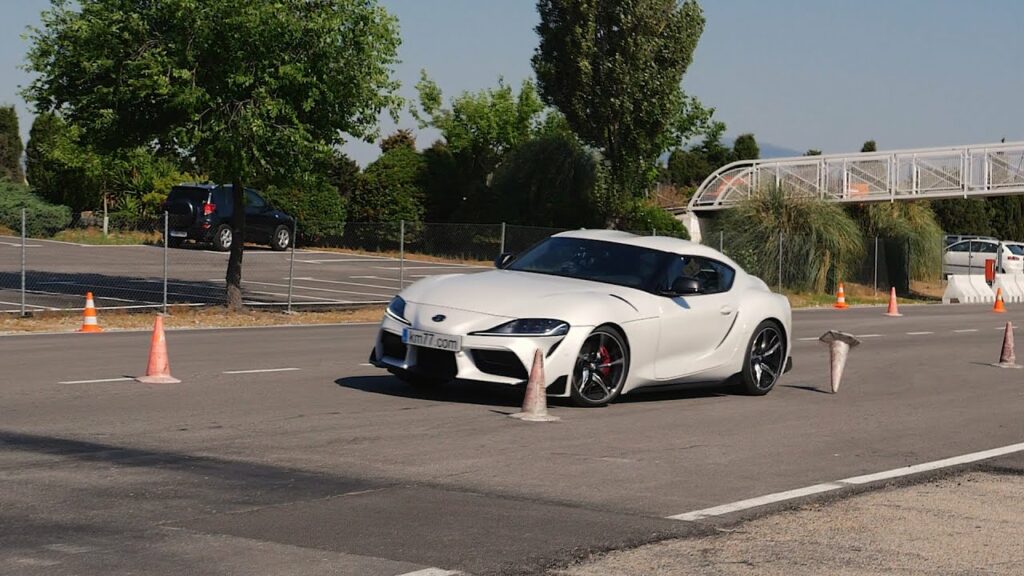
The moose test is based on a real-world scenario: a car traveling at approximately 100 km/h on a country road when an obstacle suddenly appears. At that speed, braking alone won’t prevent a collision — the driver must also swerve. Research has shown that the most critical moment occurs when speed drops from 100 km/h to around 69–70 km/h, which is when most animal-related accidents happen.
The standard moose test follows these steps:
- Accelerate the car to 100 km/h
- Apply brakes
- Perform a sharp lane change approximately two meters before the obstacle
- Return the car to its original lane
Additional test conditions include:
- Performed on a dry asphalt track only
- Vehicle loaded to its rated load capacity
- Passengers must be on board
- No drifting or skidding allowed — these result in a failed test
During the test, engineers fine-tune the suspension, shock absorbers, springs, and stabilizers to ensure the car can perform this maneuver safely — protecting both driver and animal. Today, the moose test is a mandatory part of factory testing programs for most major automakers, and results are a widely recognized quality benchmark. Chassis and steering systems are specifically calibrated based on these outcomes.
Famous Moose Test Failures That Cost Manufacturers Millions
The moose test has a long history of exposing serious design flaws — and forcing manufacturers to invest heavily in fixes.
Saab began tracking animal collision data after Julian Shermis died in a Saab-moose accident in 1948. From that year until the brand’s closure in 2011, Saab recorded over 6,100 road accidents involving animals. These incidents directly shaped the brand’s safety philosophy:
- High-strength windshields became standard
- Reinforced A-pillars were introduced
- The ignition switch was relocated from the steering column to the central tunnel — too many drivers’ knees were being crushed by heavy ignition modules during frontal impacts
Mercedes-Benz faced its most publicized moose test disaster in 1997, when Teknikens Värld journalist Robert Collin rolled a Mercedes A-Class at just 60 km/h. The cause: a flawed chassis design that made the car dangerously prone to rollover. When asked why such extreme tests were necessary, the editors replied simply: “To check how the car drives around a moose.” The fallout was enormous:
- Daimler spent approximately $250 million on redesigning the A-Class
- All 17,000 units already on sale were recalled
- The model was fundamentally reworked to eliminate rollover risk
- The incident accelerated the widespread adoption of electronic stability control (ESC) systems across the premium car segment
Which Cars Pass the Moose Test Best?
Teknikens Värld conducts regular moose tests on new car models, and over the years certain vehicles have stood out as top performers. Here are some of the best results on record:
- Citroën Xantia Activa — The all-time record holder at 85 km/h, thanks to its hydro-pneumatic Hydractive active suspension and the SC CAR system that limits body roll. It outperformed even the McLaren 675LT and Audi R8 V10 Plus supercars.
- Porsche 911 GT2 — One of the top performers, capable of completing the double lane-change at 83 km/h
- Nissan Qashqai DIG-T 160 Acenta — Impressive result of 84 km/h for a crossover
- Ferrari Testarossa — Successfully passed at 80 km/h, placing it in the top 10 on the Swedish test track
- Hyundai Tucson (front-wheel drive, diesel) — Completed double lane-change at 77 km/h without penalty points; hit cones at 80 km/h, earning a “good” overall rating
- Tesla Model 3 — Passed at 78 km/h, aided by a very low center of gravity from its floor-mounted battery pack
- Tesla Model X — Battery positioning gives this SUV a low center of gravity that significantly reduces rollover risk and gives it an edge over comparable SUVs
- Volvo S90 D4 2017 (diesel) — Best-in-class wet road performance at 74 km/h
- Modern D-class sedans — Typically average 72–73 km/h in standard conditions
Which Cars Failed the Moose Test?
Not every vehicle performs well under moose test conditions. Some notable failures highlight how weight distribution, suspension design, and vehicle size all play a critical role:
- Volkswagen Passat GTE & Skoda Superb iV (hybrid versions) — Both showed instability and lost control at just 68 km/h. The heavy batteries mounted at the rear disrupted weight distribution, causing skidding and, in the Superb’s case, a full spin-out. Interestingly, their non-hybrid counterparts pass the test without issue.
- Toyota RAV4 — Failed the moose test multiple times. Struggled to reach the minimum threshold of 69 km/h; rear end skids, and wheels sometimes left the surface entirely.
- Ford Ranger (front torsion bar suspension) — Failed above 65 km/h due to its weight and dimensions.
- Porsche Macan (new generation) — Crossed lane markings and failed the test.
- Jeep Grand Cherokee — Failed initially due to wheels lifting dangerously off the road surface; passed on a later attempt.
- Ford Focus — Flagged by Swedish testers for handling deficiencies that complicated control during the maneuver.
There are also broader vehicle categories that consistently underperform in the moose test:
- Crossovers and SUVs — Rarely manage to evade at speeds above 68 km/h due to higher centers of gravity
- Small city cars (Class A and B, wheelbase under 2,500 mm) — Most dangerous category; design limitations mean they typically can’t change lanes safely above 62–63 km/h and are prone to rollover
- Pickup trucks — Weight and body-on-frame construction make rapid evasive maneuvers difficult
Why the Moose Test Matters for Car Safety
The moose test has played a direct role in making modern cars safer. From Saab’s reinforced cabins to Mercedes’s rollover-prevention overhaul, real-world design improvements have followed directly from test results. Today, it remains one of the most respected unofficial quality indicators in the automotive industry — a practical, high-stakes measure of how a vehicle performs when it matters most.
But even the safest car requires a licensed driver behind the wheel. If you’re planning to drive internationally — including through regions where moose roam freely — make sure your documentation is in order. We make it quick and easy to obtain an international driver’s license through our website, valid for driving in any part of the world.

Published March 04, 2021 • 6m to read